
PROBLEM 19.6
1.
Temporary
Difference
Future Taxable
(Deductible) Amounts
Tax
Rate
Deferred Tax
(Asset)
Liability
2021
$ 300
30%a
$ 90
2022
300
30%b
90
2023
300
30%c
90
2024
300
35%d
2024
35%d
300
35%e
MOONEY CO.
Balance Sheet
December 31, 2020
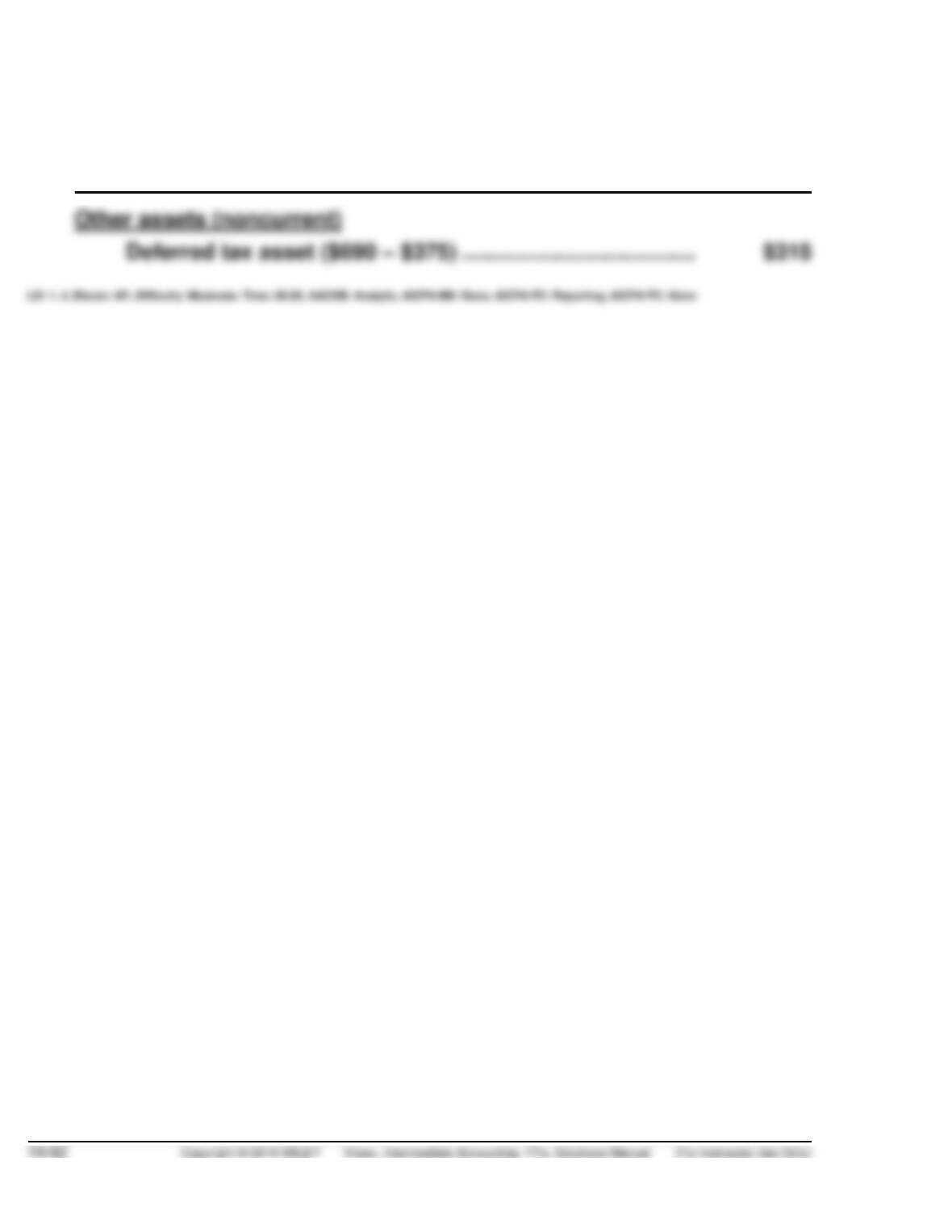
Other assets (noncurrent)
Deferred tax asset ($560f – $480g) ………………………………. $80
2.
Temporary
Difference
Future Taxable
(Deductible) Amounts
Tax
Rate
Deferred Tax
(Asset)
Liability
2021
$ 300
30%a
$ 90
2022
300
30%b
90
2023
300
30%c
90
2023
30%c
2024
300
35%d
PROBLEM 19.6 (Continued)
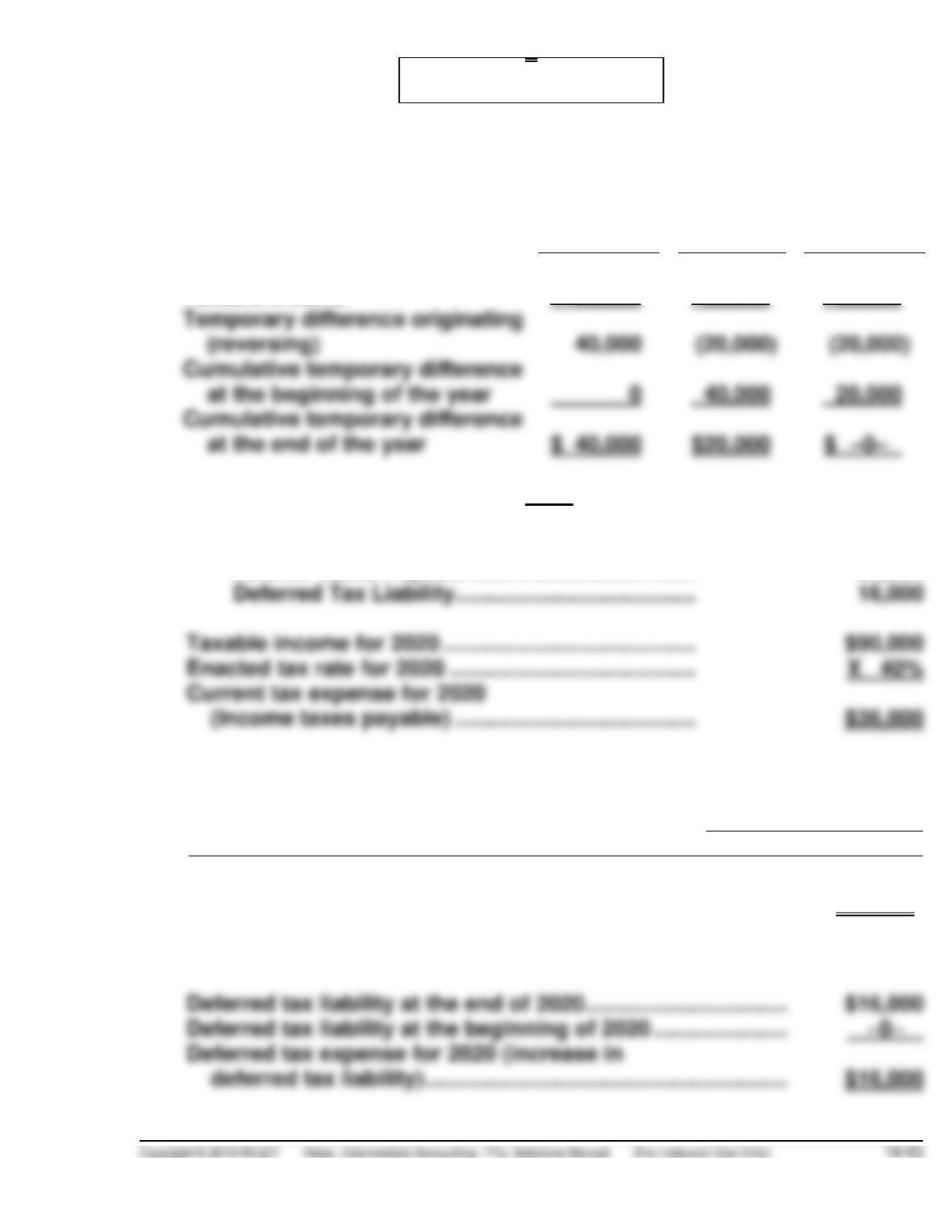
ROESCH CO.
Balance Sheet
December 31, 2020
v
PROBLEM 19.7
(a) Before deferred taxes can be computed, the amount of cumulative tem-
porary difference existing at the end of each year must be computed:
2020
2021
2022
Pretax financial income
$130,000
($70,000
($70,000
Taxable income
90,000
( 90,000
( 90,000
2020
Income Tax Expense ……………………………………….. 52,000
Income Taxes Payable ………………………………. 36,000
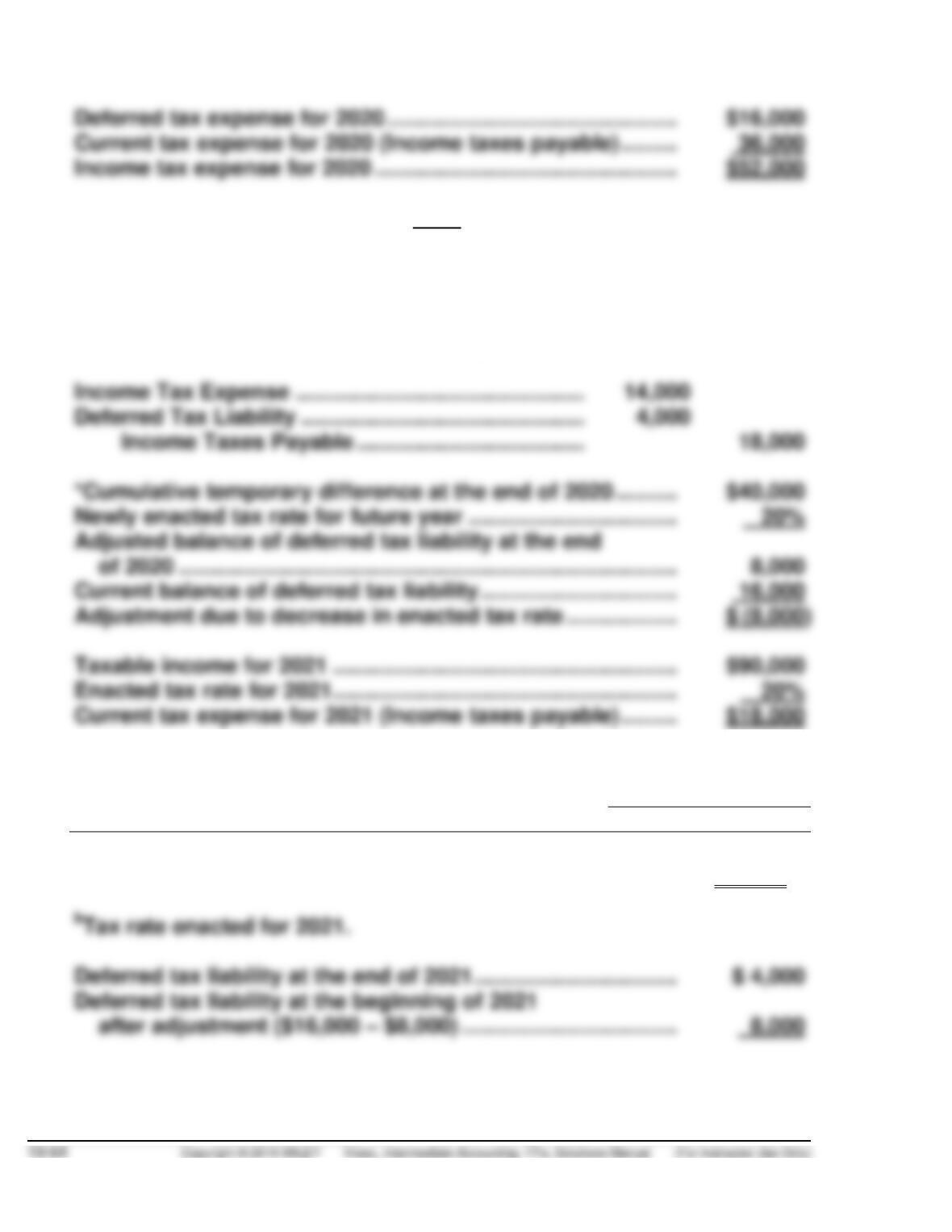
Temporary
Difference
Future Taxable
(Deductible)
Amounts
Tax
Rate
December 31, 2020
Deferred Tax
(Asset)
Liability
Installment Accounts
Receivable
(
$ 40,000
40%a
$16,000
aTax rate enacted for 2020.
PROBLEM 19.7 (Continued)
2021
Deferred Tax Liability ………………………………………. 8,000
Income Tax Expense …………………………………. 8,000*
(To record the adjustment for the
decrease in the enacted tax rate)
Temporary
Difference
Future Taxable
(Deductible) Amounts
Tax
Rate
December 31, 2021
Deferred Tax
(Asset)
Liability
Installment Accounts
Receivable
$20,000j
20%b
$ 4,000
PROBLEM 19.7 (Continued)
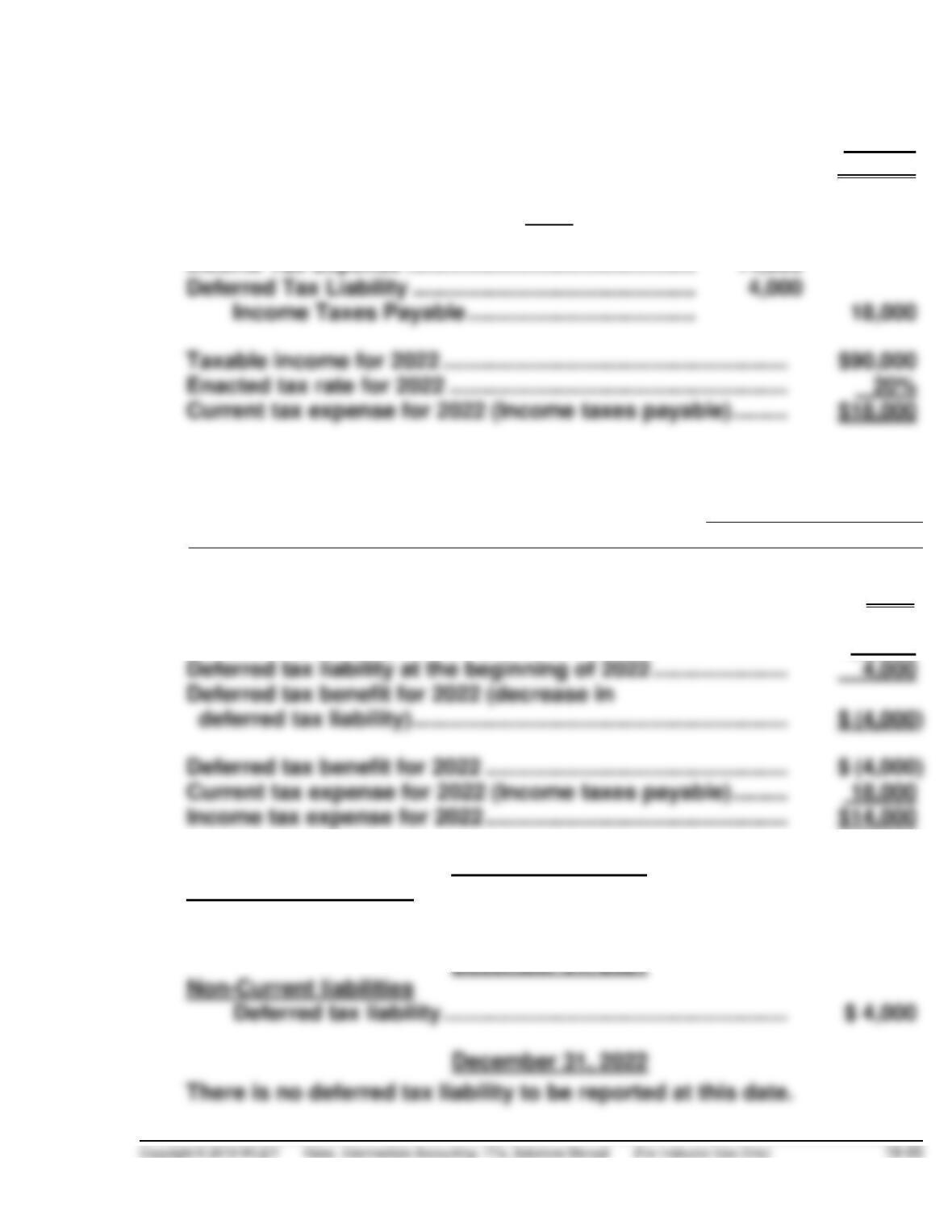
Deferred tax benefit for 2021 ………………………………………………… $ (4,000)
Current tax expense for 2021 (Income taxes payable) ……… 18,000
Income tax expense for 2021 …………………………………………. $14,000
2022
Income Tax Expense ……………………………………….. 14,000
Temporary
Difference
Future Taxable
(Deductible)
Amounts
Tax
Rate
December 31, 2022
Deferred Tax
(Asset)
Liability
Installment Accounts
Receivable
(
$–0–
20%
$–0–
Deferred tax liability at the end of 2022 …………………………... $ –0–
(b) December 31, 2020
Non-Current liabilities
Deferred tax liability ……………………………………………….. $16,000
December 31, 2021
PROBLEM 19.7 (Continued)
(c) 2020
Income before income taxes ………………………………… $130,000
Income tax expense
Current …………………………..……………………………. $36,000
Deferred ………………………………………………………. 16,000 52,000
Net income …………………………………………………………. $ 78,000
2021
2022
Income before income taxes ………………………………… $70,000
Income tax expense
PROBLEM 19.8
(a)
Temporary
Difference
Future Taxable
(Deductible) Amounts
Tax
Rate
Deferred Tax
(Asset)
Liability
Depreciation
$(60,000)*
20%
$(12,000)
(b) Income Tax Expense …………………………..………… 118,000
Deferred Tax Asset ……………………………………….. 12,000
Income Taxes Payable ……………………………. 130,000
$130,000 taxes due for 2020 ÷ .20 2020 tax rate = $650,000 taxable
income for 2020.
(c) Income before income taxes ………………………….. $590,000a
Income tax expense
Current ………………………………………………….. $130,000
Deferred ………………………………………………… (12,000) 118,000
PROBLEM 19.8 (Continued)
Book Depreciation
Tax Depreciation
bDifference
2020
$120,000
$ 60,000*
($ 60,000
2022
2023
2024
2025
0
$600,000
(d)
Temporary
Difference
Future Taxable
(Deductible) Amounts
Tax
Rate
Deferred Tax
(Asset)
Liability
Depreciation
$ (60,000)
20%
$(12,000)
20%
$(210,000)
PROBLEM 19.8 (Continued)
(e) Income Tax Expense ………………………………………. 74,000
Deferred Tax Asset …………………………………………. 30,000
Income Taxes Payable ……………………………… 104,000
(f) Income before income taxes ……………………………. $370,000
Income tax expense
Current ……………………………………………………. $104,000
Deferred ………………………………………………….. (30,000) 74,000
Net income …………………………………………………….. $ 296,000
PROBLEM 19.9
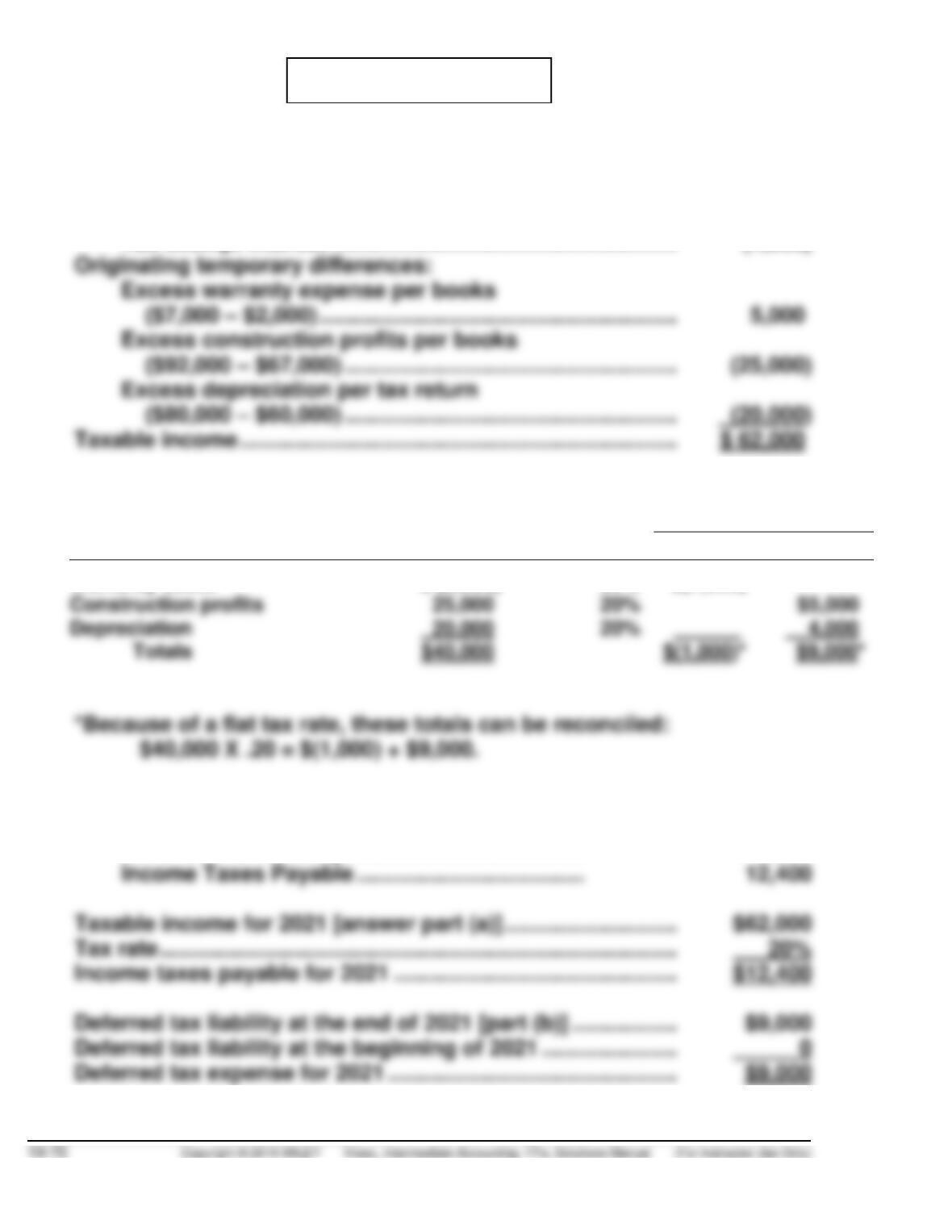
(a) Pretax financial income …………………………………………………. $100,000
Permanent differences:
Fine for pollution ……………………………………………………. 3,500
Tax-exempt interest ……………………………………………….. (1,500)
(b)
Temporary
Difference
Future Taxable
(Deductible) Amounts
Tax
Rate
Deferred Tax
(Asset)
Liability
Warranty costs
$ (5,000)
20%
$(1,000)
Depreciation
20%
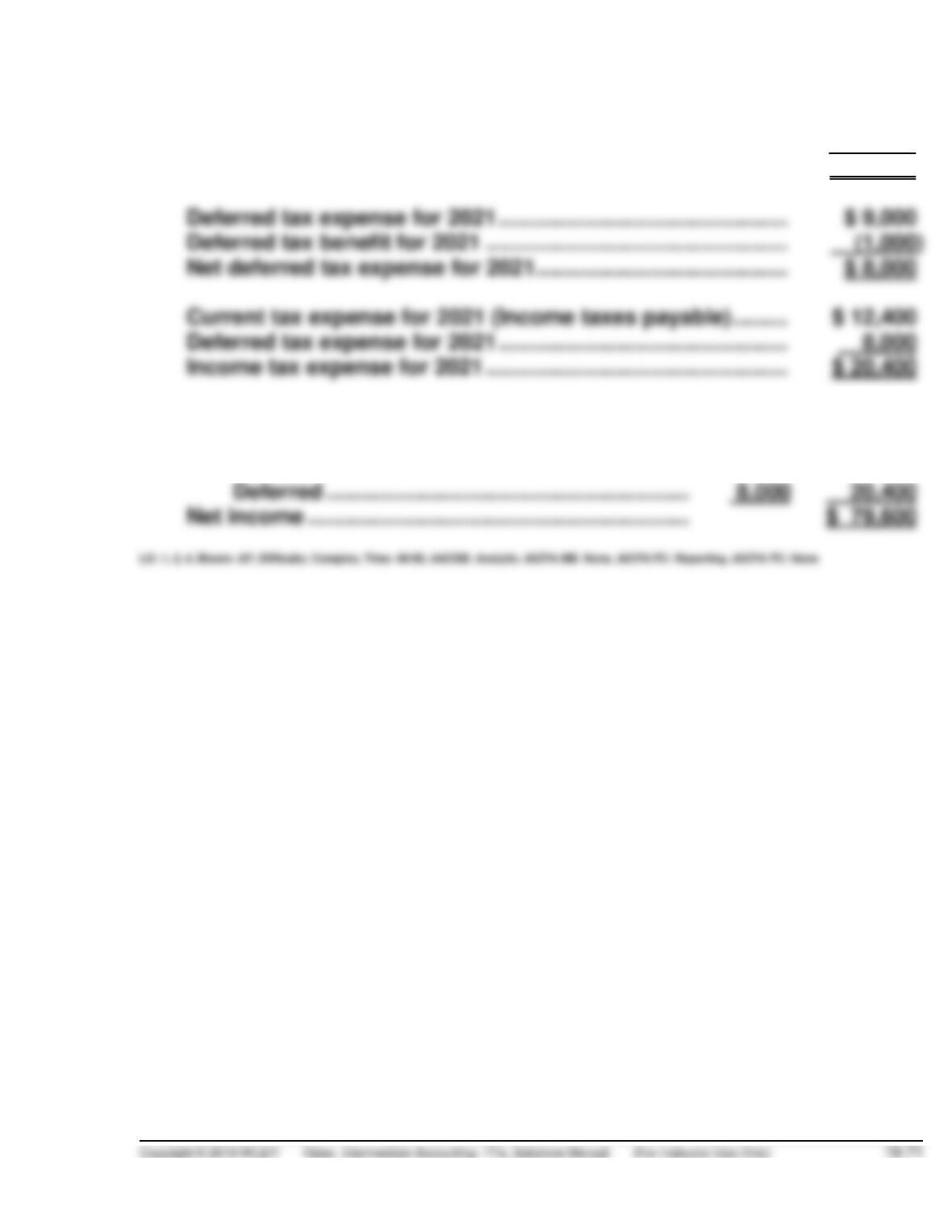
(c) Income Tax Expense …………………………..…………… 20,400
Deferred Tax Asset ………………………………………….. 1,000
Deferred Tax Liability ………………………………… 9,000
PROBLEM 19.9 (Continued)
Deferred tax asset at the end of 2021 ……………………………… $ 1,000
Deferred tax asset at the beginning of 2021 ……………………. –0–
Deferred tax benefit for 2021 …………………………………………. $ (1,000)
(d) Income before income taxes ……………………………. $100,000
Income tax expense
Current ……………………………………………………. $12,400
TIME AND PURPOSE OF CONCEPTS FOR ANALYSIS
CA 19.1 (Time 15–20 minutes)
Purpose—to provide the student an opportunity to explain the objectives in accounting for income taxes
CA 19.2 (Time 20–25 minutes)
Purpose—to provide the student an opportunity to discuss the principles of the asset-liability method,
CA 19.3 (Time 20–25 minutes)
Purpose—to develop an understanding of temporary and permanent differences. The student is
CA 19.4 (Time 20–25 minutes)
Purpose—to develop an understanding of deferred taxes and balance sheet disclosure. This case has
CA 19.5 (Time 20–25 minutes)
Purpose—to develop an understanding of how to determine the appropriate tax rate to use in
CA 19.6 (Time 20–25 minutes)
Purpose—to develop an understanding of the concept of future taxable amounts and future deductible
CA 19.7 (Time 20–25 minutes)
Purpose—to provide the student an opportunity to examine the income effects of deferred taxes,
SOLUTIONS TO CONCEPTS FOR ANALYSIS
CA 19.1
(a) The objectives in accounting for income taxes are:
(b) To implement the objectives, the following basic principles are applied in accounting for income
taxes at the date of the financial statements:
1. A current tax liability or asset is recognized for the estimated taxes payable or refundable
(c) The procedures for the annual computation of deferred income taxes are as follows:
1. Identify: (1) the types and amounts of existing temporary differences and (2) the nature and
CA 19.2
(a) The following basic principles are applied in accounting for income taxes at the date of the
financial statements:
1. A current tax liability or asset is recognized for the estimated taxes payable or refundable
(b) Dexter should do the following in accounting for the temporary differences.
1. Identify the types and amounts of existing temporary differences. The depreciation policies
give rise to a temporary difference that will result in net future taxable amounts (because
CA 19.2 (Continued)
(c) Deferred tax accounts are reported as assets and liabilities. Companies should classify these
accounts as a net noncurrent amount on the balance sheet. That is, deferred tax assets and
CA 19.3
(a) 1. Temporary difference. The full estimated three years of warranty costs reduce the current
year’s pretax financial income, but will reduce taxable income in varying amounts each
respective year, as paid. Assuming the estimate as to each warranty is valid, the total
2. Temporary difference. The difference between the tax basis and the reported amount (book
3. Temporary difference and permanent difference. The investor’s share of earnings of an
investee (other than subsidiaries and corporate joint ventures) accounted for by the equity
method is included in pretax financial income while only 20% of dividends received from
4. Temporary difference. For financial reporting purposes, any gain experienced in an
involuntary conversion of a nonmonetary asset to a monetary asset must be recognized in
CA 19.3 (Continued)
(b) Deferred tax accounts are reported as assets and liabilities. Companies should classify these
CA 19.4
Part A.
(a) Deferred income taxes are reported in the financial statements when temporary differences exist
at the balance sheet date. Deferred taxes are never reported for permanent differences.
The tax consequences of most events recognized in the financial statements for a year are
included in determining income taxes currently payable. However, tax laws often differ from the
(b) 1. Gross profit on installment sales—Deferred income taxes would be recognized when gross
profit on installment sales is included in pretax financial income in the year of sale and
included in taxable income when later collected.
2. Revenues on long-term construction contracts—Deferred income taxes would be
recognized whenever revenues on long-term construction contracts are recognized for
CA 19.4 (Continued)
Part B.
Deferred tax accounts are reported as assets and liabilities. Companies should classify these accounts
CA 19.5
(a) The 45% tax rate would be used in computing income tax payable in 2020 at December 31,
Discussion:
In determining the future tax consequences of temporary differences, it is helpful to prepare a schedule
which shows in which future years existing temporary differences will result in taxable or deductible
amounts. The appropriate enacted tax rate is applied to these future taxable and deductible amounts.
In determining the appropriate tax rate, you must make assumptions about whether the entity will report
taxable income or losses in the various future years expected to be affected by the reversal of existing
temporary differences. Thus, you calculate the taxes payable or refundable in the future due to existing
temporary differences. In making these calculations, you apply the provisions of the tax laws and enacted
tax rates for the relevant periods.
For future taxable amounts:
1. If taxable income is expected in the year that a future taxable amount is scheduled, use the
related deferred tax liability.
For future deductible amounts:
1. If taxable income is expected in the year that a future deductible amount is scheduled, use the
CA 19.6
(a) Future taxable amounts increase taxable income relative to pretax financial income in the future
due to temporary differences existing at the balance sheet date. Future deductible amounts decrease
(b) The carryforward provision will affect the amounts to be reported for the resulting deferred tax
asset and deferred tax liability.
In computing deferred tax account balances to be reported at a balance sheet date, the appropri-
ate enacted tax rate is applied to future taxable and deductible amounts related to temporary
differences existing at the balance sheet date. In determining the appropriate tax rate, you must
make assumptions about whether the entity will report taxable income or losses in the various future
years expected to be affected by the existing temporary differences. Thus, you calculate the taxes
payable or refundable in the future due to existing temporary differences. In making these calcula-
tions, you apply the provisions of the tax laws and enacted tax rates for the relevant periods.
For future taxable amounts:
1. If taxable income is expected in the year that a future taxable amount is scheduled, use the
For future deductible amounts:
1. If taxable income is expected in the year that a future deductible amount is scheduled, use
CA 19.7
(a) To realize a sizable deferred tax liability, Acme must have used an accelerated depreciation
method for tax purposes while using straight-line depreciation for its financial statements. Once
the temporary difference reversed, taxable income would exceed financial accounting income.
(b) The deferral of income taxes means that due to temporary differences caused by the difference
in financial accounting principles and tax laws, a company will be able to defer paying its income
(c) The primary stakeholders who could be harmed by Acme’s income tax practice are the federal
government, which receives fewer taxes as a result of this practice. Ultimately, other taxpayers
have to pay more. In addition, if replacement plant assets are very costly to acquire, positive cash flow
is reduced. Though the impact should not be great, investors and creditors are affected negatively.
FINANCIAL REPORTING PROBLEM
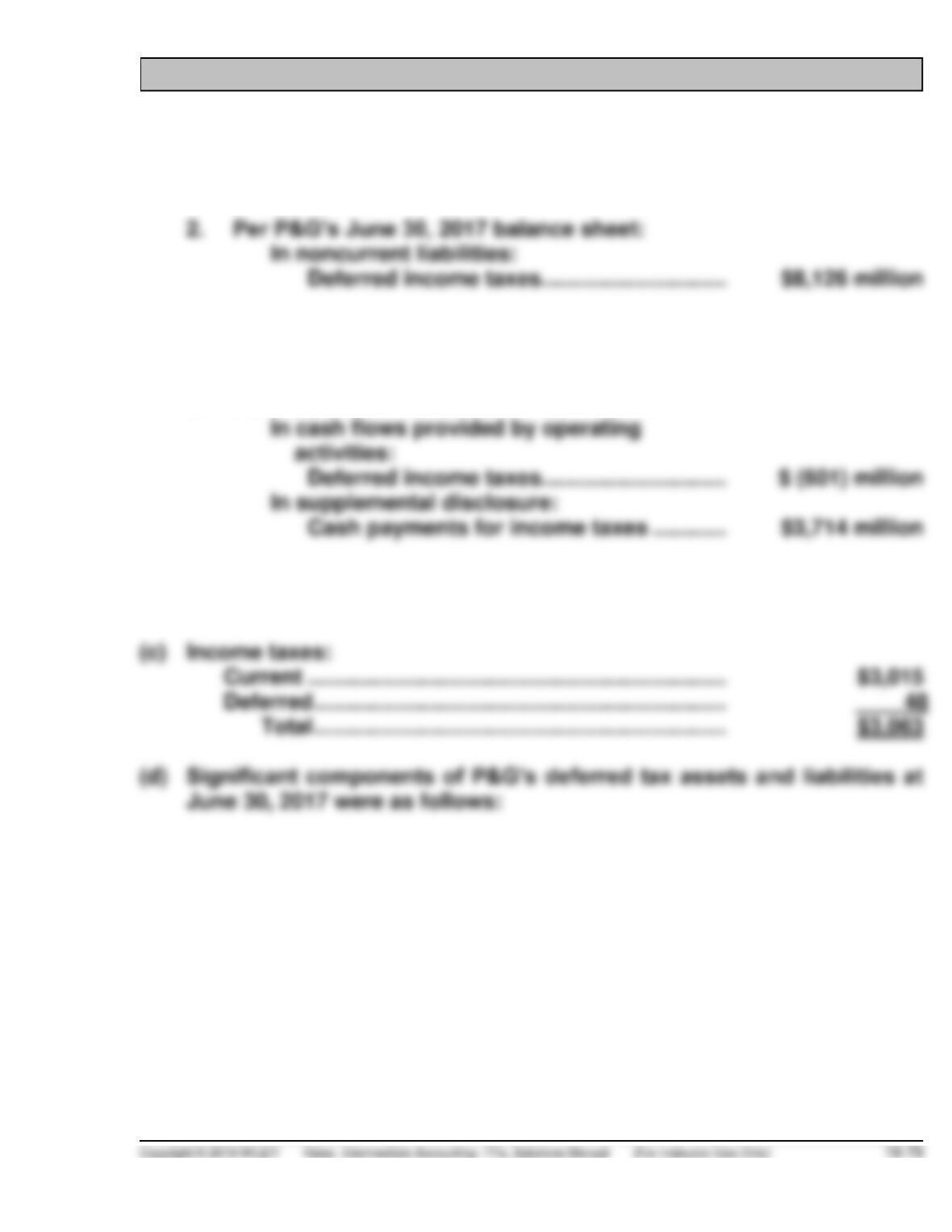
(a) 1. Per P&G’s 2017 income statement:
Income taxes on continuing operations …….. $3,063 million
Note: Classification of deferred tax amounts is in accordance with prior
GAAP-all non-current.
3. Per P&G’s 2017 statement of cash flows:
(b) P&G’s effective tax rates:
2015: (24.70%) 2016: (25.00%) 2017: (23.1%)