Financial and Managerial Accounting, 9th Edition
19-1
CHAPTER 19
VARIABLE COSTING AND ANALYSIS
Related Assignment Materials
Student Learning Objectives
Discussion
Questions
Quick Studies*
Exercises*
Problems*
AA, DA and BTN
Conceptual objectives:
C1. Describe how absorption
costing can result in
overproduction.
6
19-10, 19-12,
19-13
19-15, 19-16
19-3
BTN 19-1, BTN 19-2
Analytical objectives:
A1. Apply contribution margin ratio
5, 8, 9
19-20
AA 19-1, BTN 19-6,
A2. Convert income under variable
costing to the absorption cost
10
19-23, 19-24,
19-25, 19-26,
19-4
BTN 19-5
basis. (Appendix 19A)
19-27, 19-28
Procedural objectives:
P1. Compute unit cost under both
absorption and variable costing.
1, 2
19-1, 19-2, 19-8,
19-1, 19-2,
19-3, 19-4
DA 19-1, DA 19-2,
DA 19-3
costing.
P3. Determine product selling price
7
19-19, 19-20,
BTN 19-3
*See additional information on next page that pertains to these quick studies, exercises and problems.
SP refers to the Serial Problem
AA refers to Accounting Analysis
Planning Production
How Production Impacts Net Income
Motivating Managers Using Variable Costing
Financial and Managerial Accounting, 9th Edition
Additional Information on Related Assignment Material
See Chapter 1 of the Instructor’s Resource Manual for more information on materials for this text available in
Connect.
Connect
Available on the instructor’s course-specific website) repeats all numerical Quick Studies, all Exercises and Problems Set
A. Connect also provides algorithmic versions for Quick Study, Exercises and Problems. It allows instructors to monitor,
promote, and assess student learning. It can be used in practice, homework, or exam mode.
Hints/Guided Examples
Please note that the Guided Examples are labeled as “Hints” in Connect assignments. The animated PowerPoints without
Need-to-Know Videos
LO
Need–to-Know
Title
Time
P1
19-1
Computing Product Cost per Unit
1:05
Costing
19-3
Setting Target Prices and Analyzing a Special Offer
1:30
Concept Overview Videos
LO
Title
Time
C1
Describe how absorption costing can result in overproduction
Financial and Managerial Accounting, 9th Edition
19-3
P2
Prepare and analyze an income statement using absorption costing and
using variable costing.
Income Reporting
Flow of Product Costs through Financial Statements
Units Produced Equal Units Sold
Units Produced Exceed Units Sold
Units Produced are Less Than Units Sold
Determine product selling price and analyze special orders.
Setting Target Prices Based on Absorption Costing
Setting Target Prices Based on Absorption Costing — Illustration
Controllable and Uncontrollable Costs
Analyzing Special Orders
Variable Costing for Services
A2
Convert income under variable costing to the absorption cost basis. (Appendix
19A).
Converting Income under Variable Costing to Absorption Costing
Synopsis of Chapter Revision
NEW Opener—Da Bomb and Entrepreneurial assignment.
Streamlined learning objectives.
Revised account titles in Exhibit 19.4, 19.5, and 19.6 for consistency and simplicity.
Removed previous edition Exhibits 19.5, 19.7, and 19.9 based on student and instructor feedback.
Financial and Managerial Accounting, 9th Edition
19-4
Chapter Outline
I. Introducing Variable Costing and Absorption Costing
A. Variable costing includes direct materials, direct labor, and variable overhead costs in product costs.
Useful for many managerial decisions but cannot be used for external reporting.
B. Absorption costing includes direct materials, direct labor, and both variable and fixed overhead
E. Period expenses reported as expenses immediately in the period they are incurred.
D. Computing Unit Product Cost
1. Product cost per unit under absorption costing consists of direct labor, direct materials, variable
overhead, and fixed overhead.
II. Income Reporting –Income differs between costing methods when inventory levels change.
A. Units Produced Equal Units Sold
1. The income statement under variable costing is a contribution margin income statement.
Contribution margin is sales minus variable costs.
B. Units Produced Exceed Units Sold
1. When units produced exceeds units sold, there is a difference in total expenses and income.
C. Units Produced are Less Than Units Sold
1. Beginning inventory under absorption costing is higher than under variable costing.
3. Income under absorption costing is less than income under variable costing.
D. Summarizing Income Reporting
1. Differences in income are due to timing with which fixed overhead costs are reported in income
under the two methods.
Financial and Managerial Accounting, 9th Edition
III. Production and Pricing
A. Planning Production
1. Many companies link manager bonuses to income computed under absorption costing since this
is how income is reported to shareholders per GAAP, which can lead some managers to
overproduce and create excess inventory.
5. Reported income under variable costing is not affected by production level changes because all
fixed production costs are expensed in the year incurred. Under this method, companies increase
income by selling more units since it is not by producing excess inventory.
IV. Setting Target Prices
1. Over the long run, the selling price must be high enough to cover all costs and still provide an
acceptable return to owners.
C. Analyzing Special Orders
1. Over the long run, prices must cover all fixed and variable costs, but over the short run, fixed
costs do not change with changes in production levels.
V. Decision Analysis—Contribution Margin Ratio
A. Variable costing is useful in analyzing performance of business decisions such as sales territories and
Financial and Managerial Accounting, 9th Edition
19-6
1. Increasing selling price per unit.
3. Increasing sales efforts.
VI. Converting Income Under Variable Costing to Absorption Costing
A. Companies can use variable costing for internal reporting and business decisions but must use
C. Income under variable costing converted to income under absorption costing by adding fixed
overhead cost in ending finished goods inventory and subtracting fixed overhead cost in beginning
finished goods inventory.
D. Differences between absorption costing income and variable costing income are smaller when:
1. Fixed overhead is a small percentage of total manufacturing costs.
Financial and Managerial Accounting, 9th Edition
19-7
Chapter 19 Alternative Demo Problem
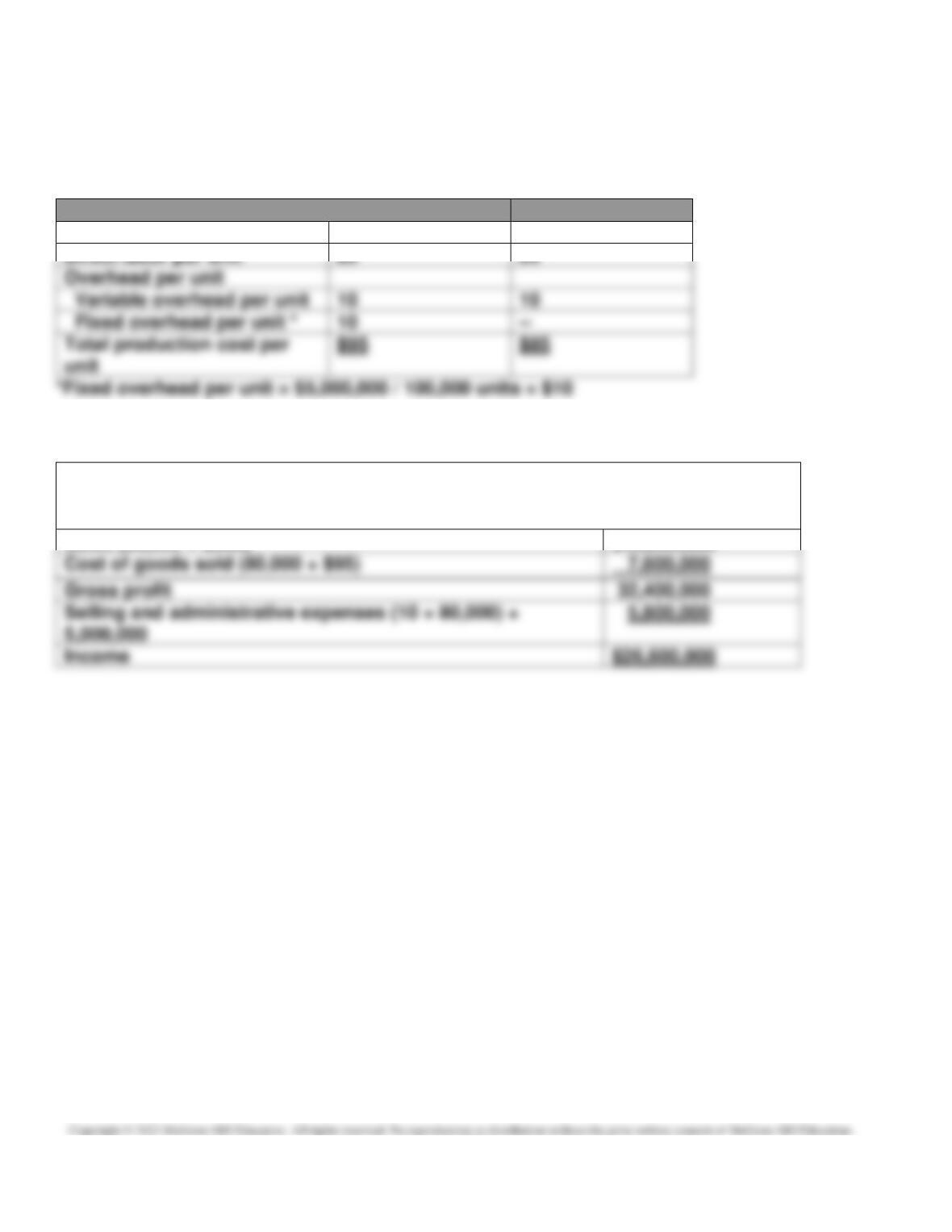
Major Company began operations on January 1, 2021. Cost and sales information for its first
two calendar years are summarized below:
Manufacturing costs:
Direct materials $50 per unit
Direct labor $25 per unit
Factory overhead costs for the year:
Required:
1. Prepare an income statement for the company for 2021 under absorption costing.
2. Prepare an income statement for the company for 2021 under variable costing.
3. Prepare an income statement for the company for 2022 under absorption costing.
Financial and Managerial Accounting, 9th Edition
19-8
Chapter 19 Solution: Alternative Demo Problem
Compute unit costs for 2021 under the two costing methods as follows:
Absorption Costing
Variable Costing
Direct materials per unit
$50
$50
Direct labor per unit
25
25
Overhead per unit
10
10
10
unit
1. Absorption costing income statement for 2021:
Major Corporation
Income Statement
For Year Ended December 31, 2021
Sales (80,000 × $500)
$40,000,000
Gross profit
32,400,000
Income
$26,600,000
Financial and Managerial Accounting, 9th Edition
19-9
Chapter 19 Solution: Alternative Demo Problem Continued
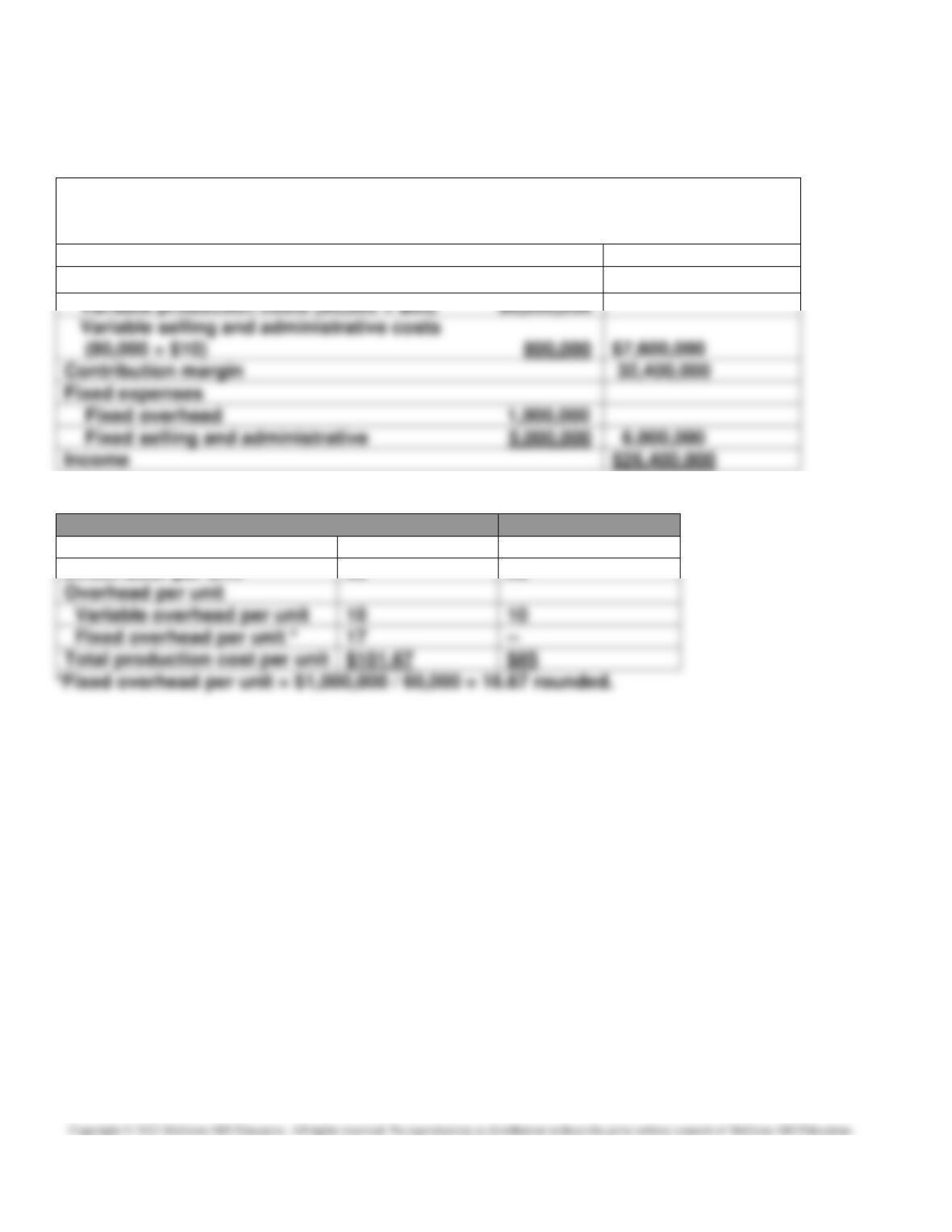
2. Variable costing income statement for 2021:
Major Corporation
Income Statement (Contribution Format)
For Year Ended December 31, 2021
Sales (80,000 × $500)
$40,000,000
Variable expenses
Contribution margin
32,400,000
Fixed expenses
Income
$26,400,000
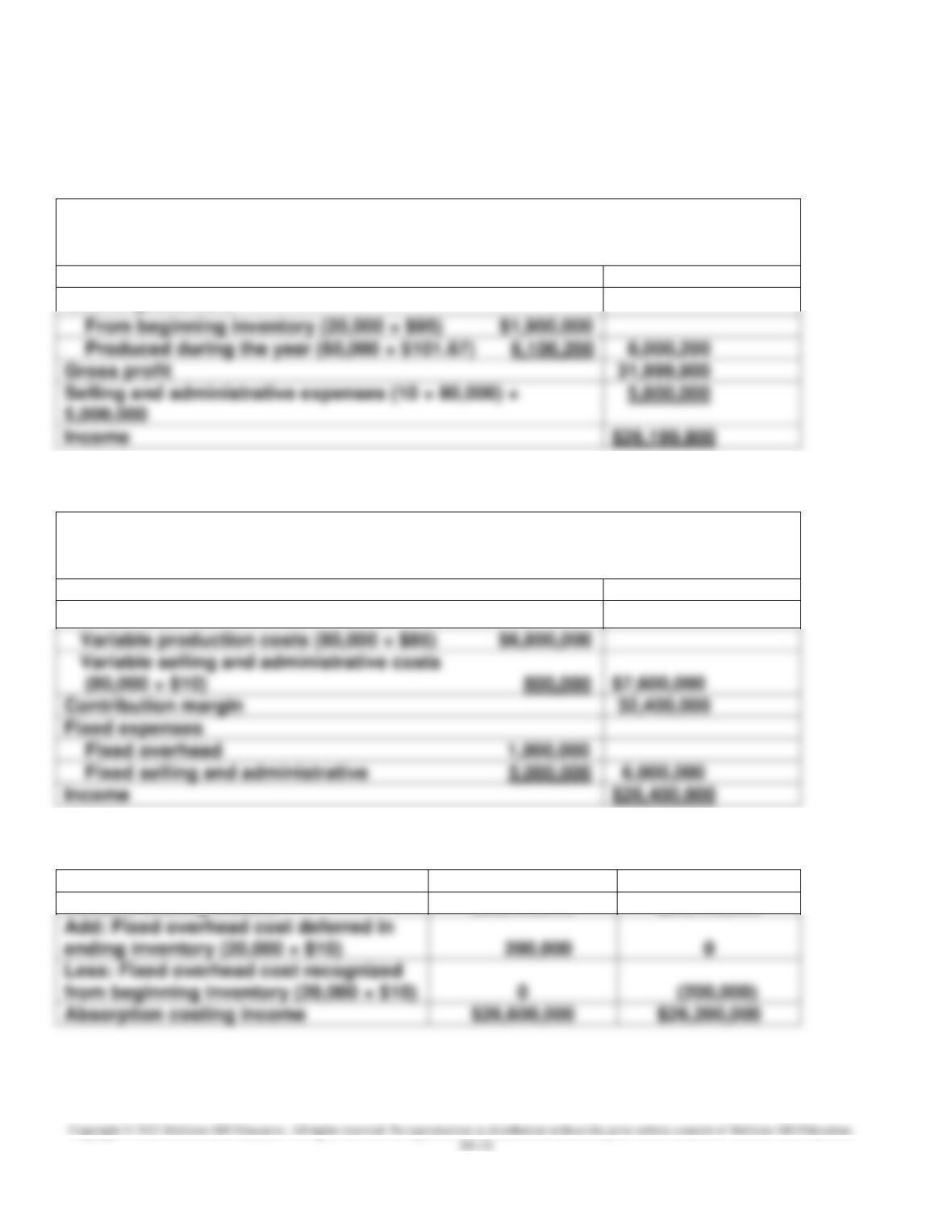
Compute unit costs for 2022 under the two costing methods as follows:
Absorption Costing
Variable Costing
Direct materials per unit
$50
$50
Direct labor per unit
25
25
Overhead per unit
10
10
17
Total production cost per unit
$101.67
$85
Financial and Managerial Accounting, 9th Edition
Chapter 19 Solution: Alternative Demo Problem Continued
3. Absorption costing income statement for 2022:
Major Corporation
Income Statement
For Year Ended December 31, 2022
Sales (80,000 × $500)
$40,000,000
Cost of goods sold
Gross profit
31,999,800
5,000,000
Income
4. Variable costing income statement for 2022:
Major Corporation
Income Statement (Contribution Format)
For Year Ended December 31, 2022
Sales (80,000 × $500)
$40,000,000
Variable expenses
Contribution margin
32,400,000
Fixed expenses
Income
$26,400,000
5. Conversion of variable costing income to absorption costing income:
2021
2022
Variable costing income
$26,400,000
$26,400,000
ending inventory (20,000 × $10)
from beginning inventory (20,000 × $10)
Absorption costing income