
chapter
19
Job Order Costing
______________________________________________
OPENING COMMENTS
Chapter 19 introduces students to managerial job order cost systems. Students will be exposed to the
terminology used to describe costs related to manufacturing.
The first of two basic manufacturing accounting systems, job order, is described in this chapter. Students
learn how costs flow through a manufacturing system and the basis for determining product costs under
job order costing.
After studying the chapter, your students should be able to:
2. Describe and illustrate a job order cost accounting system.
4. Describe the flow of costs for a service business that uses a job order cost accounting system.
STUDENT FAQS
• Why is it necessary to calculate a predetermined overhead rate?
• Why is factory overhead “Actual” debited to record factory overhead?
• If all material goes into a materials account when purchased, then why is it designated direct or
indirect material when it is taken out of the materials account?
• What is the difference between under- and overapplied factory overhead?
• Basically, job order is custom-ordered items from a customer. Then why is it necessary to keep up
with all costs when an estimate has been given before the job is taken?
• Can a business use both process and job order costing?

18 Chapter 19 Job Order Costing
• Why is it necessary to keep up with the flow of costs in a job order system?
• When we credit accumulated depreciation for the factory depreciation, why don’t we debit
depreciation expense?
OBJECTIVE 1
Describe cost accounting systems used by manufacturing businesses.
KEY TERMS
Cost Accounting Systems Process Cost System
Job Order Cost System
SUGGESTED APPROACH
Transparency Master (TM) 19-1 describes the focus and information provided by cost accounting
systems. After reviewing this information, introduce students to job order and process cost systems.
Emphasize that job order systems are used by companies that make custom, special-order type goods or
produce a high variety of products. Process cost systems are used by companies that make “a whole
bunch of stuff that all looks the same” under a continuous manufacturing process. Ask your students to
name types of manufacturers that would make products suitable to a job order system (such as new–
construction homes, replacement windows, class rings, business cards, and wedding invitations). Repeat
this exercise to identify process cost manufacturers.
OBJECTIVE 2
Describe and illustrate a job order cost accounting system.
KEY TERMS
Activity Base Materials Requisition
Activity-Based Costing Overapplied Factory Overhead
Cost Allocation Predetermined Factory Overhead Rate
Finished Goods Ledger Receiving Report
Job Cost Sheets Time Tickets
Materials Ledger Underapplied Factory Overhead
SUGGESTED APPROACH
Objective 2 introduces students to the various documents and procedures used in accumulating the
accounting data under a job order system. Two different approaches to cover the documents in a job order
system are described below.

Chapter 19 Job Order Costing 19
CLASS DISCUSSION — Information Needed in a Job Order System
Ask your students to assume that they manage the manufacturing operations for the custom order division
of a company that makes fine jewelry. The company’s raw materials consist mainly of gold (10 karat and
14 karat), precious stones, and semiprecious stones. Ask your students to describe manufacturing
information that would be important to track. List their responses on the board.
Your students should list many of the following concerns. Point out the accounting documents used to
gather and report this information.
The amount of each type of Materials Ledger — shows a record of the
material on hand amount of each material on hand
The quantity of material Materials Requisition — provides
used on each customer order authorization for materials to be released
from the inventory storage area; shows
specific quantity of materials used in each
customer order
The labor costs used on each Time Tickets — filled out by
customer order. employees; shows the amount of time
spent working on each job and the
labor cost
The total cost of making a Job Cost Sheet — lists materials (from materials
customer’s order requisitions), labor costs (from time tickets),
and overhead used on each customer job
The costs incurred on jobs Cost Ledger — job cost sheets for all orders in process
currently in process
The total cost of all completed Finished Goods Ledger — job cost sheets for
jobs all finished orders
CLASS DISCUSSION — Documents and Procedures in a Job Order System
You can also cover this objective through a bit of role playing. Tell your class to assume that they are
workers for the custom order division of a manufacturer that makes fine jewelry. Assign specific
manufacturing job responsibilities to various class members. Ask your students the questions listed below
concerning the procedures and documents they would use in their jobs.
The goal is for students to understand the information needed by various manufacturing personnel and
then attach a name to documents that report that information. You may need to be the person who
attaches the name to the students’ ideas. For example, when you ask the production scheduler how he or
she will inform the storeroom clerk of the need for inventoried materials, he or she will probably suggest
20 Chapter 19 Job Order Costing
writing a note or memo. (If the production scheduler says, “I’d call the storeroom clerk,” state that all
requests need to be in writing because of the volume of requests for raw materials.) Next, ask the
scheduler what information would be on the memo. Then you can attach a name to this memo; the
document used to request that material is a materials requisition.
1. Appoint one of your students to be the production scheduler for your company. Whenever this
student receives a customer order, he or she is to schedule when the item will be made. Tell that
student to assume that the company has just received an order to make World Series rings for the
winning baseball team. Ask him or her to name the steps that would need to be taken to schedule the
job. The student should mention the following (with a little prodding from you, if necessary):
a. Look at other jobs scheduled to see when workers will have time to start this job.
b. Determine whether the materials are on hand to make the rings.
Tell the student to assume that materials need to be ordered (the details of purchasing raw materials
are not specifically described in this chapter, you may wish to skip to step 3 which is covered in the
chapter). The company’s purchasing agent orders all materials. Ask the student how he or she would
2. Name one student as the purchasing agent. Ask what he or she would do after receiving the purchase
3. Appoint a student to be the receiving department. Ask what he or she would do when goods are
4. Name a storeroom supervisor. Ask this student what he or she would do when the materials are
Next, ask this student whether he or she would give materials to any employee who asked for them.
What would the storeroom supervisor need in order to give materials to a production employee?
5. Ask one student to be the skilled craftsman who is going to make the rings. Tell the student that the
company wants to know the labor cost of all orders. Ask what information he or she would record so
6. Appoint one of your students as the accountant. That student needs to determine the cost to make the
rings. Ask him or her to describe how to get the information to determine the cost. (Answer: Take
Ask the student how he or she could determine the costs spent on jobs that have been completed.

Chapter 19 Job Order Costing 21
Finally, ask the accountant how he or she could determine the costs spent on all jobs that are still being
LECTURE AID — Allocation of Overhead
In addition to direct materials cost and direct labor cost, objective 2 covers the allocation of overhead
costs in a job order setting. The following example may be helpful in explaining why overhead costs need
to be allocated.
Assume that you are responsible for planning a banquet for your school’s accounting club. The banquet
will feature a dinner, followed by a speaker. The costs associated with the banquet are as follows:
Meals $10 per person
Beverages (coffee and tea) $1 per person
Use of banquet room $50
Speaker’s fee $100
Assume that 50 students will attend the banquet. If you want to break even on this event, how much do
In this case, meals and beverages are costs that can be traced to each student attending the banquet. Fees
paid for use of the room and to the speaker cannot be directly traced to each student. These costs must be
allocated to each attendee in order to determine what it will cost each person to attend the banquet. The
$150 in costs allocated over 50 people equals $3 per person.
DEMONSTRATION PROBLEM — Allocation of Overhead
The costs of manufacturing a product that cannot be traced to a particular job are called overhead.
Overhead costs must be allocated to the products made to determine what each product costs.
Point out that, unlike the situation in the banquet example, overhead costs usually are not divided evenly
over the number of units produced. Assume that a television manufacturer spent $500,000 on overhead
costs to make 50,000 televisions. At first glance, it might seem fair to allocate $10 in overhead to each
television. But what if some televisions were big-screen stereo sets and some were small, portable
models? It isn’t fair to charge each set with the same overhead if some models are more complicated to
manufacture than others.
Assume that MTM manufacturing estimates it will spend $1 million on overhead expenses. MTM is a
highly automated manufacturing plant; therefore, the majority of its overhead expenses relate to
machinery (depreciation, repairs and maintenance, electricity used). Machine hours used would be a
reasonable way to allocate overhead costs to products because use of machinery causes (or drives)
overhead expenses. MTM estimates that it will run its machines for 40,000 hours during the year.
The formula to calculate MTM’s predetermined overhead rate is as follows:
22 Chapter 19 Job Order Costing
Estimated Total Factory Overhead Costs $1,000,000 $25/hour
Estimated Activity Base (machine hours) 40,000 hours
==
In this case, $25 in overhead is allocated each time a product accumulates one hour of machine time.
Ask your students to calculate the overhead that would be allocated to a product that uses 3.5 hours of
DEMONSTRATION PROBLEM — Overapplied and Underapplied Overhead
Ask your students to calculate the amount of overhead allocated to the products of a company that has a
predetermined overhead rate of $10 per machine hour if machines were used for 10,000 hours. (Answer:
$100,000)
What if the company actually spent $95,000 on overhead costs? The company has overapplied overhead
of $5,000. A company may have overapplied or underapplied overhead if:
1. Actual overhead costs do not equal the estimated costs used to compute the predetermined overhead
rate.
2. The actual activity base (machine hours) does not equal the estimated activity base used to compute
the predetermined overhead rate.
TM 19-2 shows circumstances where over- and underapplied overhead occur and how they are treated in
the accounting records.
GROUP LEARNING ACTIVITY — Journal Entries in a Job Order System
Exhibit 2 in the text summarizes the flow of costs in a job order cost system (costs move from materials
inventory to work in process to finished goods to cost of goods sold). Exhibit 8 shows the entries needed
to record manufacturing costs in T accounts. Ask your students to record the journal entries listed on TM
19-3, using Exhibits 2 and 8 as a guide. The correct entries are displayed on TM 19-4. You may want to
have your students post these entries to T accounts and determine account balances.
Chapter 19 Job Order Costing 23
Emphasize the following points as students record their entries:
2. Actual overhead costs are debited to factory overhead. Applied overhead costs are credited to factory
overhead.
4. Product sales serve as the basis for transferring jobs from finished goods to cost of goods sold.
OBJECTIVE 3
Describe the use of job order cost information for decision making.
SUGGESTED APPROACH
The goal of this objective is to explore the ways in which job cost information is used in decision making.
To put your students in the role of decision maker, use the following Group Learning Activity.
GROUP LEARNING ACTIVITY — Decision Making
Handout 19-1 is a brief problem asking students to interpret two job cost sheets. Ask your students to
work on this problem in groups. After providing sufficient time, ask some of the groups to report their
responses. TM 19-5 provides the solution.
Job 210 also is allocated more overhead because it now consumes more labor hours. This allocation
appears logical, since the job probably requires more overhead resources. The cost of activities such as
24 Chapter 19 Job Order Costing
OBJECTIVE 4
Describe the flow of costs for a service business that uses a job order cost accounting system.
SUGGESTED APPROACH
Explain that cost accounting can be applied to any organization that needs to determine the cost of its
product. For a service business, the product is the service provided. Cost accounting can be used by an
advertising agency to determine the cost to produce an ad for a customer, by an accountant to determine
the cost of preparing a tax return, or by a plumber to determine the cost to clean a drain.
Refer your students to Exhibit 11 in the text. While reviewing that diagram, stress the following points:
1. The costs incurred by a service organization are labor and overhead. Any supplies used are treated as
an overhead expense.
2. A cost of services account is used to record the cost of completed jobs.
GROUP LEARNING ACTIVITY — Job Order Costing in a Service Business
TM 19-6 presents information about a CPA firm that does audit and tax work. Divide your class into
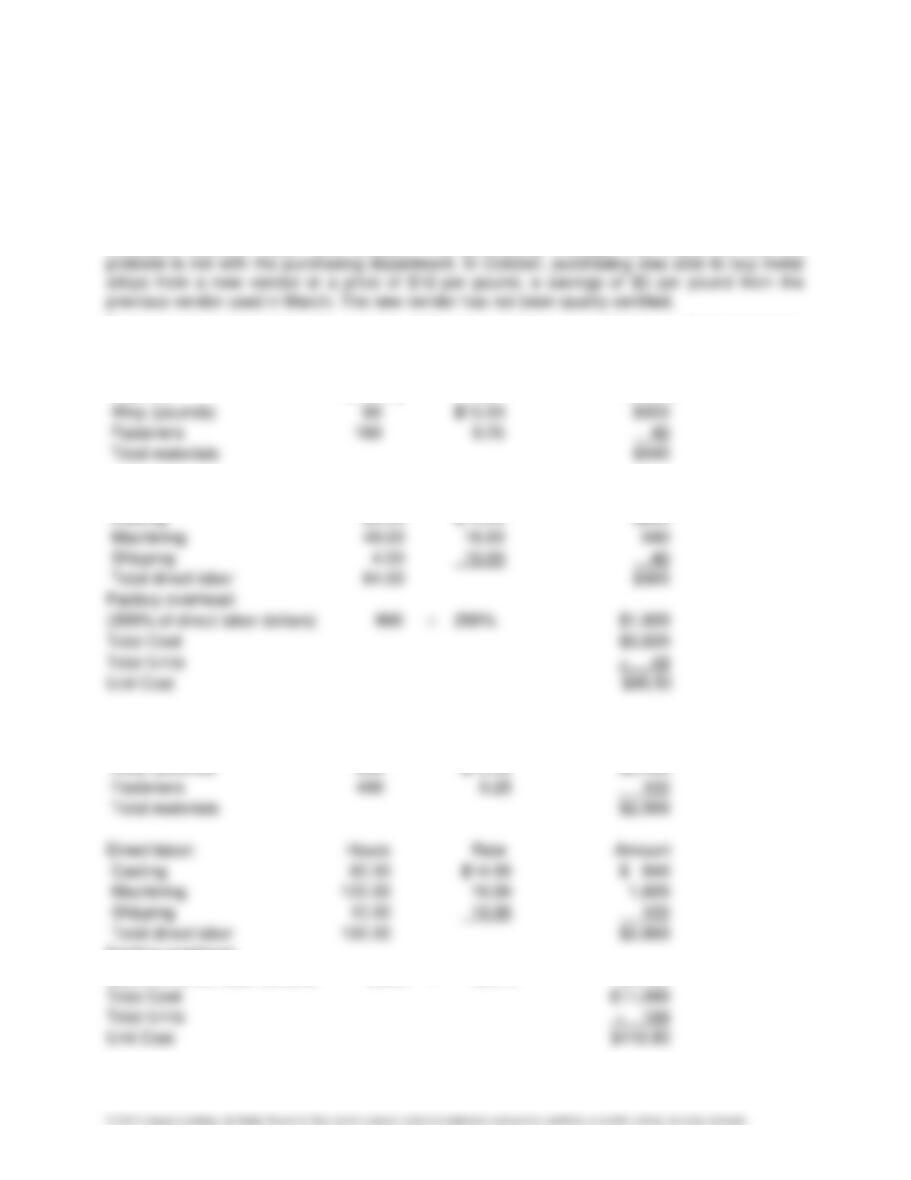
Handout 19-1
Decision Making Using Job Cost Data
Griffin Casting Company is a job shop that manufactures castings for a variety of purposes. The
following two job cost sheets relate to two different orders for an identical casting used to house
automobile generators. As can be seen from the two job cost sheets, the unit cost has
increased between March and October. The purchasing manager has explained that the
Required: Interpret the job cost reports to determine what has caused the per unit cost increase.
Job 100 Date Completed: March 30 Item: 40 automobile generator housings
Materials: Quantity Price Amount
Direct labor: Hours Rate Amount
Casting 20.00 $14.00 $280
Job 210 Date Completed: October 15 Item: 100 automobile generator housings
Materials: Quantity Price Amount
Factory overhead
(200% of direct labor dollars) 2,860 200% $5,720
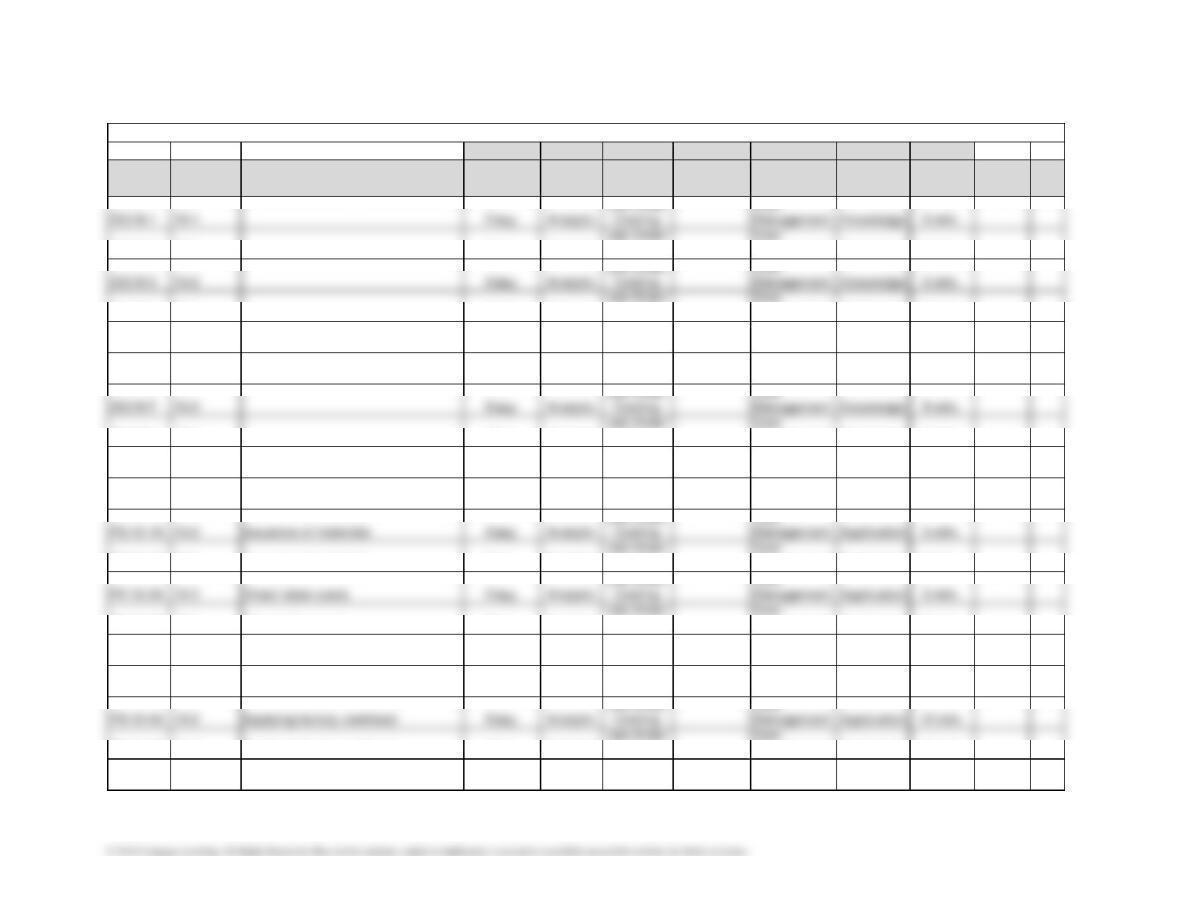
DIFFICULTY BUSPROG ACBSP ACBSP IMA BLOOM’S TIME
Problem
Learning
Objective
Description Primary Primary Secondary
Managerial
Only
Spread-
sheet
GL
DQ19–1 19–1 Easy Analytic
Job Order
Costing
Cost
Management
Knowledge 5 min.
Job Order
Cost
DQ19–2 19–1 Easy Analytic
Costing
Management
Knowledge 5 min.
Job Order
Costing
Cost
Management
Knowledge 5 min.
Job Order
Cost
DQ19–4 19–2 Easy Analytic
Costing
Management
Knowledge 5 min.
DQ19–5 19–2 Easy Analytic
Job Order
Costing
Cost
Management
Knowledge 5 min.
DQ19–6 19–2 Easy Analytic
Job Order
Costing
Cost
Management
Knowledge 5 min.
DQ19–7 19–2 Easy Analytic
Job Order
Costing
Cost
Management
Knowledge 5 min.
Job Order
Cost
DQ19–8 19–2 Easy Analytic
Costing
Management
Knowledge 5 min.
DQ19–9 19–2 Easy Analytic
Job Order
Costing
Cost
Management
Knowledge 5 min.
DQ19–10 19-4 Easy Analytic
Job Order
Costing
Cost
Management
Knowledge 5 min.
PE19-1A 19-2 Issuance of materials Easy Analytic
Costing
Management
Application 5 min.
Job Order
Cost
Job Order
Cost
PE19-1B 19-2 Issuance of materials Easy Analytic
Costing
Management
Application 5 min.
PE19-2A 19-2 Direct labor costs Easy Analytic
Job Order
Costing
Cost
Management
Application 5 min.
Job Order
Cost
PE19-2B 19-2 Direct labor costs Easy Analytic
Costing
Management
Application 5 min.
PE19-3A 19-2 Factory overhead costs Easy Analytic
Job Order
Costing
Cost
Management
Application 5 min.
PE19-3B 19-2 Factory overhead costs Easy Analytic
Job Order
Costing
Cost
Management
Application 5 min.
PE19-4A 19-2 Applying factory overhead Easy Analytic
Job Order
Costing
Cost
Management
Application 10 min.
Job Order
Cost
PE19-4B 19-2 Applying factory overhead Easy Analytic
Costing
Management
Application 10 min.
PE19-5A 19-2 Job costs Easy Analytic
Job Order
Costing
Cost
Management
Application 10 min.
HOMEWORK CHART WITH LEARNING OUTCOMES TAGGING
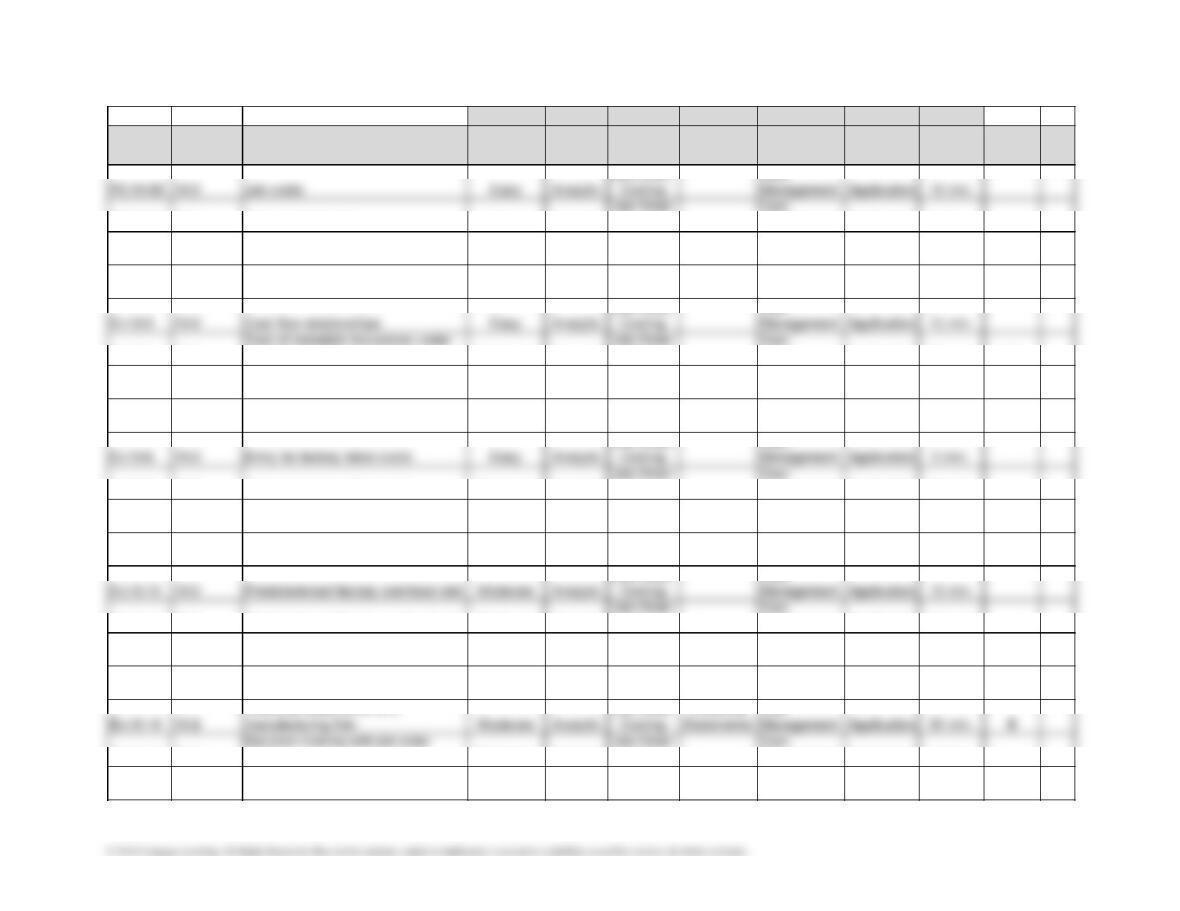
DIFFICULTY BUSPROG ACBSP ACBSP IMA BLOOM’S TIME
Problem
Learning
Objective
Description Primary Primary Secondary
Managerial
Only
Spread-
sheet
GL
PE19-5B 19–2 Job costs Easy Analytic
Costing
Management
Application 10 min.
Job Order
Cost
PE19-6A 19–2 Cost of goods sold Easy Analytic
Costing
Management
Application 5 min.
PE19-6B 19–2 Cost of goods sold Easy Analytic
Job Order
Costing
Cost
Management
Application 5 min.
Ex19-1 19–2
Transactions in a job order cost
system
Easy Analytic
Job Order
Costing
Cost
Management
Knowledge 5 min.
Ex19-2 19-2 Cost flow relationships Easy Analytic
Costing
Management
Application 10 min.
Cost of materials issuances under
Job Order
Cost
Job Order
Cost
Ex19-3 19–2
the FIFO method
Moderate Analytic
Costing
Management
Application 30 min. X
Ex19-4 19-2 Entry for issuing materials Easy Analytic
Job Order
Costing
Cost
Management
Application 5 min.
Ex19-5 19-2 Entries for materials Moderate Analytic
Job Order
Costing
Cost
Management
Application 30 min.
Job Order
Cost
Job Order
Cost
Ex19-7 19-2 Entry for factory labor costs Moderate Analytic
Costing
Management
Application 15 min.
Ex19-8 19–2
Entries for direct labor and factory
overhead
Easy Analytic
Job Order
Costing
Cost
Management
Application 10 min.
Ex19-9 19–2
Factory overhead rates, entries, and
account balance
Moderate Analytic
Job Order
Costing
Cost
Management
Application 30 min.
Job Order
Cost
Job Order
Cost
Ex19-11 19–2 Predetermined factory overhead rate Moderate Analytic
Costing
Management
Application 15 min.
Ex19-12 19-2
Entry for jobs completed; cost of
unfinished jobs
Moderate Analytic
Job Order
Costing
Cost
Management
Application 15 min.
Ex19-13 19-2
Entries for factory costs and jobs
completed
Moderate Analytic
Job Order
Costing
Cost
Management
Application 30 min.
Ex19-14 19-2
manufacturing firm
Moderate Analytic
Costing
Management
Application 30 min. X
Decision making with job order
Job Order
Cost
Financial statements of a
Job Order
Financial
Cost
Ex19-15 19-3
costs
Moderate Analytic
Costing
Management
Application 1 hour
Ex19-16 19-3
Decision making with job order
costs
Moderate Analytic
Job Order
Costing
Cost
Management
Application 30 min.
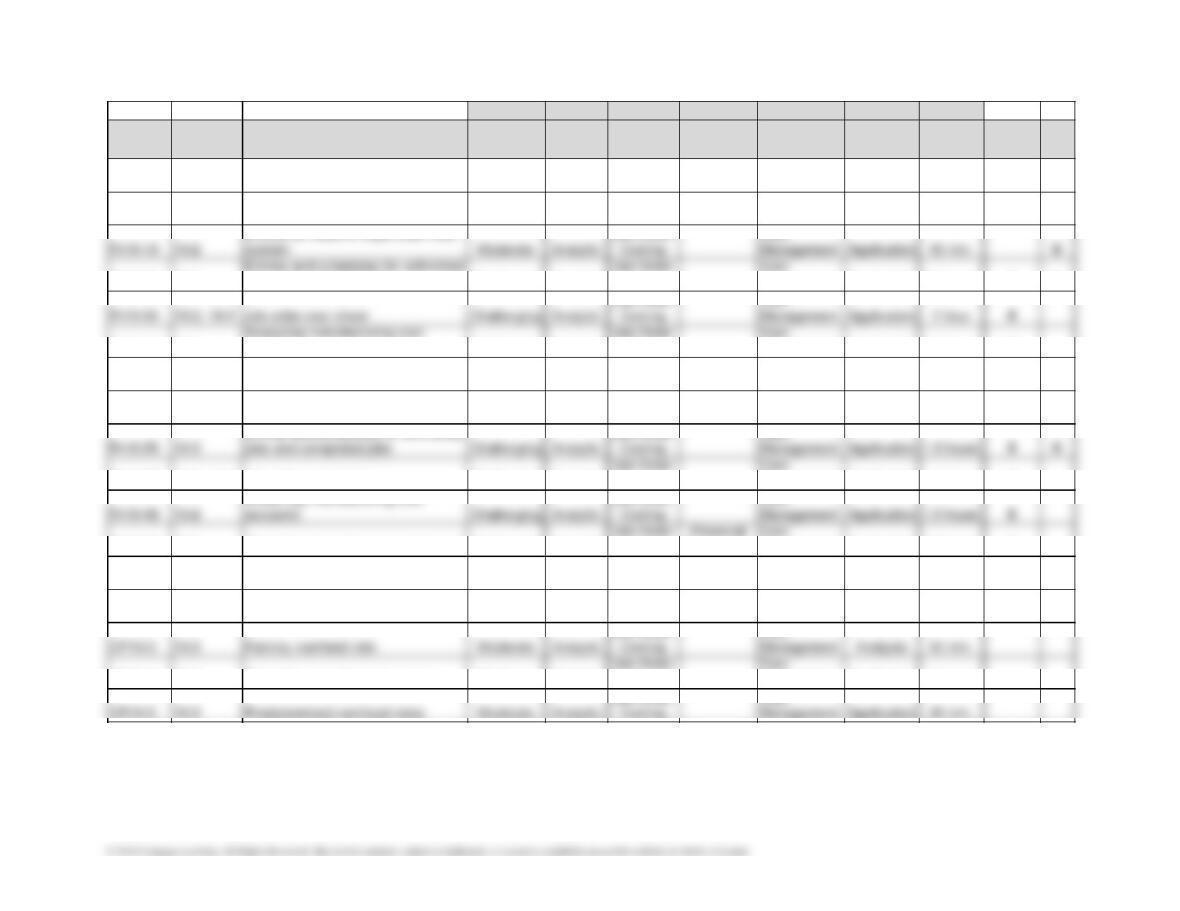
DIFFICULTY BUSPROG ACBSP ACBSP IMA BLOOM’S TIME
Problem
Learning
Objective
Description Primary Primary Secondary
Managerial
Only
Spread-
sheet
GL
Ex19-17 19-4
Job order cost accounting entries for
a service business
Moderate Analytic
Job Order
Costing
Cost
Management
Application 1 hour
Ex19-18 19-4
Job order cost accounting entries for
a service business
Moderate Analytic
Job Order
Costing
Cost
Management
Application 30 min.
Pr19–1A 19-2
system
Moderate Analytic
Costing
Management
Application 45 min. X
Entries and schedules for unfinished
Job Order
Cost
Entries for costs in a job order cost
Job Order
Cost
Pr19–2A 19-2
jobs and completed jobs
Challenging Analytic
Costing
Management
Application 1.5 hours X X
Pr19–3A 19-2, 19-3 Job order cost sheet Challenging Analytic
Costing
Management
Application 1 hour X
Analyzing manufacturing cost
Job Order
Cost
Job Order
Cost
Pr19–4A 19-2
accounts
Challenging Analytic
Costing
Management
Application 1.5 hours X
Pr19–5A 19-2 Flow of costs and income statement Challenging Analytic
Job Order
Costing
Financial
Statements
Cost
Management
Application 1.5 hours X
Pr19–1B 19-2
Entries for costs in a job order cost
system
Moderate Analytic
Job Order
Costing
Cost
Management
Application 45 min. X
Pr19–2B 19-2
jobs and completed jobs
Challenging Analytic
Costing
Management
Application 1.5 hours X X
Job Order
Cost
Entries and schedules for unfinished
Job Order
Cost
Pr19–3B 19-2, 19-3 Job order cost sheet Challenging Analytic
Costing
Management
Application 1 hour X
Pr19–4B 19-2
accounts
Challenging Analytic
Costing
Management
Application 1.5 hours X
Job Order
Financial
Cost
Analyzing manufacturing cost
Job Order
Cost
Pr19–5B 19-2 Flow of costs and income statement Challenging Analytic
Costing
Statements
Management
Application 1.5 hours X
CP19-1 19–2 Managerial analysis Easy Analytic
Job Order
Costing
Cost
Management
Analysis 15 min.
CP19-2 19–3
Job order decision making and rate
deficiencies
Challenging Analytic
Job Order
Costing
Cost
Management
Analysis 1 hour
CP19-3 19–2 Factory overhead rate Moderate Analytic
Costing
Management
Analysis 30 min.
Job Order
Cost
Job Order
Cost
CP19-4 19–2 Recording manufacturing costs Moderate Analytic
Costing
Management
Application 30 min.
Job Order
Cost