
19-1
CHAPTER 19
CAPITAL INVESTMENT
DISCUSSION QUESTIONS
1. Independent projects are such that the
acceptance of one does not preclude the ac-
ceptance of another. With mutually exclusive
projects, however, acceptance of one pre-
cludes the acceptance of others.
2. The timing and quantity of cash flows de-
termine the present value of a project. The
present value is critical for assessing wheth-
er or not a project is acceptable.
3. By ignoring the time value of money, good
projects can be rejected and bad projects
accepted.
4. The payback period is the time required to
recover the initial investment. It is used for
three reasons: (a) A measure of risk. Rough-
ly, projects with shorter paybacks are less
risky. (b) Obsolescence. If the risk of obso-
lescence is high, firms will want to recover
funds quickly. (c) Self-interest. Managers
want quick paybacks so that short-run per-
formance measures are affected positively,
enhancing chances for bonuses and promo-
tion.
5. The accounting rate of return is the average
income divided by investment.
6. The cost of capital is the cost of investment
funds and is usually viewed as the weighted
average of the costs of funds from all sources.
In capital budgeting, the cost of capital is the
rate used to discount future cash flows.
7. Disagree. Only if the funds received each
period from the investment are reinvested to
earn the IRR will the IRR be the actual rate
of return.
8. If NPV 0, then the investment is
acceptable. If NPV < 0, then the investment
should be rejected.
9. NPV signals which investment maximizes
firm value; IRR may provide misleading sig-
nals. IRR may be popular because it pro-
vides the correct signal most of the time,
and managers are accustomed to working
with rates of return.
10. NPV analysis is only as good as the accura-
cy of the cash flows. If cash flows are not
accurate, then incorrect investment deci-
sions can be made.
11. Gains and losses on the sale of existing
assets should be considered.
12. MACRS provides higher depreciation (a
non-cash expense) in earlier years than
straight-line does. Depreciation expense
provides a cash inflow from the tax savings
it produces. As a consequence, the present
value of the shielding benefit is greater for
MACRS.
13. Intangible and indirect benefits are important
factors—more important in the advanced
manufacturing and P2 environments. Great-
er quality, more reliability, reduced lead
times, improved delivery, and the ability to
maintain or increase market share are ex-
amples of intangible benefits. Reductions in
support labor in such areas as scheduling
and stores are indirect benefits.
14. A postaudit is a follow-up analysis of an
investment decision. It compares the pro-
jected costs and benefits with the actual
costs and benefits. It is especially valuable
for advanced technology investments since
it reveals intangible and indirect benefits that
can be considered in similar investments in
the future.
15. Sensitivity analysis involves changing
assumptions to see how the changes affect
the original outcome. In capital investment
decisions, sensitivity analysis can be used to
help assess the risk of a project. Uncertainty
in forecasted cash flows can be dealt with by
altering projections to see how sensitive the
decision is to errors in estimates.
CORNERSTONE EXERCISES
Cornerstone Exercise 19.1
1. Even cash flows:
Payback period = Original investment/Annual cash flow
2. Uneven cash flows:
Unrecovered Investment Annual Time Needed
Year (beginning of year) Cash Flow for Payback
1 ……………… $360,000 $112,500 1.0 year
2 ……………… 247,500 142,500 1.0 year
3. The payback for the laundry facility is 2.4 years ($360,000/150,000). The laun-
Cornerstone Exercise 19.2
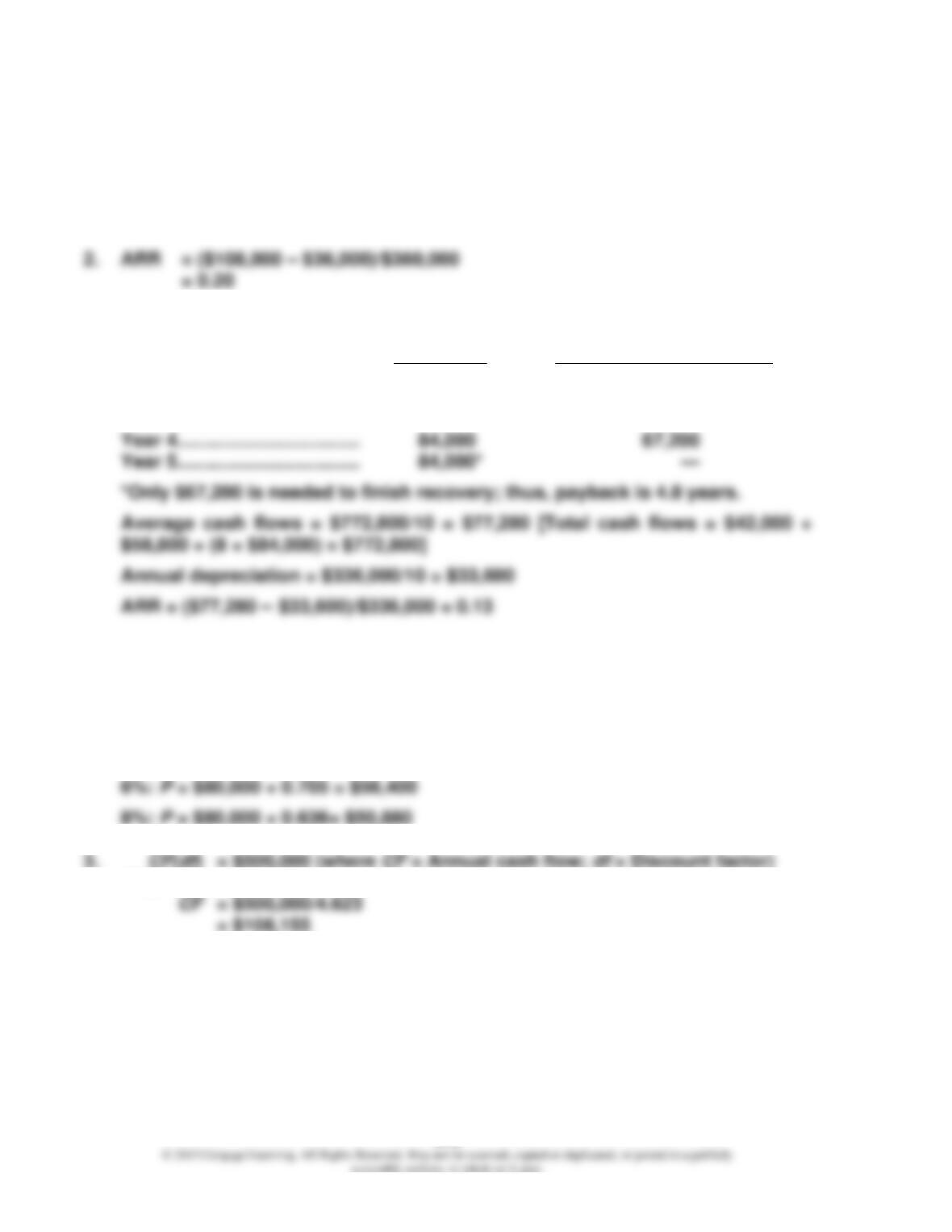
1. Yearly depreciation expense: ($170,000 – $0)/5 = $34,000
Year 1 net income = $68,000 – $34,000 = $34,000
2. Total net income (five years) = $238,000
19-3
Cornerstone Exercise 19.2 (Concluded)
3. Average net income = $221,000/5 = $44,200. Thus, ARR = $44,200/$170,000 =
0.26, which is less than the ARR of the echocardiogram. The second project
Cornerstone Exercise 19–3
1. Year Item Cash Flow
0 Equipment $(800,000)
Working capital (100,000)
2. Year Cash Flow Discount Factor* Present Value
0 …………………………... $(900,000) 1.000 $(900,000)
1–4 …………………………. 300,000 3.312 993,600
3. Correcting for the overestimation error of $150,000 would cause the product
to be rejected.
Year Cash Flow Discount Factor** Present Value
0 …………………………... $(900,000) 1.000 $(900,000)
19-4
Cornerstone Exercise 19.4
1. df = $900,000/$300,000 = 3.000. Since the life of the investment is four years,
we must find the fourth row in Exhibit 19B-2 and move across this row until
2. To find the IRR, we must find i by trial and error such that $775,000 =
$400,000/(1 + i) + $500,000/(1 + i)2. Using i = 0.12 as the first guess, Exhibit
19B-1 yields discount factors of 0.893 and 0.797 and thus the following pre-
sent value for the two cash inflows:
P = (0.893 × $400,000) + (0.797 × $500,000)
= $755,700
3. df = $900,000/$250,000 = 3.600. Using Exhibit 19B-2, this discount factor now
Cornerstone Exercise 19.5
1. Clearlook System: NPV Analysis
Year Cash Flow Discount Factor* Present Value
0 …………………………... $(900,000) 1.000 $ (900,000)
19-5
Cornerstone Exercise 19.5 (Concluded)
2. Goodview System: NPV Analysis
Year Cash Flow Discount Factor* Present Value
0 …………………………... $(800,000) 1.000 $(800,000)
3. IRR Analysis:
Clearlook: Discount factor = Initial investment/Annual cash flow
Goodview: Discount factor = Initial investment/Annual cash flow
= 3.265**
*From Exhibit 19B-2, df = 3.273 implies that IRR ≈ 16 percent
**From Exhibit 19B-2, df = 3.265 implies that IRR is slightly greater than
16 percent.
Cornerstone Exercise 19.6
1. CF = NI + NC = $54,000 + $120,000 = $174,000
2. (1 – t) × Revenue = (1 – 0.40) × $360,000 = $216,000
3. Year (1 – t)Ra –(1 – t)Cb tNCc CF
1 ………………………………….. $216,000 $(90,000) $48,000 $174,000
2 ………………………………….. 216,000 (90,000) 48,000 174,000
19-6
EXERCISES
Exercise 19.7
1. Payback period = $93,750/$31,250 = 3.00 years
3. Payback period:
Cash Flow Unrecovered Investment
Year 1 …………………………….. $42,000 $294,000
Year 2 …………………………….. 58,800 235,200
Year 3 …………………………….. 84,000 151,200
Exercise 19.8
1. F = $5,000(1.03)2 = $5,304.50
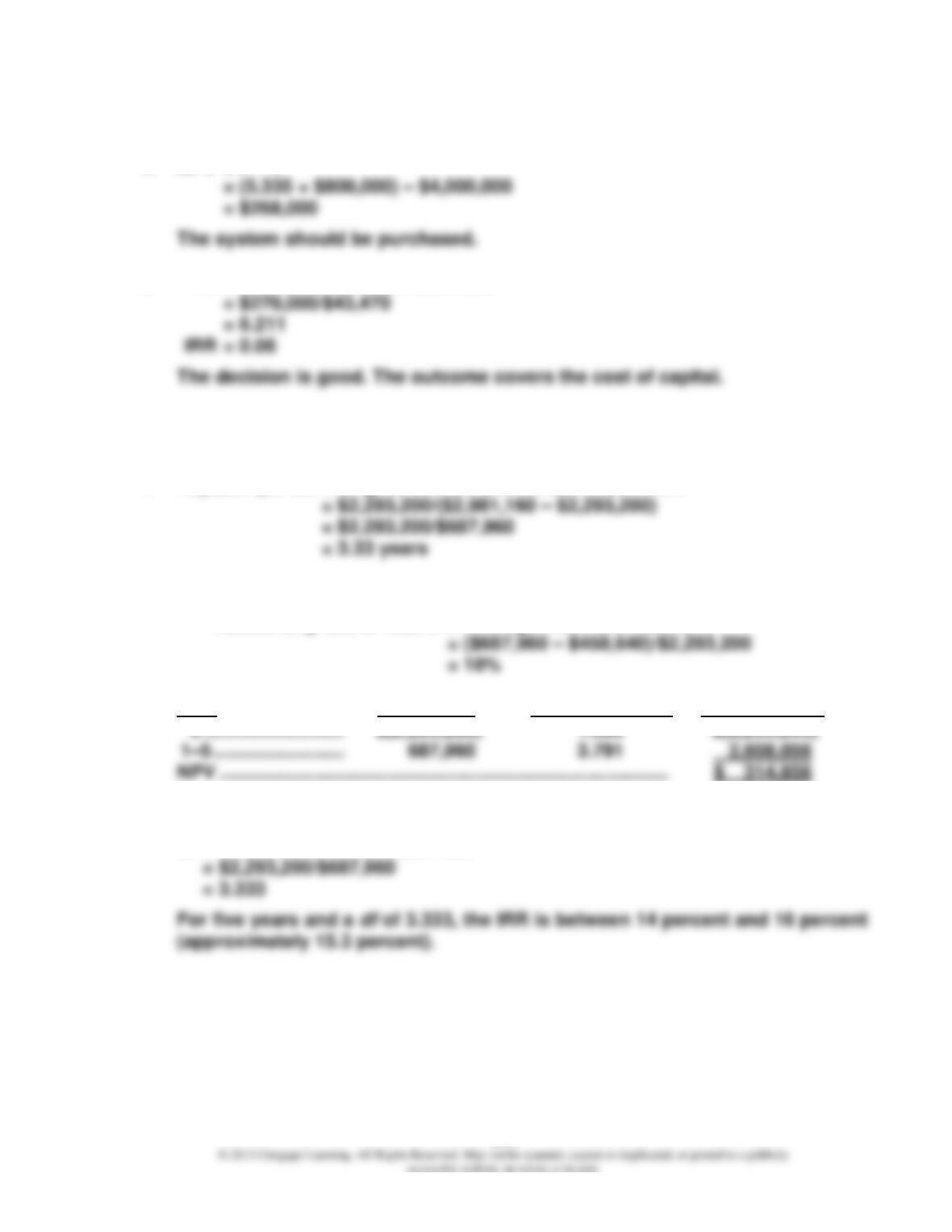
2. 4%: P = $80,000 × 0.790 = $63,200
CF(4.623) = $500,000
19-7
Exercise 19.9
1. NPV = P – I
2. df = Investment/Annual cash flow
Exercise 19.10
1. Payback period = Original investment/Annual cash inflow
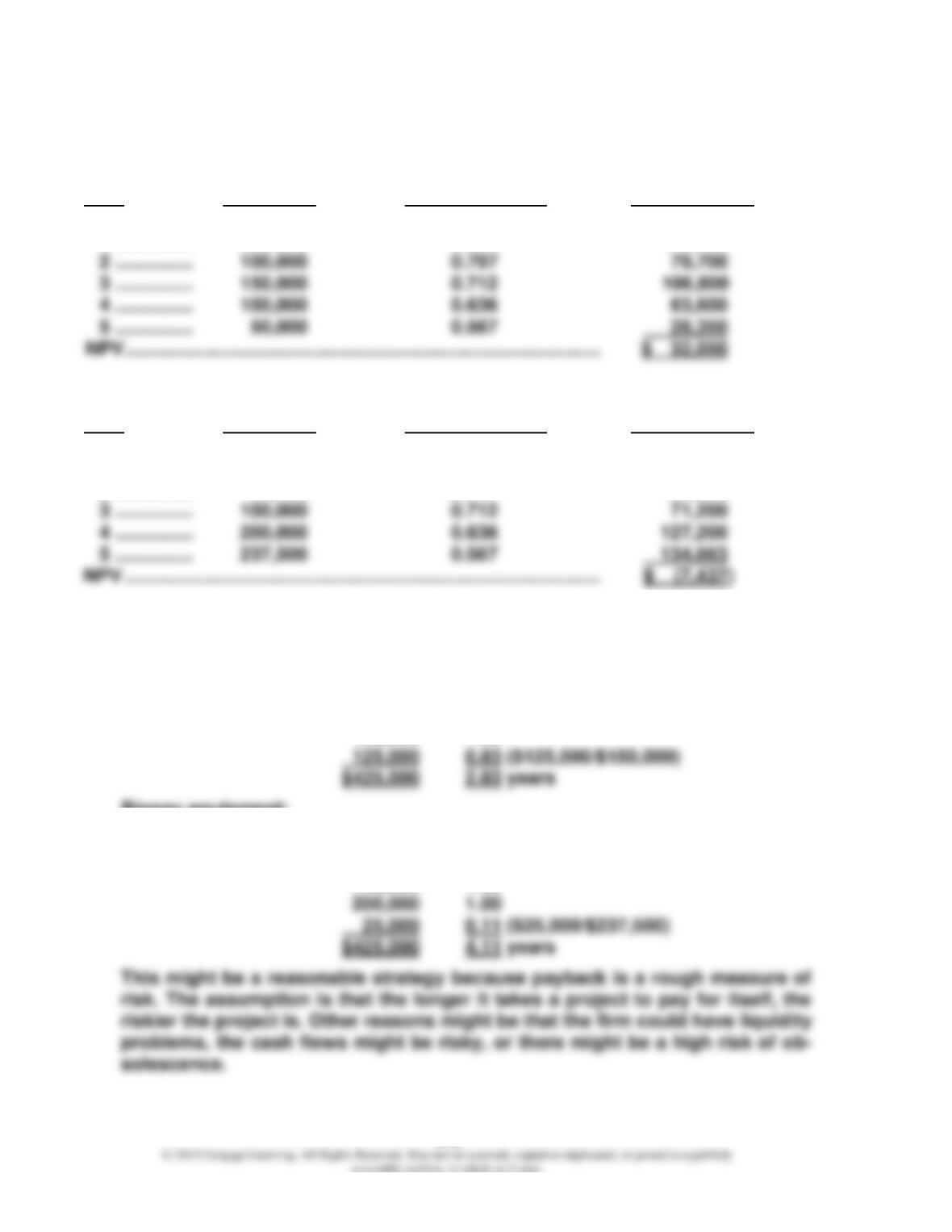
2. Yearly depreciation expense: ($2,293,200 – $0)/5 = $458,640
Accounting rate of return = Average income/Investment
3. Year Cash Flow Discount Factor Present Value
4. P = CF(df) = I for the IRR, thus,
df = Investment/Annual cash flow
19-8
Exercise 19.11
MRI equipment:
Year Cash Flow Discount Factor Present Value
0 …………… $(425,000) 1.000 $(425,000)
1 …………… 200,000 0.893 178,600
Biopsy equipment:
Year Cash Flow Discount Factor Present Value
0 …………… $(425,000) 1.000 $(425,000)
1 …………… 50,000 0.893 44,650
2 …………… 50,000 0.797 39,850
Exercise 19.12
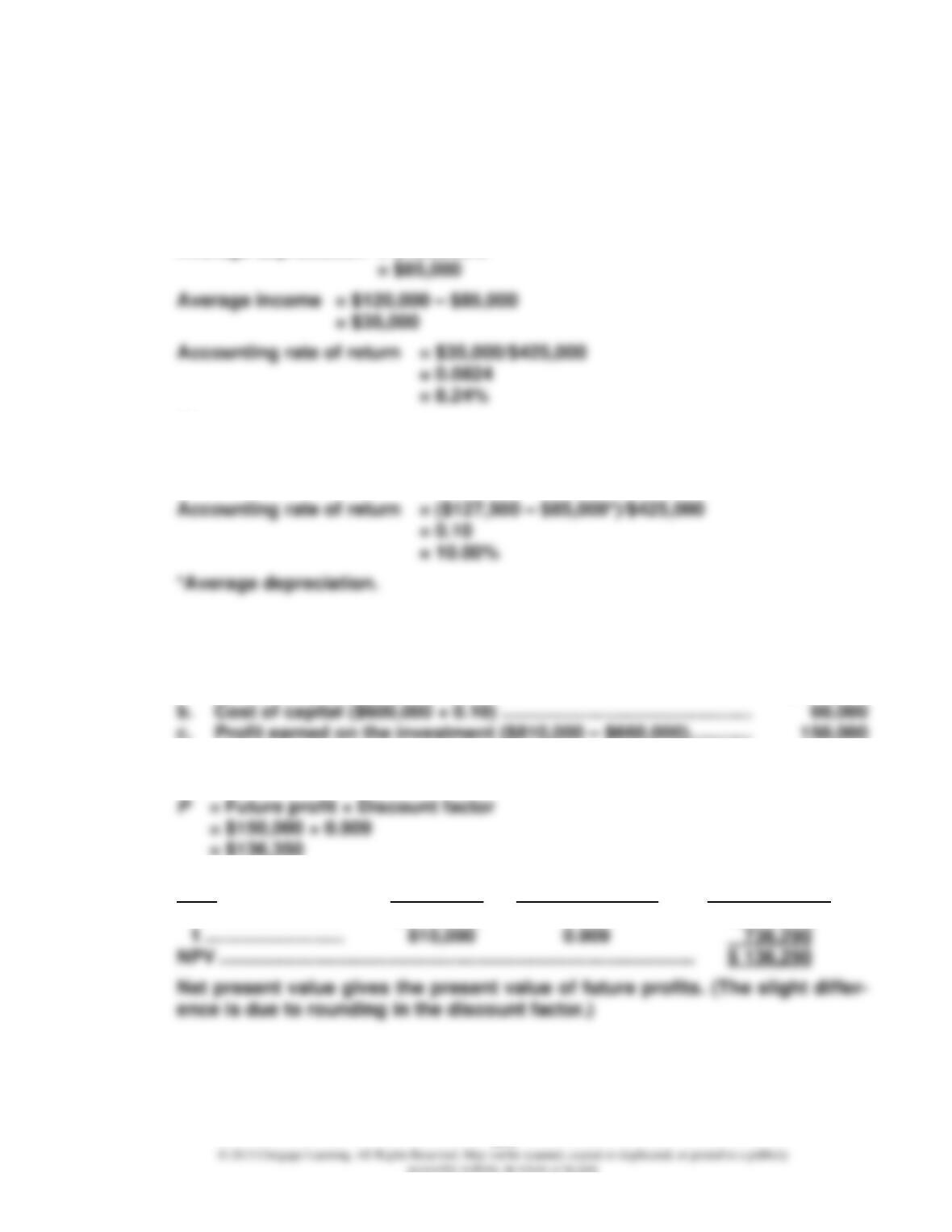
1. MRI equipment:
Payback period = $200,000 1.00 year
100,000 1.00
Biopsy equipment:
Payback period = $50,000 1.00 year
50,000 1.00
100,000 1.00
19-9
Exercise 19.12 (Concluded)
2. MRI equipment:
Average cash flow = ($200,000 + $100,000 + $150,000 + $100,000 + $50,000)/5
= $120,000
Average depreciation = $425,000/5
Biopsy equipment:
Average cash flow = ($50,000 + $50,000 + $100,000 + $200,000 + $237,500)/5
= $127,500
Exercise 19.13
1. a. Return of the original investment ………………………………………. $600,000
2. Present value of profit:
3. Year Cash Flow Discount Factor Present Value
0 ……………………… $(600,000) 1.000 $(600,000)
19–10
Exercise 19.14
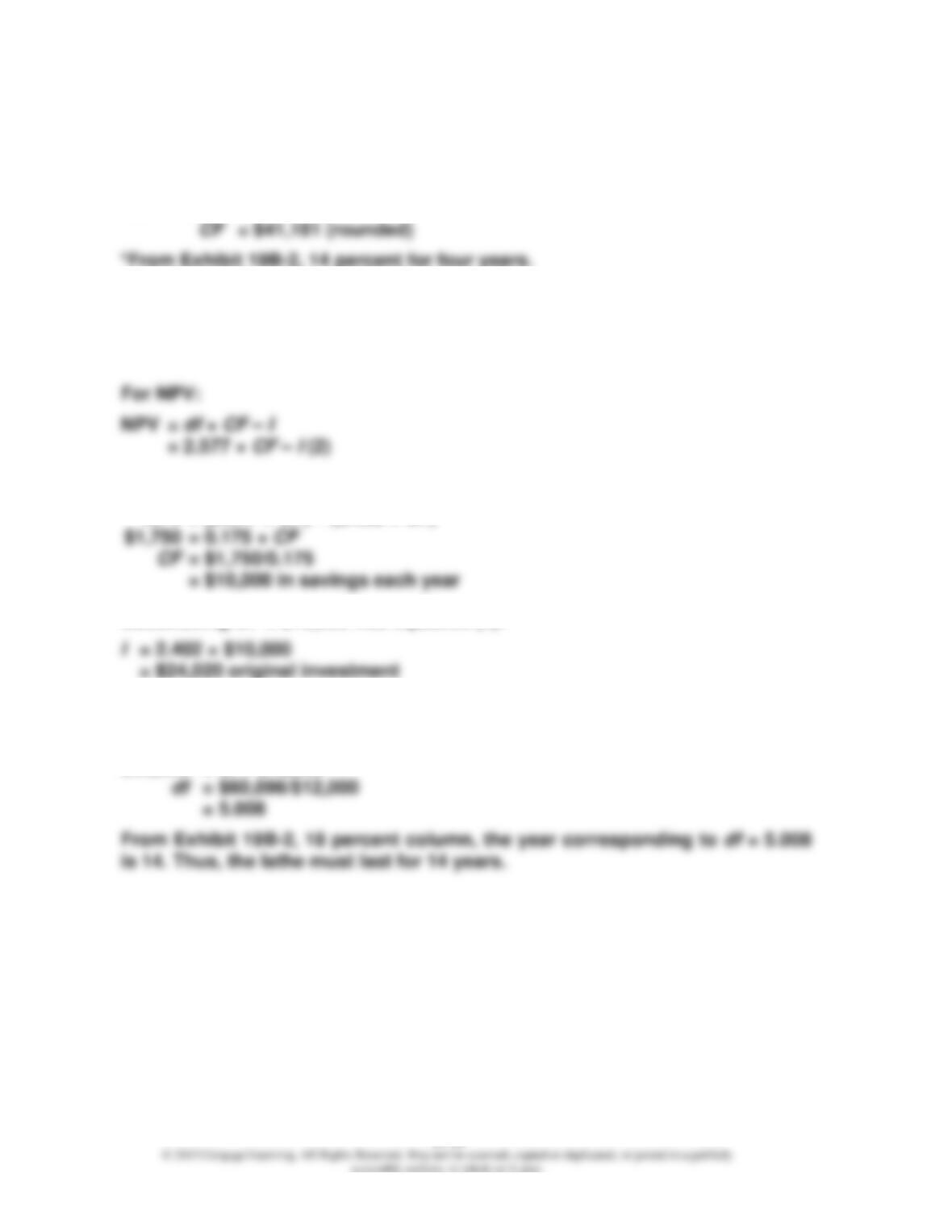
1. P = I
= df × CF
2.914* × CF = $120,000
2. For IRR: (Discount factors from Exhibit 19B-2)
I = df × CF
I = 2.402 × CF (1)
Substituting equation (1) into equation (2):
NPV = (2.577 × CF) – (2.402 × CF)
Substituting CF = $10,000 into equation (1):
3. For IRR:
I = df × CF
$60,096 = df × $12,000
19–11
Exercise 19.14 (Concluded)
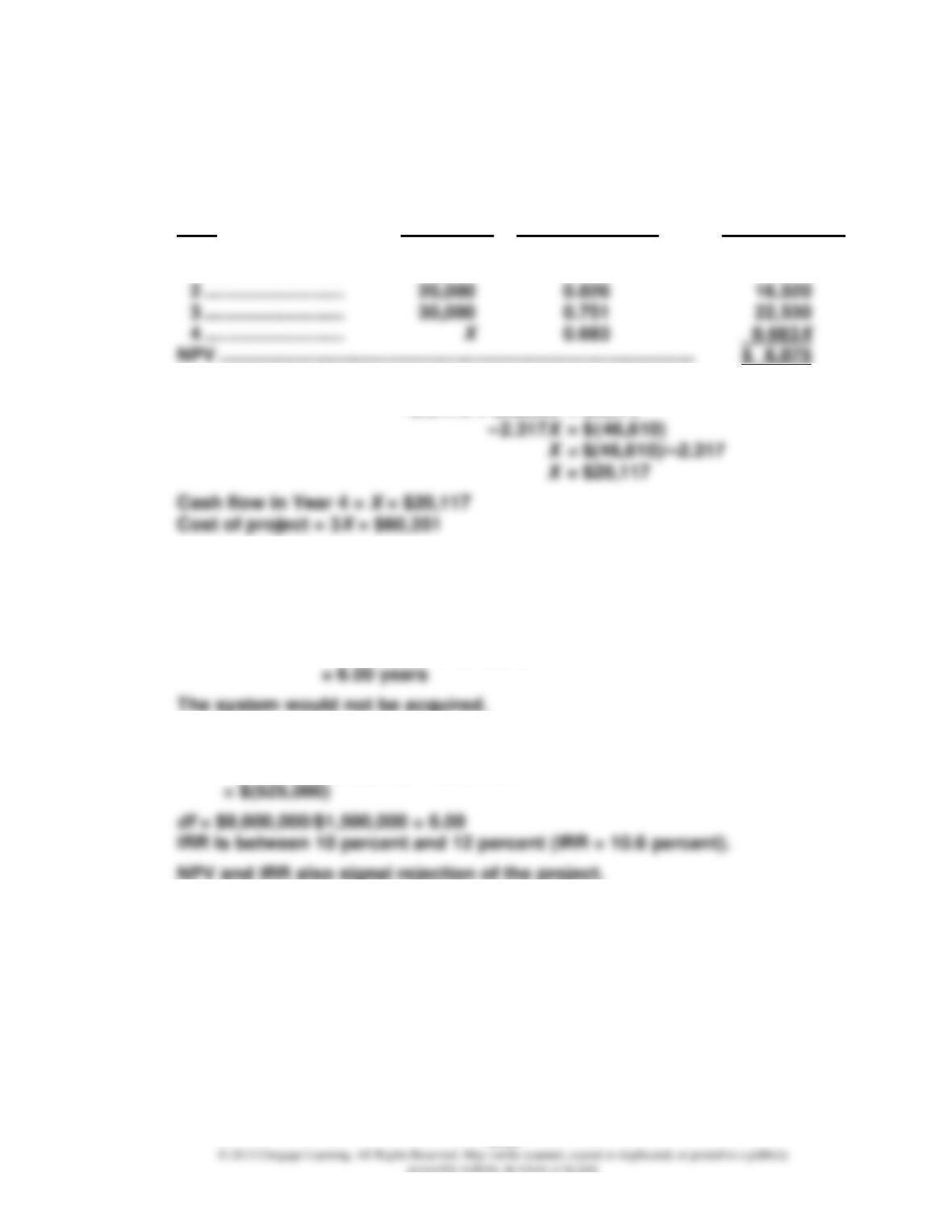
4. X = Cash flow in Year 4
Investment = 3X
Year Cash Flow Discount Factor Present Value
0 ……………………… (3X) 1.000 $ (3X)
1 ……………………… 15,000 0.909 13,635
–3X + $13,635 + $16,520 + $22,530 + 0.683X= $6,075
–2.317X + $52,685 = $6,075
Exercise 19.15
1. Payback period = Investment/Annual cash flow
= $9,000,000/$1,500,000
2. NPV = P – I
= (5.650 × $1,500,000) – $9,000,000
19–12
Exercise 19.15 (Concluded)
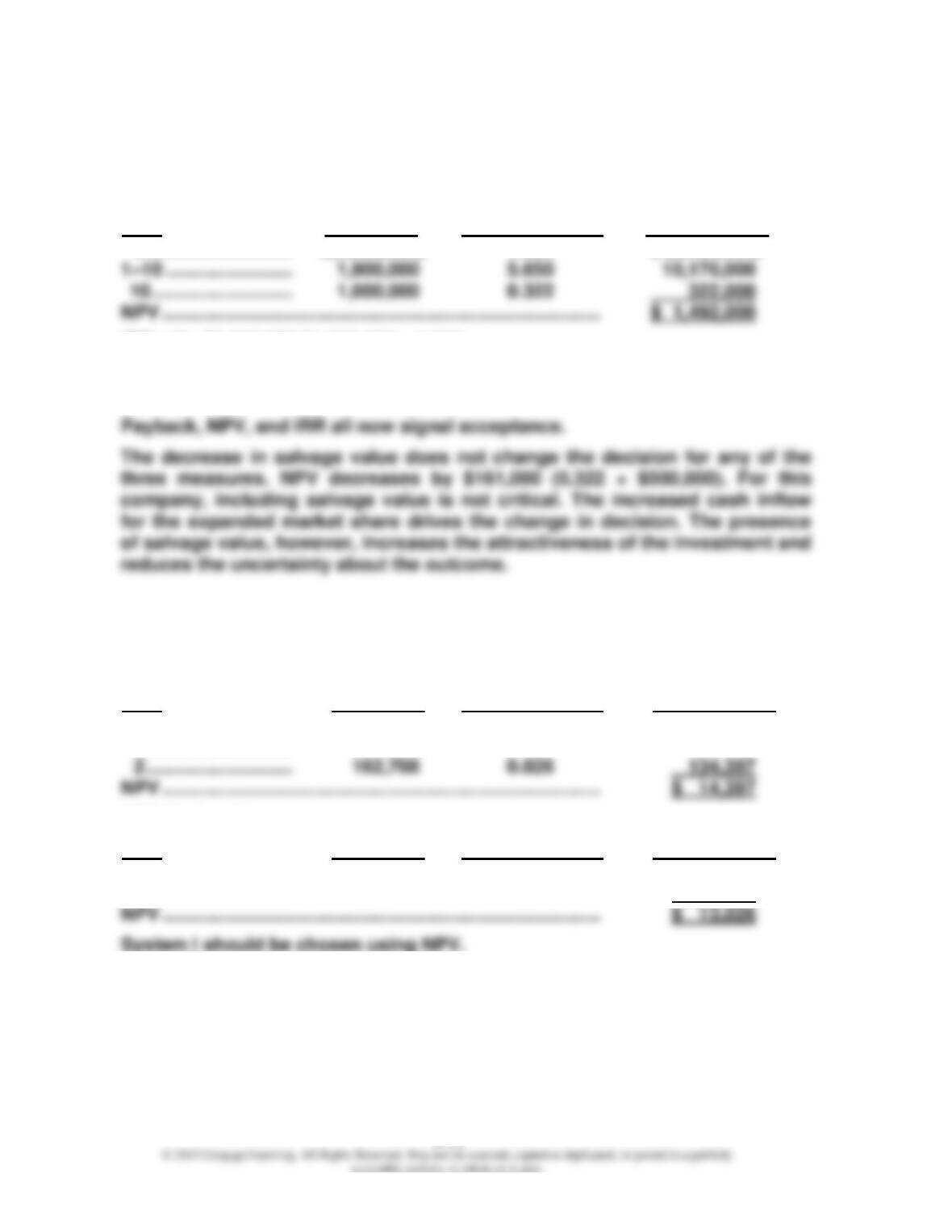
3. Payback period = $9,000,000/$1,800,000 = 5.00 years
NPV:
Year Cash Flow Discount Factor Present Value
0 ………………………. $(9,000,000) 1.000 $ (9,000,000)
IRR: df = $9,000,000/$1,800,000 = 5.000
IRR (without salvage value) is now between 14 percent and 16 percent
(approximately 15.13 percent).
Exercise 19.16
1. NPV System I:
Year Cash Flow Discount Factor Present Value
0 ………………………. $(120,000) 1.000 $(120,000)
1 ………………………. — — —
NPV System II:
Year Cash Flow Discount Factor Present Value
0 ………………………. $(120,000) 1.000 $(120,000)
1–2 …………………….. 76,628 1.736 133,026
19–13
Exercise 19.16 (Concluded)
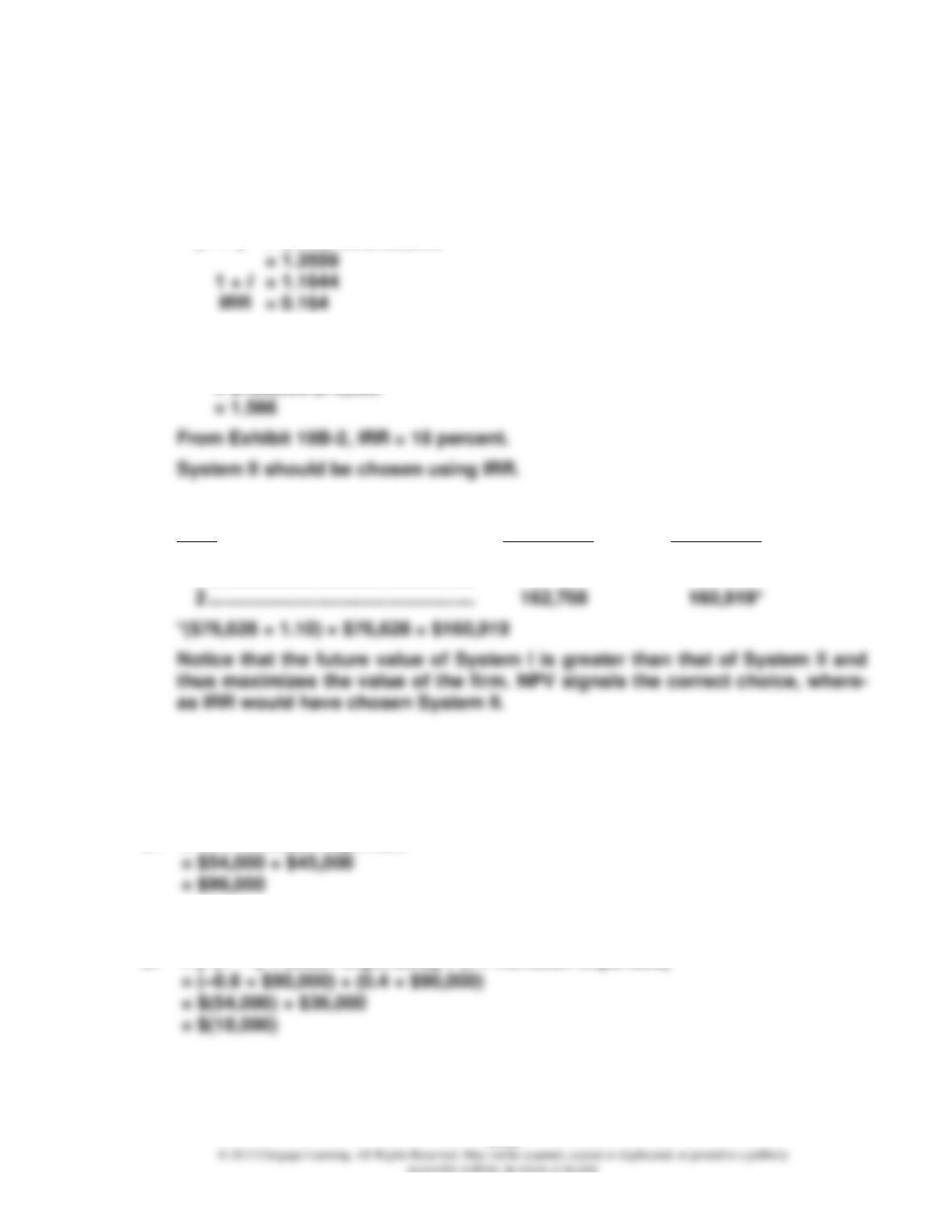
IRR System I:
I = df × CF
$120,000 = $162,708/(1 + i)2
(1 + i)2 = $162,708/$120,000
IRR System II:
df = I/CF
= $120,000/$76,628
2. Modified comparison:
Year System I System II
0 …………………………………………… $(120,000) $(120,000)
1 …………………………………………… — —
Exercise 19.17
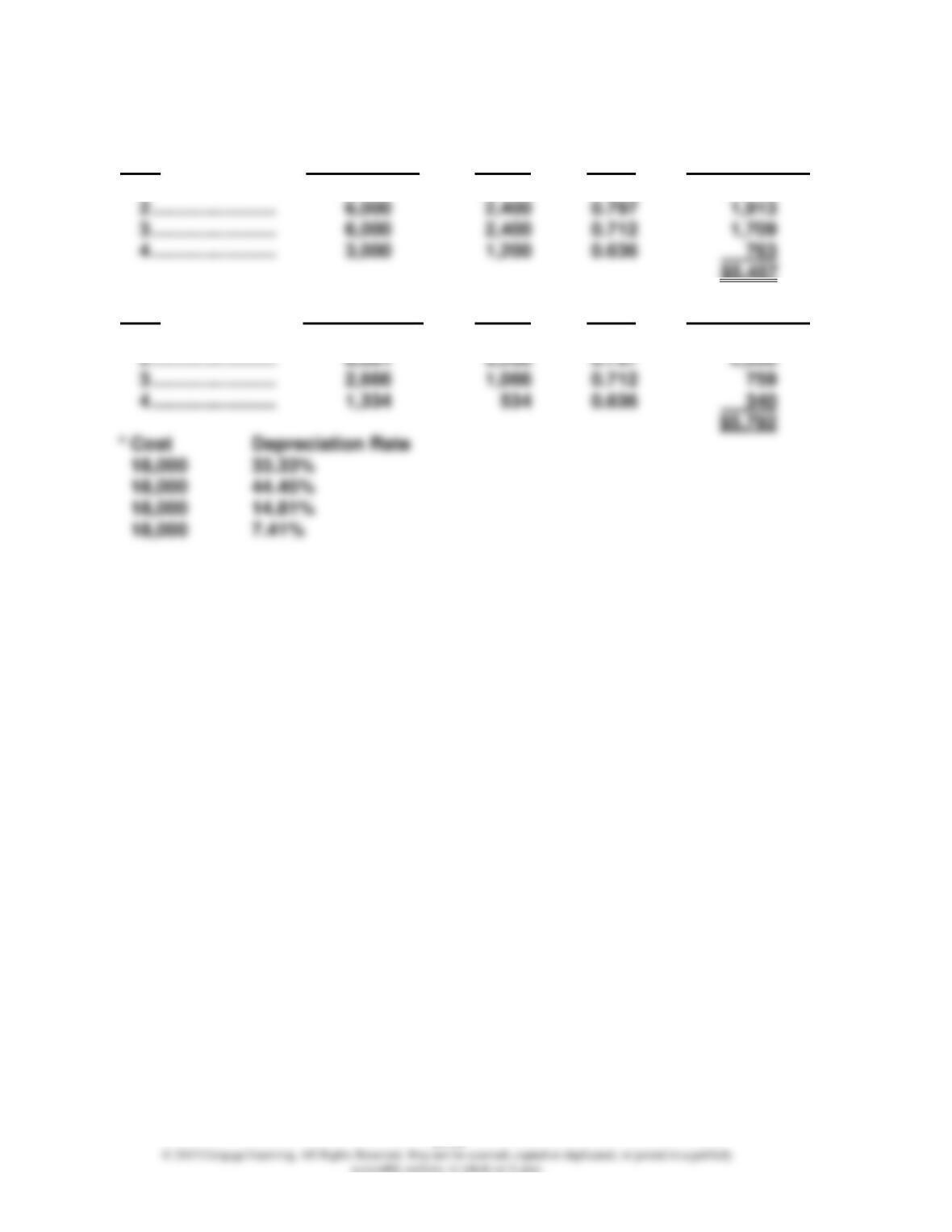
Project I:
CF = NI + Noncash expenses
Project II:
CF = [–(1 – t) × (Cash expenses)] + (t × Noncash expenses)
19–14
Exercise 19.18
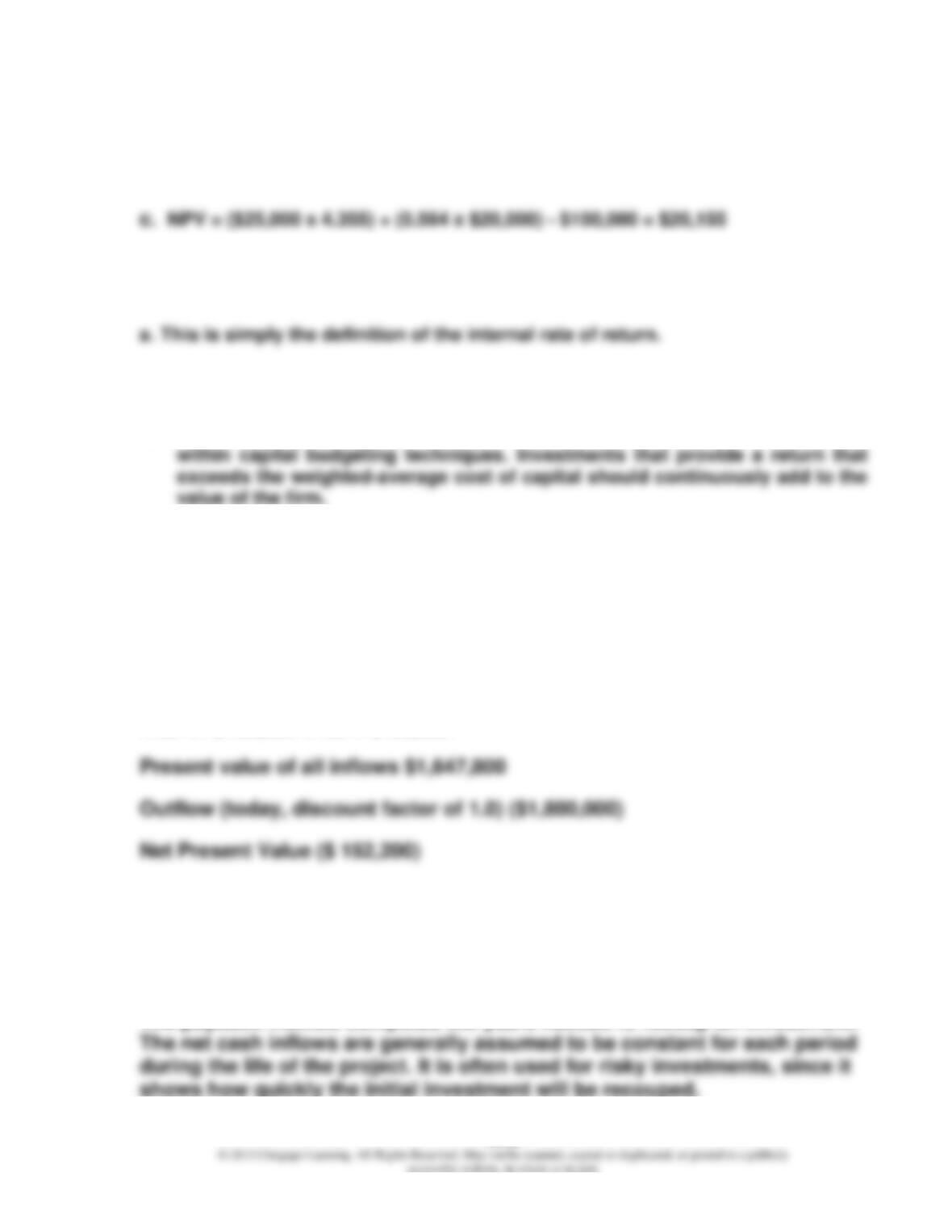
1. Year Depreciation tNC df Present Value
1 …………………… $3,000 $1,200 0.893 $1,072
2. Year Depreciation* tNC df Present Value
1 …………………… $5,999 $2,400 0.893 $2,143
3. MACRS increases the present value of tax shielding by increasing the
amount of depreciation in the earlier years.
19–15
CPA-TYPE EXERCISES
Exercises19.19
Exercise 19.20
Exercise 19.21
c. The weighted-average cost of capital is frequently used as the hurdle rate
Exercise 19.22
c. Net present value is computed as the difference between project inflows and
outflows, discounted to present value as follows.
Inflows:
Years 1 through 5: $420,000 x 3.79 = $1,591,800
Year 6: $100,000 x .56 = $ 56,000
Exercise 19.23
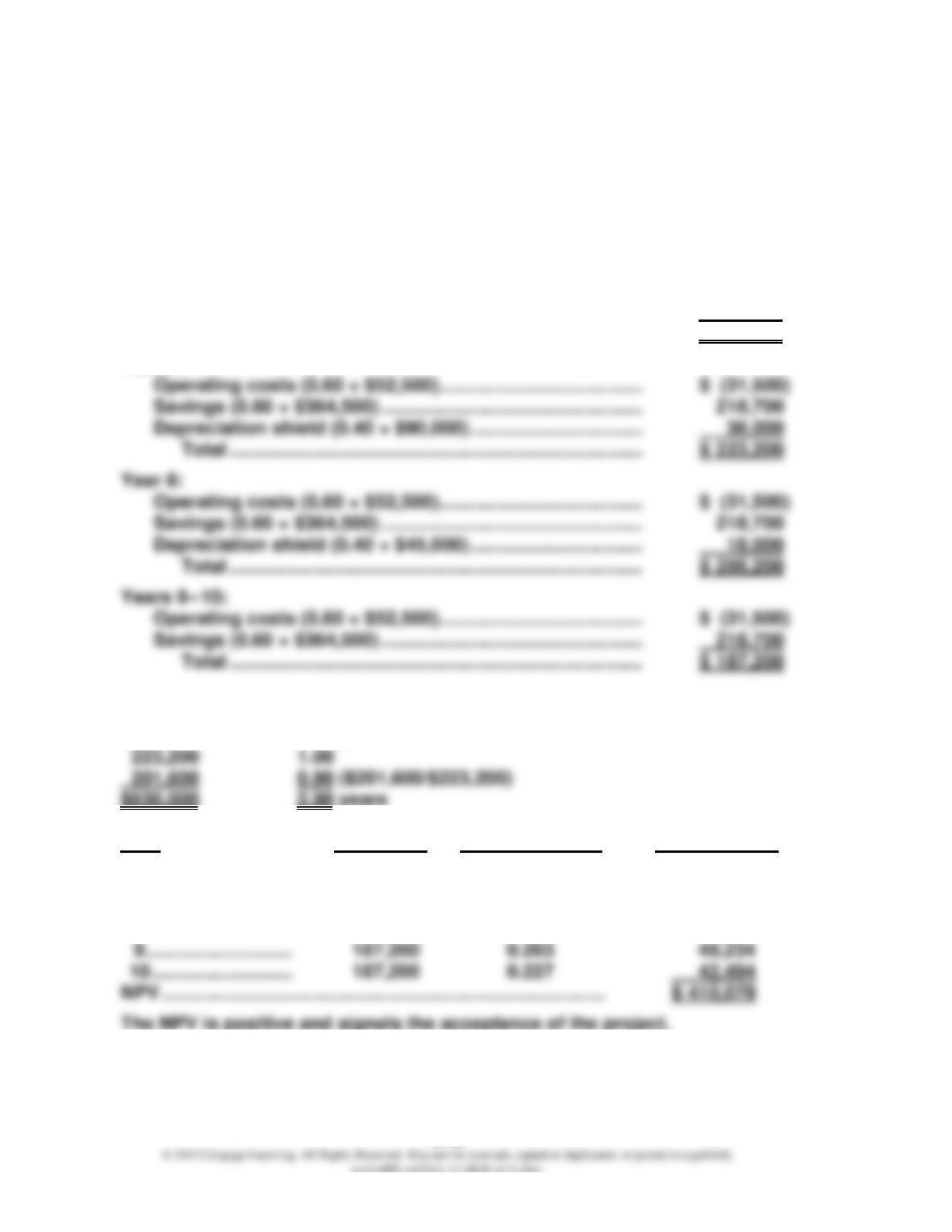
c. The formula for calculating the payback period is:
Net Initial Investment / Increase in annual net after-tax cash flow
The payback method computes the years needed to recoup an investment.
19–16
PROBLEMS
Problem 19.24
1. Year 0 …………………………………………………………………………….. $(630,000)
Year 1:
Operating costs (0.60 × $52,500) ………………………………… $ (31,500)
Savings (0.60 × $364,500) ………………………………………….. 218,700
Depreciation shield [0.40 × ($630,000/7) × 0.5] ……………. 18,000
Total ……………………………………………………………………. $ 205,200
Years 2–7:
2. Payback period:
$205,200 1.00 year
3. Year Cash Flow Discount Factor Present Value
0 ………………………. $(630,000) 1.000 $(630,000)
1 ………………………. 205,200 0.862 176,882
2–7 …………………….. 223,200 3.176 708,883
8 ………………………. 205,200 0.305 62,586