Chapter 19
Variable Costing and Analysis
QUESTIONS
1. Variable costing includes direct materials, direct labor, and variable overhead as
product costs. Fixed overhead is treated as a period cost and is not included as a
product cost.
2. Absorption costing includes direct materials, direct labor, variable overhead and fixed
overhead as part of product costs. All costs of production are “absorbed” into product
costs.
3. When units produced exceed units sold for a reporting period, income under variable
costing would be less than income determined under absorption costing. This is
because under absorption costing, fixed overhead attaches to units still in ending
inventory and is not expensed until the units in ending inventory are sold at some future
date. Variable costing expenses all of the fixed overhead in the period incurred, and
none of it is stored in ending inventory.
4. a. Gross margin is computed as sales minus cost of goods sold. Cost of goods sold
includes full absorption cost of products, which includes direct materials, direct
labor, variable overhead and fixed overhead.
b. Contribution margin is computed as sales minus variable expenses. Variable
expenses include both variable product costs (direct materials, direct labor, and
variable overhead) and variable selling and administrative expenses.
8. Absorption costing can lead to over-production for two reasons:
a. Fixed overhead cost per unit costs fall as production increases. Matching a lower
cost per unit against a constant selling price will cause gross margin and operating
income to be higher.
b. If production exceeds sales, then portions of fixed overhead are stored in ending
inventory and are not expensed in the period of production. Since these costs are
not expensed, operating income increases.
Variable costing avoids this problem, because all units have a cost equal to the variable
cost per unit, which is not affected by production levels. All fixed overhead is expensed
in the period in which it is incurred, so none of the fixed overhead gets stored in ending
inventory.
9. Variable costing may violate the matching principle, in that all manufacturing costs must
be expensed when the product is sold rather than when it is produced. For this reason,
absorption costing is the only acceptable method to use for external reporting and tax
reporting.
10. If units produced equals units sold, no conversion is necessary. If production exceeds
sales, absorption costing income can be determined by adding (increase in units of
ending inventory times the fixed costs per unit) to the variable costing income. If
production is less than sales, absorption costing income can be determined by
subtracting (decrease in units of beginning inventory times the fixed costs per unit)
from the variable costing income. This assumes that fixed cost per unit in beginning
inventory is the same as that for the period.
11. Reporting contribution margin by segment is useful in assessing the profitability of
each segment. It allows managers to analyze operations and make recommendations as
to how to direct their efforts.
QUICK STUDIES
Quick Study 19-1 (10 minutes)
Cost per unit using absorption costing
Per unit
Direct materials ……………………………………………………………………………….
$10
Direct labor ……………………………………………………………………………………
20
Variable overhead ……………………………………………………………………………
10
Fixed overhead ($160,000/20,000 units) …………………………………………….
8
Total product cost per unit ……………………………………………………….
$48
Quick Study 19-2 (10 minutes)
Cost per unit using variable costing
Per unit
Direct materials ……………………………………………………………………………….
$10
Direct labor ……………………………………………………………………………………
20
Variable overhead ……………………………………………………………………………
10
Total product cost per unit ……………………………………………………….
$40
Quick Study 19-3 (15 minutes)
ACES INC.
Variable Costing Income Statement
Sales (4,900 units x $90 per unit) …………………………..
$441,000
Variable expenses
Var. manuf. expense (4,900 units x $25) …………………..
$122,500
Var. selling and admin. expense (4,900 x $2) ……………
9,800
Total variable expenses ………………………………………….
132,300
Contribution margin …………………………………………………
Fixed expenses
Fixed selling and administrative expenses ………………
65,200
Total fixed expenses ………………………………………………
143,200
Quick Study 19-4 (10 minutes)
ACES INC.
Absorption Costing Income Statement
Sales (4,900 units x $90 per unit) ……………………………………………..
$441,000
Cost of goods sold (4,900 units x $38 per unit*) ………………………..
186,200
Gross margin …………………………………………………………………………..
$254,800
Selling and administrative expenses
Variable (4,900 units x $2 per unit) …………………………………………
9,800
Fixed ……………………………………………………………………………………
Quick Study 19-5 (10 minutes)
Assuming 20,000 units produced and 20,000 units sold:
RAMORT COMPANY
Gross Margin
Sales (20,000 units x $60/unit) ……………………………………………………….
$1,200,000
Cost of goods sold (20,000 units x $27 per unit*) …………………………..
540,000
Gross margin ……………………………………………………………………………………
$ 660,000
Quick Study 19-6 (15 minutes)
Assuming 40,000 units produced and 20,000 units sold:
RAMORT COMPANY
Gross Margin
Sales (20,000 units x $60/unit) ……………………………………………………….
$1,200,000
Cost of goods sold (20,000 units x $26 per unit*) …………………………..
520,000
Gross margin ……………………………………………………………………………………
$ 680,000
* Direct materials ……………………………………………………….
$10 per unit
Direct labor ……………………………………………………….
12 per unit
Variable overhead …………………………..
3 per unit
Fixed overhead ($40,000/40,000 units) …………………………..
1 per unit
Total cost of product …………………………..
$26 per unit
Quick Study 19-7 (15 minutes)
RAMORT COMPANY
Contribution margin
Sales (20,000 units x $60/unit) …………………………………..
$1,200,000
Variable expenses
Var. manuf. expense (20,000 units x 25/unit*) ………………..
$500,000
Var. selling and admin. expense (20,000 x $2/unit) ………
Quick Study 19-8 (5 minutes)
If Ramort uses variable costing, there will be no difference in contribution
margin from that in QS 19-7 because fixed costs are expensed in total and
not stored in ending inventory. Variable costing contribution margin is not
affected by the number of units produced, only by the number of units
sold.
Quick Study 19-9 (10 minutes)
D’SOUZA COMPANY
Manufacturing Margin
Sales (10,000 units x $80 per unit) ………………………………………….
$800,000
Variable product costs (10,000 units x $40 per unit) ………………..
400,000
Manufacturing margin ……………………………………………………………
$400,000
Quick Study 19-10 (10 minutes)
D’SOUZA COMPANY
Sales (10,000 units x $80 per unit) ………………………………………….
Variable product costs (10,000 units x $40 per unit) ………………..
400,000
Variable selling and admin. costs (10,000 units x $10 per unit) ..
100,000
Contribution margin ………………………………………………………………
$300,000
Quick Study 19-11 (15 minutes)
(1)
DIAZ COMPANY
Absorption Costing Income Statement
Sales (50,000 units x $60 per unit) ……………………………………………
$3,000,000
Cost of goods sold (50,000 units x $32 per unit*) ………………………
1,600,000
Gross margin …………………………………………………………………………..
1,400,000
Selling and administrative expenses** ……………………………………..
410,000
Net income …………………………………………………………………………..
$ 990,000
Quick Study 19-11 (continued)
(2)
The dollar difference in variable costing income and absorption costing
income = 30,000 units x $4 fixed overhead per unit, or $120,000.
Quick Study 19-12 (5 minutes)
Variable costing income ……………………………………………………….
$772,200
Fixed overhead in ending inventory (5,200 x $3.00) …………………..
15,600
Fixed overhead in beginning inventory (7,800 x $3.00) ………………
(23,400)
Absorption costing income ………………………………………………………
$764,400
Quick Study 19-13 (5 minutes)
Variable costing income ……………………………………………………….
$250,000
Fixed overhead in ending inventory (48,000 x $0.75) …………………
36,000
Fixed overhead in beginning inventory (50,000 x $0.75) …………….
(37,500)
Absorption costing income ………………………………………………………
$248,500
Quick Study 19-14 (5 minutes)
Variable costing income ……………………………………………………….
$386,100
Fixed overhead in ending inventory (3,900 x $4.00) …………………..
15,600
Fixed overhead in beginning inventory (2,600 x $4.00) ………………
(10,400)
Absorption costing income ………………………………………………………
$391,300
Quick Study 19-15 (5 minutes)
Fixed overhead in ending inventory (4,900 x $2.50) …………………..
12,250
Fixed overhead in beginning inventory (1,200 x $2.50) ………………
Absorption costing income ………………………………………………………
$139,250
Quick Study 19-16 (10 minutes)
1. The total product cost per unit if 12,500 units are produced is:
Per unit
Direct materials ……………………………………………………………………………….
$3
Direct labor ……………………………………………………………………………………
2
Variable overhead ……………………………………………………………………………
4
Fixed overhead ($50,000/12,500 units) ………………………………………………
4
Total product cost per unit ……………………………………………………….
$13
Quick Study 19-17 (10 minutes)
Per unit
Direct materials ……………………………………………………………………………….
$50
Direct labor ……………………………………………………………………………………
12
Variable overhead ……………………………………………………………………………
6
Fixed overhead ………………………………………………………………………………..
2
Total product cost using absorption costing …………………………………….
$70
Target profit ($70 x 40%)………………………………………………. 28
Target selling price ………………………………………………..…… $98
Quick Study 19-18 (10 minutes)
Yes, the order should be accepted.
Explanation: The suggested selling price for the special order ($68 per unit)
exceeds the variable costs per unit ($30 + $18 = $48 per unit). As long as
fixed costs do not change, and the company has enough capacity to
produce this order without affecting regular sales, the order will increase
overall profits by $20 per unit ($68 – $48) or $40,000 ($20 x 2,000) in total.
Direct materials ……………………………………………………………………………….
Direct labor ……………………………………………………………………………………
2
4
Variable hazardous waste disposal costs …………………………………………
2
Quick Study 19-20 (5 minutes)
Per unit
Direct materials ……………………………………………………………………………….
$ 3
Direct labor ……………………………………………………………………………………
2
Variable overhead ……………………………………………………………………………
4
Variable hazardous waste disposal costs …………………………………………
2
EXERCISES
1. Cost per unit of finished goods using absorption costing:
Direct materials ……………………………………………………………………….
$15 per unit
Direct labor ……………………………………………………………………………..
16 per unit
Variable overhead ……………………………………………………………………
4 per unit
Fixed overhead ($160,000/20,000 units) …………………………………….
Total product cost per unit ……………………………………………………….
$43 per unit
3.
Cost of goods sold using absorption costing:
14,000 units x $43 per unit = $602,000
Exercise 19-2 (15 minutes)
1. Cost per unit of finished goods using variable costing:
Direct materials ……………………………………………………………………….
$15 per unit
Direct labor ……………………………………………………………………………..
16 per unit
Variable overhead ……………………………………………………………………
Total product cost per unit ……………………………………………………….
$35 per unit
2.
Cost of ending finished goods inventory using variable costing:
6,000 units x $35 per unit = $210,000
3.
Exercise 19-3 (25 minutes)
1.
SIMS COMPANY
Variable Costing Income Statement
Sales (70,000 units x $350/unit) …………………………..
$24,500,000
Variable expenses
Var. manuf. expense (70,000 units x 130/unit*) …………
$9,100,000
Var. selling and administrative expense ………………….
770,000
Total variable expenses ………………………………………….
9,870,000
Contribution margin …………………………………………………
14,630,000
Fixed expenses
Fixed manufacturing expenses …………………………..
Fixed selling and administrative expenses ………………
4,250,000
Net income ……………………………………………………………….
2.
SIMS COMPANY
Absorption Costing Income Statement
Sales (70,000 units x $350 per unit) ………………………………………….
$24,500,000
Cost of goods sold (70,000 units x $200 per unit*)…………………….
14,000,000
Gross profit …………………………………………………………………………….
10,500,000
Selling and administrative costs ($770,000 + $4,250,000) ………….
5,020,000
Net income ………………………………………………………………………………
$ 5,480,000
Exercise 19-4 (15 minutes)
1.
KENZI KAYAKING
Variable Costing Income Statement
Sales (800 x $1,050) ……………………………………………….
$840,000
Variable expenses
Variable product costs (800 x $400) ……………………..
$320,000
Variable selling and administrative expenses ………
75,000
Total variable expenses ………………………………………
395,000
Contribution margin ………………………………………………
445,000
Fixed expenses
Fixed manufacturing costs ………………………………….
Fixed selling and administrative expenses …………..
155,000
Total fixed expenses …………………………………………..
260,000
2. The absorption costing income is $25,000 higher than the variable
costing income. This difference is equal to 250 units in ending
inventory that each have $100 per unit in fixed overhead attached.
Absorption costing includes this cost in ending inventory; variable
costing expenses this cost.
Exercise 19-5 (25 minutes)
a.
REY COMPANY
Absorption Costing Income Statement
Sales (20,000 units x $216 per unit) ………………………………………….
$4,320,000
Cost of goods sold (20,000 units x $62 per unit*) ………………………
1,240,000
Gross margin …………………………………………………………………………..
3,080,000
Selling and administrative costs [$200,000 + (20,000 x $18)] ……..
560,000
Net income ………………………………………………………………………………
$2,520,000
b.
REY COMPANY
Variable Costing Income Statement
Sales (20,000 units x $216/unit) …………………………..
$4,320,000
Variable expenses
Var. manuf. expense (20,000 units x $54/unit*) …………
$1,080,000
Var. selling and administrative expense ………………….
360,000
Total variable expenses ………………………………………….
1,440,000
Contribution margin …………………………………………………
2,880,000
Fixed expenses
Fixed overhead……………………………………………………….
160,000
Fixed selling and administrative expenses ………………
Total fixed expenses ………………………………………………
360,000
Net income ……………………………………………………………….
$2,520,000
Exercise 19-6 (15 minutes)
1.
HAYEK BIKES
Absorption Costing Income Statement
Sales (225 units x $1,600 per unit) …………………………………………………….
$360,000
Cost of goods sold (225 units x $775 per unit*) …………………………..
174,375
Gross profit ……………………………………………………………………………………
185,625
Selling and administrative expense ($14,625 + $75,000) …………………….
89,625
Net income ……………………………………………………………………………………
$ 96,000
2. The absorption costing income is $22,500 ($96,000 – $73,500) higher
than the variable costing income. This difference is equal to 150 units in
Exercise 19-7 (25 minutes)
1.
OAK MART COMPANY
Variable Costing Income Statement
Sales (118,000 units x $320 per unit) ………………………
$37,760,000
Variable expenses
Variable product costs* ………………………………………..
$15,355,000
Variable selling and administrative expenses ……….
1,416,000
Total variable expenses ……………………………………….
16,771,000
Contribution margin ………………………………………………
20,989,000
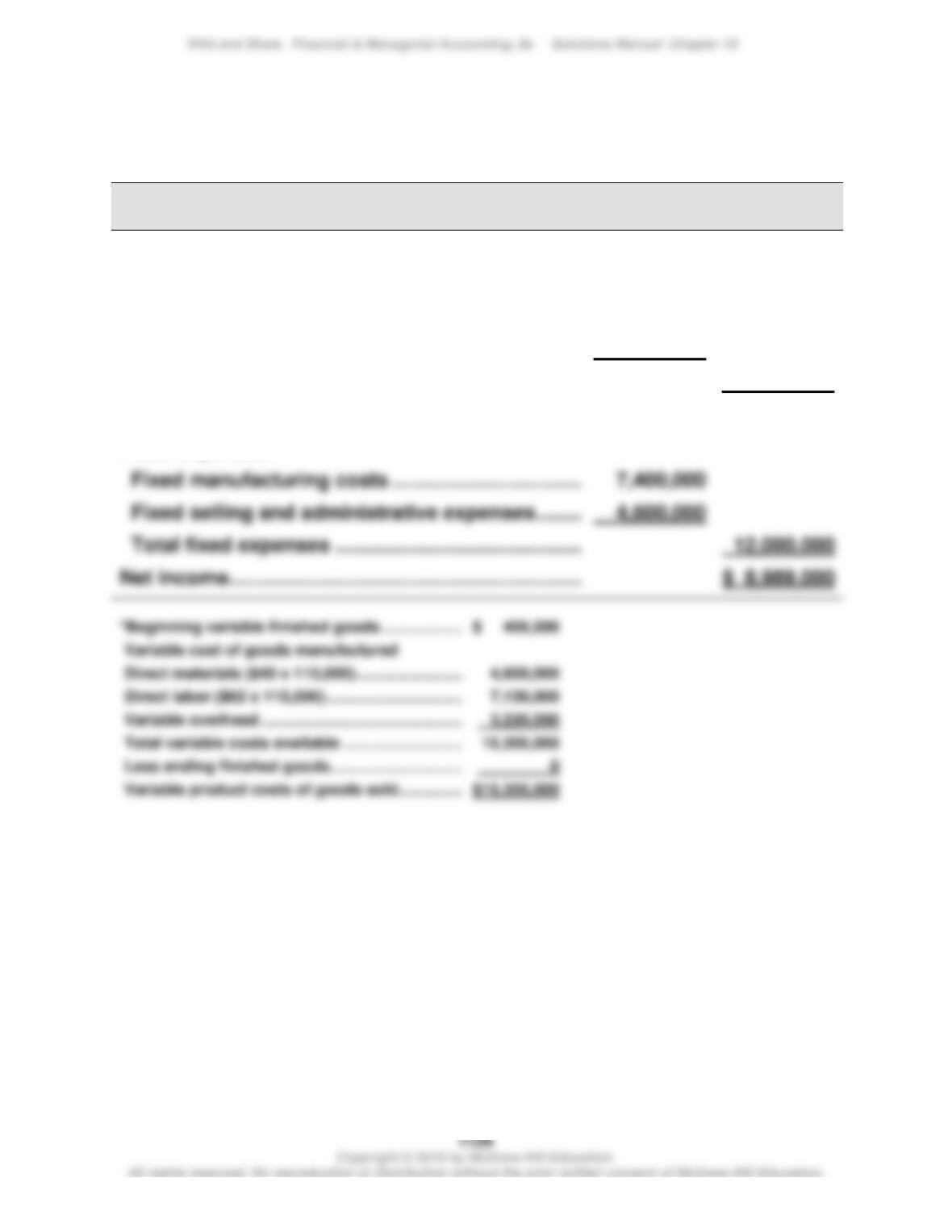
Fixed expenses
Fixed manufacturing costs …………………………………..
Fixed selling and administrative expenses ……………
4,600,000
Total fixed expenses ……………………………………………
12,000,000
2.
OAK MART COMPANY
Absorption Costing Income Statement
Sales (118,000 units x $320 per unit) ………………………
$37,760,000
Cost of goods sold
Beginning finished goods …………………………………….
$ 645,000
Cost of goods manufactured * …………………………..
22,350,000
Goods available for sale ………………………………………
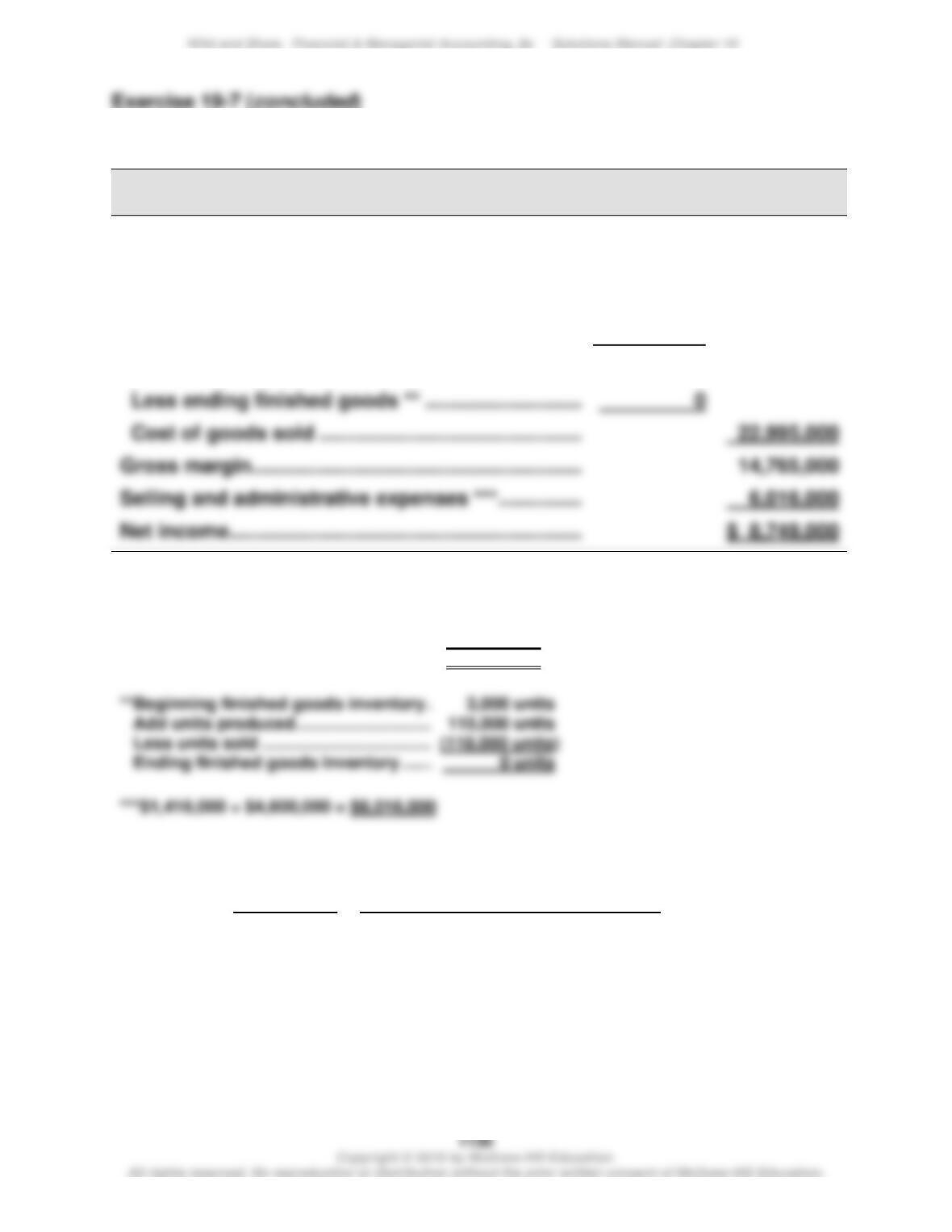
22,995,000
Less ending finished goods ** …………………………..
Cost of goods sold ………………………………………………
22,995,000
Gross margin ……………………………………………………….
14,765,000
6,016,000
* Direct materials ($40 x 115,000) ………
$ 4,600,000
Direct labor ($62 x 115,000)…………….
7,130,000
Variable overhead ………………………….
3,220,000
Fixed overhead ……………………………..
7,400,000
Total manufacturing costs ……………..
$22,350,000
Add units produced ……………………….
Less units sold ……………………………..
Ending finished goods inventory ……
3. The dollar difference in variable costing income and absorption costing
income = 3,000 units x $80,000 fixed overhead per unit. These costs
were in beginning inventory under absorption costing.
Exercise 19-8 (20 minutes)
1.
POLARIX
Income Statement—Consumer ATV Department (Contribution margin format)
For Year Ended December 31
Sales ………………………………………………………………………………
$646,000
Variable expenses
Cost of goods sold (170 ATVs* × $1,830 per ATV) ………….
$311,100
Selling expenses (170 ATVs × $270 per ATV) …………………
45,900
Administrative expenses (40% × $59,500) ……………………..
23,800
380,800
Contribution margin ……………………………………………………….
265,200
Fixed expenses
Selling expenses [$135,000 – (170 ATVs × $270 per ATV)]
89,100
Administrative expenses (60% × $59,500) ……………………..
35,700
124,800
Net income ……………………………………………………………………..
$140,400
*$646,000 sales ÷ $3,800 sales price per unit = 170 ATVs.
2.
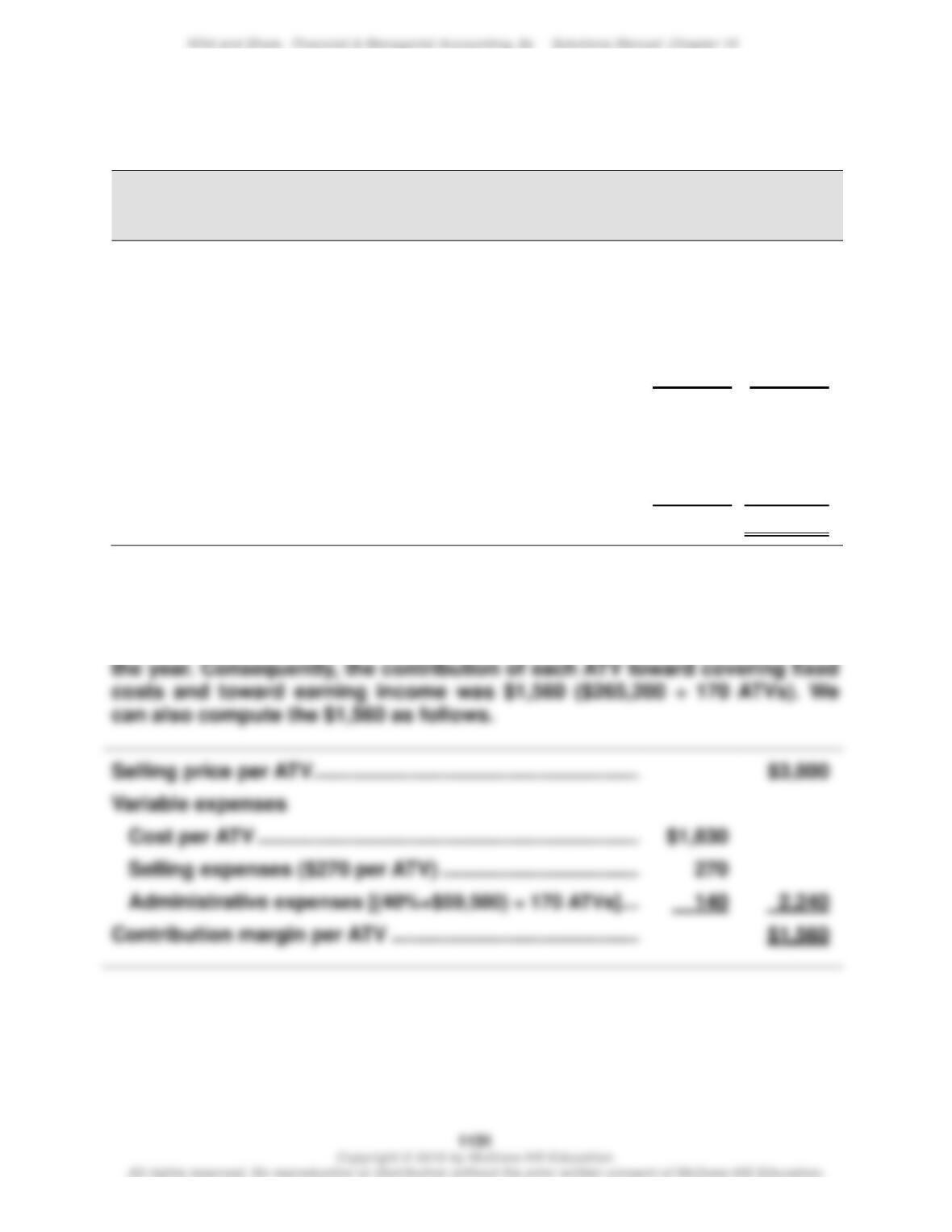
The company sold 170 ATVs and its contribution margin totals $265,200 for
Variable expenses
Cost per ATV ……………………………………………………………….
Selling expenses ($270 per ATV) …………………………………..