PROBLEM 19.2B
THE BITMORE COMPANY
a.
b.
60 Minutes, Strong
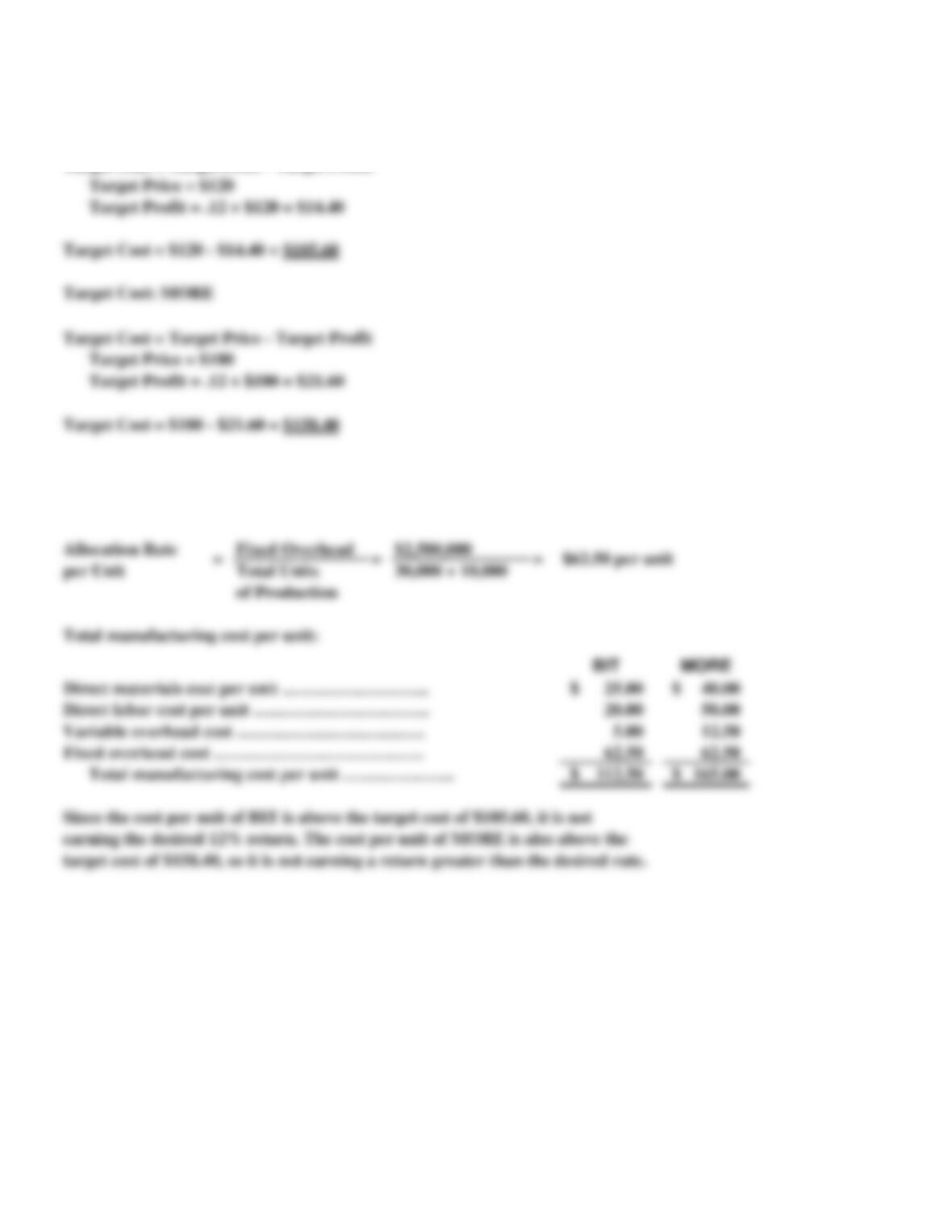
Target Cost: BIT
Target Cost = Target Price – Target Profit
Target Cost = $120 – $14.40 = $105.60
Target Cost = Target Price – Target Profit
If fixed overhead is allocated based on units of production, the fixed overhead cost per unit is
equal to $62.50 calculated as follows:
Total manufacturing cost per unit:
PROBLEM 19.2B
THE BITMORE COMPANY (continued)
c.
BIT MORE
Fixed overhead cost ………………………………………………………..
Variable overhead cost …………………………………………………….
25.00$ 40.00$
20.00 50.00
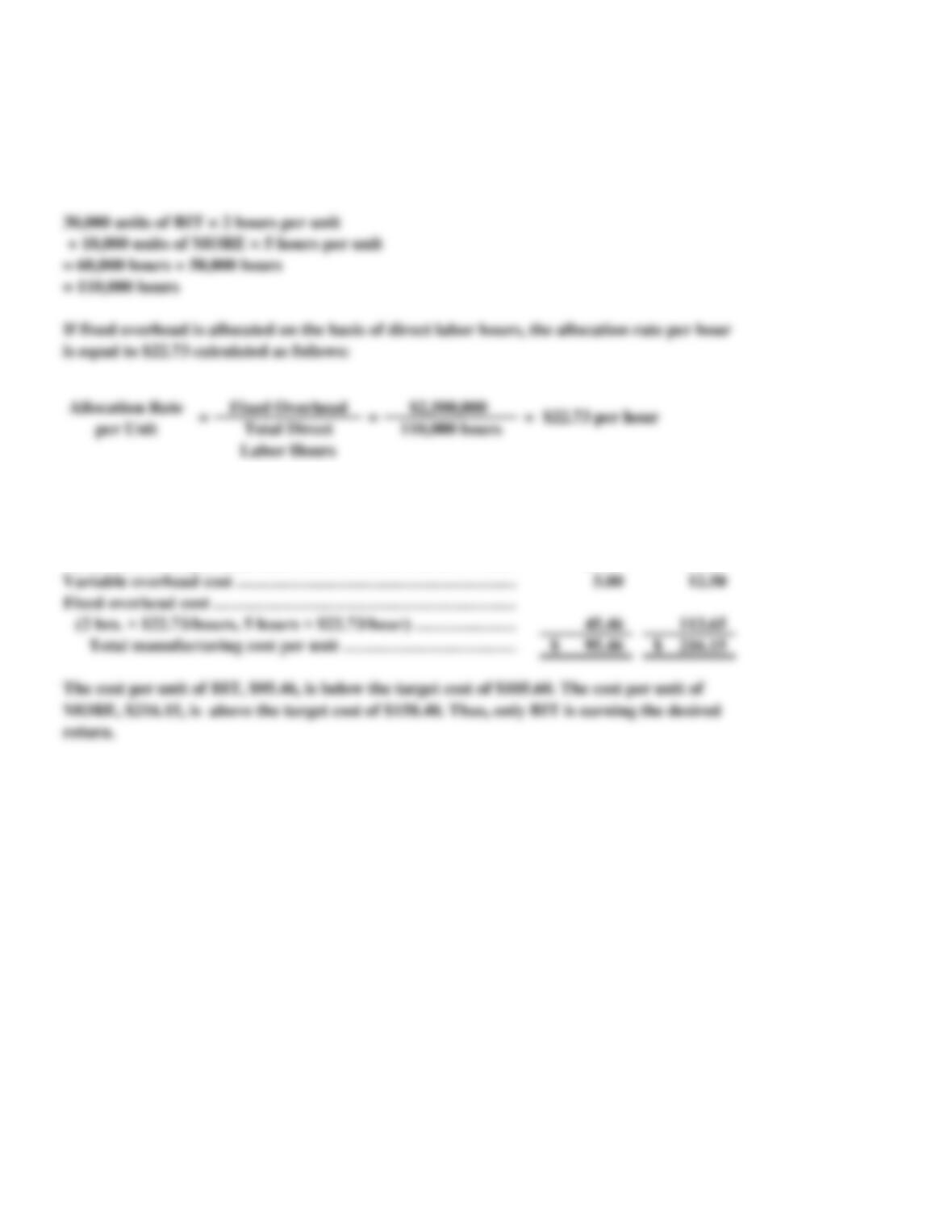
Given that it takes 2 hours ($20 total labor cost per unit/$10 per hr. wage rate) to produce
each unit of BIT and 5 hours ($50 total labor cost per unit/$10 per hr. wage rate) to
produce each unit of MORE, the total expected labor hours needed for the year are:
Total manufacturing cost per unit:
Direct labor cost per unit …………………………………………………….
Direct materials cost per unit ……………………………………………..
30,000 units of BIT × 2 hours per unit
+ 10,000 units of MORE × 5 hours per unit
= 110,000 hours
= 60,000 hours + 50,000 hours
PROBLEM 19.2B
THE BITMORE COMPANY (continued)
d.
BIT MORE
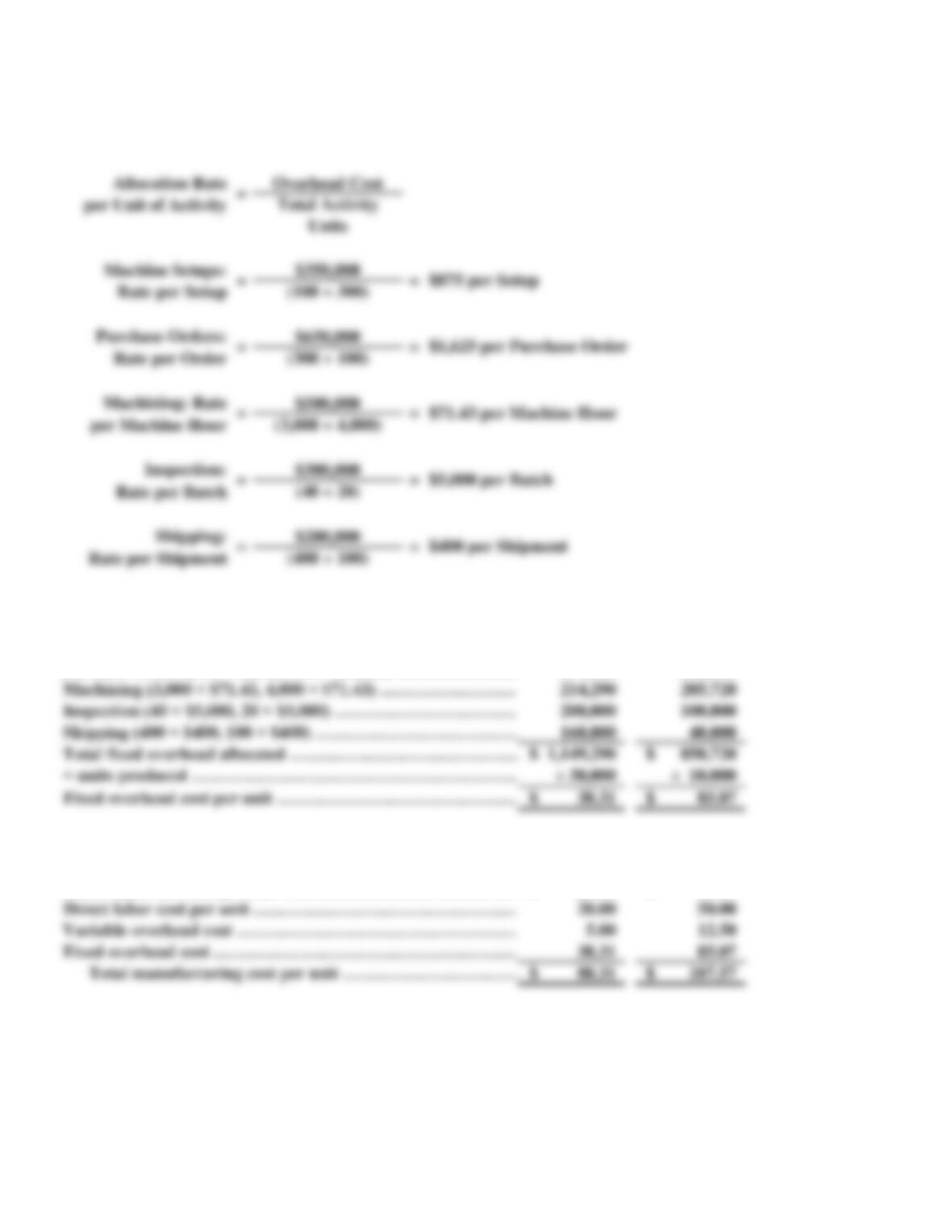
Total fixed overhead allocated …………………………………………….
Shipping (400 × $400, 100 × $400) ………………………………………….
Inspection (40 × $5,000, 20 × $5,000) ………………………………………
Machining (3,000 × $71.43, 4,000 × $71.43) ……………………………..
87,500$ 262,500$
487,500 162,500
BIT MORE
Direct labor cost per unit …………………………………………………
Variable overhead cost …………………………………………………….
25.00$ 40.00$
The allocation rates of each overhead activity are calculated as follows:
Direct materials cost per unit …………………………………………..
Total fixed overhead allocated per unit:
Setup costs (100 × $875, 300 × $875) ………………………………..
Purchase orders (300 × $1,625, 100 × $1,625) ………………………..
Total manufacturing cost per unit:
PROBLEM 19.2B
THE BITMORE COMPANY (continued)
f.
BIT MORE
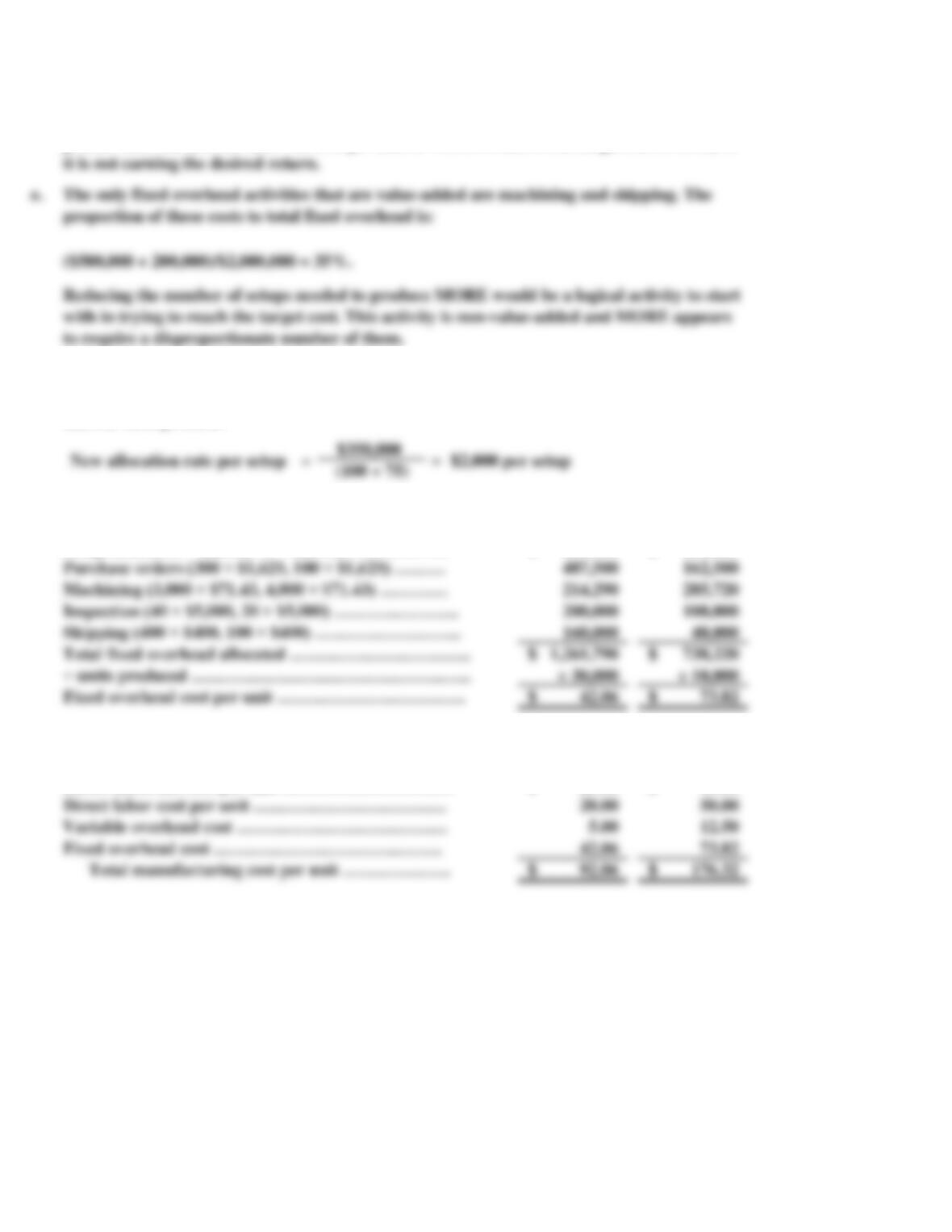
Purchase orders (300 × $1,625, 100 × $1,625) ………
Machining (3,000 × $71.43, 4,000 × $71.43) …………
Inspection (40 × $5,000, 20 × $5,000) ………………….
Shipping (400 × $400, 100 × $400) ……………………..
Total fixed overhead allocated …………………………..
÷ units produced ………………………………………….
200,000$ 150,000$
BIT MORE
Direct labor cost per unit …………………………….
Variable overhead cost ……………………………….
Fixed overhead cost ………………………………….
25.00$ 40.00$
Setup costs (100 × $2,000, 75 × $2,000) ………………
Total fixed overhead allocated per unit:
Since the cost per unit of BIT is below the target cost of $105.60, it is earning a return
greater than the desired rate. The cost per unit of MORE is above the target cost of $180, so
Reducing the number of setups required for one product while not reducing the related
overhead cost will change the allocation rate per setup and the total manufacturing cost per
unit for each product.
Total manufacturing cost per unit:
Direct materials cost per unit …………………………
($500,000 + 200,000)/$2,000,000 = 35%.
PROBLEM 19.2B
THE BITMORE COMPANY (concluded)
g.
BIT MORE
Total fixed overhead allocated …………………………………………..
Machining (3,000 × $71.43, 4,000 × $71.43) ……………………………..
Inspection (40 × $5,000, 20 × $5,000) ………………………………….
Shipping (400 × $400, 100 × $400) ……………………………………….
÷ units produced …………………………………………………………..
72,500$ 203,000$
487,500 162,500
BIT MORE
Direct labor cost per unit ………………………………………………….
Variable overhead cost ……………………………………………………….
Fixed overhead cost ………………………………………………………..
25.00$ 40.00$
With the new machine, the allocation rate per setup is calculated as follows:
Total fixed overhead allocated per unit:
Total manufacturing cost per unit:
Since the cost per unit of BIT is still below the target cost of $105.60, it is earning a return
more than the desired rate. The cost per unit of MORE is still above the target cost of
$158.40, so it is earning lower than the desired return.
Setup costs (50 × $1,450, 140 × $1,450) …………………………………
Purchase orders (300 × $1,625, 100 × $1,625) …………………………
Direct materials cost per unit ……………………………………………
30 Minutes, Medium PROBLEM 19.3B
ORO MINING
a.
b. Site A Site Z
c.
Target Cost = Target Price – Target Profit
If the conveyor is purchased, the total fixed costs associated with Site Z will increase by
Total cost per ton:
PROBLEM 19.4B
NAZU, INC.
a.
Year 1 Year 2
Prevention costs:
Product design 4,000$ 16,000$
Appraisal costs:
Raw materials inspections 5,200$ 2,000$
Final inspections 12,000 8,000
Total appraisal costs 17,200$ 10,000$
Internal failure costs:
Scrap 3,000$ 1,000$
Rework 3,000 2,800
Equipment breakdown repair 9,000 6,000
External failure costs:
Warranty expense 25,000$ 23,000$
Product liability claims 6,200 7,000
Defect returns 6,400 5,000
Lost sales 12,000 12,000
b.
d.
40 Minutes, Medium
Lost sales due to quality problems are often the result of a poor reputation. It may take
Quality Cost Report
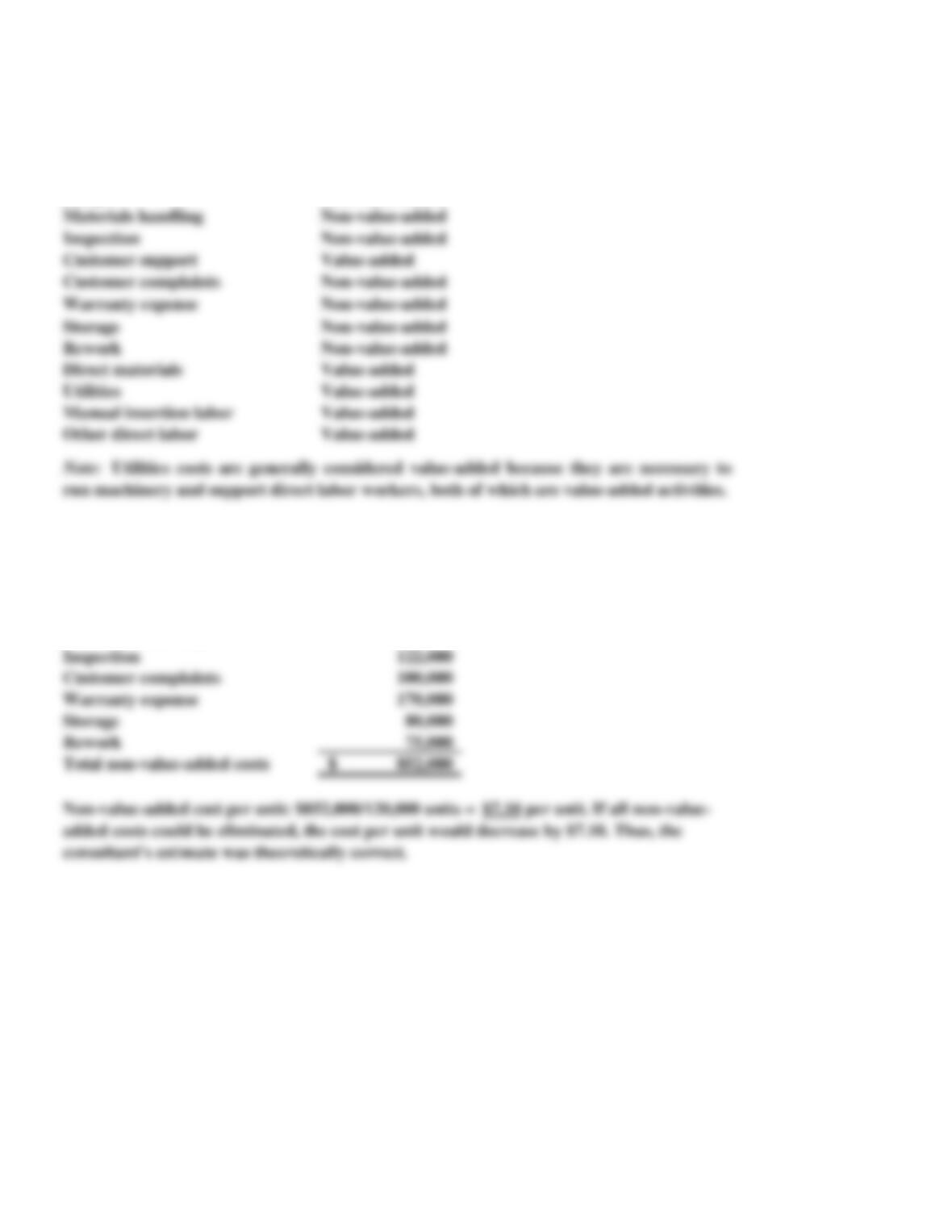
Prevention costs increased by $23,800 from Year 1 to Year 2 but external failure costs only
while maintenance costs only increased by $800.
Process reengineering 7,000 15,000
Supplier certification 600 2,000
Preventive maintenance 1,200 2,000
Employee quality training 1,400 3,000
SOLUTIONS TO CRITICAL THINKING CASES
CASE 19.1
MAYS ELECTRONICS
a. Activity Classification
Setups Non-value-added
b.
Activity Cost
Setups 125,000$
Materials handling 180,000
Inspection 122,000
Customer complaints 100,000
Warranty expense 170,000
Storage 80,000
Rework 75,000
50 Minutes, Medium
Cost of non-value-added activities:
Customer support Value-added
Direct materials Value-added
Manual insertion labor Value-added
Other direct labor Value-added
CASE 19.1
MAYS ELECTRONICS (concluded)
c.
d.
e.
Total net cost reduction:
Automated insertion 100,000$ (from part d)
Factory redesign 90,000 ($100,000 + $10,000 – $20,000)
Net cost reduction
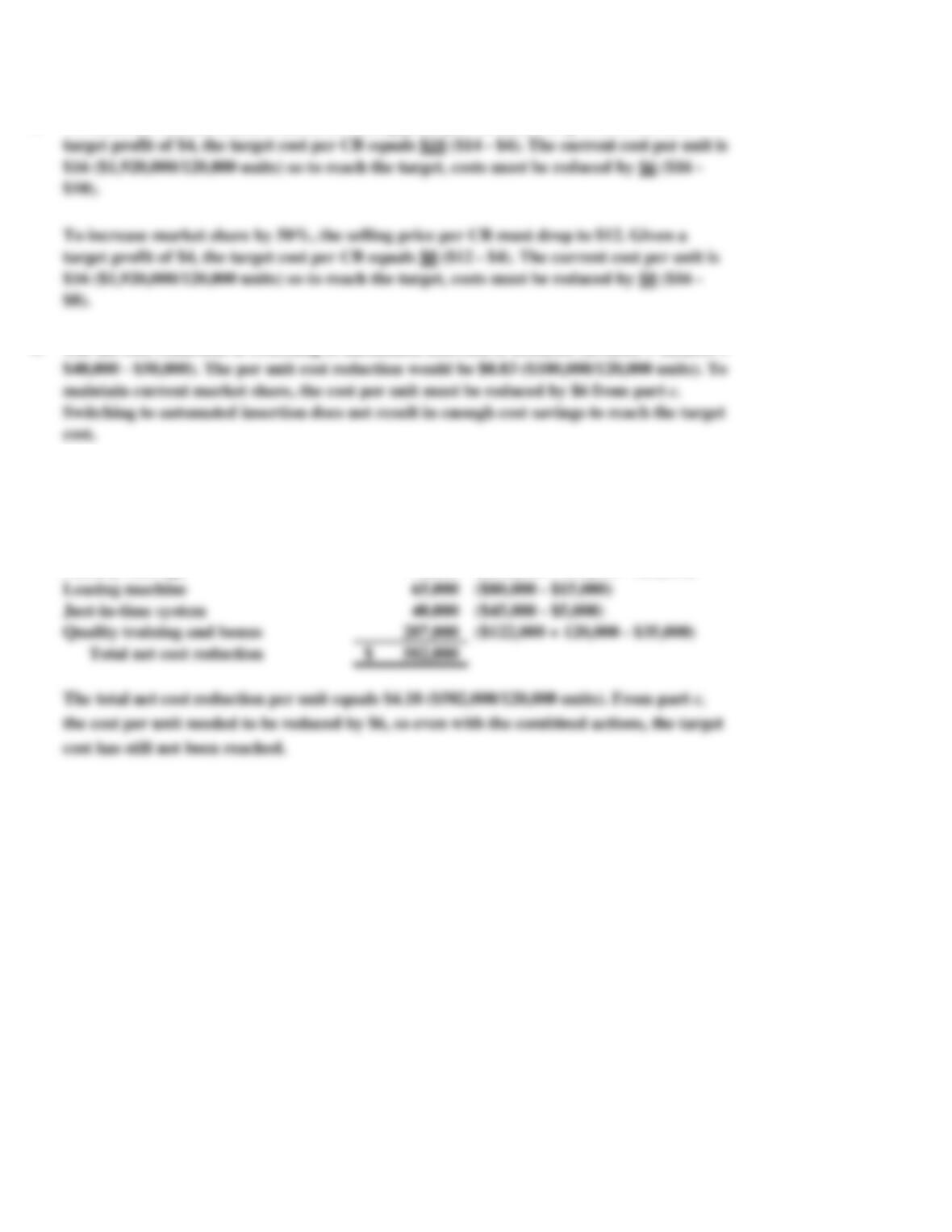
To maintain current market share, the selling price per CB must drop to $14. Given a
The net cost reduction of switching to automated insertion is $100,000 ($90,000 + $20,000 +
Leasing machine 65,000 ($80,000 – $15,000)
Just-in-time system 40,000 ($45,000 – $5,000)
Quality training and bonus 207,000 ($122,000 + 120,000 – $35,000)
CASE 19.2
HEALTHY TIMES FROZEN DINNERS
a.
b.
—
c.
40 Minutes, Strong
Description of a JIT system for Healthy Times:
The company operates from a single location—what is now the factory. Production and
receipt of direct materials are scheduled for each day of the week one week in advance. Each
A JIT manufacturing system is a “demand pull” system, in which materials are acquired
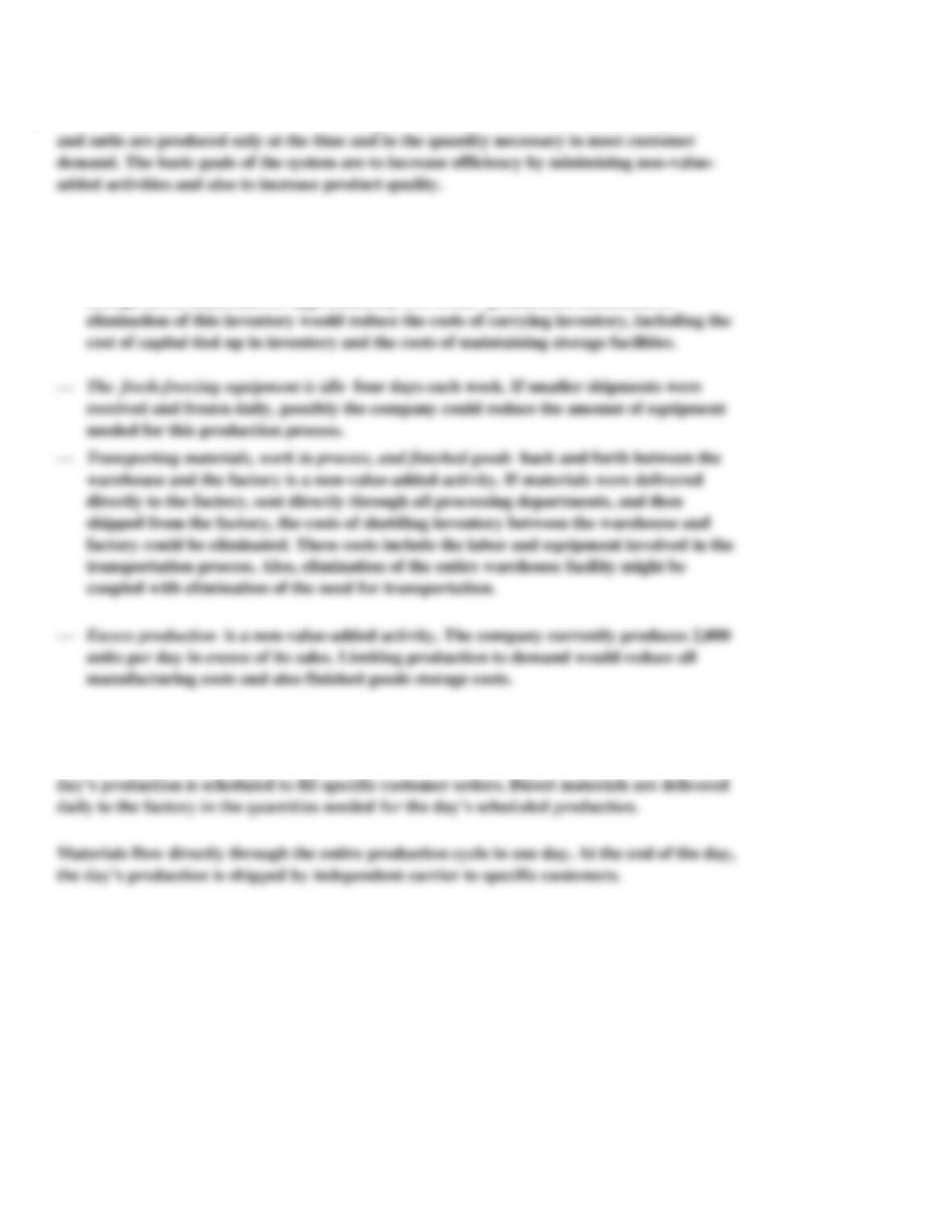
Non-value-added activities in Healthy Time’s operations and costs that might be eliminated:
Materials storage is a non-value-added activity. The company stores in its warehouse
enough direct materials for approximately two weeks’ production. Reduction or
CASE 19.2
HEALTHY TIMES FROZEN DINNERS (concluded)
d.
A JIT system should work at Healthy Times. Customer orders are received at least a week
in advance of delivery dates, which facilitates scheduling. Materials are available in
abundance from local suppliers. Therefore, it should be possible to arrange for reliable daily
deliveries of materials. Apparently all processing, including freezing and cutting, can be
MANUFACTURING ENGINEERING, INC.
INTERNET
a.
Quick Change: This includes training, implementation, operation, and sustainment.
b.
c.
Given that many of the innovations target existing products or processes, target costing and
The web site has a long list of different innovations. However, the majority of these
innovations result in changes in existing production processes or in characteristics of
existing products as illustrated by the categories below. Thus, the innovations are usually
targeted at the manufacturing phase of the value chain.
Benefits vary, but frequently involve increased productivity and reduce wait time and
30 Minutes, Medium CASE 19.3
CASE 19.4
SARBANES-OXLEY AND NON-VALUE-ADDED
ACTIVITIES ETHICS, FRAUD
& CORPORATE GOVERNANCE
a.
The costs of the Sarbanes-Oxley Act have been estimated to be enormous. Those costs
include the costs of documenting and auditing firm-wide internal control systems
processes and procedures. Besides the benefit of helping firms clarify their processes
and, as a result, identify non-value-added activities, the provisions of the Sarbanes-
25 Minutes, Medium