19-1
CHAPTER 19
VARIABLE COSTING AND ANALYSIS
Related Assignment Materials
Student Learning Objectives
Discussion
Questions
Quick Studies*
Exercises*
Problems*
AA and
BTN
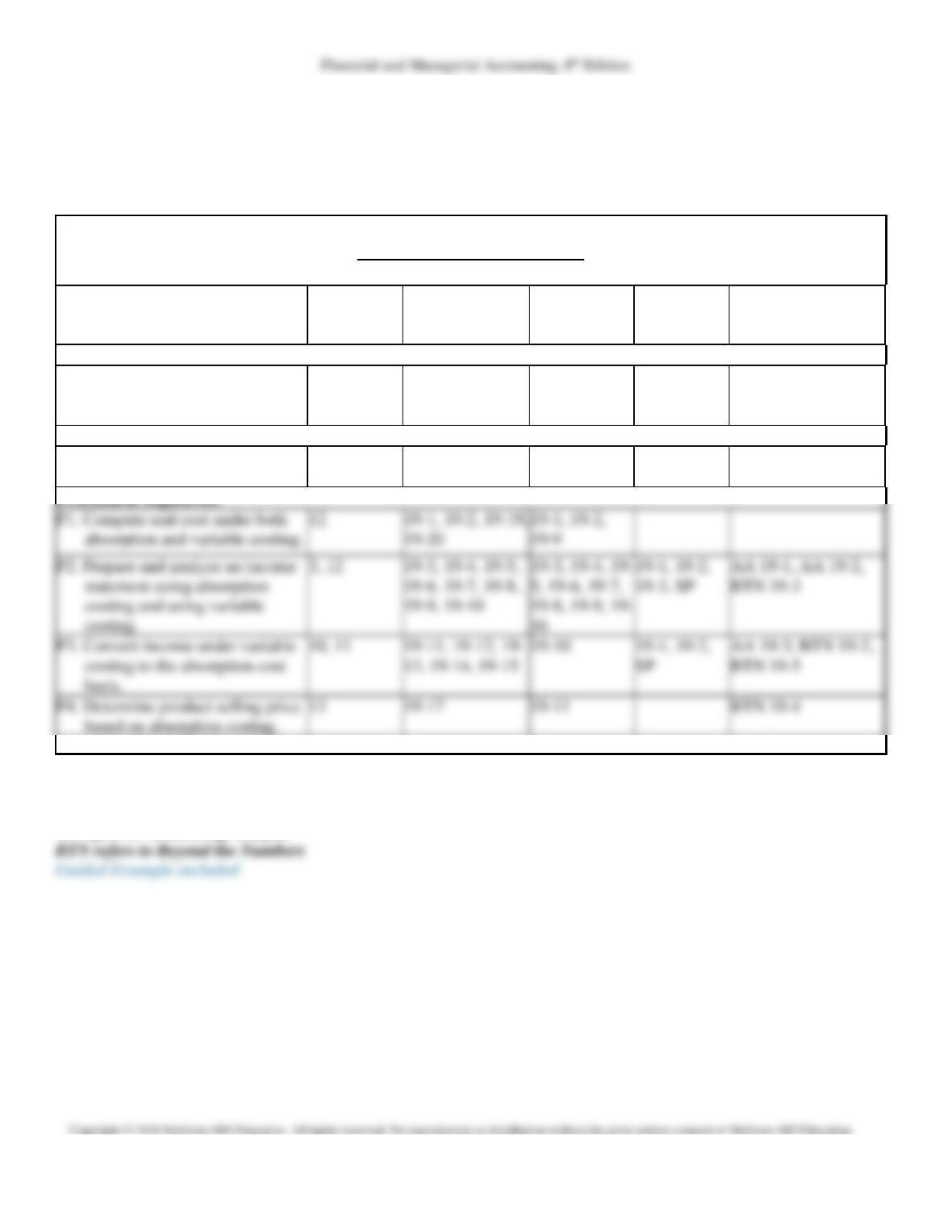
Conceptual objectives:
C1. Describe how absorption
costing can result in
overproduction.
2, 3, 4, 5, 8
19-16
19-12
19-3
BTN 19-1
Analytical objectives:
A1. Use variable costing in pricing
special orders.
1, 4, 6, 7, 9,
14
19-18
19-13, 19-14,
19-15
BTN 19-6
Procedural objectives:
costing and using variable
costing.
19-9, 19-10
19-8, 19-9, 19-
16
costing to the absorption cost
basis.
13, 19-14, 19-15
BTN 19-5
P4. Determine product selling price
based on absorption costing.
13
19-17
19-11
BTN 19-4
*See additional information on next page that pertains to these quick studies, exercises and problems.
SP refers to the Serial Problem
AA refers to Accounting Analysis
Additional Information on Related Assignment Material
See Chapter 1 of the Instructor’s Resource Manual for more information on materials for this text available in
Connect.
Connect
Available on the instructor’s course-specific website, Connect:
• All numerical Quick Studies, all Exercises and Problems Set A.
o Connect also provides algorithmic versions for Quick Study, Exercises, and Problems.
Hints/Guided Examples
Please note that the Guided Examples are labeled as “Hints” in Connect assignments. The animated PowerPoints without
the video and audio functions for the Guided Examples are also available in the Connect Instructor Library and Exercise
Presentations. These are indicated in the Related Assignment Materials grid on page 1 in blue bold font.
Need-to-Know Videos
LO
Need–to-Know
Title
Time
Concept Overview Videos
LO
Title
Time
C1
A1
Financial and Managerial Accounting, 8th Edition
19-3
P3
P4
Synopsis of Chapter Revision
NEW opener—Riffraff and entrepreneurial assignment.
Revised discussion of variable and absorption costing.
Revised discussion of income implications of variable and absorption costing.
New graphics on relations between production, sales, and income effects.
Added T-accounts to exhibits of absorption and variable costing income.
Revised discussion and exhibits of product cost assignments to financial statements.
New graphic on relation between changes in inventory and income effect.
Chapter Outline
I. Introducing Variable Costing and Absorption Costing—absorption costing, or full costing, products
include direct materials, direct labor, and both variable and fixed overhead. This method is required for
external financial reporting under GAAP, but can result in misleading product cost information and poor
managerial decisions. Under variable costing, only direct materials, direct labor, and variable overhead
costs are included in product costs. Useful for managerial decisions but cannot be used for external
financial reporting.
A. Both methods include direct materials, direct labor and variable overhead in product costs.
B. Key difference is in treatment of fixed overhead.
C. Fixed overhead is included in product costs under absorption costs and included in period expenses
under variable costing.
D. Computing Unit Product Cost
II. Income Reporting Implications
A. Units Produced Equal Units Sold
1. The income statement under variable costing is a contribution margin income statement.
Contribution margin is the excess of sales over variable costs.
2. Contribution Margin Report is a performance report that excludes fixed expenses and net
income and focuses on revenue minus variable costs.
3. When units produced equals units sold, there is no difference in total expenses reported on the
income statement, but there is a difference in what categories receive these costs.
B. Units Produced Exceed Units Sold
C. Units Produced are Less Than Units Sold
1. Beginning inventory under absorption costing is higher than under variable costing.
2. When the beginning inventory is sold, the difference in inventory is included in cost of goods
sold under absorption costing.
3. Income under absorption costing is less than income under variable costing.
D. Summarizing Income Reporting
4. We normally see differences in income for these two methods extending over several years.
E. Converting Income Under Variable Costing to Absorption Costing
III. Comparing Variable Costing and Absorption Costing
A. Planning Production
1. Many companies link manager bonuses to income computed under absorption costing since this
is how income is reported to shareholders per GAAP, which can lead such managers to produce
excess inventory.
2. Inventory build-up leads to increased costs in storage, financing, and obsolescence. If excess
inventory is never sold, it will be disposed of at a loss.
3. Managers cannot increase income under variable costing by merely increasing production
without increasing sales.
B. Setting Prices
1. Cost information is a crucial factor in setting prices.
2. Over the long run, the selling price must be high enough to cover all costs and still provide an
acceptable return to shareholders.
3. We use a 3-step process to determine product selling prices:
a. Determine the product cost per unit using absorption costing.
b. Determine the target markup on product cost per unit.
c. Add the target markup to the product cost to find the target selling price.
C. Controlling Costs
1. An effective management control practice is to hold managers responsible only for their
controllable costs.
2. Uncontrollable costs are not within the manager’s influence.
3. Variable production costs and fixed production costs are controlled at different levels of
management.
4. Variable production costs, like direct materials and direct labor, are controllable by the
production supervisor.
contribution format, the data for CVP analysis are available. If the income statement is prepared
under absorption costing, the data needed for CVP analysis are not readily available.
E. Variable Costing for Service Firms—variable costing also applies to service companies. Service
companies do not have inventory but a focus on variable costs is still useful for managerial decisions.
V. Decision Analysis—Pricing Special Orders
A. Over the long run, prices must cover all fixed and variable costs.
B. Over the short run, fixed production costs do not change in production levels.
19-7
Chapter 19 Alternative Demo Problem
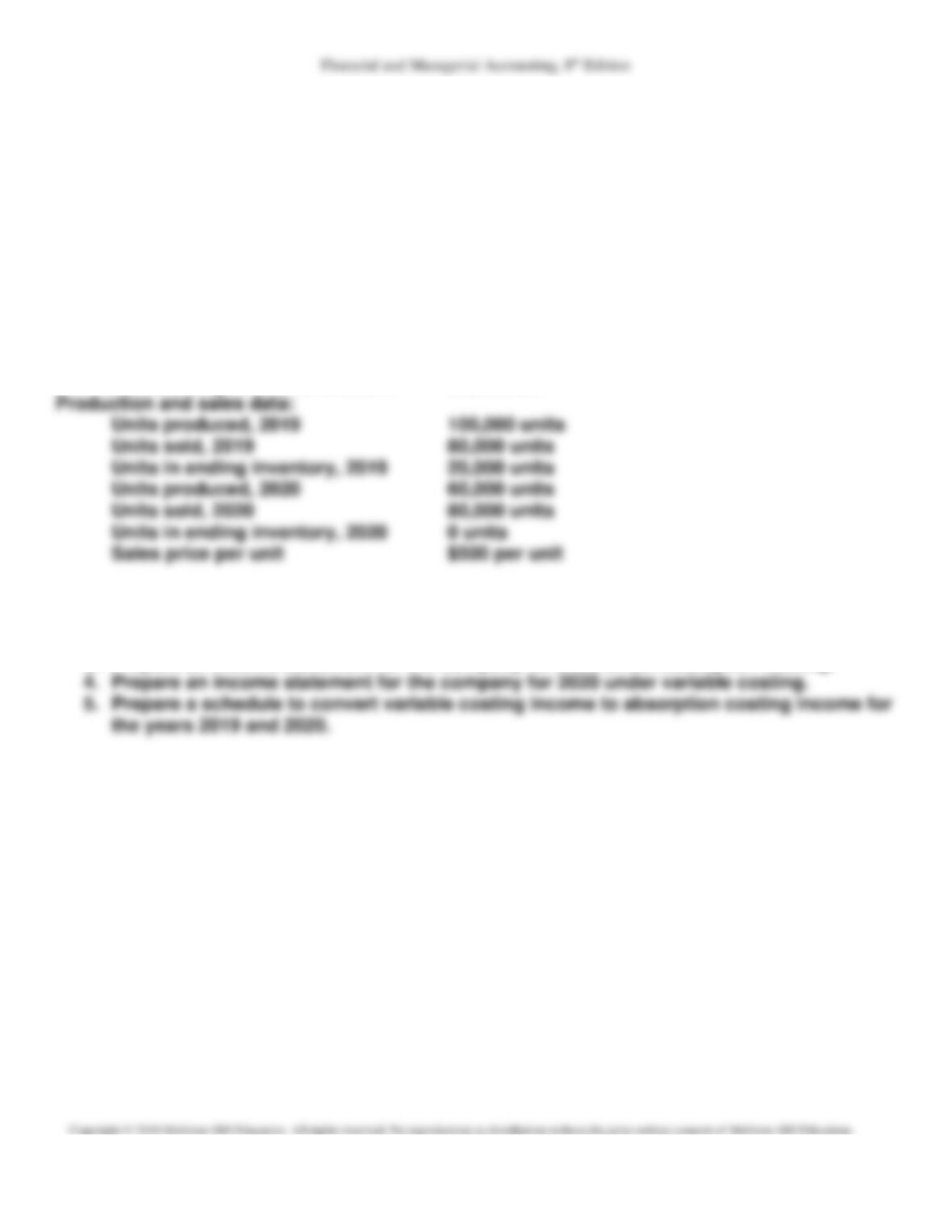
Major Company began operations on January 1, 2019. Cost and sales information for its first
two calendar years are summarized below:
Manufacturing costs:
Direct materials $50 per unit
Direct labor $25 per unit
Factory overhead costs for the year:
Variable overhead $10 per unit
Fixed overhead $1,000,000
Nonmanufacturing costs:
Variable selling and administrative $10 per unit
Fixed selling and administrative $5,000,000
Required:
1. Prepare an income statement for the company for 2019 under absorption costing.
2. Prepare an income statement for the company for 2019 under variable costing.
3. Prepare an income statement for the company for 2020 under absorption costing.
19-8
Chapter 19 Solution: Alternative Demo Problem
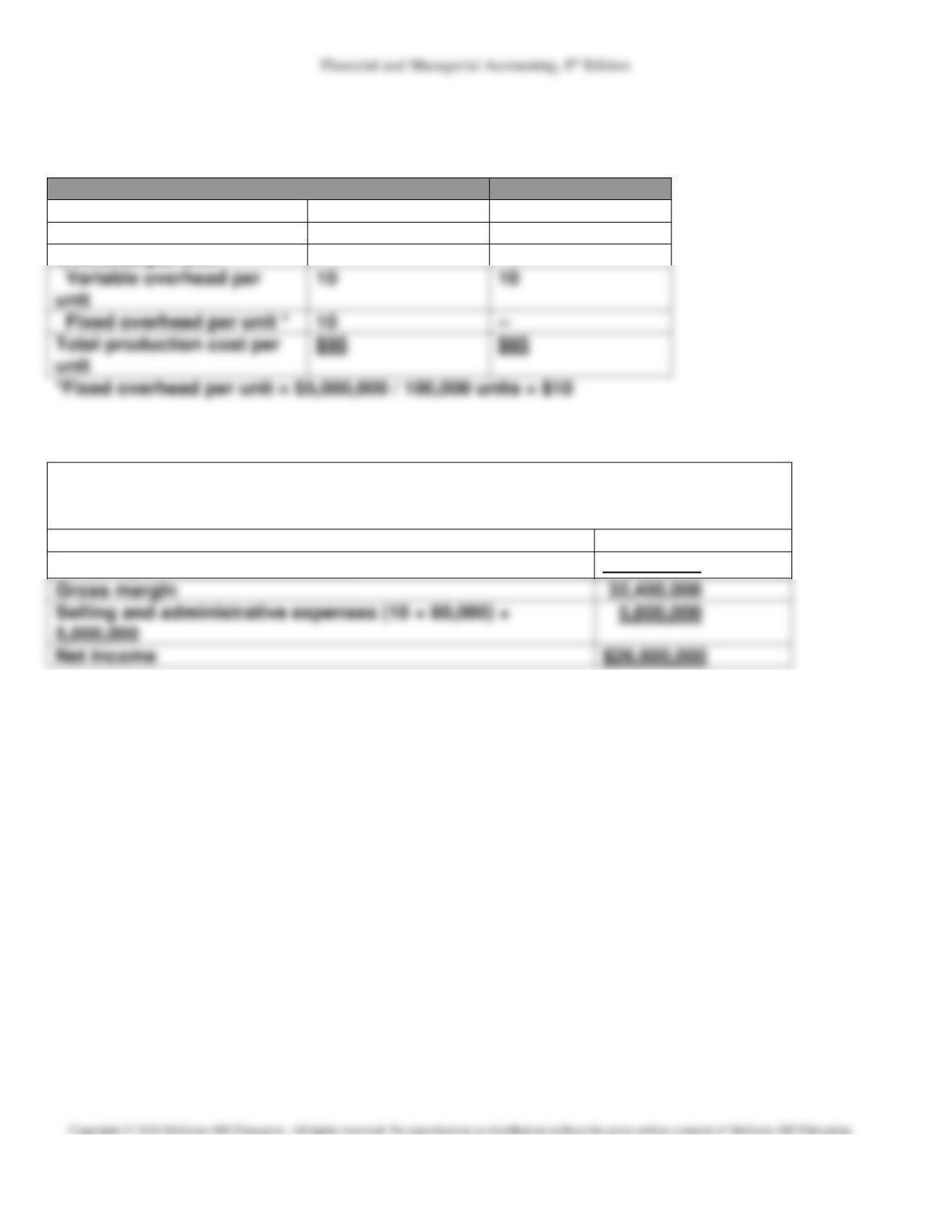
Compute unit costs for 2019 under the two costing methods as follows:
Absorption Costing
Variable Costing
Direct materials per unit
$50
$50
Direct labor per unit
25
25
Overhead per unit
unit
10
unit
1. Absorption costing income statement for 2019:
Major Corporation
Income Statement
For Year Ended December 31, 2019
Sales (80,000 × $500)
$40,000,000
Cost of goods sold (80,000 × $95)
7,600,000
Gross margin
32,400,000
5,000,000
Net income
$26,600,000
19-9
Chapter 19 Solution: Alternative Demo Problem Continued
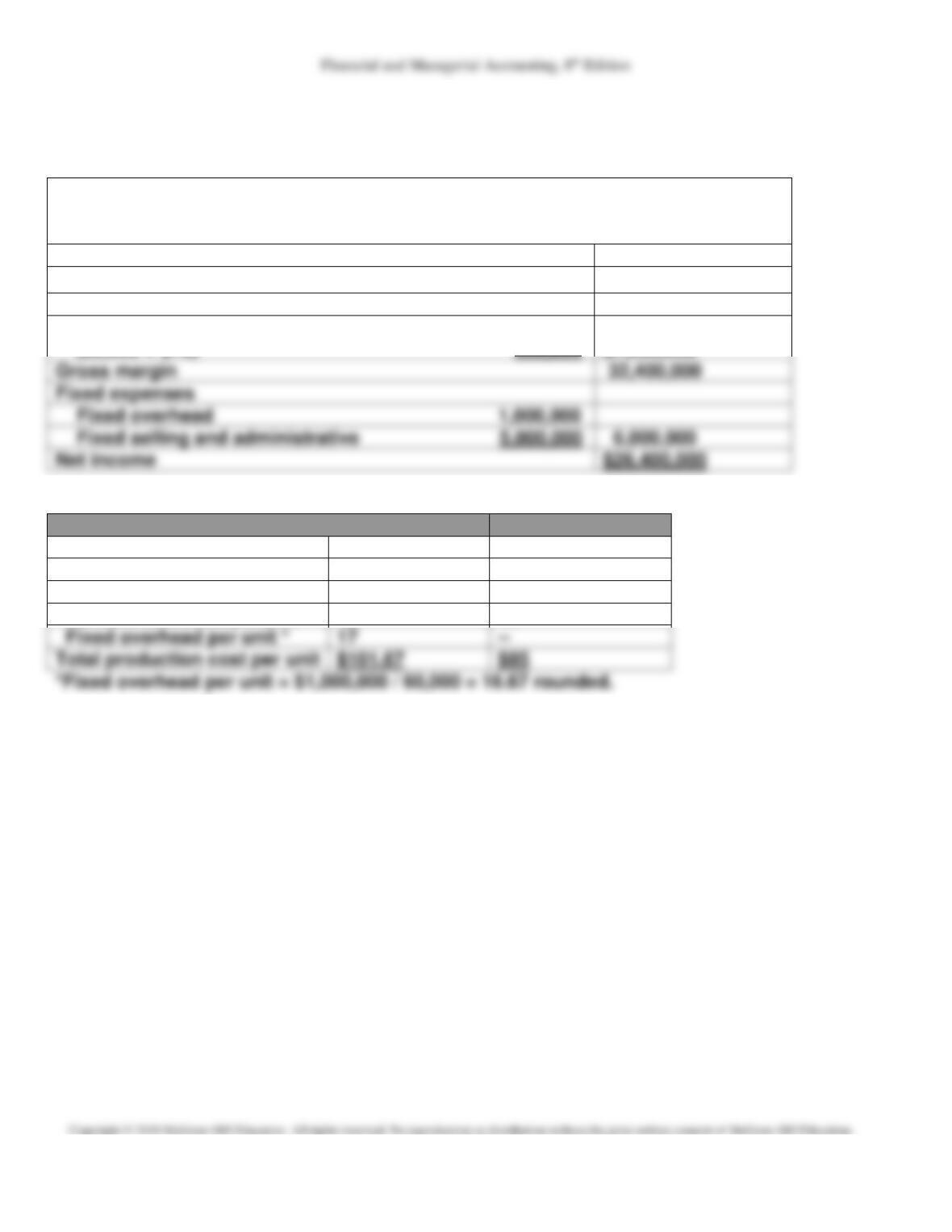
2. Variable costing income statement for 2019:
Major Corporation
Income Statement (Contribution Format)
For Year Ended December 31, 2019
Sales (80,000 × $500)
$40,000,000
Variable expenses
Variable production costs (80,000 × $85) $6,800,000
Variable selling and administrative costs
(80,000 × $10) 800,000
Gross margin
32,400,000
Fixed expenses
Fixed overhead 1,000,000
Fixed selling and administrative 5,000,000
6,000,000
Net income
$26,400,000
Compute unit costs for 2020 under the two costing methods as follows:
Absorption Costing
Variable Costing
Direct materials per unit
$50
$50
Direct labor per unit
25
25
Overhead per unit
Variable overhead per unit
10
10
Fixed overhead per unit *
17
Total production cost per unit
$101.67
$85
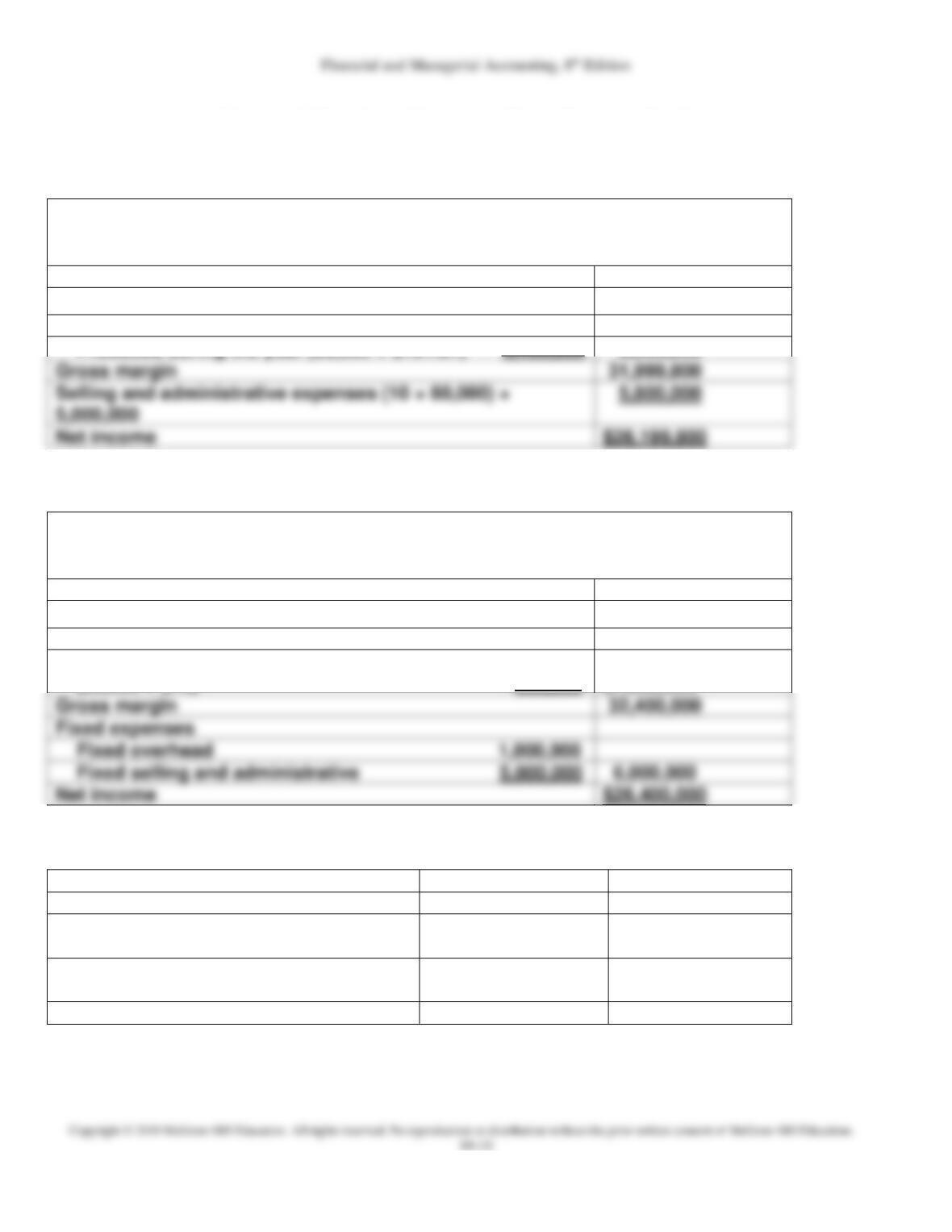
3. Absorption costing income statement for 2020:
Major Corporation
Income Statement
For Year Ended December 31, 2020
Sales (80,000 × $500)
$40,000,000
Cost of goods sold
From beginning inventory (20,000 × $95) $1,900,000
Produced during the year (60,000 × $101.67) 6,100,200
8,000,200
Gross margin
31,999,800
Selling and administrative expenses (10 × 80,000) +
5,000,000
5,800,000
Net income
4. Variable costing income statement for 2020:
Major Corporation
Income Statement (Contribution Format)
For Year Ended December 31, 2020
Sales (80,000 × $500)
$40,000,000
Variable expenses
Variable production costs (80,000 × $85) $6,800,000
Variable selling and administrative costs
(80,000 × $10) 800,000
Gross margin
32,400,000
Fixed expenses
Fixed overhead 1,000,000
Fixed selling and administrative 5,000,000
6,000,000
Net income
$26,400,000
5. Conversion of variable costing income to absorption costing income:
2019
2020
Variable costing income
$26,400,000
$26,400,000
Add: Fixed overhead cost deferred in
ending inventory (20,000 × $10)
200,000
0
Less: Fixed overhead cost recognized
from beginning inventory (20,000 × $10)
0
(200,000)
Absorption costing income
$26,600,000
$26,200,000