Chapter 19
Corporations: Stock Values, Dividends, Treasury Stocks, and
Retained Earnings
Chapter Overview
This chapter continues the discussion of owners’ equity, started in chapter 18, by discussing stock values.
Stock is valued in several ways including redemption value, market value, and book value per share. When
there is more than one type of class, the stockholders’ equity must be allocated for each class of stock before
calculating book value. The chapter continues to discuss dividends. There are three important dates involved
in dividend issuance, the date of declaration, the date of record, and the date of payment. The date of
Learning Objectives
After studying Chapter 19, your students should gain proficiency in the following:
2. Calculate and Journalize Dividends.
4. Explain Appropriation of Retained Earnings and Statement of Retained Earnings.
Chapter 19 Assignment Grid
Estimated Level
Learning Time in of
Assignment Topic(s) Objective(s) Minutes Difficulty
10 Paid-In Capital from Treasury Stock 3 5 Easy
11 Appropriation of Retained Earnings 4 5 Easy
12 Restrictions on Retained Earnings 4 5 Easy
13 Statement of Retained Earnings 4 5 Easy
14 Ethical Case 2 5 Easy
19A-4 Stock and Treasury Stock Journal Entries 3 20 Medium
19A-5 Statement of Retained Earnings 4 20 Easy
Exercises (Set B)
19B-1 Book Value for Preferred and Common 1 20 Easy
19B-2 Dividend Journal Entries 2 20 Easy
19B-1 Book Value of Stock 1 30 Medium
19B-2 Stock Dividend Entries 2 30 Medium
19B-3 Stock Entries and Retained Earnings
Statement 2, 3, 4 50 Hard
Learning Unit 19-1: Redemption, Market, and Book Value
Summary: When a corporation issues preferred stock, it often reserves the right to retire or redeem that
stock for a specific price. At the time the stock is issued, this price per share, called redemption value, is
determined, and people buy the stock knowing that the corporation can redeem it at this price. The price at
which shares of capital stock are bought and sold in the open market is called the market value. Economic
conditions, a company’s earnings, and investors’ expectations all play a factor in determining the market
price.
Book value per share is, in general, the total of stockholders’ equity (assets minus liabilities) divided by the
number of shares issued. When a corporation has only common stock, book value is calculated using the
following equation:
Book Value per Share = Total Stockholders’ Equity/Total Shares Outstanding
When a company has two classes of stock, before book value can be calculated, the stockholders’ equity
must be allocated (divided up) for each class of stock. First, for preferred stock, a corporation assigns the
redemption value (or par value if the stock has no redemption value) of the stock along with any dividends in
Key Concepts: Redemption value, market value, book value per share.
Lecture Outline:
1. Redemption value is the price per share a corporation pays to redeem or retire capital stock.
3. Market value is the price a buyer pays to purchase shares of capital stock in the open market. The market
4. Book value per share is the total of stockholders’ equity divided by the number of shares issued. It does
not represent what an owner might receive if the assets of a company were liquidated.
Book value is used for several reasons:
a. Banks may specify a company maintain a specific one in order to approve a loan.
b. Book value may be a factor in setting an exchange ratio of stock during a merger.
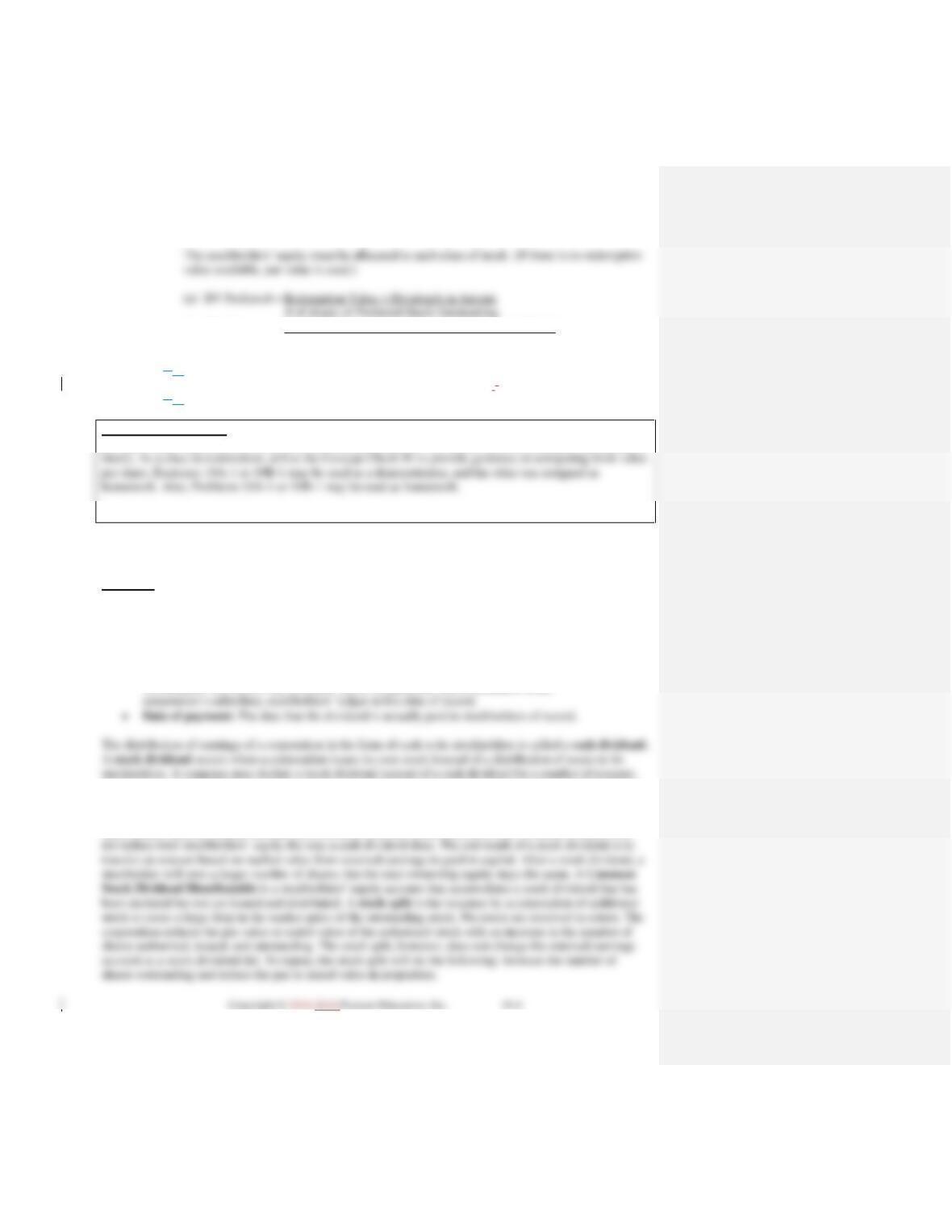
(b) BV Common = Stockholders’ Equity – Amount Assigned to Preferred
# of shares of Common Stock Outstanding
g.f. When preferred stock is redeemed, the paid-in capital in excess of par is not returned and
thus is not included as part of the preferred equity in the book –value calculation.
h.g. Stockholders’ Equity section of the balance sheet – See Figure 19.2
Teaching Tips/Strategy: Explain to students the concept of book value per share. Differentiate book value
per share based upon only one class of stock (common stock) or two classes of stock (common and preferred
Use the “Ten-Minute Quiz” question #1 to reinforce the learning concepts.
Learning Unit 19-2: Calculating and Journalizing Dividends
Summary: Dividends, as we have seen, are the distribution of earnings of the corporation. It is important to
realize that only the board of directors of a corporation has the authority to determine whether a dividend is
to be paid, how much it will be, who receives it, and when and how it will be paid. Three important dates are
associated with the dividend process:
• Date of declaration: The day the board of directors announces its decision to pay a
dividend. This date creates a liability to the company called Dividend Payable.
• Date of record: The date established by the board of directors that determines which
stockholders will receive the dividend. These stockholders can be identified in the
(1) to satisfy stockholders’ expectations. Corporation does not have enough cash to pay a cash dividend and
offers the stock dividend instead; (2) to increase permanent capital in the business (because more stock is
issued): (3) to reduce the market value of the stock, because the price may be too high in the trading on the
open market; and (4) because income tax is avoided until the stock received is sold. A stock dividend will
Key Concepts: Dividend, date of declaration, dividend payable, date of record, date of payment, cash
dividend, stock dividend, common stock dividend distributable, stock split.
Lecture Outline:
Dividends are:
1. The distribution of a company’s earnings to its owners.
2. Only the board of directors of a corporation has the authority:
a. To determine whether a dividend is to be paid,
3. There are several dates important to the issuance of dividends.
a. Date of declaration:
(a) The date upon which the board of directors of a corporation formally declares a
dividend.
4. Stock dividends are dividends in stock instead of cash or other assets.
a. There are several reasons a company may declare a stock dividend:
(a) To satisfy stockholders’ expectations when there is not enough cash to pay a cash
dividend.
5. A stock split is the issuing of additional shares of stock to stockholders, but the total par or stated
value remains the same.
a. two main reasons for a stock split:
(a) To increase the number of shares outstanding.
(b) To reduce the par or stated value per share.
corresponding journal entries.
Use the “Ten-Minute Quiz” questions #2, #3, #4, #5, and #6 to reinforce the learning concepts.
Learning Unit 19-3: Journalizing Treasury Stock Transactions
Summary: Treasury stock is stock (common or preferred) that has been reacquired by the corporation
(or given as a gift to the corporation). Reasons include: (1) a need to issue more stock for stock option
gift. 1. There are several reasons a company would reacquire treasury stock:
a. A need to issue more stock for stock option plans or for use in acquiring other corporations.
2. There are several characteristics of treasury stock:
a. The purchase of treasury stock does not change the amount of issued stock.
b. The purchase of treasury stock does not reduce issued stock; it reduces the number of shares
outstanding.
c. Treasury stock does not have rights to dividends or voting rights because it is not
Dr. Treasury Stock – common 12,000 (Cost)
Cr. Cash 12,000 (Cost)
Treasury stock can be reissued at a price above or below its purchase price.
If the stock is resold for more than the purchase price, then the cost is credited to treasury stock, and
the excess goes to the Paid-in-capital as a credit.
transactions and their impact on the stockholders’ equity section of the balance sheet. Emphasize and explain
that the treasury stock is not an increase in equity and why.
Use the “Ten-Minute Quiz” question ##7 and #8 to reinforce the learning concepts.
Learning Unit 19-4: Appropriation of Retained Earnings and the
Statement of Retained Earnings
Summary: Appropriated (restricted) retained earnings are the portion of retained earnings that are not
available for dividends. This appropriating of retained earnings could be either voluntary or contractual. For
example, the board of directors could voluntarily decide that a portion of earnings should be used for
plant expansion instead of for dividends. If a company enters into a loan with a bank, the bank may
require the company to keep a minimum balance in retained earnings to protect its rights until the
Should be LO3.
Key Concepts: Appropriated (restricted) retained earnings, statement of retained earnings, prior period
adjustment.
Lecture Outline:
1. Appropriated Retained Earnings
a. Appropriated retained earnings are not available for declaration of dividends because they
are restricted voluntarily by the board to be used as a reserve for future expansion or
contractual due to a bank requirement.
2. Accounting cycle for a corporation:
a. There is a sample worksheet of a corporation – See Figure 19.15
b. The net income shown on the income statement could be substantially different from that
reported for tax purposes because there are certain deductions on the tax return that differ
from the expenses on the books.

Name Date Section
CHAPTER 19
TEN-MINUTE QUIZ
Circle the letter of the best response.
1. When there is only common stock, the book value per share is calculated as:
a. total assets / total shares outstanding
b. total stockholders’ equity less dividends in arrears / total shares outstanding
c. total stockholders’ equity / total shares outstanding
d. common stock / total shares outstanding
2. The entry to record the declaration of a dividend for a company that declares a $3 dividend per share
on the 3,000 shares is:
a. Retained Earnings 9,000
Dividends Payable 9,000
b. Dividends Payable 9,000
Cash 9,000
c. Cash 9,000
Retained Earnings 9,000
d. Retained Earnings 9,000
Common Stock 9,000
3. The entry to record the payment of a dividend for a company that declares a $3 dividend per share
on the 3,000 shares is:
a. Retained Earnings 9,000
Dividends Payable 9,000
b. Dividends Payable 9,000
Cash 9,000
c. Cash 9,000
Retained Earnings 9,000
d. Retained Earnings 9,000
Common Stock 9,000
4. The entry to record the declaration of a stock dividend of 100 shares of $10 par stock with a market
value of $15 is:
a. Common Stock Dividend Distributable 1,000
Paid-in Capital in Excess of Par Value – Stock 500
Retained Earnings 1,500
b. Cash 9,000
Paid-in Capital in Excess of Par Value – Stock 500
Common Stock Dividend Distributable 1,000
c. Retained Earnings 1,500
Paid-in Capital in Excess of Par Value – Stock 500
Common Stock Dividend Distributable 1,000
d. Common Stock Dividend Distributable 1,5,000
Common Stock 1,500
5. The entry to record the distribution of a three-for-one stock split of 100 shares of $15 par stock with
a market value of $18 is:

a. Retained Earnings 1,500
Common Stock Dividend Distributable 1,500
b. Common Stock Dividend Distributable 1,800
Common Stock 1,500
Common Stock Dividend Distributable 300
c. Retained Earnings 1,800
Paid-in Capital in Excess of Par value – Stock 300
Common Stock Dividend Distributable 1,500
d. Common Stock Dividend Distributable 1,500
Common Stock 1,500No journal entry required, only a
memorandum notation in the journal
6. Which of the following is not a characteristic of stock splits?
a. The number of shares outstanding increases after a stock split.
b. Proportional ownership is unchanged after a stock split.
c. The market price per share decreases after a stock split.
d. The par value of the stock remains the same.
7. The entry to record the purchase of 100 shares of treasury stock purchased for $10 while the market
value is $9 per share is:
a. Treasury stock – common 900
Cash 900
b. Treasury stock – common 900
Retained earnings 900
c. Treasury stock – common 1,000
Cash 1,000
d. Treasury stock – common 1,000
Retained earnings 1,000
8. The entry to record the sale of 100 shares of treasury stock purchased for $10 and sold for $9 per
share is:
a. Treasury Stock- common 900
Additional paid-in capital (or retained earnings) 100
Retained earnings 1,000
b. Cash 900
Additional paid-in capital (or retained earnings) 100
Treasury Stock- common 1,000
c. Cash 900
Treasury Stock- common 900
d. Treasury Stock- common 900
Retained earnings 900
9. The Stockholders’ Equity Section of the balance sheet includes all of the following except:
a. par value per share
b. market value per share
c. additional paid-in capital
d. retained earnings
10. Appropriated retained earnings may be:
a. voluntary
b. contractual

c. either voluntary or contractual
d. neither voluntary nor contractual
Answer Key to Chapter 19 Quiz