CHAPTER 19 Job Order Costing
Prob. 19-2A
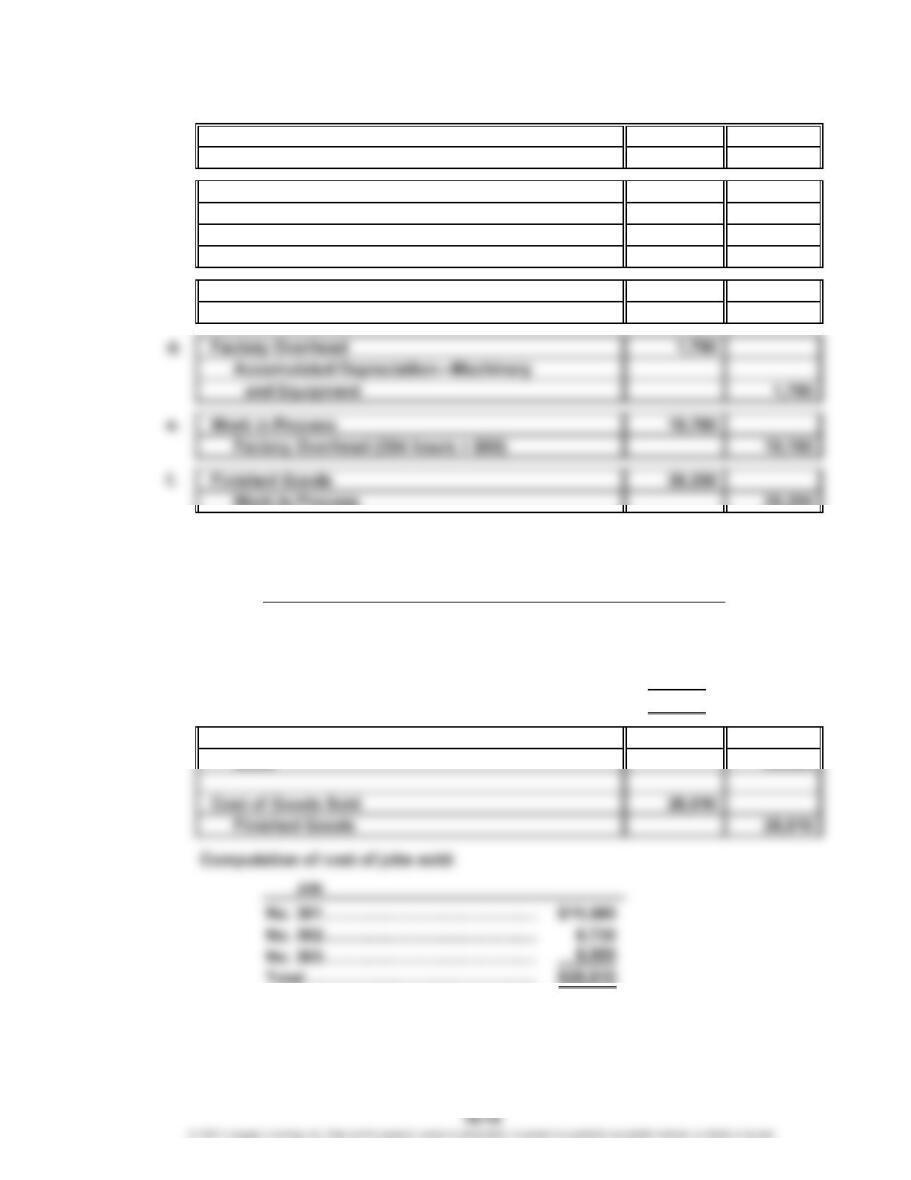
1. a. Materials 33,100
Accounts Payable
b. Work in Process 56,570
Factory Overhead 5,720
Materials
Wages Payable
c. Factory Overhead 6,470
Accounts Payable
Work in Process
Computation of cost of jobs finished:
Direct Direct Factory
Job Materials Labor Overhead Total
No. 301…… $2,740 $5,460 $3,380 $11,580
No. 302…… 3,980 2,930 1,820 8,730
No. 303…… 2,570 3,070 2,860 8,500
No. 305…… 6,210 1,840 2,340 10,390
Total…………………………………………………
…
$39,200
g. Accounts Receivable 60,020
Total……………………………………
…
$28,810
39,200
33,100
32,450
6,470
29,840
CHAPTER 19 Job Order Costing
Prob. 19-2A (Concluded)
2.
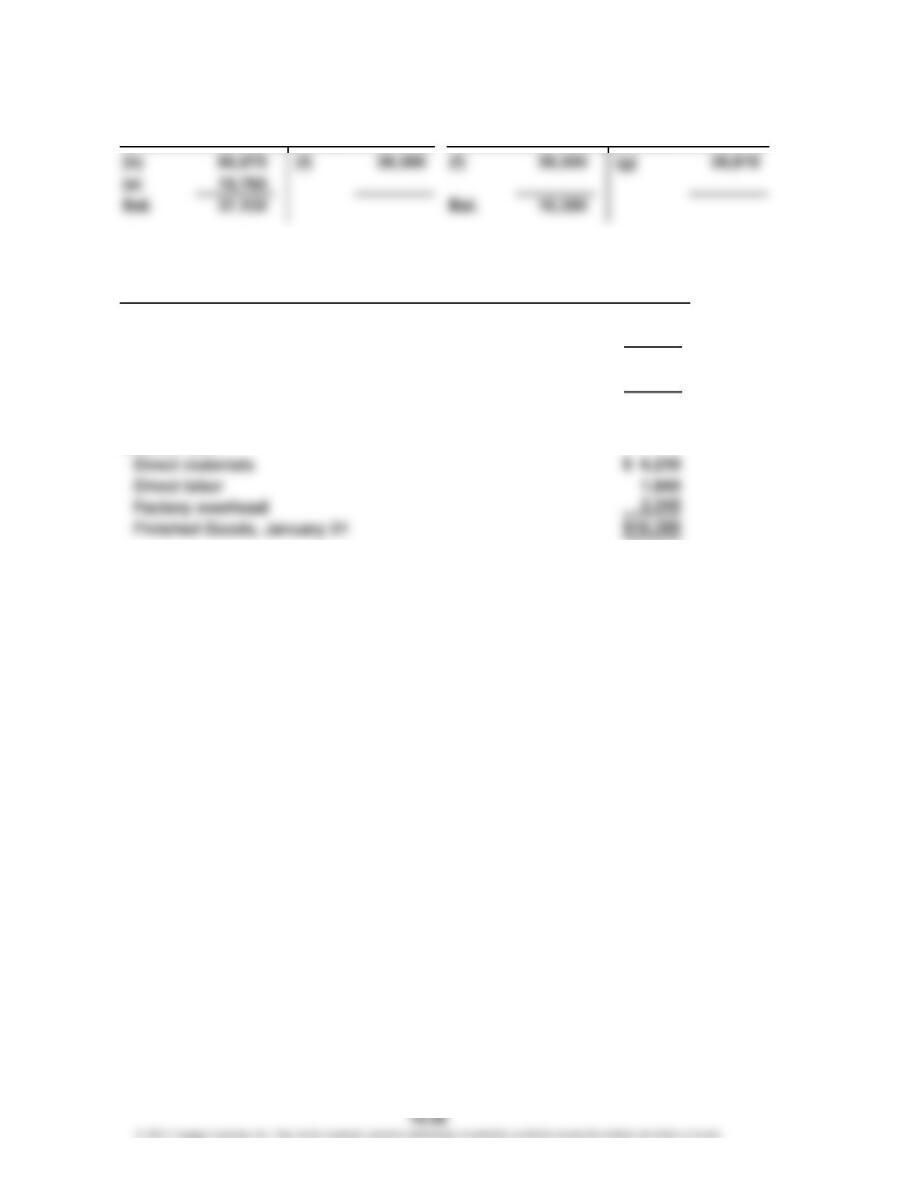
3. Schedule of unfinished jobs:
Direct Factory
Job Labor Overhead
No. 304…………………………
…
$8,520 $4,225
No. 306…………………………
…
6,110 5,135
Balance of Work in
Process, January 31…………………………………………………
4.
Job No. 305:
$8,850
4,290
$21,595
15,535
Work in Process Finished Goods
Direct
TotalMaterials
$37,130
Schedule of completed jobs:
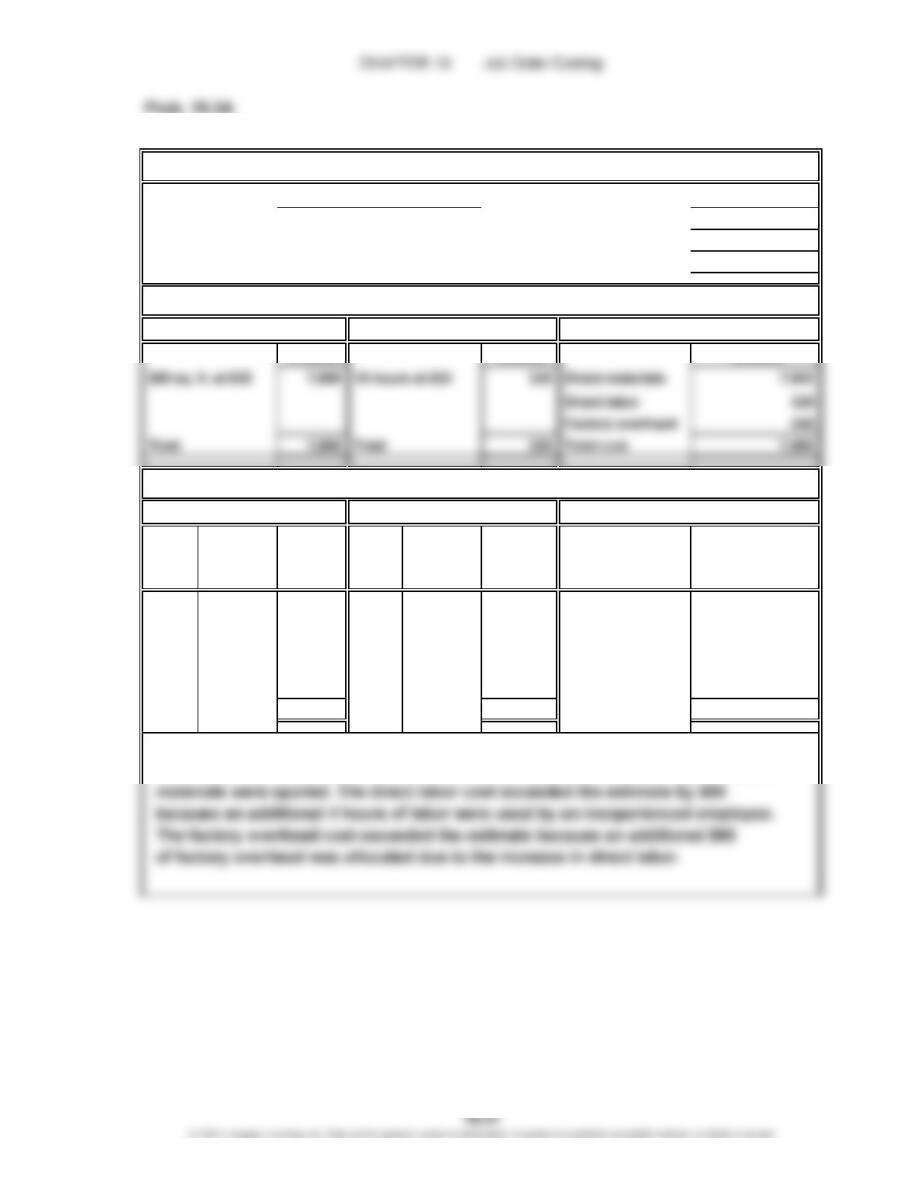
1. and 2.
Jackson Consulting Date October 1
Date wanted October 10
Date completed October 10
Job. No.
Mat. Time
Req. Ticket
No. Description Amount No. Description Amount Item Amount
112 140 sq. ft. H10 10 hours
at $35 4,900 at $20 200 Direct materials 7,280
Direct labor 400
114 68 sq. ft. H11 10 hours Factory overhead 300
at $35 2,380 at $20 200
Total 7,280 Total 400 Total cost 7,980
Comments:
The direct materials cost exceeded the estimate by $280 because 8 square feet of
ESTIMATE
Direct Materials Direct Labor Summary
ACTUAL
Direct Materials Direct Labor Summary
JOB ORDER COST SHEET
Customer
CHAPTER 19 Job Order Costing
Prob. 19-4A
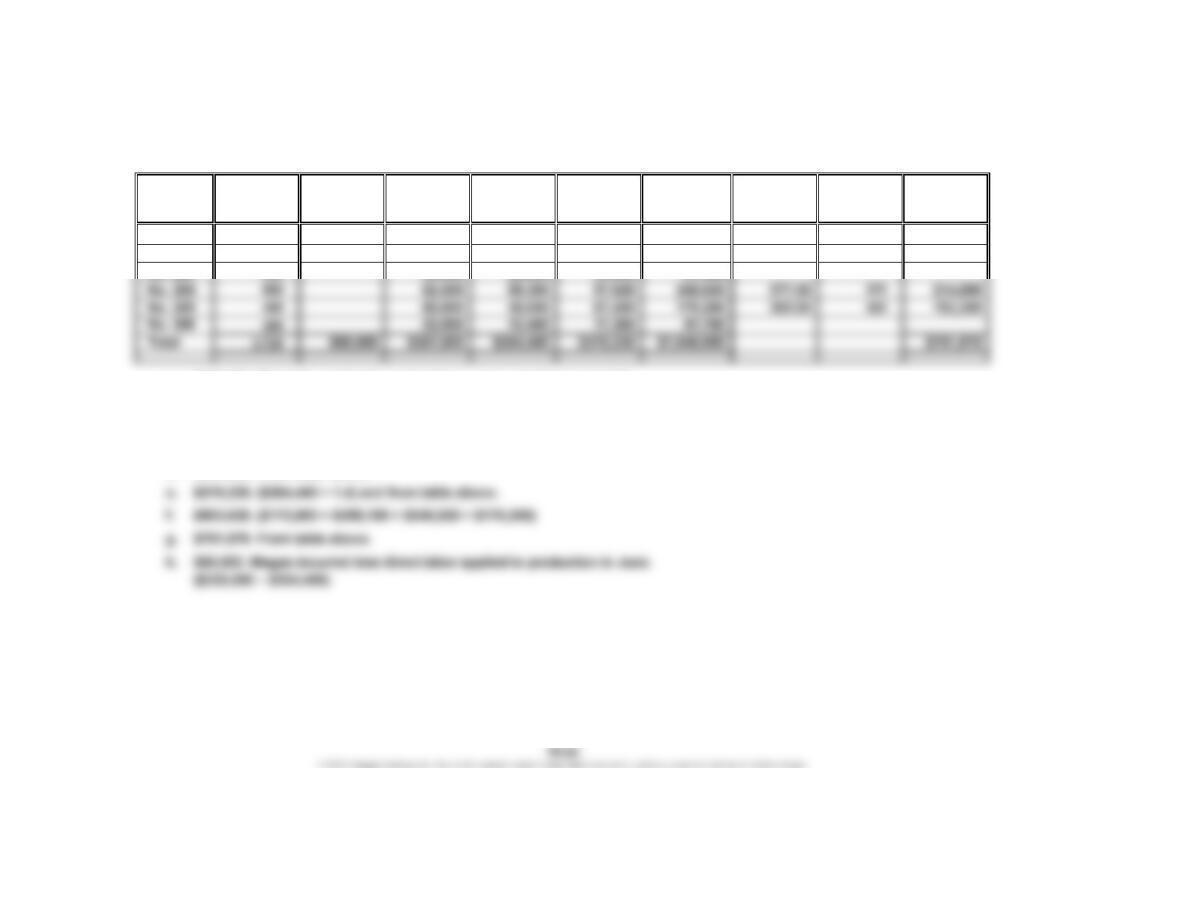
1. Supporting calculations:
June 1 Cost of
Work in Direct Direct Factory Total Unit Units Goods
Quantity Process Materials Labor Overhead Cost Cost Sold Sold
No. 201 550 $16,500 $ 55,000 $ 41,250 $ 57,750 $ 170,500 $310.00 440 $136,400
No. 202 1,100 44,000 93,500 71,500 100,100 309,100 281.00 880 247,280
a. $395,500. Materials applied to production in June + indirect materials.
($351,500 + $44,000)
b. $60,500. From table above and problem.
c. $351,500. From table above.
d. $264,450. From table above.
Job. No.

CHAPTER 19 Job Order Costing
Prob. 19-4A (Concluded)
2. June 30 balances:
Materials……………………
…
$ 17,000 ($82,500 + $330,000 – $395,500)
Work in Process*…………
…
143,060 ($91,300 + $51,760, Job 203 and Job 206)
Finished Goods**…………
…
151,750 ($903,620 – $751,870)
Factory Overhead…………
…
9,820 Dr. underapplied ($33,000 + $65,550
+ $44,000 + $237,500 – $370,230)
*$60,500 + $351,500 + $264,450 + $370,230 – $903,620 = $143,060
** Units in Unit Total
Inventory Cost Cost
110 $310.00 $ 34,100
201
Job. No.
CHAPTER 19 Job Order Costing
Prob. 19-5A
1.
Sales $17,920,000
Cost of goods sold 10,864,000
Gross profit $ 7,056,000
Selling expenses:
Infomercial campaign $2,000,000
Promotional materials 3,600,000
Shipping expenses 224,000
Supporting calculations:
Sales: 1,120,000 units × $16 = $17,920,000
Cost of goods sold: 1,120,000 units × $9.70 = $10,864,000
Manufacturing cost per unit (knife):
Direct materials:
Hardened steel blanks……………………………
…
$4.00
Wood (for handle)…………………………………
…
1.50
Packaging……………………………………………
…
0.50
*$800 ÷ 250 knives per hour
Infomercial campaign: $600,000 + $1,400,000 = $2,000,000
Promotional materials: 60,000 stores × $60 = $3,600,000
Shipping expenses: 1,120,000 units × $0.20 = $224,000
2. Finished Goods balance, December 31, 20Y8:
Ginocera Inc.
Income Statement
For the Year Ended December 31, 20Y8
CHAPTER 19 Job Order Costing
Prob. 19-1B
a. Materials 770,000
Accounts Payable 770,000
d. Factory Overhead 245,000
Selling Expenses 171,500
Administrative Expenses 110,600
Accounts Payable 527,100
f. Factory Overhead 49,500
Depreciation Expense—Office Equipment 61,800
Depreciation Expense—Office Building 14,900
Accumulated Depreciation—Factory Equipment 49,500
Accumulated Depreciation—Office Equipment 61,800
Accumulated Depreciation—Office Building 14,900
g. Work in Process 568,500
Factory Overhead 568,500
CHAPTER 19 Job Order Costing
Prob. 19-2B
1. a. Materials 147,000
Accounts Payable
d. Factory Overhead 4,100
Accumulated Depreciation—Machinery
and Equipment
e. Work in Process 40,480
Factory Overhead (1,012 hours × $40)
Computation of cost of jobs finished:
Direct Direct Factory
Job Materials Labor Overhead Total
No. 101…… $19,320 $19,500 $6,160 $ 44,980
No. 102…… 23,100 28,140 6,400 57,640
No. 103…… 13,440 14,000 5,040 32,480
No. 105…… 18,050 15,540 6,400 39,990
Total……………………………………………………
…
$175,090
g. Accounts Receivable 189,100
Sales*
*$62,900 + $80,700 + $45,500
40,480
4,100
189,100
147,000
CHAPTER 19 Job Order Costing
Prob. 19-2B (Concluded)
2.
(b) 262,490 (f) 175,090 (f) 175,090 (g) 142,610
3. Schedule of unfinished jobs:
Direct Factory
Job Labor Overhead
No. 104……………………
…
$36,500 $9,520
…
4. Schedule of completed jobs:
Job No. 103:
Direct materials
$13,440
$38,200
$ 84,220
Work in Process Finished Goods
Direct
TotalMaterials
CHAPTER 19 Job Order Costing
Prob. 19-3B
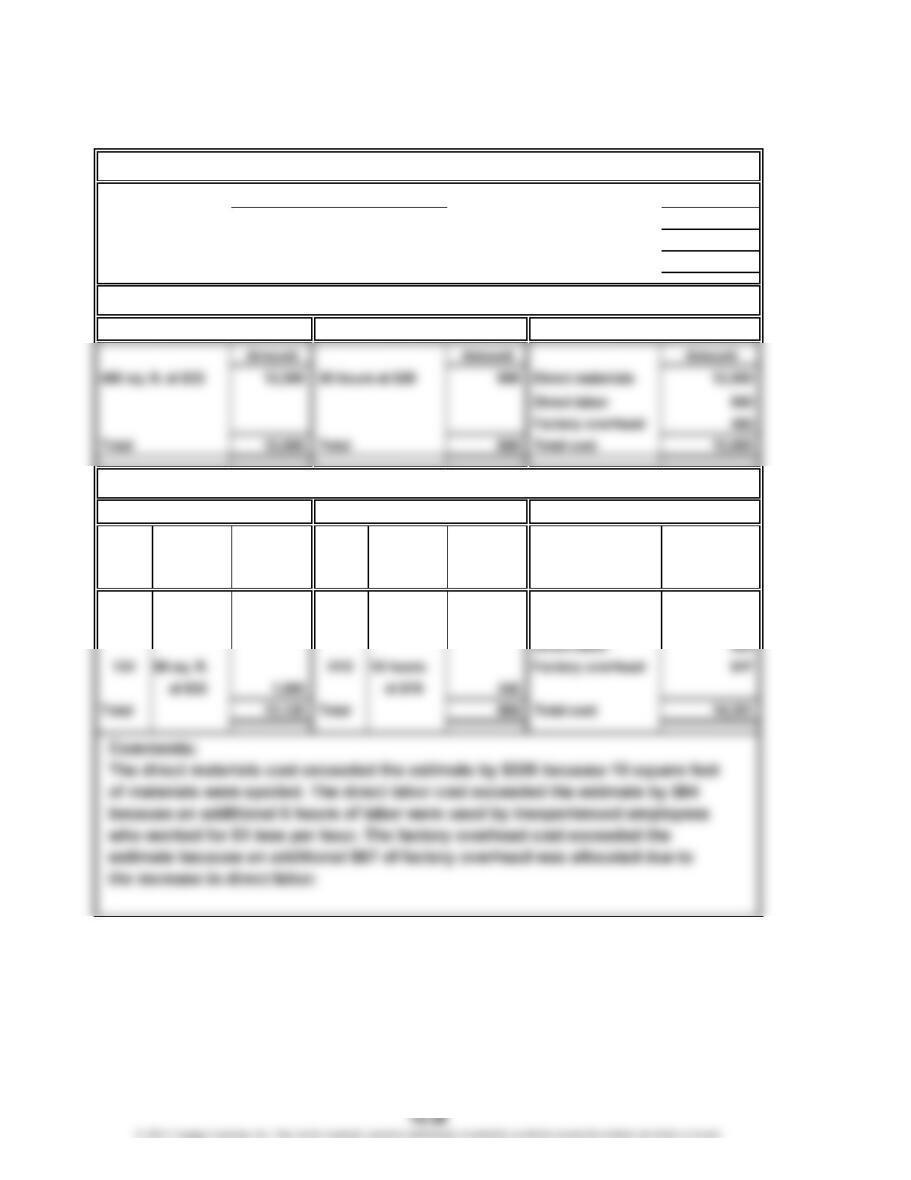
1. and 2.
Lunden Consulting Date May 9
Date wanted May 15
Date completed May 15
Job. No.
Mat. Time
Req. Ticket
No. Description Amount No. Description Amount Item Amount
132 360 sq. ft. H9 18 hours
at $32 11,520 at $19 342 Direct materials 13,120
ESTIMATE
Direct Materials Direct Labor Summary
ACTUAL
Direct Materials Direct Labor Summary
JOB ORDER COST SHEET
Customer
CHAPTER 19 Job Order Costing
Prob. 19-4B
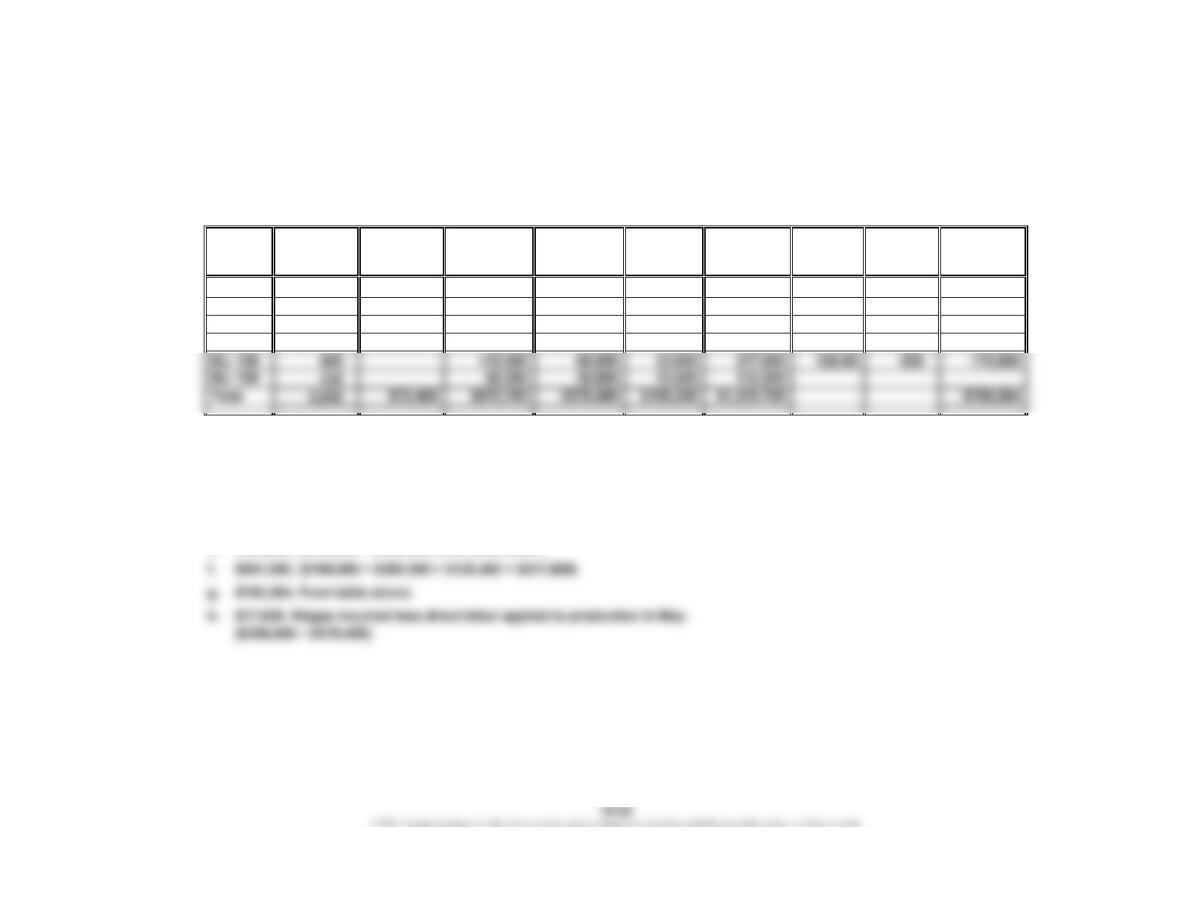
1. Supporting calculations:
May 1 Cost of
Work in Direct Direct Factory Total Unit Units Goods
Quantity Process Materials Labor Overhead Cost Cost Sold Sold
No. 101 330 $26,400 $ 82,500 $ 59,400 $ 29,700 $ 198,000 $600.00 264 $158,400
No. 102 380 46,000 105,400 72,600 36,300 260,300 685.00 360 246,600
No. 103 500 132,000 110,000 55,000 297,000
No. 104 400 66,000 39,600 19,800 125,400 313.50 384 120,384
a. $586,100. Materials applied to production in May + indirect materials.
($570,700 + $15,400)
b. $72,400. From table above and problem.
c. $570,700. From table above.
d. $378,400. From table above.
Job. No.
CHAPTER 19 Job Order Costing
Prob. 19-4B (Concluded)
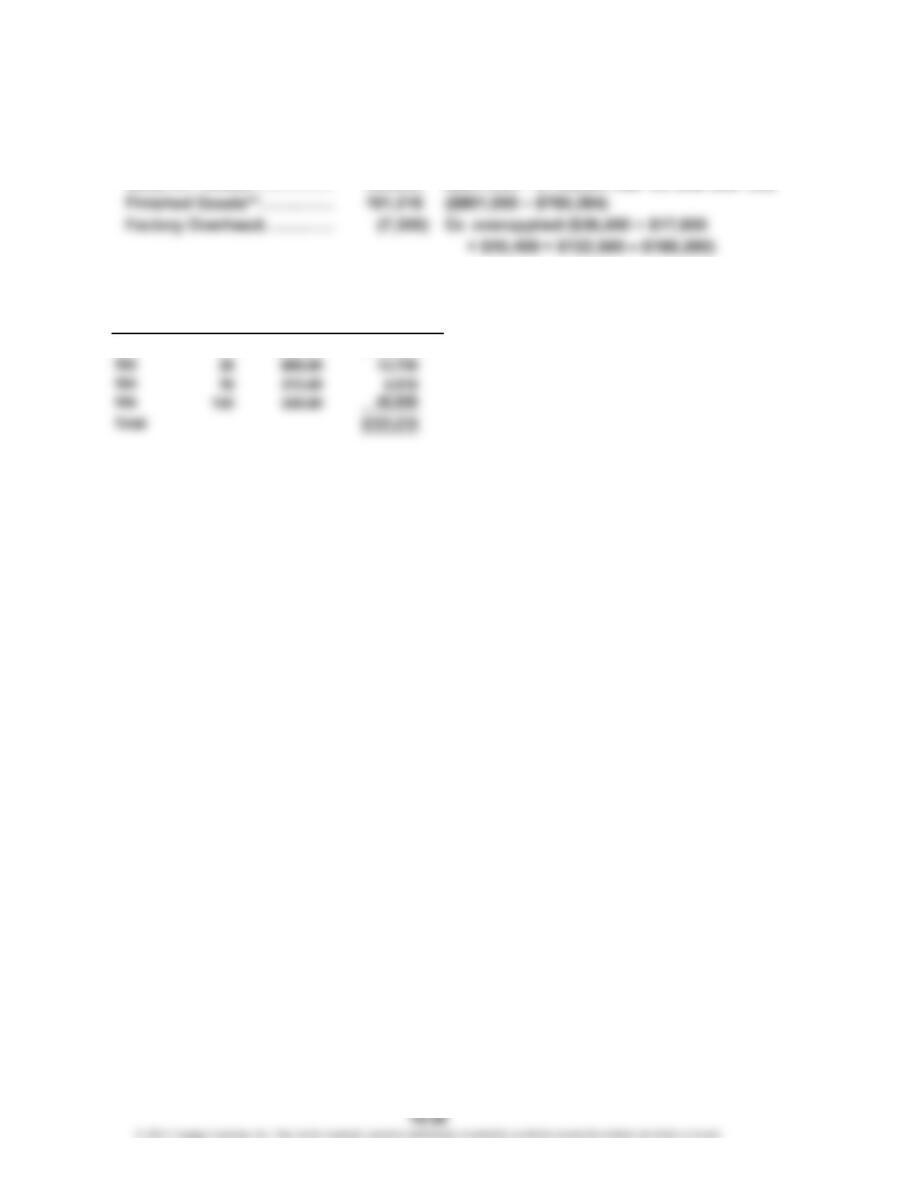
2. May 31 balances:
Materials……………………
…
$ 19,500 ($105,600 + $500,000 – $586,100)
*$72,400 + $570,700 + $378,400 + $189,200 – $801,500 = $409,200
** Units in Unit Total
Inventory Cost Cost
66 $600.00 $ 39,600
Job. No.
101
…
CHAPTER 19 Job Order Costing
Prob. 19-5B
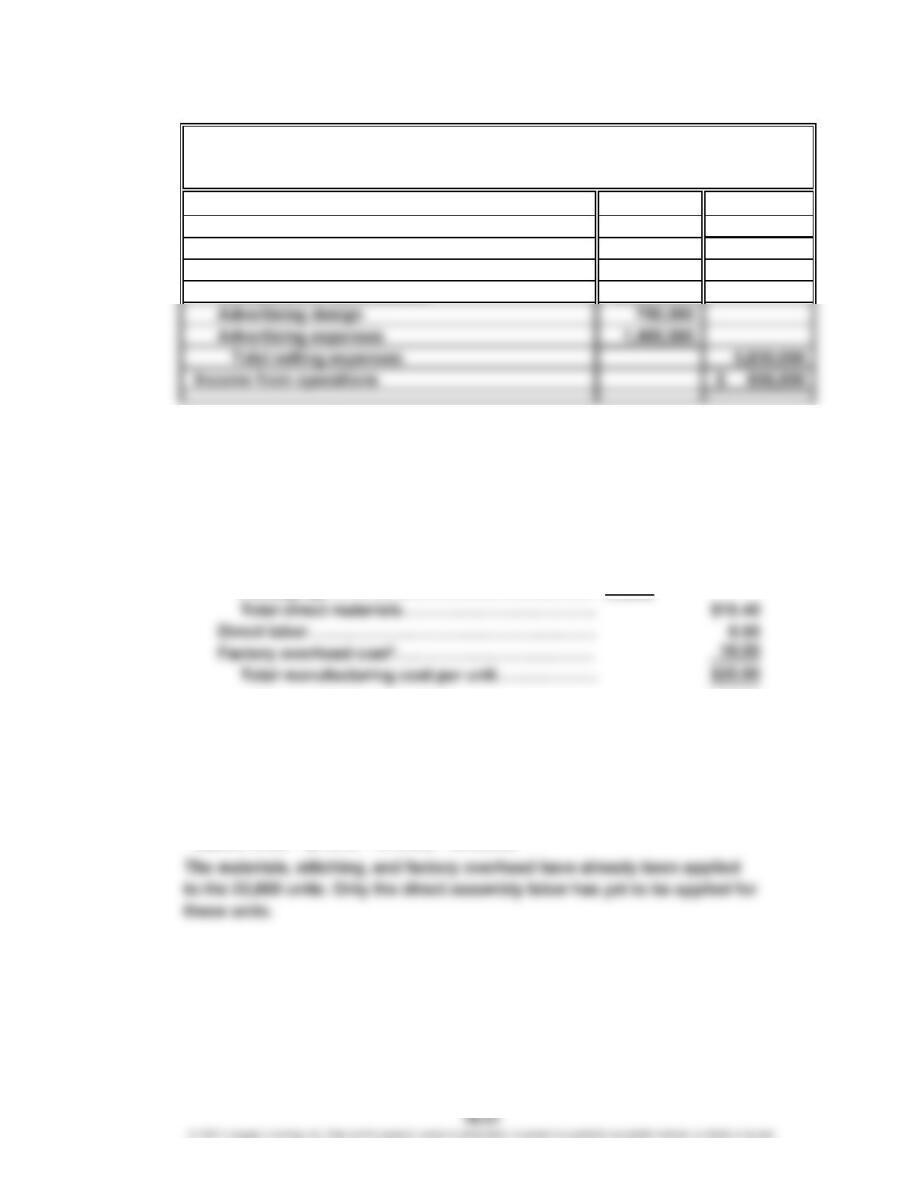
1.
Sales $18,400,000
Cost of goods sold 11,914,000
Gross profit $ 6,486,000
Selling expenses:
Salespersons commissions $3,680,000
Supporting calculations:
Sales: 460,000 units × $40 = $18,400,000
Cost of goods sold: 460,000 units × $25.90 = $11,914,000
Manufacturing cost per unit:
Direct materials:
Leather………………………………………………
…
$10.00
V
elvet (for interior)…………………………………
…
5.00
Packaging……………………………………………
…
0.40
*$1,250 ÷ 125 units per hour
Salespersons commissions: $18,400,000 × 20% = $3,680,000
2. Finished Goods balance, December 31, 20Y3:
(500,000 units – 460,000 units) × $25.90 = $1,036,000
Work in Process, December 31, 20Y3:
22,000 units × ($15.40 + $10.00) = $558,800
Technology Accessories Inc.
Income Statement
For the Year Ended December 31, 20Y3
CHAPTER 19 Job Order Costing
CP 19-1
No. Tandy’s plan is not ethical. A job order cost accounting system accumulates and
records product costs by jobs. The resulting total and unit product costs can be
compared to similar jobs, compared over time, or compared to expected costs. In this
way, a job order cost system can be used by managers for cost evaluation and control.
CP 19-2
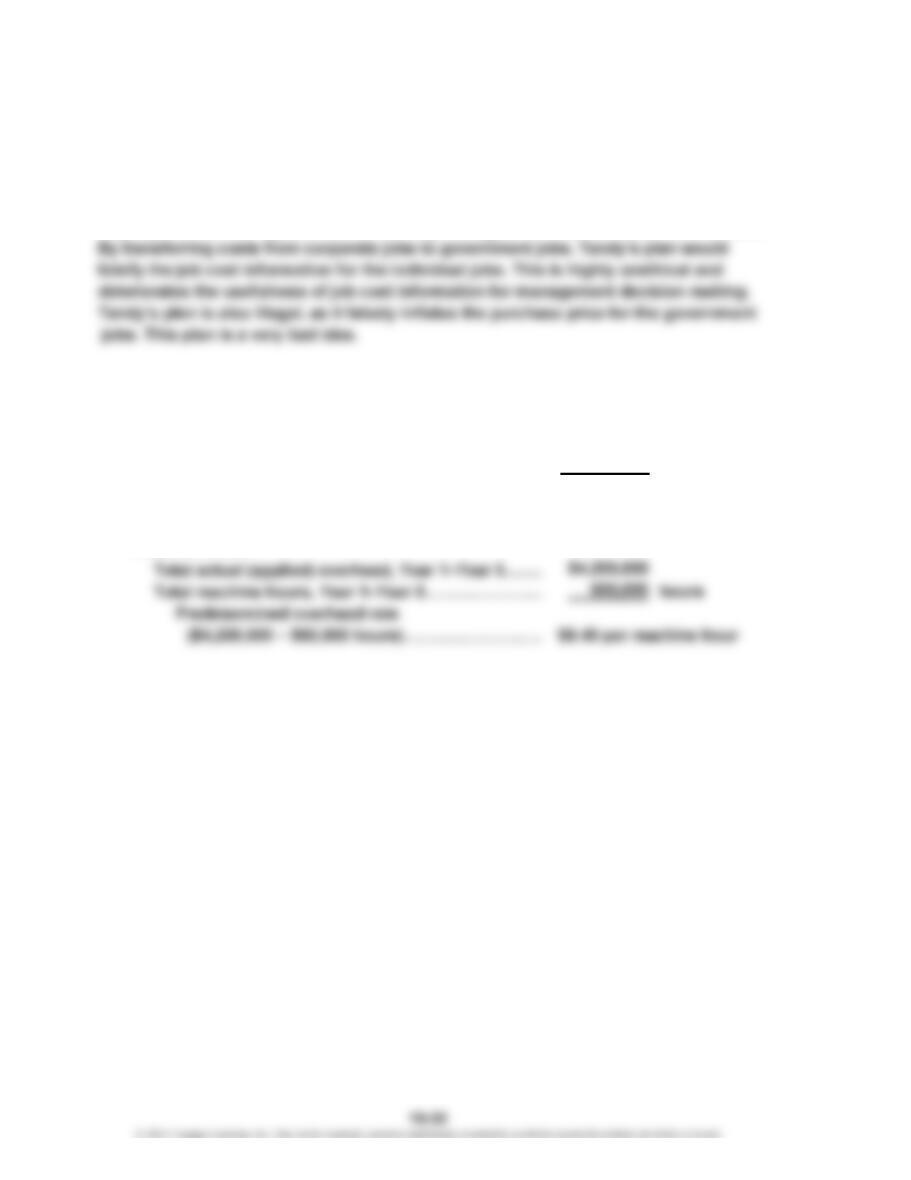
1. Direct labor cost:
Total actual (applied) overhead, Year 1–Year 5……
…
$ 4,200,000
Total direct labor cost, Year 1–Year 5………………
…
21,000,000
Predetermined overhead rate
($4,200,000 ÷ $21,000,000)………………………
…
20% of direct labor cost
Machine hours:
…
…
…
CASES & PROJECTS
CHAPTER 19 Job Order Costing
CP 19-2 (Continued)
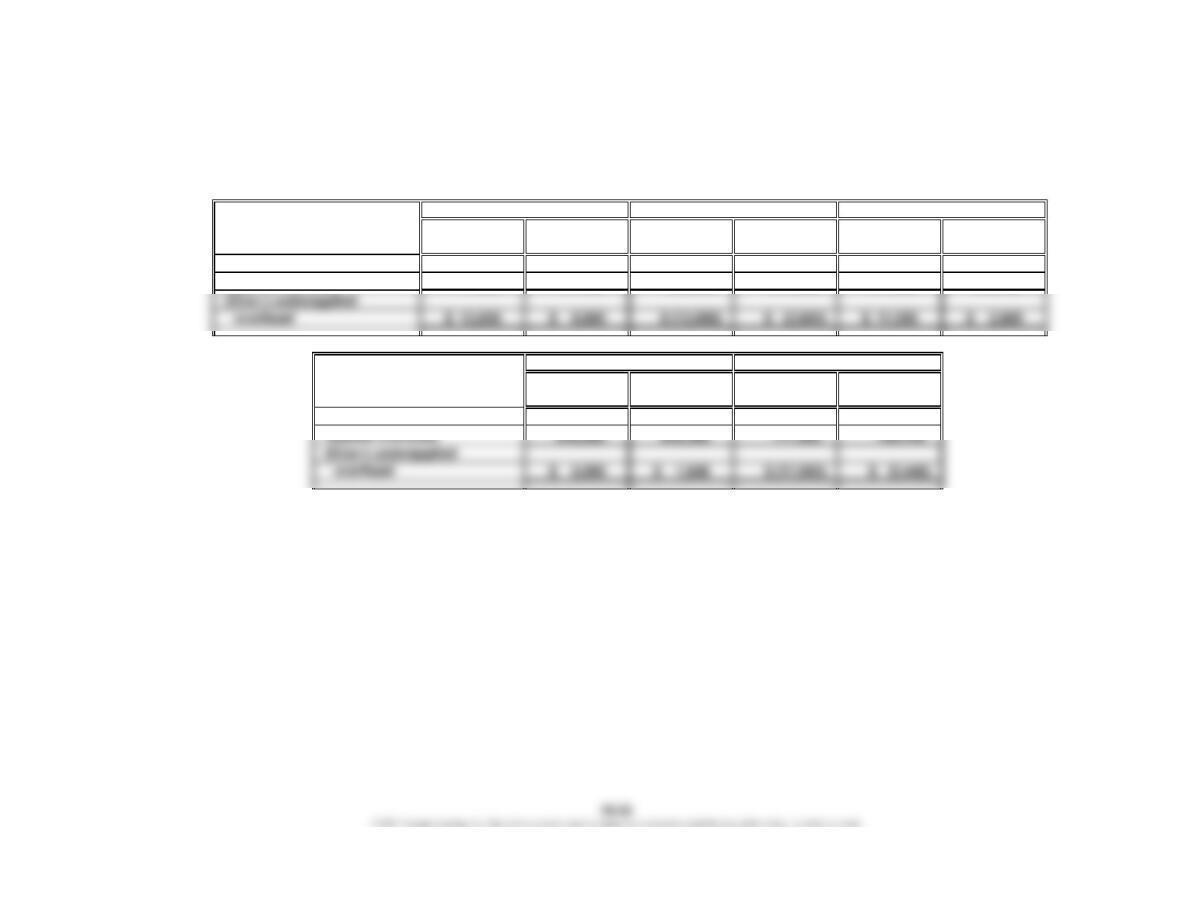
2.
Direct Labor Machine Direct Labor Machine Direct Labor Machine
Cost Hours Cost Hours Cost Hours
Actual overhead $790,000 $790,000 $870,000 $870,000 $935,000 $935,000
Applied overhead 777,000 781,200 882,000 873,600 924,000 932,400
Direct Labor Machine Direct Labor Machine
Cost Hours Cost Hours
$845,000 $845,000 $760,000 $760,000
Year 5 Year 4
Year 1
Year 3
Year 2
Actual overhead
CHAPTER 19 Job Order Costing
CP 19-2 (Concluded)
3. The best predetermined overhead rate is machine hours. Although the total
overhead applied for each rate developed in part (1) is the same over the entire
five-year period (as a result of the method by which the predetermined overhead
rates were developed), the predetermined overhead rate based on machine hours
CP 19-3
To: Carol Creedence
From: A+ Student
Re: Product CCR Job Cost
The graph of job costs for Product CCR indicates two significant trends in job cost.
First, there appears to be a strong and consistent “Friday effect.” Unit cost increases
significantly on Fridays, then falls on Monday. Each Friday effect is larger than the
previous week. There also appears to be a steady increase in the unit cost over time, with
unit cost increasing significantly over the time period.
The “Friday effect” could be caused by a reduction in the efficiency of the workforce on
Fridays, as it is the last day of the workweek. If this is the case and the trend is not
product-related, then it should also appear throughout the plant. To test this explanation,
management should collect job cost data for other products in the plant. If the trend
CHAPTER 19 Job Order Costing
CP 19-4
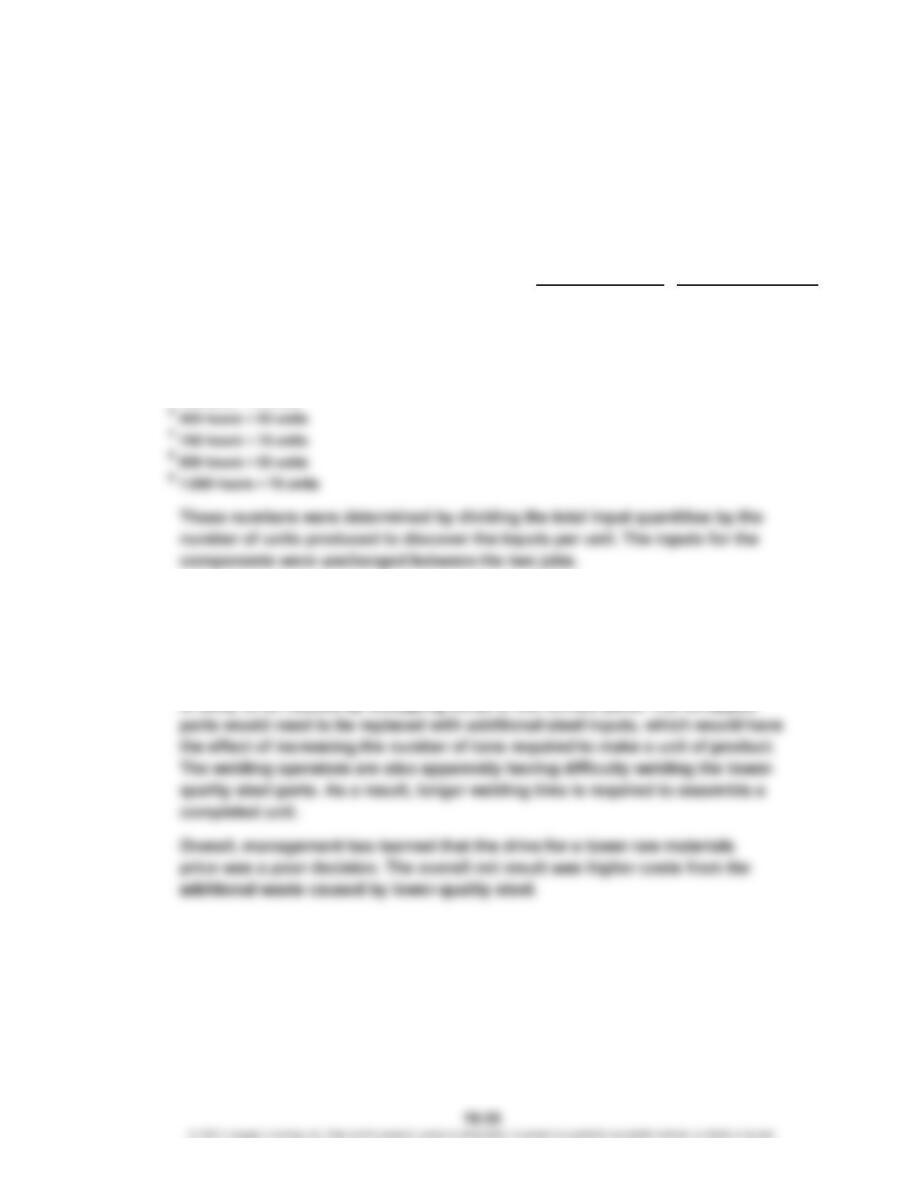
1. The unit costs are influenced by both the price and quantity of inputs. On the
price side, the cost of steel has dropped from $1,200 to $1,100 per ton. This is
apparently the result of the purchasing manager’s decision to reduce the cost
of raw materials by going to a new vendor. No other input prices change.
Some of the input quantities changed for the worse. Specifically, the following:
Steel input…………………………………………
…
2.10 tons12.60 tons2
Foundry labor……………………………………
…
8.00 hours
3
10.00 hours
4
Welding labor……………………………………… 11.00 hours
5
14.00 hours
6
1105 tons ÷ 50 units
2195 tons ÷ 75 units
2. A possible reason for this deterioration in performance is related to the
purchasing manager’s decision to change vendors in order to secure a lower
price per ton. The new vendor is apparently delivering a lower-quality steel
product to the company. As a result, the foundry operation is spending
more time forming the steel parts. Moreover, the increased steel tons per unit
Job 206 Job 228
Input Quantity per Unit

CHAPTER 19 Job Order Costing
CP 19-5
1. Todd should record the debits for factory wages as a debit to Work in Process.
The factory wages are product costs that must be accumulated in the cost of
producing the product. Eventually, these wage costs will become part of the
finished goods inventory and the cost of goods sold when the gift items are sold.
Likewise, the depreciation should be recorded as a debit to Factory Overhead.
The overhead is then applied to production work in process. Like the wages, the
depreciation will also eventually become part of the finished goods inventory and
2. Jeff would not be concerned about expensing administrative wages and