*CA 18.9
(a) Widjaja Company should recognize revenue as it performs the work on the contract (the
percentage-of-completion method) because it meets the criteria for revenue recognition over
time.
(b) Progress billings would be accounted for by increasing accounts receivable and increasing progress
(c) The income recognized in the second year of the four-year contract would be determined using
the cost-to-cost method of determining percentage of completion as follows:
1. The estimated total income from the contract would be determined by deducting the estimated
total costs of the contract (the actual costs to date plus the estimated costs to complete) from
income recognized in the first year of the contract from the total income recognizable to date.
(d) Earnings per share in the second year of the four-year contract would be higher using the
percentage-of-completion method instead of the completed-contract method because income
(a) 2017 Net sales: $65,058 million.
(b) P&G’s net sales decreased from $65,299 million to $65,058 million or
$214 million ($65,299 – $65,058) from 2016 to 2017, or 0.37%
($214/$65,299). Net sales decreased from $70,749 million to $65,299
million or $5,450 ($70,749 – $65,299) from 2015 to 2016, or 7.7%
($5,450/$70,749).
(c) Sales are recognized when revenue is realized or realizable and has
been earned. Revenue transactions represent sales of inventory. The
(d) Trade promotions, consisting primarily of customer pricing allowances,
merchandising funds and consumer coupons, are offered through
various programs to customers and consumers. Sales are recorded
net of trade promotion spending, which is recognized as incurred,
generally at the time of the sale. Most of these arrangements have
FINANCIAL REPORTING PROBLEM
(a) For the year 2017, Coca-Cola reported net operating revenues of
$35,410 million and PepsiCo reported net revenue of $63,525 million.
(b) Revenue Recognition Policies
Coca-Cola provided the following revenue recognition note (Note 1:
Business and Summary of Significant Accounting Policies – p. 79)
Our Company recognizes revenue when persuasive evidence of an
COMPARATIVE ANALYSIS CASE
COMPARATIVE ANALYSIS CASE (Continued)
PepsiCo’s Revenue Recognition note [Note 2 (p. 72) – Our Significant
Accounting Policies] is as follows:
We recognize revenue upon shipment or delivery to our customers
based on written sales terms that do not allow for a right of return.
As a result, we record reserves based on estimates, for anticipated
damaged and out-of-date products.
For additional unaudited information on our revenue recognition
(c) In 2017, Coca Cola experienced significant amounts of revenue in
Europe middle east and Africa, $7,374 million; Latin America, $4,029
million; and Asia Pacific $5,176 million (Note 19 – Operating Segments
WESTINGHOUSE ELECTRIC CORPORATION
(a) For product sales, Westinghouse Electric Corporation uses the date of
delivery, point of sale, basis for revenue recognition. For services ren-
dered, Westinghouse uses the “when services are complete and billable
(b) For the most part, companies recognize revenue at the point of sale
because that is when the performance obligation is satisfied. Under
A company satisfies a performance obligation and recognizes revenue
over time if at least one of the following three criteria is met:
1. The customer simultaneously receives and consumes the benefits of
the entity’s performance as the entity performs.
2. The company’s performance creates or enhances an asset (for
FINANCIAL STATEMENT ANALYSIS CASE
Financial Statement Analysis Case (Continued)
Therefore, if criterion 1 or 2 is met, then a company recognizes
revenue over time if it can reasonably estimate its progress toward
satisfaction of the performance obligations. That is, it recognizes
revenues and gross profits each period based upon the progress of
the construction—referred to as the percentage-of-completion method.
completed to date (even if the customer can terminate the contract for
reasons other than the company’s failure to perform as promised).
Alternatively, if the criteria for recognition over time are not met (e.g.,
the company does not have a right to payment for work completed to
date), the company recognizes revenues and gross profit at a point in
time, that is, when the contract is completed. This approach is referred
to as the completed-contract method.
(c) WFSI is probably a wholly-owned finance subsidiary of Westinghouse
ACCOUNTING, ANALYSIS, AND PRINCIPLES
Accounting
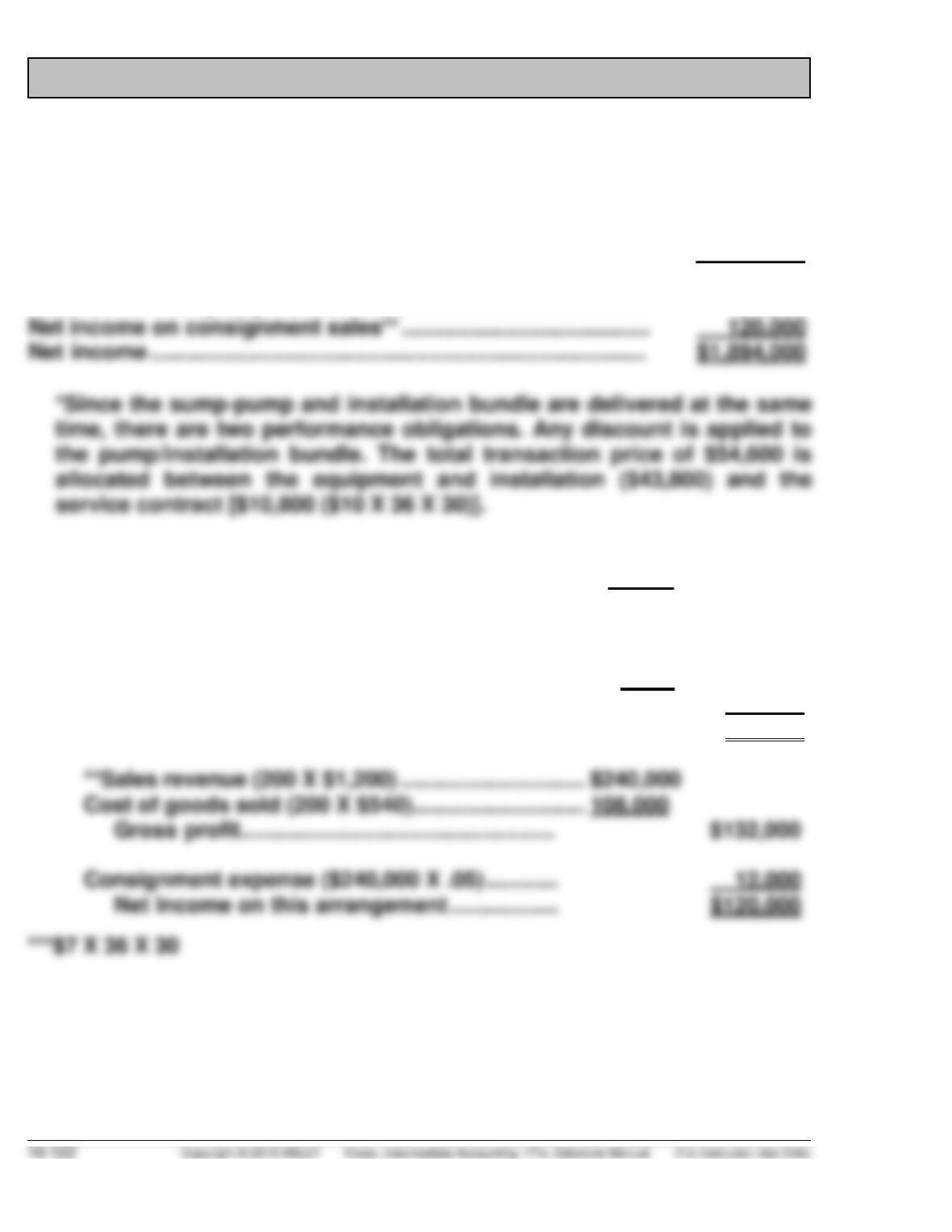
Sales revenue ………….……………………..………………………………..
$9,500,000
Expenses .……………………………………………………..…………………
7,750,000
1,750,000
Net income from pump bundle*…..……………………..………………
24,000
Net income on consignment sales** …………………………………..
Net income ………………………………….……………………..…………….
Sales revenue …………………………….………………. $43,800
Cost of goods sold [30 X ($540 + $150)] ……….. 20,700
Gross profit……….…………………………………… $23,100
Service revenue [($10,800 ÷ 36) X 10 months] $3,000
Expenses [($7,560*** ÷ 36) X 10 months] ………. 2,100
Income on service contract …………………….. 900
Net income on this arrangement ……………… $24,000
ACCOUNTING, ANALYSIS, AND PRINCIPLES (Continued)
Analysis
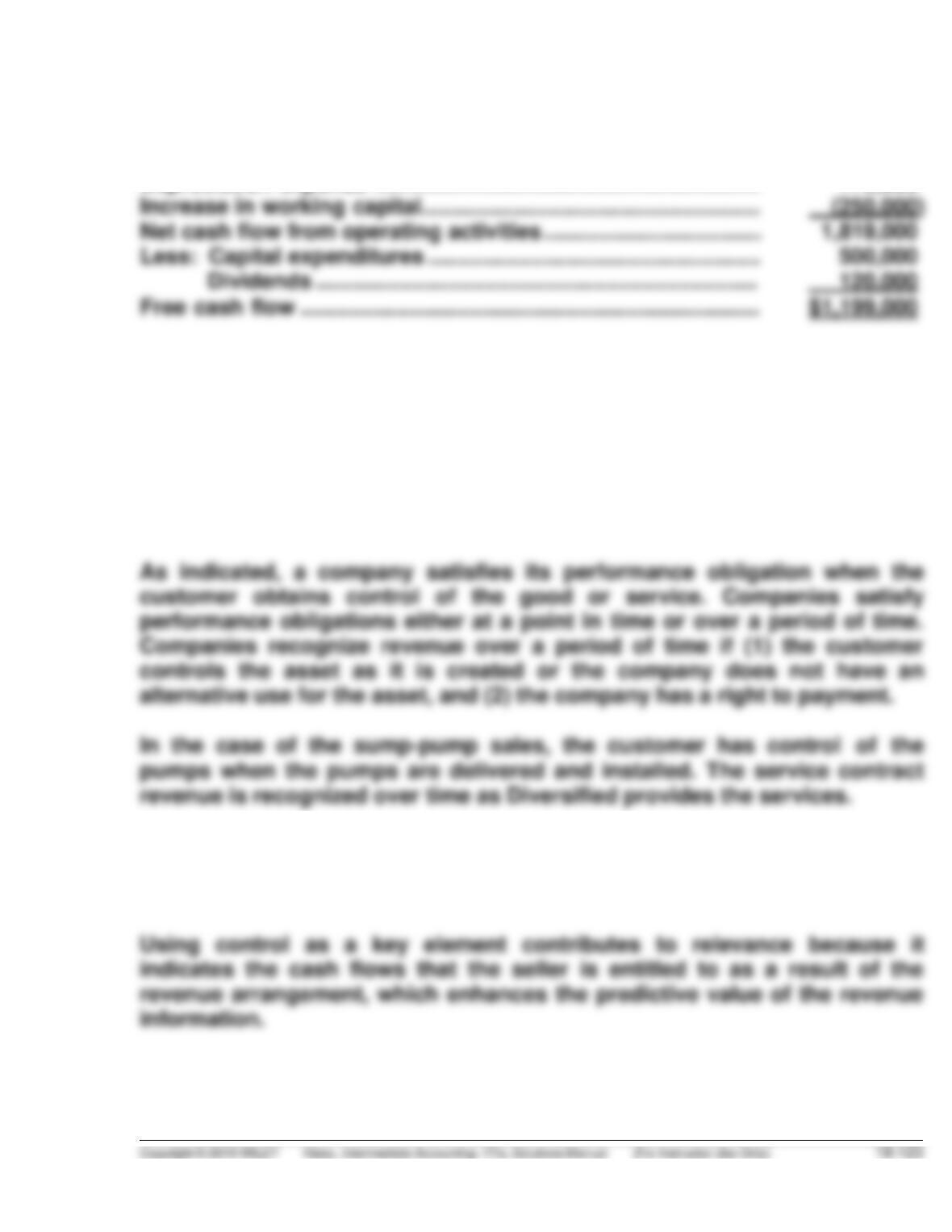
Net income.………………….……………………..……………………..…….
$1,894,000
Depreciation expense …………………………………………..…………..
175,000
Increase in working capital…………..……………………………………
(250,000)
Net cash flow from operating activities ………………………………
Less: Capital expenditures .…………………………………..………….
500,000
Principles
Under the 5-step model, a company first identifies the
contract with
customer(s); identifies the separate performance obligations in the
contract; determines the transaction price; allocates the transaction price
to separate performance obligations, and recognizes revenue when each
performance obligation is satisfied.
With respect to the consignment sales, Menards is acting as an agent;
revenue on those sales is recognized when the customers purchase (have
control of) the pumps.
ACCOUNTING, ANALYSIS, AND PRINCIPLES (Continued)
Faithful representation may be sacrificed for situations in which companies
must allocate the transaction price to more than one performance
obligation in a contract. If an allocation is needed, the transaction price
CE18.1
(a) Customer – A user or reseller. A party that has contracted with an entity to obtain goods or
services that are an output of the entity’s ordinary activities in exchange for consideration.
(b) Performance Obligation – A promise in a contract with a customer to transfer to the customer
either:
CE18.2
According to FASB ASC 606–10–25–15:
An entity shall account for a contract modification as a separate contract if both of the following
conditions are present:
a. The scope of the contract increases because of the addition of promised goods or services that
are distinct (in accordance with paragraphs 606-10–25–18 through 25-22).
b. The price of the contract increases by an amount of consideration that reflects the entity’s
CODIFICATION EXERCISES
CE18.3
According to FASB ASC 606–10–32–10:
Refund Liabilities
An entity shall recognize a refund liability if the entity receives consideration from a customer and
expects to refund some or all of that consideration to the customer. A refund liability is measured at the
CE18.4
According to FASB ASC 606-10–32-36 to 38
Allocation of a Discount
36 – A customer receives a discount for purchasing a bundle of goods or services if the sum of the
standalone selling prices of those promised goods or services in the contract exceeds the
promised consideration in a contract. Except when an entity has observable evidence in
37 – An entity shall allocate a discount entirely to one or more, but not all, performance obligations in
the contract if all of the following criteria are met:
a. The entity regularly sells each distinct good or service (or each bundle of distinct goods or
services) in the contract on a standalone basis.
38 – If a discount is allocated entirely to one or more performance obligations in the contract in
accordance with paragraph 606-10–32-37, an entity shall allocate the discount before using the
(a) Sale with a Right of Return is addressed at FASB ASC 606–10–55.
(b) According to FASB ASC 606–10–55–22 related to right of return:
In some contracts, an entity transfers control of a product to a
customer and also grants the customer the right to return the product
Bill-and-Hold: According to FASB ASC 606-10–55-81: A bill-and-hold
arrangement is a contract under which an entity bills a customer for a
(c) According to FASB ASC 606-10–55–23:
To account for the transfer of products with a right of return (and for
some services that are provided subject to a refund), an entity should
recognize all of the following:
a. Revenue for the transferred products in the amount of
CODIFICATION RESEARCH CASE
CODIFICATION RESEARCH CASE (Continued)
(d) According to FASB ASC 606–10–55–82 to 84:
82 – An entity should determine when it has satisfied its performance
obligation to transfer a product by evaluating when a customer
obtains control of that product (see paragraph 606–10–25-30). For
some contracts, control is transferred either when the product is
delivered to the customer’s site or when the product is shipped,
over the customer’s asset.
83 – In addition to applying the guidance in paragraph 606–10–25-30,
for a customer to have obtained control of a product in a bill-and-
hold arrangement, all of the following criteria must be met:
a. The reason for the bill-and-hold arrangement must be
substantive (for example, the customer has requested the
CODIFICATION RESEARCH CASE (Continued)
84 – If an entity recognizes revenue for the sale of a product on a bill–
and-hold basis, the entity should consider whether it has