Wild and Shaw, Financial & Managerial Accounting 9e Solutions Manual: Chapter 18
1150
Problem 18-3B (Continued)
Part 3 continued
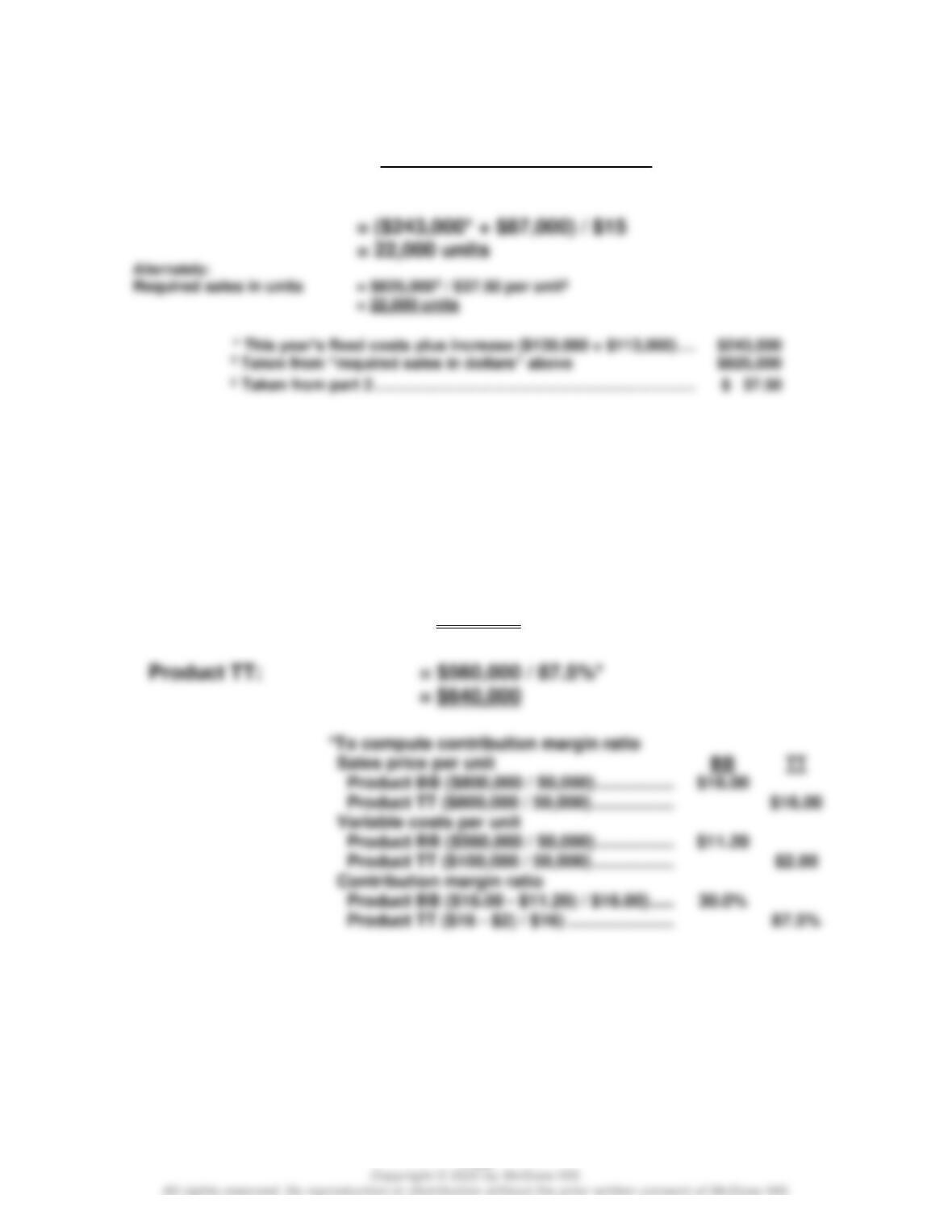
Fixed costs + Target income
Required sales in units = Contribution margin per unit
Problem 18-4B (60 minutes)
Part 1
Break-even in dollar sales = Fixed costs / Contribution margin ratio
Product BB: = $100,000 / 30%*
= $333,334 (rounded up to dollar)
Wild and Shaw, Financial & Managerial Accounting 9e Solutions Manual: Chapter 18
1151
Problem 18-4B (continued)
Part 2
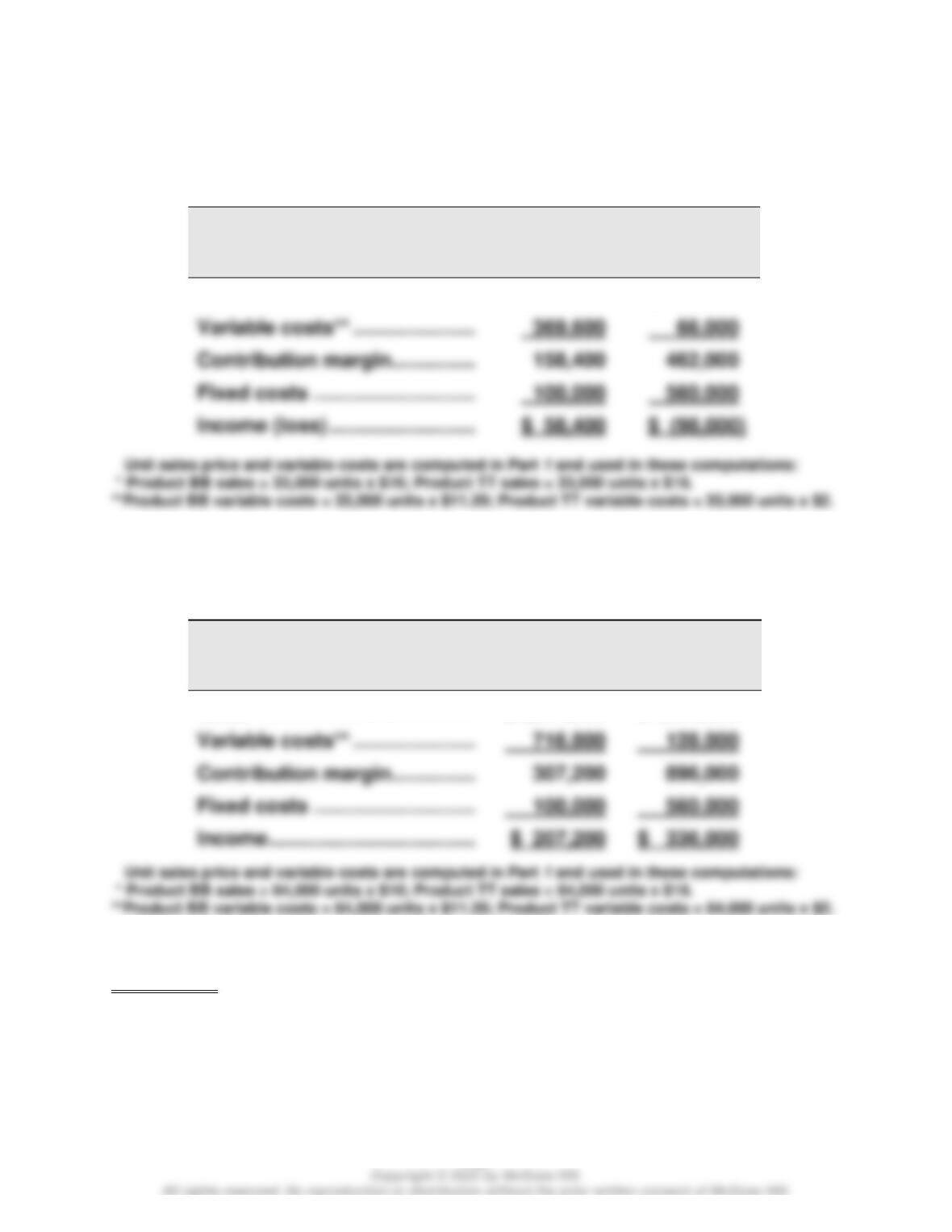
Next year’s contribution margin income statements for each product
assuming sales decline to 33,000 units with no change in unit sales price.
STAM CO.
Contribution Margin Income Statement
Product BB
Product TT
Sales* ………………………………..
$528,000
$ 528,000
Part 3
Next year’s contribution margin income statements for each product
assuming sales increase to 64,000 units with no change in unit sales price.
STAM CO.
Contribution Margin Income Statement
Product BB
Product TT
Sales* ………………………………..
$1,024,000
$1,024,000
Part 4
Product TT
If sales of each product increase to 64,000 units, Product TT would
experience the greater increase in income. Its cost structure includes more
fixed costs, which remain constant as sales increase.
Wild and Shaw, Financial & Managerial Accounting 9e Solutions Manual: Chapter 18
1152
Problem 18–5B (45 minutes)
Part 1
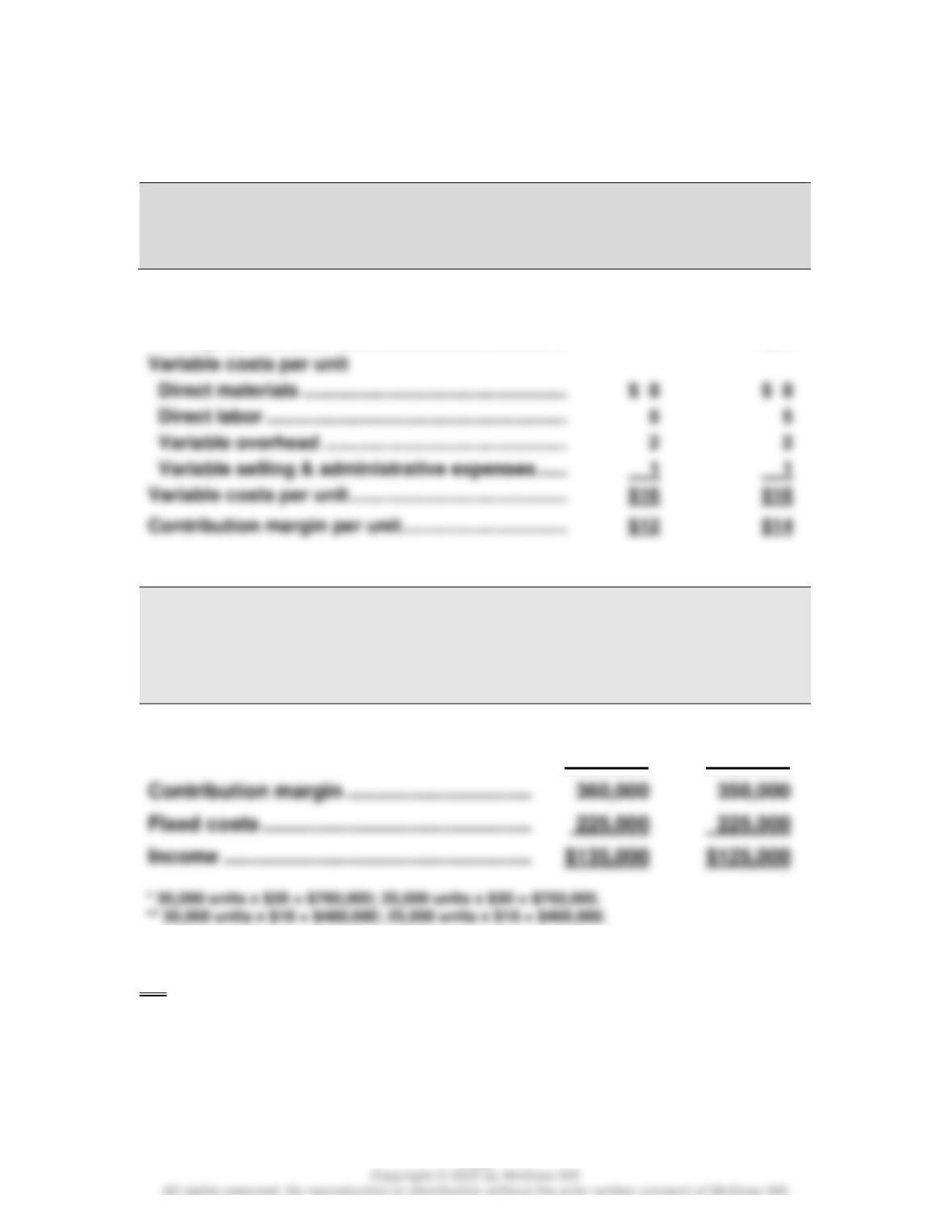
Contribution margin per unit
(a)
With new
material
(b)
With new
material and
price increase
Sales price per unit
Current ………………………………………………………….
With price increase ………………………………………..
$28
$30
Part 2
Contribution Margin Income Statements
(a)
With new
material
(b)
With new
material and
price increase
Sales* ……………………………………………………
$840,000
$750,000
Variable costs** ……………………………………..
480,000
400,000
Fixed costs ……………………………………………
225,000
Part 3
No. Based on (next year’s) income computed in part 2, the company
should not increase its selling price.
1153
Problem 18-6B (40 minutes)
Part 1
(a) Break-even in unit sales = Fixed costs / Contribution margin per unit
= $42,000 / $140*
= 300 units
Part 2
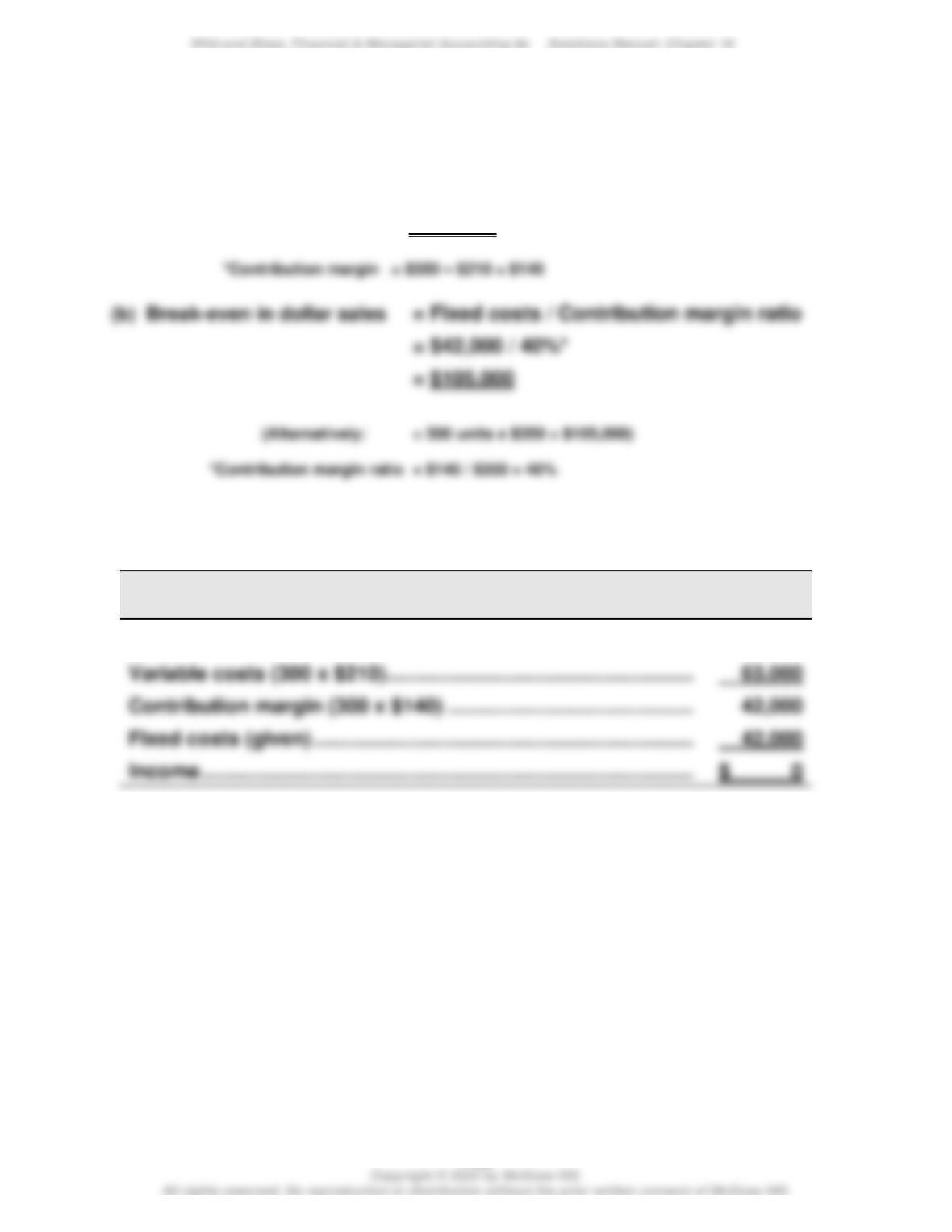
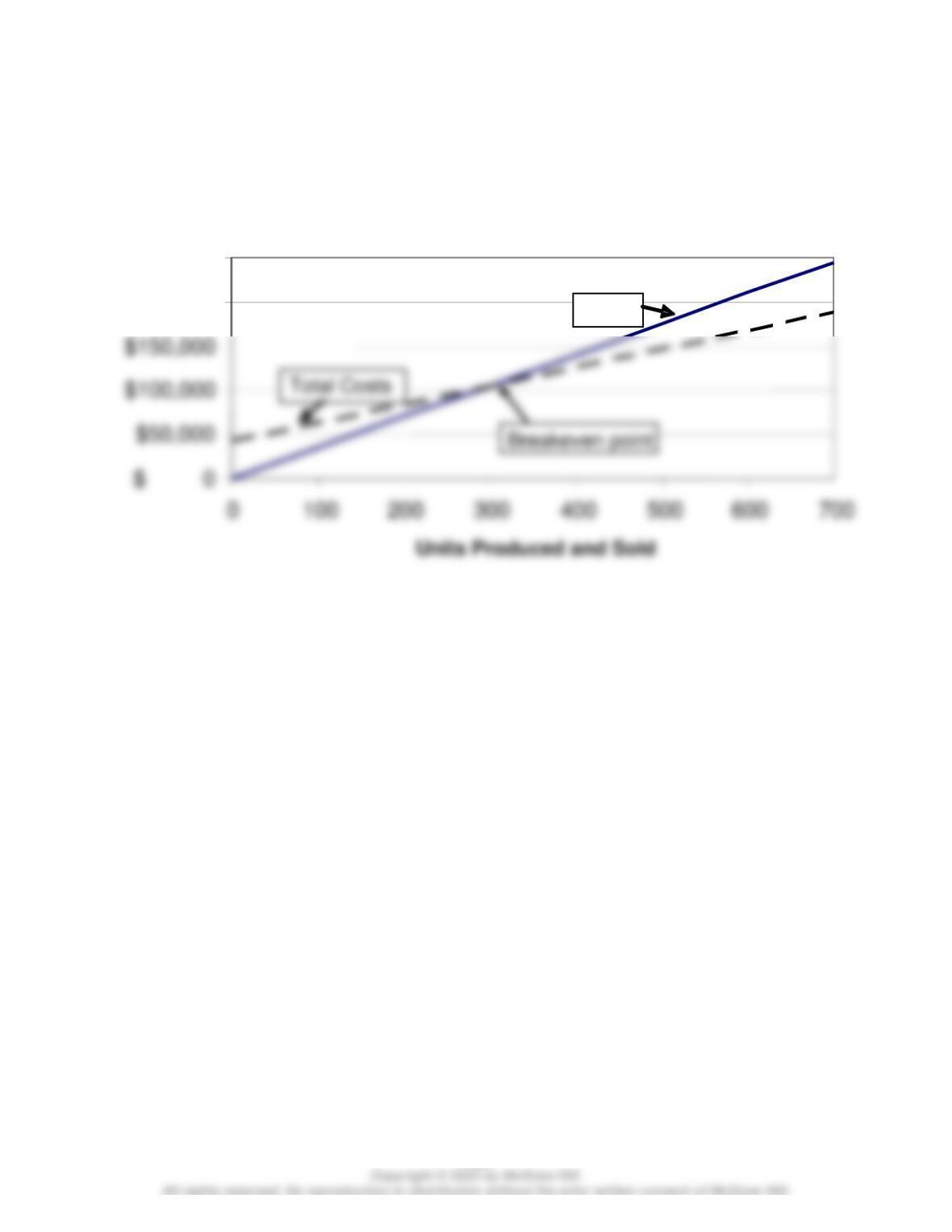
HIP-HOP CO.
Contribution Margin Income Statement (at Break-Even)—Keyboards
Sales (300 x $350) …………………………………………………………….
$105,000
Variable costs (300 x $210) ……………………………………………….
Fixed costs (given) …………………………………………………………..
Wild and Shaw, Financial & Managerial Accounting 9e Solutions Manual: Chapter 18
1154
Problem 18-6B (Continued)
Part 3
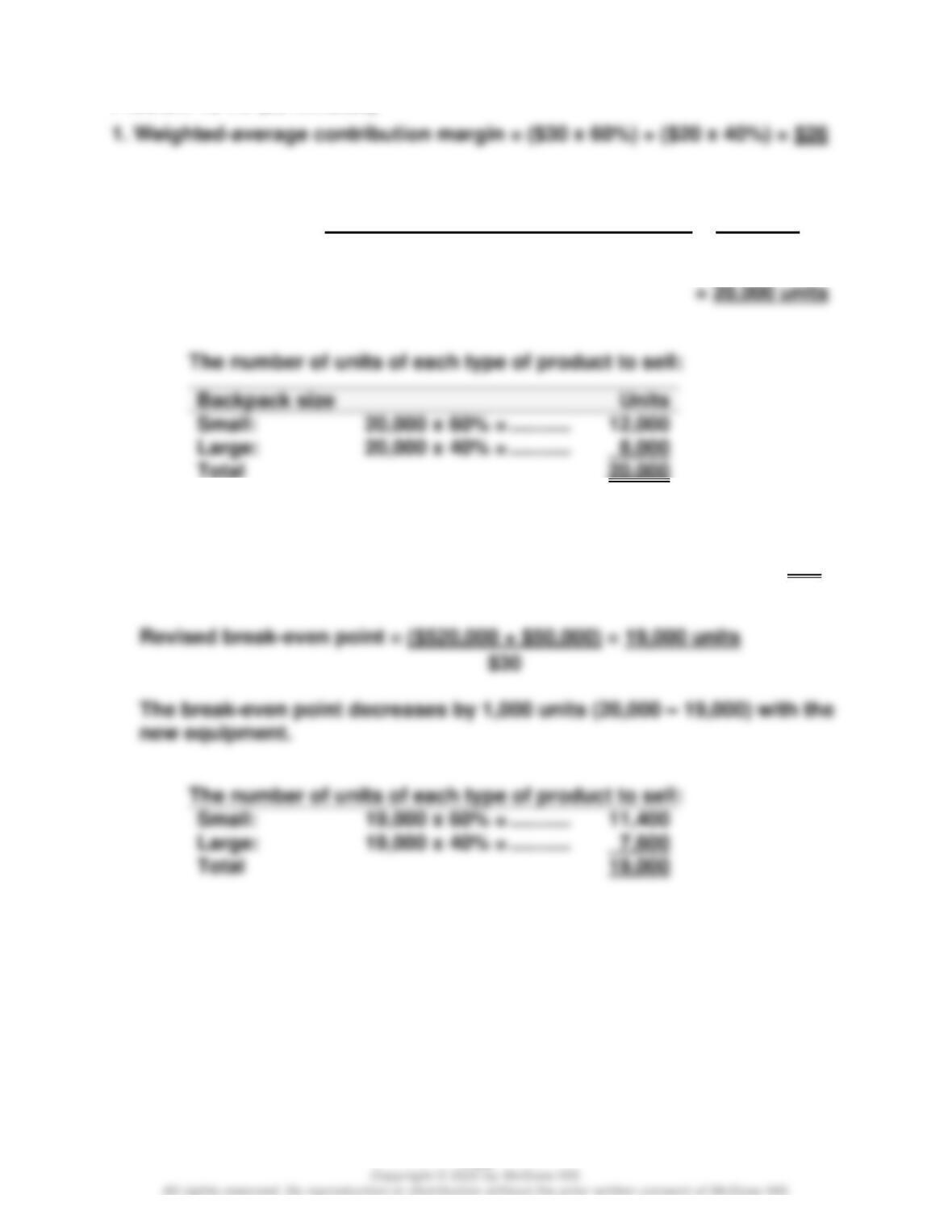
Hip-Hop Company CVP chart
$150,000
$200,000
$250,000
Sales
Wild and Shaw, Financial & Managerial Accounting 9e Solutions Manual: Chapter 18
1155
Problem 18-7B (25 minutes)
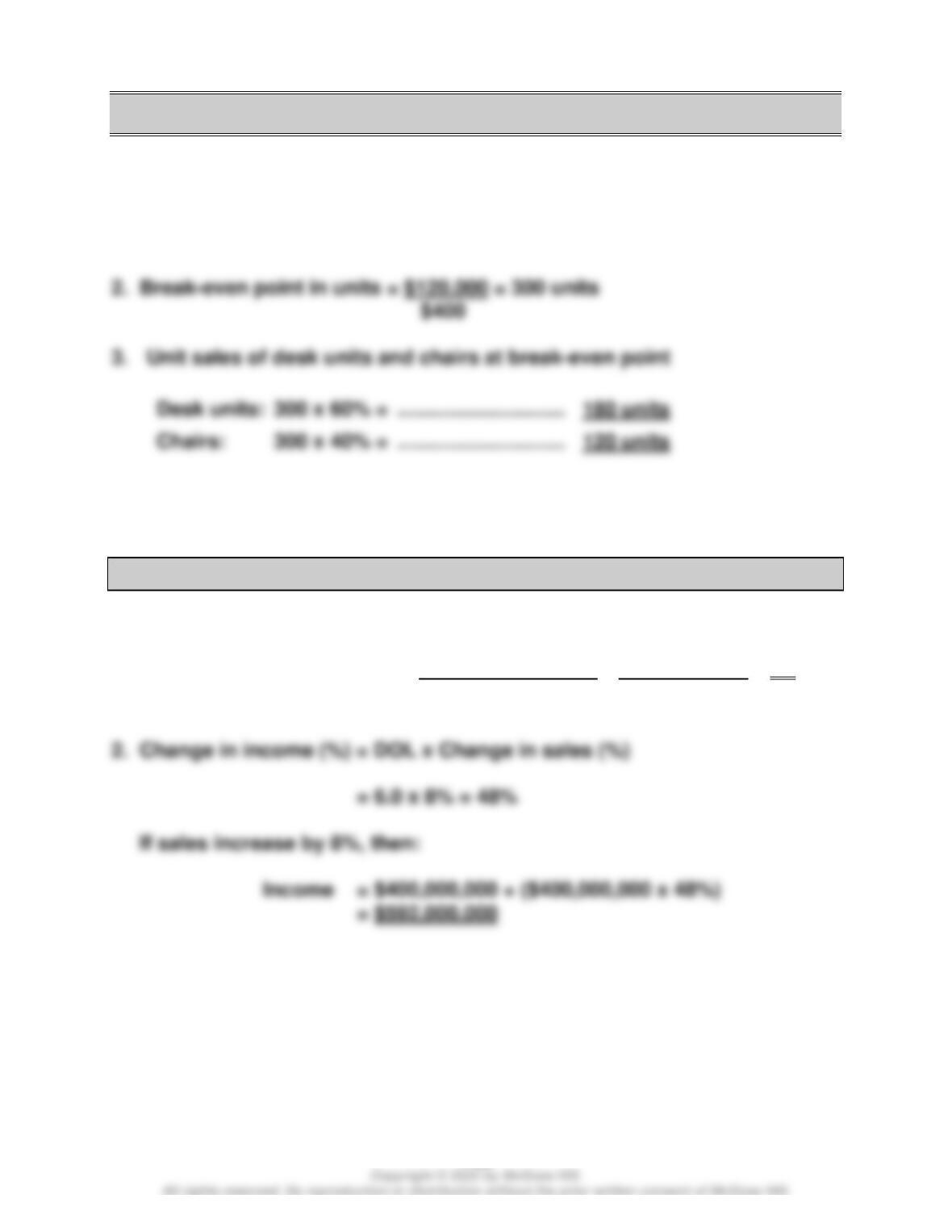
2. Break-even point = Fixed costs = $520,000
in units Weighted-average contribution margin $26
3. Revised weighted-average contribution margin
= ($34 x 60%) + ($24 x 40%) = $30
Wild and Shaw, Financial & Managerial Accounting 9e Solutions Manual: Chapter 18
1156
SERIAL PROBLEM — SP 18
Serial Problem, Business Solutions (20 minutes)
1. Weighted-average contribution margin = ($500 x 60%) + ($250 x 40%) = $400
Accounting Analysis — AA 18-1
Note: $ in millions
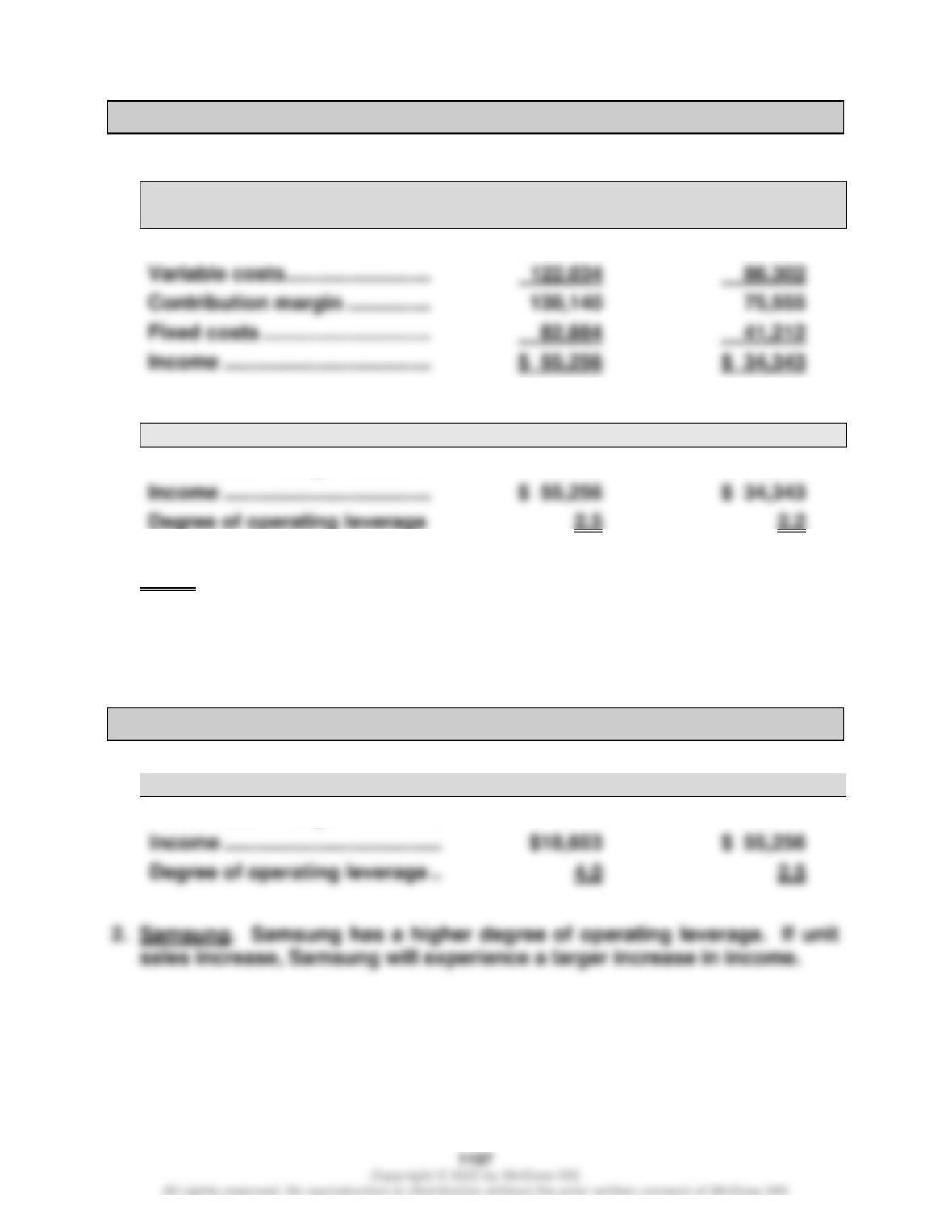
1. Degree of operating leverage = Contribution margin = $2,400,000,000 = 6.0
(DOL) Income $400,000,000
Wild and Shaw, Financial & Managerial Accounting 9e Solutions Manual: Chapter 18
Comparative Analysis — AA 18-2
1.
Contribution Margin Income Statements
$ millions Apple Google
Sales …………………………………..
$260,174
$161,857
2.
$ millions Apple Google
Contribution margin ……………
$138,140
$ 75,555
3. Apple. Apple has a higher degree of operating leverage. If unit sales
decline, Apple will experience a larger decline in income.
Extended Analysis — AA 18-3
1.
$ millions
Samsung
Apple
Contribution margin ……………..
$74,612
$138,140
Wild and Shaw, Financial & Managerial Accounting 9e Solutions Manual: Chapter 18
1158
DISCUSSION QUESTIONS
1. A variable cost is one that varies proportionately with the volume of activity. Direct
2. Within the relevant range of activity, variable costs per unit stay the same (remain
constant) when output volume changes.
3. Within the relevant range of activity, fixed costs per unit decrease when output volume
4. Cost-volume-profit analysis requires the number of units sold, sales price per unit,
variable costs per unit, and fixed costs (in total).
5. A mixed cost include both a variable and a fixed component. Salesperson
6. Definition: Contribution margin per unit = Sales price per unit – Variable costs per unit.
7. Definition: Contribution margin ratio = Contribution margin per unit / Sales price per
8. First, the contribution margin income statement classifies costs and expenses as
variable or fixed. A traditional income statement classifies costs as product or period.
9. A CVP analysis for a manufacturing company is simplified by assuming that the
10. Margin of safety is the excess of expected sales over the break-even sales level. It is
the amount by which sales could drop before a net loss is incurred.
11. The relevant range of operations is the normal operating range for a business. It
12. Three common methods for measuring cost behavior are: the scatter diagram, the
high-low method, and least-squares regression.
13. A scatter diagram is used to display the relation between past costs and sales
14. At break-even, income is zero. Break-even is the point where sales equals fixed plus
variable costs.
Wild and Shaw, Financial & Managerial Accounting 9e Solutions Manual: Chapter 18
1159
15. The four assumptions in CVP analysis are: costs can be classified as variable or fixed,
17. Multiproduct CVP analysis assumes that sales mix of different products is known and
remains constant during the planning period.
18. The degree of operating leverage is a measure of the relative size of fixed costs in a
company’s cost structure. It is computed as the total contribution margin (in dollars)
divided by the income (in dollars).
19. Apple’s primary variable costs in making tablet computers are: direct materials
20. Apple manufactures several different types of products (e.g. computers, phones, and
21. A 65% increase in sales of a popular smartphone model of Samsung is likely viewed
as large. When this occurs, the sales and cost structures are likely to change.
22. If units produced equals units sold, no conversion is necessary. If production
exceeds sales, absorption costing income can be determined by adding [increase in
Wild and Shaw, Financial & Managerial Accounting 9e Solutions Manual: Chapter 18
1160
Ethics Challenge — BTN 18-1
Instructor note: This question can serve to generate class discussion on
cost analysis and estimation. Discussion can focus on accounting,
business, and other ethical concerns.
MEMORANDUM
To: “Mechanics” and “Owners”
From: Your name
RE: Analysis of labor costs for survey
Date: Current date
The memorandum should include many of the following points:
Objectivity: A statement about the need to be objective in the analysis. Both
ethical and professional concerns should motivate the preparer’s desire for
objectivity.
Cost Accounting Estimation: The memorandum should outline how cost
Business Concerns: The memorandum should point out that the repair
business should follow established business practices for setting cost
estimates. There should also be an expressed concern of fairness for the
Mechanic-Related Issues: The memorandum should also be concerned about
the quality of mechanical work. Is the work being done correctly and is
Wild and Shaw, Financial & Managerial Accounting 9e Solutions Manual: Chapter 18
Communicating in Practice — BTN 18-2
Instructor note: Reports will vary, but a typical report would likely include
assumptions similar to the following.
1. Revenue (salary) assumptions
• Find job that pays a specified amount.
2. Cost assumptions
• Find living accommodations at a specified amount.
Teamwork in Action — BTN 18-3
(a) Questions for school administrators (others are possible)
• Number of students that would attend the theater.
(b) Questions for owners (others are possible)
• List of other potential markets for theater showings during school
days.
Wild and Shaw, Financial & Managerial Accounting 9e Solutions Manual: Chapter 18
Entrepreneurial Decision — BTN 18-4
1. Costs that won’t change regardless of how much candy SmartSweets
(i.e., fixed costs) produces likely include rent, production supervisor
salaries, depreciation on equipment, insurance, and taxes.
3. Tara can use CVP techniques to manage her company. Focusing on
contribution margins enables the company to set selling prices that