Chapter 18
Corporations: Organizations and Stock
Chapter Overview
This chapter discusses another form of organization – the corporation. It begins with the steps involved in
forming a corporation along with the advantages and disadvantages of corporations. Corporations have the
advantages of limited liability because they are separate legal entities. They also have unlimited life, and ease of
transferring ownership interest. There is no mutual agency as there is in partnerships but corporations have the
added ability to raise capital easily. The disadvantages include being difficult to form corporations due to legal
requirements and corporations being taxed twice – once as corporate income and a second time when the
dividends are taxed to the shareholders.
Learning Objectives
After studying Chapter 18, your students should gain proficiency in the following:
2. Explain Retained Earnings and Stockholders’ Equity.
4. Journalize Entries to Record Capital Stock Transactions for a Subscription Plan.
Chapter 18 Assignment Grid
Estimated Level
Learning Time in of
Assignment Topic(s) Objective(s) Minutes Difficulty
Discussion Questions and Critical Thinking/Ethical Case
1 Corporation Requirements 1 5 Easy
2 Board of Directors 1 5 Easy
13 Common Stock Subscribed 4 5 Easy
14 Ethical Case 1 5 Medium
Concept Checks
1 Stockholders’ Equity 2 15 Easy
Exercises (Set A)
18A-1 Journal Entry for Issuing Stock 2, 3 20 Medium
18A-2 Journal Entry for Issuing Stock for Equipment 3 20 Medium
Exercises (Set B)
18B-1 Journal Entry for Issuing Stock 2, 3 20 Medium
18B-2 Journal Entry for Issuing Stock for Equipment 3 20 Medium
18B-3 Calculating Dividends 3 30 Medium
18B-4 Journalizing Stock Subscriptions 4 30 Medium
18B-5 Stockholders’ Equity 4 30 Medium
Problems (Set A)
Problems (Set B)
18B-1 Journal Entries for Issuing Stock 3, 4 50 Medium
18B-2 Calculating Dividends 3 50 Hard
18B-3 Stockholders’ Equity 4 40 Medium
18B-4 Entries and Stockholders’ Equity 3, 4 40 Hard
Estimated Level
Learning Time in of
Assignment Topic(s) Objective(s) Minutes Difficulty
Financial Report Problem
Learning Unit 18-1: The Advantages and Disadvantages of the
Corporate Structure
Summary: A corporation is a separate legal entity. Four steps are involved in forming a corporation: (1) The
incorporators, those wishing to form the corporation, apply to a state for a charter and articles of incorporation
Key Concepts: Incorporators, articles of incorporation, charter, certificate of incorporation, stockholders,
directors, minute book, limited liability, stock certificate.
Lecture Outline:
Corporations are another form of organization.
1. There are four steps involved in forming a corporation:
2. The incorporators, those wishing to form the corporation, submit articles of incorporation and apply to
the state for a charter.
a. The articles of incorporation include:
i. Name of corporation and the incorporation date
ii. Purpose of the business
vi. Types of stocks to be offered
3. Advantages of the corporate form of organization – like sole proprietorships and partnerships, there are
some advantages and disadvantages to the corporate form of organization. The advantages are:
a. Limited Liability / Separate Legal Entity – Stockholders have limited liability. They are not
4. The disadvantages to the corporate form of organization.
a. Difficulty in forming a corporation due to government regulations. (More difficult than a
partnership and sole proprietorship.)
b. Corporate taxes – A “C” corporation is taxed twice. The corporation pays taxes on its income, and
its shareholders are taxed on any income distributed to them. An “S” corporation is taxed at the
stockholder level similar to a partnership.
Teaching Tips/Strategy: Use Success Coach LU 18-1 to assess some basic corporate characteristics introduced
in the chapter. The first three Discussion Questions may be useful in engaging students in discussion.
Use the “Ten–Minute Quiz” questions #1, and #2 to reinforce the Learning Objective concepts.
Learning Unit 18-2: Retained Earnings and Stockholders’ Equity
Summary: The equity section of a balance sheet of a corporation differs from that of a sole proprietorship or a
partnership. With the corporation, the stockholders’ equity section is broken down into two major parts: Paid-
In Capital and Retained Earnings. Paid-In Capital is the amount that stockholders have invested in the
business. Retained earnings are accumulated profits that are retained or kept in the corporation. Various equity
terms are defined in this chapter. Also, characteristics of common stock and preferred stock are listed and
explained.
Dividends are paid to stockholders as their share of the corporation’s profits. A dividend must be voted and
Lecture Outline:
1. The equity section of a corporation’s balance sheet differs from other forms of organization.
a. Paid-in capital shows the amount that stockholders have invested in the business.
b. Retained earnings are accumulated profits that are retained or kept in the corporation after dividends to
shareholders.
c. Capital stock is issued by the corporation to shareholders in return for their investment in the
corporation.
i. Authorized capital – The charter of the corporation indicates the maximum amount of shares of
2. There are two classes of capital stock:
a. Common stock is the most basic type of stock.
i. Common stockholders are entitled to certain rights due to owning this class of stock.
ii. The right to vote at stockholders’ meetings.
iii. The right to share in profits by receiving dividends.

b. Preferred stockholders have claim to a corporation’s profits and assets over common stockholders.
i. Corporations watch current market conditions and try to offer preferred stock that will be
attractive to investors.
c. Dividends on common and preferred stock:
i. Voted on by the board of directors and are paid to shareholders as their share of the
corporation’s profit.
ii. Several ways for preferred stockholders to receive a prior claim on a corporation’s earnings
v. Nonparticipating preferred stock:
a) Stock that provides its shareholders with a certain percentage as a dividend while the
remainder goes to common stockholders.
vi. Participating dividend:
a) Stock that entitles its holders to a fixed dividend with a split of the remainder (in
various ways) with common stockholders.
d. Stock value for capital stock:
i. Par value is an arbitrary value that is placed on each share of stock.
Teaching Tips/Strategy: Explain par value and stated value. Use Exercise 18A-2 to demonstrate the issuance
of the stock using par. When issuing stock for non-cash, explain that market value is the key for the amount to
include on the journal entry. Explain preferred stock and how this type of stock has preference over the
common stock for dividends. Explain the type of stock and the specific characteristics of each type of preferred
stock (participative, cumulative, etc.)
Use the “Ten-Minute Quiz” questions #3 and #4 to reinforce the Learning Objective concept.
Learning Unit 18-3: Capital Stock Transactions and Calculating
Dividends
Summary: In this unit we look at how to record the issuing of stock that has (1) par value, (2) no-par value, and
premium (more than par value), the common stock is recorded at par value. Because this stock is sold at a
premium (more than par value), the excess of the par value will be recorded in a new account called paid-in
capital in excess of par value—common. Note in the transactional analysis that follows that this account is part
Selling common stock at a discount (below par), occurs when a stock is sold below par. As a result, a discount
on stock results. An account called discount on common stock records the discount. It is a contra-stockholders’
equity account that will reduce the common stock account to which it is related. Some states do not allow stock
to be sold at a discount. Selling no-par common stock with a stated value at an amount of above stated value
stated value placed on stock by the board of directors. This amount is not credited to the stock account.
When recording transactions in which stock is exchanged for noncash assets, the assets are recorded at fair
market value. Common stock is recorded at par value. If fair market value is not available for assets, one can try
To calculate preferred dividends, you multiply the number of preferred shares times the par value per share
times the rate of dividend. The result is the dividend allocated to preferred stockholders. To calculate the
common stock dividend, you multiply the number of shares times the par value per share times the same rate of
Key Concepts: Premium, paid-in capital in excess of par value-common, discount on stock, paid-in capital in
excess of stated value-common, organization cost
Lecture Outline:
1. Journal entries:
a. When recording sale of common stock at par value (Figure 18-2)
For example: 200 shares @ 10 par value = $2,000
The journal entry is:
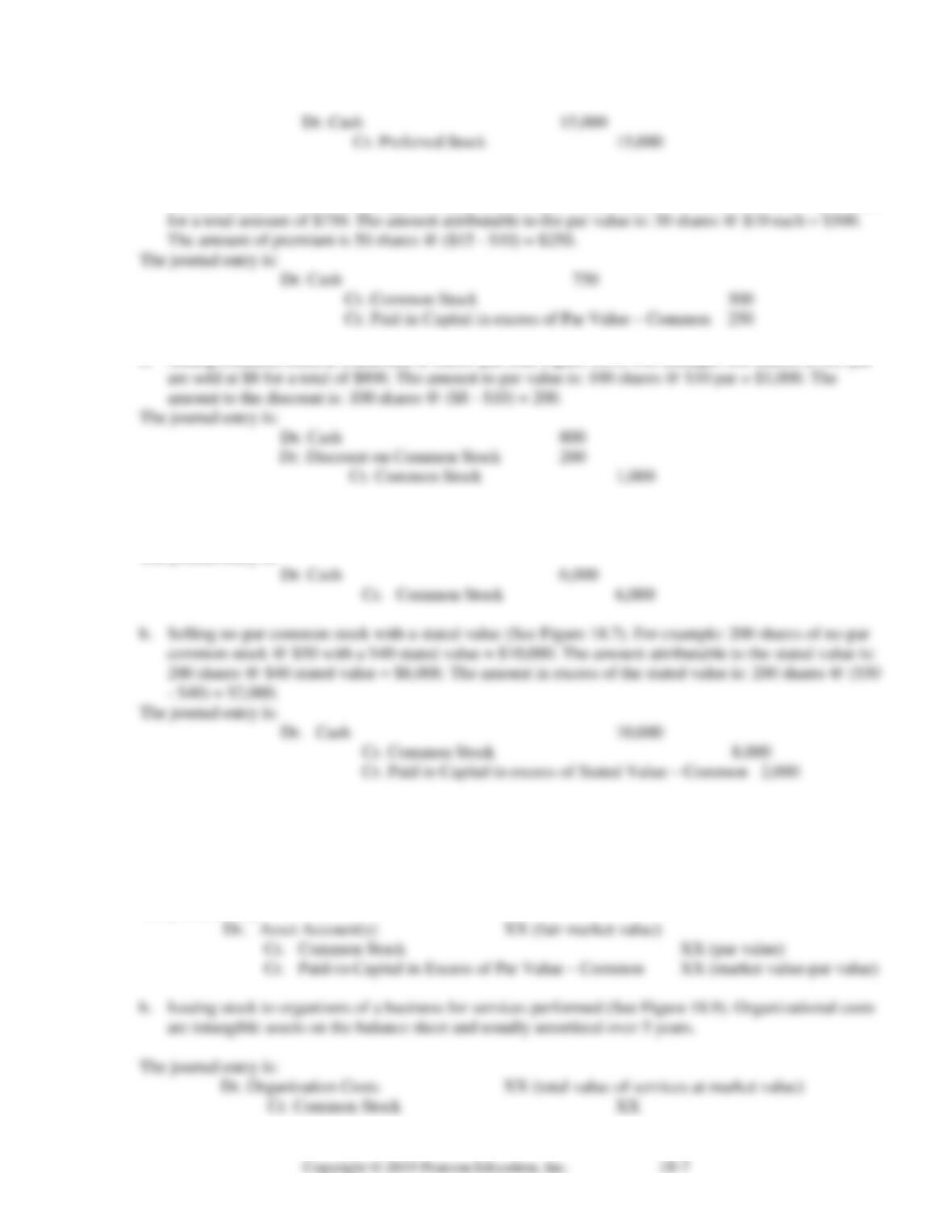
c. Selling common stock at a premium (See Figure 18.4). Premium is a term that records the sale of stock
at more than par value. For example: 50 shares of $10 par-value common stock are sold at $15 per share
d. Selling common stock at a discount or below par (See Figure 18.5). For example 100 shares of $10 par
2. Recording sale of stock with no par value and no stated value (See Figure 18.6).
a. For example: 300 shares of no-par common stock for $20 per share = $6,000.
The journal entry is:
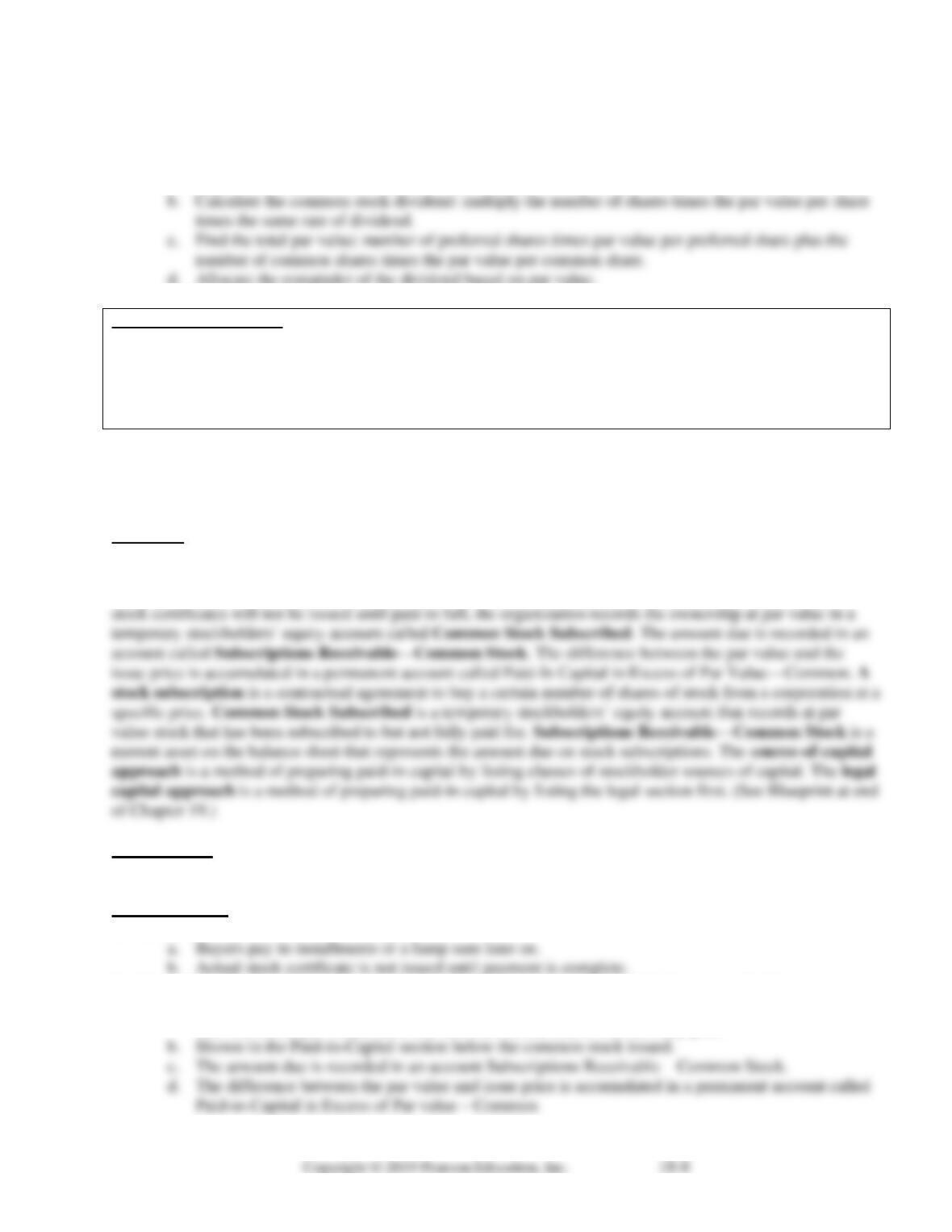
3. Recording transaction in which stock is exchanged for non-cash assets (See Figure 18.8):
a. The assets are recorded at fair market value
b. Common stock is recorded at par value.
c. The difference is recorded as Paid-in-Capital in Excess of Par Value
The journal entry:
4. Dividend calculations (See Table 18.1):
a. Calculate preferred dividends: multiply the number of shares times the par value per share times the
rate of the dividend.
d. Allocate the remainder of the dividend based on par value.
Teaching Tips/Strategy: Review Success Coach LU 18-3 while lecturing the topic. To review, use Concept
Checks #2 and #4 to explain the allocation of dividends between preferred and common stock. Exercise 18A-3,
Exercise 18B-3, Problem 18A-2, or 18B-2 are excellent to use as demonstration exercises or homework.
Use the “Ten-Minute Quiz” questions ##5, #6, #7, #8 and #9 to reinforce the Learning Unit Objectives #2
– #3 concepts.
Learning Unit 18-4: Journalizing Entries to Record Capital Stock
Transactions for a Subscription Plan
Summary: In the last unit, we assumed that stocks were immediately issued and full payment of cash or other
assets was received. In this unit, we examine stock transactions under stock subscription plans. Under such
plans, buyers pledge to buy certain stocks but pay in installments or in a later lump sum. In most cases,
companies will not issue the actual stock certificates to these buyers until payment is complete. Because the
Key Concepts: Stock subscription, common stock subscribed, subscriptions receivable-common stock, source-
of-capital approach, legal capital approach.
Lecture Outline:
1. Stock subscription is a contractual agreement:
2. Using the example in the chapter: the company accepted subscription of 1,000 shares at $160 per share.
a. The amount is recorded in Common Stock Subscribed – a temporary stockholder’s equity account
that records, at par value, stock that has been subscribed to but not fully paid.
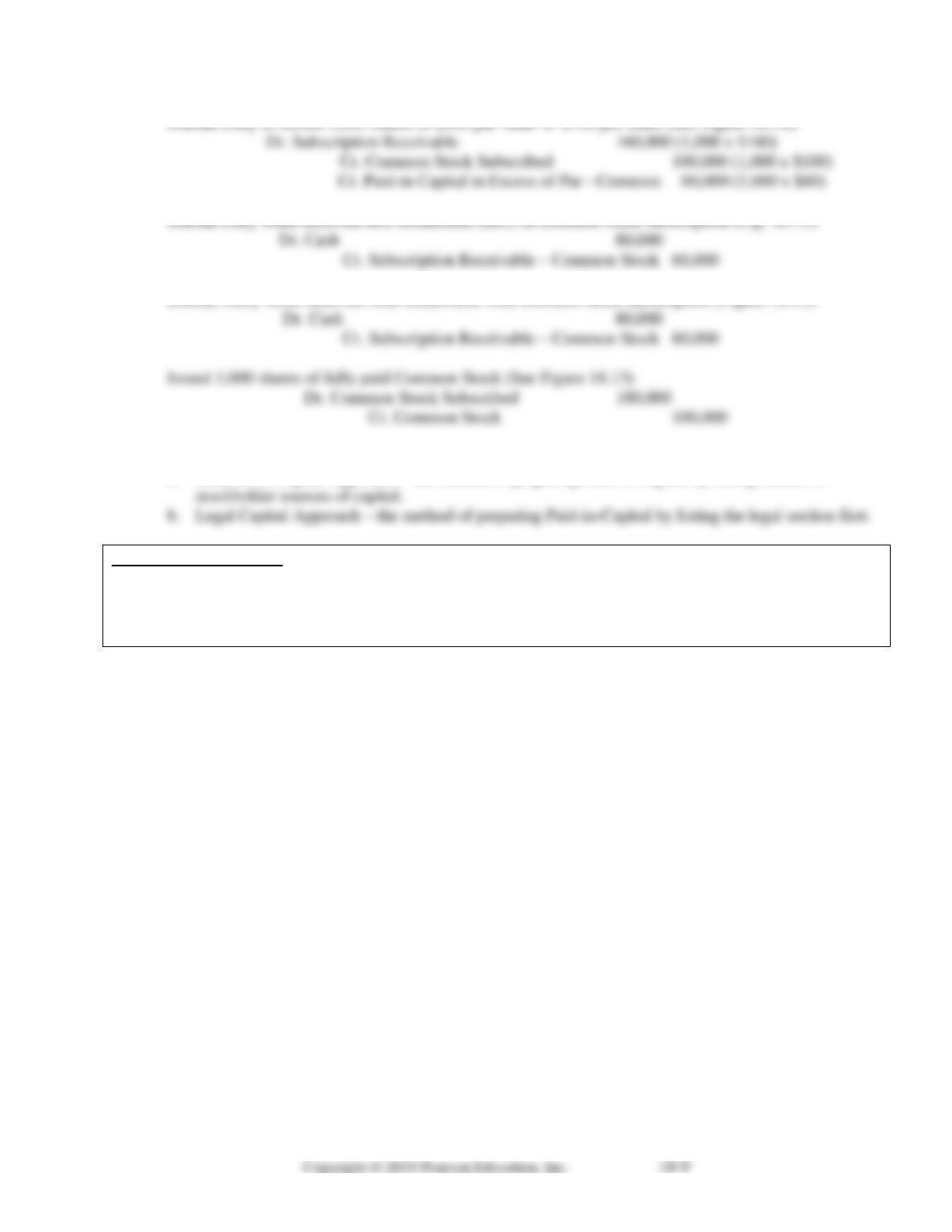
Journal Entry when received final installment from common stock subscription (Figure 18.12):
3. Stockholders’ Equity – two approaches of presentation on the balance sheet.
a. Sources-of-Capital Approach – the method of preparing Paid-in-Capital by listing classes of
Teaching Tips/Strategy: Use Success Coach LU 18-4 to clarify the concepts. Then proceed to use Discussion
Question #13 to engage the students on the topic. To assess the knowledge, utilize the Concept Checks #5 and
Exercises 18A-4 and 18B-4.
Use the “Ten-Minute Quiz” question #10 to reinforce the Learning Objective concepts.

Name Date Section
CHAPTER 18
TEN-MINUTE QUIZ
Circle the letter of the best response.
1. Which of the following is not an advantage of corporations?
a. corporations are separate legal entities
b. corporations are simple to form
c. corporations have an unlimited life
d. transferring ownership between corporations is easy
2. The board of directors is elected by:
a. the president of the company b. the president of the board
c. the common stockholders d. the preferred stockholders
3. Which of the following is a characteristic of common stock?
a. the right to accumulate dividends
b. the right to participate in dividends with the preferred stockholders.
c. the right to make contracts on behalf of the corporation
d. the right to dispose of or sell the stock.
4. Retained earnings are:
a. the total earnings of a business
b. the total earnings of a business less distributions to shareholders
c. the cumulative total of dividends paid
d. the total received in the sale of stock
5. Preferred stockholders’ claims on assets and income come ________ those of creditors.
a. before b. after
c. simultaneously d. before or simultaneously
6. Preferred stockholders’ claims on assets and income come ________ those of common stockholders.
a. before b. after
c. simultaneously d. before or simultaneously
7. Par value is:
a. an arbitrary value b. based on the market price
c. the same as the stated value d. preemptive right
8. Paid-in-Capital in Excess of Par is calculated as:
a. number of shares times the market price
b. number of shares times the difference between the market price and the par value
c. number of shares times the par value
d. the number of shares times the discount on the stock
9. Shares outstanding is:
a. the number of shares issued by the corporation and still in the possession of the shareholders
b. the number of shares affected by the organization costs
c. the number of shares allowed by the corporate charter

d. the number of shares issued by the corporation
10. When stock is issued under a stock subscription plan:
a. paid in capital in excess of par does not exist
b. stock is recorded only at the par value
c. common stock is credited
d. common stock subscribed is the account used until the cash is received
Answer Key to Chapter 18 Quiz