18
Performance Measurement to Support Business
Strategy
Solutions to Review Questions
18–1.
Good performance requires both a successful strategy and an organization that can enact
the strategy. That is, we need alignment between the strategy and organizational
structures to obtain performance. Cost accounting and management control practices are
important organizational structures for enacting strategy. Management accountants who
understand the business strategy will be better able to design and use accounting
systems to enact strategy.
18–2.
No. The balanced scorecard is a set of performance targets and results that show an
organization’s performance in meeting its objectives relating to competing stakeholders’
expectations. The performance measures are linked to the goals and the strategy for
meeting those goals.
18–3.
18–4.
Financial measures of performance attract attention and identify areas where
improvements need to be made. Nonfinancial performance measures direct employees’
attention to the organization’s objectives and focus on the measures that are controllable
by each employee. They are more likely to be understood by operating personnel and also
are more timely.
18–5.
Critical success factors are the factors that are important to the organization’s success.
18–6.
People at different levels in the organization have different responsibilities. Performance
measures are most effective when they relate to what people at different levels control.
18–7.
Benchmarking identifies an activity that needs to be improved, finds an organization that is
the most efficient at the activity, studies its process, and then utilizes that process.
18–8.
18–9.
The firm’s value proposition describes how the organization will create value for its
18–10.
An organization’s mission includes the organization’s values, its responsibilities to
stakeholders, and its goals. The strategy is the means to accomplish the mission.
18–11.
Customer satisfaction measures reflect the performance of the organization on several
factors, including quality control and delivery performance, that a customer values.
18–12.
18–13.
Delivery performance measures indicate how proficient the organization is at delivering
18–14.
Worker involvement is important for three reasons:
18–15.
See Exhibit 18.11 for examples.
Solutions to Critical Analysis and Discussion Questions
18–16.
Answers will vary, but should include discussions of the value proposition and the
demands that this places on the organization. Examples follow:
Local coffee shop:
Porter Framework: probably best considered a focused competitor — focusing on regional
or local coffee preferences while delivering a consistent product and service experience.
18–17.
Answers will vary, but should include:
Stakeholders—students, professors, employees, publishers, authors, and regents.
Critical success factors—sufficient inventory and accurate class/text information.
Critical success factors for a non-campus bookstore include sufficient inventory, as above,
but also a broad selection of titles.
18–18.
Answers will vary.
Quality control:
1) Defects, e.g., scratches in the case
Delivery performance:
1) Percentage of on-time deliveries
18–19.
Answers will vary. Multiple measures of performance serve two purposes in an
18–20.
Answers will vary. Subjective and objective questions measure different aspects of
learning. Objective measures are useful for assessing learning of facts and methods.
Subjective measures are useful for assessing critical thinking.
18–21.
Ultimately, the goal is to increase profits. In many, maybe most, settings, customer
18–22.
The number of complaints is a measure of general dissatisfaction with a product or
service. It might fail to measure adequately customer service if customers find it easy to
switch suppliers, so that it is not worth the effort to complain.

18–23.
18–24.
Answers will vary. Benchmarking does not have to take place at the company level. It is
possible to benchmark processes. For example, you can compare customer retention
rates or employee turnover.
Solutions to Exercises
18–25. (15 min.) Strategy and Management Accounting Systems: Joe’s Pizzeria.
a. Answers should consider the following:
Joe’s initial business model required providing a low cost pizza configured as the
customer ordered it and delivered to the correct location quickly. In this setting
performance measures would focus on cost control, order accuracy and delivery speed.
b. Answers should consider the following:
Old strategy: core capabilities around pizza delivery, core assets include pizza crust recipe
and long term ‘brand’ of Joe’s Pizzeria
18–26. (15 min.) Business Strategy Classification
Organization
Dominant Porter Strategy
Apple
Product differentiation for mass-appeal consumer
electronic products
18–27. (20 min.) Nonfinancial Performance Measures.
Answers will vary. Note that these positions are (typically) paid on an hourly basis, but all
have customer-facing jobs. Therefore, their performance can directly affect organizational
performance. None of the measures suggested here are perfect (no measure would be).
An interesting discussion can focus on what type of dysfunctional behavior could these
measures induce.
a. Barista: Number of customers served, correct orders, complaints.
b. Dental hygienist: Adherence to schedule, repeat visits, satisfaction.
18–28. (20 min.) Performance Measures and the Balanced Scorecard: Snowy
Mountain Financial Advisors.
Perspective
Performance Measure
Perspective
Number
1.
Financial
Market share
1
2.
Customer
Regulatory compliance
4
3.
Learning and growth
New customer referrals from
existing customers
2
4.
Internal business processes
Training hours
3
Order errors
4
Branch profit
1
18–29. (20 min.) Performance Measures and the Balanced Scorecard: Metro
Museum.
Perspective
Performance Measure
Perspective
Number
1.
Financial
Operating surplus (revenues
less costs)
1
2.
Customer
Ratings on a well-known travel
web site
2
3.
Learning and growth
Average wait time for ticket
purchase
4
New memberships
Staff to visitor ratio
4
18–30. (20 min.) Different Performance Measures Across the Organization.
This question is based on the authors’ experience.
Answers will vary, but should include the following:
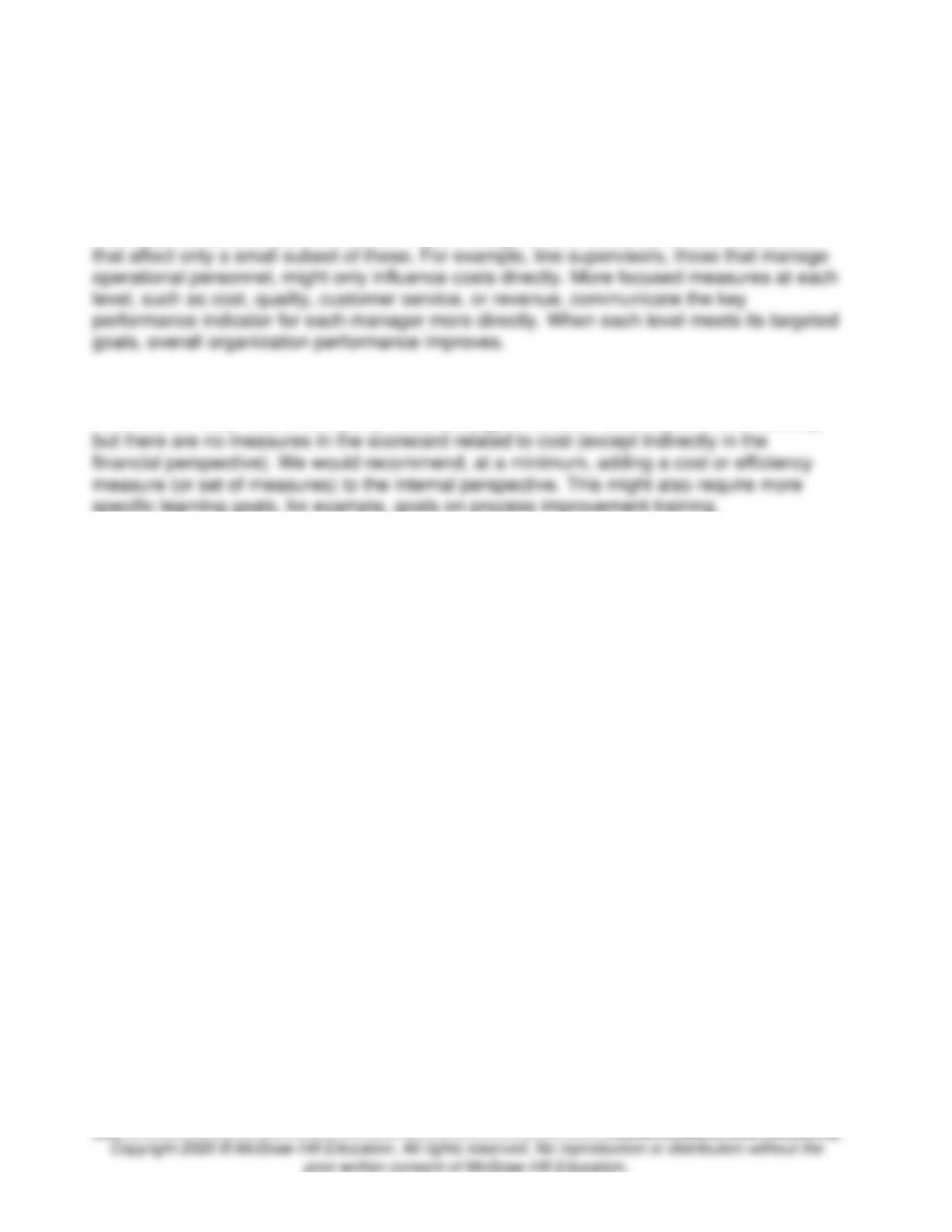
A single measure, such as RONA or ROI is based on a combination of factors, in this case
revenues, costs, and asset utilization. Most managers have authority to make decisions
18–31. (20 min.) Balanced Scorecards and Strategy Maps: Crane Company.
Answers will vary. Crane Company has a strategy to be a low-cost leader in the industry,
18–32. (20 min.) Balanced Scorecards and Strategy Maps: TechMasters, Inc.
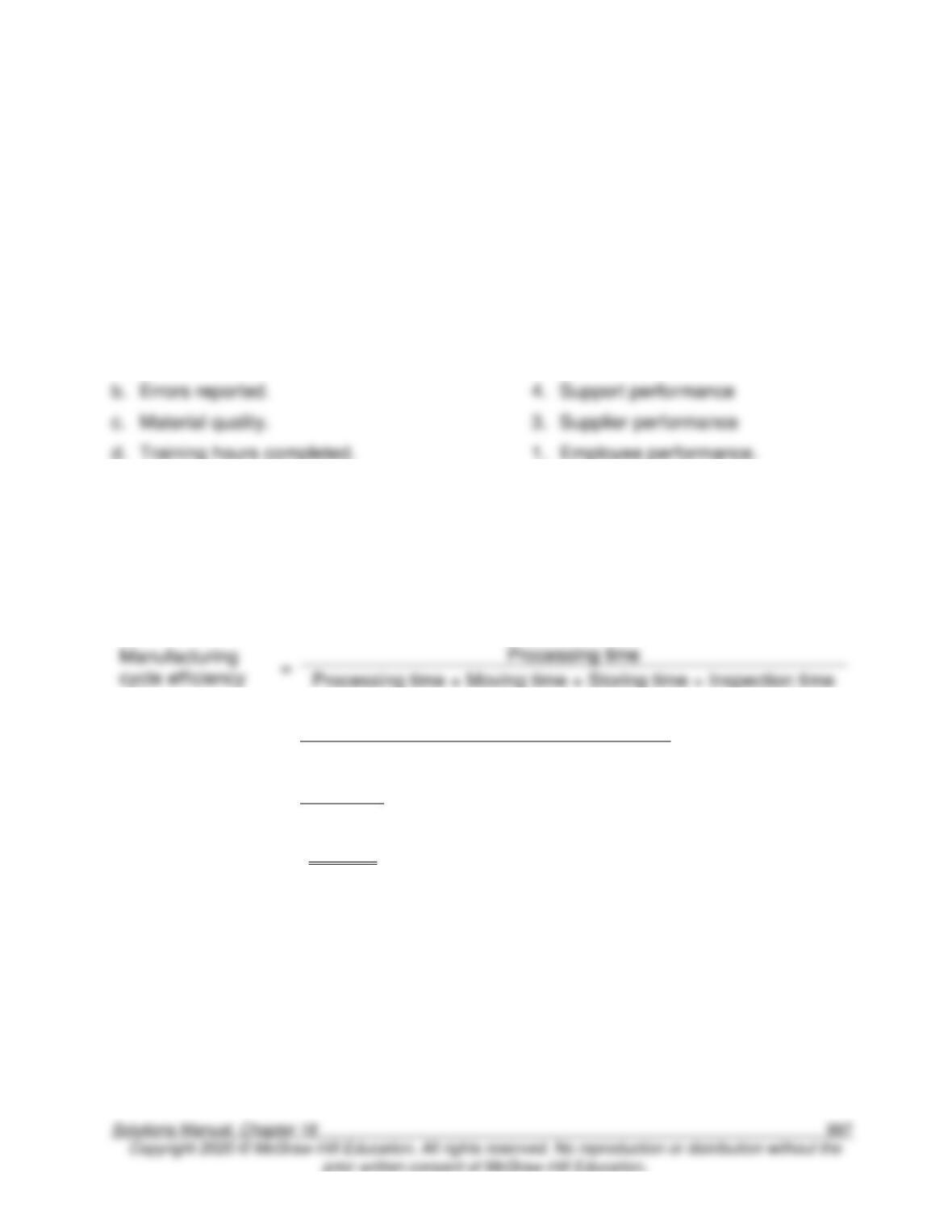
Answers will vary. TechMasters wants to lead in innovation, but there are no measures
regarding learning or innovation in the scorecard. We would recommend at a minimum
that innovation measures, such as new product introductions, patents, and employee
development (rather than simply retention and satisfaction) be added.
18–33. (20 min.) Benchmarks.
a. Length of time to fill vacant positions. 4. Support performance.
b. Number of product recalls. 2. Product performance.
c. Number of requests for transfer. 1. Employee performance.
d. Percentage of late deliveries. 3. Supplier performance.
18–34. (20 min.) Benchmarks.
a. Customer returns. 2. Product performance.
18–35. (15 min.) Performance measures.
Answers will vary, but might include: correct orders, time to serve, time to greet, number of
times the waitstaff need to be called, returned meals.
18–36. (10 min.) Manufacturing Cycle Time and Efficiency: Bell & Porter.
=
2.10 hrs.
2.10 hrs. + 3.25 hr. + 0.35 hrs. + 0.30 hrs.
=
2.10 hrs.
6.00 hrs.
=
35%
18–37. (20 min.) Functional measures.
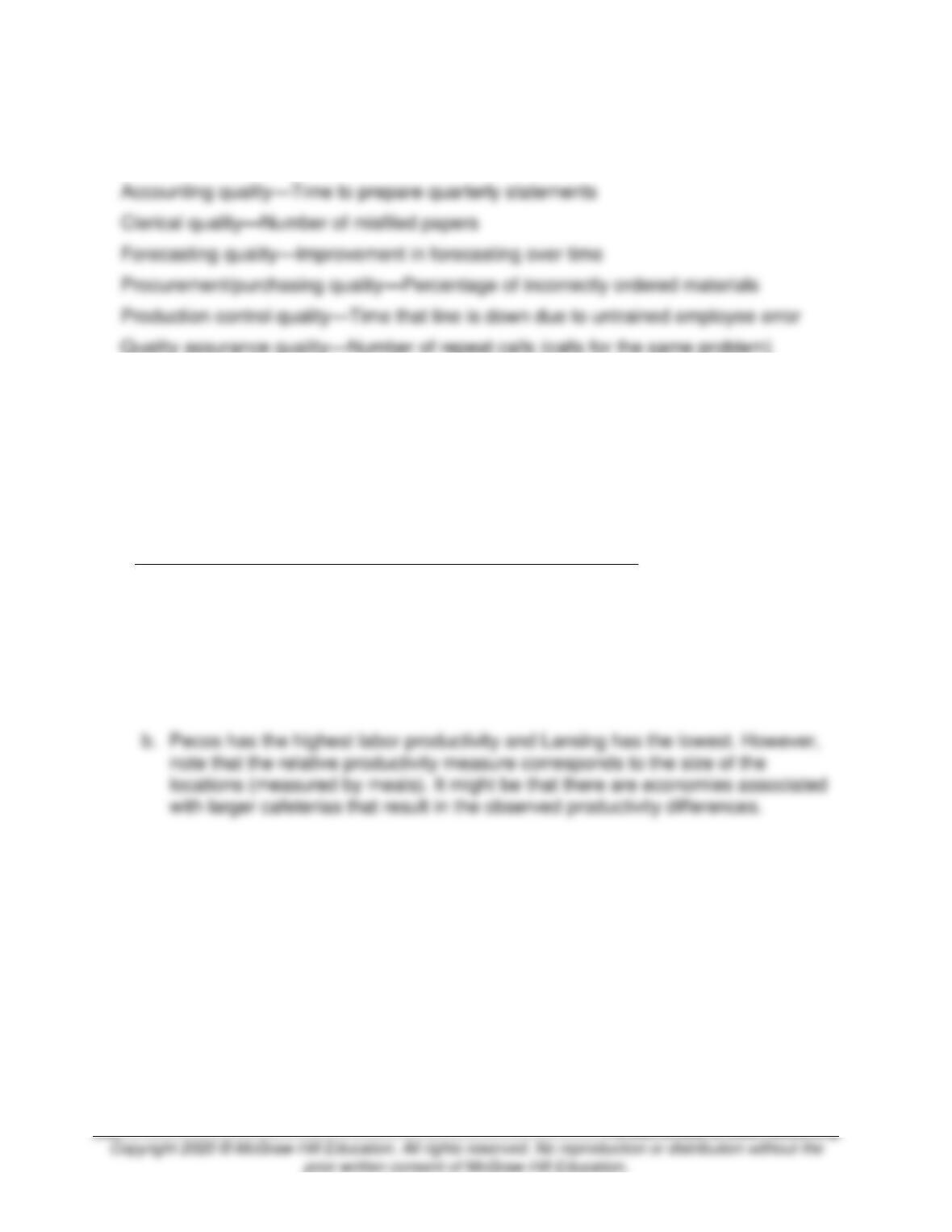
Answers will vary. Some possible examples are:
18–38. (30 min.) Partial Productivity Measures: McMahon Corporation.
a. Partial labor productivity = Output (meals) ÷ Input (hours)
Location
Output
(Meals)
÷
Input
(Hours)
=
Partial Labor
Productivity
Mobile ……….
114,000
÷
35,000
=
3.257
Pecos ……….
216,000
÷
55,000
=
3.927
Spokane ……
74,000
÷
22,500
=
3.289
Lansing ……..
13,500
÷
5,250
=
2.571
18–39. (30 min.) Partial Productivity Measures: Cambria Chemicals.
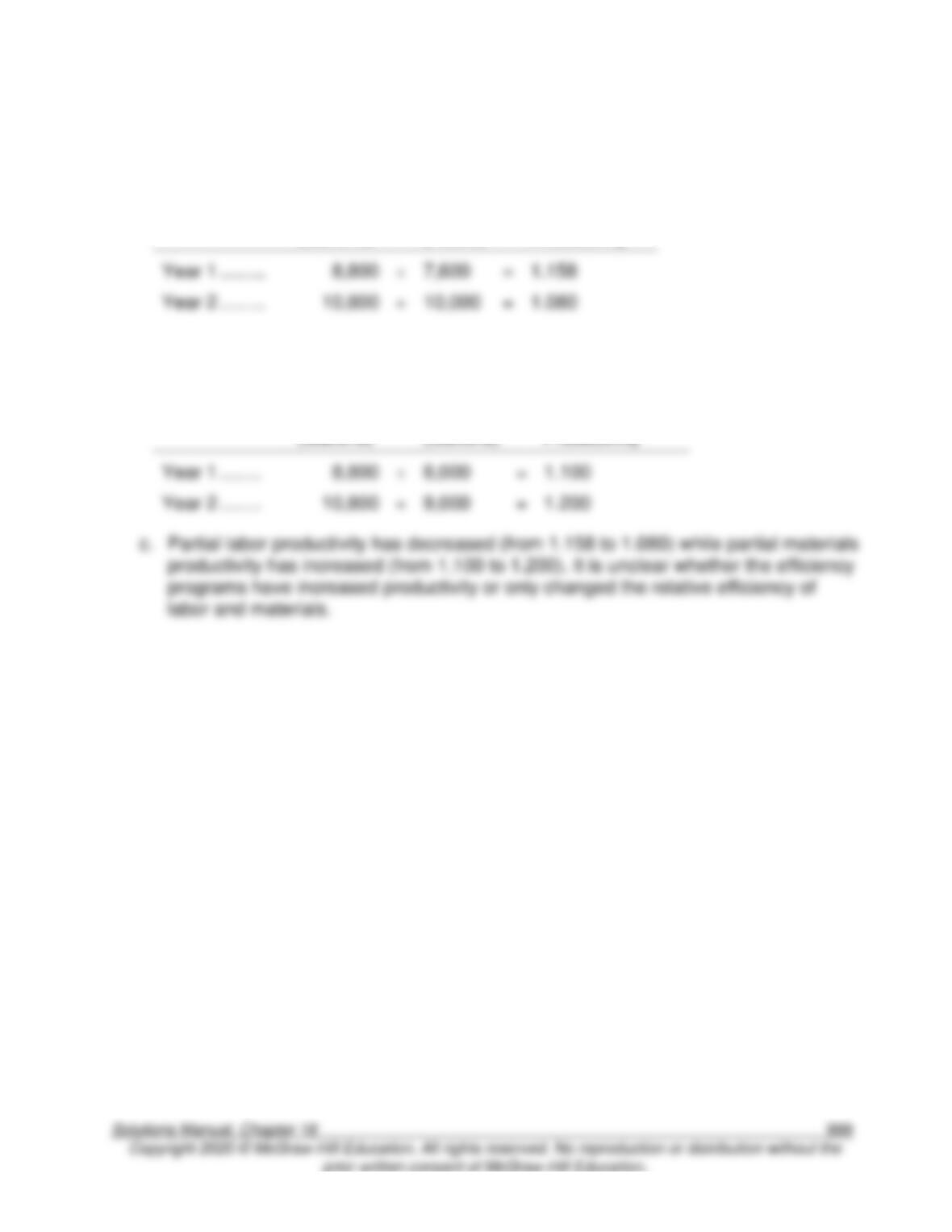
a. Partial labor productivity = Output (gallons) ÷ Input (hours)
Year
Output
(Gallons)
÷
Input
(Hours)
=
Partial Labor
Productivity
b. Partial materials productivity = Output (gallons) ÷ Input (gallons)
Year
Output
(Gallons)
(Gallons)
Productivity
÷
Input
=
Partial Materials
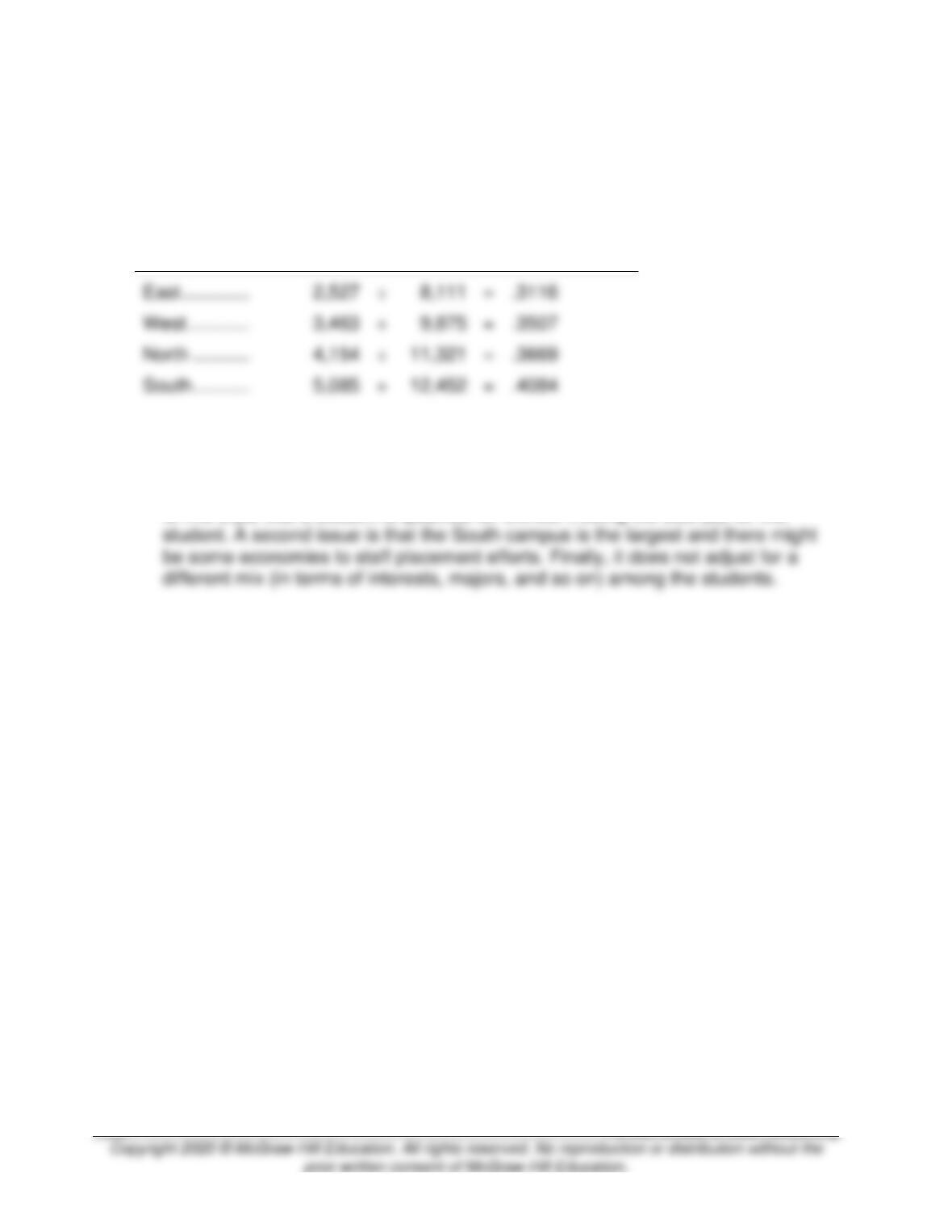
18–40. (30 min.) Partial Productivity Measures: Gigantic State University.
a. Partial labor productivity = Output (students placed) ÷ Input (hours)
Location
Output
(Students
Placed)
÷
Input
(Hours)
=
Partial Staff
Productivity
b. The South campus has the highest staff productivity and the East campus has the
lowest. There are several problems with this measure, however. The measure
does not control for the type (or pay) of the job. The staff might have an incentive