18
Nonfinancial and Multiple Measures of
Performance
Solutions to Review Questions
18–1.
Good performance requires both a successful strategy and an organization that can enact
18–2.
No. The balanced scorecard is a set of performance targets and results that show an
18–3.
18–4.
Financial measures of performance attract attention and identify areas where
18–5.
Critical success factors are the factors that are important to the organization’s success.
18–6.
18–7.
18–8.
18–9.
The firm’s value proposition describes how the organization will create value for its
18–10.
18–11.
18–12.
Manufacturing cycle efficiency measures the efficiency of the total manufacturing cycle
18–13.
Delivery performance measures indicate how proficient the organization is at delivering
18–14.
Worker involvement is important for three reasons:
1) Increased worker involvement often translates to an increased commitment to the
18–15.
See Exhibit 18.7 for examples.
Solutions to Critical Analysis and Discussion Questions
18–16.
Answers will vary, but should include discussions of the value proposition and the
demands that this places on the organization. Examples follow:
Local coffee shop:
Porter Framework: probably best considered a focused competitor — focusing on regional
18–17.
Answers will vary, but should include:
18–18.
Answers will vary.
Quality control:
1) Defects, e.g., scratches in the case
18–19.
Answers will vary. Multiple measures of performance serve two purposes in an
18–20.
Answers will vary. Subjective and objective questions measure different aspects of
18–21.
Ultimately, the goal is to increase profits. In many, maybe most, settings, customer
18–22.
The number of complaints is a measure of general dissatisfaction with a product or
18–23.
The point of using multiple measures of performance is that each provides information to
18–24.
Answers will vary. Benchmarking does not have to take place at the company level. It is
Solutions to Exercises
18–25. (15 min.) Strategy and Management Accounting Systems.
a. Answers should consider the following:
Joe’s initial business model required providing a low cost pizza configured as the
b. Answers should consider the following:
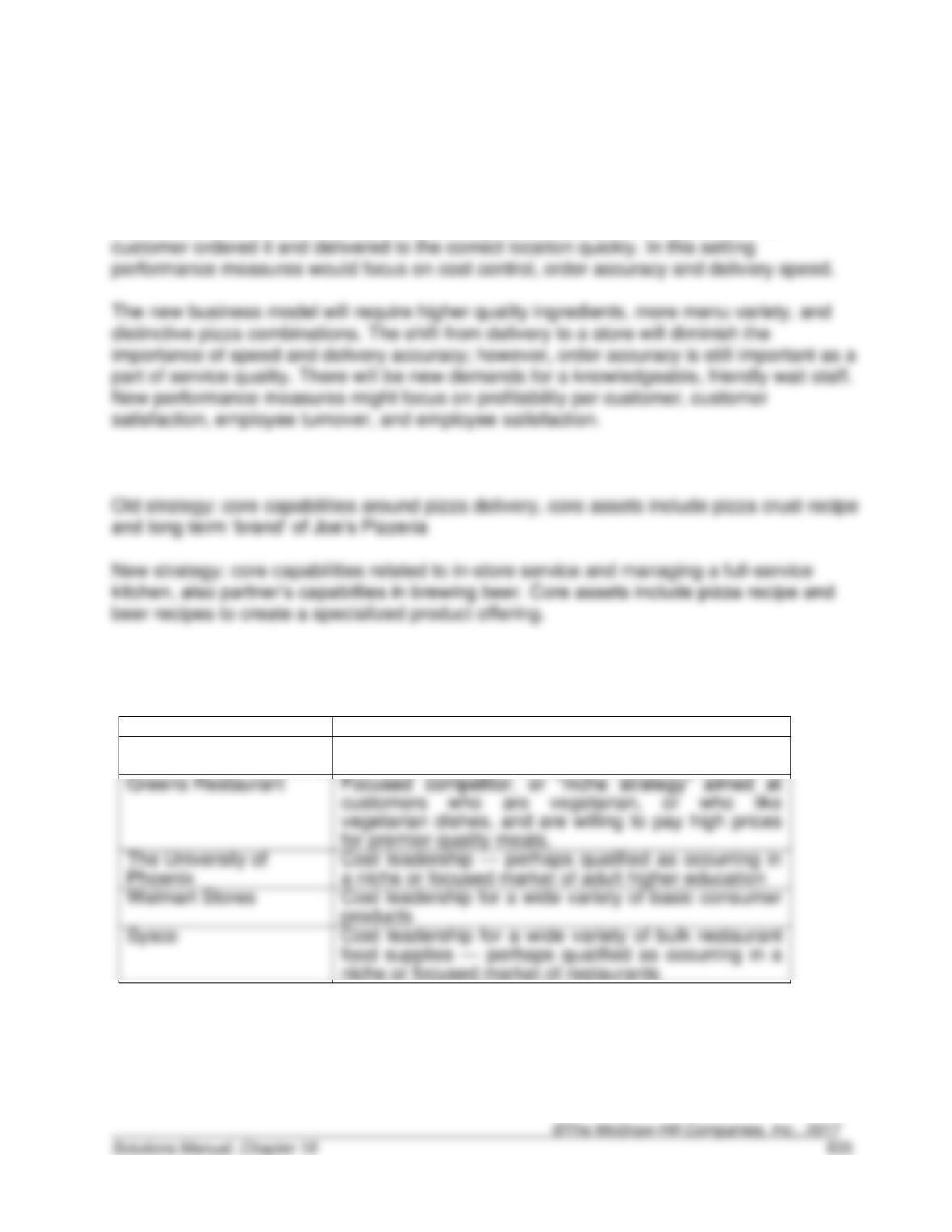
18–26. (15 min.) Business Strategy Classification
Organization
Dominant Porter Strategy
Apple
Product differentiation for mass-appeal consumer
electronic products
vegetarian dishes, and are willing to pay high prices
for premier quality meals.
The University of
Phoenix
Cost leadership — perhaps qualified as occurring in
a niche or focused market of adult higher education
products
food supplies — perhaps qualified as occurring in a
niche or focused market of restaurants
18–27. (20 min.) Nonfinancial Performance Measures.
Answers will vary. Note that these positions are (typically) paid on an hourly basis, but all
have customer-facing jobs. Therefore, their performance can directly affect organizational
performance. None of the measures suggested here are perfect (no measure would be).
An interesting discussion can focus on what type of dysfunctional behavior could these
measures induce.
a. Barista: Number of customers served, correct orders, complaints.
18–28. (20 min.) Different Performance Measures Across the Organization.
This question is based on the authors’ experience.
Answers will vary, but should include the following:
18–29. (20 min.) Balanced Scorecards and Strategy Maps: Crane Company.
Answers will vary. Crane Company has a strategy to be a low-cost leader in the industry,
18–30. (20 min.) Balanced Scorecards and Strategy Maps: TechMasters, Inc.
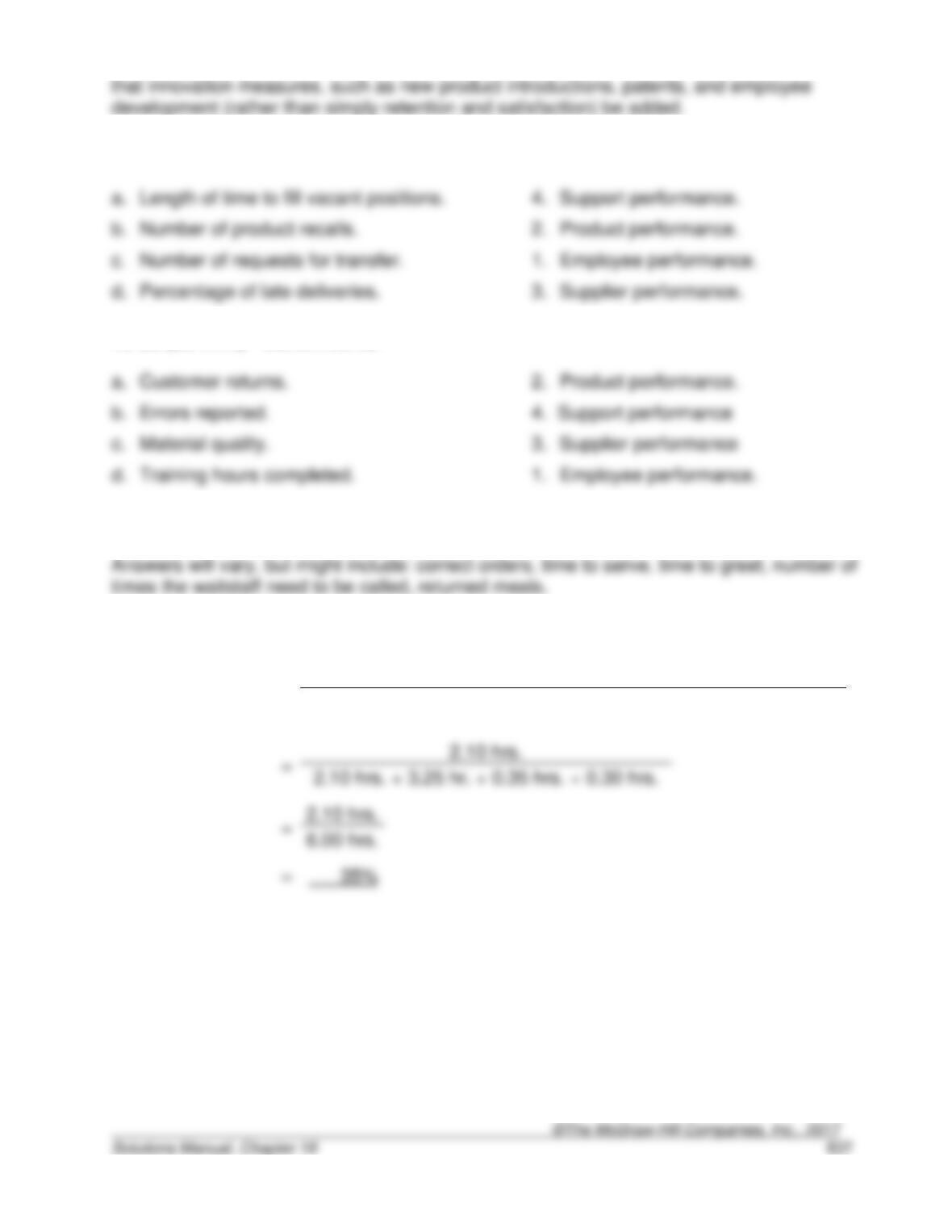
Answers will vary. TechMasters wants to lead in innovation, but there are no measures
regarding learning or innovation in the scorecard. We would recommend at a minimum
18–31. (20 min.) Benchmarks.
18–32. (20 min.) Benchmarks.
18–33. (15 min.) Performance measures.
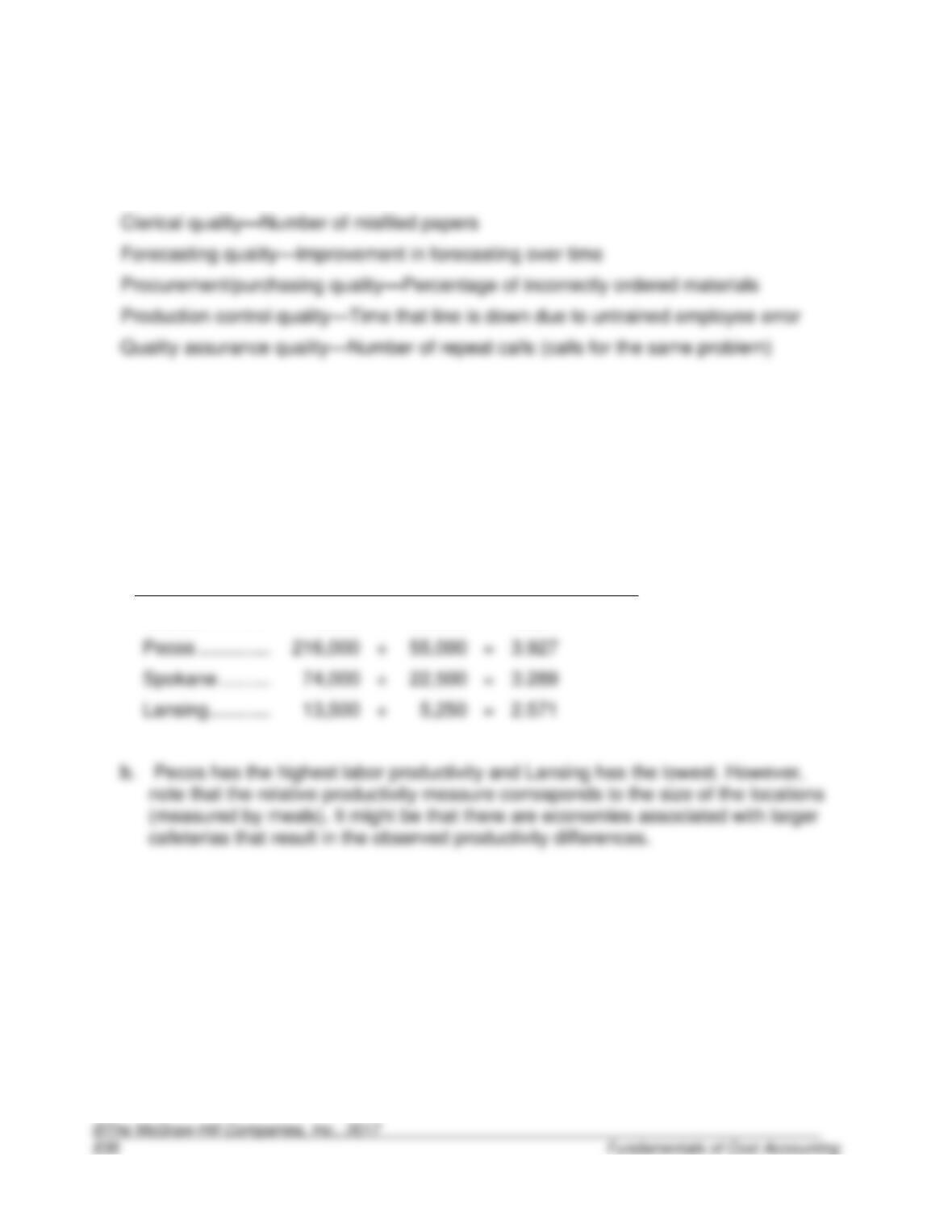
18–34. (10 min.) Manufacturing Cycle Time and Efficiency: Bell & Porter.
Manufacturing
cycle efficiency
=
Processing time
Processing time + Moving time + Storing time + Inspection time
=
=
18–35. 20 min.) Functional measures.
Answers will vary. Some possible examples are:
Accounting quality—Time to prepare quarterly statements
18–36. (30 min.) Partial Productivity Measures: McMahon Corporation.
a. Partial labor productivity = Output (meals) ÷ Input (hours)
Location
Output
(Meals)
÷
Input
(Hours)
=
Partial Labor
Productivity
Mobile ……………….
114,000
÷
35,000
=
3.257
Pecos ……………….
216,000
÷
55,000
=
3.927
Spokane ……………
÷
=
3.289
Lansing ……………..
÷
=
18–37. (30 min.) Partial Productivity Measures: Cambria Chemicals.
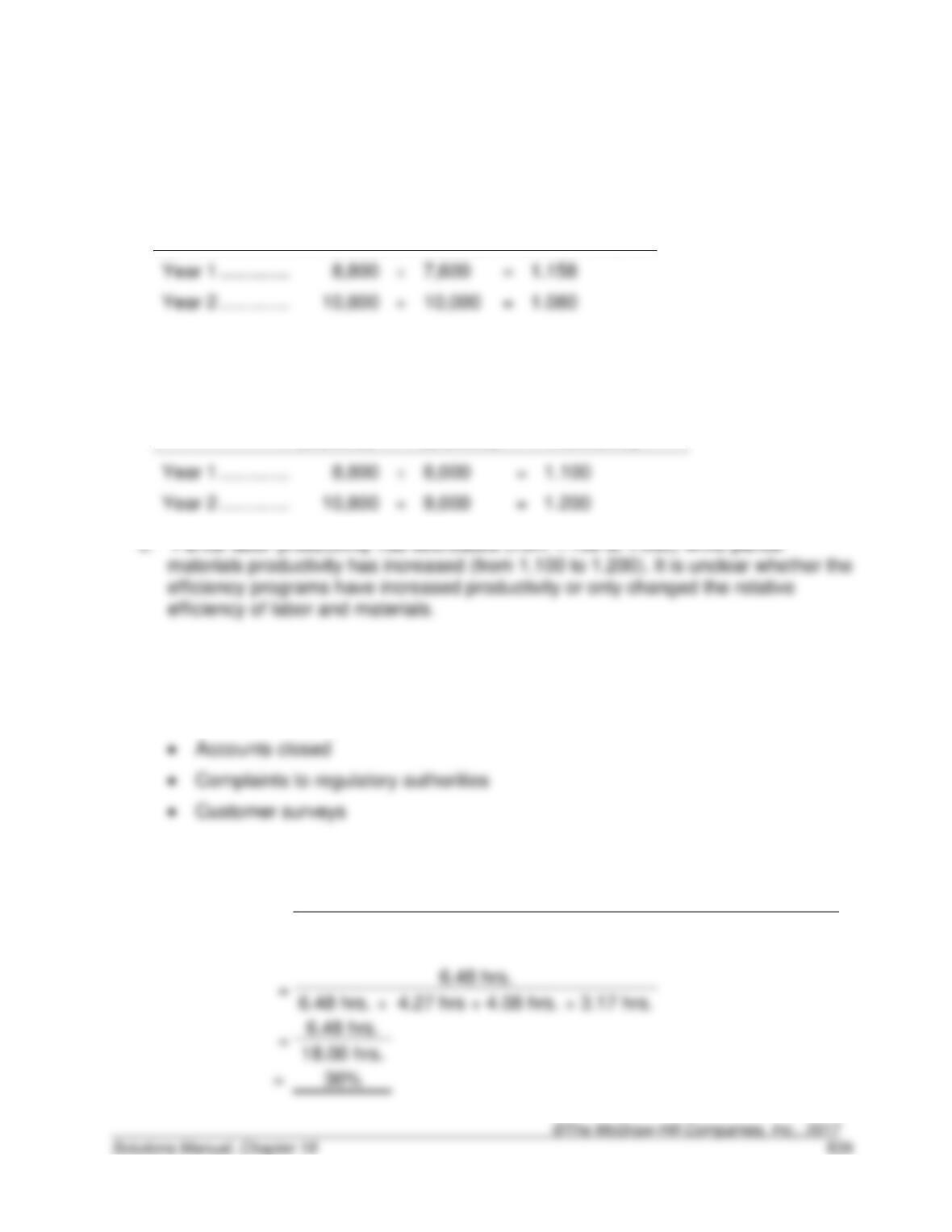
a. Partial labor productivity = Output (gallons) ÷ Input (hours)
Year
Output
(Gallons)
÷
Input
(Hours)
=
Partial Labor
Productivity
b. Partial materials productivity = Output (gallons) ÷ Input (gallons)
Year
Output
(Gallons)
÷
Input
(Gallons)
=
Partial Materials
Productivity
18–38. (20 min.) Specifying Nonfinancial Measures.
Answers will vary. Measures of customer satisfaction for JYC include:
• Customer complaints
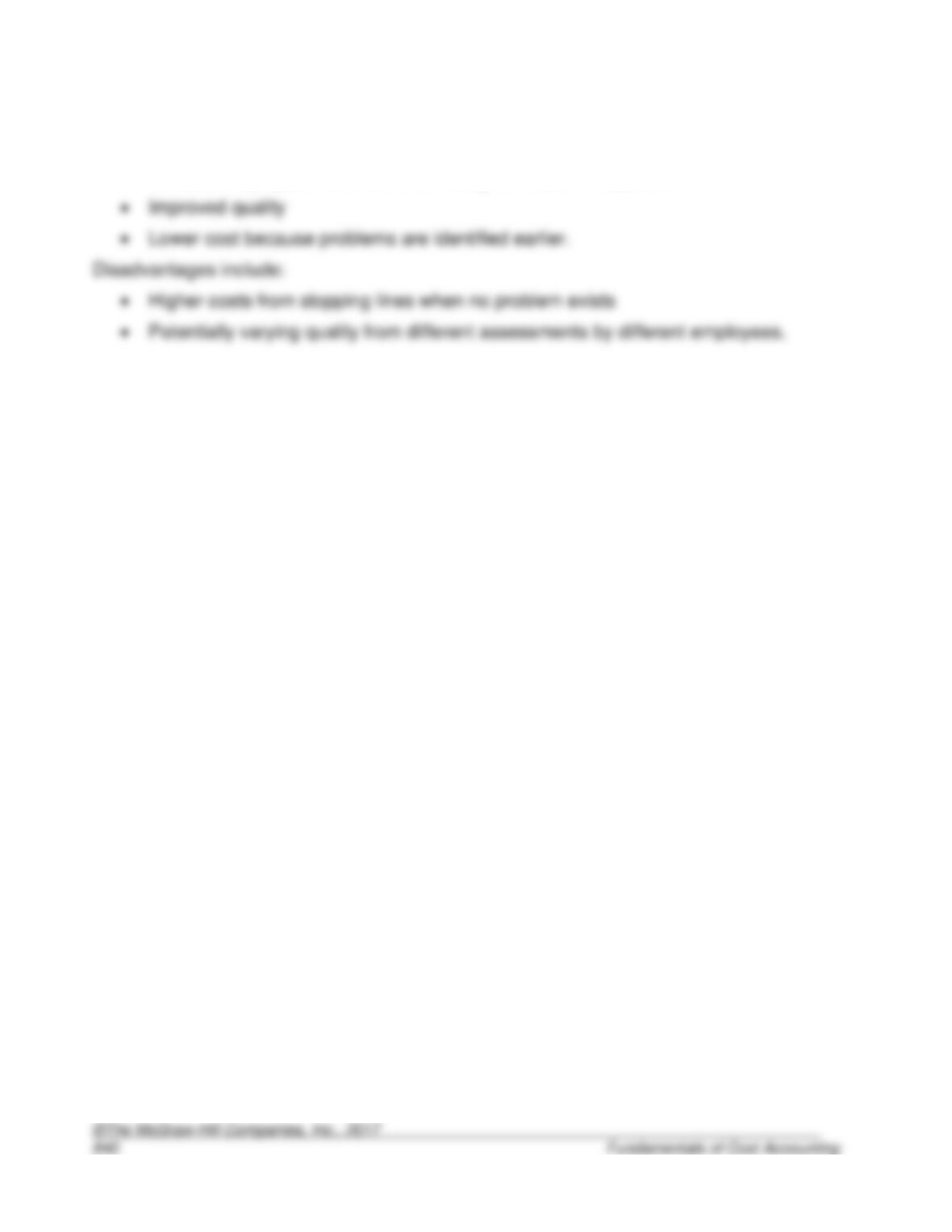
18–39. (20 min.) Manufacturing Cycle Time and Efficiency.
Manufacturing
cycle efficiency
=
Processing time
Processing time + Moving time + Storing time + Inspection time
18–40. (20 min.) Employee Involvement.
Answers will vary.
The advantages include:
• Increase employee motivation from being involved in the process
Solutions to Problems
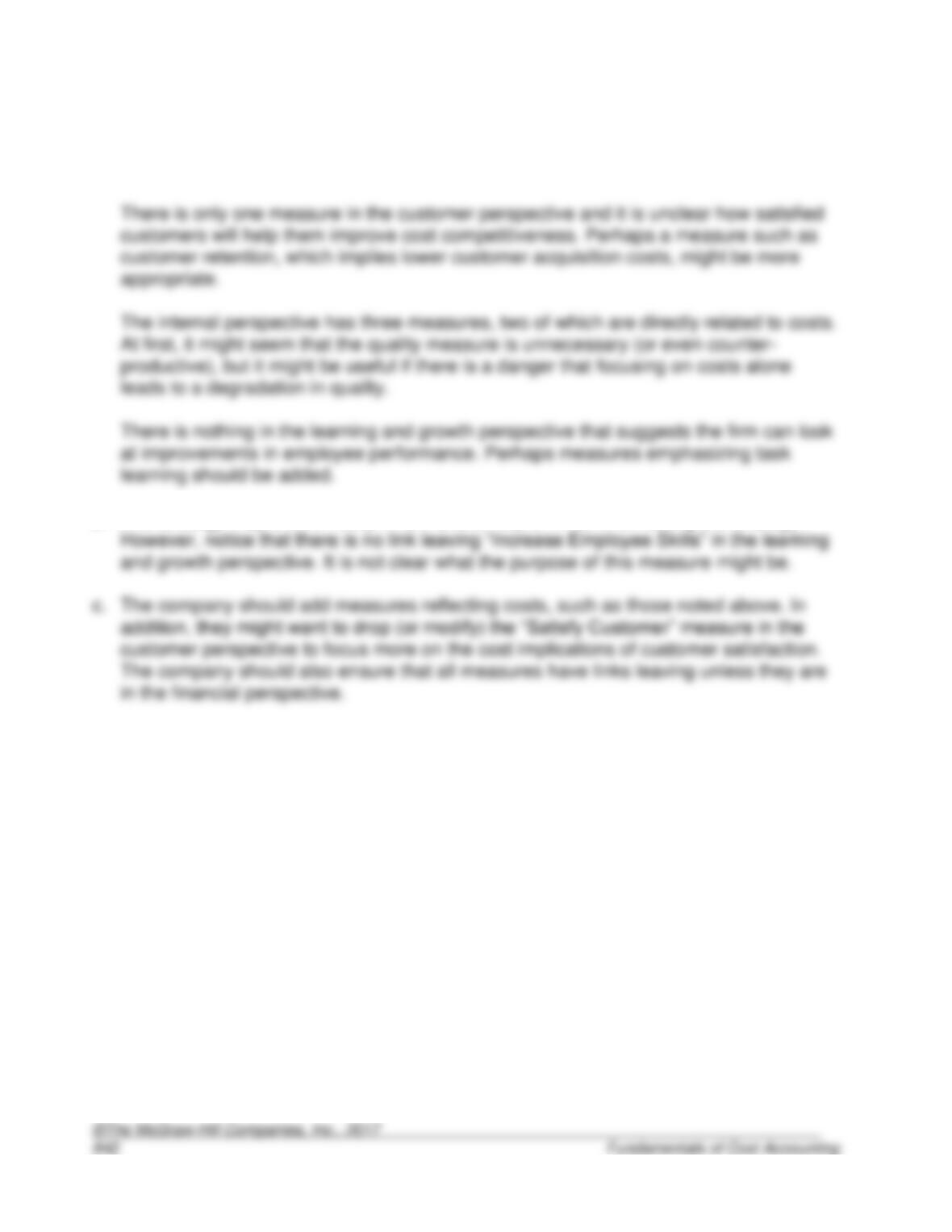
18–41. (30 min.) Core Assets and Capabilities
Answers will vary; however, core assets and capabilities should be both essential to the
business strategy and proprietary in nature. Non-core assets may be important things that
the company must do; however, it is typically not essential to the strategy or proprietary.
Some examples are:
Company
Core Asset or Capability
Non-core Asset or
Capability
Apple
Copyright ‘bitten apple’ logo
Highly trained ‘genius’ store
assistants
Cash registers and POS
scanners in stores
Corporate accounting
18–42. (30 min.) Balanced Scorecards and Strategy Maps: Hill Street Company.
a. Answers will vary. The measures in the financial perspective are reasonable, although
the company might want to add one specifically related to cost improvement (such as
growth in margins).
b. The strategy map shows many links that are helpful in communicating the strategy.
18–43. (30 min.) Balanced Scorecards and Strategy Maps: Monroe Corporation.
a. Answers will vary. The measures in the financial perspective are reasonable, although
the company might want to include a measure on cost of quality (but this might be
better placed in the internal perspective).
18–44. (20 min.) Benchmarks: Delta Airlines.
Answers will vary, but might include the following:
• On-time arrivals.
18–45. (45 min.) Mission Statement.
Answers will vary, but should identify the stakeholders (students, faculty, staff, and
community) and state how the organization intends to add value to each group.
18–46. (45 min.) Performance Measures: Garnet Electronics
a.
Perspective
Performance Measure
Perspective
Number
1.
Financial
Profit
1
3.
Learning and growth
Percentage of defects
4
Employee turnover
Patents awarded
3
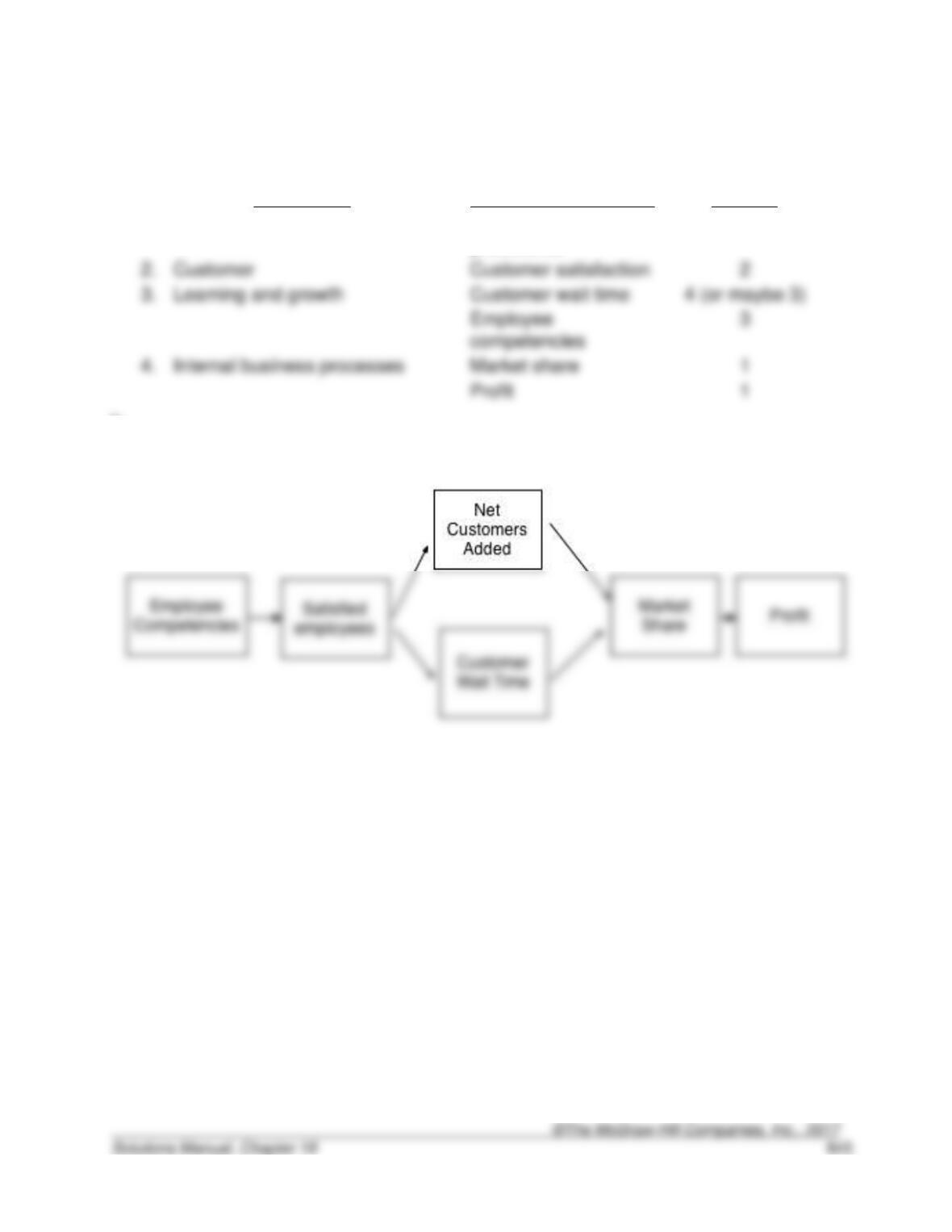
b. Answers will vary, but the following is one possibility:
18–47. (45 min.) Performance Measures: Local Bank.
a.
Perspective
Performance Measure
Perspective
Number
1.
Financial
Compliance with
procedures
4
Customer
Customer satisfaction
Learning and growth
Customer wait time
Employee
competencies
3
Profit
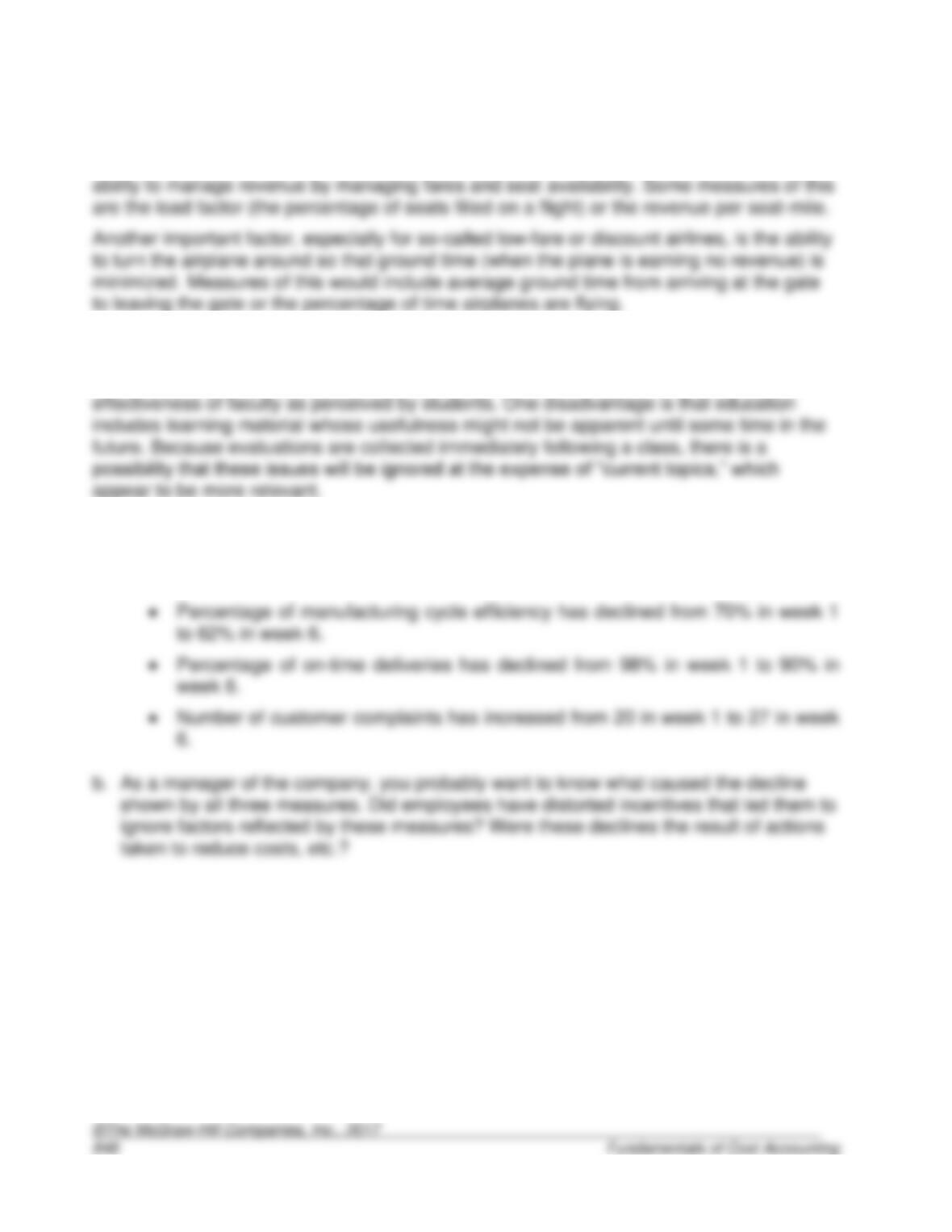
b. Answers will vary, but the following is one possibility:
18–48. (20 min.) Functional measures.
Answers will vary, but might include any of the functional measures shown in Exhibit 18.7.
The following is one example. An important critical success factor for many airlines is the
18–49. (45 min.) Performance measures.
Answers will vary. The advantages are easier to identify. They provide a measure of
18–50. (20 min.) Operational performance measures: Zuma Company.
a. Answers will vary, but should address the following points:
18–51. (40 min.) Objective and Subjective Performance Measures.
Answers will vary:
a.
An advantage of using a combination of performance measures is that for any one
dimension of performance (communications skills, for example), a good measure can be
18–52. (40 min.) Operational performance measures: Mid-States Metal Finishers.
a. Answers might include:
The percentage of orders filled on-time, the percentage of defective units produced
and the number of customer returns all improved significantly over the six month
period. There are several probable causes for this including:
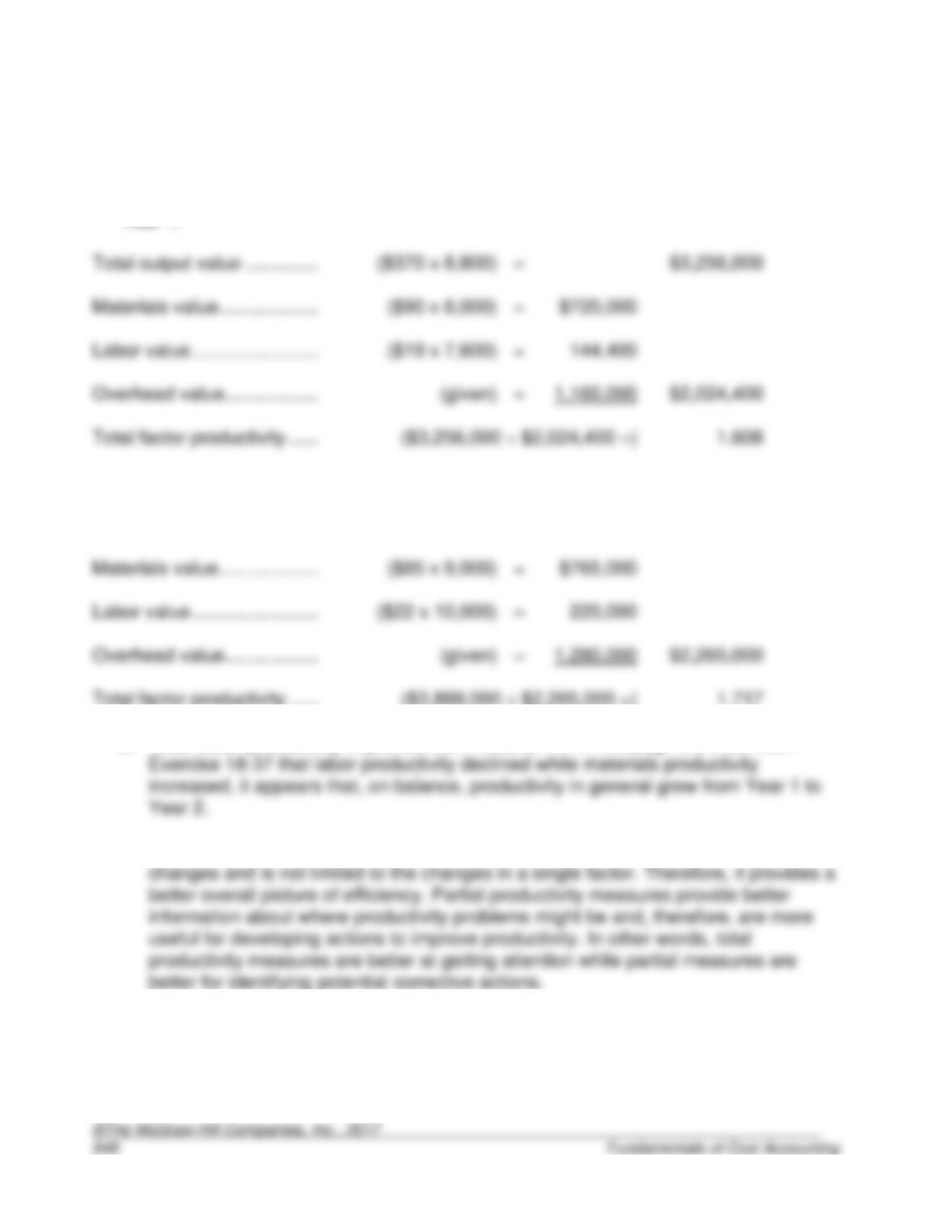
Total output value ……………
=
$3,256,000
Materials value ………………..
=
Labor value …………………….
=
Overhead value……………….
=
Total factor productivity …….
($3,256,000 ÷ $2,024,400 =)
1.608
18–53. (30 Minutes) Productivity Measures: Cambria Chemicals.
a. Total productivity = Value of output ÷ Value of inputs (materials, labor, and
overhead).
Year 2:
Total output value ……………
($360 x 10,800)
=
$3,888,000
Materials value ………………..
=
Labor value …………………….
=
Overhead value……………….
=
$2,265,000
Total factor productivity …….
($3,888,000 ÷ $2,265,000 =)
1.717
b. Total factor productivity improved from 1.608 to 1.717. Although we know from
c. Total factor productivity provides a comprehensive measure of productivity
18–54. (20 Minutes) Employee Involvement.
a. Answers will vary, but might include:
By providing line employees the authority to make decisions, customer satisfaction can
b. There are at least two reasons why banks and other financial institutions might be less
Solution to Integrative Case
18–55. (40 min.) Balanced Scorecards and Strategy Maps: University of California,
Davis.
a. Some organizations are concerned that names of new programs label them as the
b. Many large organizations experiment with pilot projects to evaluate the feasibility of
new management programs or solutions. It is easier to design and implement
c. Many university professors are independent agents who conduct their research and
teaching without regard to explicit overall goals or objectives of the university. Most