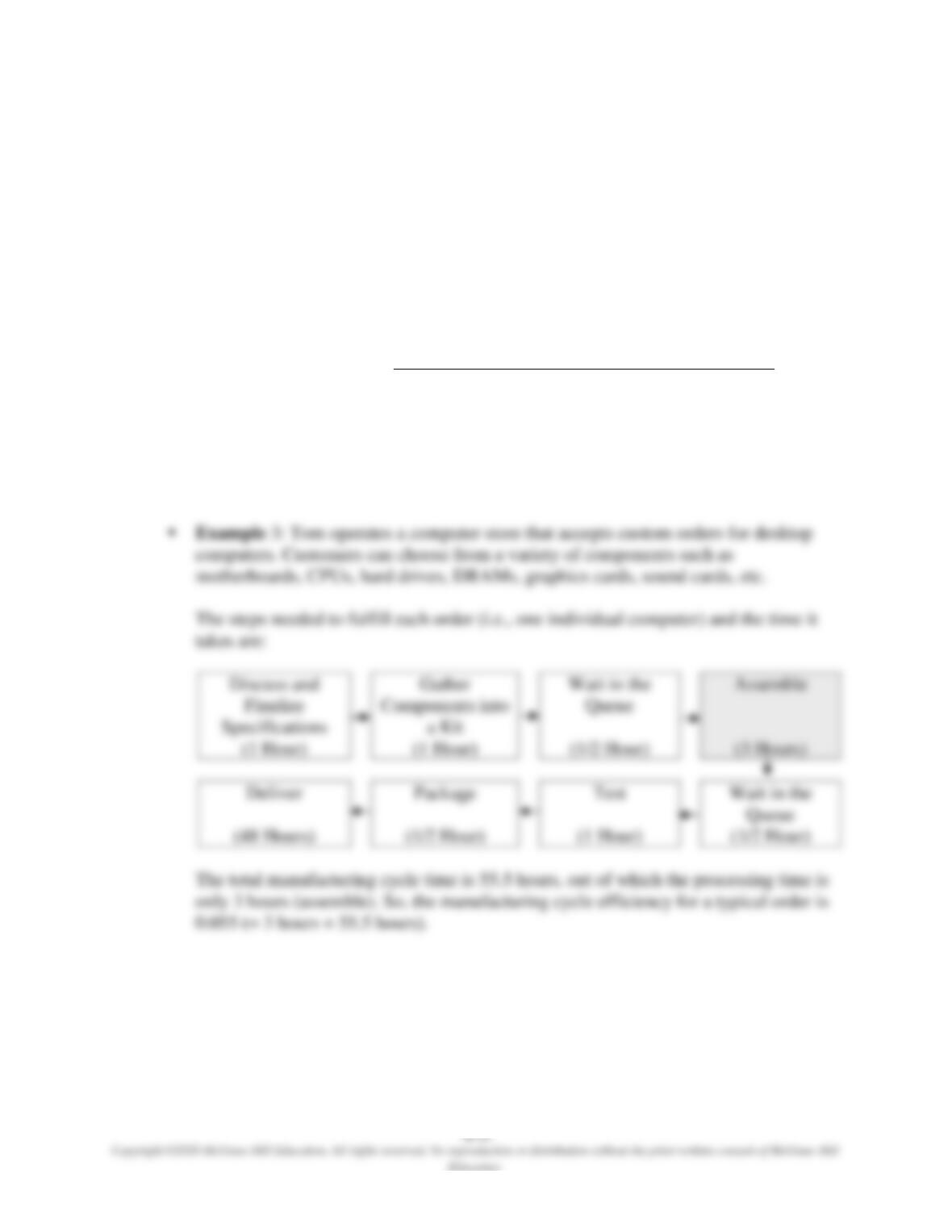
o Manufacturing Cycle Efficiency
▪ Manufacturing cycle efficiency measures the efficiency of the total manufacturing
cycle.
▪ Manufacturing cycle efficiency is a measure of the efficiency of the total
manufacturing cycle; it equals processing time divided by the manufacturing cycle
time.
▪ Manufacturing cycle efficiency for one unit is calculated as follows:
Manufacturing Cycle
Efficiency
=
Processing Time
Processing time + Moving time + Storage Time
+ Inspection Time
• This formula calculates a percentage representing the time actually spent
processing the unit. The higher the percentage, the less the time (and costs) that
needs to be spent on nonvalue-added activities.

• Productivity
o Manufacturing cycle efficiency focuses on the effective use of time. Productivity focuses
on the efficient conversion of inputs into outputs.
o Productivity is a measure that expresses the efficient conversion of inputs into outputs.
o Partial productivity measures the relation between output and a single input, or
▪ Partial productivity measures are typically measured as:
Partial Productivity
=
Output (quantity or value)
Single input such as labor (quantity or value)
▪ Partial productivity measures are closely related to the manufacturing efficiency
variances (discussed in Chapter 16).
o One approach for comparing the productivity of business units that use a different mix of
inputs (or even different inputs) is to calculate total factor productivity.
▪ Total factor productivity is a ratio of the value of output to the value of all key
inputs.

o An Illustration of Various Productivity Measures
▪ Exhibit 18.8 provides selected operating data.
▪ Exhibits 18.9 and 18.10 provide the results.
See Demonstration Problem
• Nonfinancial Performance and Activity-Based Management
o Organizations should manage by using activity data rather than cost data to identify
problems, to suggest an approach to solve problems, and to prioritize improvement
efforts.
▪ Companies often make four mistakes when trying to measure nonfinancial
performance:
• Not linking measures to strategy
• Not validating the links
• Not setting the right performance targets
• Measuring not correctly
▪ Using a business model that identifies the connections between the measures and the
firm’s goals helps avoid these problems.
• Objective and Subjective Performance Measures

▪ Subjective measures allow managers to consider many factors, including those
outside the employee’s control, that could distort an objective measure. (See Business
Application box “Is There a ‘Fixation’ on Metrics.”)
LO 18-7 Explain why employee involvement is important for an effective
performance measurement system.
EMPLOYEE INVOLVEMENT
• Nonfinancial measures have the advantage that they are more likely to be understandable by
employees directly involved in operations.
o Line employees are thus encouraged to participate in performance improvement activities.
▪ Suggestion boxes, worker circles, and team meetings are ways for employees to
suggest ideas for improvements.
o Worker involvement is important for three reasons:
o Companies need to evaluate their own performance in getting workers involved and
committed.
▪ Exhibit 18.11 lists performance measures that organizations can use to assess their
accomplishments in terms of worker involvement and commitment.
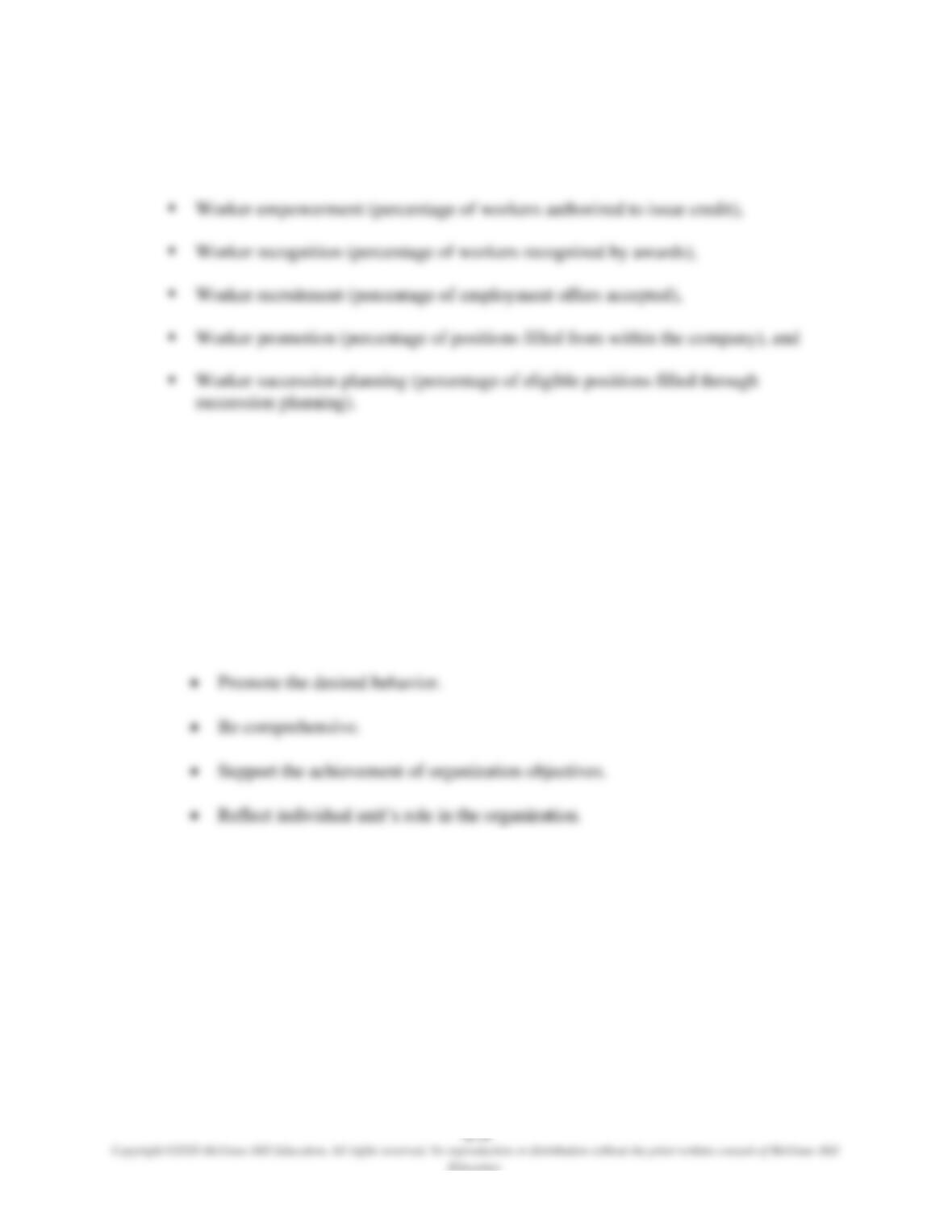
o Worker involvement and commitment measures include:
▪ Worker development (percentage of workers in mentor programs),
o Increasing the percentages on these measures demonstrate the organization’s attempt to
increase worker involvement and commitment to it.
o Effective worker involvement presents three challenges for management.
▪ Management must create a system that conveys the organization’s objectives and
critical success factors to all members.
▪ The measures the organization uses to evaluate individual performance determine the
system’s success in promoting goal congruence. These measures must
▪ Management must ensure that the performance measures are applied consistently and
accurately. (See Business Application box “Empowering Employees to Compensate
Customers for Service Failures.”)

DIFFICULTIES IN IMPLEMENTING NONFINANCIAL PERFORMANCE
MEASUREMENT SYSTEMS
• Fixation on Financial Measures
• Reliability of Nonfinancial Measures
o Nonfinancial measures suffer from the lack of external review, are more subjective and
less reliable.
• Lack of Correlation between Nonfinancial Measures and Financial Results
o The casual relationship between nonfinancial measures and financial results is not clear
for a number of reasons.
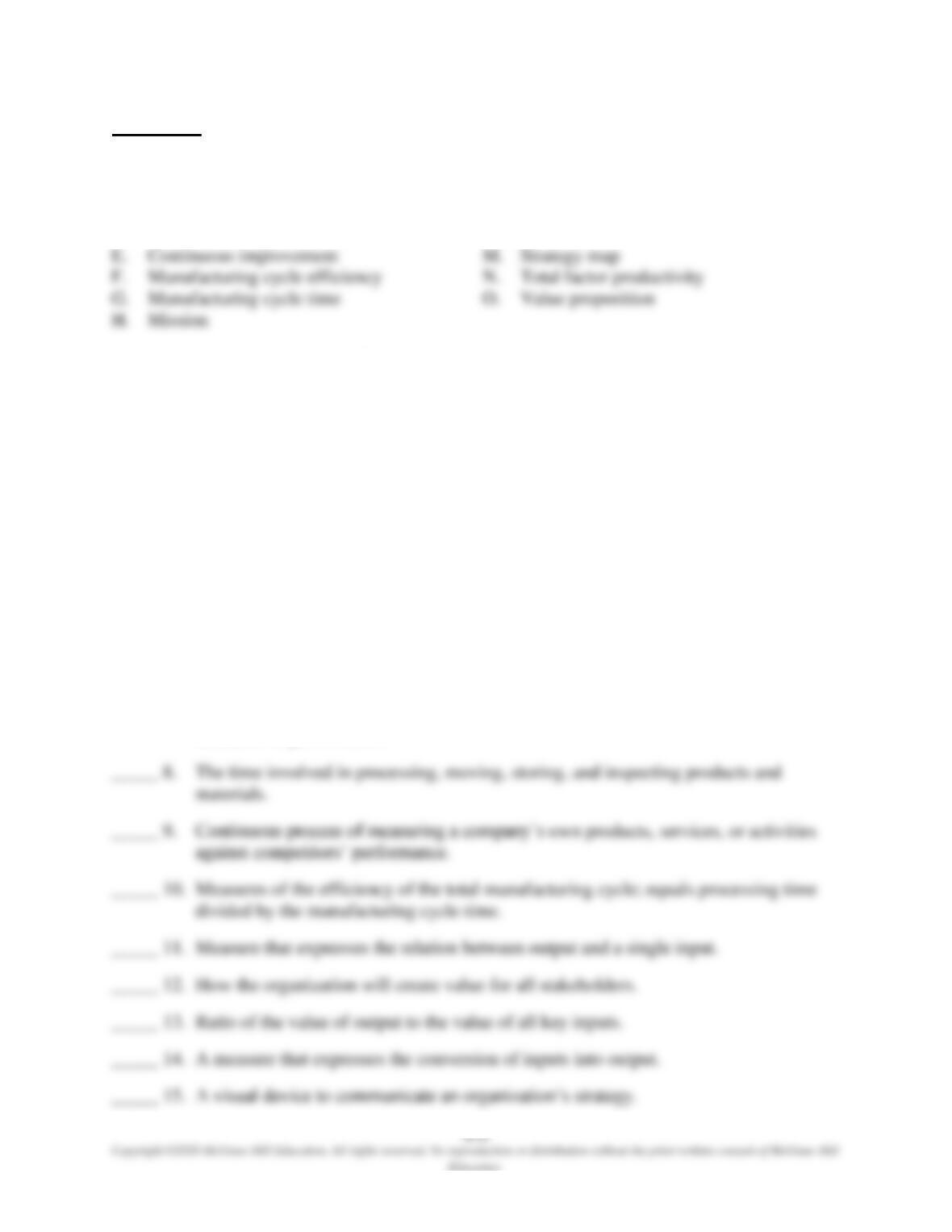
Matching
A.
Balanced scorecard
I.
Mission statement
B.
Benchmarking
J.
Partial productivity
C.
Business model
K.
Productivity
D.
Business strategy
L.
Stakeholders
E.
Continuous improvement
M.
Strategy map
Manufacturing cycle efficiency
N.
Total factor productivity
G.
Manufacturing cycle time
O.
Value proposition
H.
Mission
_____ 1. Description of how different levels and employees in the organization must perform
for the organization to achieve its goals.
_____ 2. Why an organization exists; its purpose and goals.
_____ 3. Description of an organization’s values, definition of its responsibilities to
stakeholders, and identification of its major strategies.
_____ 4. A company’s specific approach for deploying the organizational assets and
capabilities required to meet its customers’ needs competitively, while delivering the
desired returns to shareholders.
_____ 5. Groups or individuals, such as employees, suppliers, customers, shareholders, and
communities, who have an interest in what the organization does.
_____ 6. Continuous reevaluation and improvement of the efficiency of an organization’s
activities.
_____ 7. Performance measurement system relying on multiple financial and nonfinancial
measures of performance.

Matching Answers
2. H
4. D
6. E
8. G
10. F
12. O
14. K

Multiple Choice
1. Which of the following is a nonfinancial measure?
a. Number of customer complaints
b. Return on investment
c. Prevention cost
d. Opportunity cost
2. Which of the following statements is correct?
3. A balanced scorecard:
a. emphasizes financial performance.
b. caters to the needs of employees.
c. tries to meet the organization’s responsibilities to stakeholders.
d. is just a set of multiple performance measures.
4. Manufacturing cycle time is an example of a balanced-scorecard measure of:
a. financial performance.
5. Continuous improvement:
a. is a philosophy of running the business.
b. is independent of benchmarking.
c. is looking to improve the efficiency of activities.
d. Both a and c.
6. Which of the following can be used to measure customer satisfaction?
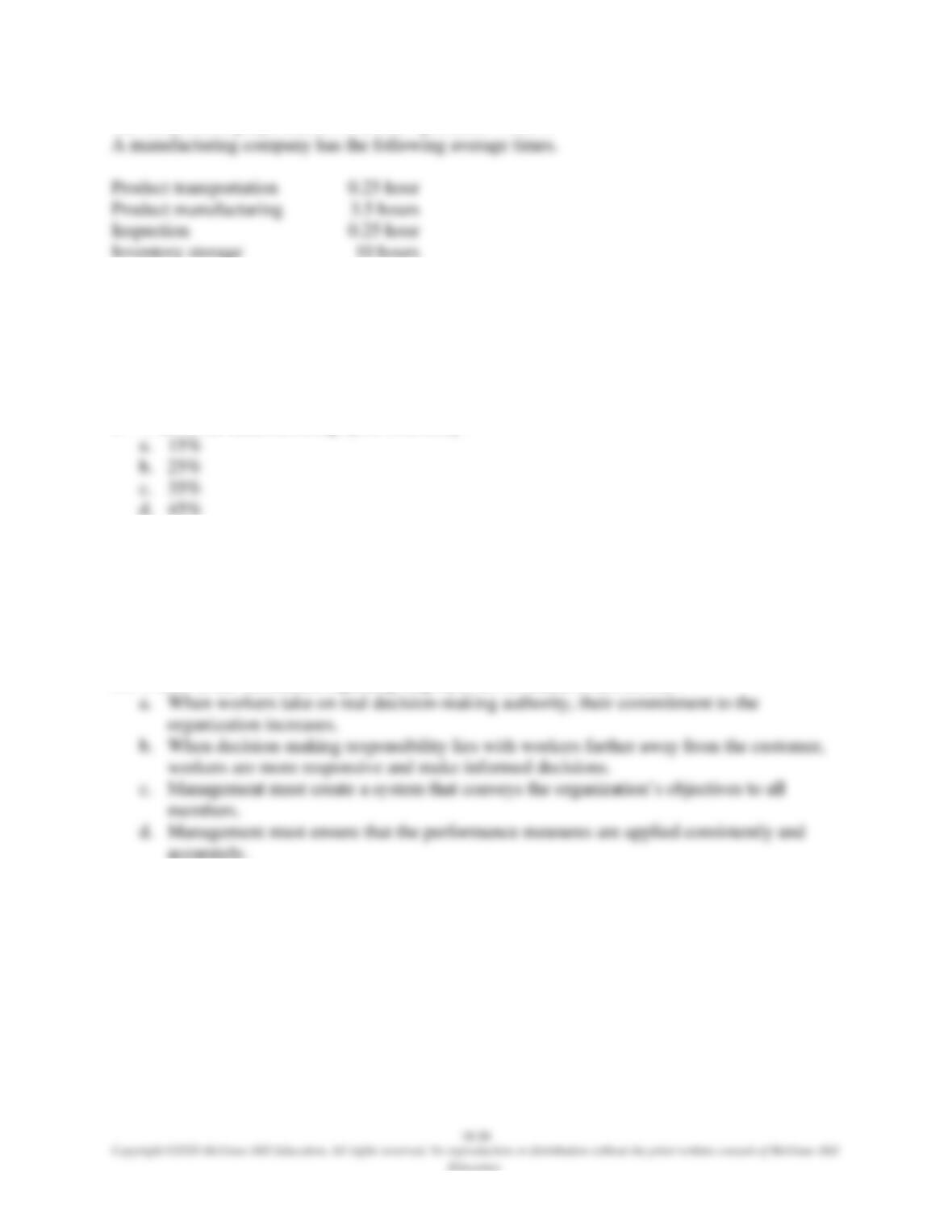
Use the following information to answer questions 7 and 8:
7. What is the average manufacturing cycle time (in hours)?
a. 14.00
b. 13.75
c. 13.50
d. 10.00
8. What is the manufacturing cycle efficiency?
9. Which of the following is an example of subjective measurement?
a. Economic conditions of the city where a branch is located
b. Employee turnover
c. Branch profits
d. Defect rates
10. Which of the statements regarding employee involvement is not correct?
11. Which of the statements is not correct?
a. People at different levels in the organization have different responsibilities.
b. At the lower levels, financial measures are critical.
c. At the middle levels, it is important to coordinate ongoing activities.
d. At the top levels, performance measures focus on meeting stakeholders’ needs.

12. Which of the following performance measures are appropriate for a regional manager?
a. Profitability
b. Employee turnover
c. Customer and employee satisfaction
d. All of the above.

Multiple Choice Answers
2. d (LO2, LO3)
4. c (LO4, LO6)
6. d (LO6)
8. b (LO6)
10. b (LO7)
12. d (LO3)
Demonstration Problem
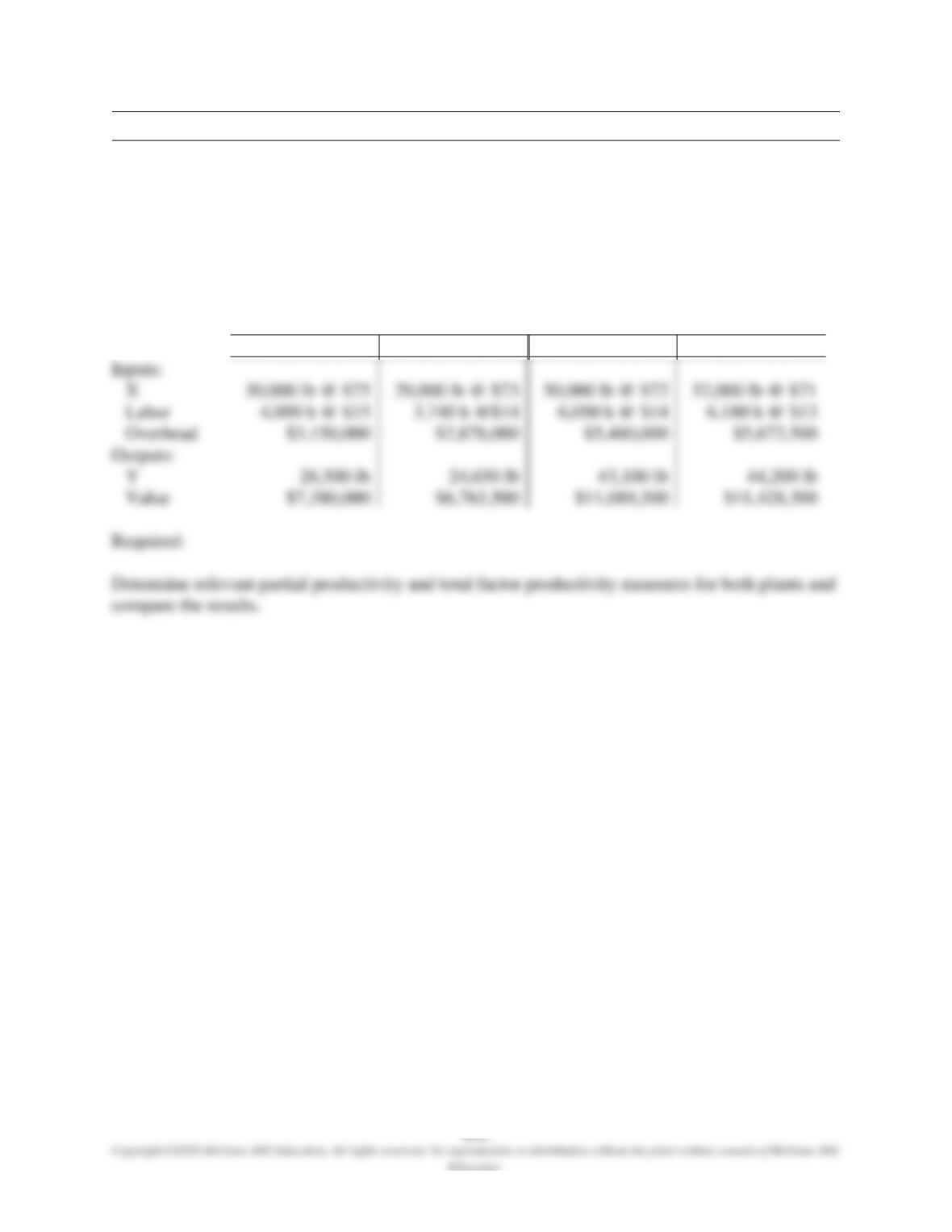
ChemUSA operates two highly automated chemical processing plants: East Plant and West Plant.
The same production process takes place in the two plants and turns material X into chemical
compound Y.
In order to evaluate their productivity measures, the managers of ChemUSA have the accounting
department gather comparative operating and financial data in the follow table.
East Plant
West Plant
This Year
Last Year
This Year
Last Year
Inputs:
X
Labor
Overhead
Outputs:
Y
Value
Demonstration Problem – Solution
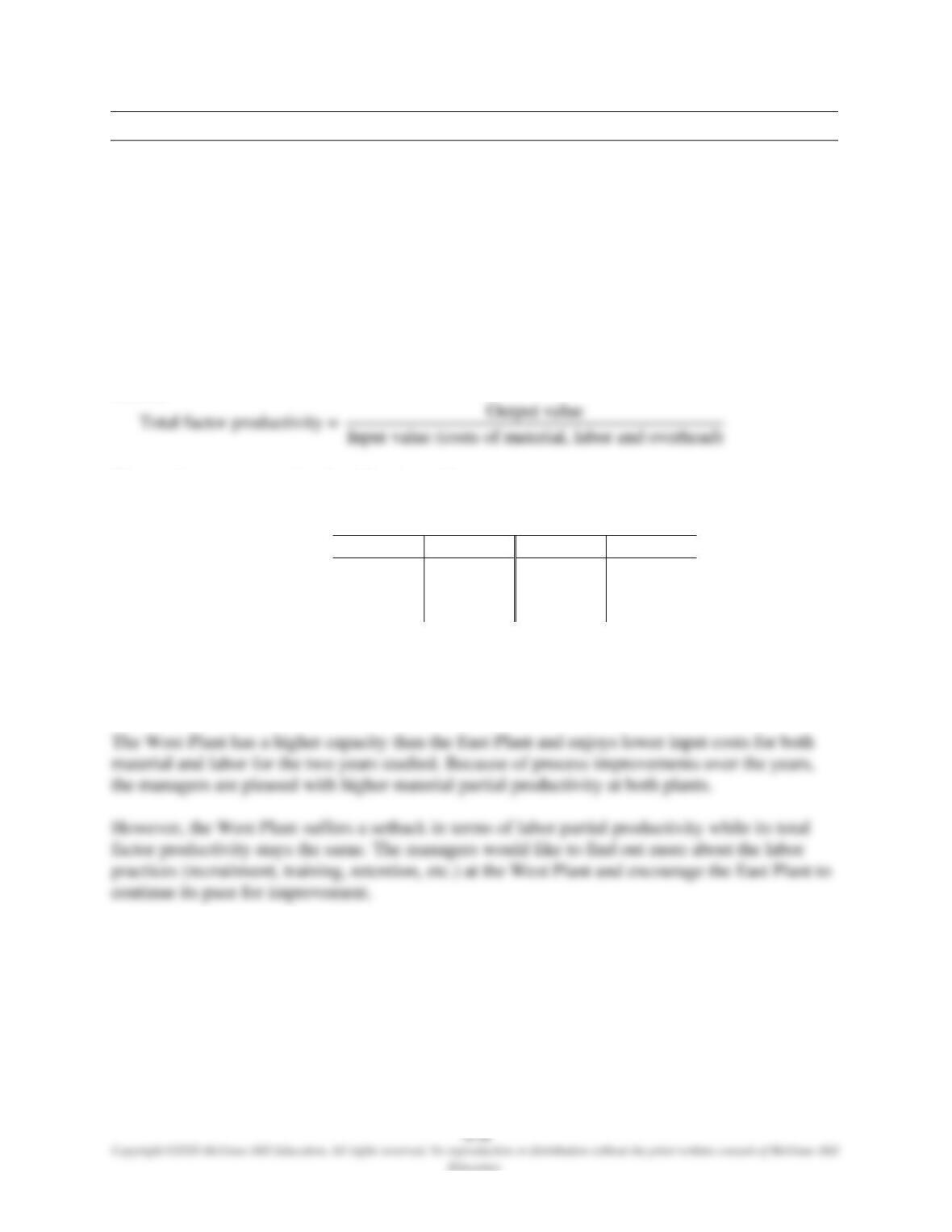
The accounting department recommends the calculation of two partial productivity measures
corresponding to the use of material input (X) and labor input (hours), respectively.
Material partial productivity = Output in pounds (lbs.) ÷ Input in pounds (lbs.)
Labor partial productivity = Output in pounds (lbs.) ÷ Input in labor hours
In addition, total factor productivity is also calculated and includes as key inputs material (X),
labor and overhead.
That is:
The results are presented in the following table:
East Plant
West Plant
This Year
Last Year
This Year
Last Year
Material partial productivity
0.88a
0.85
0.86
0.85
Labor partial productivity
6.625b
6.59
7.12
7.15
Total factor productivity
1.35c
1.34
1.21
1.21
a 0.88 = 26,500 ÷ 30,000
b 6.625 = 26,500 ÷ 4,000
c 1.35 = $7,380,000 ÷ ($75 × 30,000 + $15 × 4,000 + $3,150,000)