18-1
CHAPTER 18
SPOILAGE, REWORK, AND SCRAP
18-1 Managers have found that improved quality and intolerance for high spoilage have
lowered overall costs and increased sales.
value compared to the total sales value of the product.
18-3 Yes. Normal spoilage is spoilage inherent in a particular production process that arises
even under efficient operating conditions. Management decides the spoilage rate it considers
normal depending on the production process.
18-6 Normal spoilage typically is expressed as a percentage of good units passing the
inspection point. Given actual spoiled units, we infer abnormal spoilage as follows:
Abnormal spoilage = Actual spoilage – Normal spoilage.
18-7 Accounting for spoiled goods deals with cost assignment, rather than with cost
incurrence, because the existence of spoiled goods does not involve any additional cost beyond
the amount already incurred.
18-9 Yes, the point of inspection is the key to the assignment of spoilage costs. Normal
spoilage costs do not attach solely to units transferred out. Thus, if units in ending work in
process have passed inspection, they should have normal spoilage costs added to them.
18-2
18-10 No. If abnormal spoilage is detected at a different point in the production cycle than
normal spoilage, then unit costs would differ. If, however, normal and abnormal spoilage are
detected at the same point in the production cycle, their unit costs would be the same.
18-13 Yes. Abnormal rework is a loss just like abnormal spoilage. By charging it to
manufacturing overhead, the abnormal rework costs are spread over other jobs and also included
in inventory to the extent a job is not complete. Abnormal rework is rework over and above what
is expected during a period and is recognized as a loss for that period.
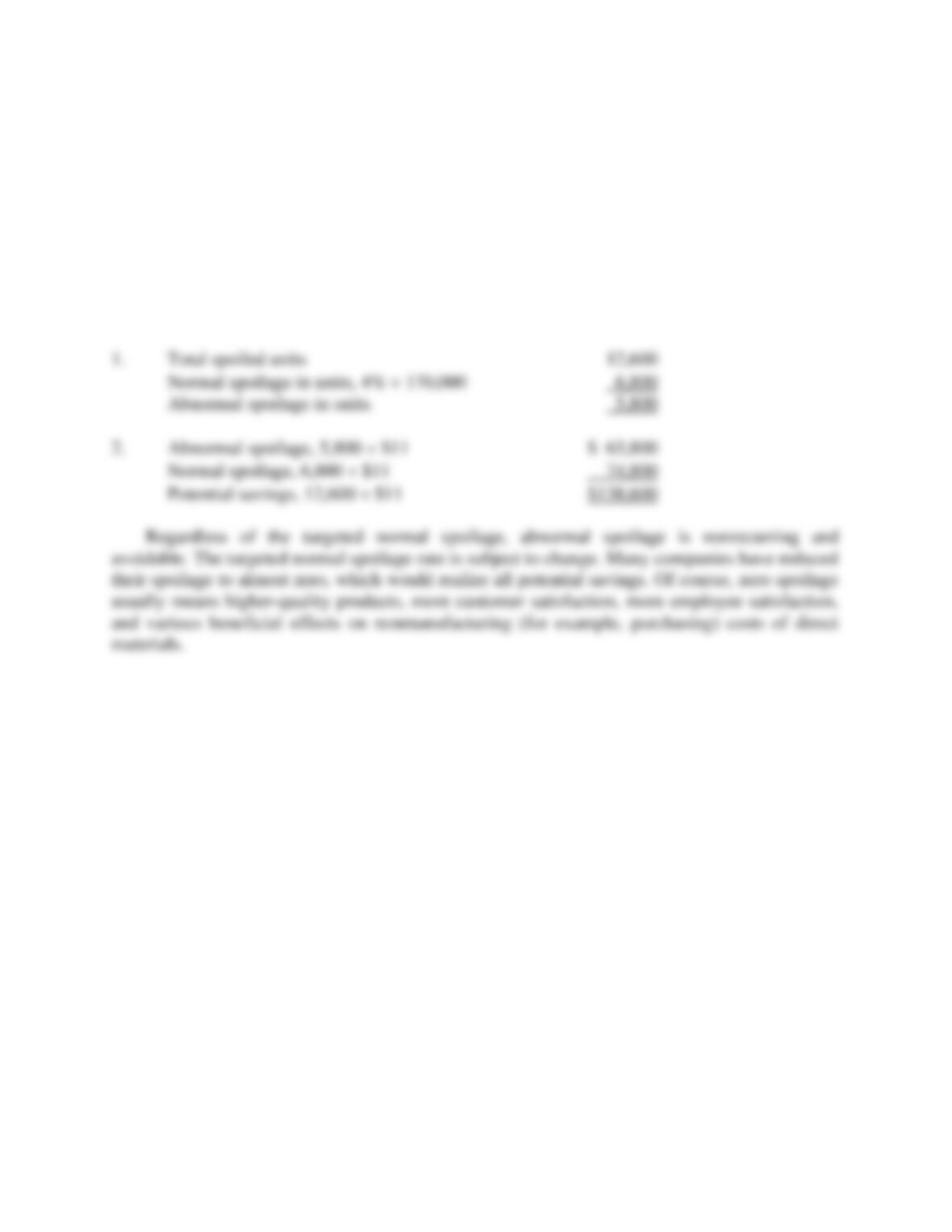
18-16 (5–10 min.) Normal and abnormal spoilage in units.
The following data, in physical units, describe a grinding process for January:
18-3
Inspection occurs at the 100% completion stage. Normal spoilage is 4% of the good units passing
inspection.
Required:
1. Compute the normal and abnormal spoilage in units.
2. Assume that the equivalent-unit cost of a spoiled unit is $11. Compute the amount of
potential savings if all spoilage were eliminated, assuming that all other costs would be
unaffected. Comment on your answer.
SOLUTION
18-4
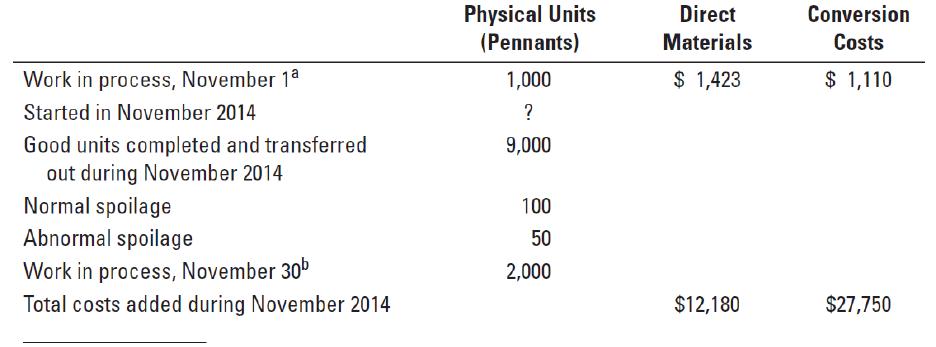
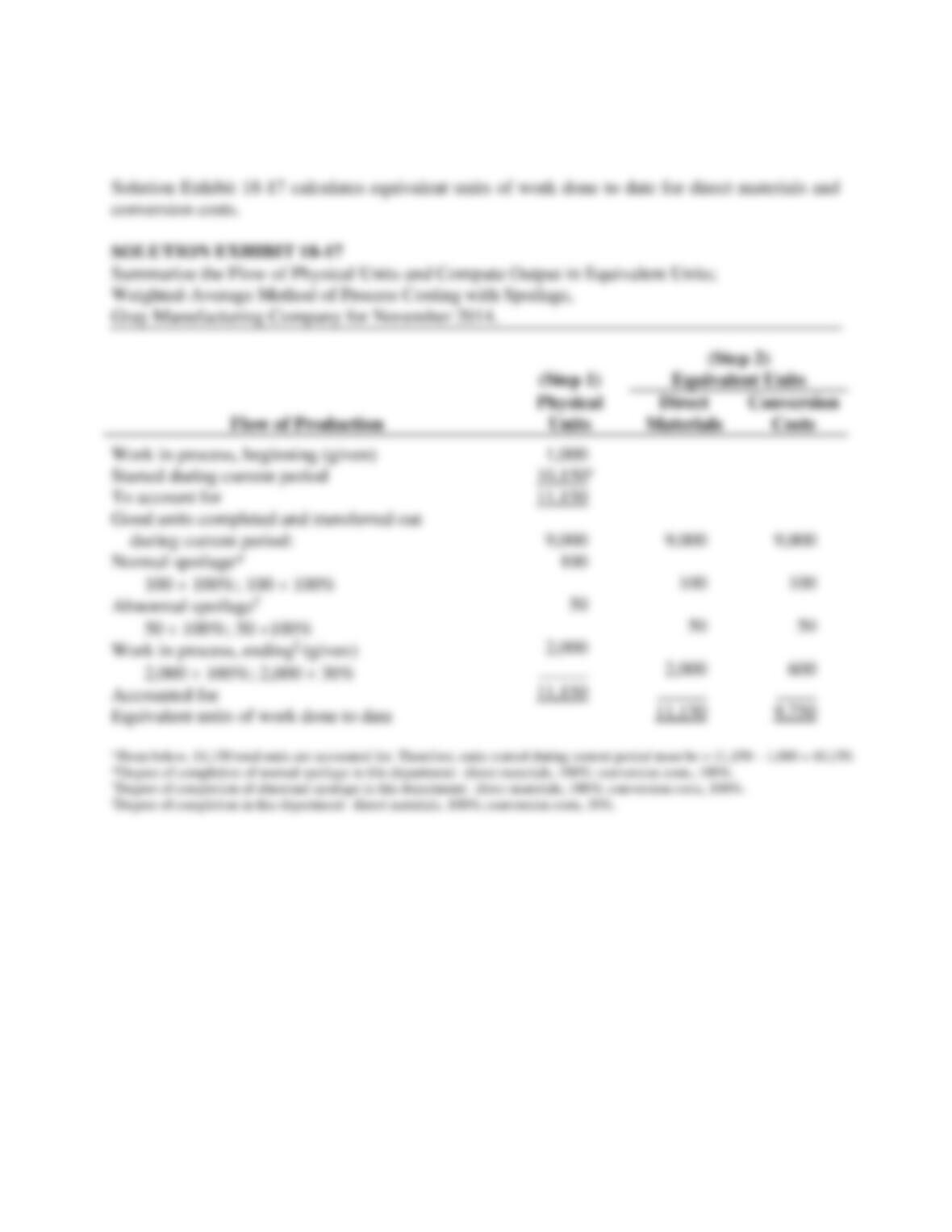
18-17 (20 min.) Weighted-average method, spoilage, equivalent units.
(CMA, adapted) Consider the following data for November 2014 from Gray Manufacturing
Company, which makes silk pennants and uses a process-costing system. All direct materials are
added at the beginning of the process, and conversion costs are added evenly during the process.
Spoilage is detected upon inspection at the completion of the process. Spoiled units are disposed
of at zero net disposal value. Gray Manufacturing Company uses the weighted-average method
of process costing.
aDegree of completion: direct materials, 100%; conversion costs, 50%.
bDegree of completion: direct materials, 100%; conversion costs, 30%.
Required:
Compute equivalent units for direct materials and conversion costs. Show physical units in the
first column of your schedule.
18-5
SOLUTION
18-6
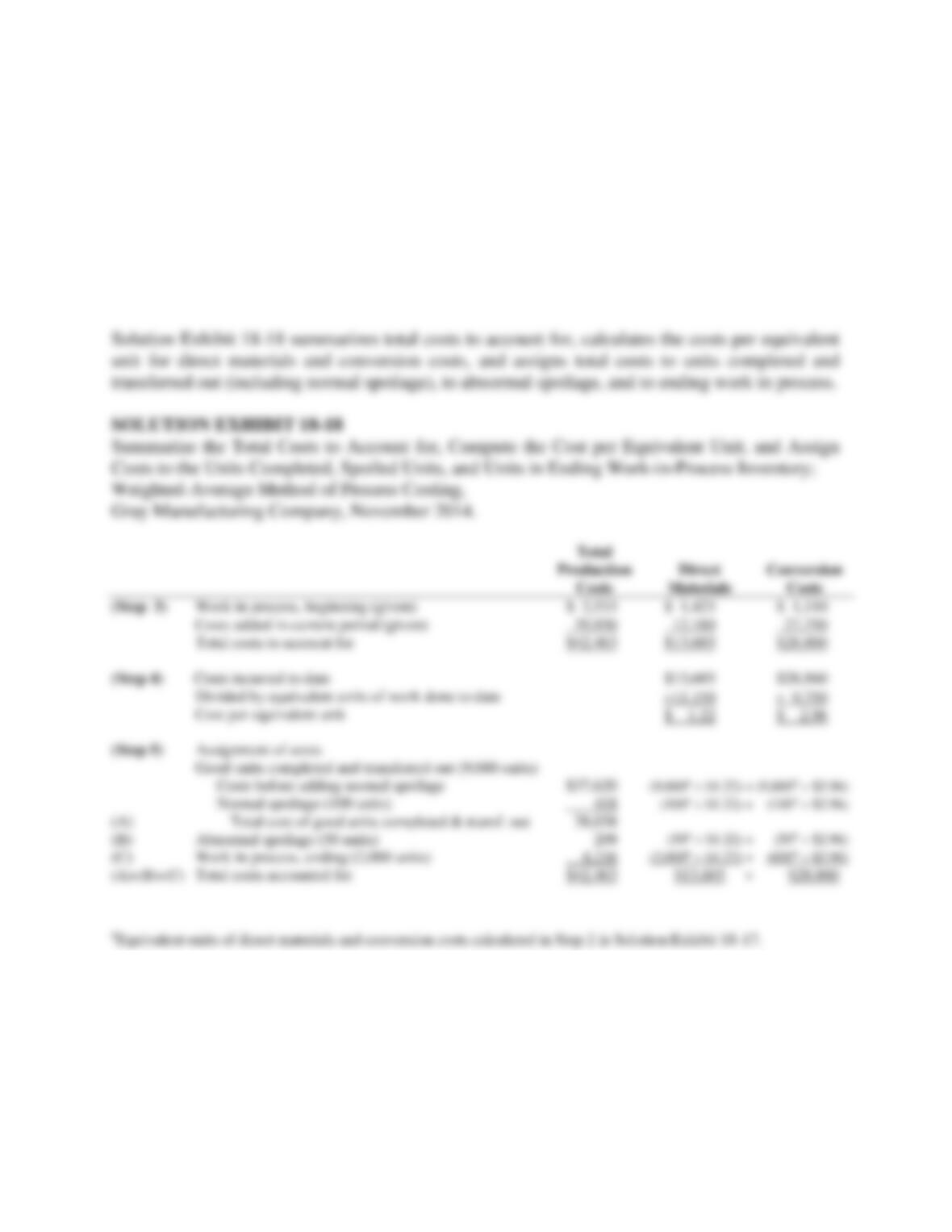
18-18 (20−25 min.) Weighted-average method, assigning costs (continuation of 18-17).
Required:
For the data in Exercise 18-17, summarize the total costs to account for; calculate the cost per
equivalent unit for direct materials and conversion costs; and assign costs to units completed and
transferred out (including normal spoilage), to abnormal spoilage, and to units in ending work–
in-process inventory.
SOLUTION
18-7
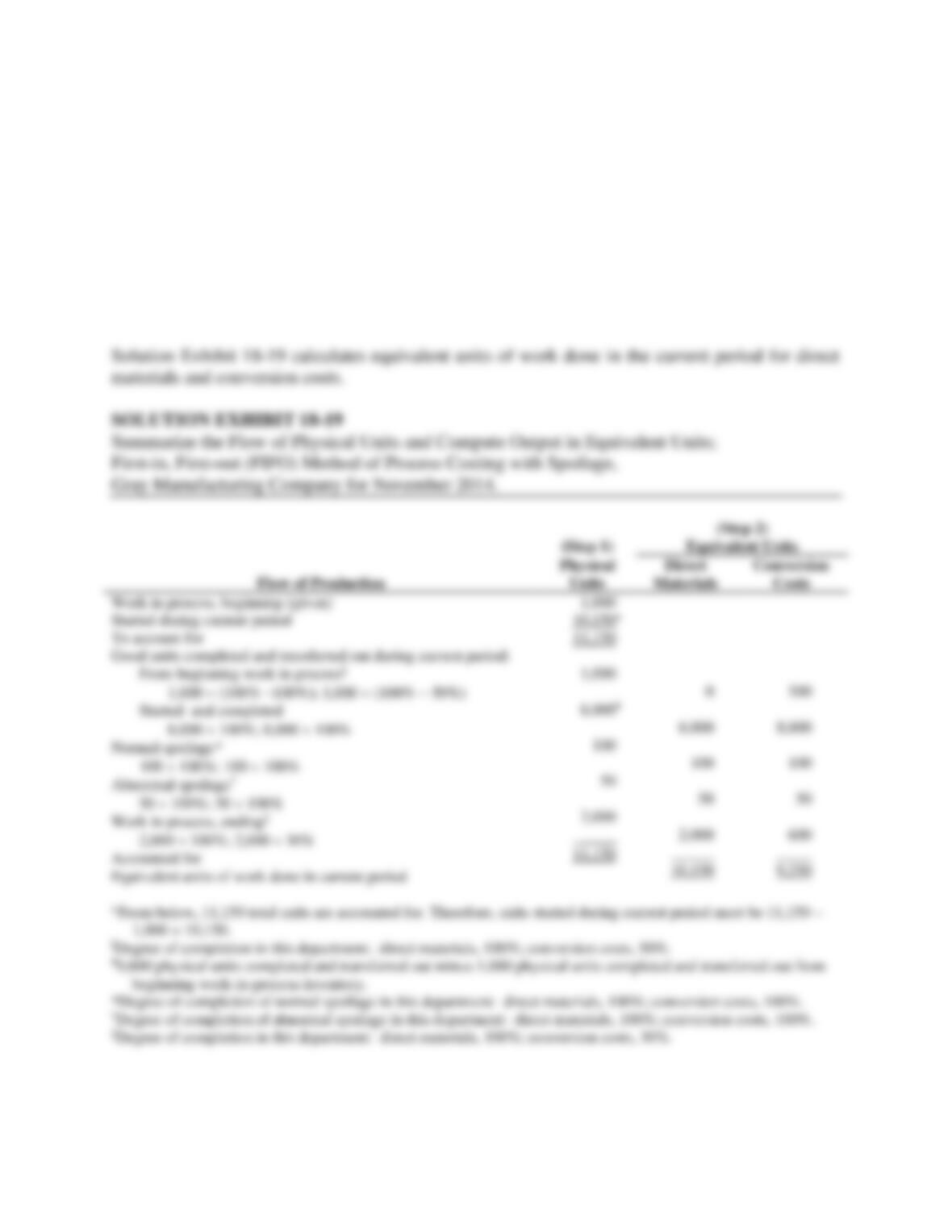
18-19 (15 min.) FIFO method, spoilage, equivalent units.
Refer to the information in Exercise 18-17. Suppose Gray Manufacturing Company uses the
FIFO method of process costing instead of the weighted-average method.
Required:
Compute equivalent units for direct materials and conversion costs. Show physical units in the
first column of your schedule.
SOLUTION
18-8
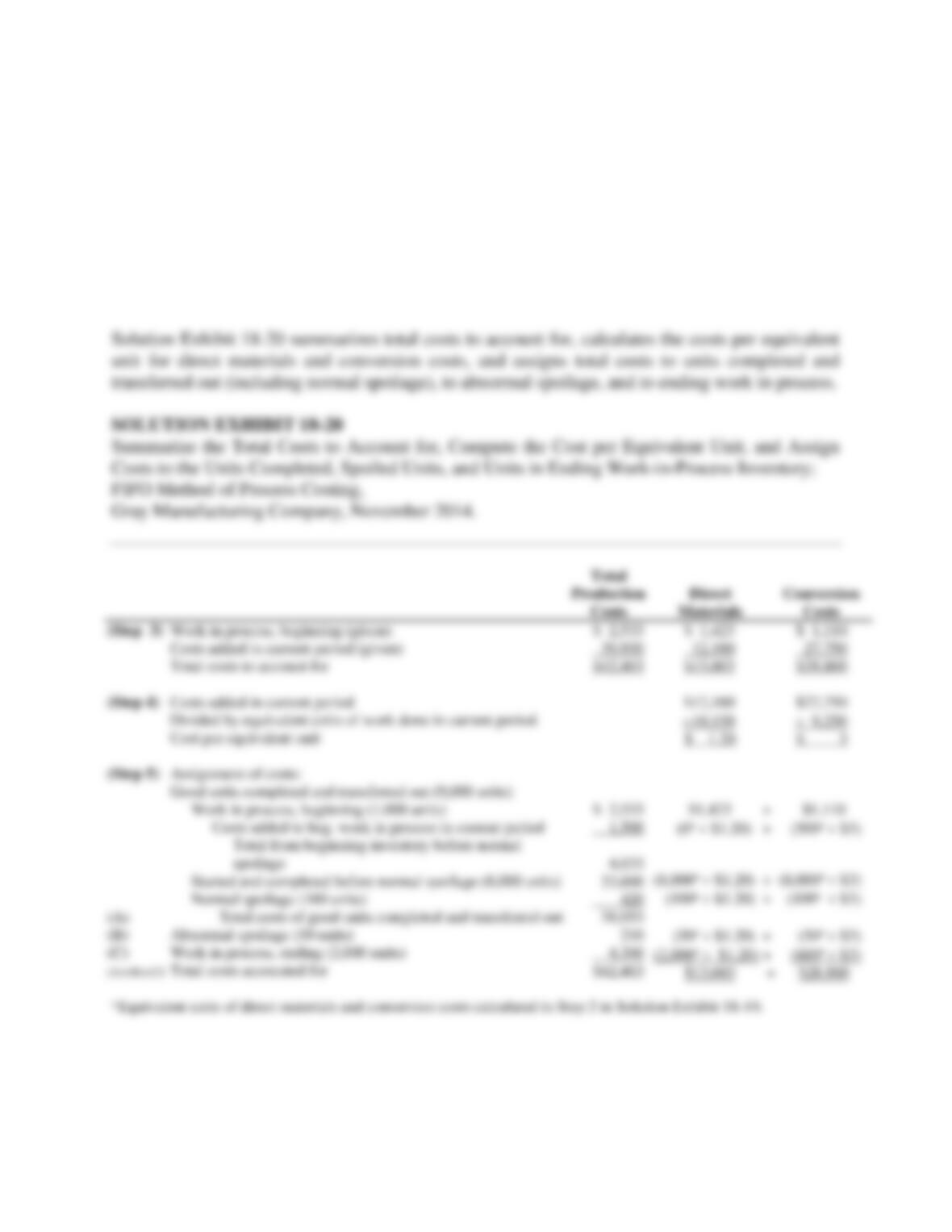
18-20 (20−25 min.) FIFO method, assigning costs (continuation of 18-19).
Required:
For the data in Exercise 18-17, use the FIFO method to summarize the total costs to account for;
calculate the cost per equivalent unit for direct materials and conversion costs; and assign costs
to units completed and transferred out (including normal spoilage), to abnormal spoilage, and to
units in ending work in process.
SOLUTION
18-9
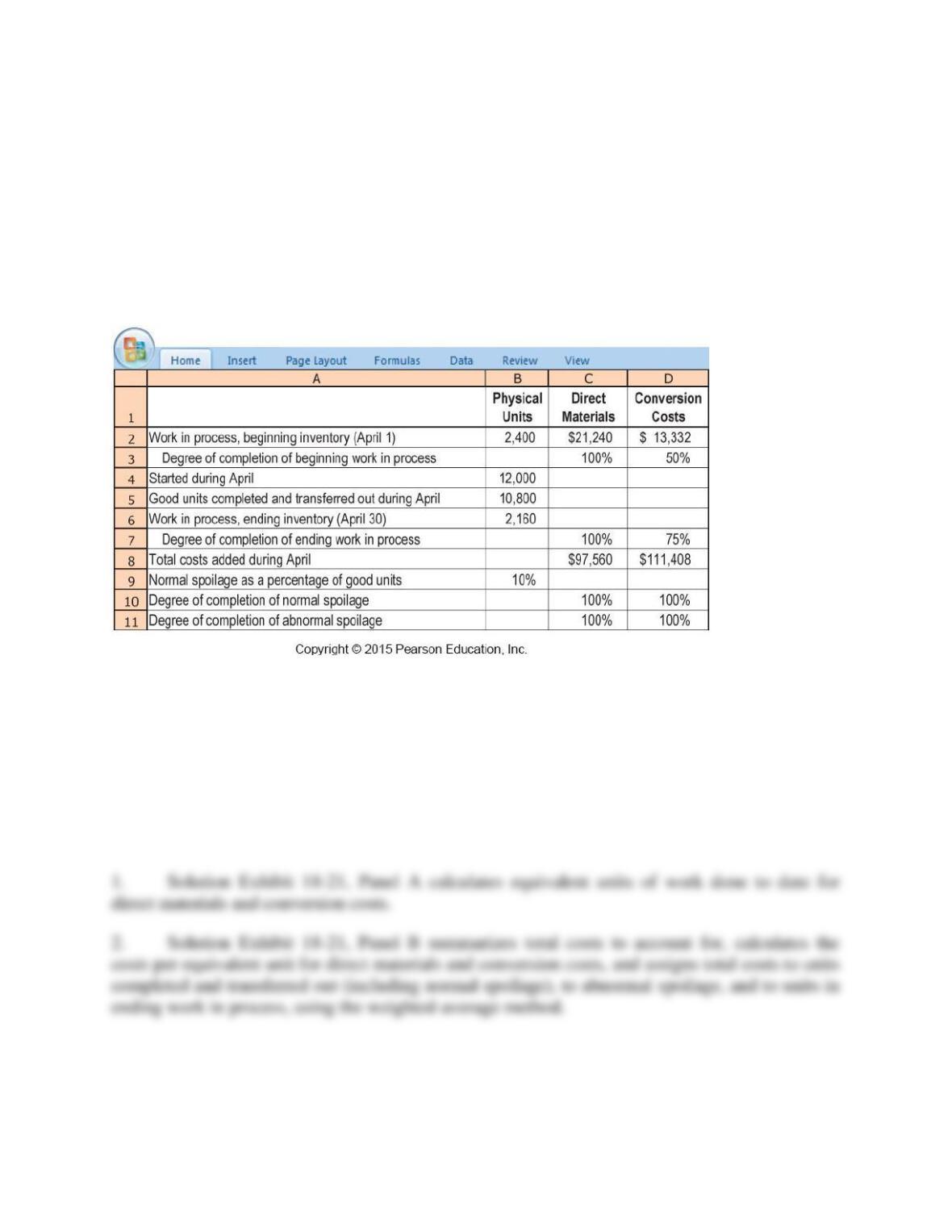
18-21 (35 min.) Weighted-average method, spoilage.
LaCroix Company produces handbags from leather of moderate quality. It distributes the product
through outlet stores and department store chains. At LaCroix’s facility in northeast Ohio, direct
materials (primarily leather hides) are added at the beginning of the process, while conversion
costs are added evenly during the process. Given the importance of minimizing product returns,
spoiled units are detected upon inspection at the end of the process and are discarded at a net
disposal value of zero.
LaCroix uses the weighted-average method of process costing. Summary data for April 2014
are as follows:
Required:
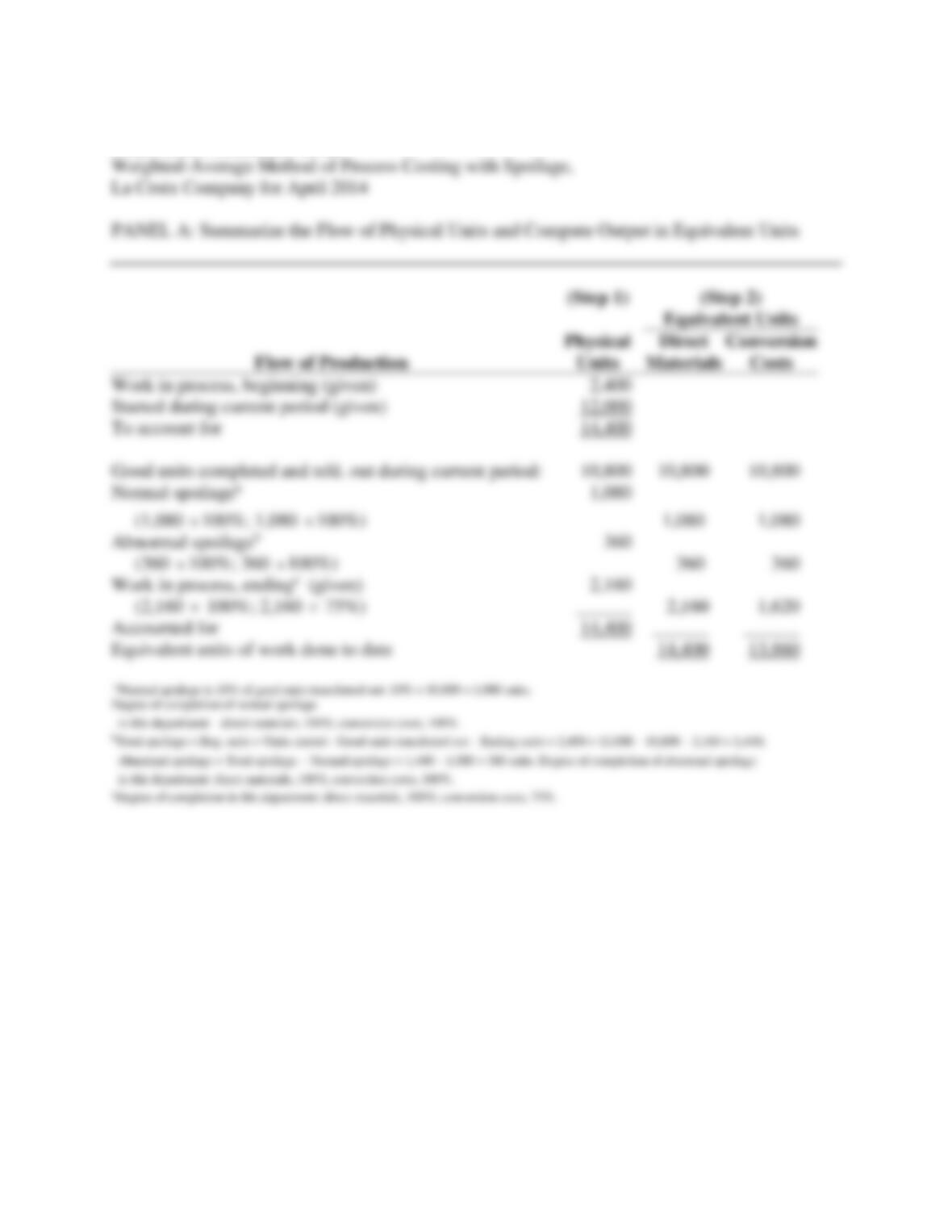
1. For each cost category, calculate equivalent units. Show physical units in the first column of
your schedule.
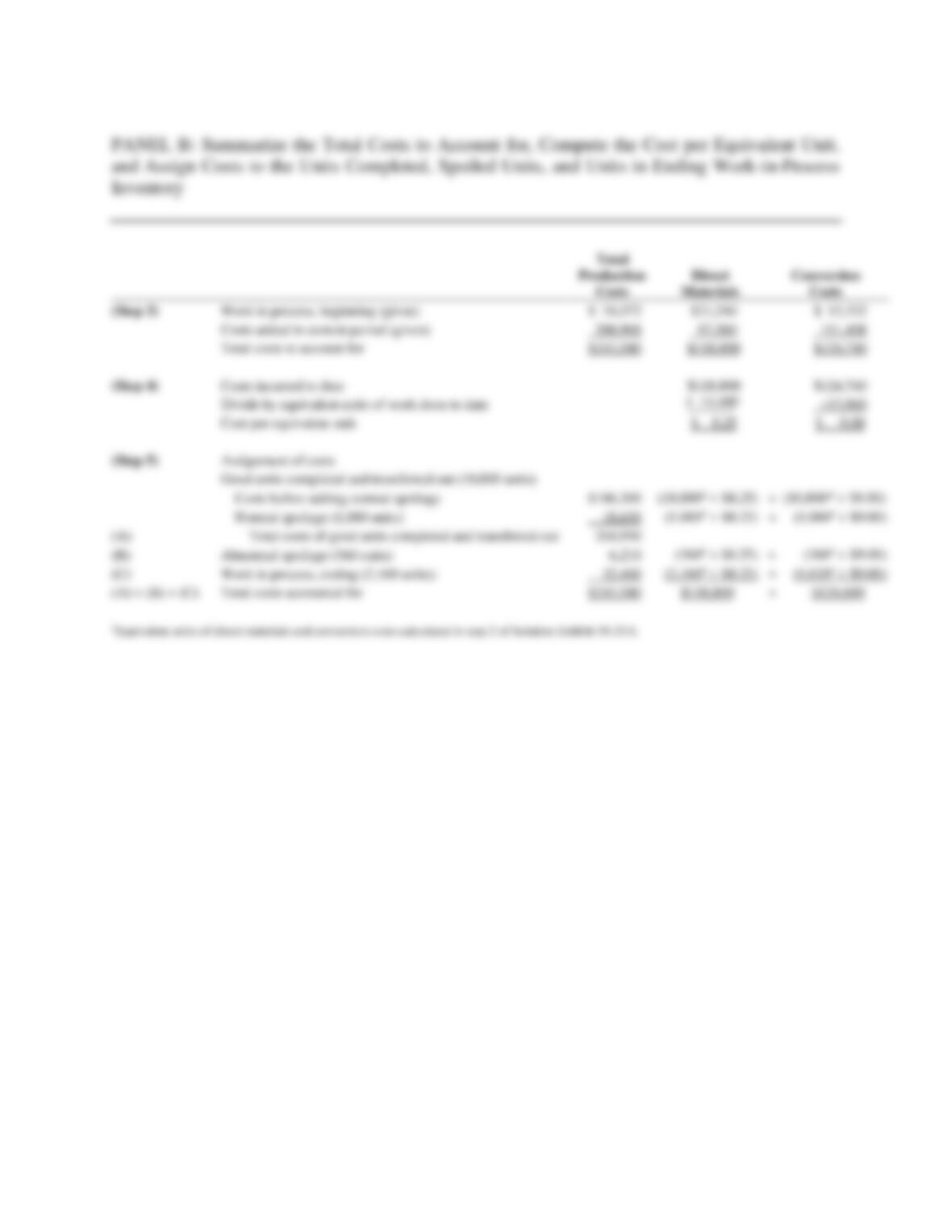
2. Summarize the total costs to account for; calculate the cost per equivalent unit for each cost
category; and assign costs to units completed and transferred out (including normal spoilage),
to abnormal spoilage, and to units in ending work in process.
SOLUTION
18-10
SOLUTION EXHIBIT 18-21
18-11
18-12
18-22 (35 min.) FIFO method, spoilage.
Required:
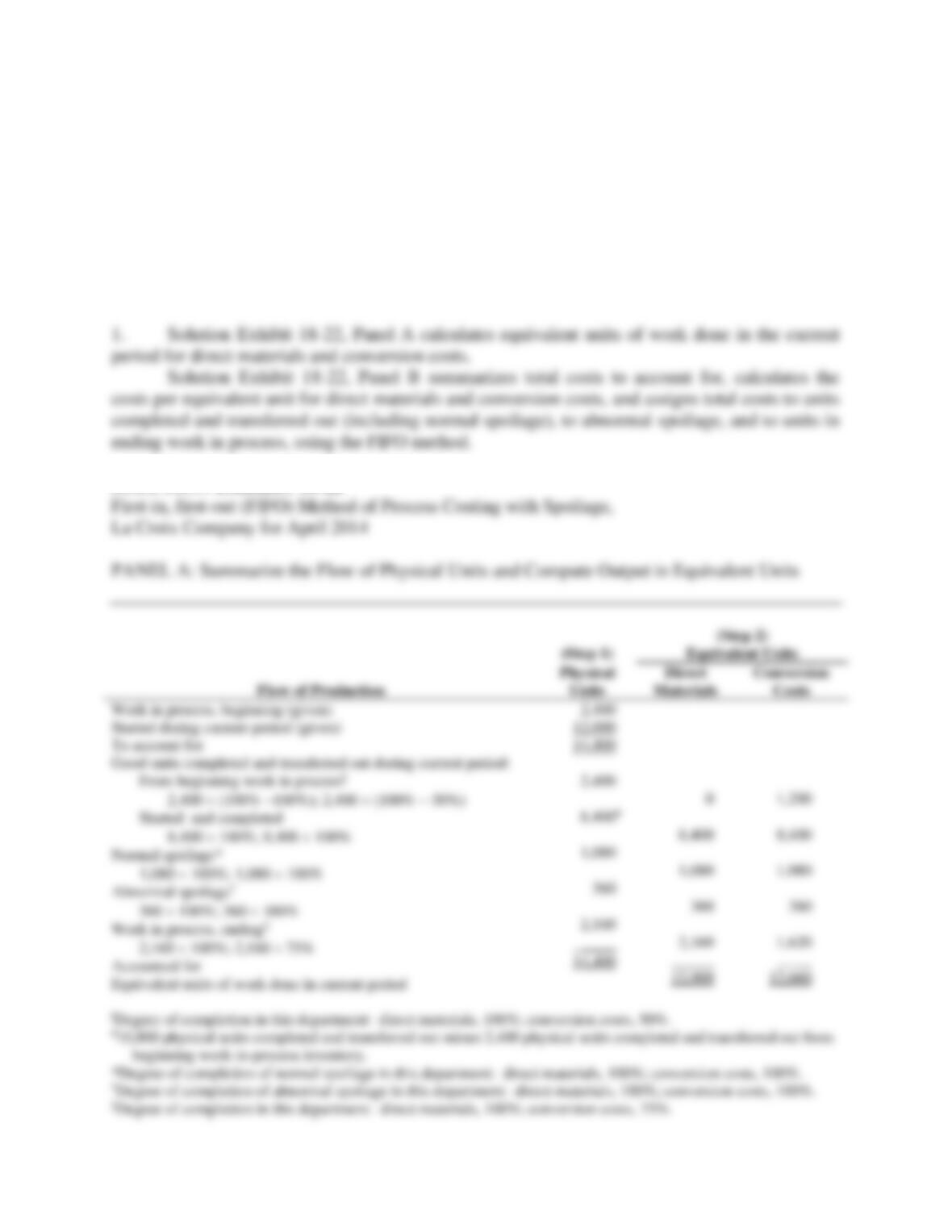
1. Do Exercise 18-21 using the FIFO method.
2. What are the managerial issues involved in selecting or reviewing the percentage of spoilage
considered normal? How would your answer to requirement 1 differ if all spoilage were
viewed as normal?
SOLUTION
SOLUTION EXHIBIT 18-22
18-13
18-14
18-23 (10 min.) Spoilage, journal entries.
Safeclear, Inc., is the leading manufacturer of automotive glass components such as windshields.
The company uses a process-costing system to account for its work-in-process inventories. When
Job 26, an order for windshields for the Chevy Malibu, was being processed, a piece of
laminated sheet glass was off-center in the cutting machine and two windshields were spoiled.
Because this problem occurs periodically, it is considered normal spoilage and is consequently
recorded as an overhead cost. Because this step comes first in the process of making the
windshields, the only costs incurred were $325 for direct materials. Assume the laminated glass
cannot be sold, and its cost has been recorded in work-in-process inventory.
Required:
Prepare the journal entries to record the spoilage incurred.
SOLUTION
18-24 (15 min.) Recognition of loss from spoilage.
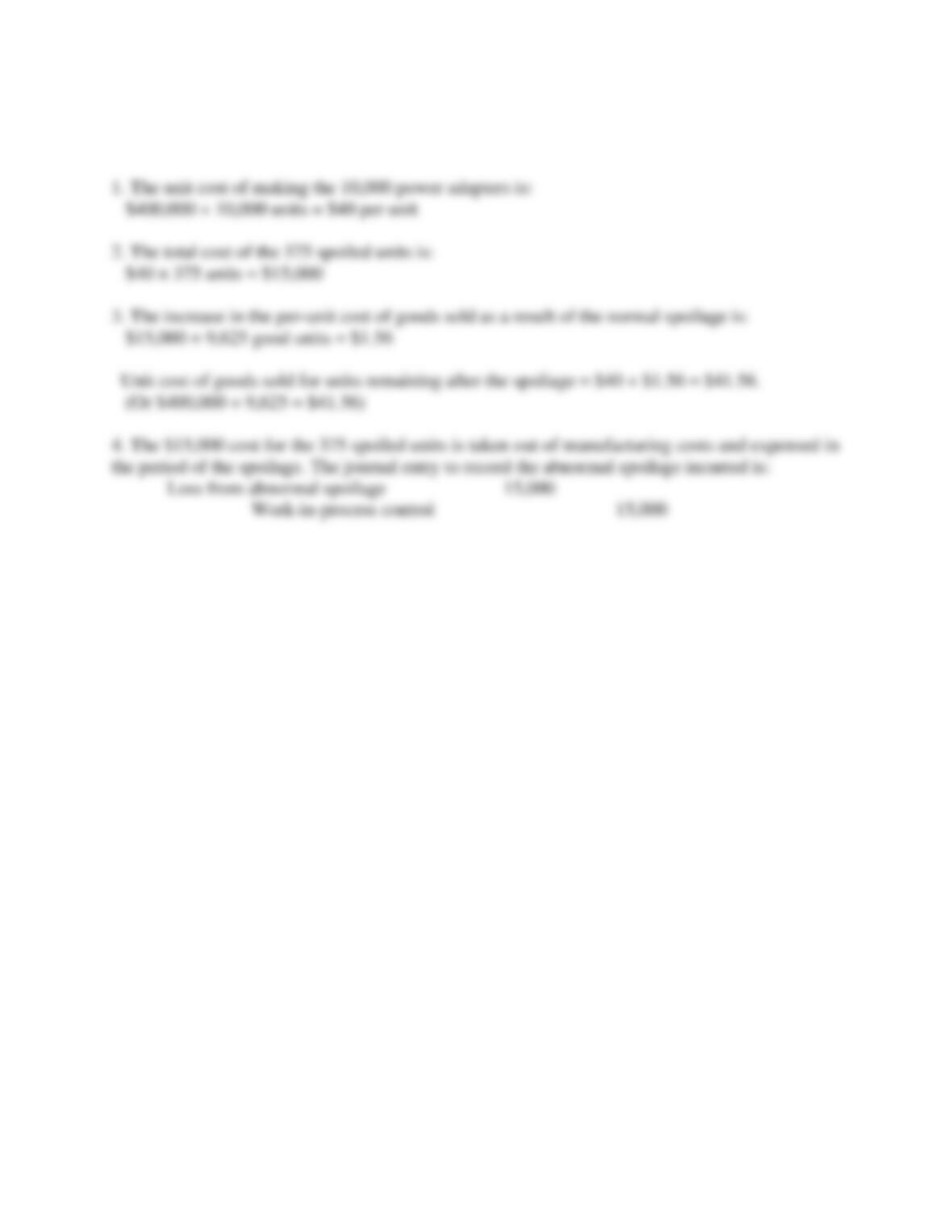
Roku Electronics manufactures universal power adapters at its Desert Sands plant. The company
provides you with the following information regarding operations for April 2014:
Assume the spoiled units have no disposal value.
Required:
1. What is the unit cost of making the 10,000 universal power adapters?
2. What is the total cost of the 375 spoiled units?
3. If the spoilage is considered normal, what is the increase in the unit cost of good adapters
manufactured as a result of the spoilage?
4. If the spoilage is considered abnormal, prepare the journal entries for the spoilage incurred.
18-15
SOLUTION
18-16
18-25 (25 min.) Weighted-average method, spoilage.
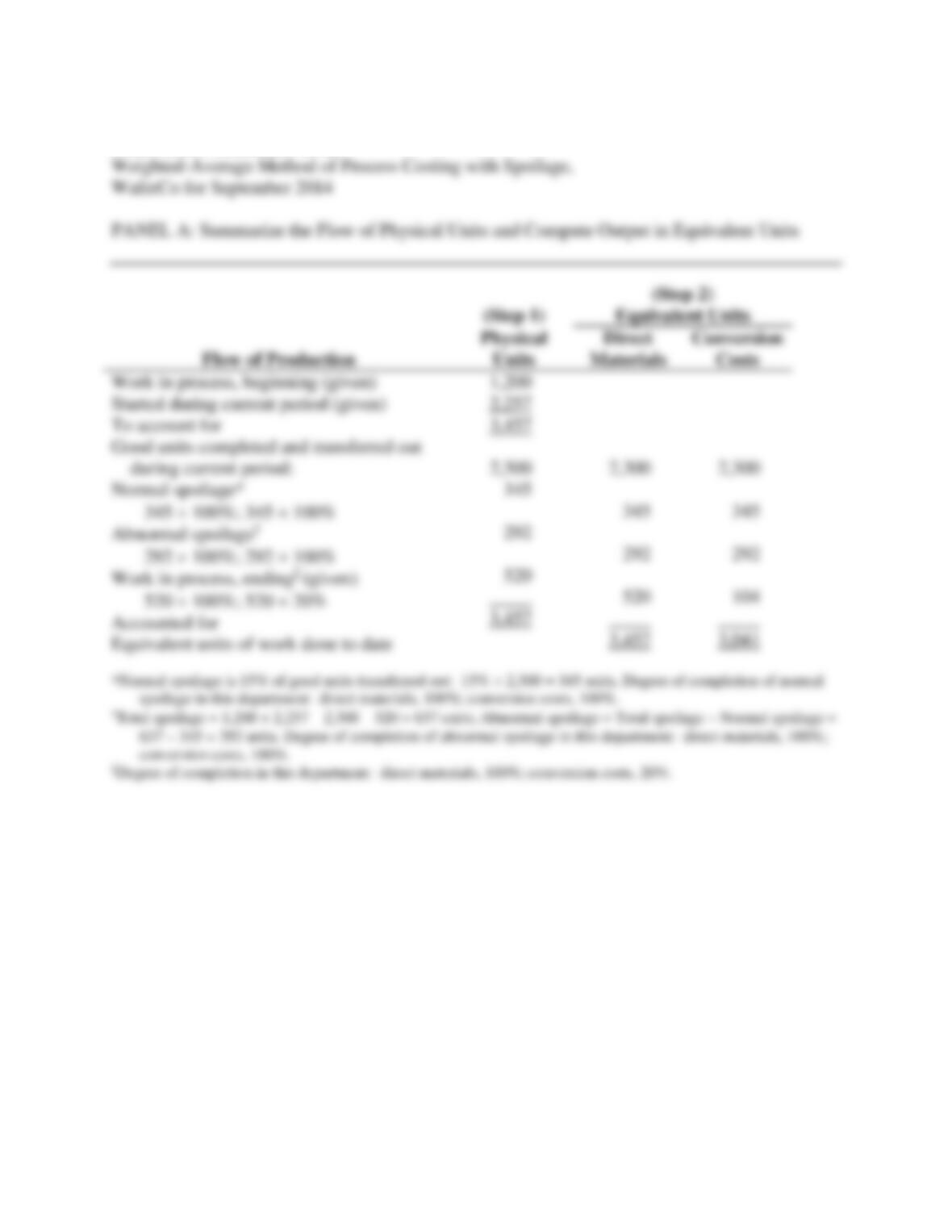
WaferCo is a fast-growing manufacturer of computer chips. Direct materials are added at the
start of the production process. Conversion costs are added evenly during the process. Some
units of this product are spoiled as a result of defects not detectable before inspection of finished
goods. Spoiled units are disposed of at zero net disposal value. WaferCo uses the weighted–
average method of process costing.
Summary data for September 2014 are as follows:
Required:
1. For each cost category, compute equivalent units. Show physical units in the first column of
your schedule.
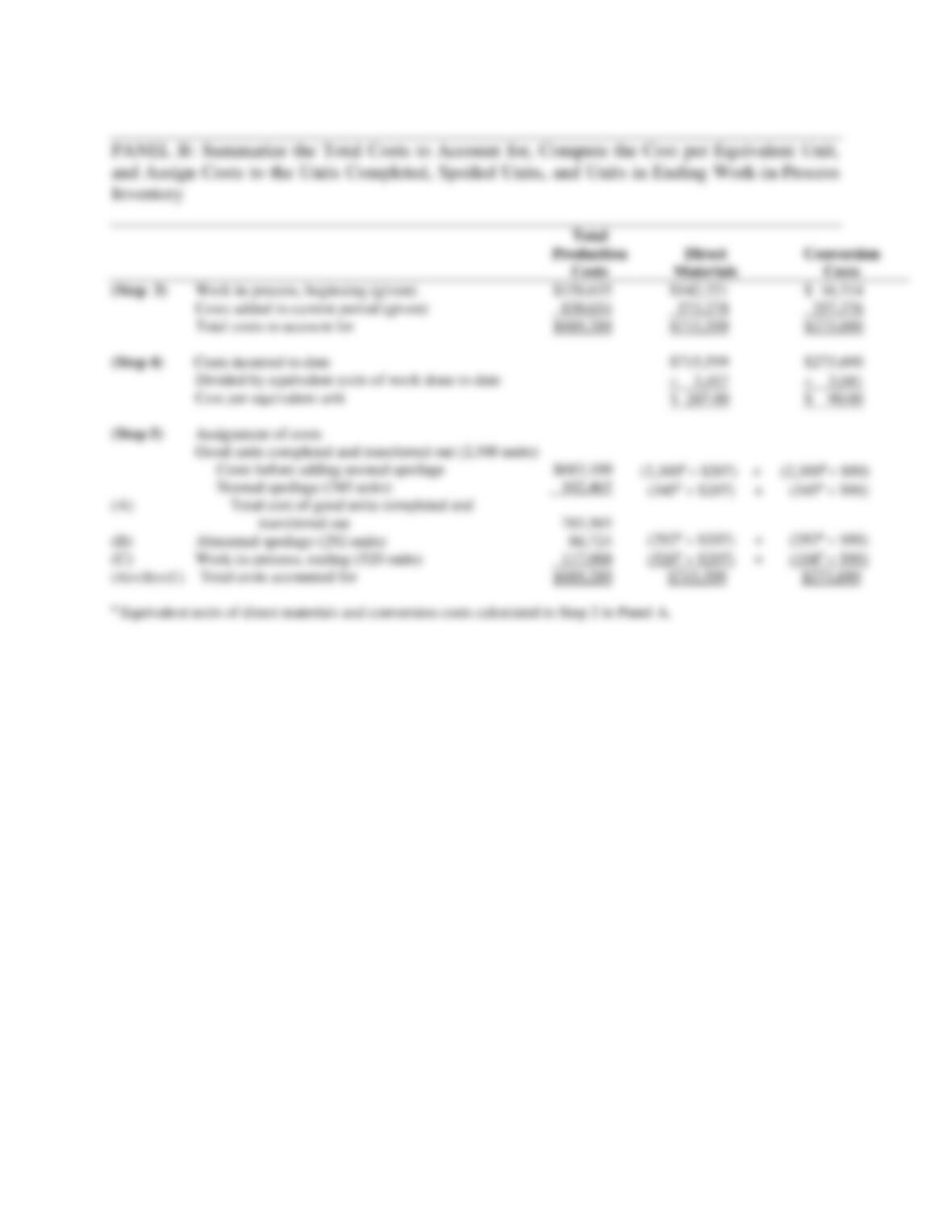
2. Summarize the total costs to account for; calculate the cost per equivalent unit for each cost
category; and assign costs to units completed and transferred out (including normal spoilage),
to abnormal spoilage, and to units in ending work in process.
SOLUTION
18-17
SOLUTION EXHIBIT 18-25
18-18
18-19
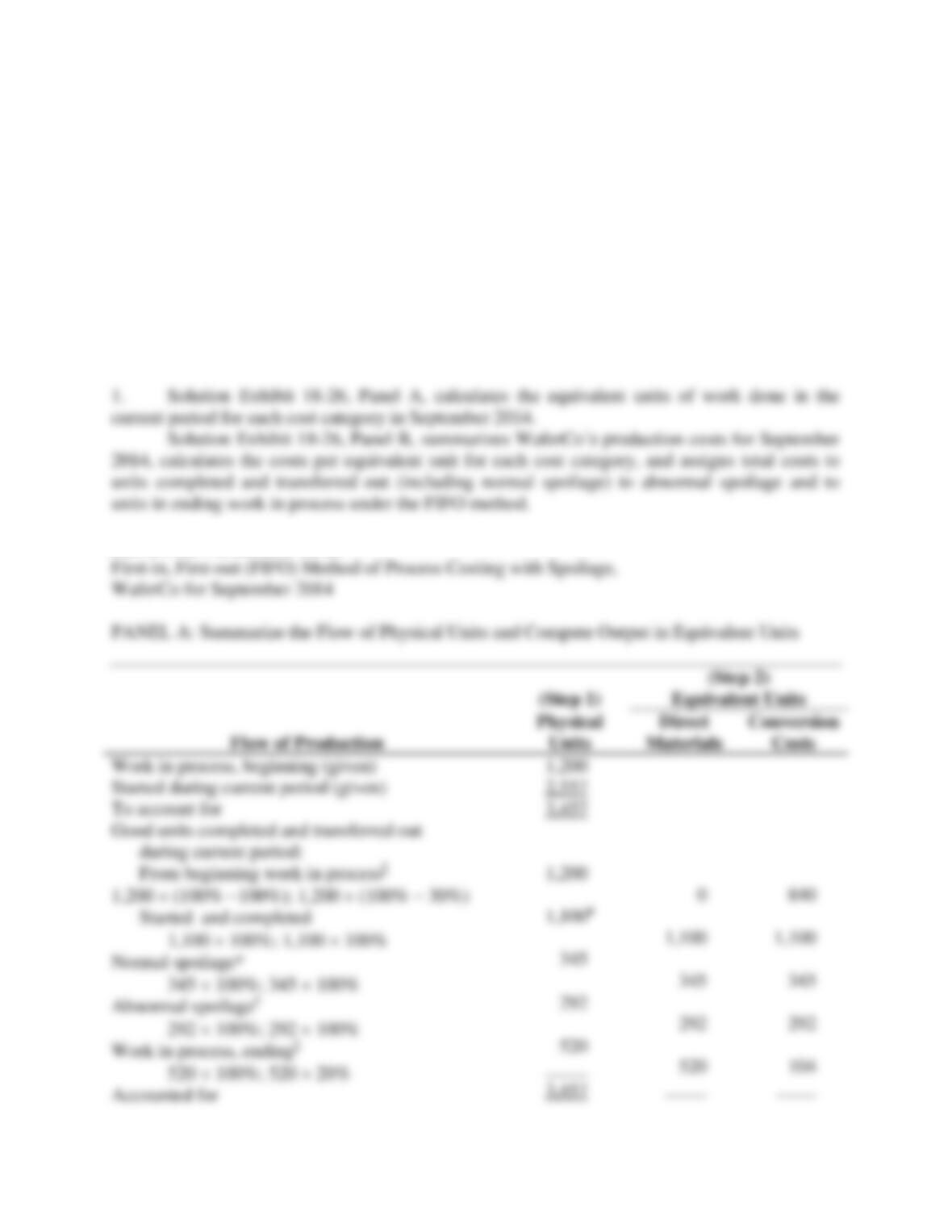
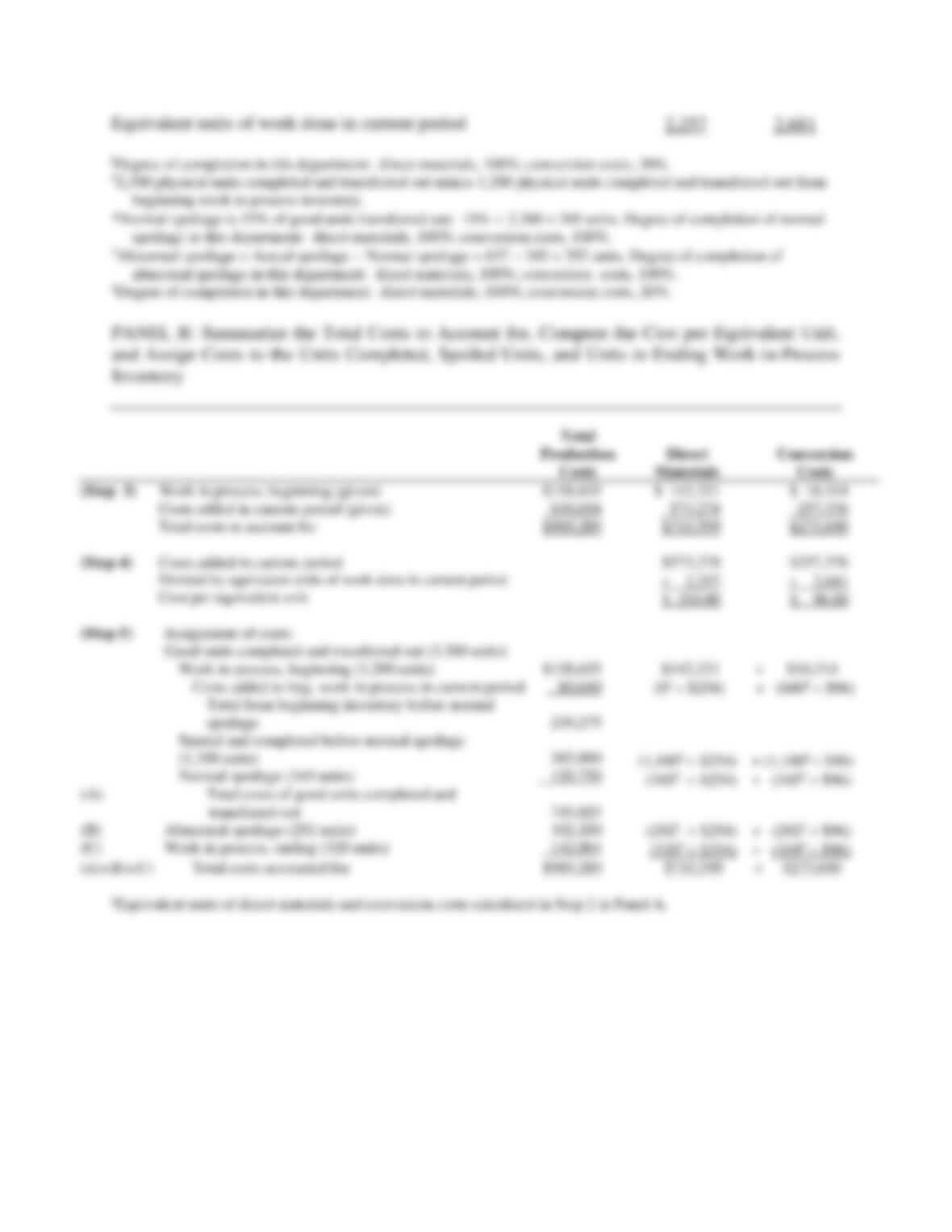
18-26 (25 min.) FIFO method, spoilage.
Refer to the information in Exercise 18-25.
Required:
1. Do Exercise 18-25 using the FIFO method of process costing.
2. Should WaferCo’s managers choose the weighted-average method or the FIFO method?
Explain briefly.
SOLUTION
SOLUTION EXHIBIT 18-26
18-20