18-21
18-22
18-27 (30 min.) Standard-costing method, spoilage.
Refer to the information in Exercise 18-25. Suppose WaferCo determines standard costs of $240
per equivalent unit for direct materials and $100 per equivalent unit for conversion costs for both
beginning work in process and work done in the current period.
Required:
1. Do Exercise 18-25 using the standard-costing method.
2. What issues should the manager focus on when reviewing the equivalent units calculation?
SOLUTION
18-23
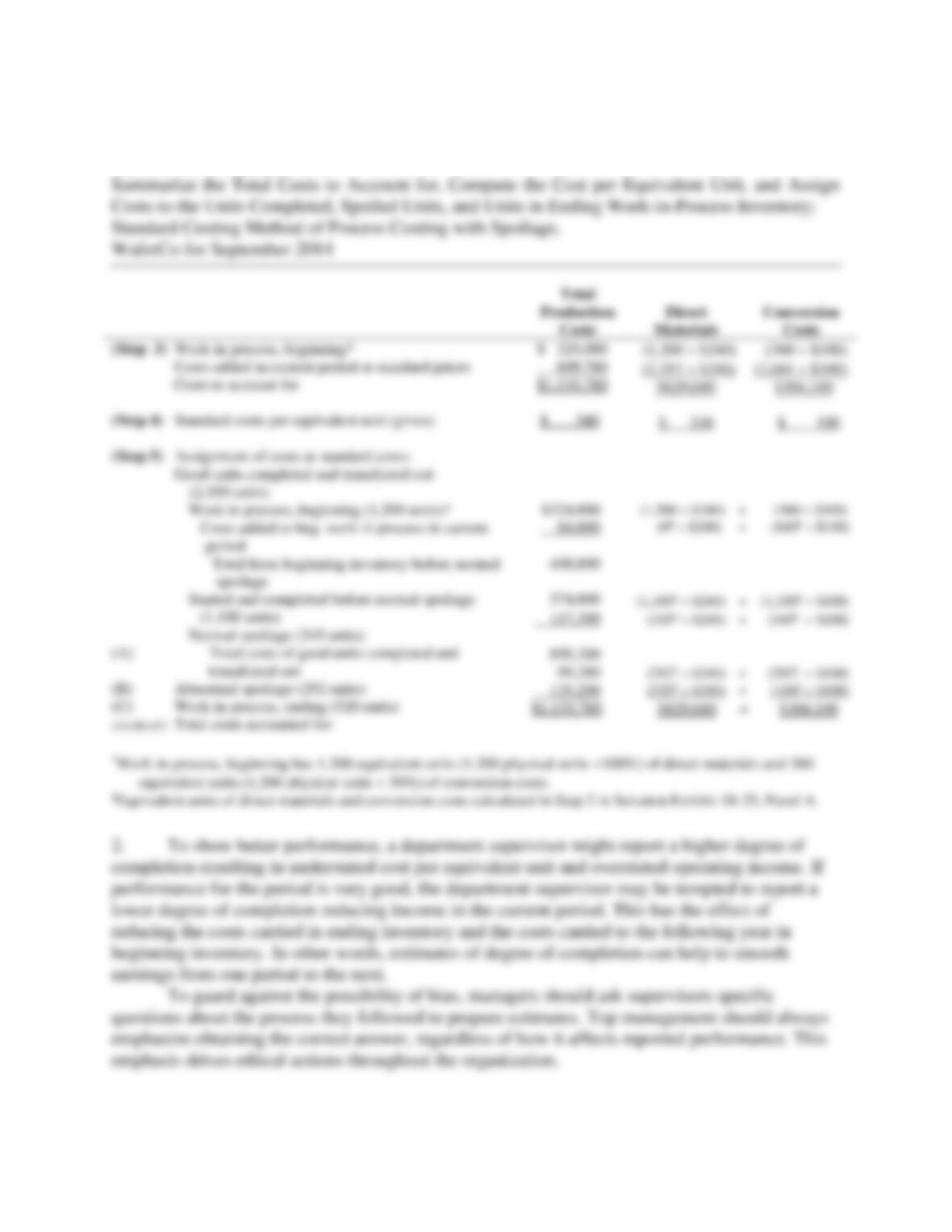
SOLUTION EXHIBIT 18-27
18-24
18-28 (20–30 min.) Spoilage and job costing.
(L. Bamber) Barrett Kitchens produces a variety of items in accordance with special job orders
from hospitals, plant cafeterias, and university dormitories. An order for 2,100 cases of mixed
vegetables costs $9 per case: direct materials, $4; direct manufacturing labor, $3; and
manufacturing overhead allocated, $2. The manufacturing overhead rate includes a provision for
normal spoilage. Consider each requirement independently.
Required:
1. Assume that a laborer dropped 420 cases. Suppose part of the 420 cases could be sold to a
nearby prison for $420 cash. Prepare a journal entry to record this event. Calculate and
explain briefly the unit cost of the remaining 1,680 cases.
2. Refer to the original data. Tasters at the company reject 420 of the 2,100 cases. The 420
cases are disposed of for $840. Assume that this rejection rate is considered normal. Prepare
a journal entry to record this event, and do the following:
a. Calculate the unit cost if the rejection is attributable to exacting specifications of this
particular job.
b. Calculate the unit cost if the rejection is characteristic of the production process and is
not attributable to this specific job.
c. Are unit costs the same in requirements 2a and 2b? Explain your reasoning briefly.
3. Refer to the original data. Tasters rejected 420 cases that had insufficient salt. The product
can be placed in a vat, salt can be added, and the product can be reprocessed into jars. This
operation, which is considered normal, will cost $420. Prepare a journal entry to record this
event and do the following:
a. Calculate the unit cost of all the cases if this additional cost was incurred because of the
exacting specifications of this particular job.
b. Calculate the unit cost of all the cases if this additional cost occurs regularly because of
difficulty in seasoning.
c. Are unit costs the same in requirements 3a and 3b? Explain your reasoning briefly.
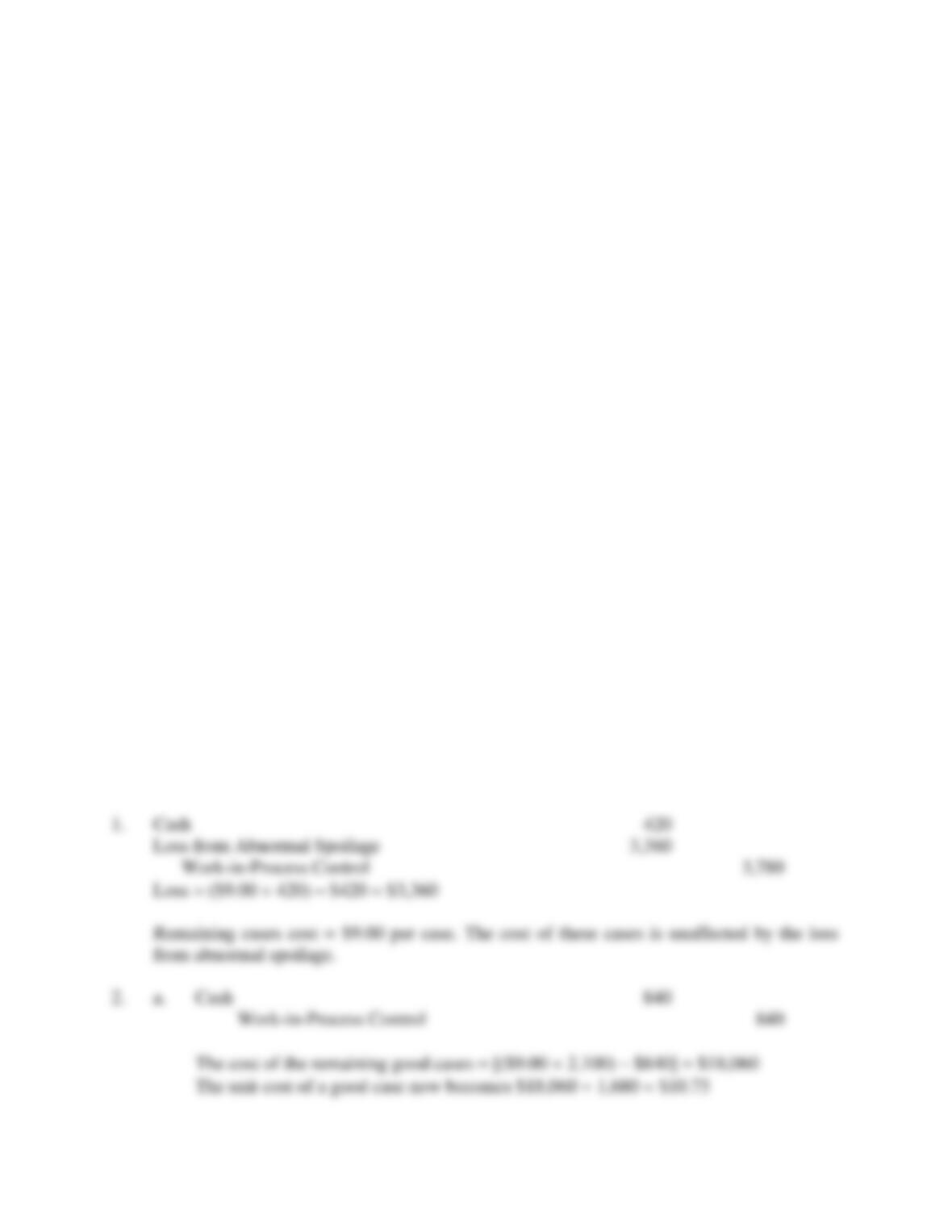
SOLUTION
18-25
18-29 (15 min.) Reworked units, costs of rework.
Heyer Appliances assembles dishwashers at its plant in Tuscaloosa, Alabama. In February 2014,
60 circulation motors that cost $110 each (from a new supplier who subsequently went bankrupt)
were defective and had to be disposed of at zero net disposal value. Heyer Appliances was able
to rework all 60 dishwashers by substituting new circulation motors purchased from one of its
existing suppliers. Each replacement motor cost $125.
Required:
1. What alternative approaches are there to account for the materials cost of reworked units?
2. Should Heyer Appliances use the $110 circulation motor or the $125 motor to calculate the
cost of materials reworked? Explain.
3. What other costs might Heyer Appliances include in its analysis of the total costs of rework
due to the circulation motors purchased from the (now) bankrupt supplier?
18-26
SOLUTION
18-30 (25 min.) Scrap, job costing.
The Russell Company has an extensive job-costing facility that uses a variety of metals.
Consider each requirement independently.
Required:
1. Job 372 uses a particular metal alloy that is not used for any other job. Assume that scrap is
material in amount and sold for $480 quickly after it is produced. Prepare the journal entry.
2. The scrap from Job 372 consists of a metal used by many other jobs. No record is maintained
of the scrap generated by individual jobs. Assume that scrap is accounted for at the time of its
sale. Scrap totaling $4,500 is sold. Prepare two alternative journal entries that could be used
to account for the sale of scrap.
3. Suppose the scrap generated in requirement 2 is returned to the storeroom for future use, and
a journal entry is made to record the scrap. A month later, the scrap is reused as direct
material on a subsequent job. Prepare the journal entries to record these transactions.
18-27
SOLUTION
18-28
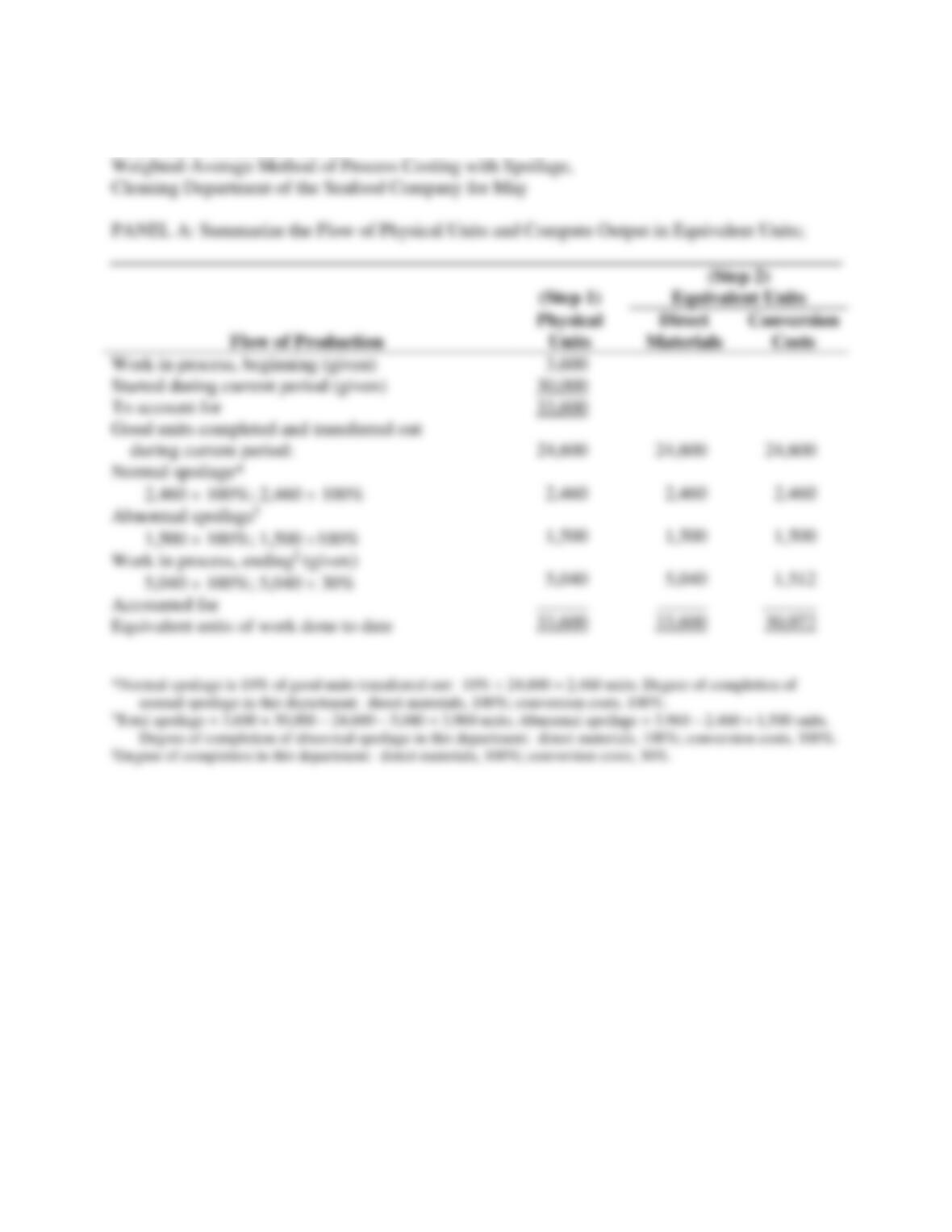
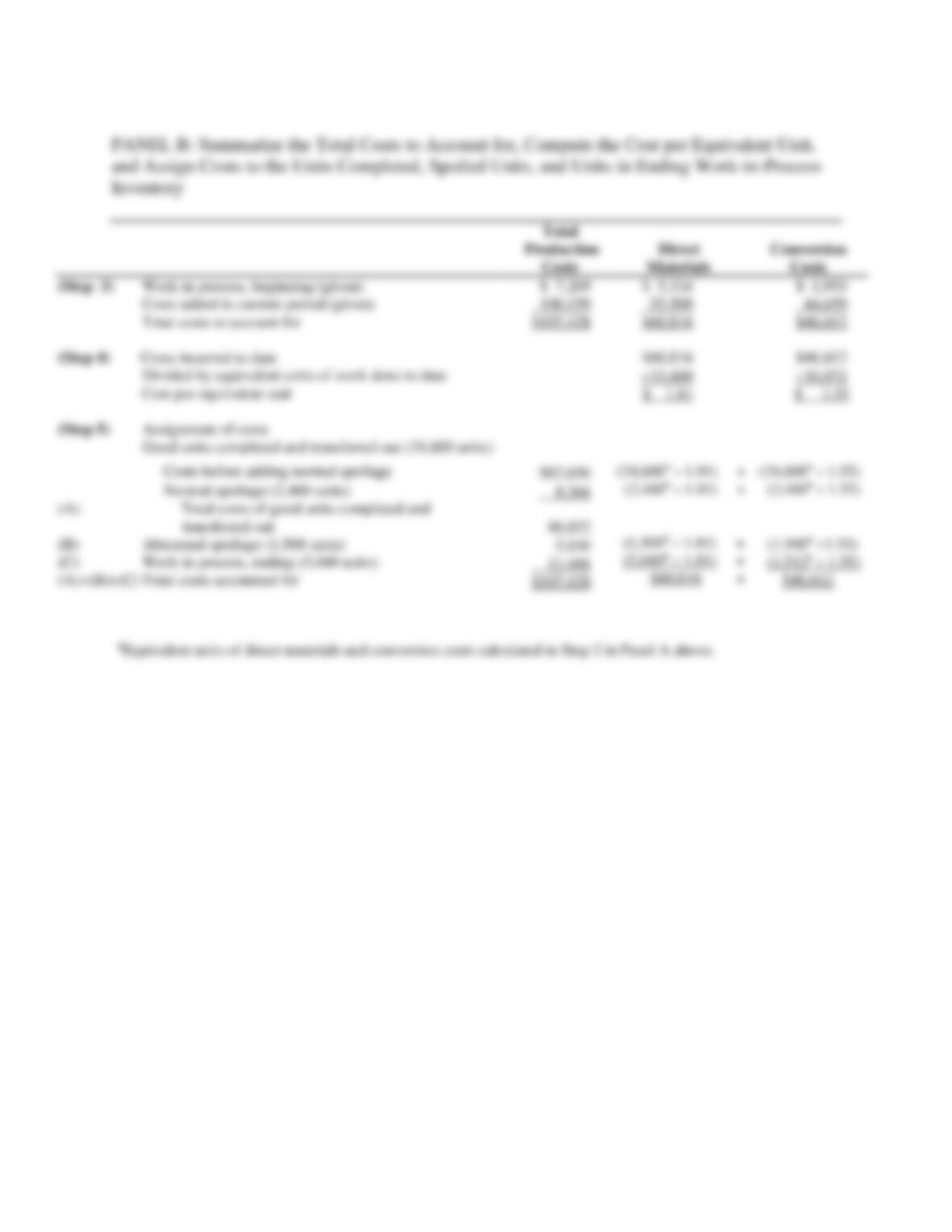
18-31 (30 min.) Weighted-average method, spoilage.
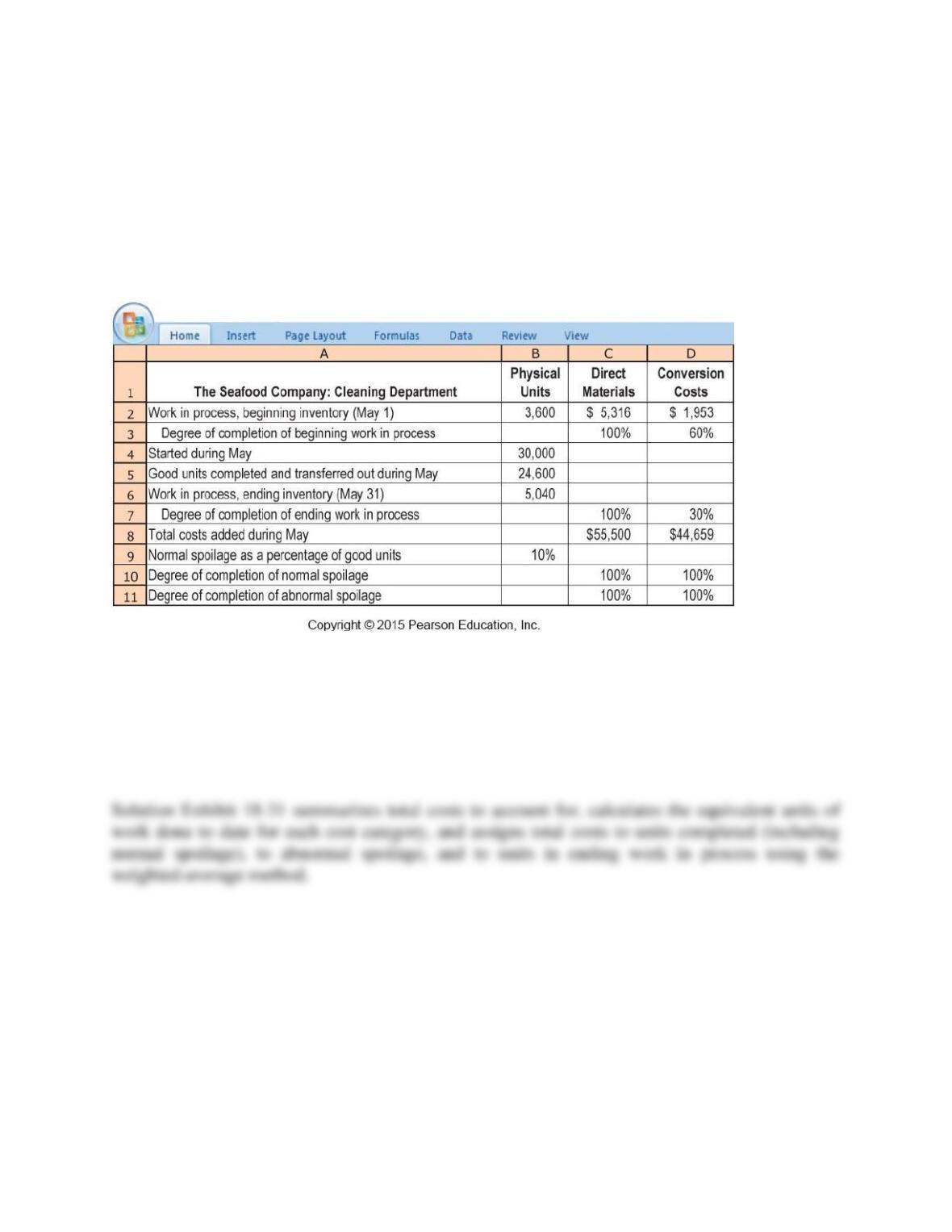
The Seafood Company is a food-processing firm based in Maine. It operates under the weighted–
average method of process costing and has two departments: cleaning and packaging. For the
cleaning department, conversion costs are added evenly during the process, and direct materials
are added at the beginning of the process. Spoiled units are detected upon inspection at the end of
the process and are disposed of at zero net disposal value. All completed work is transferred to
the packaging department. Summary data for May follow:
Required:
For the cleaning department, summarize the total costs to account for and assign those costs to
units completed and transferred out (including normal spoilage), to abnormal spoilage, and to
units in ending work in process. (Problem 18-33 explores additional facets of this problem.)
SOLUTION
18-29
SOLUTION EXHIBIT 18-31
18-30
18-31
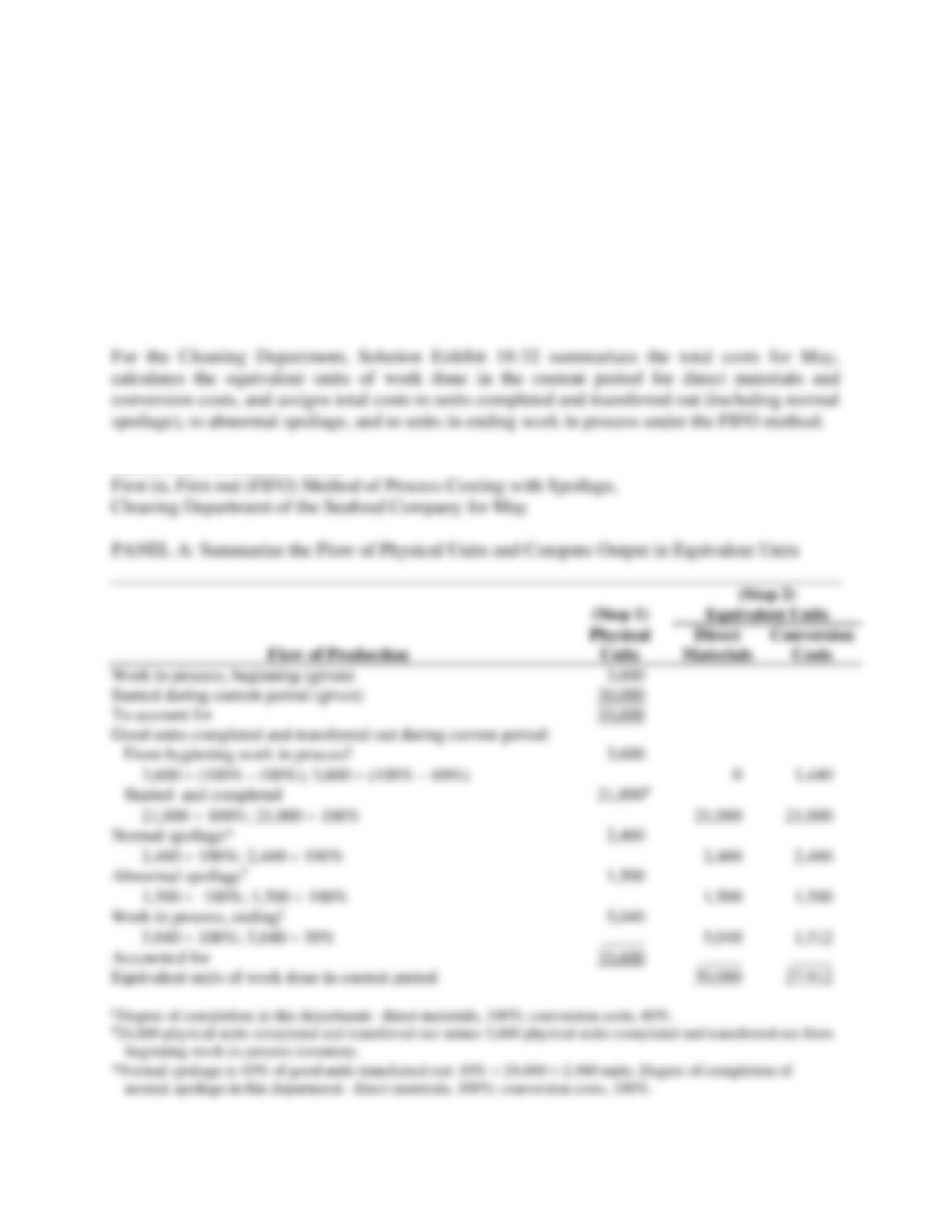
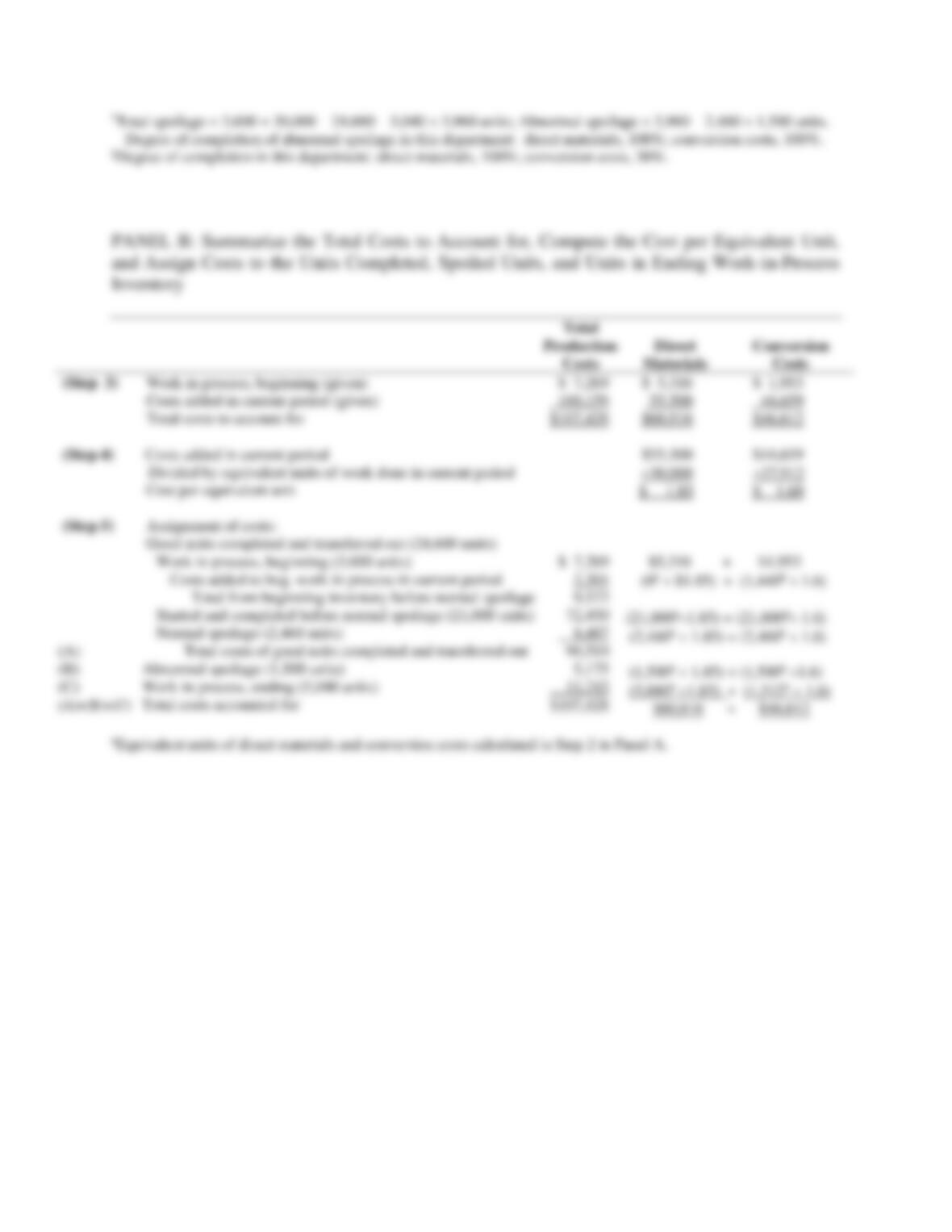
18-32 (25 min.) FIFO method, spoilage.
Refer to the information in Problem 18-31.
Required:
Do Problem 18-31 using the FIFO method of process costing. (Problem 18-34 explores
additional facets of this problem.)
SOLUTION
SOLUTION EXHIBIT 18-32
18-32
18-33
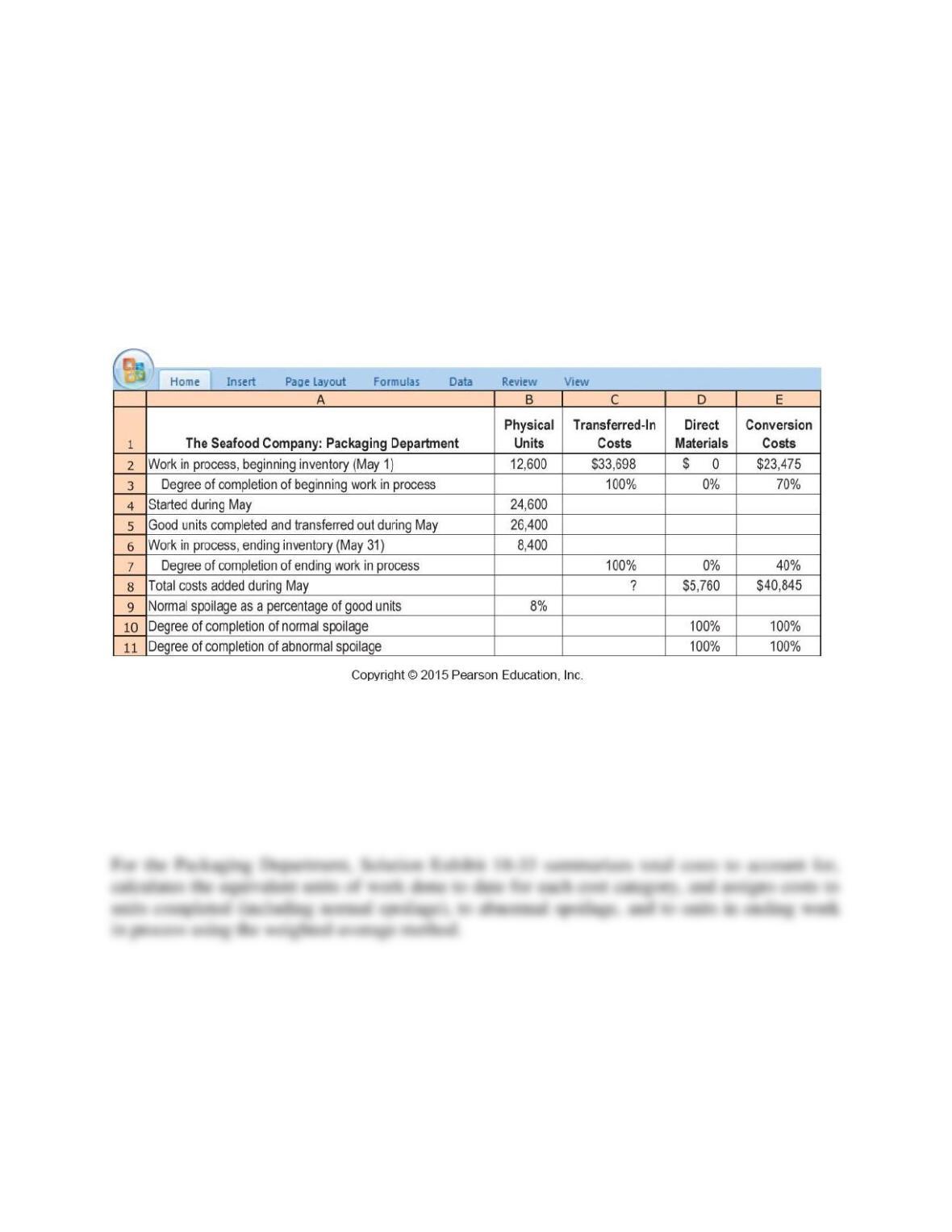
18-33 (35 min.) Weighted-average method, Packaging Department (continuation of 18-
31).
In the Seafood Company’s packaging department, conversion costs are added evenly during the
process, and direct materials are added at the end of the process. Spoiled units are detected upon
inspection at the end of the process and are disposed of at zero net disposal value. All completed
work is transferred to the next department. The transferred-in costs for May equal the total cost
of good units completed and transferred out in May from the cleaning department, which were
calculated in Problem 18-31 using the weighted-average method of process costing. Summary
data for May follow.
Required:
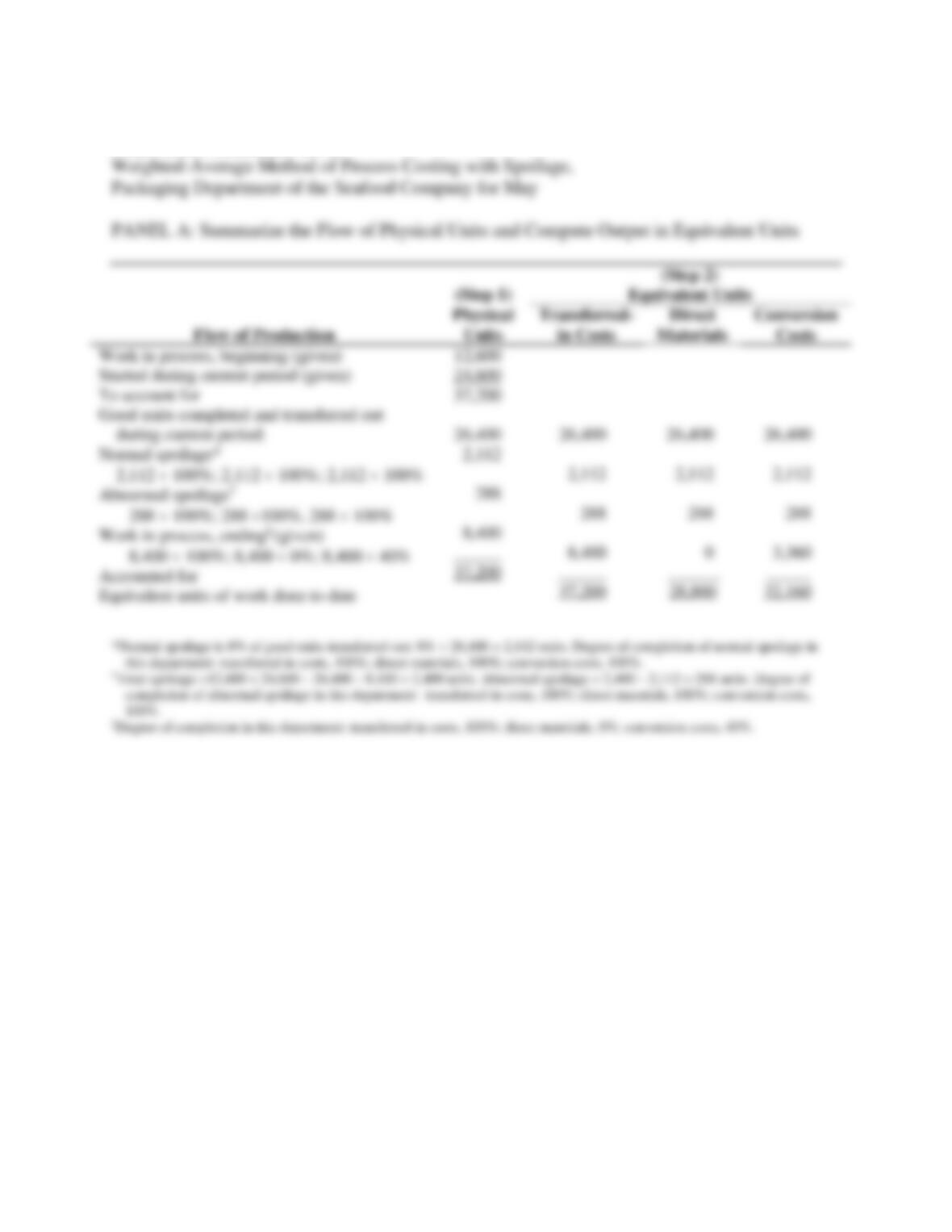
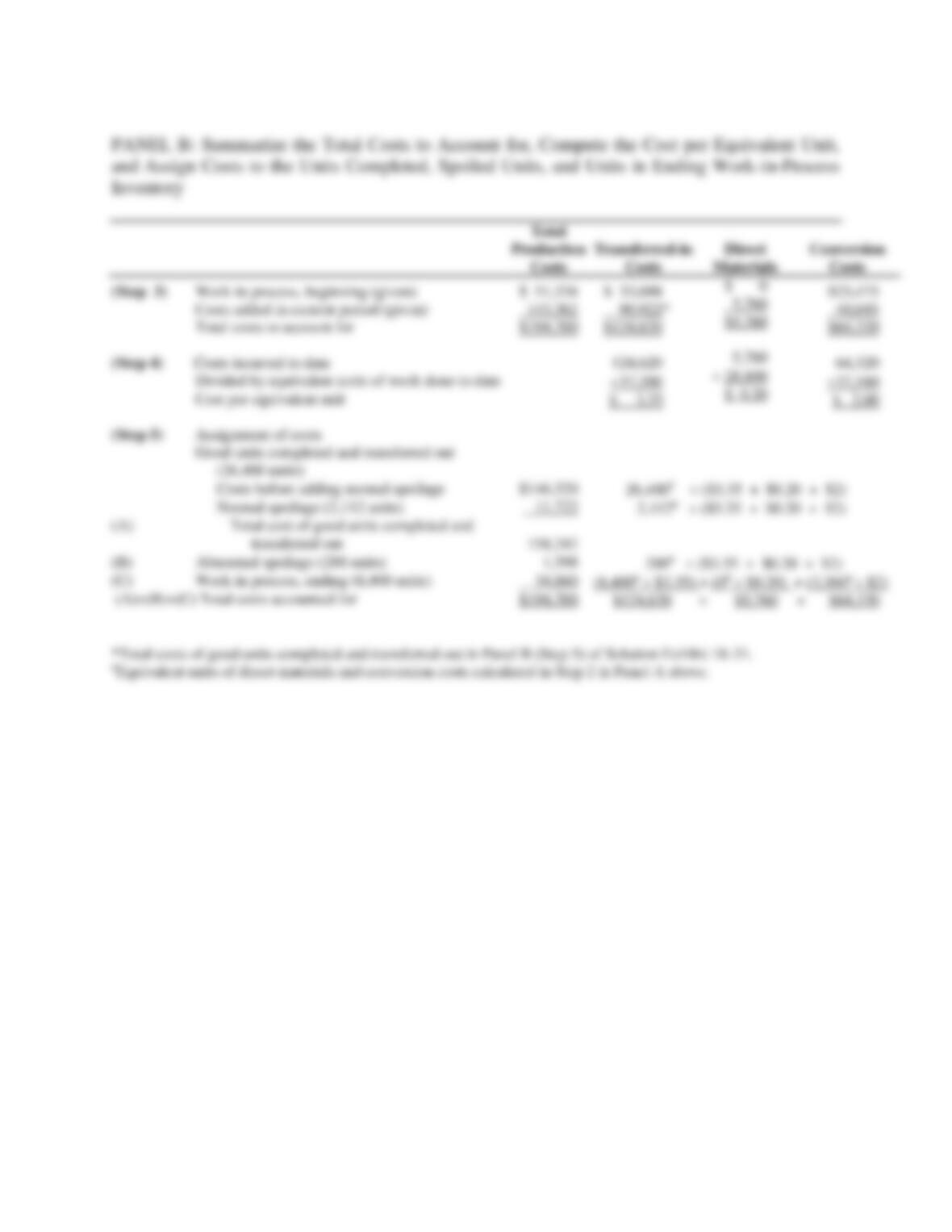
For the packaging department, use the weighted-average method to summarize the total costs to
account for and assign those costs to units completed and transferred out (including normal
spoilage), to abnormal spoilage, and to units in ending work in process.
SOLUTION
18-34
SOLUTION EXHIBIT 18-33
18-35
18-36
18-34 (25 min.) FIFO method, Packaging Department (continuation of 18-32).
Refer to the information in Problem 18-33 except that the transferred-in costs of beginning work
in process on May 1 are $33,090 (instead of $33,698). Transferred-in costs for May equal the
total cost of good units completed and transferred out in May from the cleaning department, as
calculated in Problem 18-32 using the FIFO method of process costing.
Required:
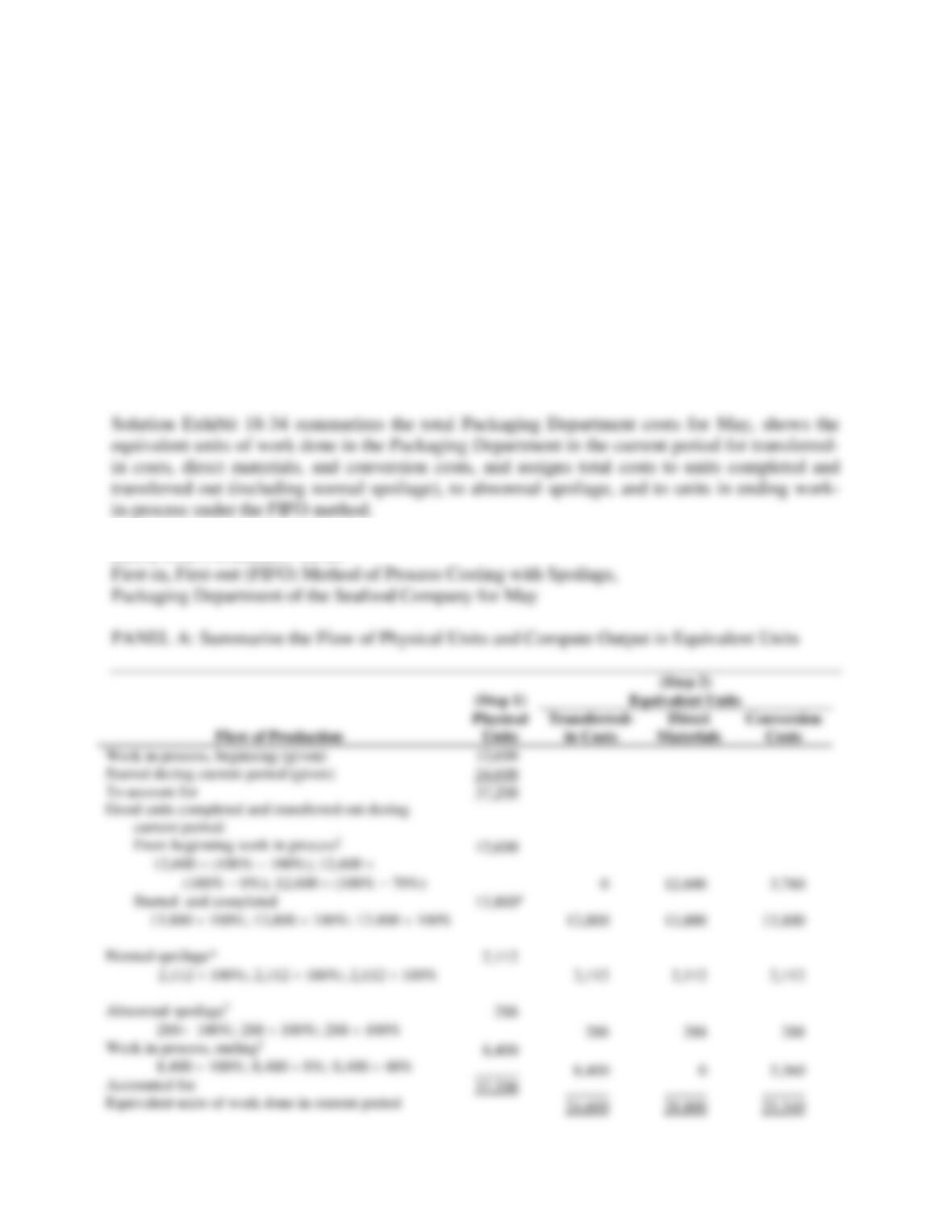
For the packaging department, use the FIFO method to summarize the total costs to account for
and assign those costs to units completed and transferred out (including normal spoilage), to
abnormal spoilage, and to units in ending work in process.
SOLUTION
SOLUTION EXHIBIT 18-34
18-37