
Chapter 18
Performance Measurement to
Support Business Strategy
Learning Objectives
1. Explain why management accountants should know the business strategy of their
organization.
2. Explain why companies use nonfinancial performance measures.
3. Understand the reasons why performance measures differ across levels of the organization.
4. Understand how the balanced scorecard helps organizations recognize and deal with their
conflicting responsibilities.
5. Understand how to apply benchmarking to support continuous improvement.
6. Identify examples of nonfinancial performance measures and discuss the potential for
improved performance resulting from improved activity management.
7. Explain why employee involvement is important for an effective performance measurement
system.
Chapter Overview
I. STRATEGY AND PERFORMANCE
II. THE FOUNDATION OF A SUCCESSFUL BUSINESS STRATEGY
III. BEYOND THE ACCOUNTING NUMBERS
IV. RESPONSIBILITIES ACCORDING TO LEVEL OF ORGANIZATION
V. BUSINESS MODEL
VI. MULTIPLE MEASURES OR A SINGLE MEASURE OF PERFORMANCE?
• Balanced Scorecard
• Continuous Improvement and Benchmarking
VII. PERFORMANCE MEASUREMENT FOR CONTROL
VIII. SOME COMMON NONFINANCIAL PERFORMANCE MEASURES
IX. EMPLOYEE INVOLVEMENT
X. DIFFICULTIES IN IMPLEMENTING NONFINANCIAL PERFORMANCE
MEASUREMENT SYSTEMS
• Fixation on Financial Measures
• Reliability of Nonfinancial Measures
• Lack of Correlation between Nonfinancial Measures and Financial Results
Chapter Outline
LO 18-1 Explain why management accountants should know the business
strategy of their organization.
STRATEGY AND PERFORMANCE
• The performance measures that accountants develop must tie directly to concepts in strategy
and organizational behavior.
o We have to know what kind of performance adds value to the company.
▪ We define business strategy as a company’s specific approach for deploying the
organizational assets and capabilities required to meet its customers’ needs competi–
tively, while delivering the desired returns to stakeholders.
• Stakeholders are groups or individuals who have an interest in what the
organization does.
their involvement with the firm.
o The business strategy identifies the firm’s value proposition.
▪ The firm’s value proposition is how the organization will create value for all
stakeholders.
▪ This statement may also imply the firm’s mission.
THE FOUNDATION OF A SUCCESSFUL BUSINESS STRATEGY
• Managers start forming strategy by identifying the company’s core assets and capabilities.
O Core resources and capabilities are those things that, if used well, can make the company
very successful.
• Porter Framework
o Of many frameworks for thinking about strategy, we present one of the most popular by a
scholar named Michael E. Porter.
▪ Porter identified three types of companies that are successful. They are:
• Cost leaders.
• Product differentiators.
• Focused competitors.
o Cost Leaders
▪ Cost leaders have a high-volume production of an undifferentiated product, called a
commodity.
o Product Differentiators
▪ The product differentiator earns a premium price for a product with unique features.
• Product differentiators must develop products that customers value.
To do so, they use measures of marketing performance and the balanced
scorecard, discussed later in this chapter.
At the same time, they use methods such as target costing to help maintain
profitability.
o Focused Competitors
▪ The focus strategy (also called a niche strategy or segmentation strategy) requires a
company to select a narrow segment of customers or products and apply a
LO 18-2 Explain why companies use nonfinancial performance measures.
BEYOND THE ACCOUNTING NUMBERS
• Financial performance measures, especially those that come from the company’s accounting
systems, are commonly used to evaluate employee performance.
o Financial performance measures are easily quantifiable and can motivate employees to
improve the company’s accounting profits.
▪ Financial measures are good at getting managers’ attention.
o Financial measures suffer from several flaws that reduce their value as an operational
control device.
o In recent years, more and more companies have begun using nonfinancial metrics
because:
o Performance evaluation starts by understanding the organization’s objectives and strategy.
LO 18-3 Understand the reasons why performance measures differ across
levels of the organization.
RESPONSIBILITIES ACCORDING TO LEVEL OF ORGANIZATION
• Effective performance measurement is based on two factors:
• Effective performance measurement systems use measures that emphasize different things at
different levels of the organization.
o In general, performance measures should relate to what people at different levels control.
▪ At the lower levels in the organization, nonfinancial performance measures focus on
factors these employees can control, such as:
▪ At middle levels in organizations, nonfinancial performance measurement often
focuses on how well the operating systems work together and how effective these
systems are in comparison with those of competitors.
• At this organizational level, coordination and improvement of ongoing activities
take place in addition to redesigning products and processes.
• The following are some of the nonfinancial performance measures that
organizations use to evaluate middle managers’ performance:
▪ At the top levels of the organization, performance measurement focuses on
determining whether the organization is meeting its responsibilities from the
perspectives of its stakeholders.
• Performance at top levels requires delicately balancing trade-offs.
BUSINESS MODEL
• A business model is a description of how different levels and employees in the organization
must perform for the organization to achieve its goals.
o A business model is a framework that links the roles of various employees and levels in
the organization and that illustrates how the successful completion of these roles will
result in achievement of the organization’s goals.
o For a given strategy and environment, many possible business models could be
appropriate.
LO 18-4 Understand how the balanced scorecard helps organizations
recognize and deal with their conflicting responsibilities.
MULTIPLE MEASURES OR A SINGLE MEASURE OF PERFORMANCE?
• Balanced Scorecard
o One structured approach to implementing a set of performance measures is the balanced
scorecard, which is a set of performance targets and results that show how well an
organization has performed in meeting its objectives relating to its stakeholders.
o An example of a balanced scorecard is shown in Exhibit 18.2.
Financial
Perspective
Internal Business
Process Perspective
Customer
Perspective
Vision and
Strategy
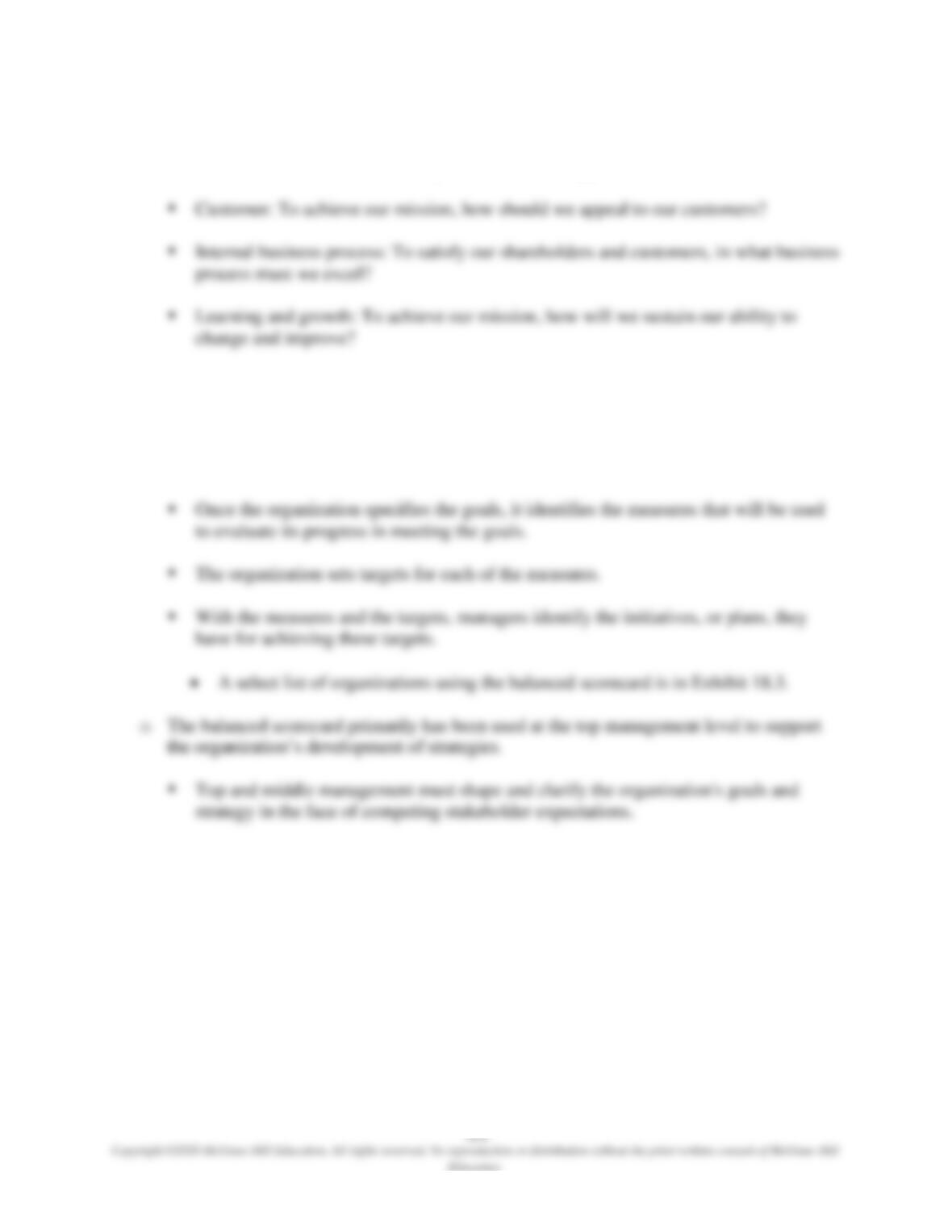
o The balanced scorecard has four views or perspectives:
▪ Financial: To succeed financially, how should we appeal to our shareholders?
o A balanced scorecard for any particular organization could be based on any other
perspectives if they are important for the organization’s success.
▪ Within each perspective, the scorecard identifies the goals, or objectives, for the
organization as often shaped by the competitive environment.
▪ A typical development of the balanced scorecard may involve the following:
Step 1: A company’s top executives form a team to clarify the company’s strategy
and objectives to meet responsibilities.
Step 2: The top and middle managers of the company are brought together to discuss
the new strategy and to develop performance measures (i.e., scorecards) for
each part of the company.
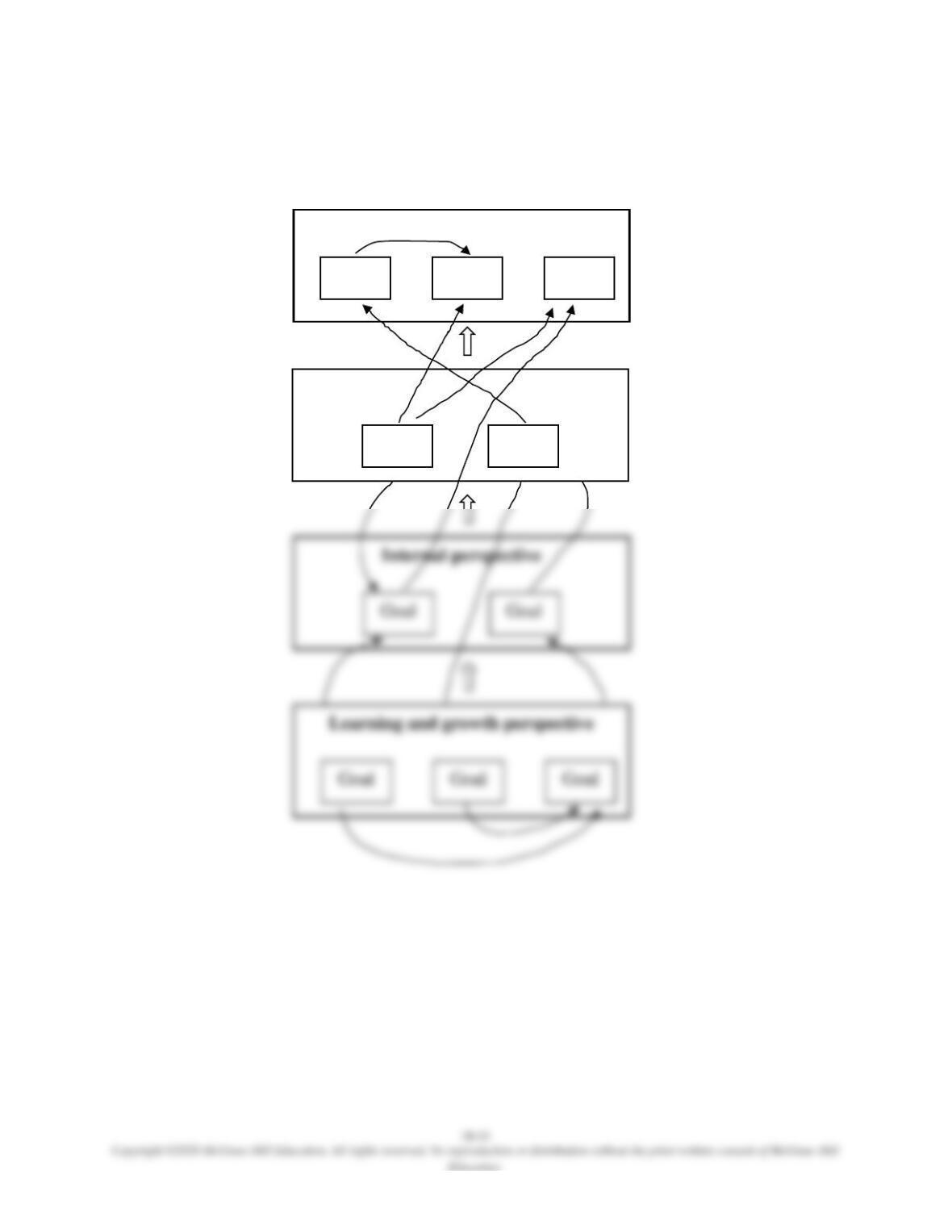
o A company’s strategy, as illustrated in the business model, can be linked to the balanced
scorecard through a strategy map, as shown in Exhibit 18.5. Specifically, the strategy
map links the objectives or goals in each of the perspectives.
▪ By drawing the strategy map, a company can determine if it is missing measures in
any of the perspectives or if it has goals that do not seem to be linked to other parts of
the map.
Financial perspective
Goal
Goal
Goal
Goal
Goal
Customer perspective
Goal
Goal
LO 18-5 Understand how to apply benchmarking to support continuous
improvement.
• Continuous Improvement and Benchmarking
o Performance measurement is useful not only for evaluation, but also for control.
▪ Continuous improvement means the continuous reevaluation and improvement of
the efficiency of an organization’s activities.
• Continuous improvement is a philosophy that seeks to:
▪ Benchmarking involves continuously identifying an activity that needs to be
improved, finding an organization (sometimes in one’s own organization) that is the
most efficient in performing the activity, studying its process, and then utilizing that
process.
• Benchmarks are used to evaluate the performance of an activity, operation, or
organization relative to its performance by other companies.
• Important guidelines for benchmarking include:
• Exhibit 18.6 presents some common questions raised in the benchmarking process.
(See Business Application box “Challenges to Identifying Appropriate
Benchmarking Organizations.”)
PERFORMANCE MEASUREMENT FOR CONTROL
• Companies develop multiple performance measures as a way to evaluate the achievement of
its managers.
LO 18-6 Identify examples of nonfinancial performance measures and discuss
the potential for improved performance resulting from improved
activity management.
SOME COMMON NONFINANCIAL PERFORMANCE MEASURES
• Customer Satisfaction Performance Measures
o Quality Control
▪ Objective of quality control is to increase customer satisfaction with the product,
reduce the costs of dealing with customer complaints, and reduce the costs of
repairing products or providing a new service.
▪ Measures include:
o Delivery Performance
▪ The objective of delivery performance is to deliver goods and services when
promised.
▪ Measures include:
o Bookings and Purchase Orders
▪ Bookings and purchase orders are a lead indicator of revenues.
• Companies have to measure bookings and purchase orders “off the books” because
they are not recorded as sales.
▪ A decrease in bookings and purchase orders sends a signal to management to devote
more marketing effort to generate sales.
o Market Share
• Functional Performance Measures
o An organization must evaluate its internal functional process performance while serving
external customers.
o Manufacturing Cycle Time
▪ Manufacturing cycle time represents the time involved in processing, moving,
storing, and inspecting products and materials. It is the total time taken to produce a
good or service.