18-1
CHAPTER 18
PRICING AND PROFITABILITY ANALYSIS
DISCUSSION QUESTIONS
1. Price elasticity of demand is measured by
the percentage change in quantity divided
by the percentage change in price. If de-
mand is relatively elastic, a price change of
X percent results in a quantity change of
more than X percent. If demand is relatively
inelastic, a price change of X percent results
2. Perfectly competitive markets are character-
ized by the following: many buyers and
sellers—no one of which is large enough to
influence the market; a homogeneous prod-
uct (one company’s product is virtually iden-
tical to any other company’s product); and
easy entry into and exit from the industry.
3. The markup percentage on cost of goods
4. Target costing is a method of determining
the cost of a product or service based on the
ly. Price skimming is a pricing strategy in
which a higher price is charged at the be-
ginning of a product’s life cycle, and then
lowered at later phases of the life cycle.
6. There are a number of possible reasons;
here are three. First, the price difference
therefore, the price charged may be higher.
Third, the price elasticity of demand for gas-
oline purchased in town may be higher due
to the larger number of competing gas sta-
tions.
7. Price discrimination is the charging of differ-
ent prices to different customers for essen-
tially the same commodity. It is legal in some
firm adheres to government regulations.
Regulated firms must measure profit to en-
9. A segment is any portion of a firm. Seg-
ments may be product lines, divisions, re-
18-2
10. Alpha Company may continue to produce
and sell “Loser” because (a) customers of all
lines prefer to deal with a “full–service” com-
11. Absorption costing differs from variable cost-
ing in that fixed factory overhead is included
in unit cost under absorption costing. The re-
sult is that absorption-costing operating in-
12. Net income must be calculated for external
reporting purposes. An advantage is that net
income is calculated according to GAAP so
outside parties have an understanding of the
Net income also has disadvantages. Net
income does not include the cost of capital
employed to operate the business. As a re-
sult, net income can be positive while the
13. Firms may measure customer profitability
when groups of customers differ in the
14. Sales price and sales volume variances may
be computed from actual and expected rev-
enue amounts. These variances help man-
growth phase, sales increase and so do
profits. The maturity phase is marked by
stable costs and relatively high sales. In the
decline phase of the product life cycle, sales
fall; costs may or may not fall, depending on
maturity phase should lead to stable unit-
level costs. The decline phase, with fewer
units produced, does not enjoy quantity dis-
counts, but unit costs may remain low due to
Setup number and complexity increase, pur-
chasing orders rise, and inspection costs
may increase. Finally, in the decline stage,
batch-level costs again fall as product lines
are streamlined to just a few best-selling
Facility-level costs may or may not be
18-3
CORNERSTONE EXERCISES
Cornerstone Exercise 18.1
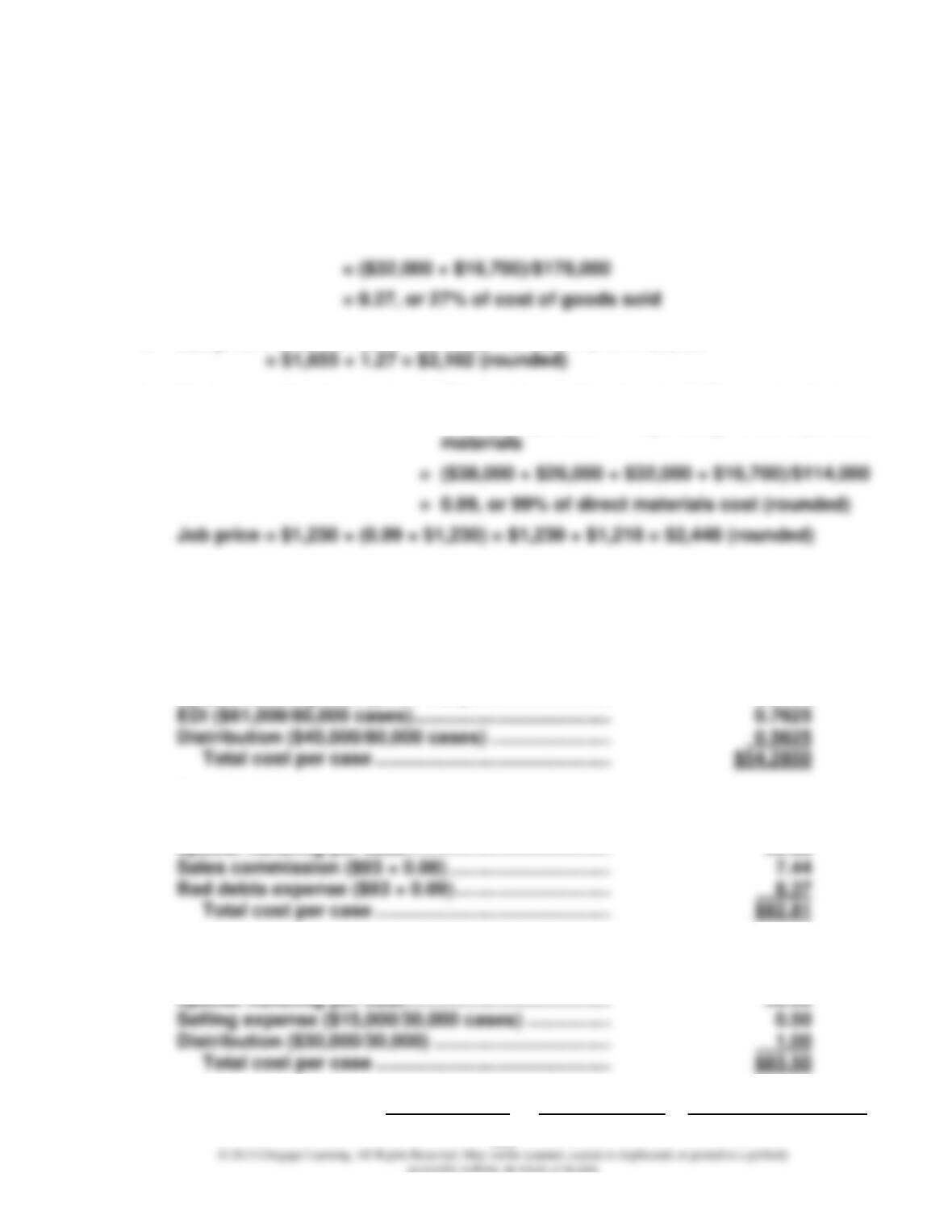
1. Markup on COGS = (Selling and administrative expenses + Operating
income)/COGS
2. Job price = $1,655 + (0.27 × $1,655) = $1,655 + $447 = $2,102
3. Markup on direct materials = (Direct labor + Overhead + Selling and adminis-
trative expenses + Operating income)/Direct
Cornerstone Exercise 18.2
1. Supermarkets:
Manufacturing cost per case ……………………………. $52.0000
Special labeling cost ($0.04 × 24) ……………………… 0.9600
Small grocers:
Manufacturing cost per case ……………………………. $52.00
Special handling per case ………………………………… 25.00
Convenience stores:
Manufacturing cost per case ……………………………. $52.00
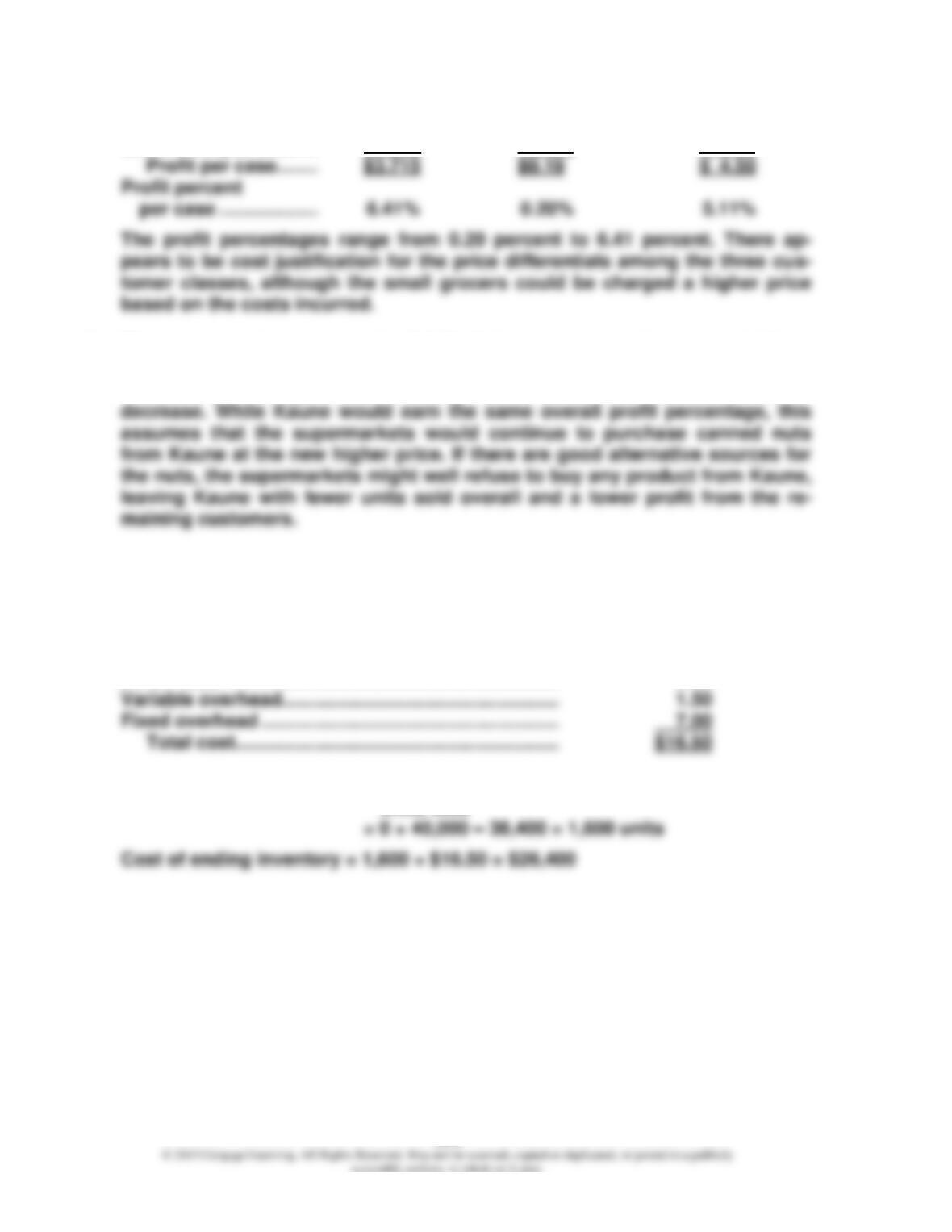
2. Supermarkets Small Grocers Convenience Stores
18-4
Price per case …………. $58.000 $93.00 $88.00
Less: Cost per case …. 54.285 92.81 83.50
3. The average price per case is $79.67. If this price were charged to all three
customers, the profit percentage for the supermarkets would increase and
the profit percentages to the small grocers and convenience stores would
Cornerstone Exercise 18.3
1. The unit product (manufacturing) cost under absorption costing is:
Direct materials………………………………………………… $ 5.00
Direct labor ……………………………………………………… 3.00
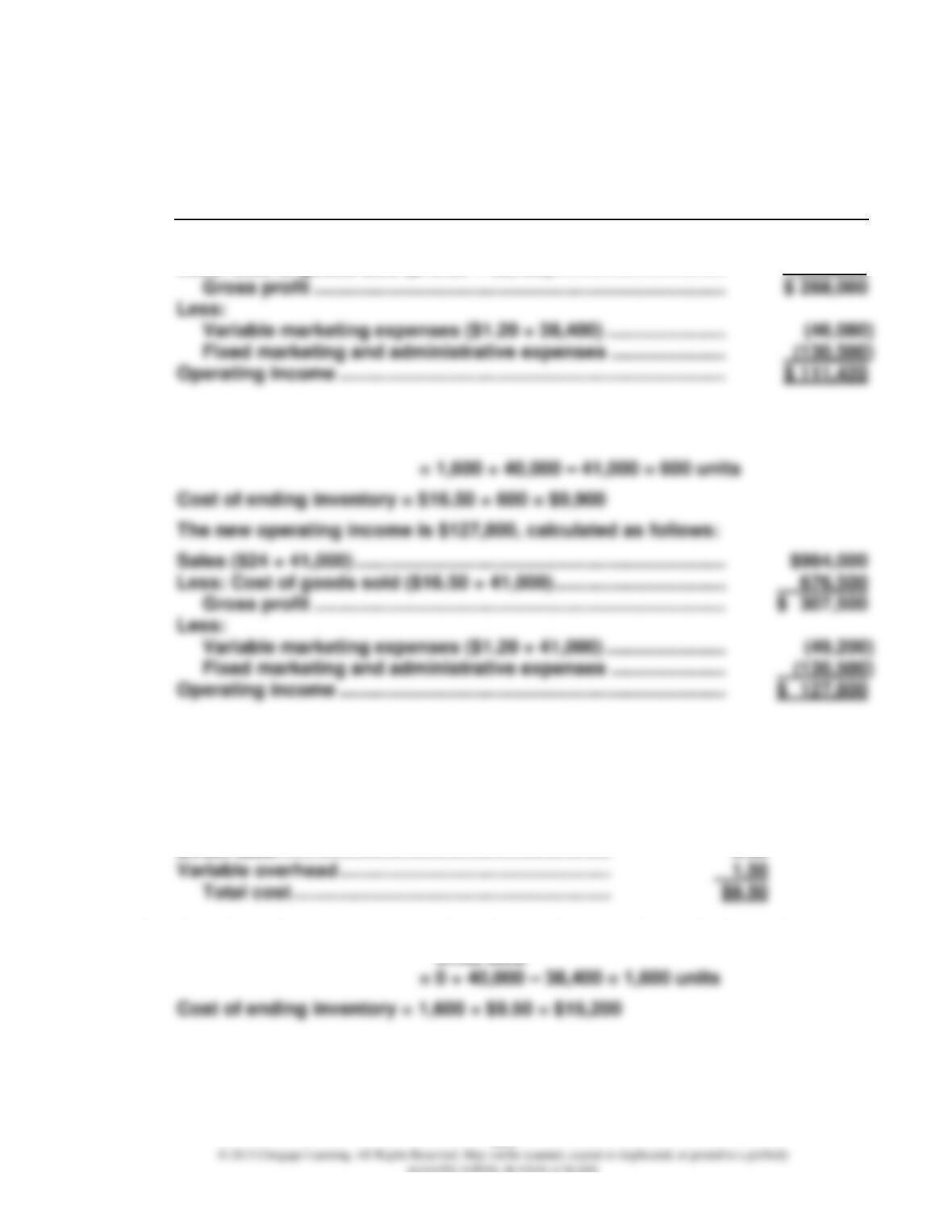
2. Units in ending inventory = Units, beginning inventory + Units produced –
Units sold
18-5
Cornerstone Exercise 18.3 (Concluded)
3. Pattison Products, Inc.
Absorption-Costing Income Statement
For the Month of October
Sales ($24 × 38,400) …………………………………………………………….. $ 921,600
Less: Cost of goods sold ($16.50 × 38,400) …………………………... 633,600
4. Units in ending inventory = Units, beginning inventory + Units produced –
Units sold
Cornerstone Exercise 18.4
1. The unit product (manufacturing) cost under variable costing is:
Direct materials ……………………………………………….. $5.00
Direct labor ……………………………………………………… 3.00
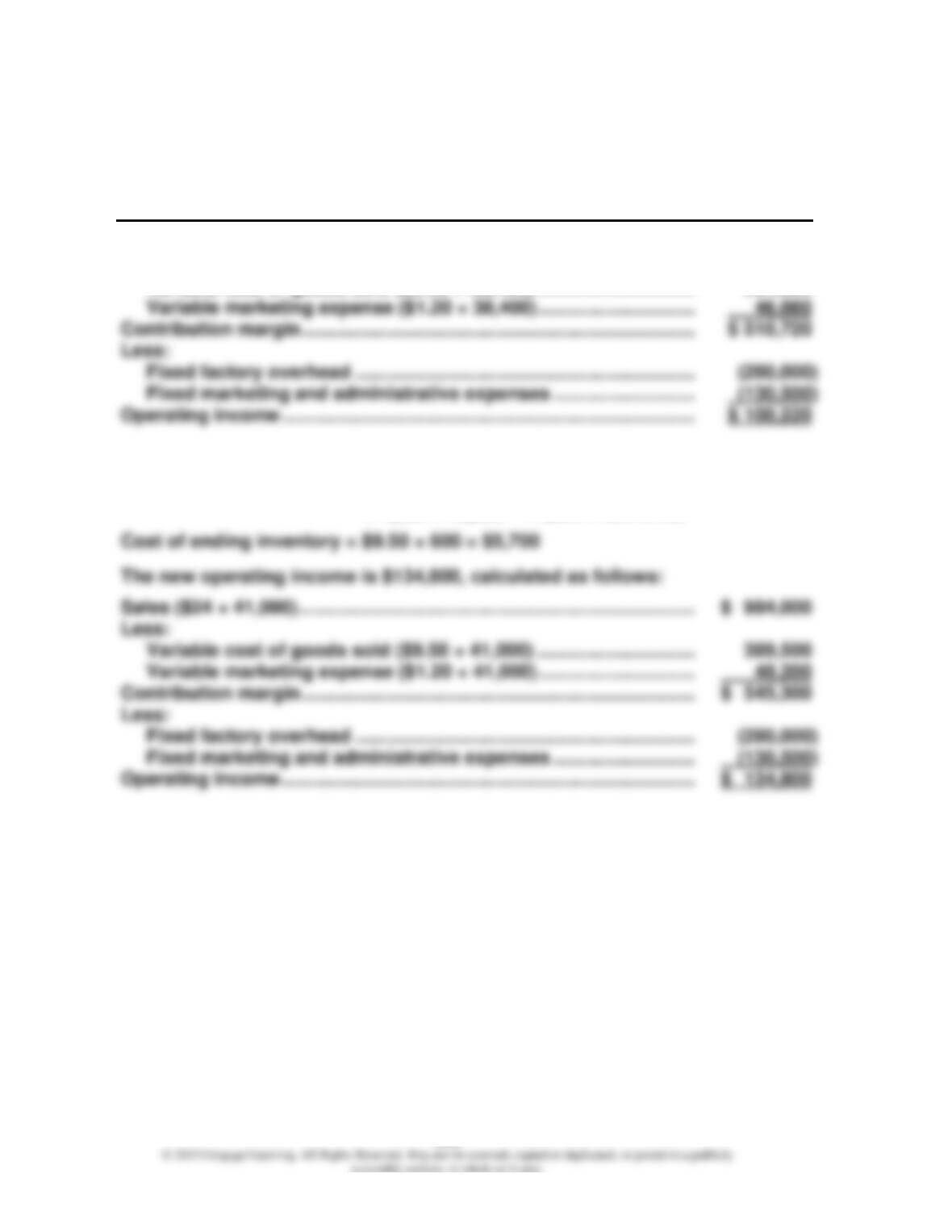
2. Units in ending inventory = Units, beginning inventory + Units produced –
Units sold
18-6
Cornerstone Exercise 18.4 (Concluded)
3. Pattison Products, Inc.
Variable-Costing Income Statement
For the Month of October
Sales ($24 × 38,400) …………………………………………………………………. $ 921,600
Less:
Variable cost of goods sold ($9.50 × 38,400) ………………………… 364,800
4. Units in ending inventory = Units, beginning inventory + Units
produced – Units sold
= 1,600 + 40,000 – 41,000 = 600 units
18-7
Cornerstone Exercise 18.5
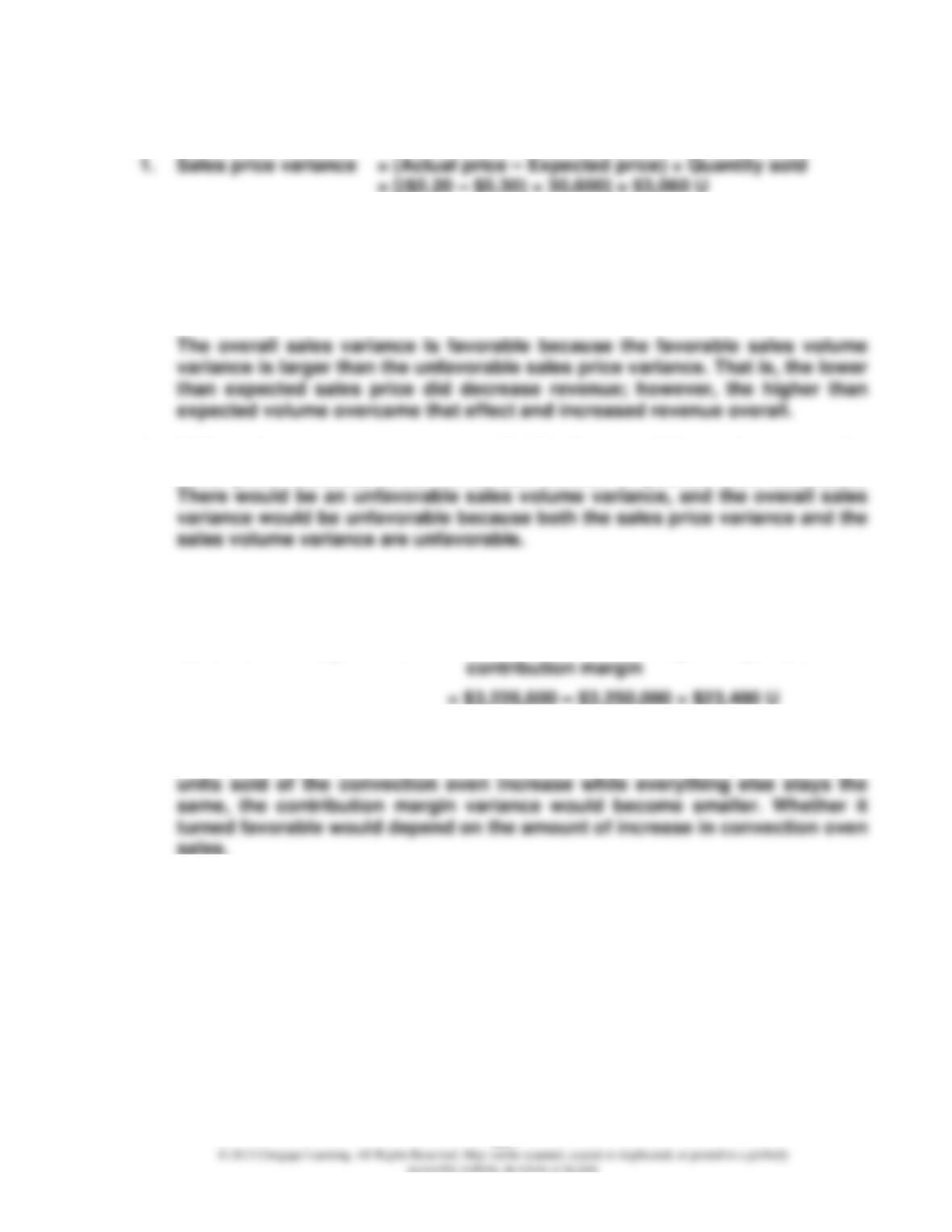
2. Sales volume variance = (Actual volume – Expected volume) × Expected price
= [(30,600 – 30,000) × $5.30] = $3,180 F
3. Overall sales variance = Sales price variance + Sales volume variance
= $3,060 U + $3,180 F = $120 F
4. If December sales in pounds were 29,800, there would be a decrease in the
sales price variance, since the actual number of pounds sold decreased.
Cornerstone Exercise 18.6
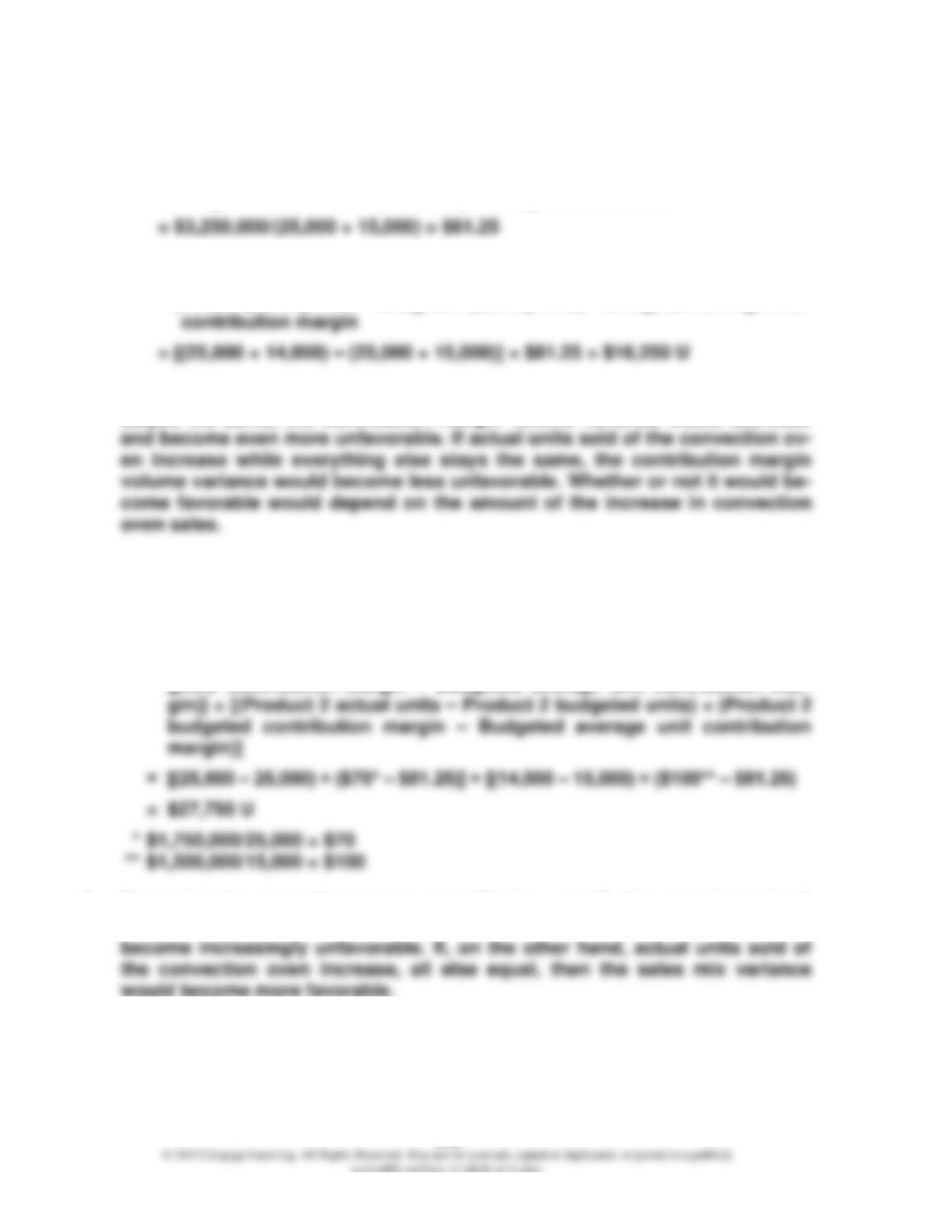
1. Contribution margin variance = Actual contribution margin – Expected
2. If units sold of the convection oven decrease while everything else stays the
same, the contribution margin variance would increase. On the other hand, if
18-8
Cornerstone Exercise 18.7
1. Budgeted average unit contribution margin
= Budgeted total contribution margin/Budgeted total units
2. Contribution margin volume variance
= (Actual quantity sold – Budgeted quantity sold) × Budgeted average unit
3. If actual units sold of the convection oven decrease while everything else
stayed the same, the contribution margin volume variance would decrease
Cornerstone Exercise 18.8
1. Sales mix variance
= [(Product 1 actual units – Product 1 budgeted units) × (Product 1 bud–
geted contribution margin – Budgeted average unit contribution mar-
2. If actual units sold of the toaster oven (the low contribution margin product)
increase while everything else stays the same, the sales mix variance would
18-9
Cornerstone Exercise 18.9
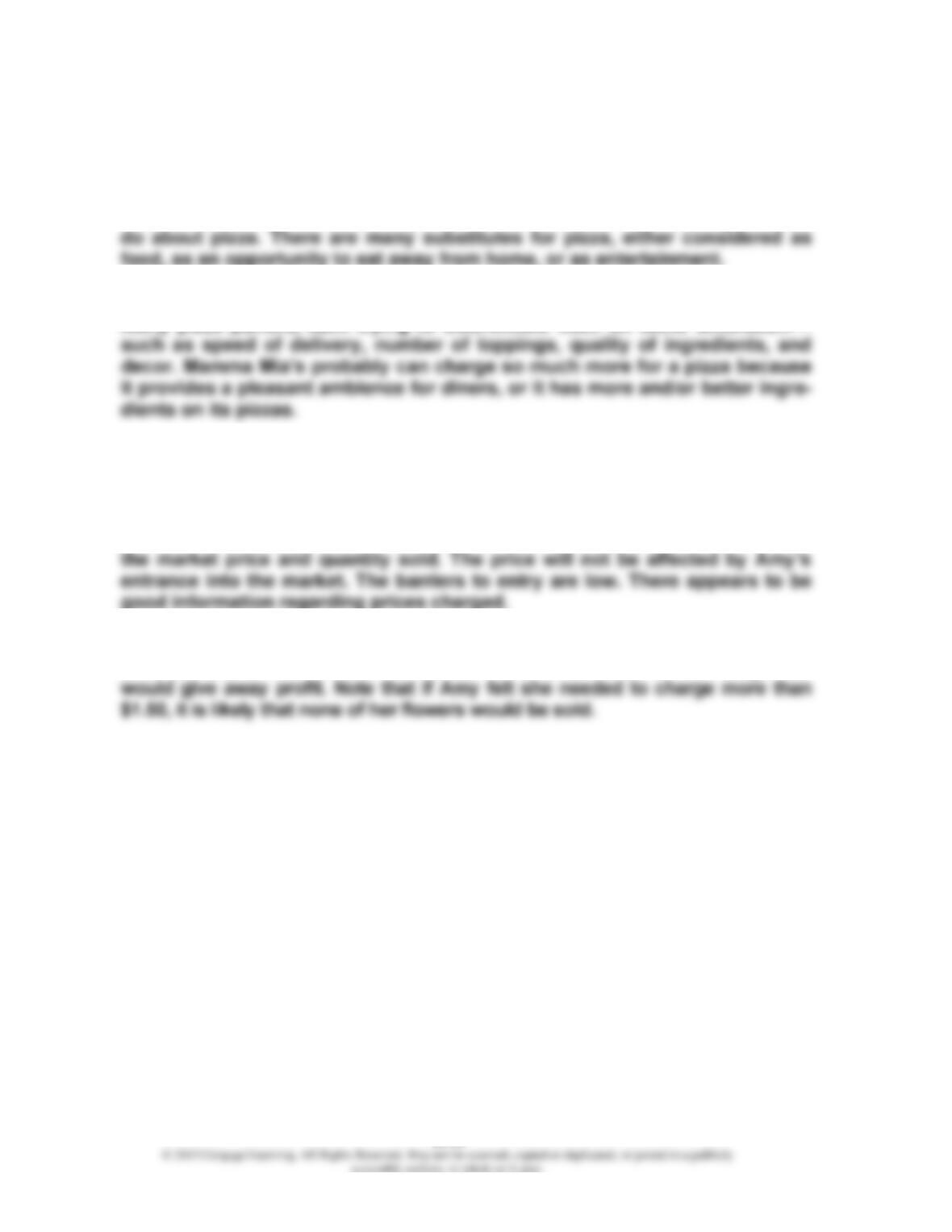
1. Market share variance
= [(Actual market share percentage – Budgeted market share percentage)
× Actual industry sales in units] × Budgeted average unit contribution
margin
2. Market size variance
= [(Actual industry sales in units – Budgeted industry sales in units) ×
Budgeted market share percentage] × Budgeted average unit contribu-
tion margin
3. If Iliff actually sold a total of 41,000 units, then the actual market share
18–10
EXERCISES
Exercise 18.10
1. The demand for pizza is relatively elastic. This makes sense knowing what we
2. The pizza industry is characterized by monopolistic competition. There are
many pizza parlors, each trying to differentiate itself on some dimension—
Exercise 18.11
1. The flower-growing industry has the characteristics of perfect competition.
There are many buyers and sellers, no one of which has much control over
2. Given the perfectly competitive structure of the industry, Amy should charge
$1.50 per bunch. She can sell all that she wants to at that price. To charge less
18–11
Exercise 18.12
Foster would be ill-advised to charge $75 per hour. There are no doubt many ac-
countants in town; they average $65 per hour for a reason—clients will not pay
much more than that amount. Accounting is a monopolistically competitive in-
dustry. There are many accountants, but they vary somewhat in age, experience,
and preferred type of work (auditing, tax, management advisory services, in-
house bookkeeping for clients). As a result, the price will not vary greatly among
the firms.
Since Foster is new in town, he might adopt a penetration pricing strategy. He is
in the introduction stage of his “service life cycle.” He needs to get some clients
so that he can demonstrate his expertise and start some favorable “word–of–
Exercise 18–13
1. Markup percentage = $1,140,000/$7,600,000 = 0.15, or 15%
2. Bid = $570,000 + (0.15 × $570,000) = $655,500
18–12
Exercise 18.14
a. The markup percentage of 100 percent is typical for department stores. It
must cover all costs of storing and selling the goods, including salaries of
sales personnel; rent or purchase of the building; advertising; hangers and
racks for display; supplies (tags, cleaning supplies, toilet paper for the
restrooms); equipment (e.g., cash registers); and so on. The profit earned is
typically a small proportion of the markup percentage.
b. Like department stores, jewelry store markups include all costs of storing
and selling the goods. In addition, because turnover is much lower in jewelry
Exercise 18.15
1. Absorption unit cost: Variable unit cost:
Direct materials………… $ 6.00 Direct materials ………. $ 6.00
18–13
Exercise 18.15 (Continued)
2. Flaherty, Inc.
Absorption-Costing Income Statement
For the First Year of Operations
Sales (21,300 × $36) ………………………………………………. $766,800
Cost of goods sold (21,300 × $22.50) ……………………… $479,250
Less: Overapplied overhead* ………………………………… 7,000 472,250
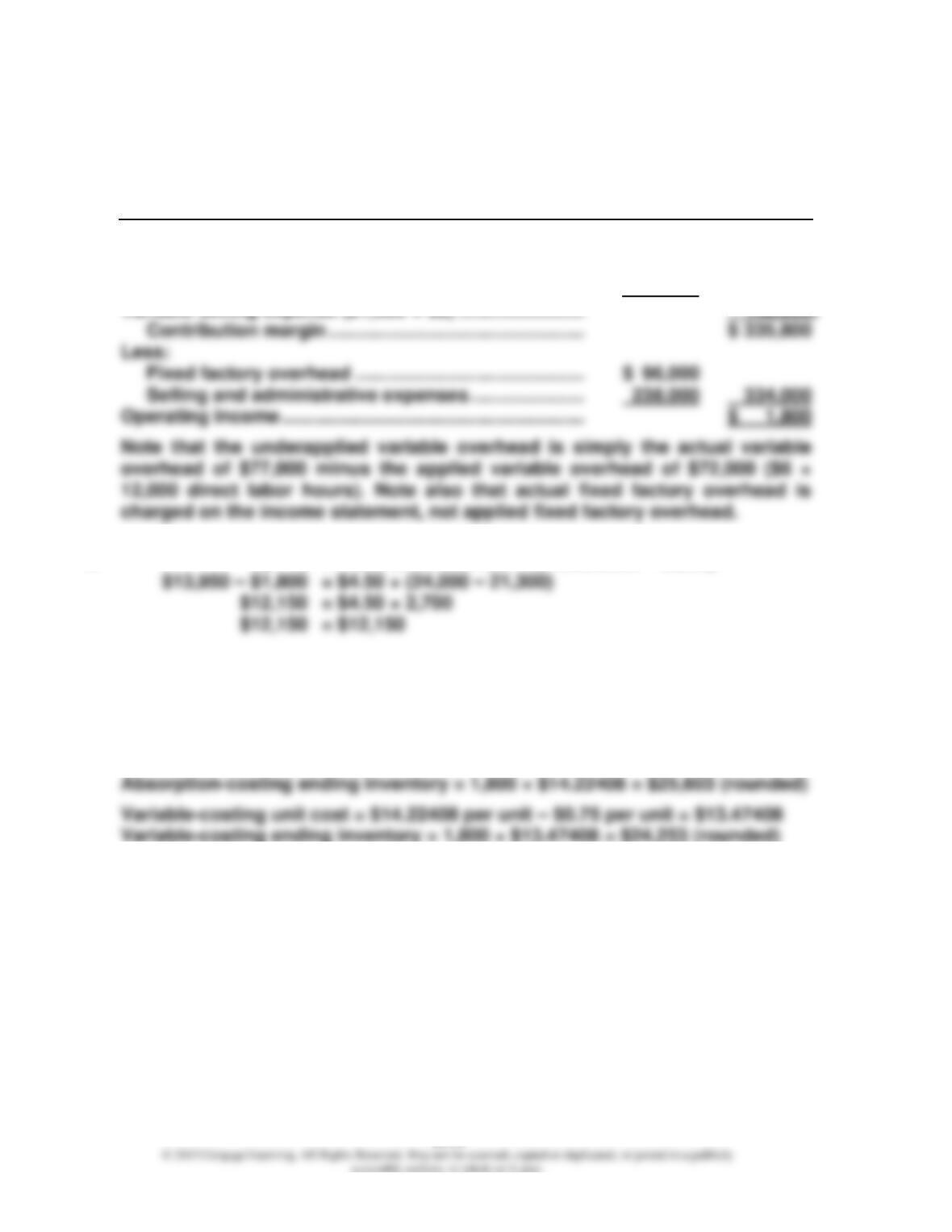
* The budgeted fixed overhead rate of $9 per direct labor hour was computed
based on 12,000 direct labor hours. Therefore, budgeted fixed overhead must
have been $108,000. Since actual fixed overhead was $12,000 less than
Both variable and fixed overhead were applied on the basis of direct labor
hours. Since 12,000 hours were worked, total applied overhead amounts to
$180,000. Actual overhead was $173,000 (actual fixed of $96,000 plus actual
variable of $77,000).
18–14
Exercise 18.15 (Concluded)
3. Flaherty, Inc.
Variable-Costing Income Statement
For the First Year of Operations
Sales (21,300 × $36) ………………………………………………. $ 766,800
Variable cost of goods sold (21,300 × $18) …………….. $383,400
Add: Underapplied variable overhead ……………………. 5,000 (388,400)
Variable selling expense (21,300 × $2) …………………… (42,600)
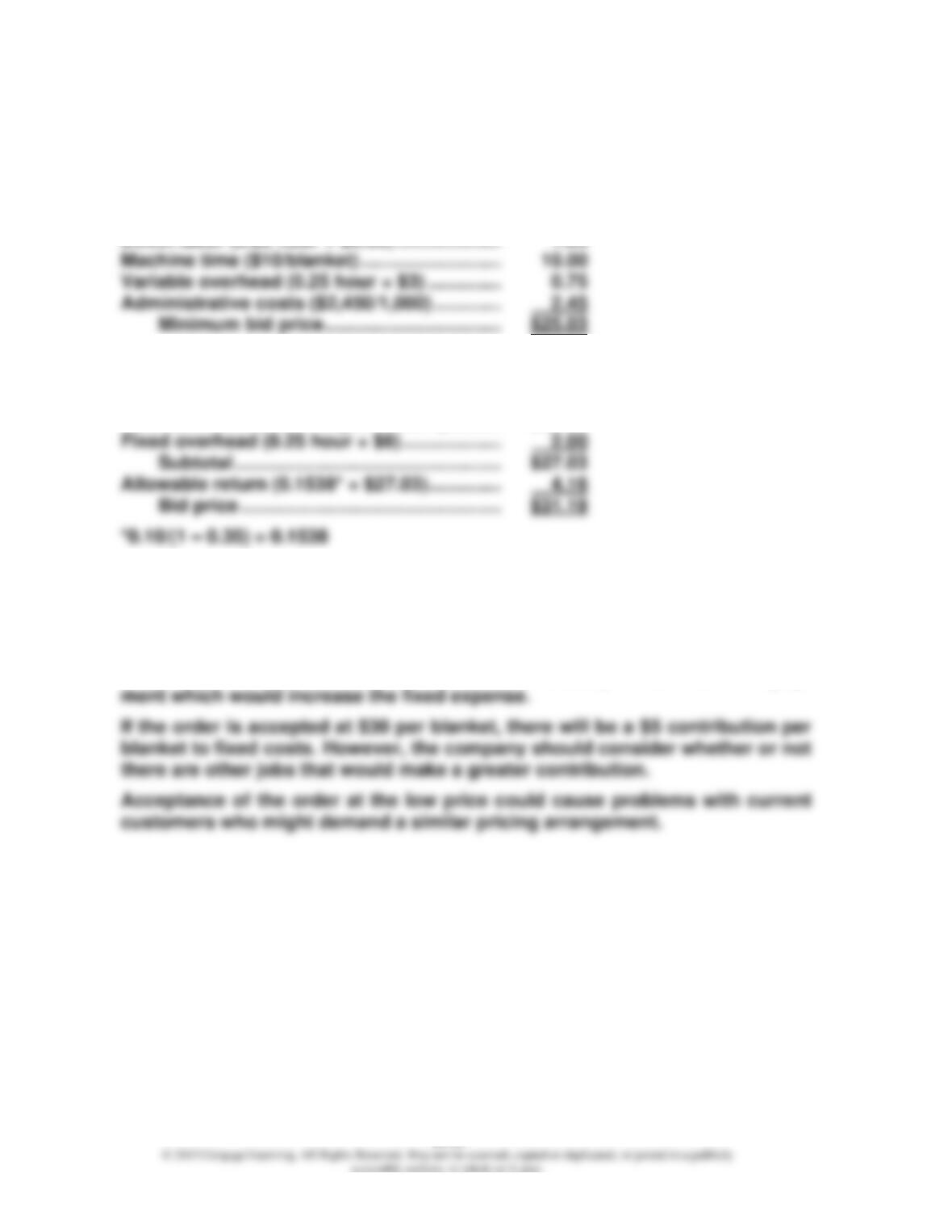
4. IA – IV = Fixed overhead rate × (Production – Sales)
Exercise 18.16
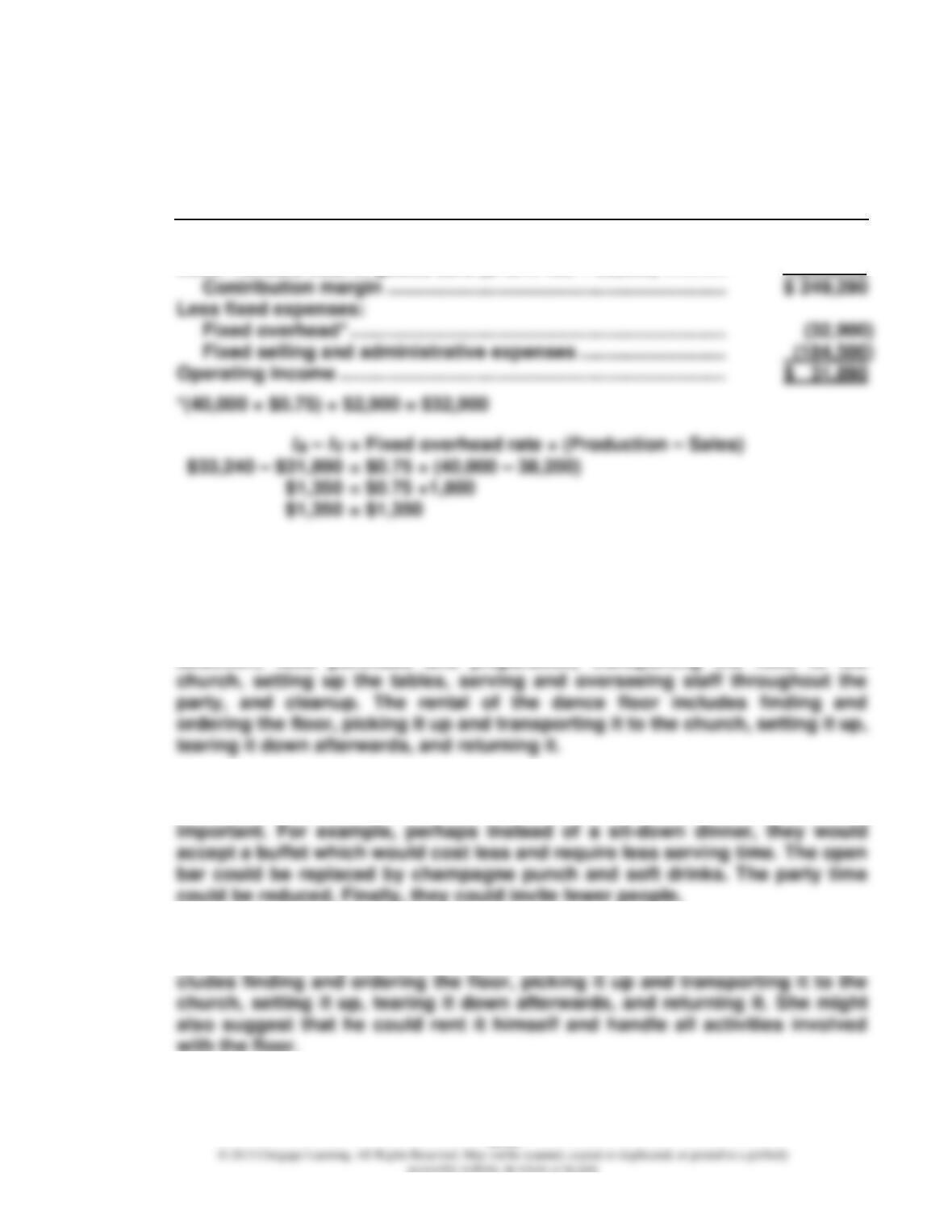
1. Unadjusted cost of goods sold = $546,260 – $2,900 = $543,360
Unit cost = $543,360/38,200 = $14.22408 (rounded)
18–15
Exercise 18.16 (Concluded)
2. Snobegon, Inc.
Variable-Costing Income Statement
For the First Year of Operations
Sales ($20 × 38,200) …………………………………………………………….. $ 764,000
Less: Variable cost of goods sold ($13.47408 × 38,200) ………… 514,710
Exercise 18.17
1. Carina’s labor and profit are embedded in the material prices quoted. For
example, the food preparation includes numerous activities such as recipe
selection, food purchase and preparation, transporting the food to the
2. Carina will need to sit down with Maria and Estefan and determine which
features of the party are most important to them and which are less
3. Carina should remind Mr. Montero that there are many activities involved in
renting and setting up the dance floor. Her rental price for the dance floor in-
18–16
Exercise 18.18
1. The minimum price per blanket that Otero Fibers, Inc., could bid without re-
ducing the company’s net income is $25.03, calculated as follows:
Direct materials (6 pounds × $1.70) …………. $10.20
Direct labor (0.25 hour × $6.50) ……………….. 1.63
2. Using the full-cost criteria and the maximum allowable return specified, Otero
Fibers, Inc.’s, bid price per blanket would be $31.19, calculated as follows:
Relevant costs (from Requirement 1) ………. $25.03
3. Factors that Otero Fibers, Inc., should consider before deciding whether or
not to submit a bid at the maximum acceptable price of $30 per blanket in-
clude the following:
The company should be sure there is sufficient excess capacity to fulfill the
order and that no additional investment is necessary in facilities or equip-
18–17
Exercise 18.19
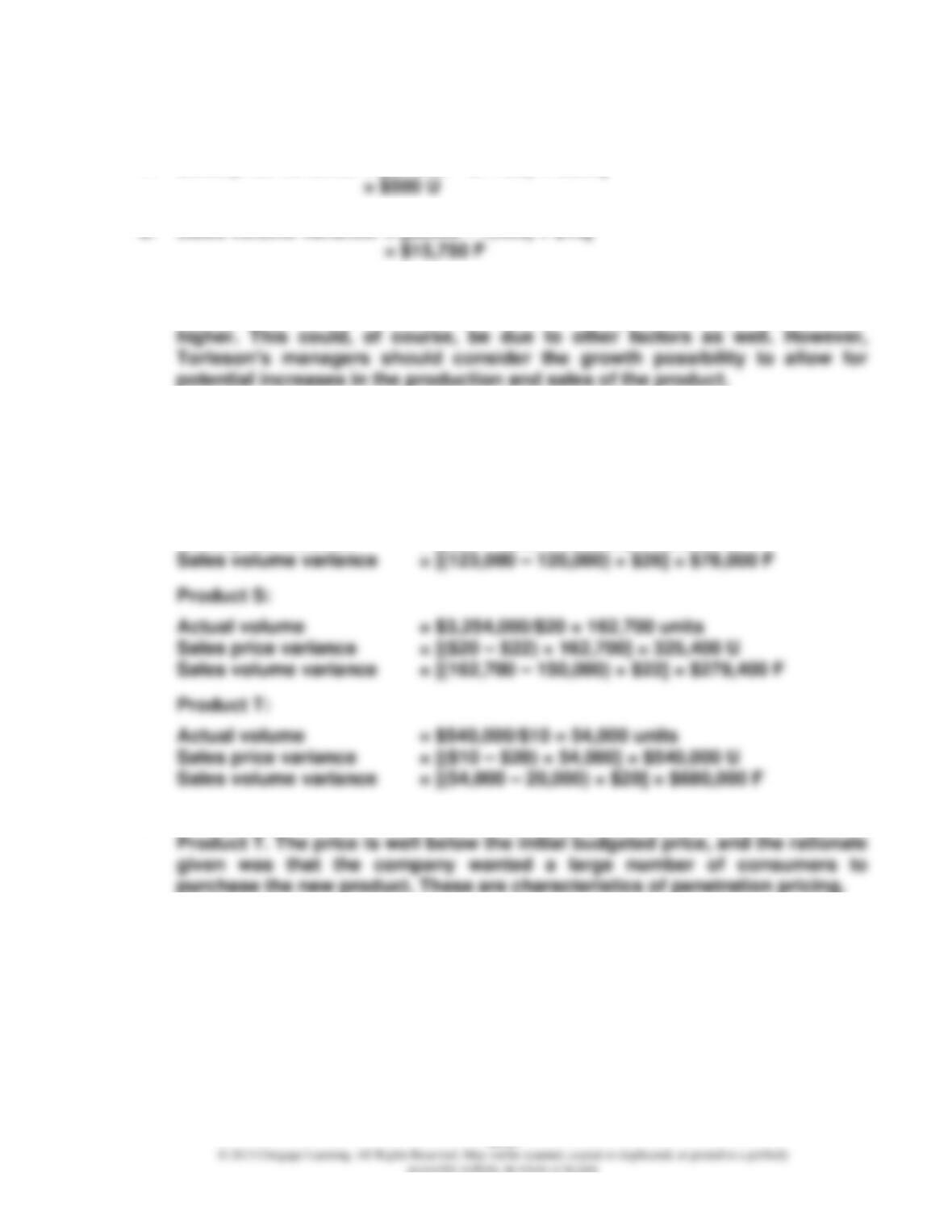
1. Sales price variance = [($15.00 – $14.80) × 2,500]
2. Sales volume variance = [(2,500 – 1,450) × $15]
3. This product looks like it might be entering the growth phase of the product
life cycle. While price is slightly lower than budgeted, the quantity is much
Exercise 18.20
1. Product R:
Actual volume = $3,075,000/$25 = 123,000 units
Sales price variance = [($26 – $25) × 123,000] = 123,000 U
2. It appears that Eastman is following a penetration pricing strategy for
18–18
CPA-TYPE EXERCISES
Exercise 18.21
Exercise 18.22
Exercise 18.23
Exercise 18.24
Exercise 18.25