
18–41. (30 min.) Partial Productivity Measures: Del Norte Clinics.
a. Partial labor productivity = Output (patients treated) ÷ Input (hours)
Location
Output
(Patients
treated)
÷
Input
(Hours)
=
Partial Labor
Productivity
Clinic A …….
4,221
÷
4,123
=
1.024
Clinic B …….
4,512
÷
3,322
=
1.358
Clinic C …….
1,449
÷
1,569
=
0.924

18–42. (20 min.) Specifying Nonfinancial Measures.
Answers will vary. Measures of customer satisfaction for SCT include:
• Customer complaints
• Wait times
• Store cleanliness
• Complaints to health authorities
• Customer surveys
18–43. (20 min.) Manufacturing Cycle Time and Efficiency.
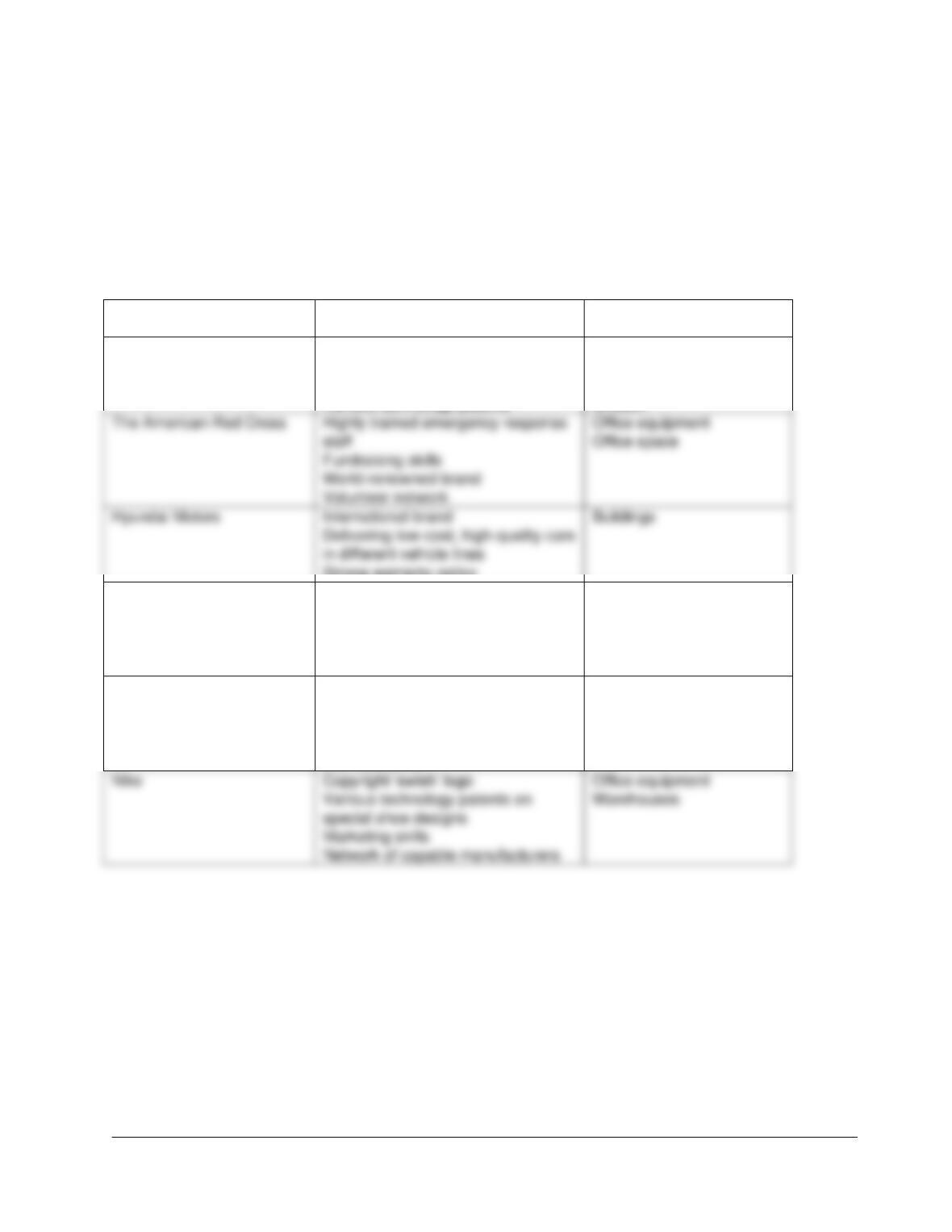
18–44. (20 min.) Employee Involvement.
Answers will vary.
The advantages include:
Solutions Manual, Chapter 18 1003
Copyright 2020 © McGraw–Hill Education. All rights reserved. No reproduction or distribution without the
prior written consent of McGraw-Hill Education.
Solutions to Problems
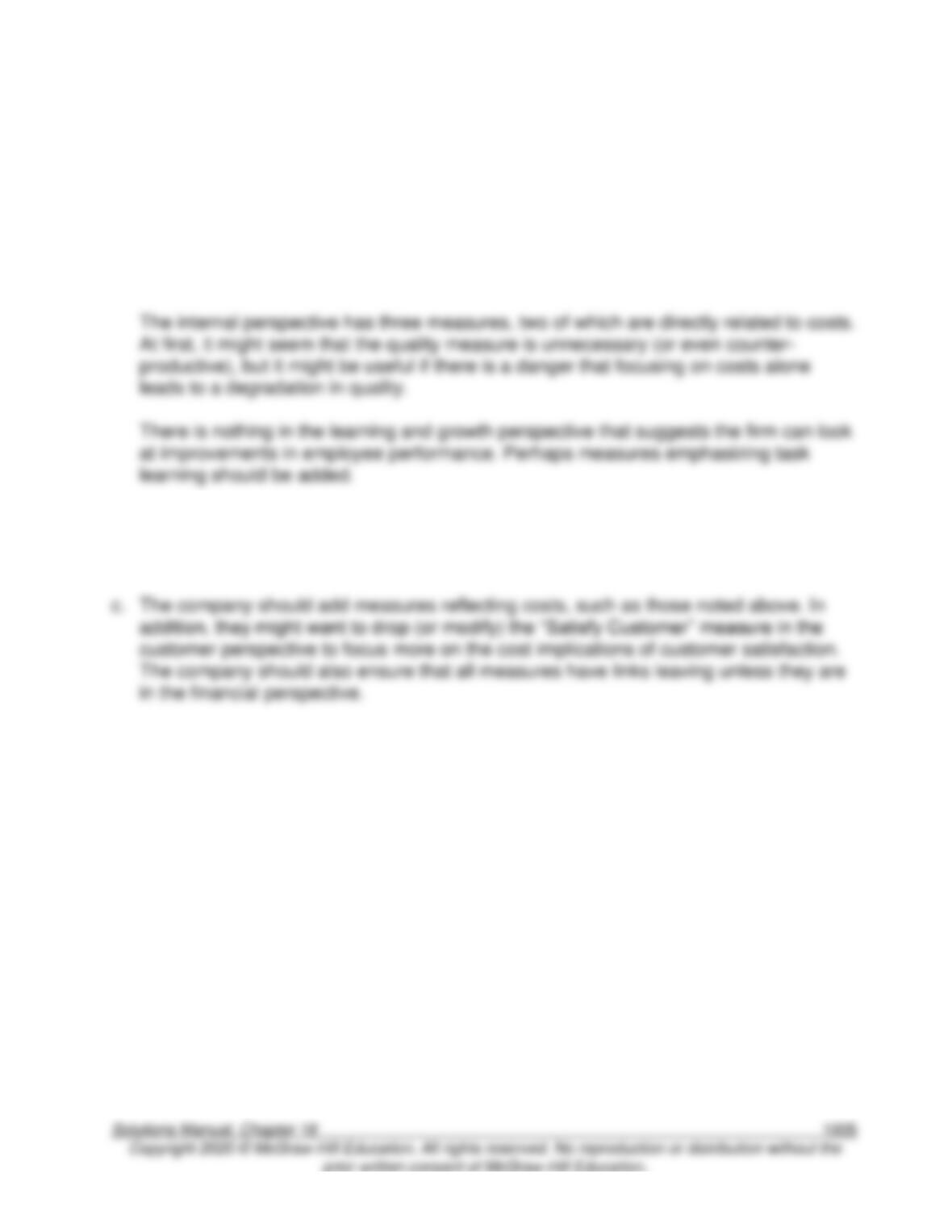
18–45. (30 min.) Core Assets and Capabilities
Answers will vary; however, core assets and capabilities should be both essential to the
business strategy and proprietary in nature. Non-core assets may be important things that
the company must do; however, it is typically not essential to the strategy or proprietary.
Some examples are:
Company
Core Asset or Capability
Non-core Asset or
Capability
Apple
Copyright ‘bitten apple’ logo
Highly trained ‘genius’ store
assistants
The American Red Cross
Highly trained emergency response
Fundraising skills
World-renowned brand
Volunteer network
Office equipment
Office space
Hyundai Motors
International brand
Delivering low-cost, high-quality cars
in different vehicle lines
Cash registers and POS
scanners in stores
Corporate accounting
Strong warranty policy
Target
Network of low-cost suppliers
Ability to buy in large quantity
Ability to distribute product to
dispersed stores in the right quantity
at the right time (inventory control)
Cashiers and retail sales
employees
Store building
Sysco
Inventory management capabilities
Management of fleet of trucks for
efficient effective delivery
Network of capable food
manufacturers
Fleet of trucks
Corporate accounting
function
Warehouses
Nike
Various technology patents on
special shoe designs
Marketing skills
Network of capable manufacturers
Office equipment

18–46. (30 min.) Financial and Non-Financial Performance Measures.
Answers will vary.
The advantage of sales revenue is that it is a financial measure that is easily linked to
profit and the financial goals of the firm. The disadvantage is that it is a combination of
sales quantity, which might be a more direct measure of the marketing manager’s
effort and is not affected by market changes.
18–47. (30 min.) Balanced Scorecards and Strategy Maps: Hill Street Company.
a. Answers will vary. The measures in the financial perspective are reasonable, although
the company might want to add one specifically related to cost improvement (such as
growth in margins).
There is only one measure in the customer perspective and it is unclear how satisfied
customers will help them improve cost competitiveness. Perhaps a measure such as
customer retention, which implies lower customer acquisition costs, might be more
appropriate.
b. The strategy map shows many links that are helpful in communicating the strategy.
However, notice that there is no link leaving “Increase Employee Skills” in the learning
and growth perspective. It is not clear what the purpose of this measure might be.

18–48. (30 min.) Balanced Scorecards and Strategy Maps: Monroe Corporation.
a. Answers will vary. The measures in the financial perspective are reasonable, although
the company might want to include a measure on cost of quality (but this might be
better placed in the internal perspective).
There is only one measure in the customer perspective. Because the company is
focused on quality, other measures they might include are returns (or deliveries
rejected), complaints, and warranty claims.
b. The goal “Satisfy Customers” links to financial perspective, but there is no indication of
what leads to satisfied customers. The goal “Improve Quality” does not link to anything.
Why does the company want to improve quality? (The answer to this is obvious for this
firm, but it is not apparent from the strategy map.)
18–49. (20 min.) Benchmarks: Delta Airlines.
Answers will vary, but might include the following:
• On-time arrivals.
• Load factor.
18–50. (45 min.) Mission Statement.
Answers will vary, but should identify the stakeholders (students, faculty, staff, and
community) and state how the organization intends to add value to each group.
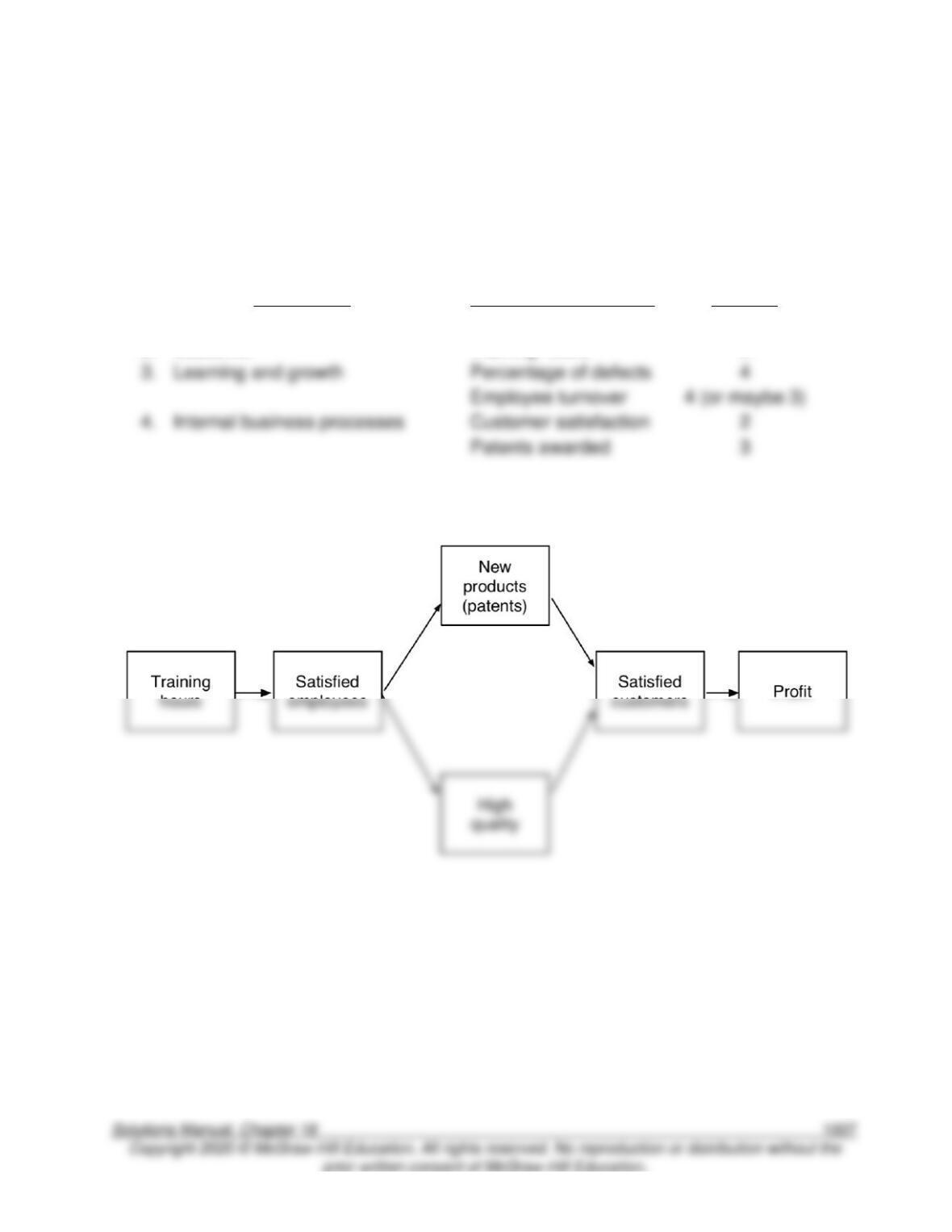
18–51. (45 min.) Performance Measures: Garnet Electronics
a.
Perspective
Performance Measure
Perspective
Number
1.
Financial
Profit
1
2.
Customer
Training hours
3
3.
Learning and growth
Percentage of defects
4
Employee turnover
4.
Internal business processes
Customer satisfaction
2
Patents awarded
3
b.
Answers will vary, but the following is one possibility:
18–52. (45 min.) Performance Measures: Local Bank.
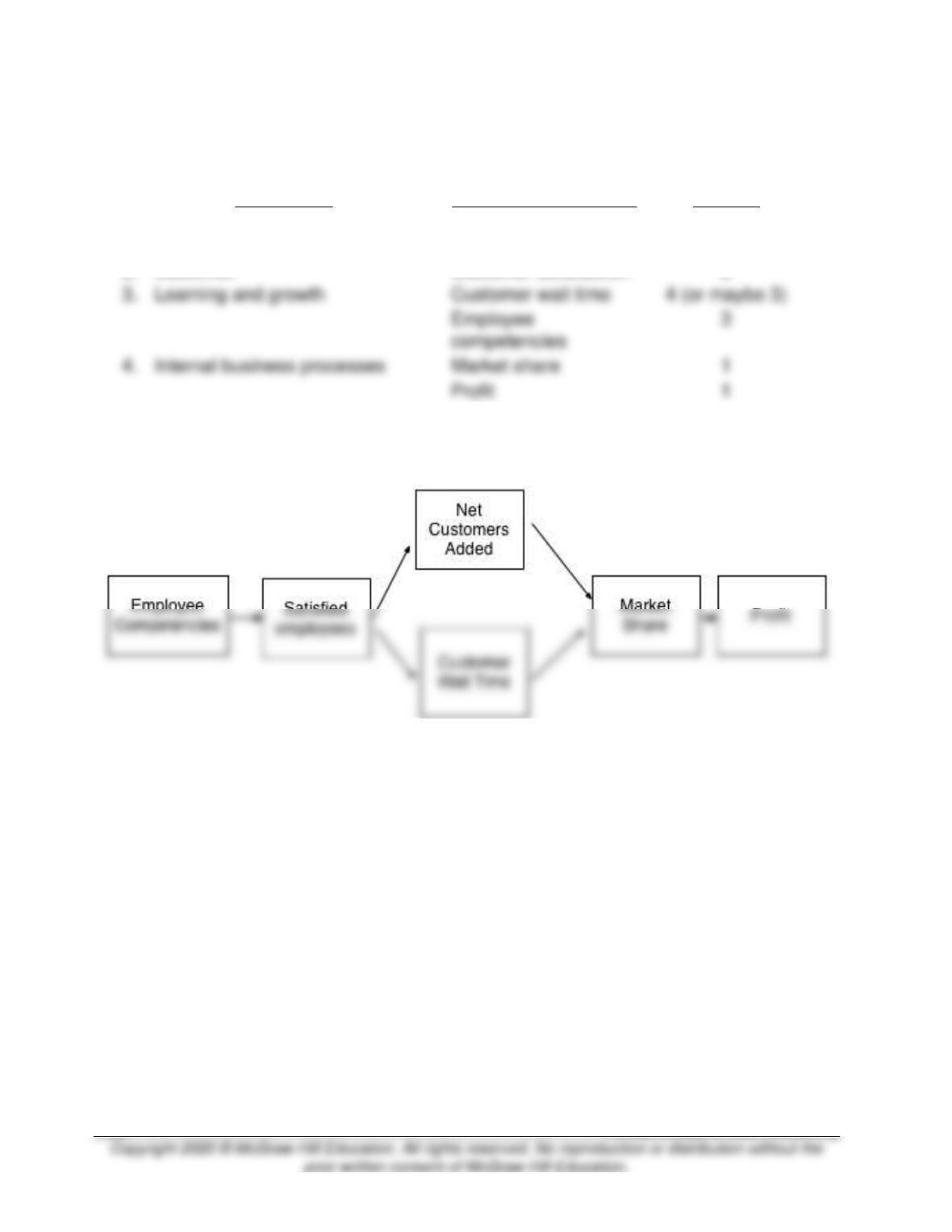
a.
Perspective
Performance Measure
Perspective
Number
1.
Financial
Compliance with
procedures
4
Employee
3
b.
Answers will vary, but the following is one possibility:
18–53. (20 min.) Functional measures.
Answers will vary, but might include any of the functional measures shown in Exhibit 18.7.
The following is one example. An important critical success factor for many airlines is the
ability to manage revenue by managing fares and seat availability. Some measures of this
are the load factor (the percentage of seats filled on a flight) or the revenue per seat-mile.
18–54. (45 min.) Performance measures.
Answers will vary. The advantages are easier to identify. They provide a measure of
effectiveness of faculty as perceived by students. One disadvantage is that education
includes learning material whose usefulness might not be apparent until some time in the
future. Because evaluations are collected immediately following a class, there is a
possibility that these issues will be ignored at the expense of “current topics,” which
appear to be more relevant.
18–55. (20 min.) Operational performance measures: Zuma Company.
a. Answers will vary, but should address the following points:
b. As a manager of the company, you probably want to know what caused the decline
shown by all three measures. Did employees have distorted incentives that led them to
ignore factors reflected by these measures? Were these declines the result of actions
taken to reduce costs, etc.?
18–56. (40 min.) Objective and Subjective Performance Measures.
Answers will vary:
a.
An advantage of using a combination of performance measures is that for any one
dimension of performance (communications skills, for example), a good measure can be
identified (class participation). For some dimensions of performance, especially those that
are harder to measure cleanly in an objective test, subjective measures are all that are
available.
The disadvantage of subjective measures is that it is harder to communicate what is
expected. The disadvantage of multiple measures is that some weighting of the measures
is required and that weighting can affect performance on other dimensions.
b.
18–57. (40 min.) Operational performance measures: Mid-States Metal Finishers.
a. Answers might include:
The percentage of orders filled on-time, the percentage of defective units produced
and the number of customer returns all improved significantly over the six month
period. There are several probable causes for this including:

18–58. (30 Minutes) Productivity Measures: Cambria Chemicals.
a. Total productivity = Value of output ÷ Value of inputs (materials, labor, and
overhead).
Year 1:
Total output value ……….
($370 x 8,800)
=
$3,256,000
Materials value …………..
($90 x 8,000)
=
$720,000
Labor value ……………….
($19 x 7,600)
=
Overhead value ………….
=
Total factor productivity .
Year 2:
Total output value ……….
($360 x 10,800)
=
$3,888,000
Materials value …………..
($85 x 9,000)
=
$765,000
Labor value ……………….
=
Overhead value ………….
=
$2,265,000
Total factor productivity .
b. Total factor productivity improved from 1.608 to 1.717. Although we know from
Exercise 18-37 that labor productivity declined while materials productivity
increased, it appears that, on balance, productivity in general grew from Year 1 to
Year 2.
c. Total factor productivity provides a comprehensive measure of productivity
changes and is not limited to the changes in a single factor. Therefore, it provides a

18–59. (20 Minutes) Employee Involvement.
a. Answers will vary, but might include:
By providing line employees the authority to make decisions, customer satisfaction can
increase. The employees can make timely decisions regarding how providing a special
service will keep a customer loyal and increase long-term profitability. In the case of
b. There are at least two reasons why banks and other financial institutions might be less
willing to provide this decision-making authority. First, on-site supervisors are more
easily contacted. They are closer to the decision being made and, often, there is not
the immediate need for a decision. Second, many of the concessions made in the case
of hotels and airlines involve otherwise unused capacity and the costs are less direct.
This is less often the case in banks.

18–60. (20 Minutes) Employee Involvement.
Answers will vary.
a. Other problems that might arise include inconsistent experiences by customers.
Because the compensation will likely depend on the length of the flight, for example,
customers might receive different amounts for the same issue.
Another problem is that a customer has to be a member of the airline’s frequent flyer
Solution to Integrative Case
18–61. (40 min.) Balanced Scorecards and Strategy Maps: University of California,
Davis.
a. Some organizations are concerned that names of new programs label them as the
latest fads and that employees will automatically resist them for that reason. Many
university employees are resistant to change and reject the application of a “corporate”
model to a university setting.
c. Many university professors are independent agents who conduct their research and
teaching without regard to explicit overall goals or objectives of the university. Most
faculty resist being told what to do or how to do it. Importing successful management
techniques, such as the balanced scorecard, can be difficult in academic departments.
(We don’t see professors of humanities embracing the balanced scorecard, or any
non-academic scorecard, for that matter).