Financial and Managerial Accounting, 9th Edition
17-1
CHAPTER 17
ACTIVITY-BASED COSTING AND ANALYSIS
Related Assignment Materials
Student Learning Objectives
Discussion
Questions
Quick
Studies*
Exercises*
Problems*
AA, DA and BTN
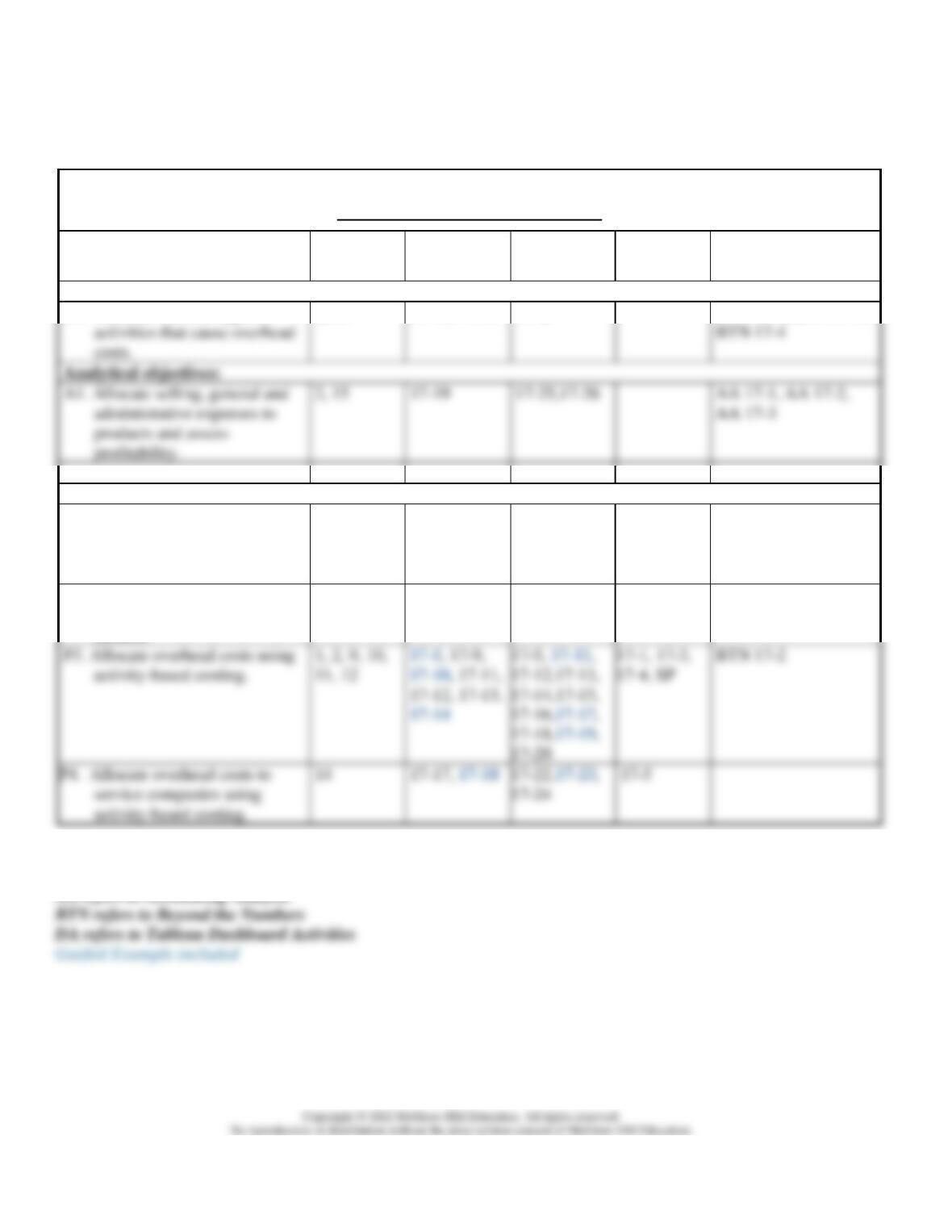
Conceptual objectives:
activities that cause overhead
BTN 17-4
Analytical objectives:
administrative expenses to
products and assess
AA 17-3
C1. Describe the four types of
6, 13
17-15, 17-16
17-21
BTN 17-1, BTN 17-3,
Procedural objectives:
P1. Allocate overhead costs using
the plantwide overhead rate
method.
1, 2, 3, 4, 5,
7
17-1, 17-2,
17-3, 17-4,
17-6
17-1, 17-2,
17-3, 17-4,
17-5, 17-7,
17-9, 17-11
17-1, 17-2,
17-5
P2. Allocate overhead costs using
the departmental overhead rate
method.
1, 2, 3, 8, 9
17-7, 17-8
17-6, 17-8,
17-9, 17-10
17-4
17-12, 17-13,
17-14
17-14,17-15,
17-20
P4. Allocate overhead costs to
service companies using
14
17-17, 17-18
17-24
17-5
*See additional information on next page that pertains to these quick studies, exercises and problems.
SP refers to the Serial Problem
AA refers to Accounting Analysis
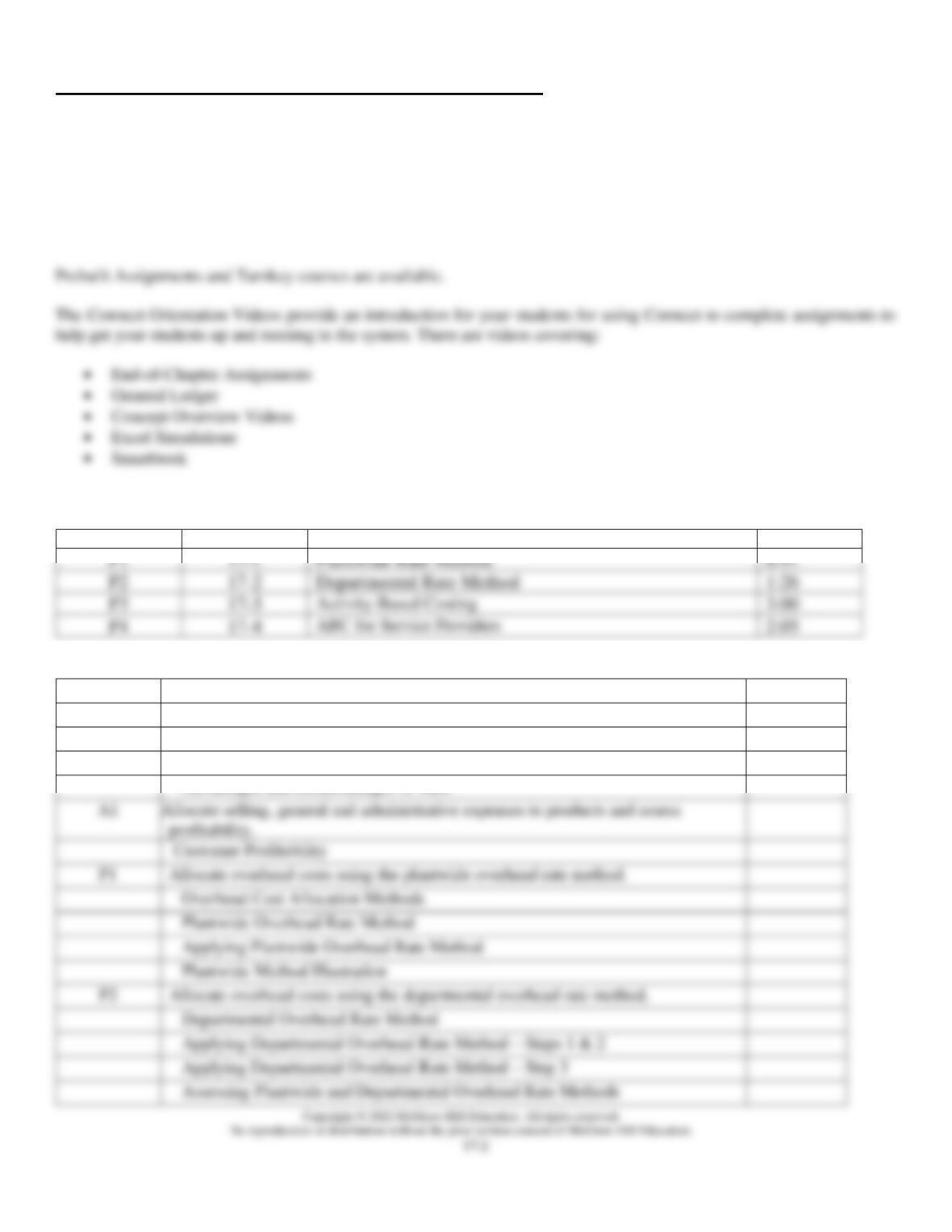
Allocate overhead costs using the plantwide overhead rate method.
Overhead Cost Allocation Methods
Plantwide Overhead Rate Method
Applying Plantwide Overhead Rate Method
Plantwide Method Illustration
Allocate overhead costs using the departmental overhead rate method.
Departmental Overhead Rate Method
Applying Departmental Overhead Rate Method – Steps 1 & 2
Assessing Plantwide and Departmental Overhead Rate Methods
Financial and Managerial Accounting, 9th Edition
Additional Information on Related Assignment Material
See Chapter 1 of the Instructor’s Resource Manual for more information on materials for this text available in
Connect.
Connect
Available on the instructor’s course-specific website) repeats all numerical Quick Studies, all Exercises and Problems Set
A. Connect also provides algorithmic versions for Quick Study, Exercises and Problems. It allows instructors to monitor,
promote, and assess student learning. It can be used in practice, homework, or exam mode.
Need-to-Know Videos
LO
Need–to-Know
Title
Time
Concept Overview Videos
LO
Title
Time
C1
Describe the four types of activities that cause overhead costs.
Types of Activities
Examples of Activities and Activity Drivers
Advantages and Disadvantages of ABC
Financial and Managerial Accounting, 9th Edition
17-3
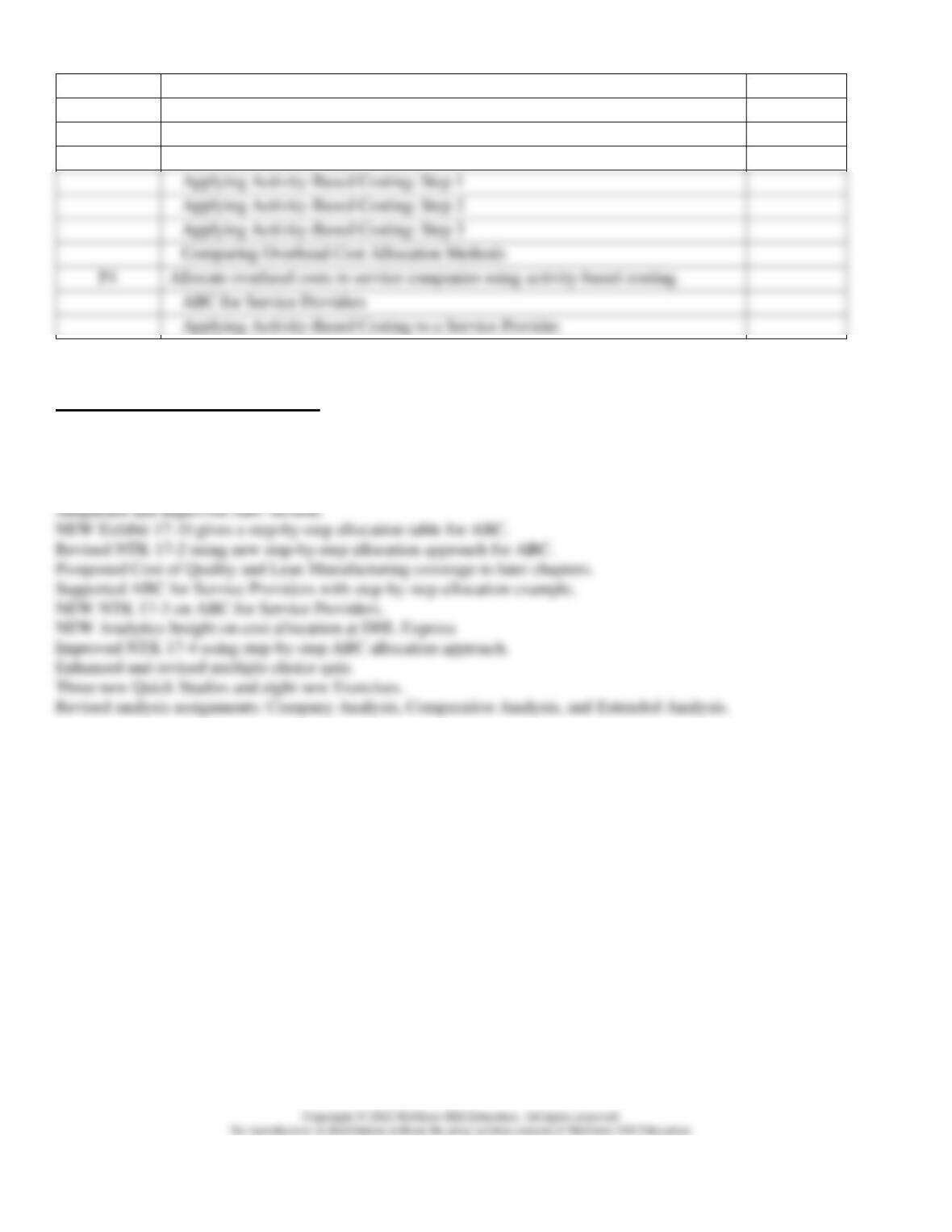
Plantwide Overhead Rate Method Assumptions
Departmental Overhead Rate Method Assumptions
P3
Allocate overhead cost using activity-based costing.
Activity-Based Costing
Applying Activity-Based Costing: Step 1
Applying Activity-Based Costing: Step 2
Applying Activity-Based Costing: Step 3
Comparing Overhead Cost Allocation Methods
P4
Allocate overhead costs to service companies using activity-based costing.
ABC for Service Providers
Applying Activity-Based Costing to a Service Provider
Synopsis of Chapter Revision
NEW Opener—Grimm Artisanal Ales and entrepreneurial assignment.
Streamlined learning objectives.
Revised Exhibit 17.4 (previously 17.5)
Enhanced NTK 17-1 for consistency with assignment materials.
Financial and Managerial Accounting, 9th Edition
17-4
Chapter Outline
I. Overhead Cost Allocation Methods – Manager decisions involving product pricing, product mix, and
cost control depend on accurate product cost information. Product costs consist of direct labor, direct
materials, and overhead (indirect costs). Overhead costs cannot be traced to units of product in the same
II. Plantwide Overhead Rate Method
A. Plantwide Overhead Rate Method—uses one overhead rate to allocate overhead costs.
1. Target of cost assignment, cost object, is the unit of product.
2. Rate is determined using a volume-related measure such as direct labor hours or machine hours.
III. Departmental Overhead Rate Method
A. Departmental Overhead Rate Method – uses multiple overhead rates which can result in better
overhead cost allocations and improve management decisions.
B. Uses a different overhead rate for each department and follows a three-step process:
1. Assign budgeted overhead cost to department cost pools.
2. Select an allocation base and compute an overhead allocation rate for each department.
3. Allocate overhead costs to cost objects.
6. Both the plantwide and departmental overhead rate methods have a weakness: overhead cost is
often too complex to be explained by factors such as direct labor hours or machine hours.
7. Plantwide Overhead Rate Method: usefulness depends on two assumptions:
a. Overhead costs change with the allocation base.
8. Departmental Overhead Rate Method: two assumptions:
a. Different products are similar in volume, complexity, and batch size
b. Departmental overhead costs are proportional to the departmental allocation base.
Financial and Managerial Accounting, 9th Edition
c. When products differ in batch size and complexity, they usually consume different amounts
IV. Activity-Based Costing
Activity-Based Costing (ABC) assigns overhead cost by focusing on activities.
1. Unlike plantwide method, ABC uses more than a single rate and unlike departmental method,
ABC focuses on activities rather than departments.
a. Basic principle is that activities, which are tasks, operations, or procedures, cause overhead
A. Step 1: Identifies individual activities, grouped into cost pools.
1. Activity cost pool is a group of costs that are related to the same activity.
D. Total product cost per unit can then be computed.
E. Comparing Overhead Cost Allocation Methods:
1. ABC emphasizes activities and their costs, which can better reflect how overhead cost is used in
making products.
V. Activity Levels and Cost Management
A. Activity Levels—activities can be separated into four levels:
1. Unit level activities—performed on each unit. Costs tend to change with the number of units
produced.
Financial and Managerial Accounting, 9th Edition
17-6
3. Allocate overhead cost to cost objects.
5. Activity-based management (ABM) outgrowth of ABC that uses the link between activities and
product from non-value-added activities, which do not.
B. Advantages of Activity-Based Costing
1. More Effective Overhead Cost Control—can be used to identify activities that can benefit from
process improvement by focusing on activities.
accurately set selling prices.
C. Disadvantages of Activity-Based Costing
1. Costly to Implement and Maintain ABC. Requires thorough analysis of cost activities and cost
effect relation with the costs.
3. Not Compliant with GAAP. Cannot be used for external financial reporting purposes under
GAAP.
VI. ABC for Service Providers
A. ABC applies to service providers who classify cists by activity levels.
B. Typical Activity levels include unit level, batch level, service level and facility level.
C. Steps include:
1. Identify activities and their budgeted overhead cost.
VII. Decision Analysis: Customer Profitability.
A. ABC can be used to allocate selling, general and administrative costs to products and determine

Financial and Managerial Accounting, 9th Edition
17-7
Chapter 17 Alternate Demo Problem
Windy River Float Trips uses activity-based costing to compute the cost of the river raft
trips. Each raft holds six customers and a guide. The costs for these float trips are as
follows:
Activities (cost driver) Costs
Trailer rent fee (trip) $127 per trip
Financial and Managerial Accounting, 9th Edition
17-8
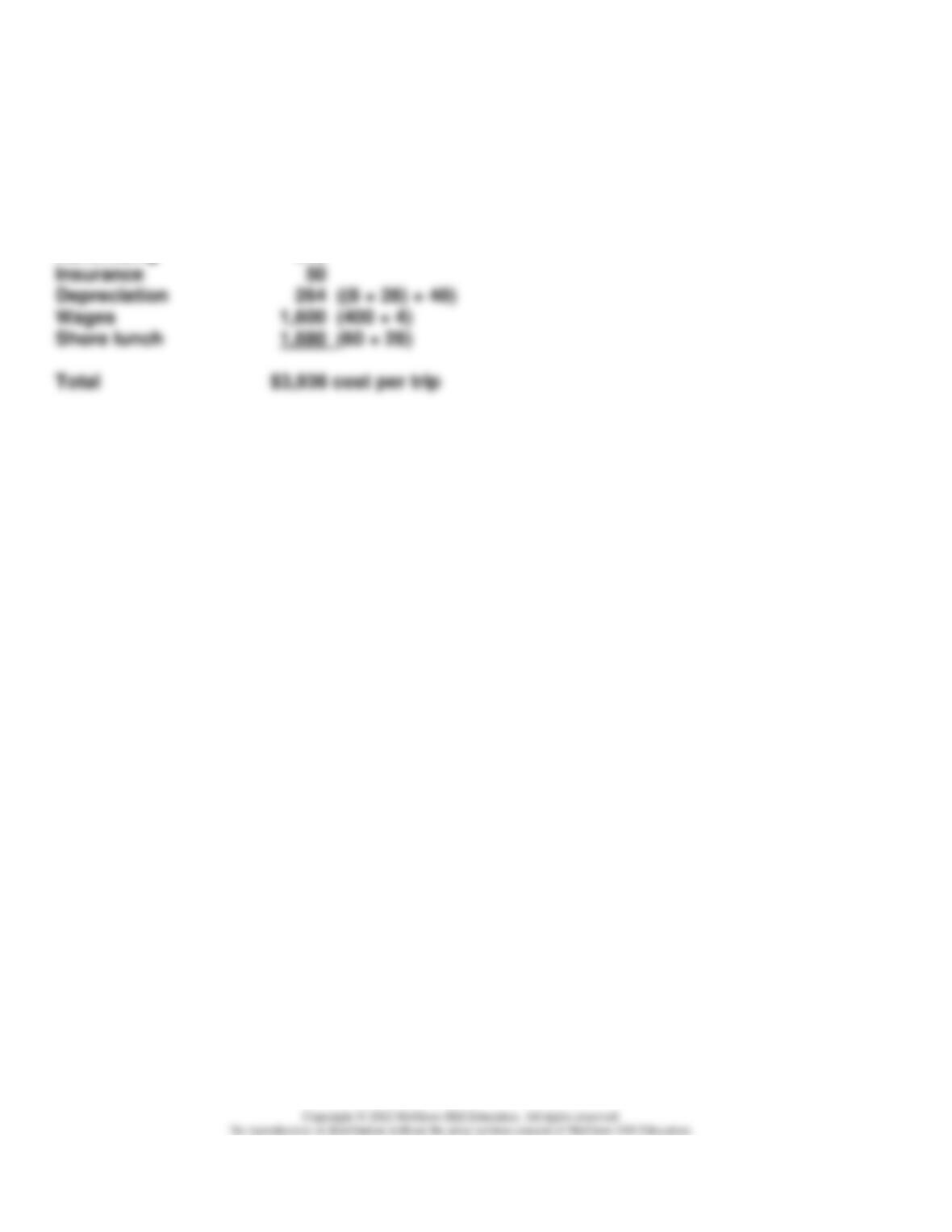
Chapter 17 Solution: Alternate Demo Problem
Activities River Float Trips
Trailer Rent Fee $ 127
Advertising 215