CHAPTER 17
Investments
ASSIGNMENT CLASSIFICATION TABLE (BY TOPIC)
Topics
Questions
Brief
Exercises
Exercises
Problems
Concepts
for Analysis
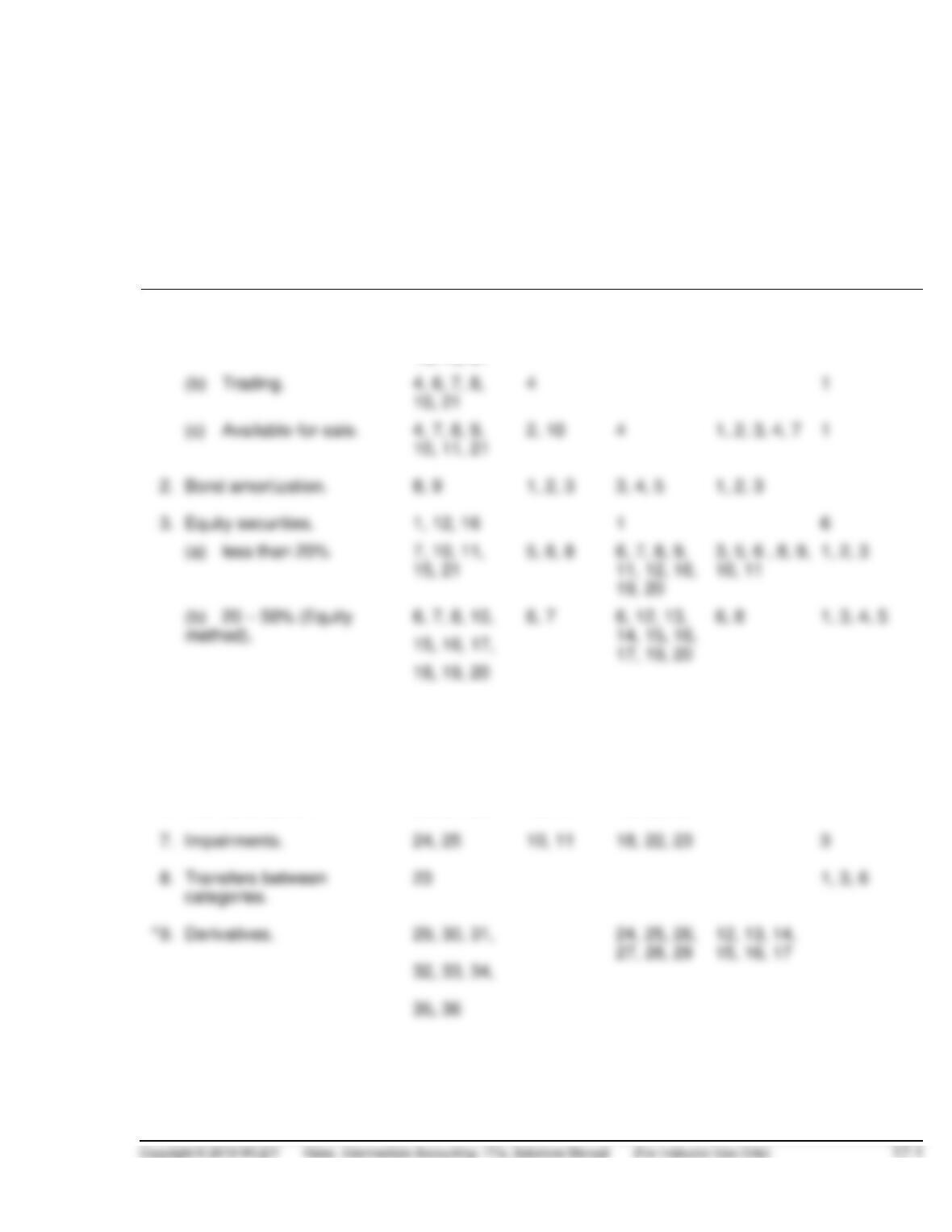
1. Debt securities.
1, 2, 3, 13
1
6
(a) Held-to-maturity.
4, 5, 7, 8,
10, 13, 21
1, 3
2, 3, 5
1, 7
(b) Trading.
4, 6, 7, 8,
10, 21
4
1
(c) Available-for-sale.
4, 7, 8, 9,
10, 11, 21
2, 10
4
1, 2, 3, 4, 7
1
2. Bond amortization.
8, 9
1, 2, 3
3, 4, 5
1, 2, 3
3. Equity securities.
1, 12, 16
1
6
15, 21
11, 12, 16,
19, 20
10, 11
4. Comprehensive income.
22
9
10
9, 11
5. Disclosures of investments.
18
10
5, 8, 9, 10,
11
6. Fair value option.
26, 27, 28
12, 13
19, 20, 21
7. Impairments.
24, 25
10, 11
18, 22, 23
3
35, 36
*This material is dealt with in an Appendix to the chapter.
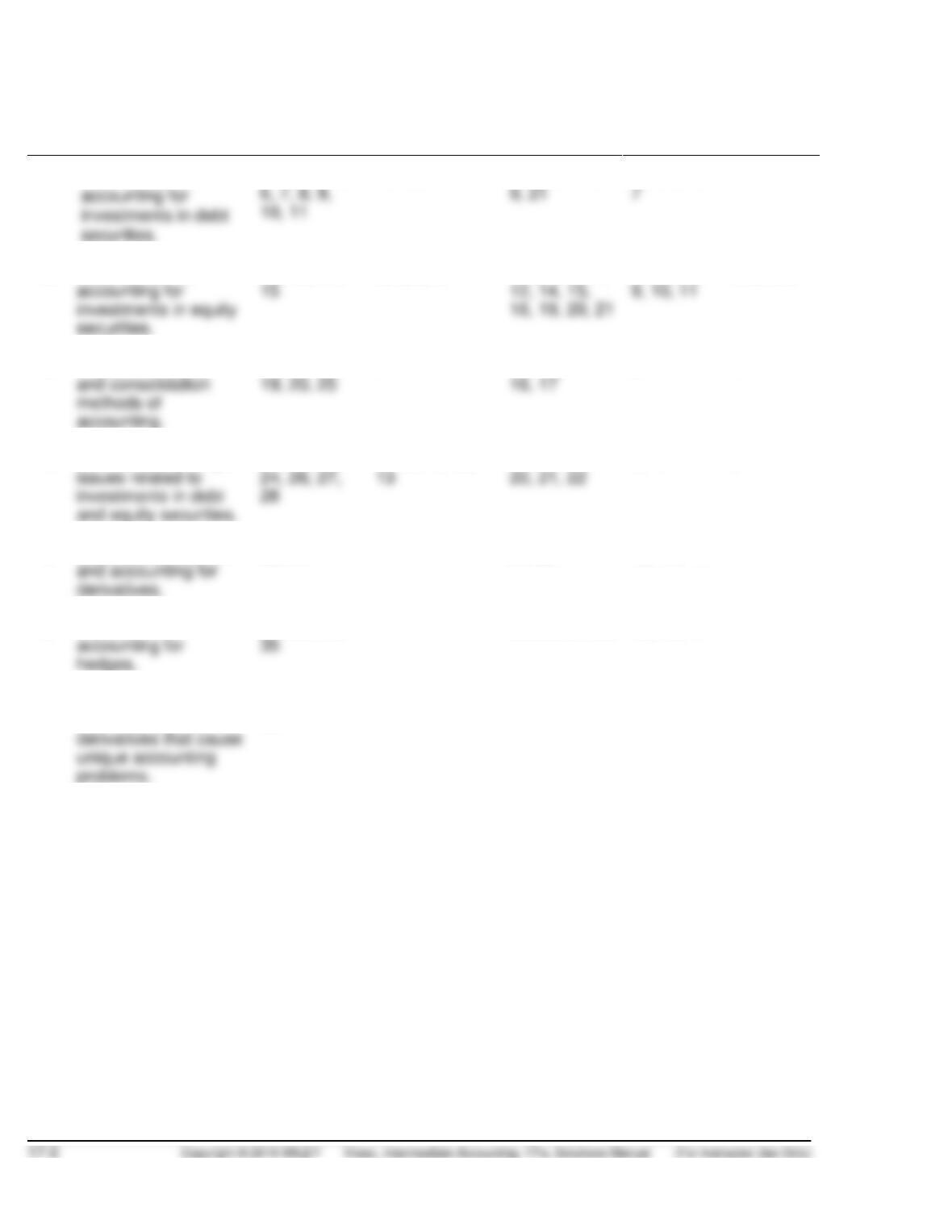
ASSIGNMENT CLASSIFICATION TABLE (BY LEARNING OBJECTIVE)
Learning Objectives
Questions
Brief
Exercises
Exercises
Problems
Concepts
for
Analysis
1. Understand the
1, 2, 3, 4, 5,
1, 2, 3, 4
1, 2, 3, 4, 5,
1, 2, 3, 4,
1
securities.
15
12, 14, 15,
16, 19, 20, 21
9, 10, 11
2. Understand the
12, 13, 14,
5, 6, 8, 9,
1, 6, 7, 8, 11,
3, 5, 6, 8,
1, 2, 3, 5
3. Explain the equity
16, 17, 18,
7
12, 13,
8
4
24, 26, 27,
13
20, 21, 22
4. Evaluate other major
21, 22, 23,
9, 10, 11, 12,
10, 18, 19,
9, 11
6
derivatives.
*5. Describe the uses of
29, 30
24, 28
12, 13, 14
*6. Explain to the
31, 32, 34,
25, 26, 27, 29
15, 16, 17
*7. Identify special
reporting issues for
33, 34, 35,
36
16
*8. Describe required fair
value disclosures.
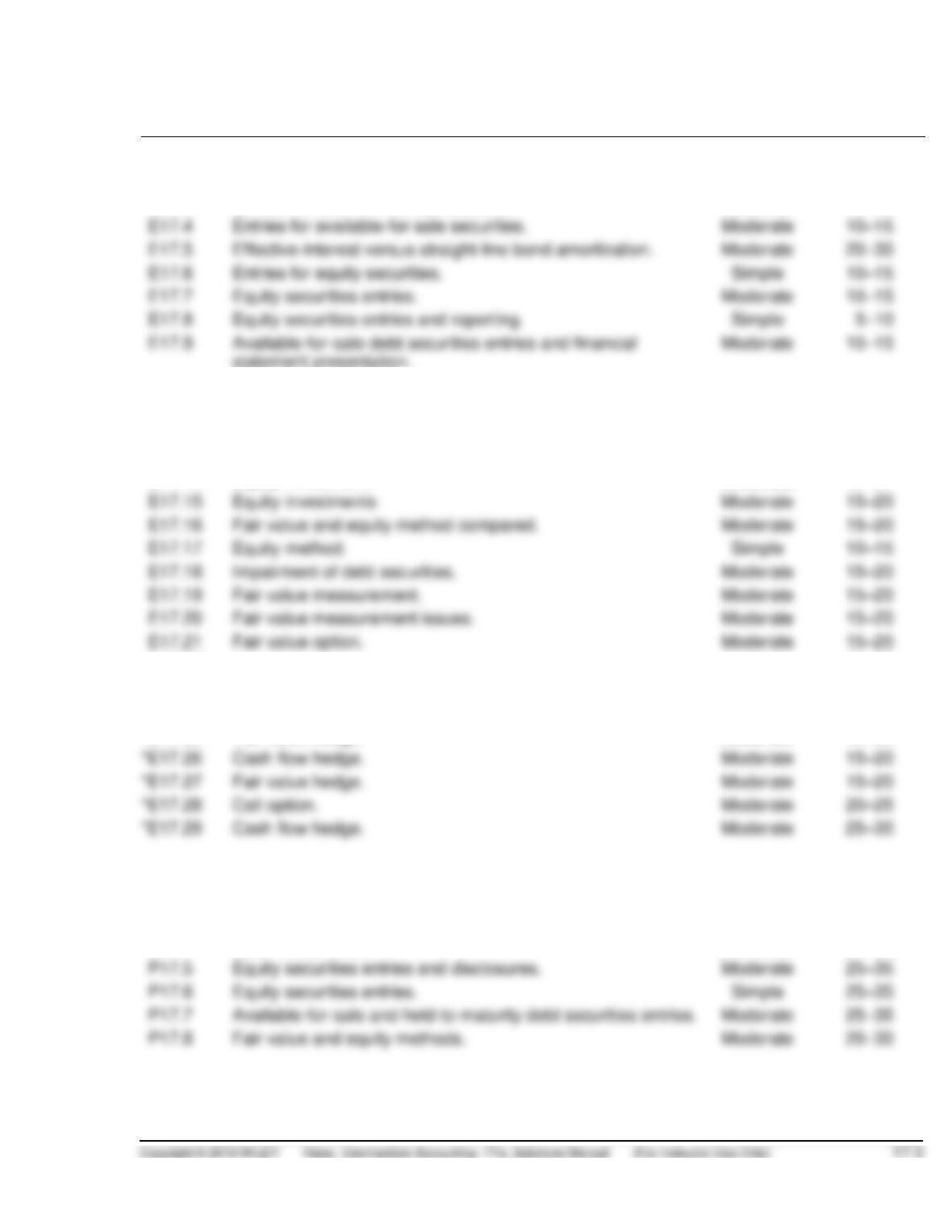
ASSIGNMENT CHARACTERISTICS TABLE
Item
Description
Level of
Difficulty
Time
(minutes)
E17.1
Investment classifications.
Moderate
5–10
E17.2
Entries for held-to-maturity securities.
Simple
10–15
E17.3
Entries for held-to-maturity securities.
Moderate
15–20
E17.4
Entries for available-for-sale securities.
Moderate
10–15
E17.5
Effective-interest versus straight-line bond amortization.
Moderate
20–30
E17.6
Entries for equity securities.
Simple
10–15
E17.7
Equity securities entries.
Moderate
10–15
E17.8
Equity securities entries and reporting.
Simple
statement presentation.
E17.10
Comprehensive income disclosure.
Moderate
20–25
E17.11
Equity securities entries.
Moderate
20–25
E17.12
Journal entries for fair value and equity methods.
Moderate
15–20
E17.13
Equity method.
Moderate
8–10
E17.14
Equity investment.
Moderate
8–10
E17.15
Equity investments
Moderate
15–20
E17.16
Fair value and equity method compared.
Moderate
15–20
E17.17
Equity method.
Simple
10–15
E17.18
Impairment of debt securities.
Moderate
15–20
E17.19
Fair value measurement.
Moderate
15–20
E17.20
Fair value measurement issues.
Moderate
15–20
E17.21
Fair value option.
Moderate
15–20
E 17.22
E17.23
*E17.24
Impairment
Impairment
Derivative transaction.
Moderate
Moderate
Moderate
20–25
20–25
15–20
*E17.25
Fair value hedge.
Moderate
15–20
*E17.26
Cash flow hedge.
Moderate
15–20
*E17.27
Fair value hedge.
Moderate
15–20
*E17.28
Call option.
Moderate
20–25
*E17.29
Cash flow hedge.
Moderate
25–30
P17.1
Debt securities.
Moderate
20–30
P17.2
Available-for-sale debt investments.
Moderate
30–40
P17.3
Debt and equity investments.
Moderate
25–30
P17.4
Debt investments.
Moderate
25–35
P17.5
Equity securities entries and disclosures.
Moderate
25–35
P17.6
Equity securities entries.
Simple
25–35
P17.7
Available-for-sale and held-to–maturity debt securities entries.
Moderate
25–35
P17.8
Fair value and equity methods.
Moderate
20–30
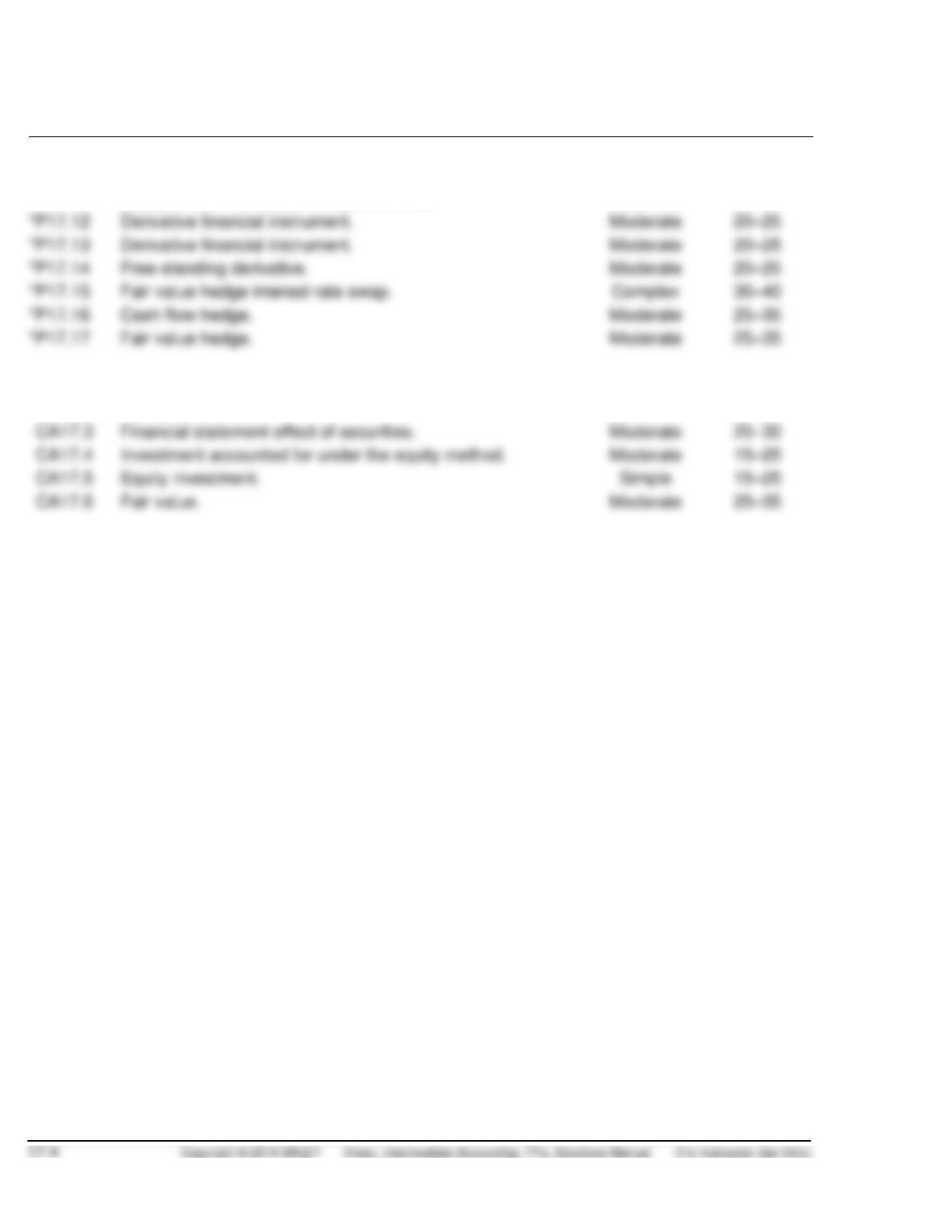
ASSIGNMENT CHARACTERISTICS TABLE (Continued)
Item
Description
Level of
Difficulty
Time
(minutes)
P17.9
Gain on sale of investments and comprehensive income.
Moderate
20–30
P17.10
Equity investments.
Complex
30–40
P17.11
Equity securities—statement presentation.
Moderate
20–30
Derivative financial instrument.
Moderate
20–25
Derivative financial instrument.
Moderate
20–25
Free-standing derivative.
Moderate
20–25
Fair value hedge interest rate swap.
Complex
30–40
Cash flow hedge.
Moderate
25–35
Fair value hedge.
Moderate
25–35
CA17.1
Issues raised about investment securities.
Moderate
25–30
CA17.2
Equity securities.
Moderate
25–30
CA17.3
Financial statement effect of securities.
Moderate
20–30
CA17.4
Investment accounted for under the equity method.
Moderate
15–25
CA17.5
Equity investment.
15–25
CA17.6
Fair value.
Moderate
25–35
ANSWERS TO QUESTIONS
1. A debt security is an instrument representing a creditor relationship with an entity. Debt securities
include U.S. government securities, municipal securities, corporate bonds, convertible debt, and
commercial paper. Trade accounts receivable and loans receivable are not debt securities
2. The variety in bond features along with the variability in interest rates permits investors to shop
3. Cost of a long-term investment in bonds includes the total consideration to acquire the
4. The three types of classifications for debt investments are:
Held-to-maturity: Debt investments that the company has the positive intent and ability to
5. A debt investment should be classified as held-to–maturity only if the company has both: (1) the
6. Debt investments classified as trading are reported at fair value, with unrealized holding gains
7. Trading and available-for-sale debt securities should be reported at fair value, whereas held-to–
8. $3,500,000 X 10% = $350,000; $350,000 ÷ 2 = $175,000. Wheeler would make the following entry:
Cash ($4,000,000 X 8% X 1/2) …………………………………………………… 160,000
Questions Chapter 17 (Continued)
9. Fair Value Adjustment ……………………………………………………………………. 89,000
Unrealized Holding Gain or Loss—Equity
10. Unrealized holding gains and losses for trading debt securities should be included in net income
for the current period. Unrealized holding gains and losses for available-for-sale debt securities
11. (a) Unrealized Holding Gain or Loss—Equity ………………………………. 60,000
Fair Value Adjustment ………………………………………………….. 60,000
12. Investments in equity securities can be classified as follows:
(a) Holdings of less than 20% (fair value method)—investor has passive interest.
13. Investments in stock do not have a maturity date and therefore cannot be classified as held–to–
maturity securities.
LO: 2, Bloom: K, Difficulty: Simple, Time: 1-3, AACSB: Communication, AICPA BB: Critical Thinking, AICPA FC: Reporting, AICPA PC: Communication
14. Selling price of 10,000 shares at $27.50 ……………………………………….. $275,000
Less: Brokerage commissions ……………………………………………………. 1,770
Proceeds from sale ……………………………………………………………………. 273,230
15. Marketable equity securities are reported at fair value. Any unrealized holding gain or loss is
reported in net income. Nonmarketable securities are reported at cost less impairments. A
Questions Chapter 17 (Continued)
16. Significant influence over an investee may result from representation on the board of directors,
participation in policy-making processes, material intercompany transactions, interchange of
17. Under the equity method, the investment is originally recorded at cost, but is adjusted for
changes in the investee’s net assets. The investment account is increased (decreased) by the
18. The 20% rule is that an investment (direct or indirect) of 20 percent or more of the voting stock of
an investee leads to the presumption that an investor has the ability to exercise significant
influence over an investee and the equity method should be used. However, there are other
factors, when considered, may indicate that ownership of 20 percent or more may not enable an
19. Dividends subsequent to acquisition should be accounted for as a reduction in the Equity
20. Ordinarily, Raleigh Corp. should discontinue applying the equity method and not provide for
additional losses beyond the carrying value of $170,000. However, if Raleigh Corp.’s loss is not
21. Trading securities should be reported at aggregate fair value as current assets. Individual held-to–
maturity and available-for-sale securities are classified as current or noncurrent depending upon the
Questions Chapter 17 (Continued)
22. Reclassification adjustments are necessary to insure that double counting does not result when
23. When a security is transferred from one category to another, the transfer should be recorded at
fair value, which in this case becomes the new basis for the security. Any unrealized gain or loss
24. A debt security is impaired when “it is probable that the investor will be unable to collect all
amounts due according to the contractual terms.” When an impairment has occurred, the security
25. The amount of credit losses (impairment) that can be realized on available-for-sale debt
securities is limited to the amount that the fair value is less than amortized cost. In other words, if
26. Fair value is defined as “the price that would be received to sell an asset or paid to transfer a
27. The fair value option gives companies the option to report most financial instruments at fair value
with all gains and losses related to changes in fair value reported in the income statement. This
28. No. The fair value option is generally available only at the time a company first purchases the
*29. An underlying is a special interest rate, security price, commodity price, index of prices or rates,
or other market-related variable. Changes in the underlying determine changes in the value of
Questions Chapter 17 (Continued)
*30. See illustration below:
Feature
Traditional Financial Instrument
(e.g., Trading Security)
Derivative Financial Instrument
(e.g., Call Option)
Payment Provision
Initial Investment
Stock price times the number
Change in stock price (underlying)
*31. The purpose of a fair value hedge is to offset the exposure to changes in the fair value of a
*32. The unrealized holding gain or loss on inventory should be reported as income when this
inventory is designated as a hedged item in a qualifying fair value hedge. If the hedge meets the
*33. Entering into an interest rate swap is likely a setting where the company is hedging the fair value
of a fixed-rate debt obligation. The fixed payments received on the swap will offset fixed
*34. A cash flow hedge is used to hedge exposures to cash flow risk, which is exposure to the
variability in cash flows. The cash flows received on the hedging instrument (derivative) will offset
*35. Derivatives used in cash flow hedges are accounted for at fair value on the balance sheet but
gains or losses are recorded in equity as part of other comprehensive income.
*36. A hybrid security is a security that has characteristics of both debt and equity and often is a
combination of traditional and derivative financial instruments. A convertible bond is a hybrid
SOLUTIONS TO BRIEF EXERCISES
BRIEF EXERCISE 17.1
January 1, 2020
(a) Debt Investments …………………………..………………… 74,086
Cash …………………………………………………………. 74,086
BRIEF EXERCISE 17.2
January 1, 2020
(a) Debt Investments ……………………………………………… 74,086
Cash …………………………………………………………. 74,086
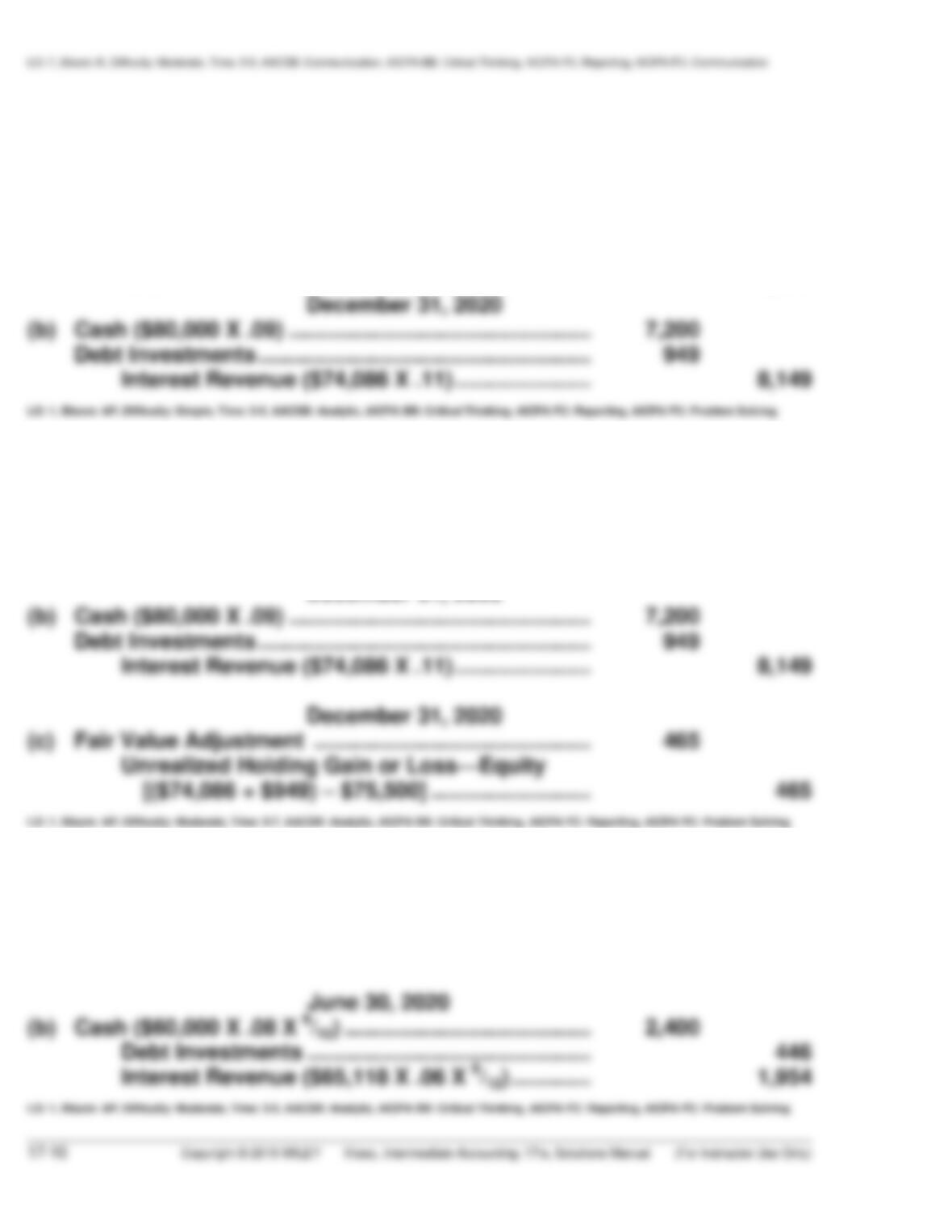
December 31, 2020
BRIEF EXERCISE 17.3
January 1, 2020
(a) Debt Investments ……………………………………………… 65,118
Cash …………………………………………………………. 65,118
BRIEF EXERCISE 17.4
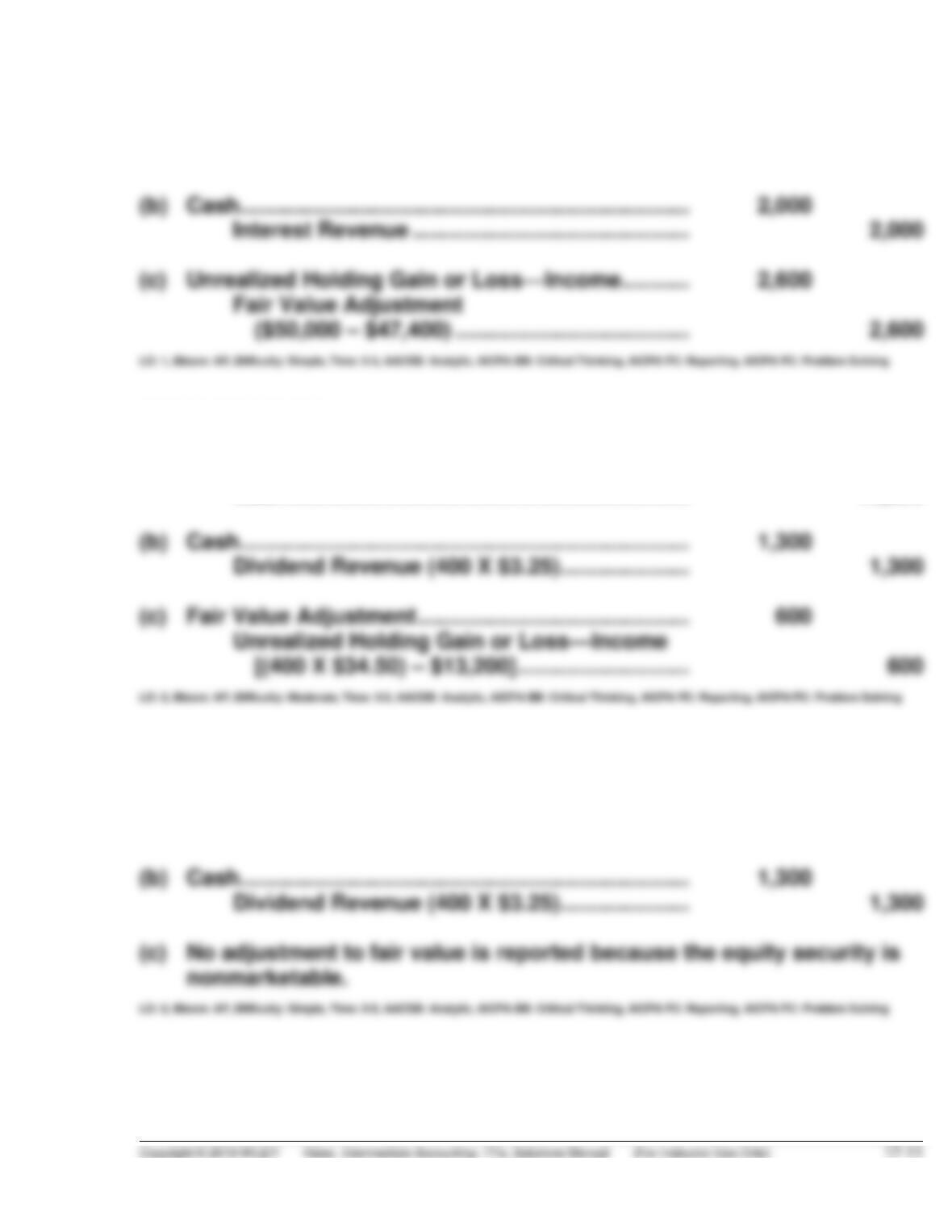
(a) Debt Investments ……………………………………………. 50,000
Cash ……………………………………………………….. 50,000
BRIEF EXERCISE 17.5
(a) Equity Investments …………………………………………. 13,200
Cash ……………………………………………………….. 13,200
BRIEF EXERCISE 17.6
(a) Equity Investments ………………………………………… 13,200
Cash ……………………………………………………….. 13,200
BRIEF EXERCISE 17.7
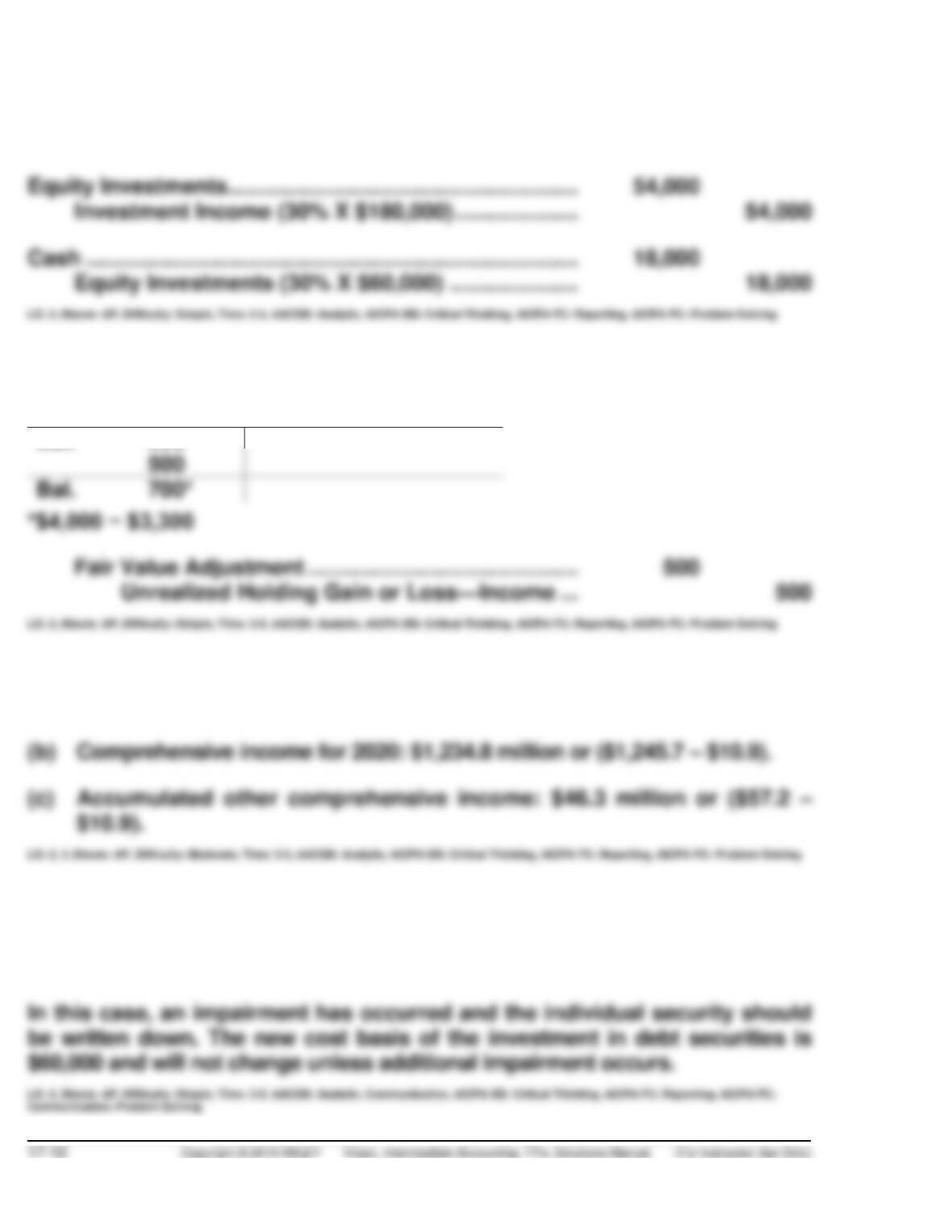
Equity Investments ………………………………………………… 300,000
Cash ………………………………………………………………. 300,000
BRIEF EXERCISE 17.8
Fair Value Adjustment
Bal. 200
BRIEF EXERCISE 17.9
(a) Other comprehensive loss for 2020 of $10.9 million.
BRIEF EXERCISE 17.10
Allowance for Doubtful Accounts ($70,000 − $60,000) … 10,000
Debt Investments ……………………………………………… 10,000
BRIEF EXERCISE 17.11
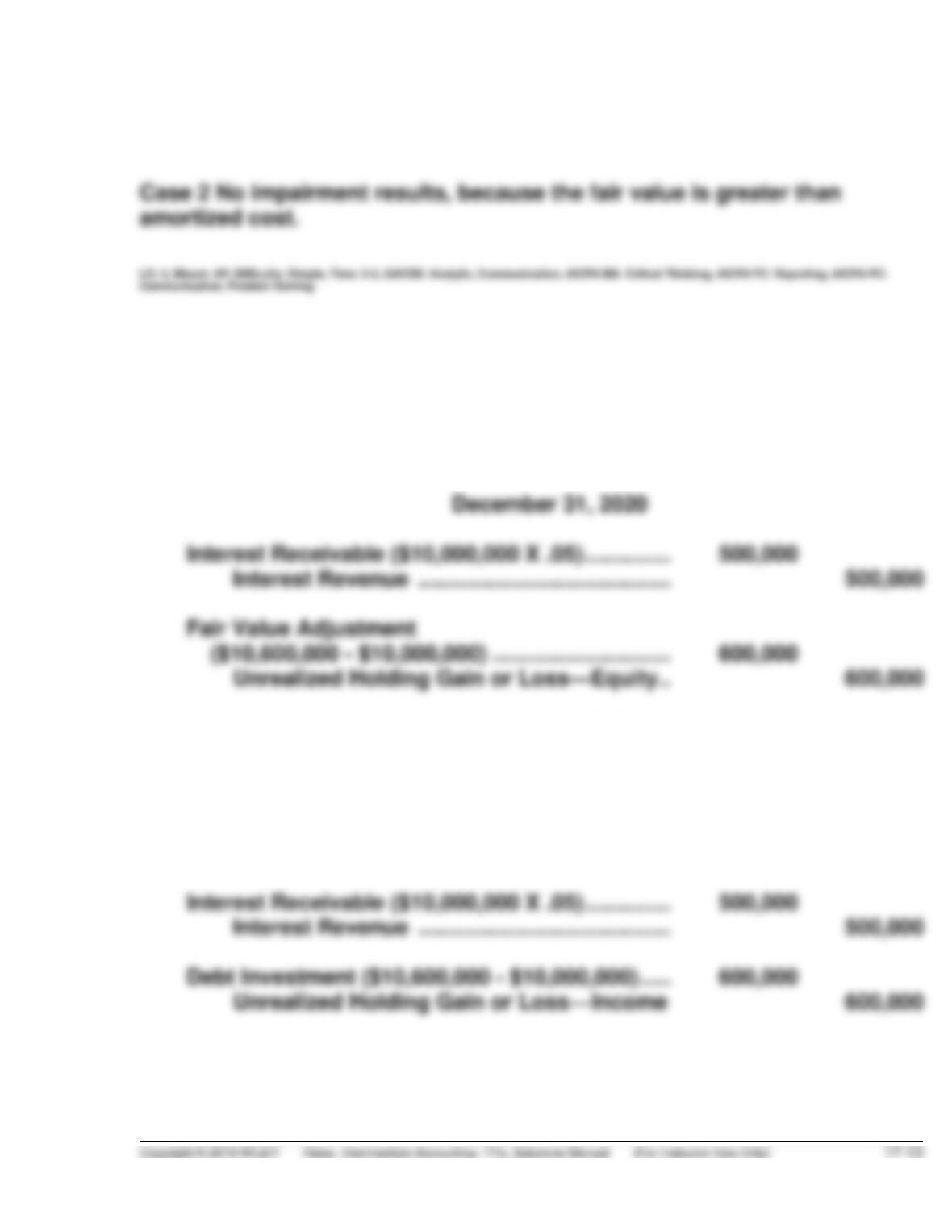
Case 1 The impairment loss is $10,000 ($40,000 – $30,000). The loss is
limited by the lower of amortized cost or fair value
BRIEF EXERCISE 17.12
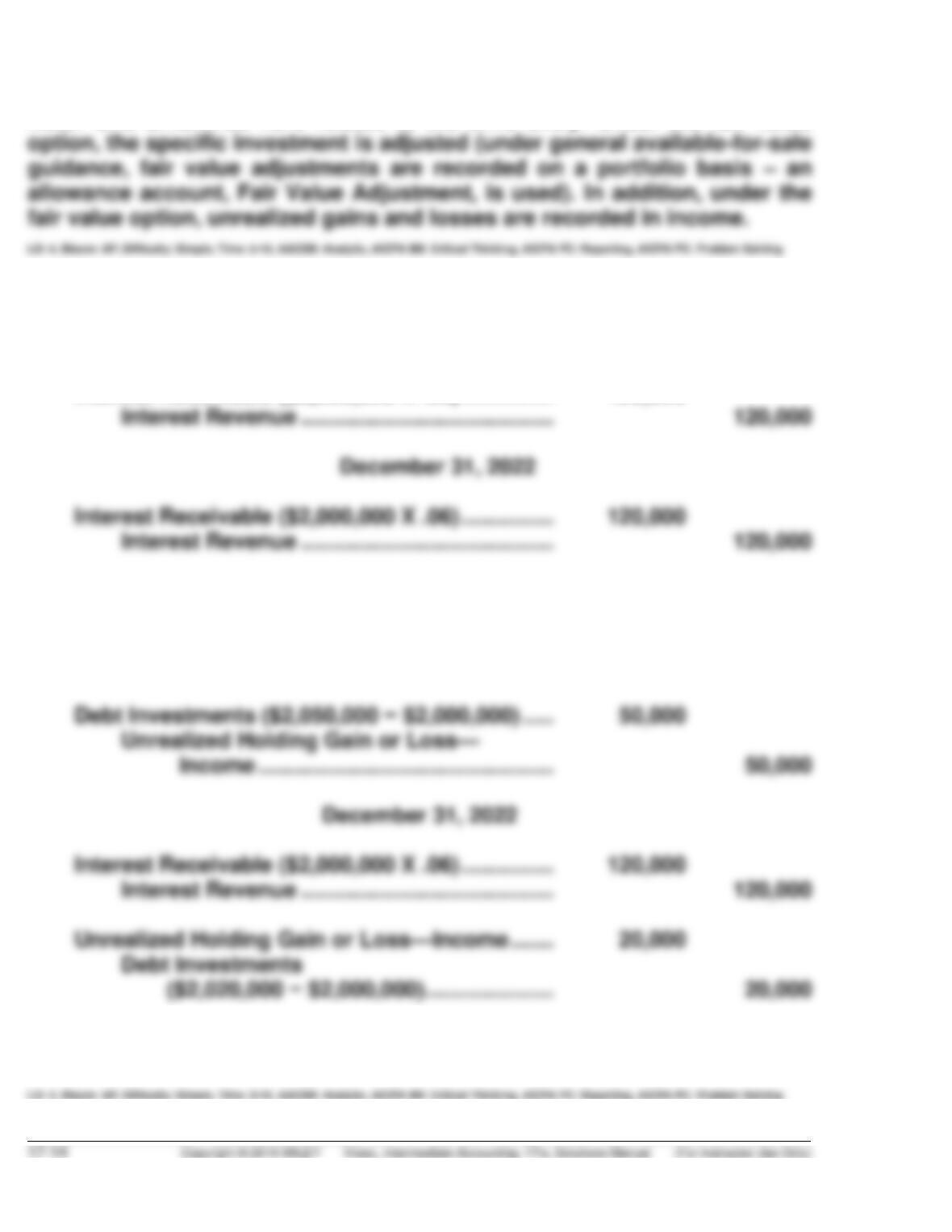
(a) January 1, 2020
Debt Investments ………………………………………… 10,000,000
Cash …………………………………………………….. 10,000,000
(b) January 1, 2020
Debt Investments ………………………………………… 10,000,000
Cash …………………………………………………….. 10,000,000
December 31, 2020
BRIEF EXERCISE 17.12 (Continued)
Note: One difference here relates to the third entry. Under the fair value
BRIEF EXERCISE 17.13
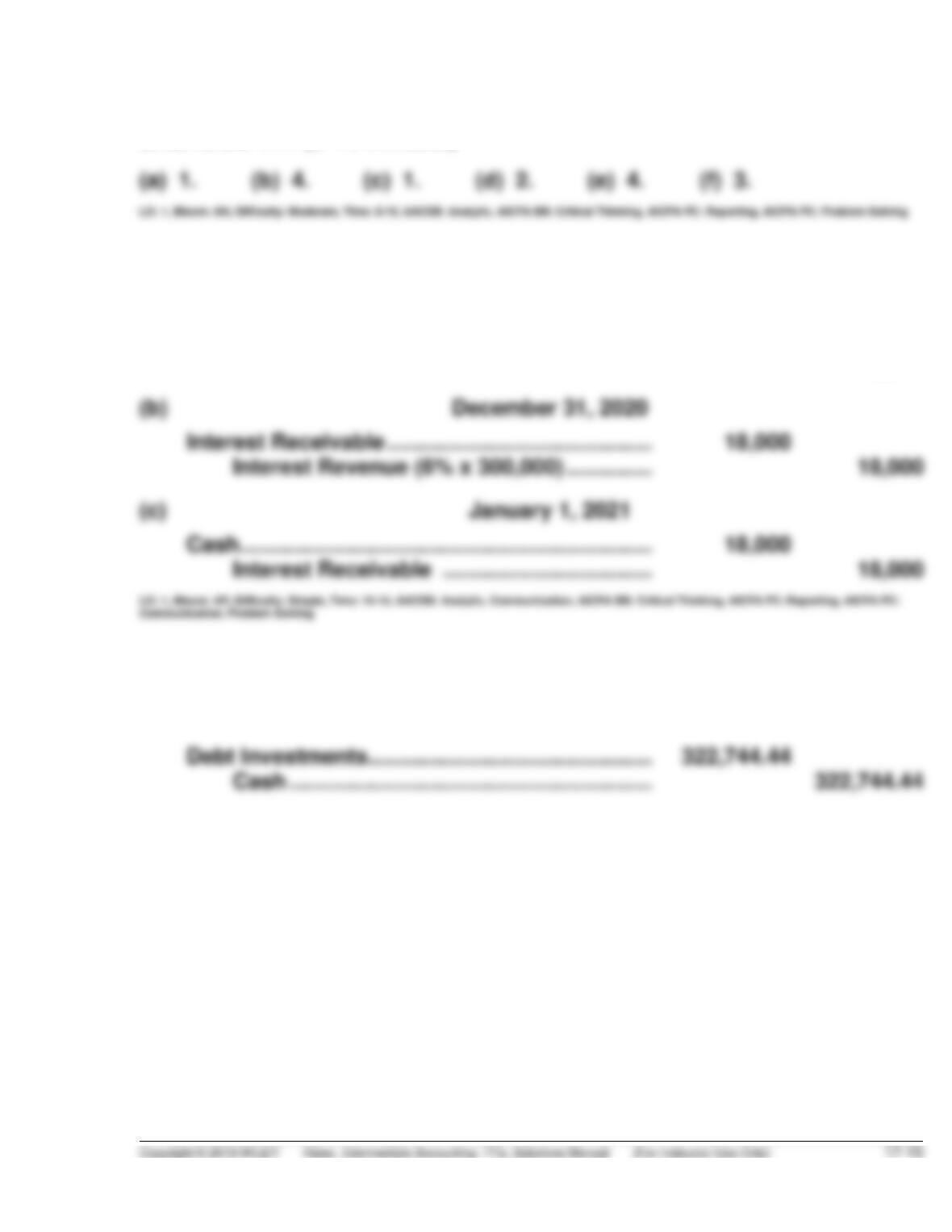
(a) December 31, 2020
Interest Receivable ($2,000,000 X .06) …………… 120,000
(b) December 31, 2020
Interest Receivable ($2,000,000 X .06) …………… 120,000
Interest Revenue ………………………………….. 120,000
Note: The Debt Investment account is adjusted because the company is
using the fair value option.
SOLUTIONS TO EXERCISES
EXERCISE 17.1 (5–10 minutes)
EXERCISE 17.2 (10–15 minutes)
(a) January 1, 2020
Debt Investments ………………………………………. 300,000
Cash ………………………………………………….. 300,000
EXERCISE 17.3 (15–20 minutes)
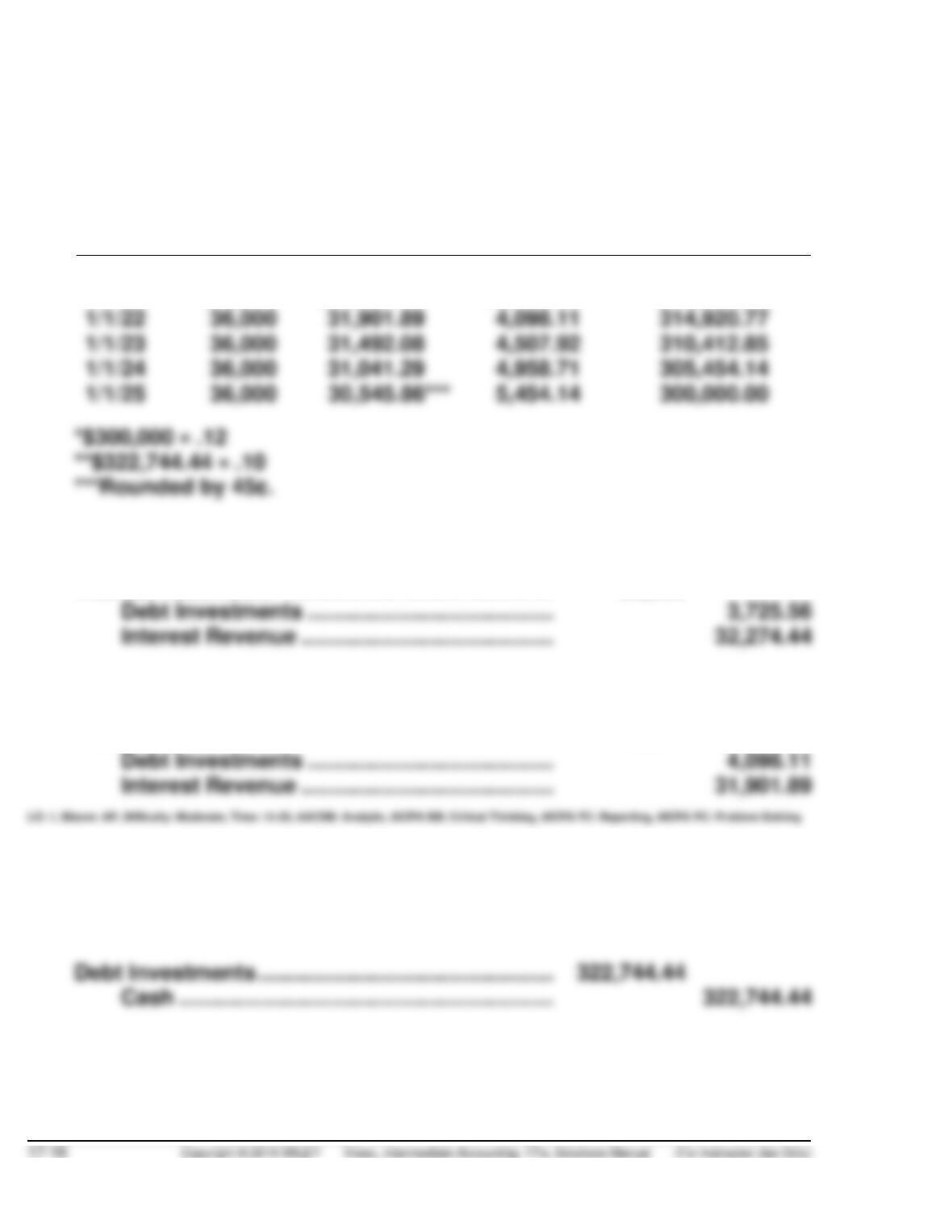
(a) January 1, 2020
EXERCISE 17.3 (Continued)
(b) Schedule of Interest Revenue and Bond Premium Amortization
Effective-Interest Method
12% Bonds Sold to Yield 10%
Date
Cash
Received
Interest
Revenue
Premium
Amortized
Carrying Amount
of Bonds
1/1/20
—
—
—
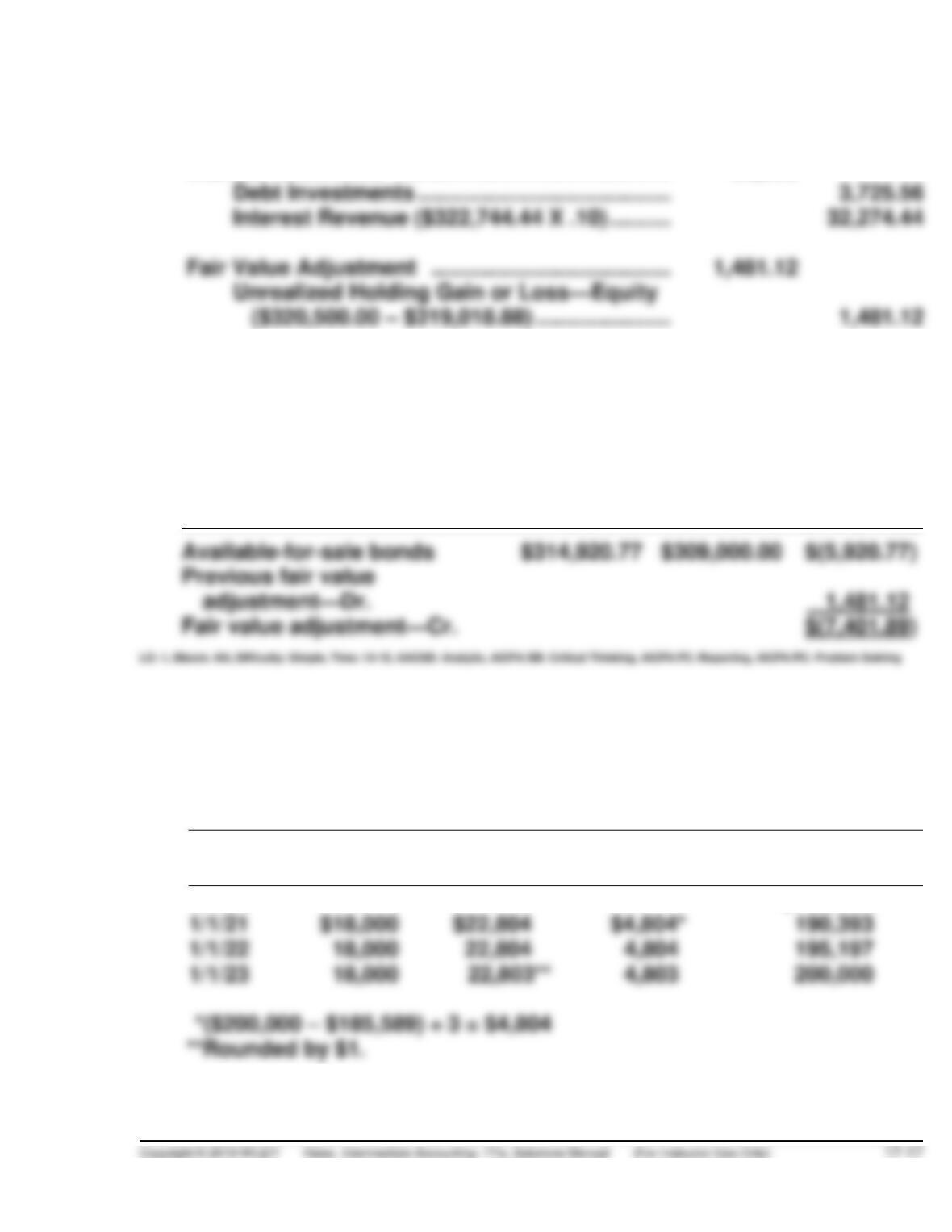
$322,744.44
1/1/21
$36,000*
$32,274.44**
$3,725.56
319,018.88
1/1/22
314,920.77
310,412.85
300,000.00
(c) December 31, 2020
Interest Receivable …………………………………….. 36,000
(d) December 31, 2021
Interest Receivable …………………………………….. 36,000
EXERCISE 17.4 (10–15 minutes)
(a) January 1, 2020
EXERCISE 17.4 (Continued)
(b) December 31, 2020
Interest Receivable ……………………………………… 36,000
(c) December 31, 2021
Unrealized Holding Gain or Loss—Equity ……… 7,401.89
Fair Value Adjustment ………………………….. 7,401.89
Amortized
Cost
Fair Value
Unrealized
Gain (Loss)
Previous fair value
EXERCISE 17.5 (20–30 minutes)
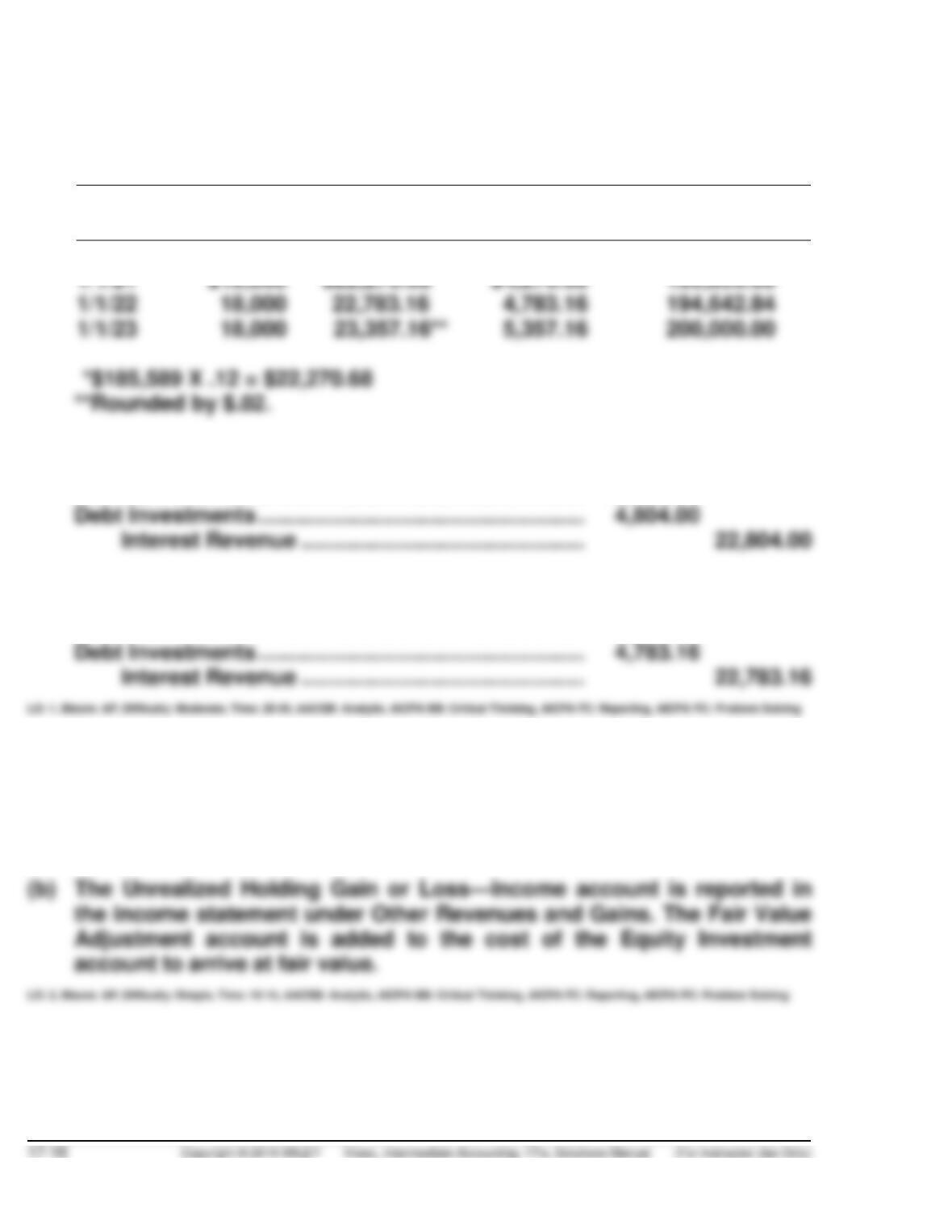
(a) Schedule of Interest Revenue and Bond Discount Amortization
Straight-line Method
9% Bond Purchased to Yield 12%
Date
Cash
Received
Interest
Revenue
Bond Discount
Amortization
Carrying Amount
of Bonds
1/1/20
—
—
—
$185,589
EXERCISE 17.5 (Continued)
(b) Schedule of Interest Revenue and Bond Discount Amortization
Effective-Interest Method
9% Bond Purchased to Yield 12%
Date
Cash
Received
Interest
Revenue
Bond Discount
Amortization
Carrying Amount
of Bonds
1/1/20
—
—
—
$185,589.00
1/1/22
18,000
18,000
(c) December 31, 2021
Interest Receivable ………………………………………….. 18,000.00
(d) December 31, 2021
Interest Receivable ………………………………………….. 18,000.00
EXERCISE 17.6 (10–15 minutes)
(a) Fair Value Adjustment ($70,000 − $65,000) ………… 5,000
Unrealized Holding Gain or Loss—Income …. 5,000
EXERCISE 17.7 (10–15 minutes)
(a) December 31, 2020
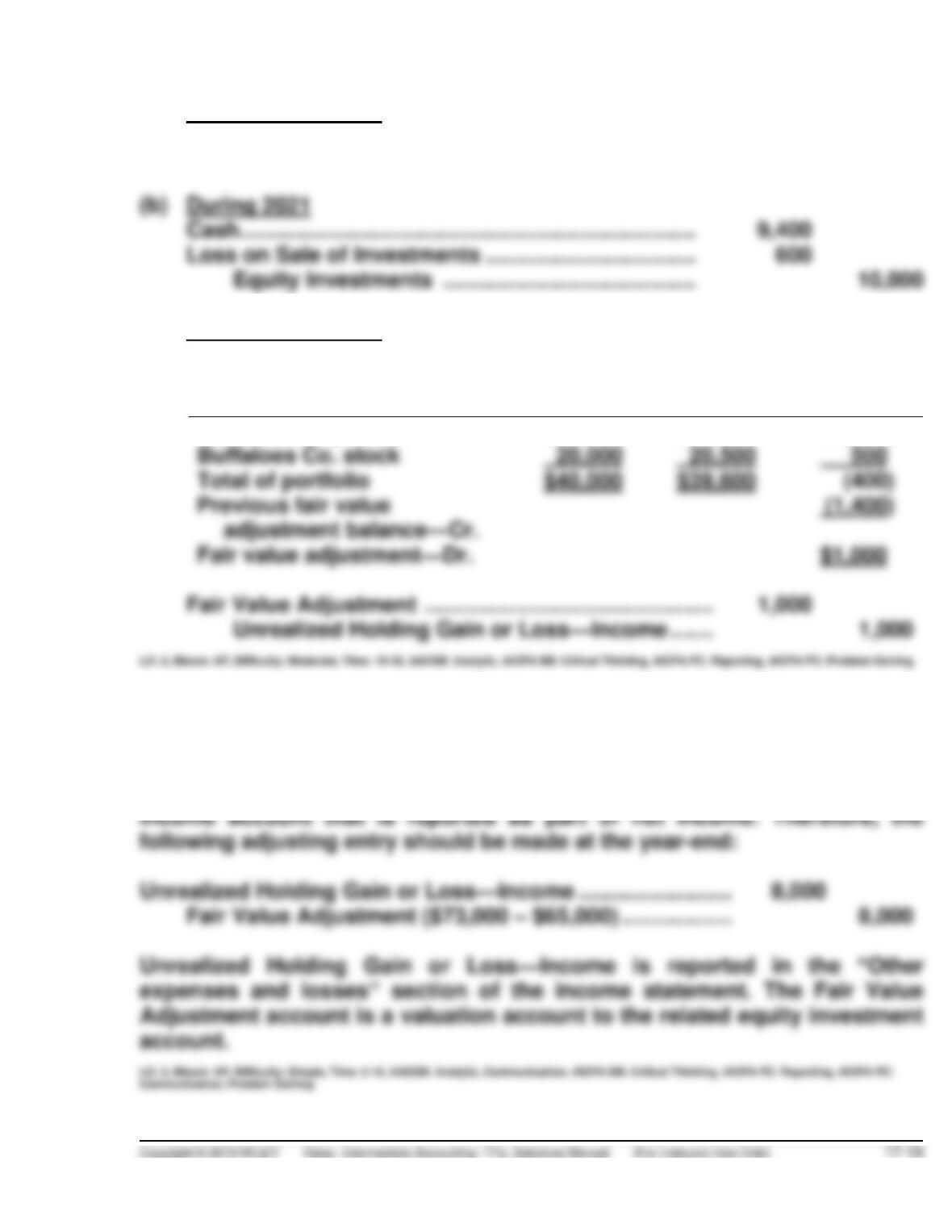
Unrealized Holding Gain or Loss—Income ………… 1,400
Fair Value Adjustment ……………………………… 1,400
(c) December 31, 2021
Securities
Cost
Fair Value
Unrealized
Gain (Loss)
Clemson Corp. stock
$20,000
$19,100
($ (900)
Buffaloes Co. stock
( 500)
Total of portfolio
$40,000
$39,600
( (400)
EXERCISE 17.8 (5–10 minutes)
The unrealized gains and losses resulting from changes in the fair value of
equity securities are recorded in an Unrealized Holding Gain or Loss-
EXERCISE 17.9 (10–15 minutes)
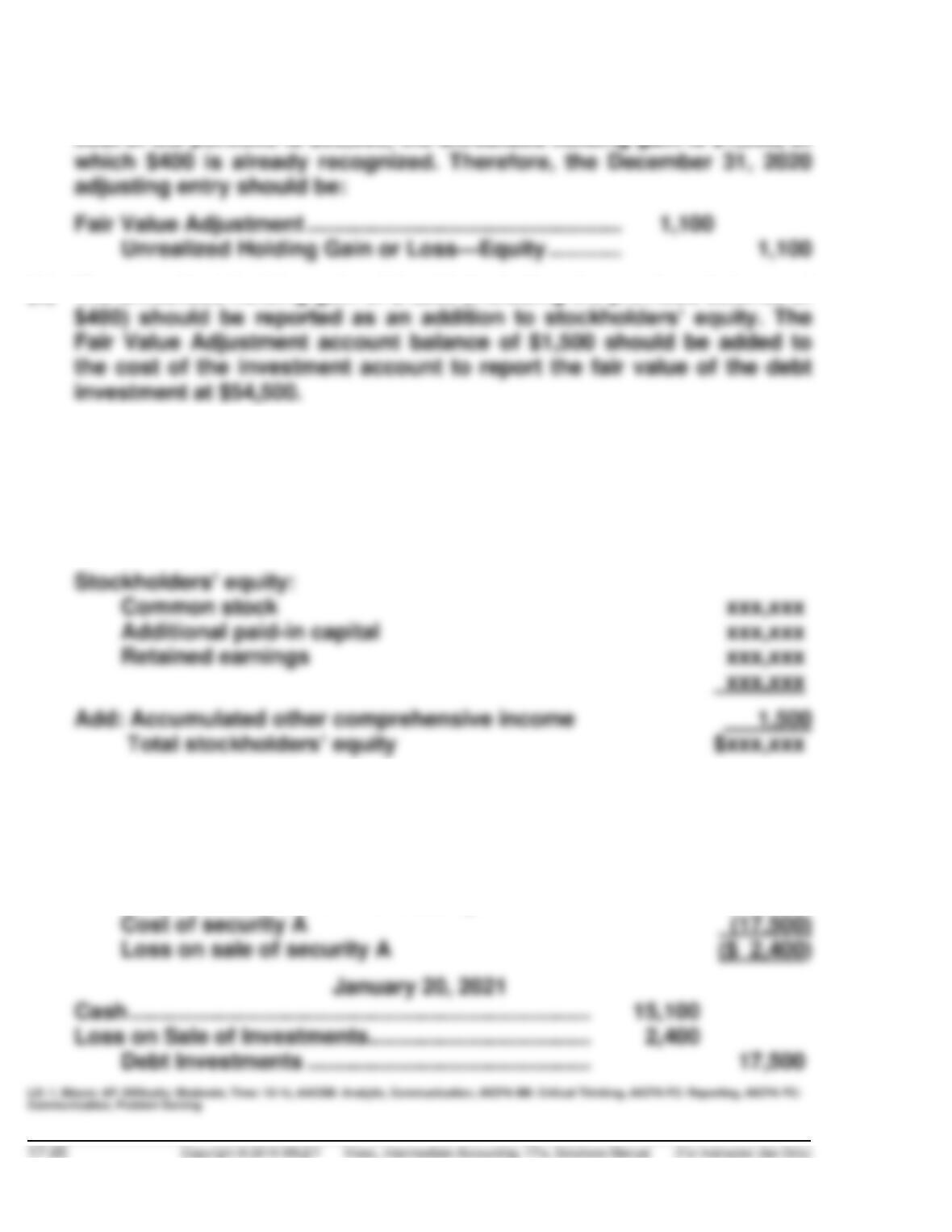
(a) The portfolio should be reported at the fair value of $54,500. Since the
cost of the portfolio is $53,000, the unrealized holding gain is $1,500, of
(b) The unrealized holding gain of $1,500 (including the previous balance of
STEFFI GRAF, INC.
Balance Sheet
As of December 31, 2020
____________________________________________________________
Current assets:
Debt investments $54,500*
*A portion of the debt investment could be reported as noncurrent,
depending on the expected date of collection. The unrealized holding gain
could also be disclosed.
(c) Computation of realized gain or loss on sale of debt security:
Net proceeds from sale of security A $15,100