Wild and Shaw, Financial & Managerial Accounting, 8e Solutions Manual: Chapter 17
Chapter 17
Activity-Based Costing and Analysis
QUESTIONS
1. Manufacturing overhead costs cannot be traced to units of product like direct
materials and direct labor. Assigning overhead costs to units of product requires
some sort of allocation on some “reasonable” basis.
2. Overhead is commonly assigned to products using (a) a plantwide overhead rate,
(b) departmental overhead rates, or (c) activity based costing.
3. Direct labor hours and machine hours are commonly used to assign overhead costs
because they are readily available. Companies keep track of direct labor hours for
payroll purposes anyway and machine hours can be measured easily. The ready
availability and understandability of these measures are reasons that many
companies use them as the basis for assigning overhead. Many overhead costs
such as indirect labor and supervision may be related to direct labor hours, and
others such as machine maintenance and electricity may be closely related to
machine hours. So, there is also logic for using these measures for assigning such
overhead costs.
8. Departmental overhead rates reflect the unique costs and drivers in various
departments, whereas these potentially important differences are lost when all the
costs are combined into a single plantwide overhead rate.
9. Departmental overhead rates are similar to plantwide overhead rates in the fact that
they pool together costs that may be incurred differently. Distorted cost
assignments can occur under both departmental and plant-wide methods. They are
different because the departmental rates recognize differences among departments
and assign overhead to products based on the driver that makes the most sense for
each department.
12. The first step in ABC is to identify the activities that cause costs to be incurred.
13. An activity cost driver is the measure of the activity that causes costs to be
incurred. For instance, the activity driver for the activity “printing checks” might be
number of checks printed.
14. Value-added activities are those that increase the value of a product or service.
15. Unit level activities: Activities that must be performed for each unit of product.
16. Activity-based costing may be used in any type of organization. The premise of
17. While ABC may provide more accurate cost assignments, the additional cost to
implement activity-based costing may not be justified. That is, the value of the
improved accuracy may not result in higher profitability. Like any business
decision, the choice of accounting method depends on weighing the costs against
the benefits.
QUICK STUDIES
Quick Study 17-1 (5 minutes)
1. A, C, D 2. B 3. A, B
Quick Study 17-2 (10 minutes)
Quick Study 17-3 (10 minutes)
1. D 2. A 3. C 4. B
Quick Study 17-4 (5 minutes)
Quick Study 17-5 (5 minutes)
Quick Study 17-6 (5 minutes)
1. A 2. A 3. D 4. D 5. A
Quick Study 17-7 (5 minutes)
1. D 2. A 3. D
Quick Study 17-8 (10 minutes)
1. P 2. P 3. A 4. I 5. I 6. A 7. I 8. E
Quick Study 17-9 (5 minutes)
Quick Study 17-10 (5 minutes)
2. Plant-wide overhead rate (based on machine hours)
($1,200,000 + $600,000)/(6,000 MH + 16,000 MH) = $81.82/MH (rounded)
Quick Study 17-11 (5 minutes)
Quick Study 17-12 (5 minutes)
Departmental overhead rate
Finishing: $600,000/16,000 MH = $37.50/MH
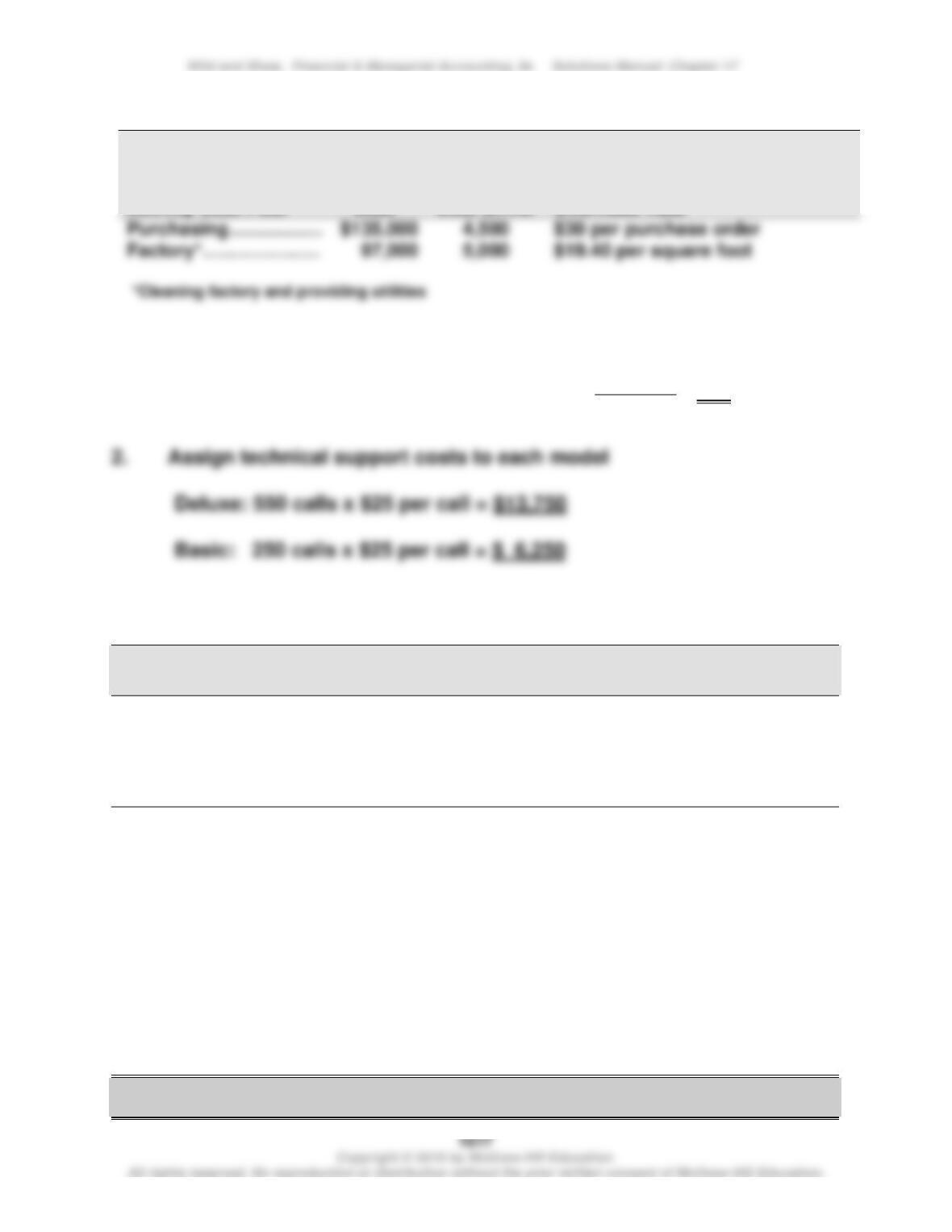
Quick Study 17-13 (10 minutes)
$19.40 per square foot
Expected
Expected
Amount of
Activity
Quick Study 17-14 (10 minutes)
1. Cost of technical support per service call =
10,000
$250,000
= $25
Quick Study 17-15 (10 minutes)
Expected Activity Activity
Activity Cost Driver* Rate
1 $ 140,000 35,000 $ 4.00
2 90,000 30,000 3.00
3 82,000 5,125 16.00
*Computed as the sum of the budgeted cost driver activity of all three products.
Quick Study 17-16 (10 minutes)
1. $825,000/3,300 = $250 hazardous waste disposal cost per ton
2. $250 cost per ton x 5 tons = $1,250 hazardous waste disposal cost
assigned to completed Job 125
EXERCISES
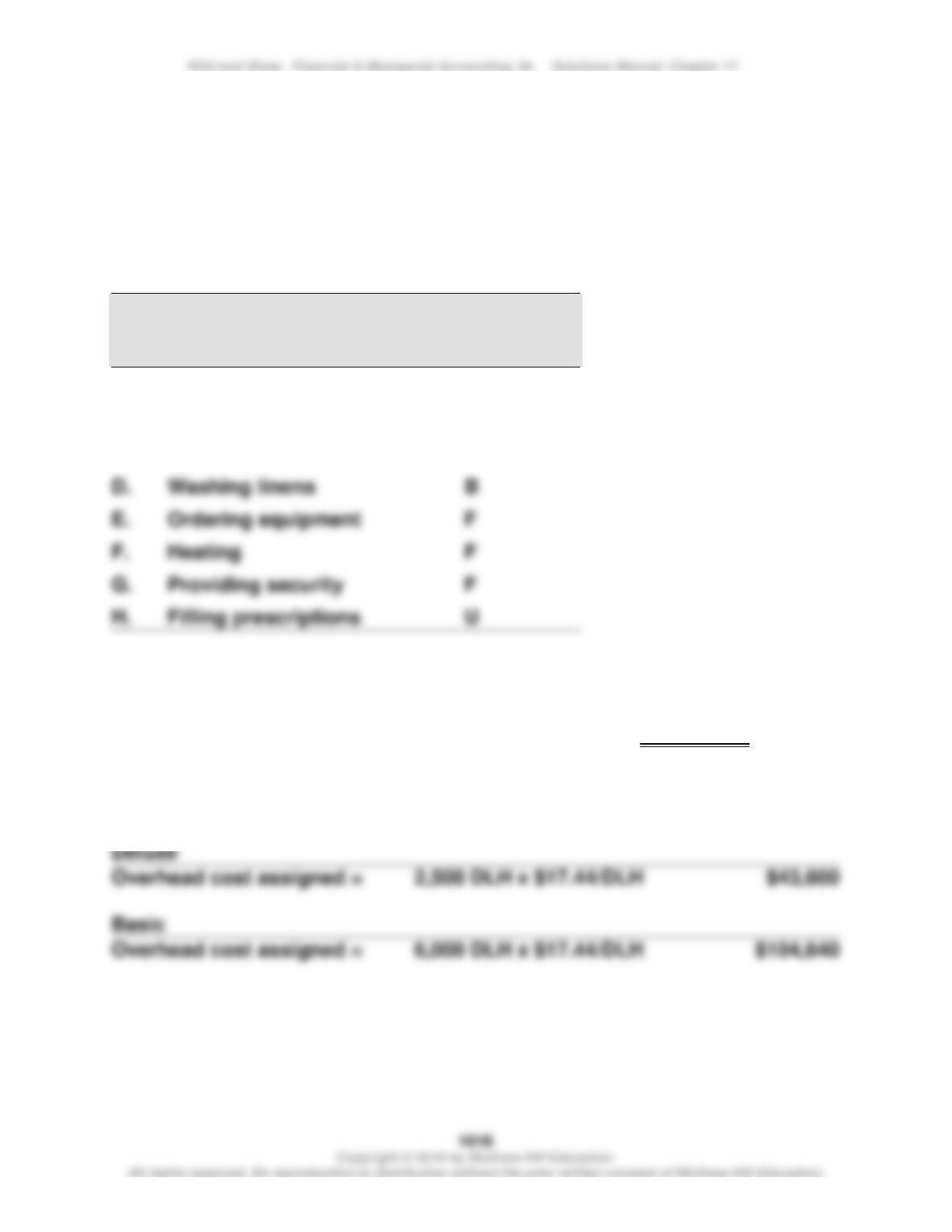
Exercise 17-1 (10 minutes)
1. F 2. U 3. P 4. F 5. U 6. B 7. B 8. B 9. F
Exercise 17-2 (10 minutes)
Control
Activity Level
A. Registering patients U
B. Cleaning beds U
C. Stocking exam rooms F
Exercise 17-3 (10 minutes)
1. Plantwide overhead rate: $2,180,000/125,000 DLH = $17.44/DLH
2. Assign overhead costs to deluxe and basic models
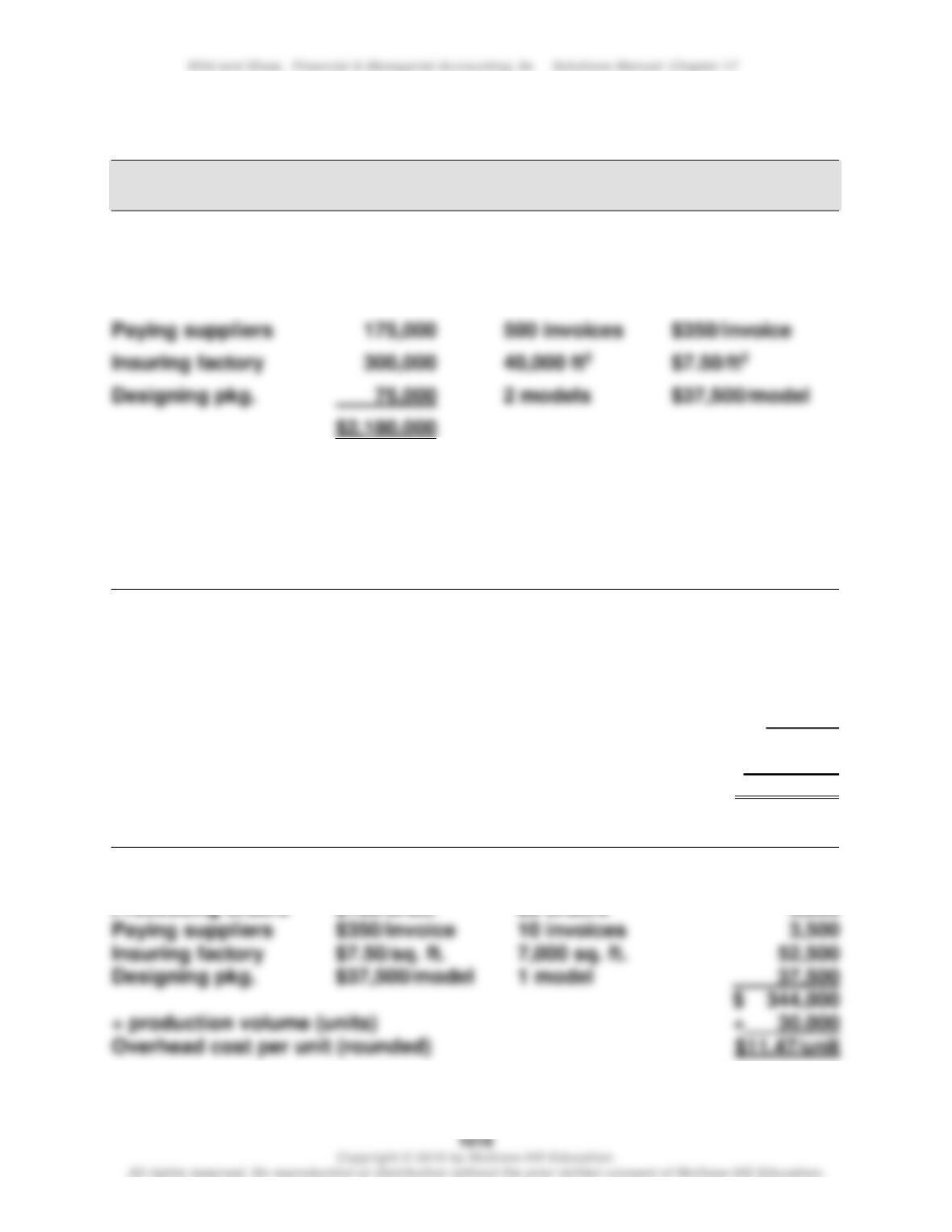
Exercise 17-4 (15 minutes)
Compute overhead allocation rates for each activity
Expected Activity Activity
Activity Cost Driver Rate
Handling material $ 625,000 100,000 parts $6.25/part
Inspecting product 900,000 1,500 batches $600/batch
Processing orders 105,000 700 orders $150/order
Exercise 17-5 (15 minutes)
Note: Activity rates are taken from Exercise 17-4.
Assign overhead costs to deluxe and basic models using ABC
Deluxe
Handling material $6.25/part 20,000 parts $ 125,000
Inspecting product $600/batch 250 batches 150,000
Processing orders $150/order 50 orders 7,500
Paying suppliers $350/invoice 50 invoices 17,500
Insuring factory $7.50/sq. ft. 10,000 sq. ft. 75,000
Designing pkg. $37,500/model 1 model 37,500
$ 412,500
÷ production volume (units) ÷ 10,000
Overhead cost per unit $41.25/unit
Basic
Handling material $6.25/part 30,000 parts $ 187,500
Inspecting product $600/batch 100 batches 60,000
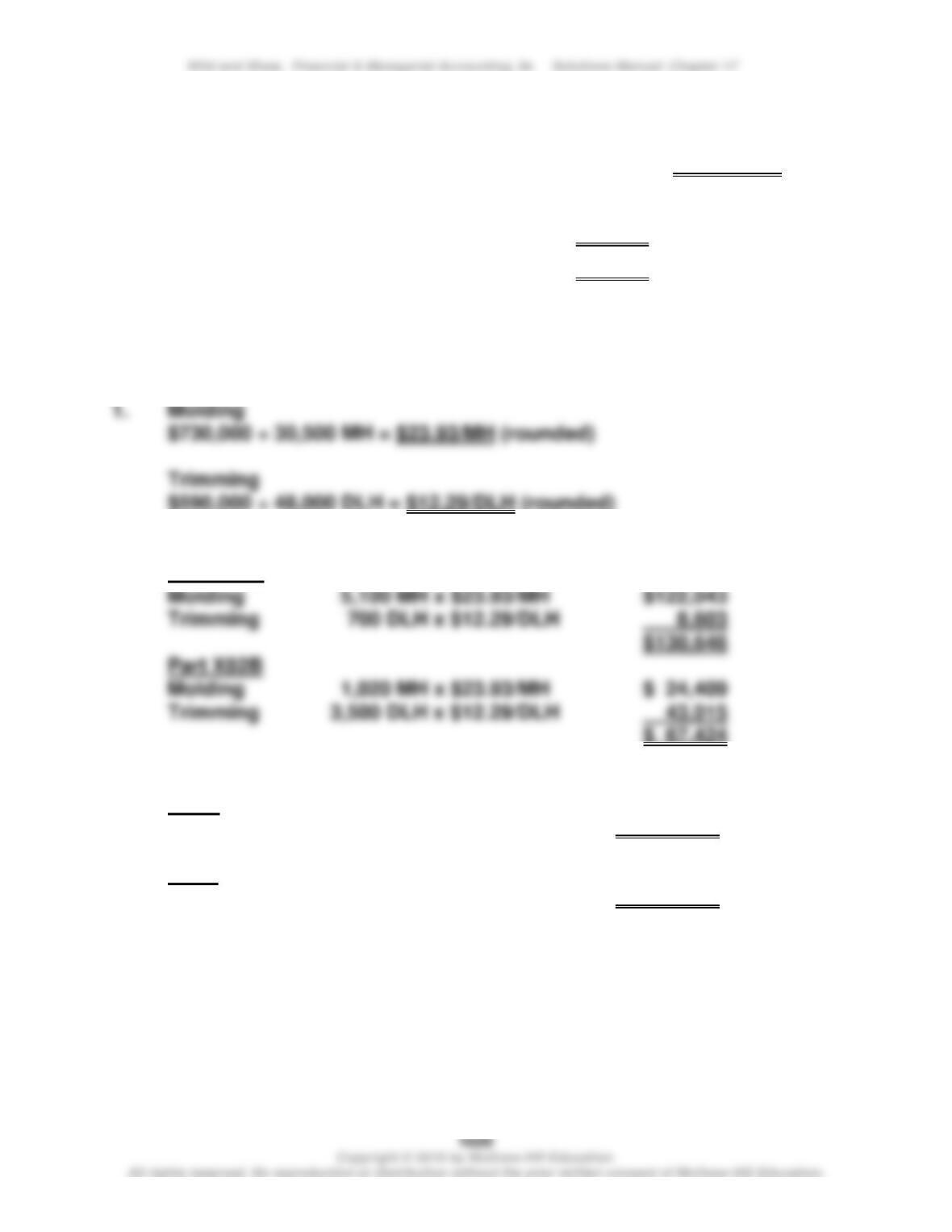
Exercise 17-6 (10 minutes)
1. ($730,000 + $590,000) / (52,000 DLH + 48,000 DLH) = $13.20/DLH
2.
Part A27C
6,200 DLH x $13.20/DLH =
$81,840
Part X82B
5,650 DLH x $13.20/DLH =
$74,580
Exercise 17-7 (15 minutes)
2. Part A27C
3. A27C
Departmental $130,646 ÷ 9,800 units $13.33/unit*
X82B
Departmental $67,424 ÷ 54,500 units $ 1.24/unit*
*rounded
Exercise 17-8 (25 minutes)
1. $1,004,000 + $465,300 + $232,000 = $283.55/machine hour
6,000 machine hours
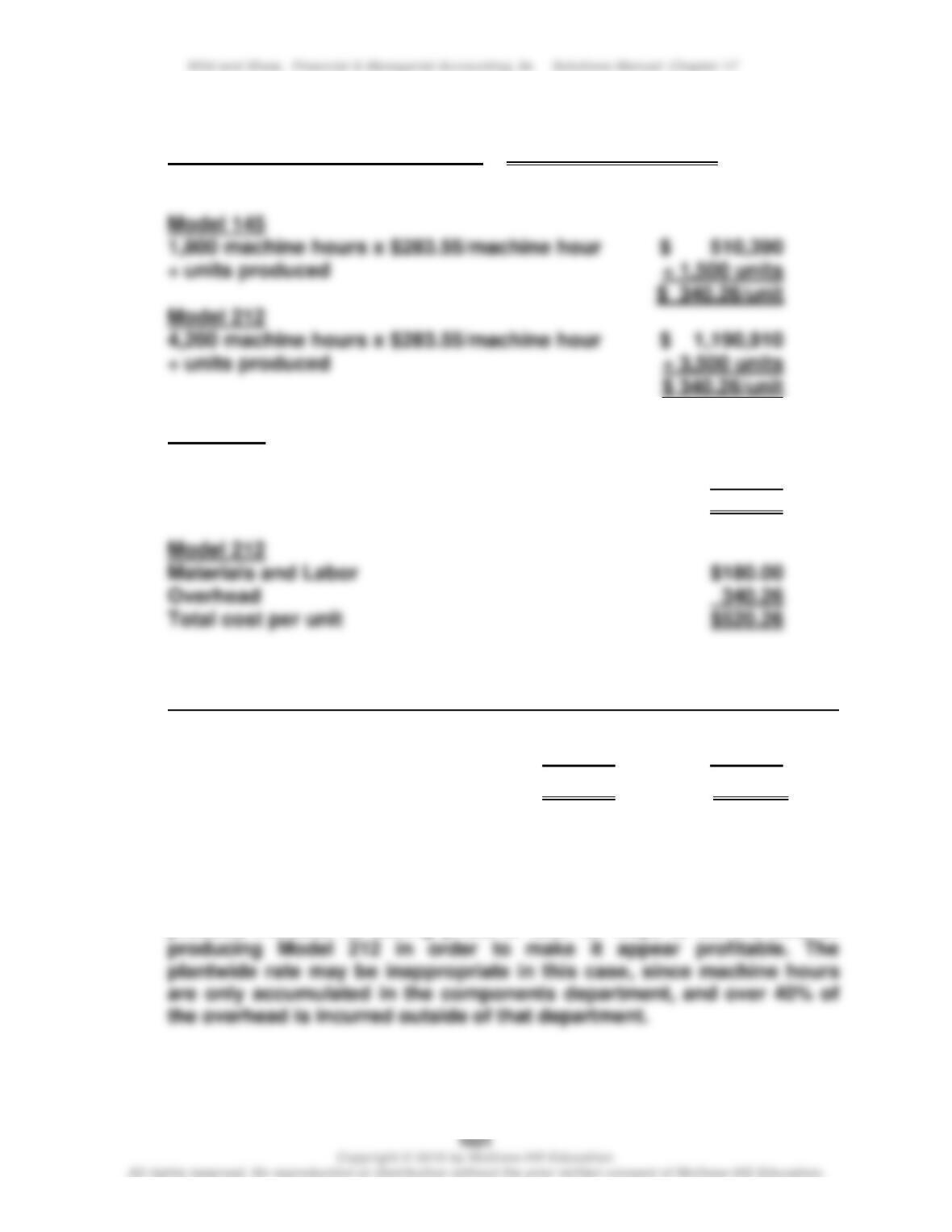
2. Model 145
Materials and labor $250.00
Overhead 340.26
Total cost per unit $590.26
3. Model 145 Model 212
Price per unit $820.00 $480.00
Cost per unit 590.26 520.26
Profit (loss) per unit $229.74 $(40.26)
Using a single plantwide overhead rate, Model 212 appears to be
unprofitable. Management may be inclined to stop producing this
product, increase its selling price, or look for ways to cut the cost of
Exercise 17-9 (25 minutes)
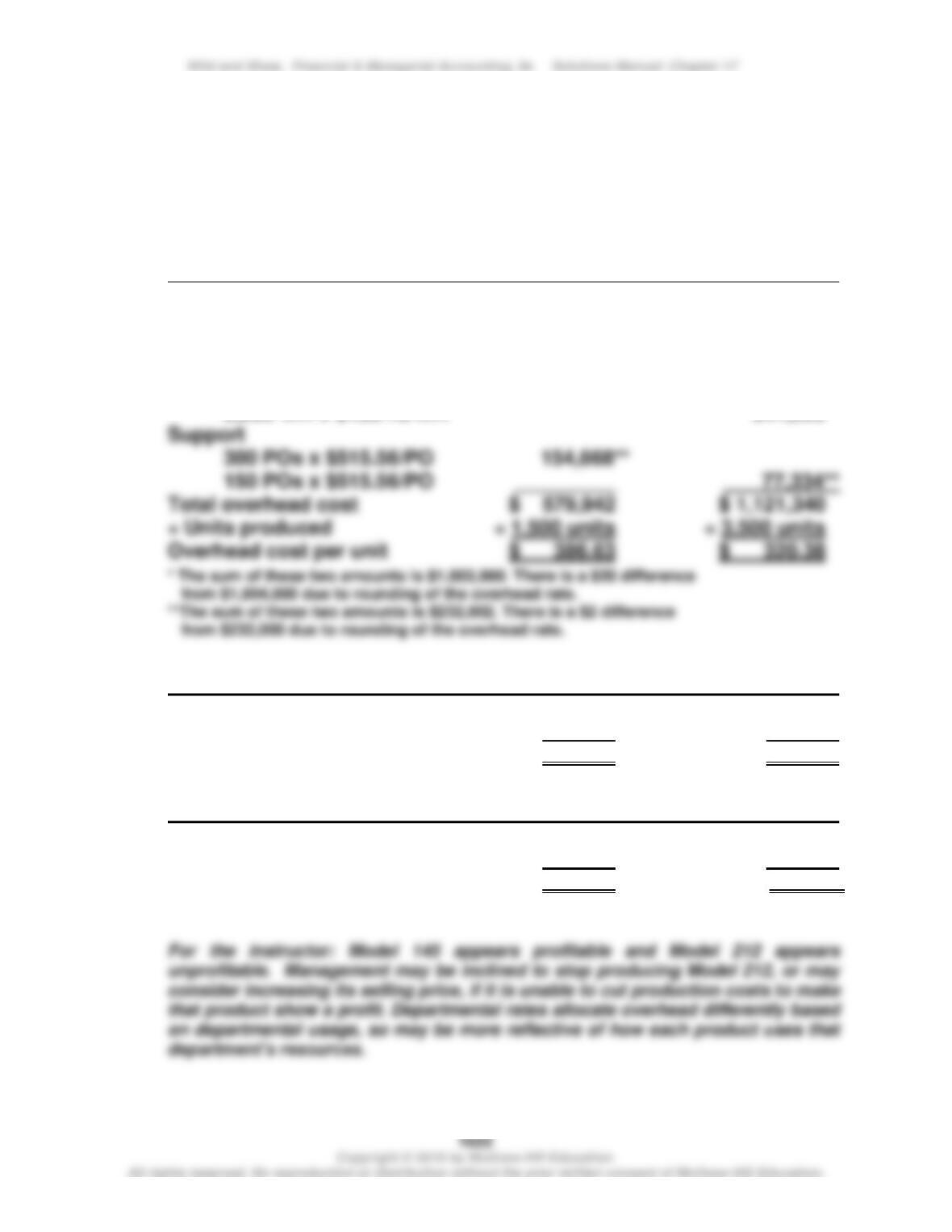
1. Components $1,004,000/6,000 MH $167.33/machine hour*
Finishing $465,300/3,000 WH $155.10/welding hour
Support $232,000/450 PO $515.56/purchase order*
*rounded
Model 145 Model 212
Components
1,800 MH x $167.33/MH $ 301,194*
4,200 MH x $167.33/MH $ 702,786*
Finishing
800 WH x $155.10/WH 124,080
2. Model 145 Model 212
Materials & labor per unit $250.00 $180.00
Overhead cost per unit 386.63 320.38
Total cost per unit $636.63 $500.38
3. Model 145 Model 212
Price per unit $820.00 $480.00
Cost per unit 636.63 500.38
Profit (loss) per unit $183.37 $(20.38)
Exercise 17-10 (25 minutes)
1. ($300,000 + $200,000) / (75,000 + 125,000) DLH = $2.50/DLH
2.
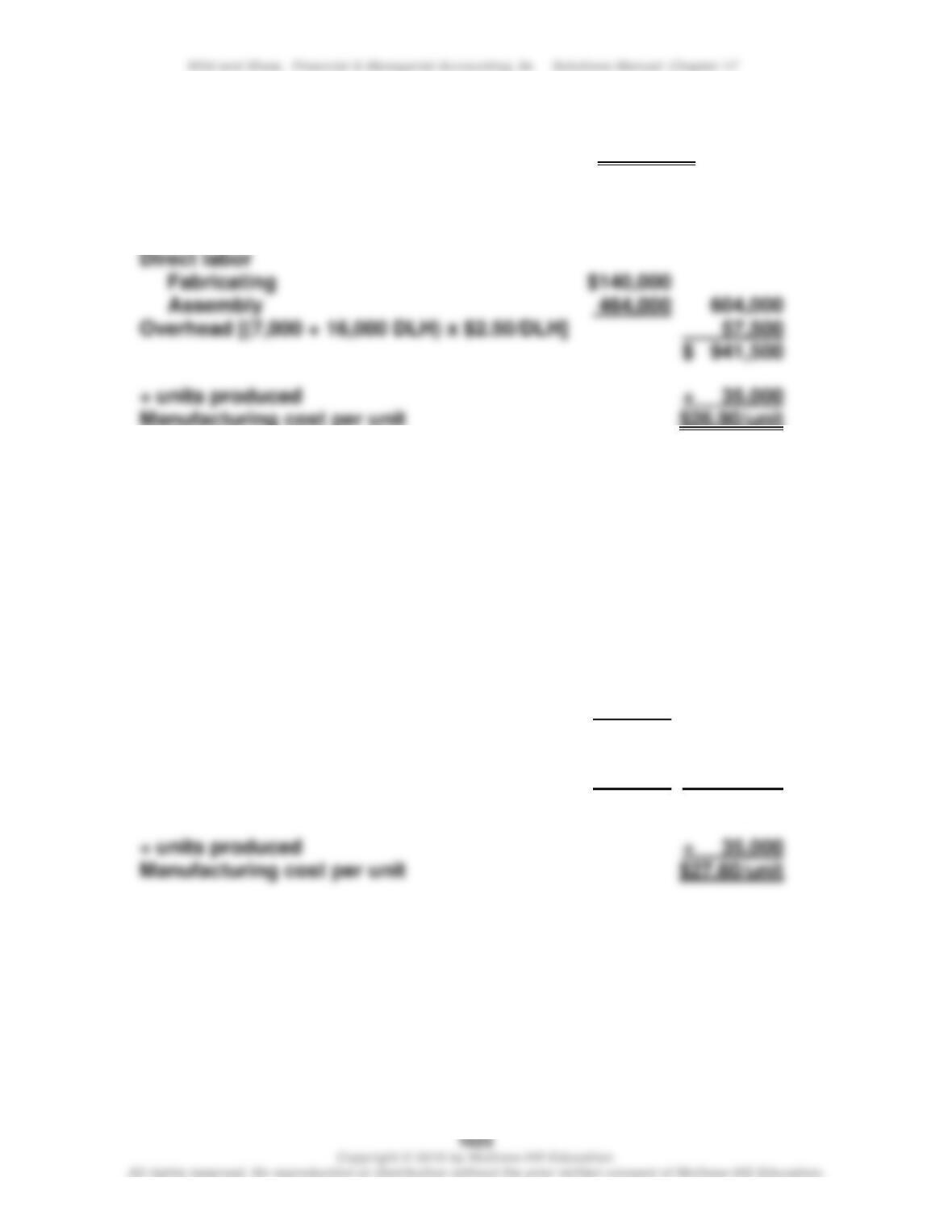
Direct materials $ 280,000
3.
Fabricating $300,000 / 80,000 MH = $3.75/MH
Assembly $200,000 / 125,000 DLH = $1.60/DLH
4.
Direct materials $ 280,000
Direct labor
Fabricating $140,000
Assembly 464,000 604,000
Overhead
Fabricating (15,040 MH x $3.75/MH) 56,400
Assembly (16,000 DLH x $1.60/DLH) 25,600 82,000
$ 966,000
Exercise 17-11 (35 minutes)
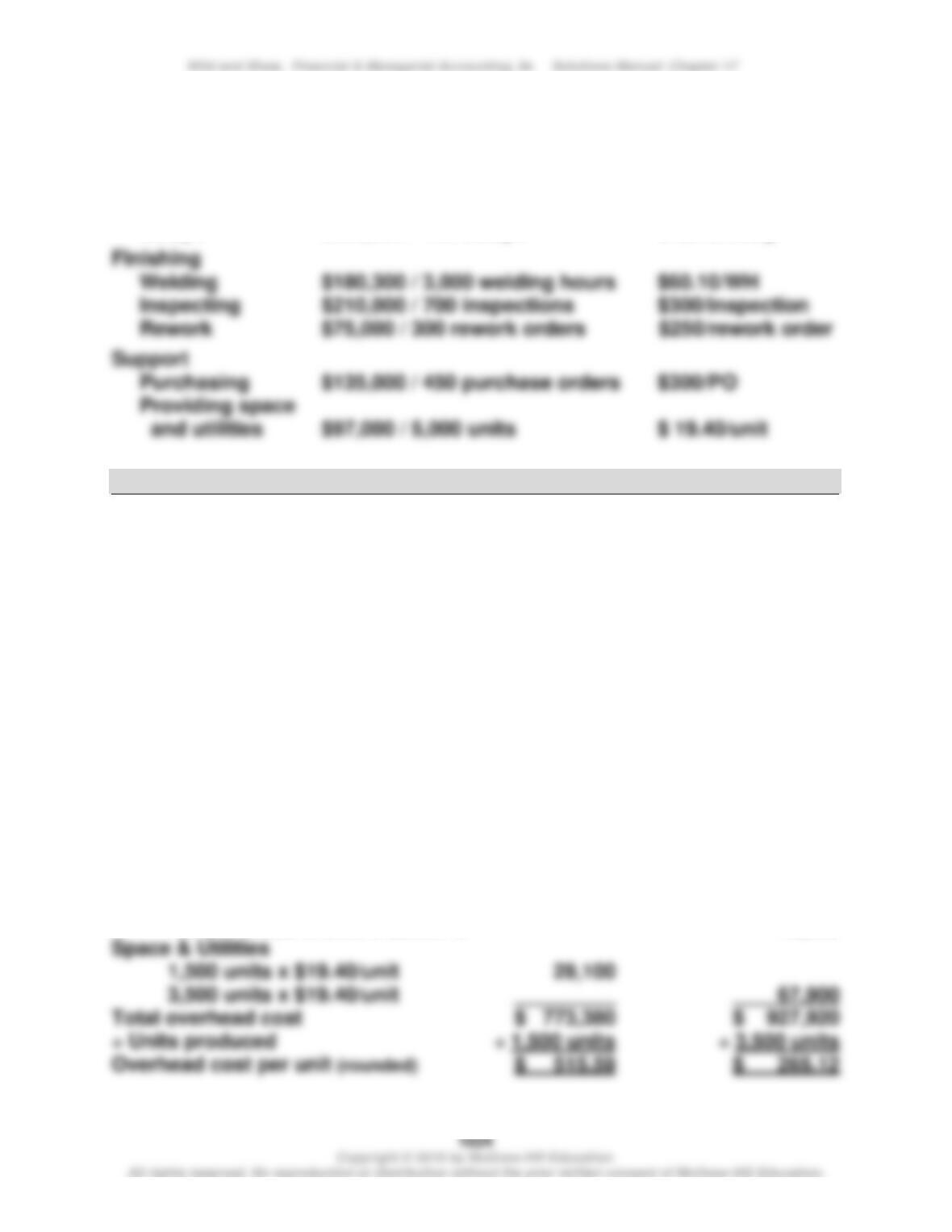
1. Compute overhead allocation rates for each activity
Components
Changeover $500,000 / 800 batches $625/batch
Machining $279,000 / 6,000 machine hours $46.50/MH
Setups $225,000 / 120 setups $1,875/setup
Assign overhead costs to products Model 145 Model 212
Changeover
400 batches x $625/batch $ 250,000 $ 250,000
Machining
1,800 MH x $46.50/MH 83,700
4,200 MH x $46.50/MH 195,300
Setups
60 setups x $1,875/setup 112,500 112,500
Welding
800 WH x $60.10/WH 48,080
2,200 WH x $60.10/WH 132,220
Inspecting
400 inspections x $300/inspection 120,000
300 inspections x $300/inspection 90,000
Rework
160 rework orders x $250/rework order 40,000
140 rework orders x $250/rework order 35,000
Purchasing
300 purchase orders x $300/PO 90,000
150 purchase orders x $300/PO 45,000
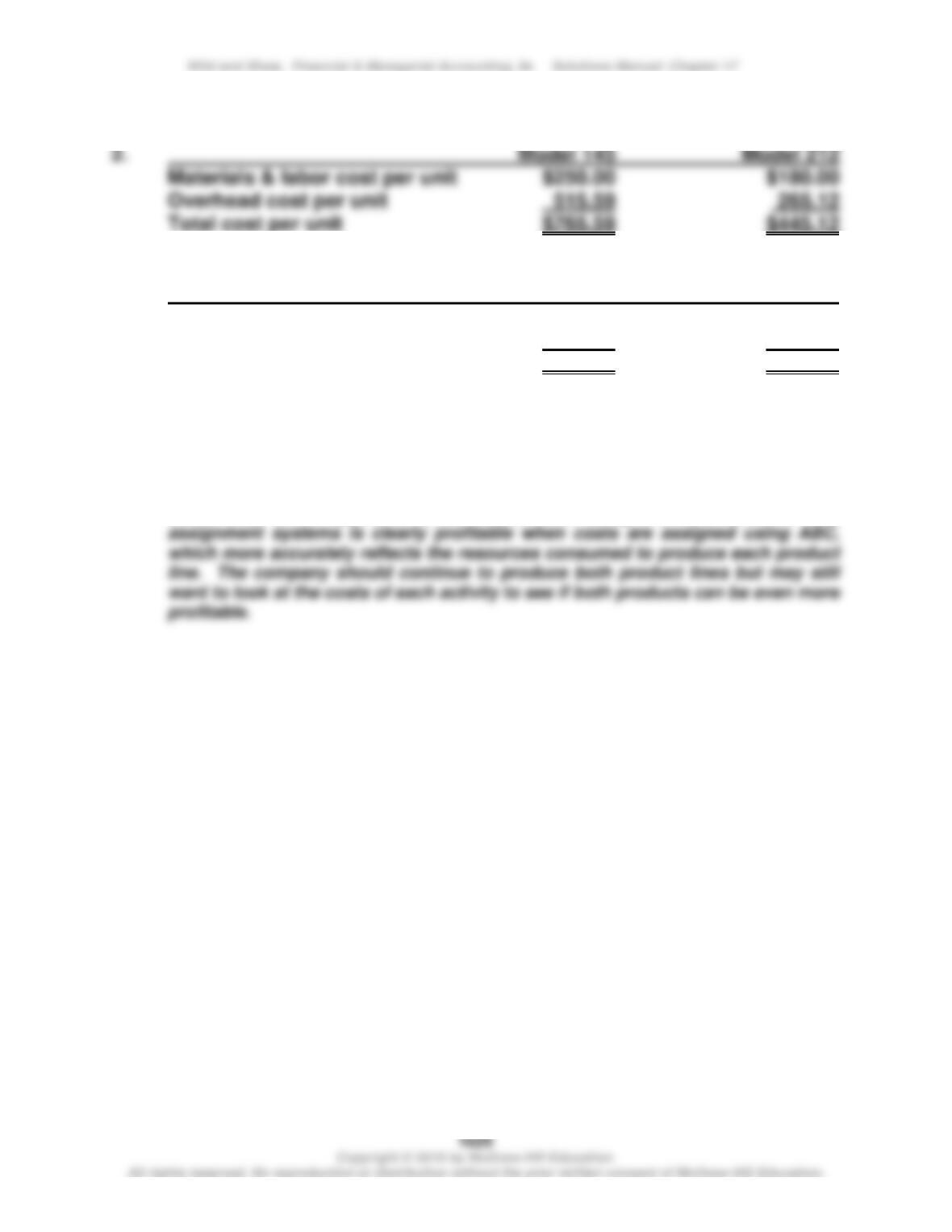
Exercise 17-11 (concluded)
3. Model 145 Model 212
Price per unit $820.00 $480.00
Total cost per unit 765.59 445.12
Profit (loss) per unit $ 54.41 $ 34.88
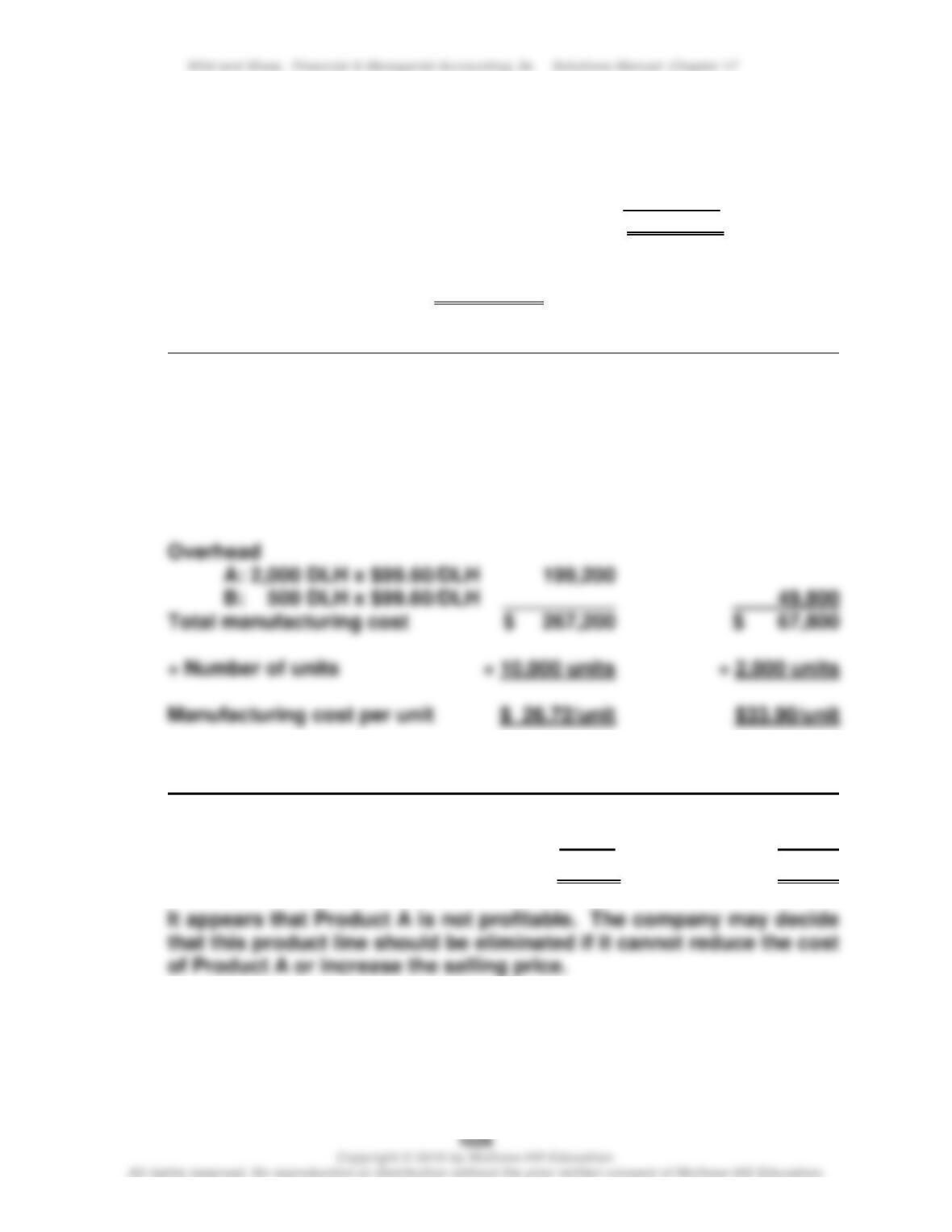
For the instructor: Both product lines appear profitable. Using ABC we see that
Model 145 is not generating nearly as much profit as it appeared to generate using
the volume-based systems in Exercise 17-8 and Exercise 17-9. Furthermore,
Model 212, which appeared to be unprofitable using the volume-based cost
Exercise 17-12 (35 minutes)
1. Total direct labor hours:
Product A: 10,000 units x 0.20 DLH/unit = 2,000 DLH
Product B: 2,000 units x 0.25 DLH/unit = 500 DLH
Total direct labor hours 2,500 DLH
Plant-wide overhead rate:
$249,000/2,500 DLH = $99.60/DLH
Product A Product B
Direct materials
A: 10,000 units x $2/unit $ 20,000
B: 2,000 units x $3/unit $ 6,000
Direct labor
A: 2,000 DLH x $24/DLH 48,000
B: 500 DLH x $24/DLH 12,000
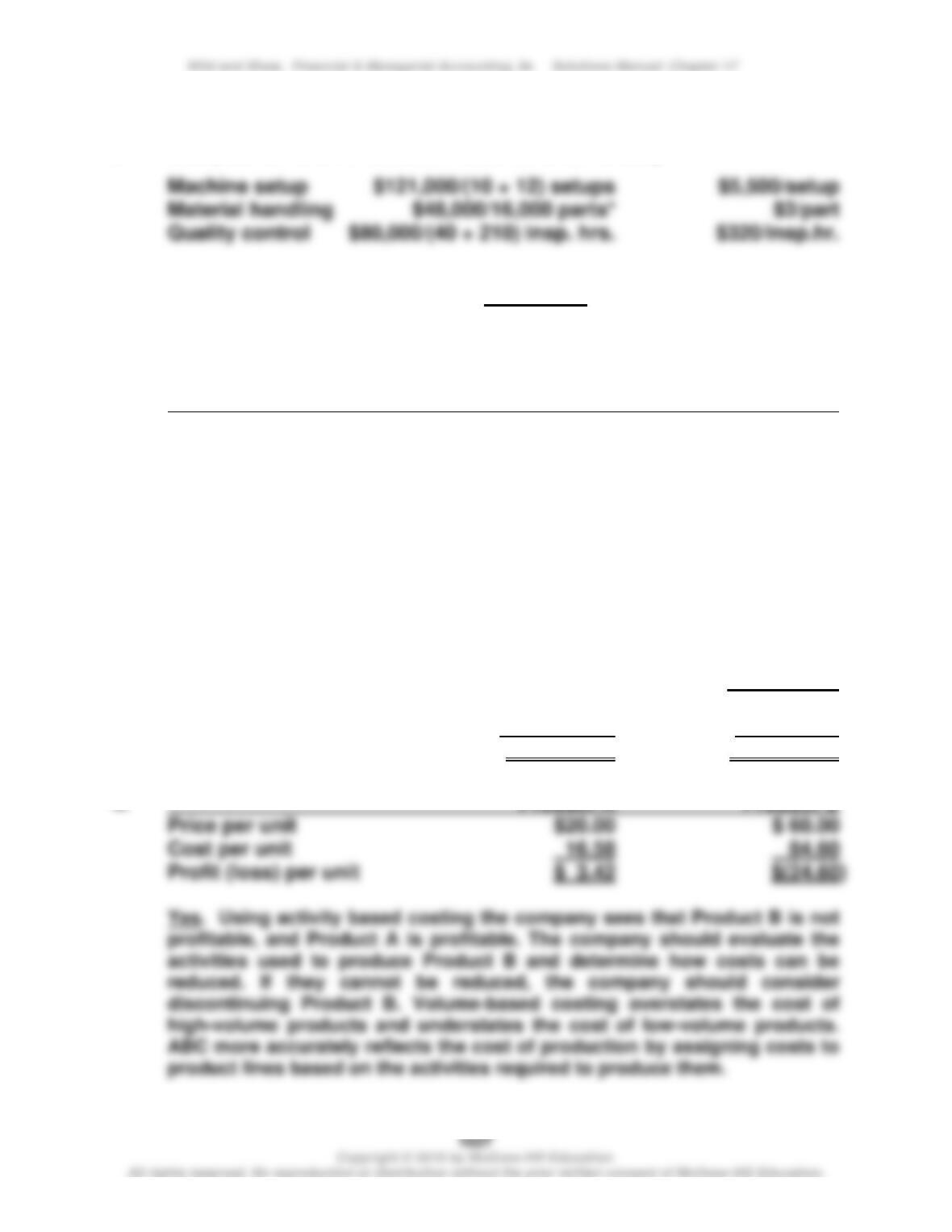
2. Product A Product B
Price per unit $20.00 $60.00
Cost per unit 26.72 33.90
Profit (loss) per unit $(6.72) $26.10
Exercise 17-12 (concluded)
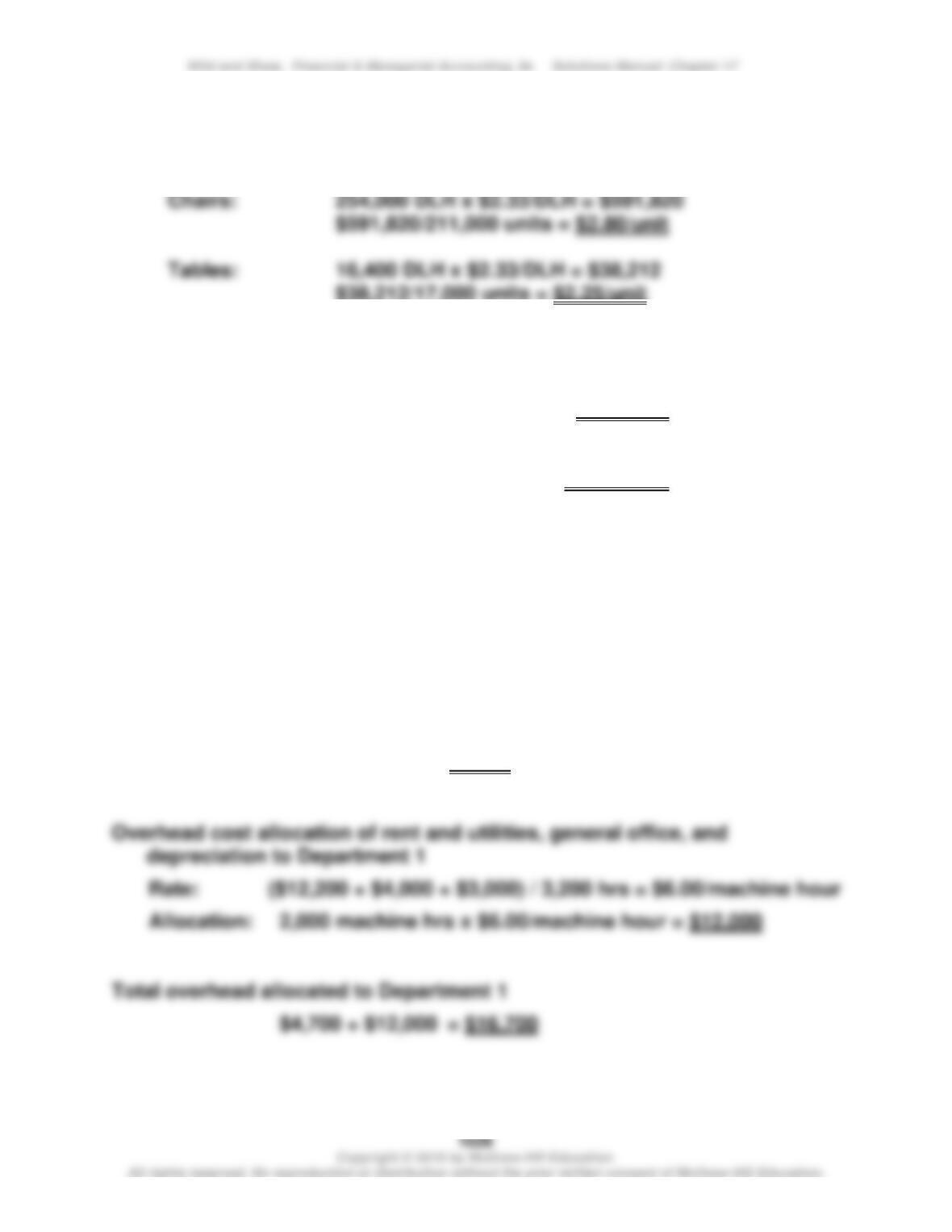
3. Compute overhead allocation rates for each activity
*Product A: 1 part/unit x 10,000 units = 10,000 parts
Product B: 3 parts/unit x 2,000 units = 6,000 parts
16,000 parts
Assign overhead (and direct materials and direct labor) costs to products
Product A Product B
Direct materials (from part 1) $ 20,000 $ 6,000
Direct labor (from part 1) 48,000 12,000
Overhead
Machine setup
A: 10 setups x $5,500/setup 55,000
B: 12 setups x $5,500/setup 66,000
Material handling
A: 10,000 parts x $3/part 30,000
B: 6,000 parts x $3/part 18,000
Quality control
A: 40 insp. hr. x $320/insp. hr. 12,800
B: 210 insp. hr. x $320/insp. hr._________ 67,200
Total manufacturing cost $ 165,800 $ 169,200
÷ Number of units ÷ 10,000 units ÷ 2,000 units
Manufacturing cost per unit $ 16.58/unit $ 84.60/unit
Exercise 17-13 (15 minutes)
1. Overhead rate: $630,000/270,400 DLH = $2.33/DLH
2. Overhead rate: $630,000/1,000 pounds = $630/pounds
Chairs: $630/setup x 200 pounds = $126,000
$126,000/211,000 units = $0.60/unit
Tables: $630/setup x 800 pounds = $504,000
$504,000/17,000 units = $29.65/unit
For the instructor: Assigning the hazardous waste disposal costs based on the activity
that drives these costs will give a more accurate cost assignment. This is true because
hazardous waste disposal cost is a batch-level cost and not a unit-level cost (as would
be implied if direct labor hours was used as the base).
Exercise 17-14 (15 minutes)
Overhead cost allocation of indirect labor and supplies to Department 1
Rate: ($5,400 + $2,600) / $32,000 = $0.25 / $ of labor cost
Allocation: $18,800 x $0.25 = $4,700
Exercise 17-15 (15 minutes)
1. Compute overhead allocation rates for each activity
Expected Activity Activity
Activity Cost Driver Rate
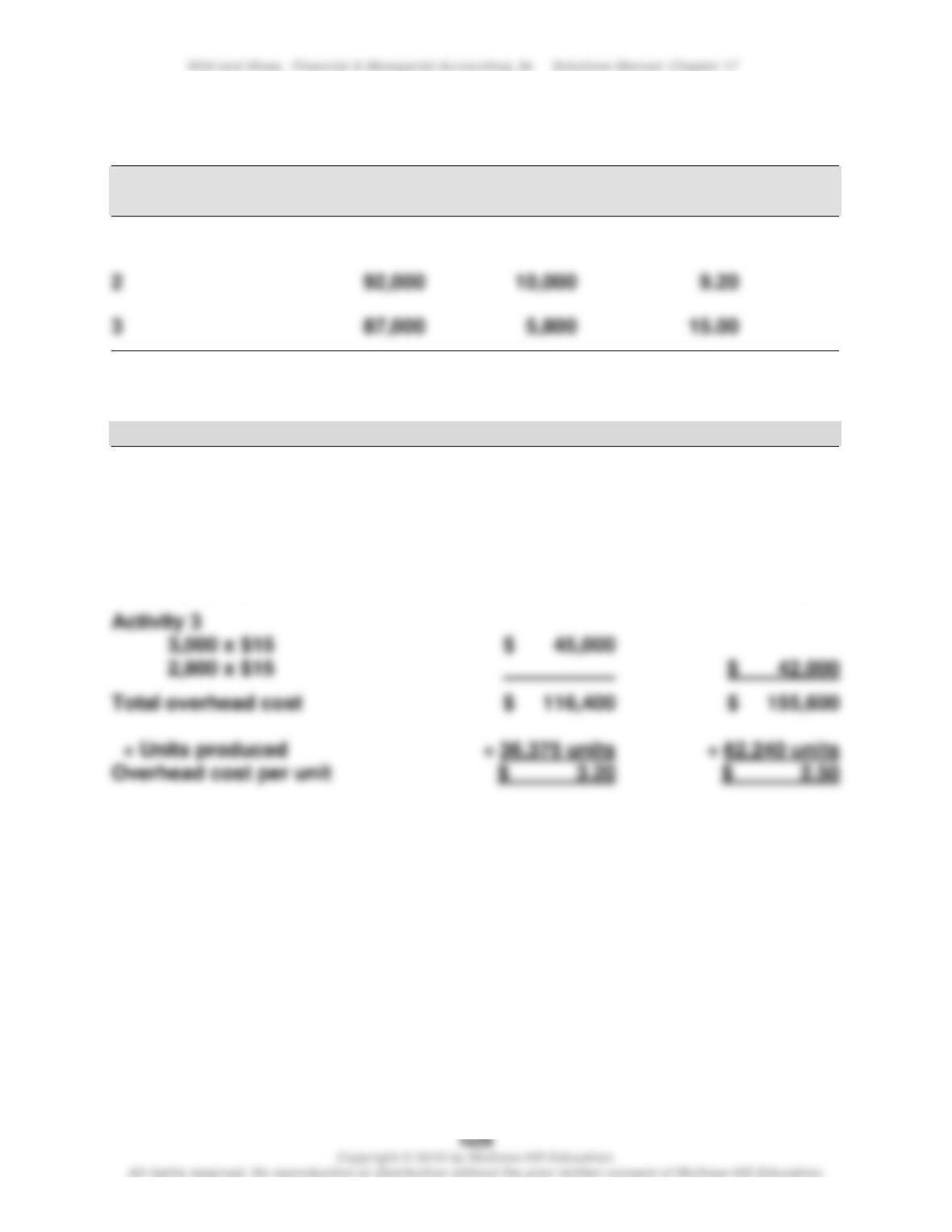
1 $ 93,000 7,750 $ 12.00
2. and 3. Assign overhead costs to products
Standard Deluxe
Activity 1
2,500 x $12 30,000
5,250 x $12 63,000
Activity 2
4,500 x $9.20 41,400
5,500 x $9.20 50,600
Exercise 17-16 (20 minutes)
1. Compute overhead allocation rates for each activity
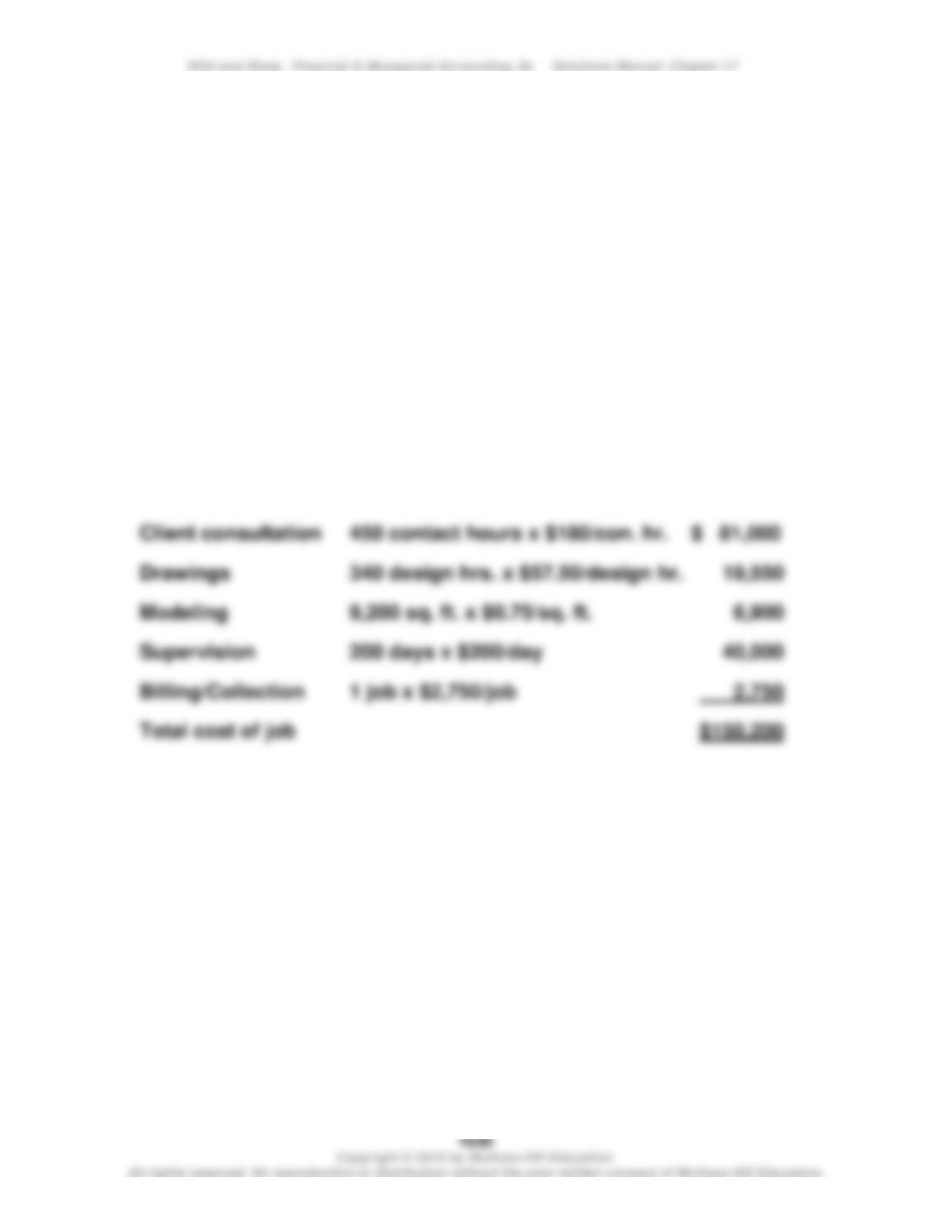
Client consultation $270,000/1,500 contact hours $180/con.hr.
Drawings $115,000/2,000 design hours $57.50/design hr.
Modeling $30,000/40,000 sq. ft. $0.75/sq. ft.
Supervision $120,000/600 days $200/day
Billing/Collection $22,000/8 jobs $2,750/job
2. Assign overhead costs to architectural job
Exercise 17-17 (30 minutes)
Compute overhead allocation rates for each activity
Overhead Cost
Category (Activity
Cost Pool)
Total
Cost
Total
Amount of
Cost Driver
Predetermined Overhead Rate
Supervision ………………….
$ 5,400
$36,000
15%
of direct labor cost
Depreciation…………………
56,600
2,000 MH
$28.30
per machine hour
Line preparation …………..
46,000
250 setups
$184.00
per setup
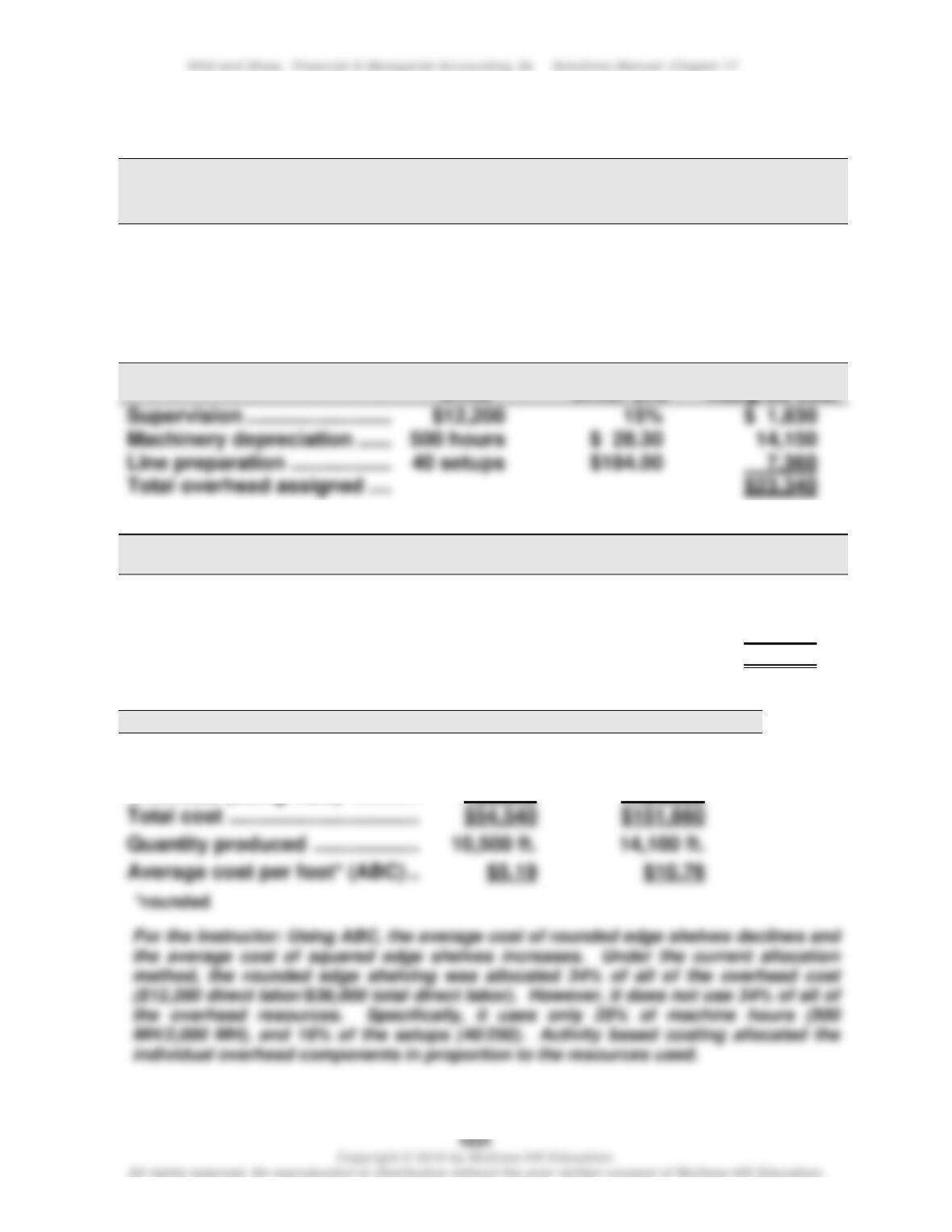
1. Assign overhead costs to the two products using ABC
Rounded edge
Cost
Driver Unit
Assigned Cost
Supervision ……………………….
$ 1,830
Machinery depreciation ……..
$ 28.30
14,150
Line preparation ………………..
$184.00
7,360
Total overhead assigned ……
$23,340
Cost per
Squared edge
Cost
Driver
Cost per
Driver Unit
Assigned Cost
Supervision ……………………….
$23,800
15%
$ 3,570
Machinery depreciation ……..
1,500 hours
$ 28.30
42,450
Line preparation ………………..
210 setups
$184.00
38,640
Total overhead assigned ……
$84,660
2. Average cost per foot of the two products
Rounded edge
Squared edge
Direct materials ………………………
$19,000
$ 43,200
Direct labor …………………………..
12,200
23,800
Overhead (using ABC) ……………
23,340
84,660
Total cost ……………………………….
$54,540
$151,660
Average cost per foot* (ABC) …..
$10.76
Exercise 17-18 (40 minutes)
Part 1
Compute the overhead allocation rates for each activity
Activity Cost Pool
Cost
Activity
Allocation Rate
Professional salaries …………………..
$1,600,000
10,000 hours
$160 per hour
Patient services & supplies …………
$ 27,000
600 patients
$45 per patient
Building cost …………………………..
$ 150,000
1,500 sq. ft.
$100 per sq. ft.
Total costs …………………………..
$1,777,000
Part 2
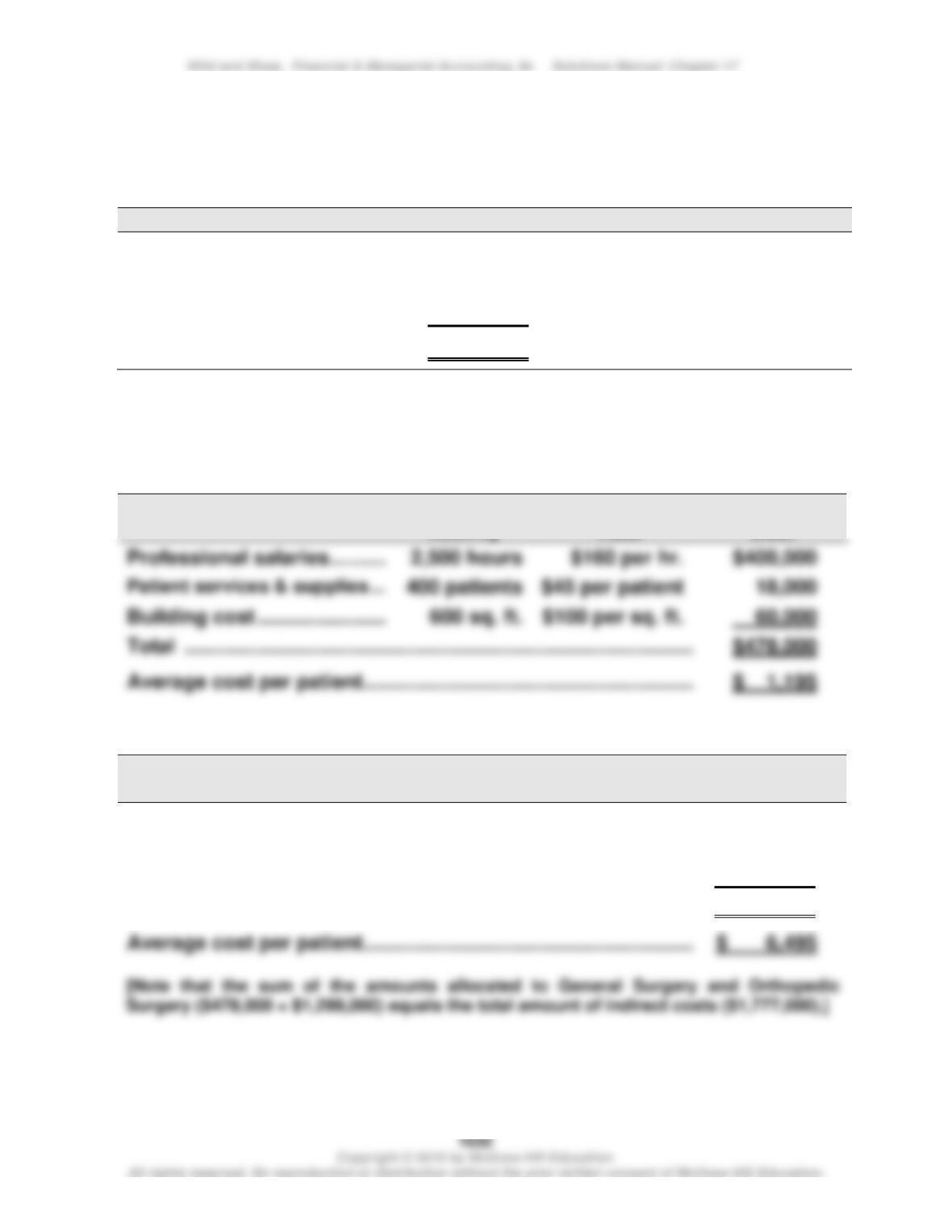
Assign costs to the surgical departments using ABC
GENERAL SURGERY
Activity
Rate
Cost
Professional salaries ………….
2,500 hours
$160 per hr.
$400,000
Patient services & supplies ……
400 patients
$45 per patient
Building cost ……………………..
600 sq. ft.
Total ……………………………………………………………………………………
$478,000
Average cost per patient ……………………………………………………….
Allocation
Allocated
ORTHOPEDIC SURGERY
Activity
Allocation
Rate
Allocated
Cost
Professional salaries ………….
7,500 hours
$160 per hr.
$1,200,000
Patient services & supplies ……
200 patients
$45 per patient
9,000
Building cost ……………………..
900 sq. ft.
$100 per sq. ft
90,000
Total ……………………………………………………………………………………
$1,299,000
Average cost per patient ……………………………………………………….