17-21
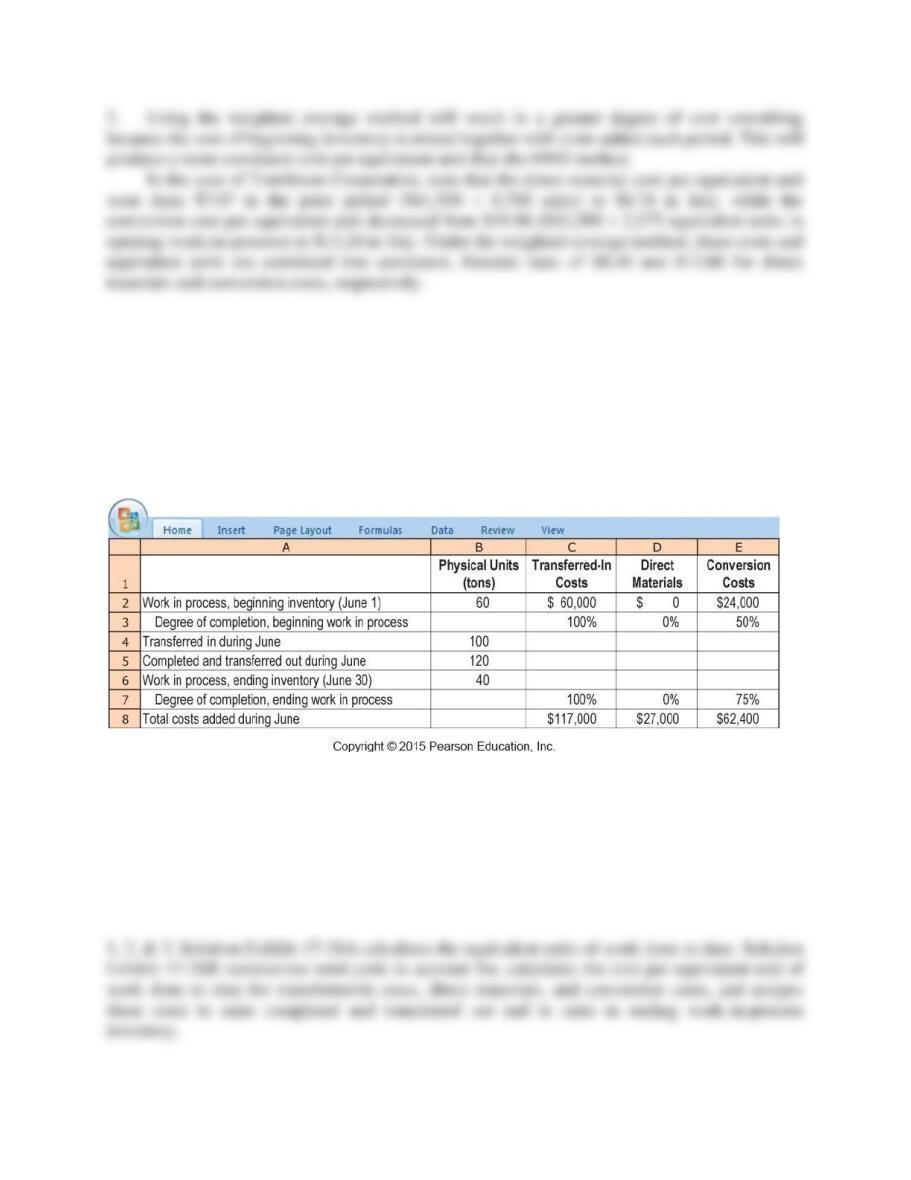
17-26 (35–40 min.) Transferred-in costs, weighted-average method.
Trendy Clothing, Inc., is a manufacturer of winter clothes. It has a knitting department and a
finishing department. This exercise focuses on the finishing department. Direct materials are
added at the end of the process. Conversion costs are added evenly during the process. Trendy
uses the weighted-average method of process costing. The following information for June 2014
is available.
Required:
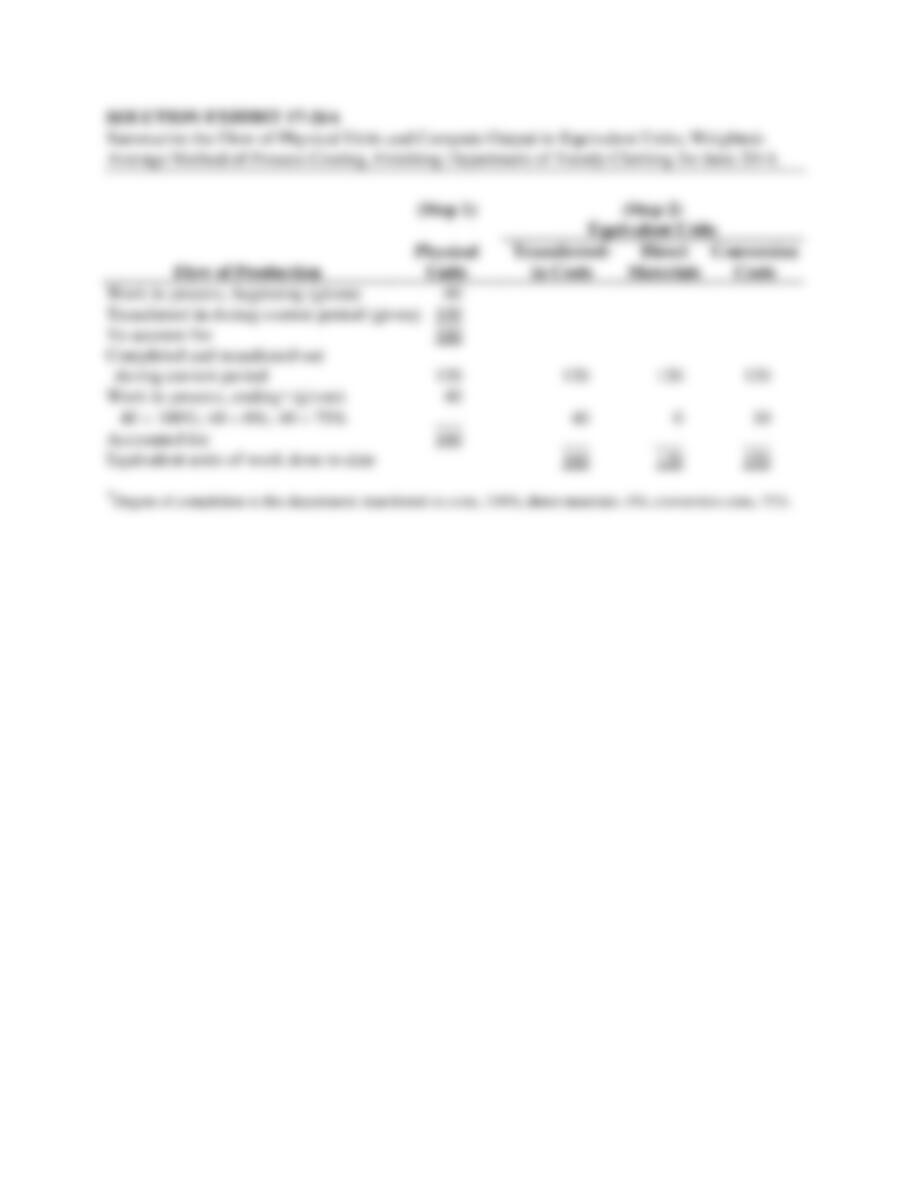
1. Calculate equivalent units of transferred-in costs, direct materials, and conversion costs.
2. Summarize the total costs to account for, and calculate the cost per equivalent unit for
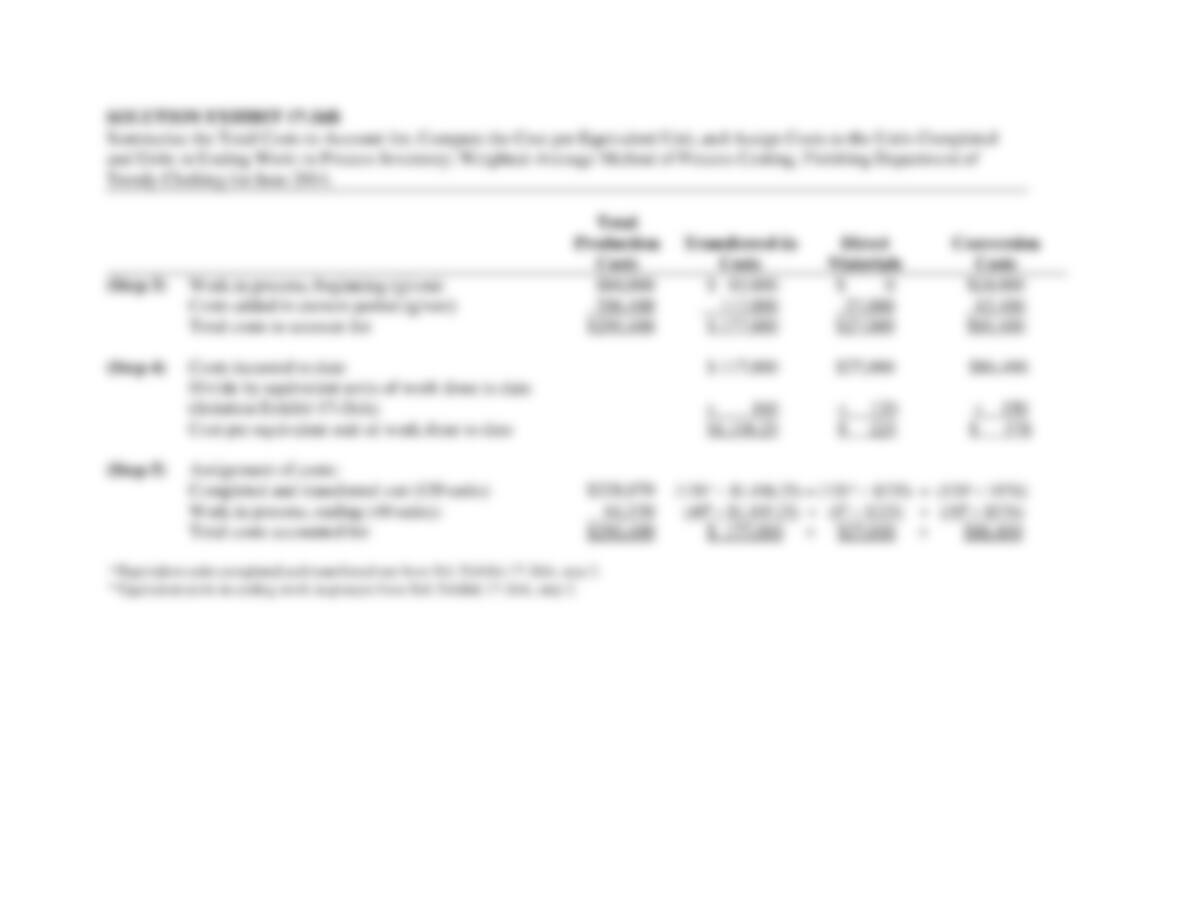
transferred-in costs, direct materials, and conversion costs.
3. Assign costs to units completed (and transferred out) and to units in ending work in process.
SOLUTION
17-22
17-23
17-24
17-27 (35–40 min.) Transferred-in costs, FIFO method.
Refer to the information in Exercise 17-26. Suppose that Trendy uses the FIFO method instead
of the weighted-average method in all of its departments. The only changes to Exercise 17-26
under the FIFO method are that total transferred-in costs of beginning work in process on June 1
are $45,000 (instead of $60,000) and total transferred-in costs added during June are $114,000
(instead of $117,000).
Required:
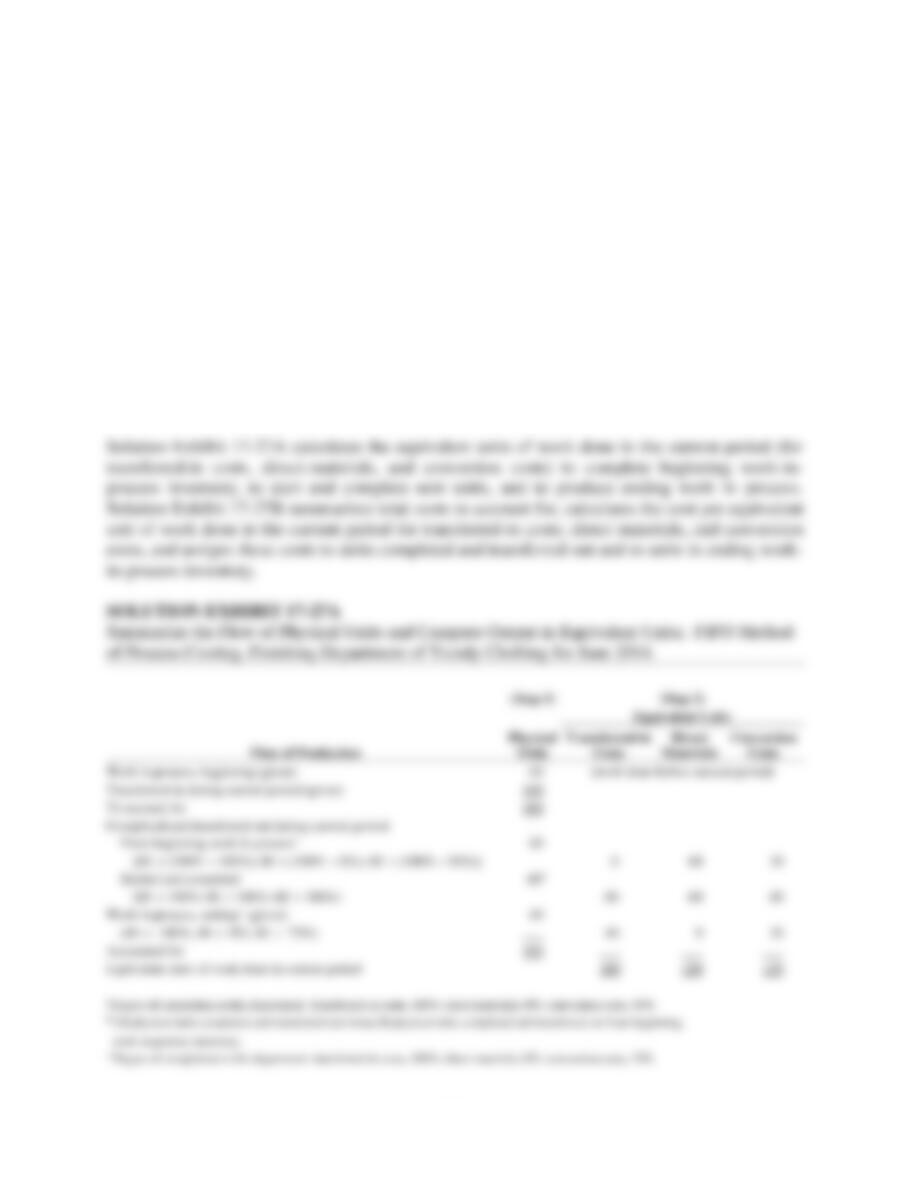
Do Exercise 17-26 using the FIFO method. Note that you first need to calculate equivalent units
of work done in the current period (for transferred-in costs, direct materials, and conversion
costs) to complete beginning work in process, to start and complete new units, and to produce
ending work in process.
SOLUTION
17-25
17-26
17-28 (15-20 min.) Operation costing.
Purex produces three different types of detergents: Breeze, Fresh, and Joy. The company uses
four operations to manufacture the detergents: spray drying, mixing, blending, and packaging.
Breeze and Fresh are produced in powder form in the mixing department, while Joy is produced
in liquid form in the blending department. The powder detergents are packed in 50-ounce
paperboard cartons, and the liquid detergent is packed in 50-ounce bottles made of recycled
plastic.
Purex applies conversion costs based on labor-hours in the spray drying department. It takes
1½ minutes to mix the ingredients for a 50-ounce container for each product. Conversion costs
are applied based on the number of containers in the mixing and blending departments and on the
basis of machine-hours in the packaging department. It takes 0.3 minutes of machine time to fill
a 50-ounce container, regardless of the product.
The budgeted number of containers and expected direct materials cost for each type of
detergent are as follows:
The budgeted conversion costs for each department for July are as follows:
Required:
1. Calculate the conversion cost rates for each department.
2. Calculate the budgeted cost of goods manufactured for Breeze, Fresh, and Joy for the month
of July.
3. Calculate the cost per 50-ounce container for each type of detergent for the month of July.
SOLUTION
17-27
17-28
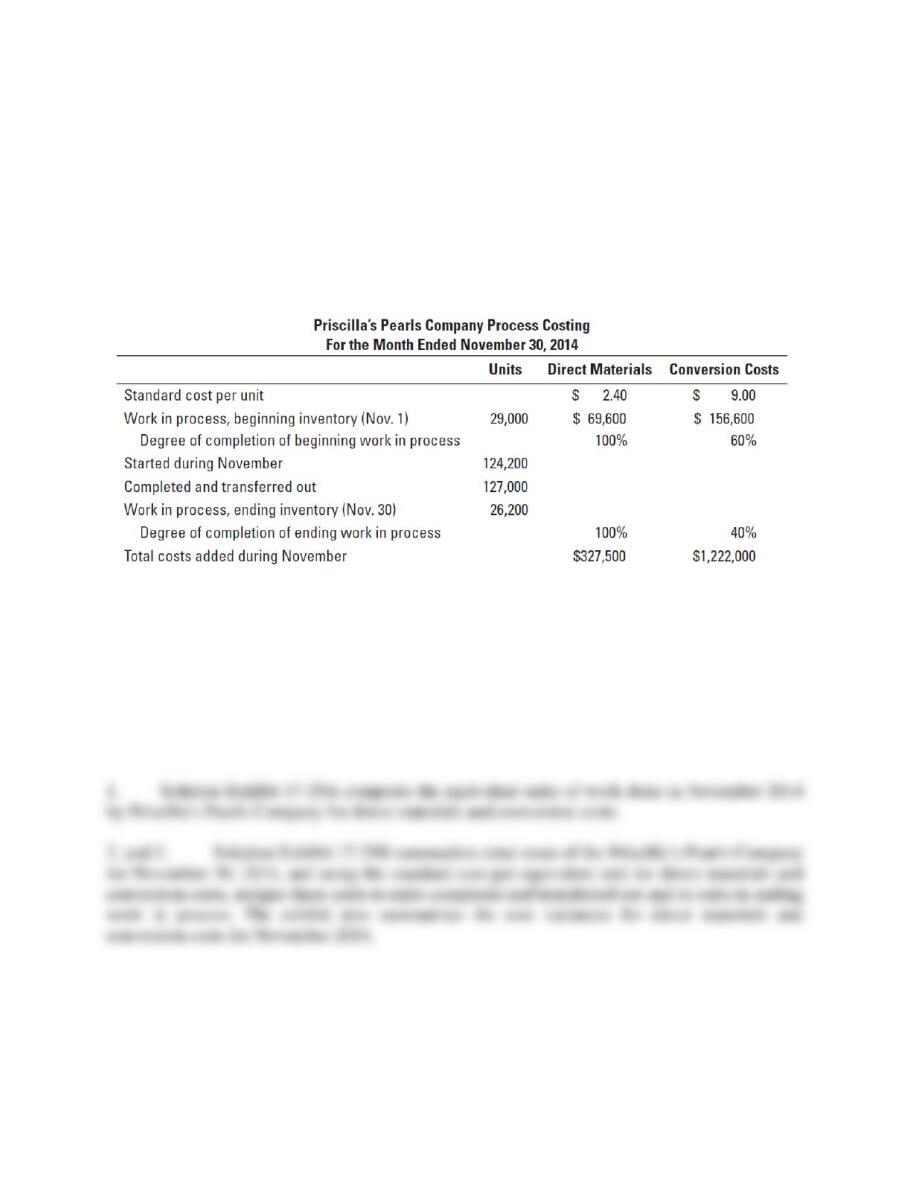
17-29 (30-35 min.) Standard-costing with beginning and ending work in process.
Priscilla’s Pearls Company (PPC) is a manufacturer of knock-off jewelry. Priscilla attends
Fashion Week in New York City every September and February to gauge the latest fashion
trends in jewelry. She then makes jewelry at a fraction of the cost of those designers who
participate in Fashion Week. This fall’s biggest item is triple-stranded pearl necklaces. Because
of her large volume, Priscilla uses process costing to account for her production. In October, she
had started some of the triple strands. She continued to work on those in November. Costs and
output figures are as follows:
Required:
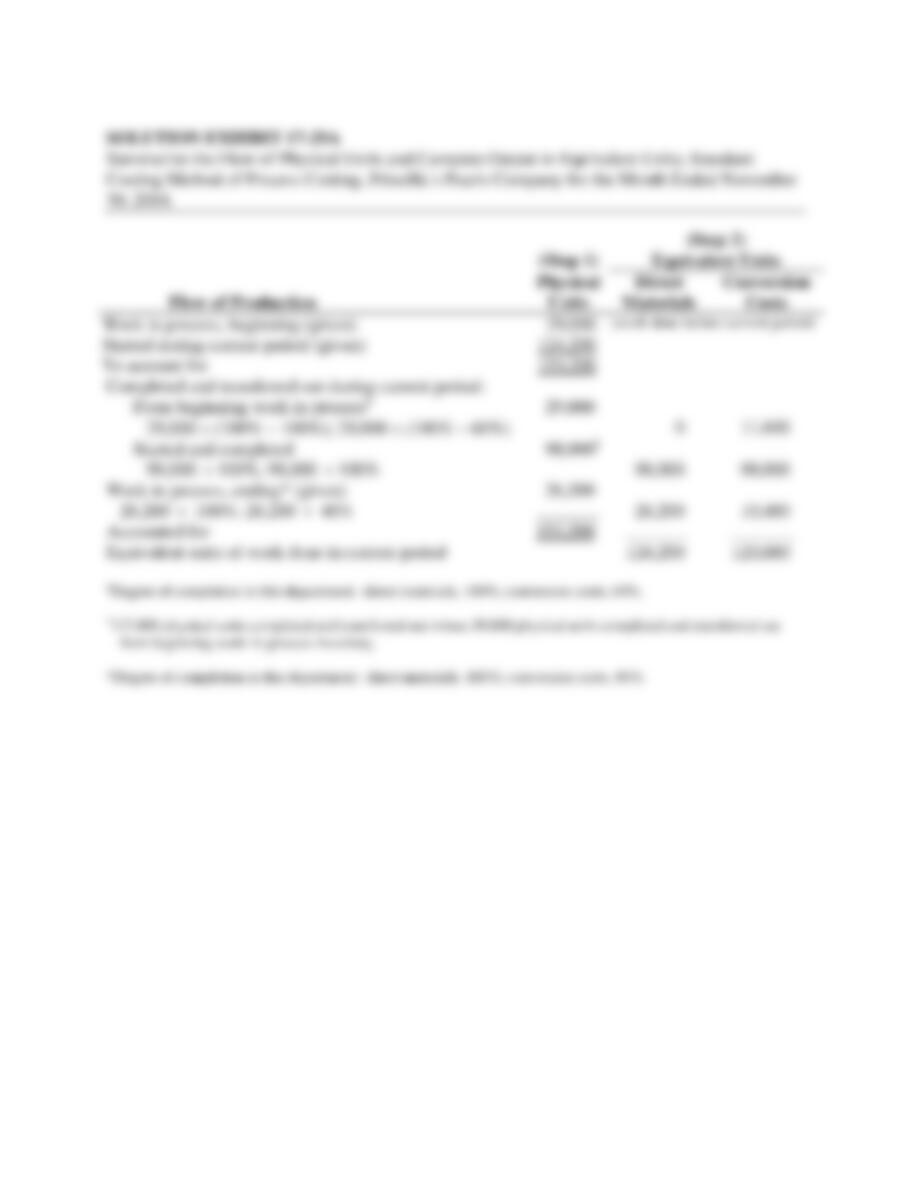
1. Compute equivalent units for direct materials and conversion costs. Show physical units in
the first column of your schedule.
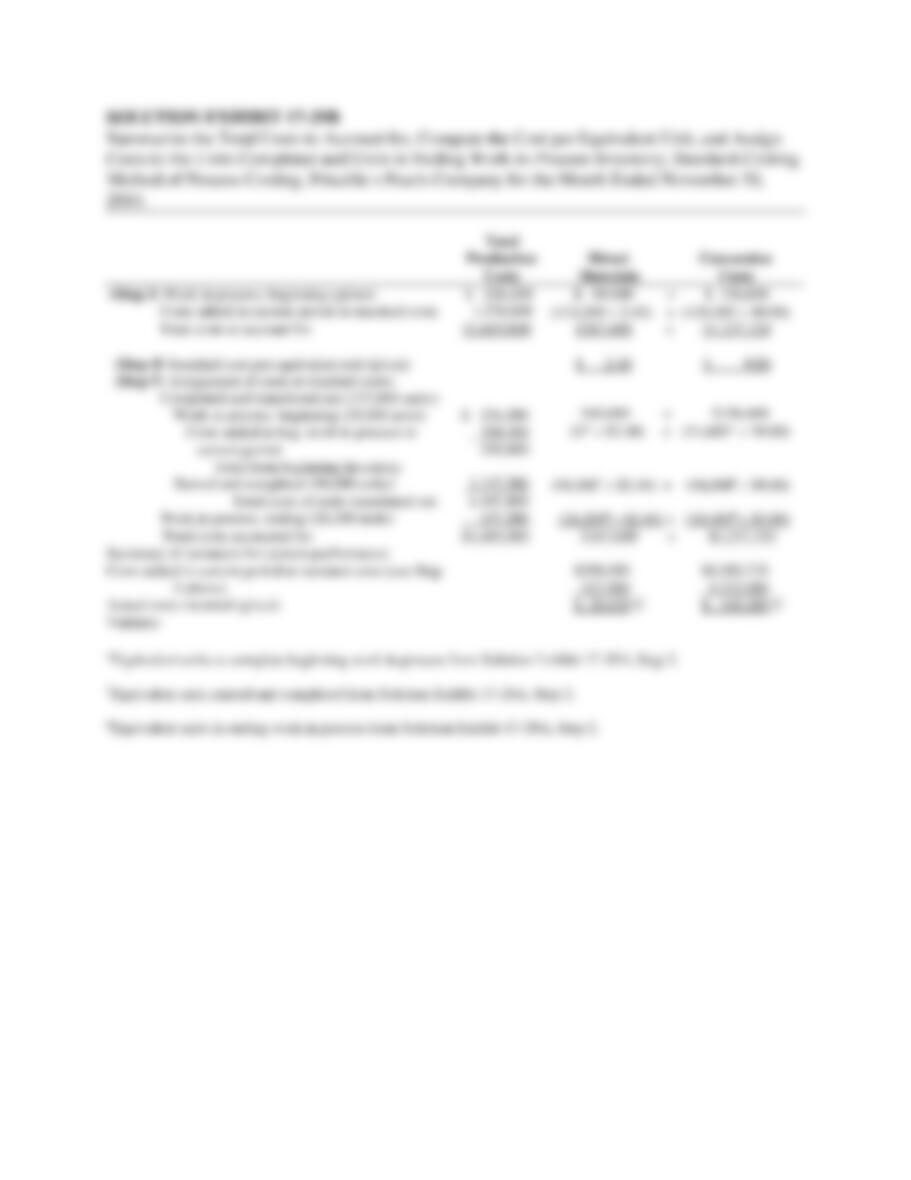
2. Compute the total standard costs of pearls transferred out in November and the total standard
costs of the November 30 inventory of work in process.
3. Compute the total November variances for direct materials and conversion costs.
SOLUTION
17-29
17-30
17-31
17-30 (30 min.) Equivalent units, comprehensive.
Louisville Sports manufactures baseball bats for use by players in the major leagues. A critical
requirement for elite players is that each bat they use have an identical look and feel. As a result,
Louisville uses a dedicated process to produce bats to each player’s specifications.
One of Louisville’s key clients is Ryan Brown of the Green Bay Brewers. Producing his bat
involves the use of three materials—ash, cork, and ink—and a sequence of 20 standardized steps.
Materials are added as follows:
Ash: This is the basic wood used in bats. Eighty percent of the ash content is added at the start
of the process; the rest is added at the start of the 16th step of the process.
Cork: This is inserted into the bat in order to increase Ryan’s bat speed. Half of the cork is
introduced at the beginning of the seventh step of the process; the rest is added at the
beginning of the 14th step.
Ink: This is used to stamp Ryan’s name on the finished bat and is added at the end of the
process.
Of the total conversion costs, 6% are added during each of the first 10 steps of the process, and
4% are added at each of the remaining 10 steps.
On May 1, 2014, Louisville had 100 bats in inventory. These bats had completed the ninth
step of the process as of April 30, 2014. During May, Louisville put another 60 bats into
production. At the end of May, Louisville was left with 40 bats that had completed the 12th step
of the production process.
Required:
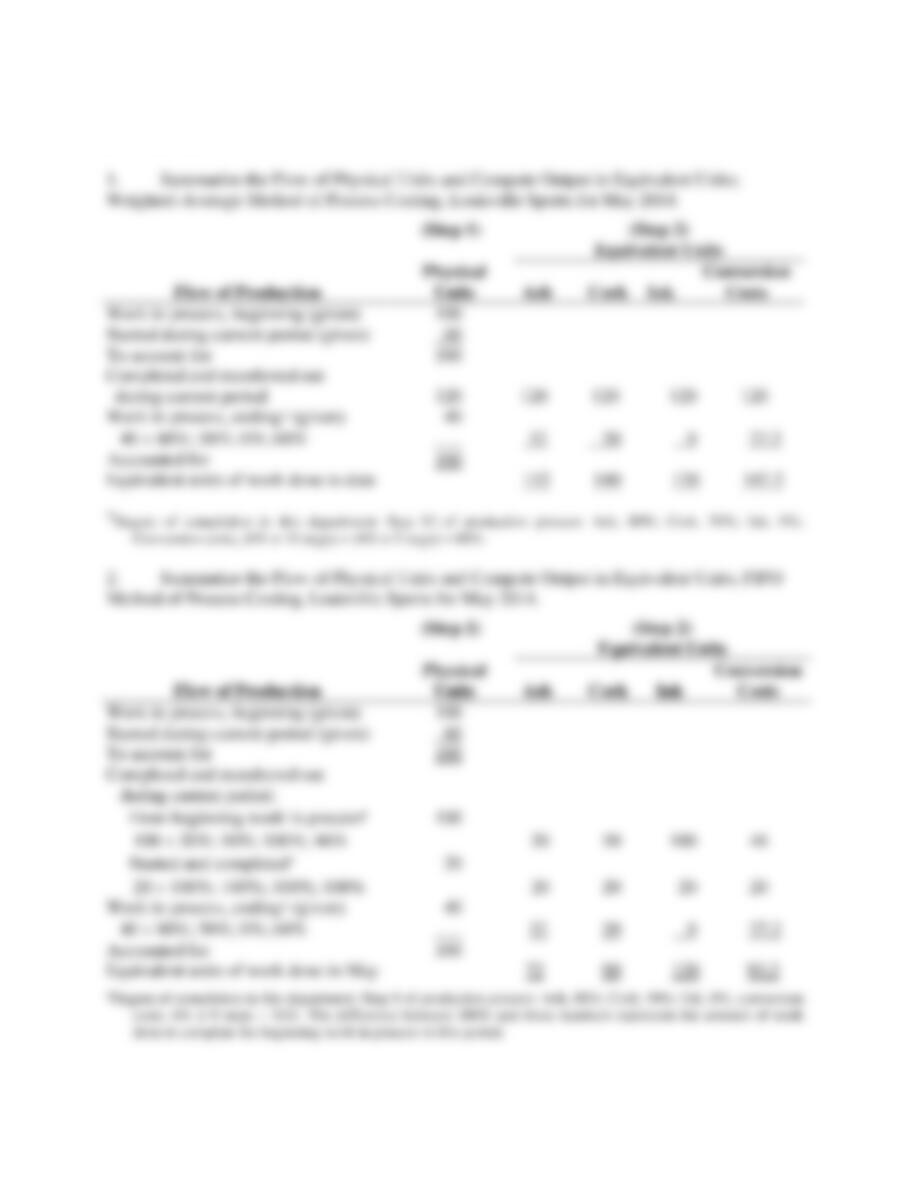
1. Under the weighted-average method of process costing, compute equivalent units of work
done for each relevant input for the month of May.
2. Under the FIFO method of process costing, compute equivalent units of work done for each
relevant input for the month of May.
17-32
SOLUTION
17-33
17-31 (25 min.) Weighted-average method.
Larsen Company manufactures car seats in its San Antonio plant. Each car seat passes through
the assembly department and the testing department. This problem focuses on the assembly
department. The process-costing system at Larsen Company has a single direct-cost category
(direct materials) and a single indirect-cost category (conversion costs). Direct materials are
added at the beginning of the process. Conversion costs are added evenly during the process.
When the assembly department finishes work on each car seat, it is immediately transferred to
testing.
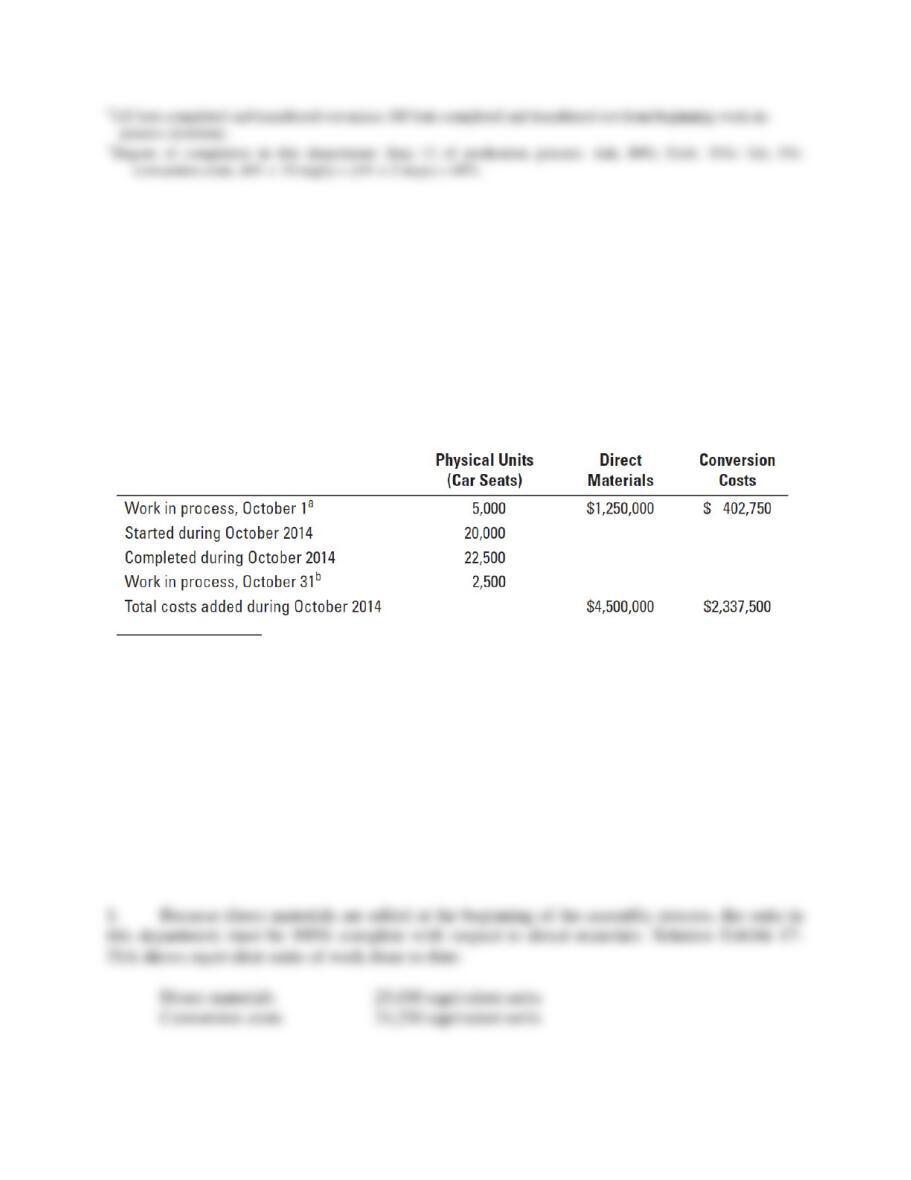
Larsen Company uses the weighted-average method of process costing. Data for the assembly
department for October 2014 are as follows:
aDegree of completion: direct materials,?%; conversion costs, 60%.
bDegree of completion: direct materials,?%; conversion costs, 70%.
Required:
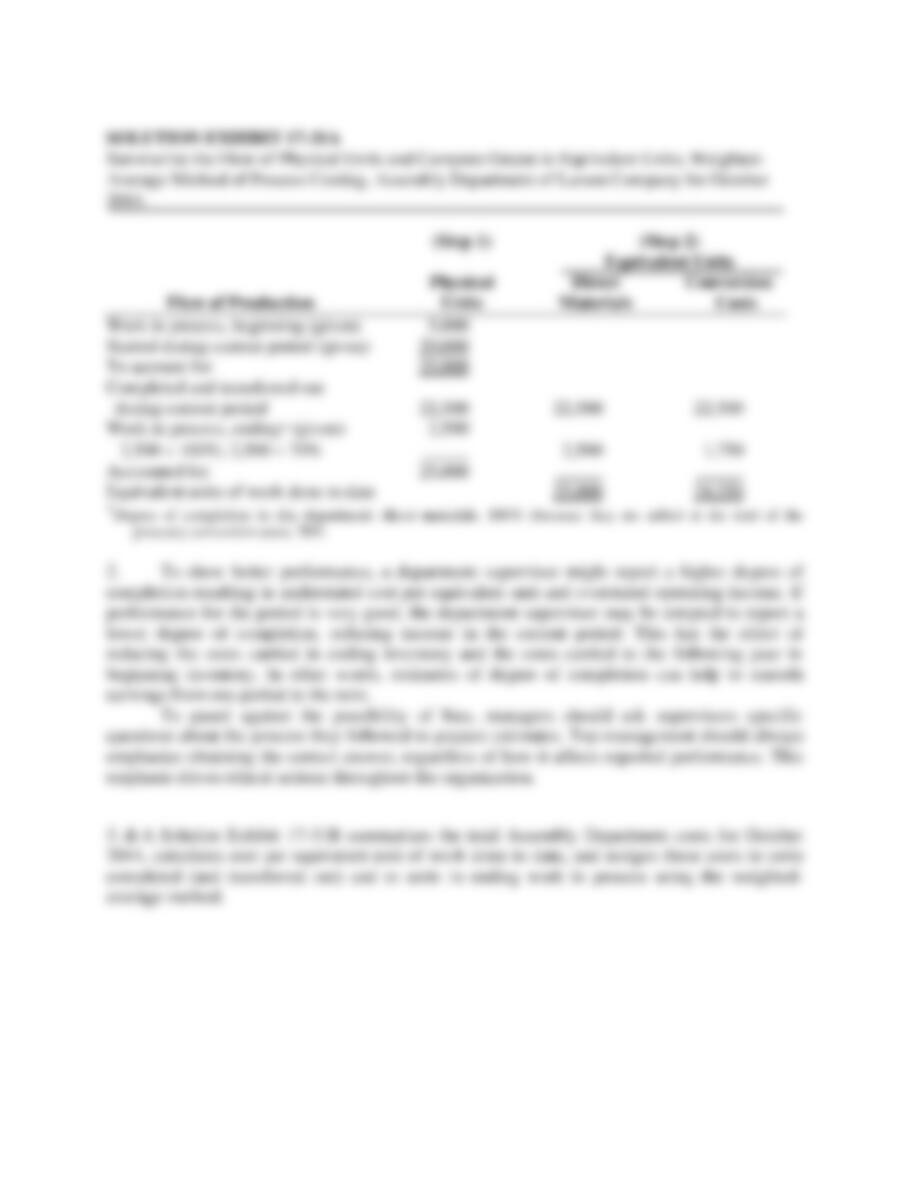
1. For each cost category, compute equivalent units in the assembly department. Show physical
units in the first column of your schedule.
2. What issues should the manager focus on when reviewing the equivalent units calculation?
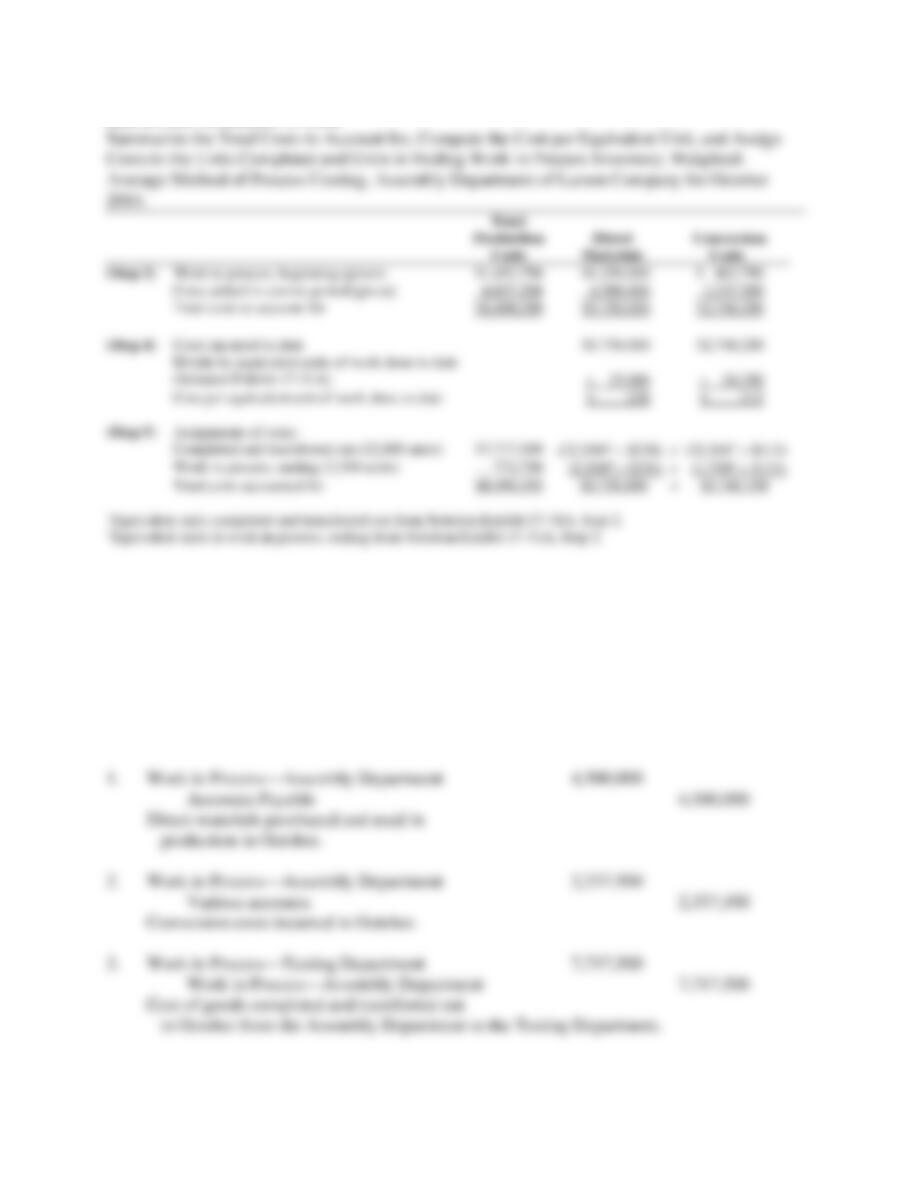
3. For each cost category, summarize total assembly department costs for October 2014 and
calculate the cost per equivalent unit.
4. Assign costs to units completed and transferred out and to units in ending work in process.
SOLUTION
17-34
17-35
SOLUTION EXHIBIT 17-31B
17-32 (10 min.) Journal entries (continuation of 17-31).
Required:
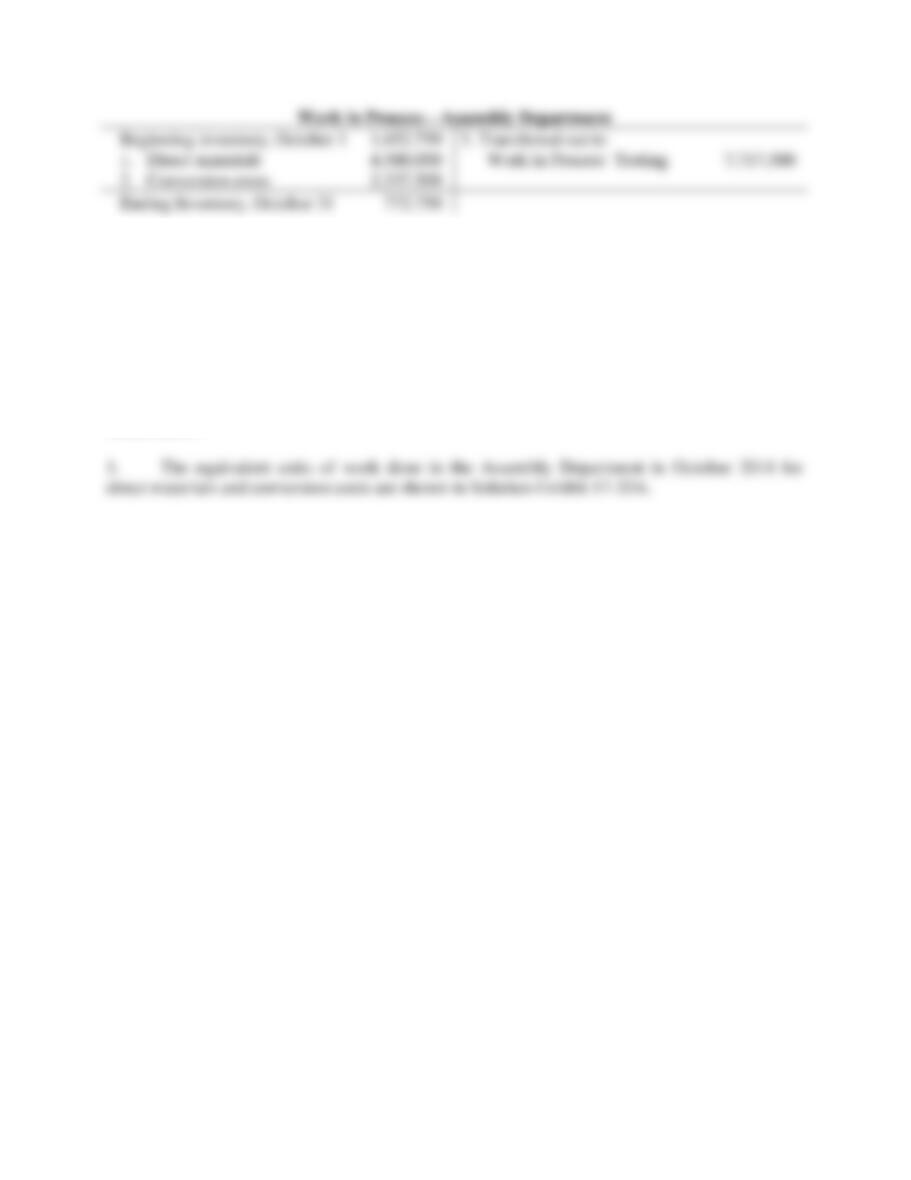
Prepare a set of summarized journal entries for all October 2014 transactions affecting Work in
Process—Assembly. Set up a T-account for Work in Process—Assembly and post your entries to
it.
SOLUTION
17-36
17-33 (20 min.) FIFO method (continuation of 17-31).
Required:
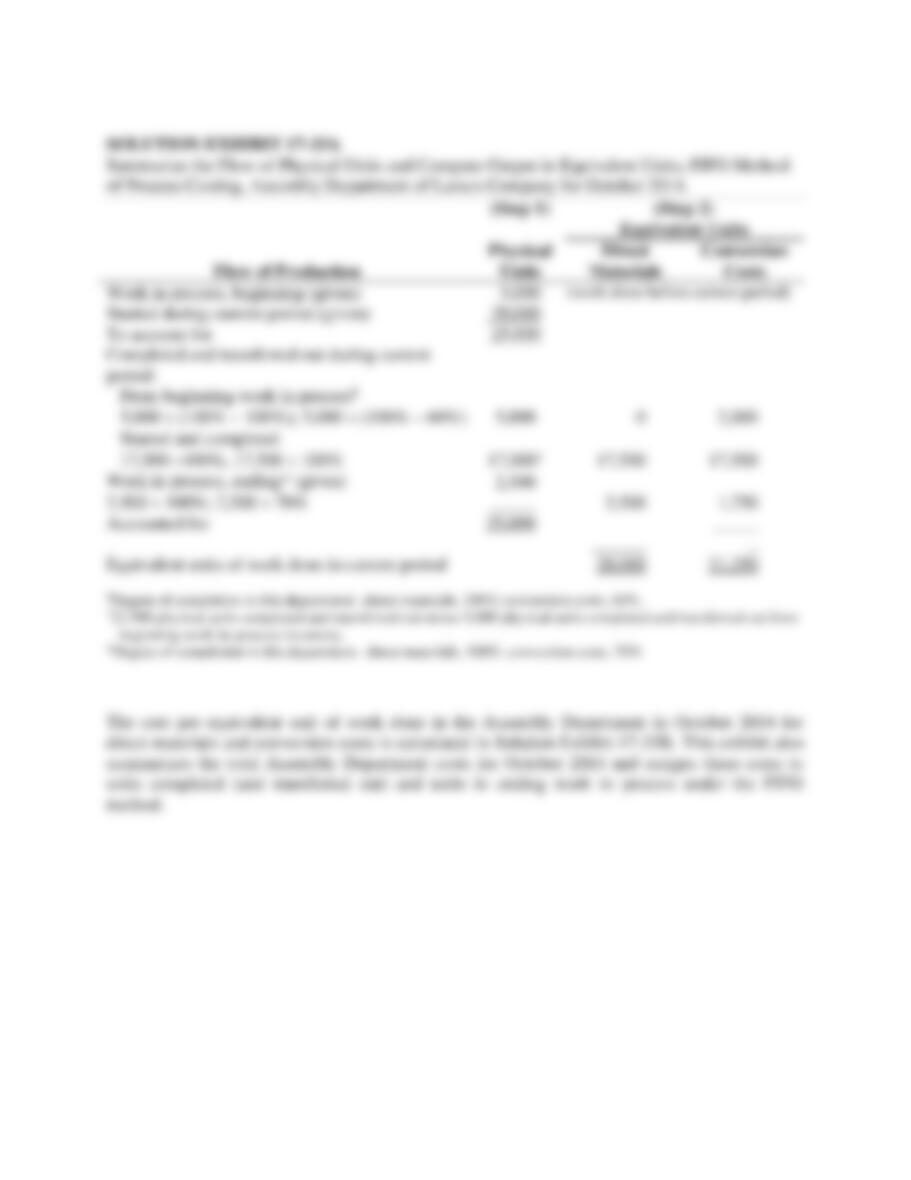
1. Do Problem 17-31 using the FIFO method of process costing. Explain any difference
between the cost per equivalent unit in the assembly department under the weighted-average
method and the FIFO method.
2. Should Larsen’s managers choose the weighted-average method or the FIFO method?
Explain briefly.
SOLUTION
17-37
17-38
17-39
17-40
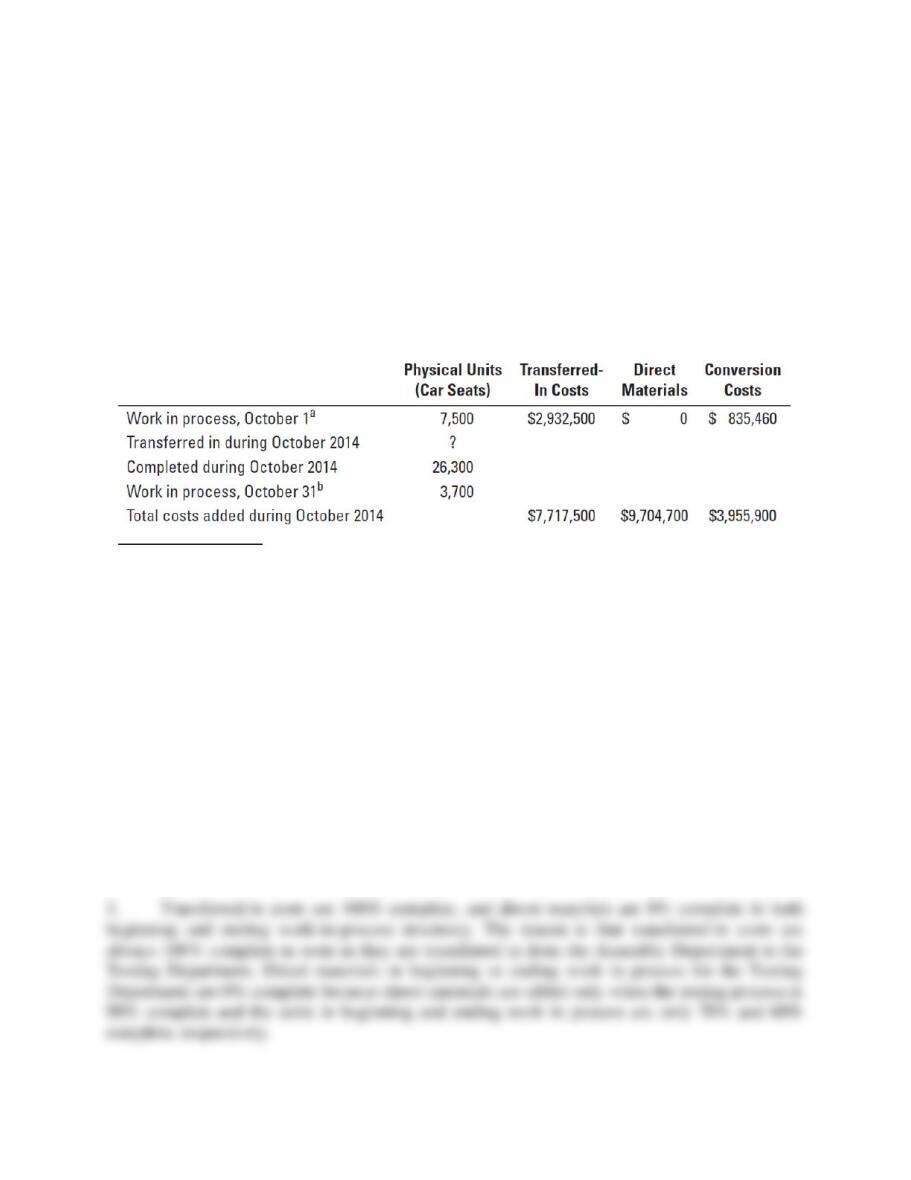
17-34 (30 min.) Transferred-in costs, weighted-average method (related to 17-31 to 17-33).
Larsen Company, as you know, is a manufacturer of car seats. Each car seat passes through the
assembly department and testing department. This problem focuses on the testing department.
Direct materials are added when the testing department process is 90% complete. Conversion
costs are added evenly during the testing department’s process. As work in assembly is
completed, each unit is immediately transferred to testing. As each unit is completed in testing, it
is immediately transferred to Finished Goods.
Larsen Company uses the weighted-average method of process costing. Data for the testing
department for October 2014 are as follows:
aDegree of completion: transferred-in costs,?%; direct materials,?%; conversion costs, 70%.
bDegree of completion: transferred-in costs,?%; direct materials,?%; conversion costs, 60%.
Required:
1. What is the percentage of completion for (a) transferred-in costs and direct materials in
beginning work-in-process inventory and (b) transferred-in costs and direct materials in
ending work-in-process inventory?
2. For each cost category, compute equivalent units in the testing department. Show physical
units in the first column of your schedule.
3. For each cost category, summarize total testing department costs for October 2014, calculate
the cost per equivalent unit, and assign costs to units completed (and transferred out) and to
units in ending work in process.
4. Prepare journal entries for October transfers from the assembly department to the testing
department and from the testing department to Finished Goods.
SOLUTION