SOLUTIONS TO PROBLEMS SET B
20 Minutes, Easy
PROBLEM 17.1B
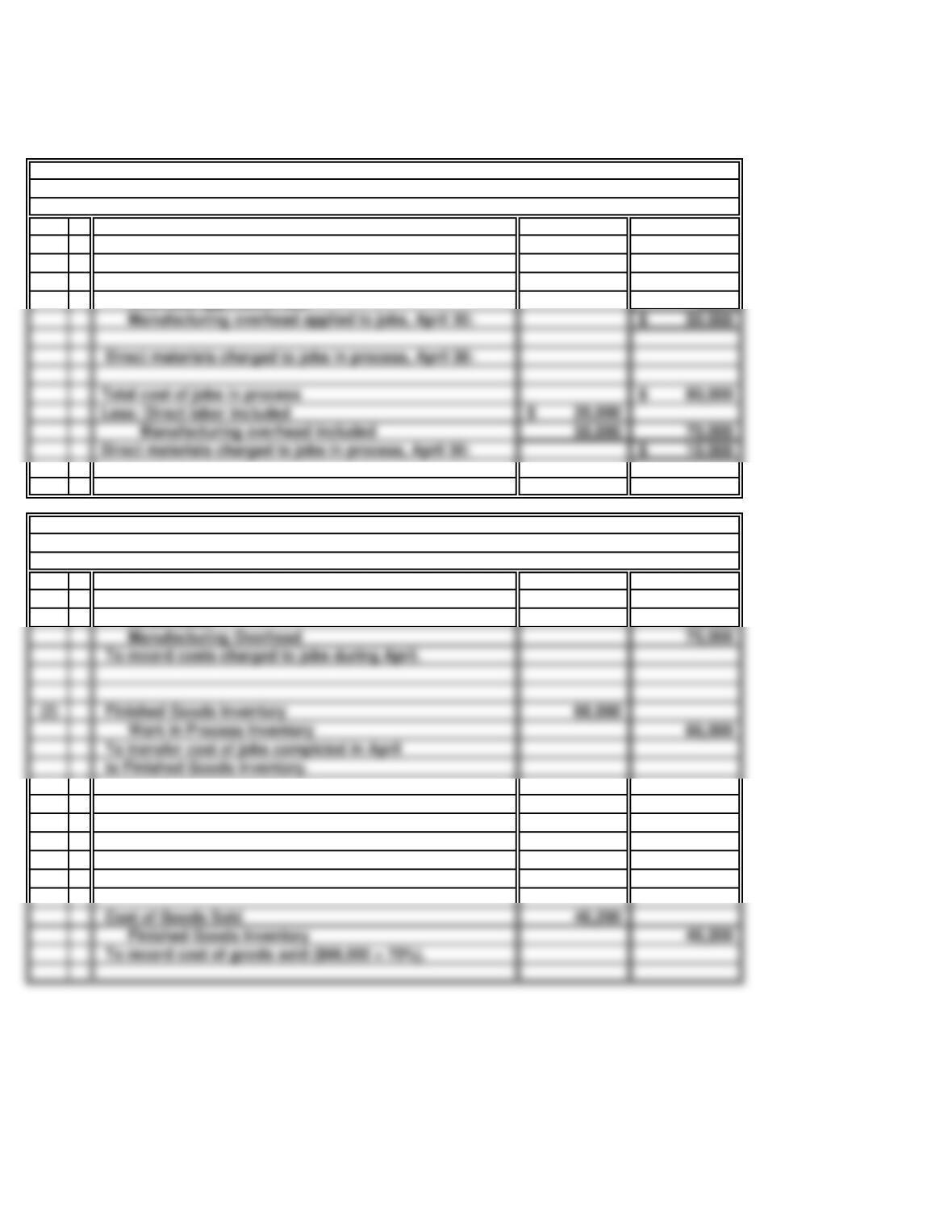
WINONA ENTERPRISES
a.
Manufacturing overhead charged to jobs in process,
April 30:
Direct labor charged to jobs in process, April 30: 20,000$
Overhead application rate 250%
b.
(1) Work in Process Inventory 130,000
Materials Inventory 25,000
Direct Labor 30,000
Manufacturing Overhead 75,000
To record costs charged to jobs during April.
(2) Finished Goods Inventory 66,000
Work in Process Inventory 66,000
To transfer cost of jobs completed in April
to Finished Goods Inventory.
(3) Cash 98,000
Sales 98,000
To record cash sale of 70% of goods completed
in April.
Finished Goods Inventory 46,200
To record cost of goods sold ($66,000 × 70%).
General Journal
Manufacturing overhead applied to jobs, April 30: 50,000$
Direct materials charged to jobs in process, April 30:
Manufacturing overhead included 50,000 70,000
15 Minutes, Easy
PROBLEM 17.2B
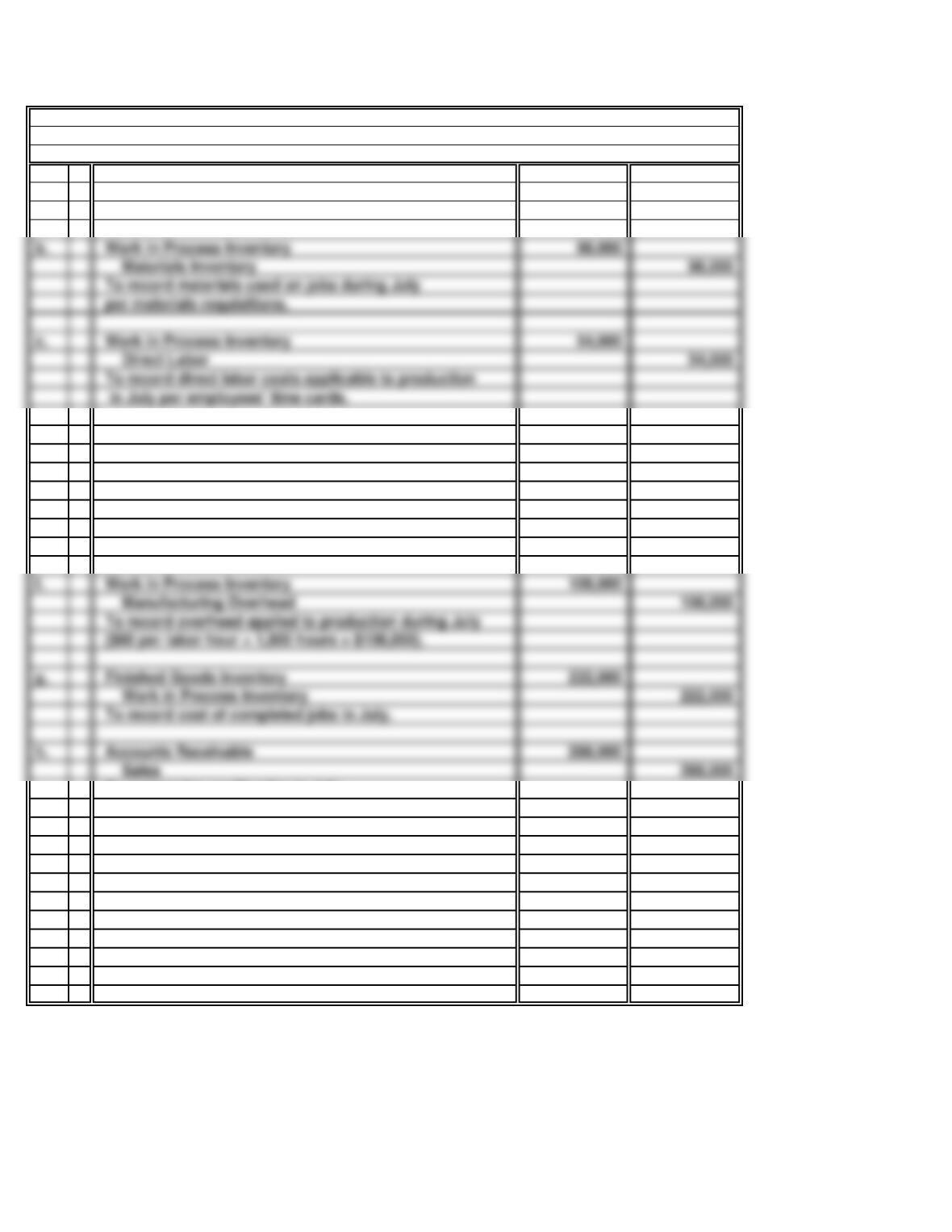
FARGO DEVELOPMENT CO.
General Journal
a. Materials Inventory 100,000
Accounts Payable 100,000
To record purchases of direct materials during July.
d. Direct Labor 50,000
Cash 50,000
To record direct labor payrolls paid in July.
e. Manufacturing Overhead 110,000
Accounts Payable 110,000
To record actual overhead costs in July.
f. Work in Process Inventory 108,000
Manufacturing Overhead 108,000
To record overhead applied to production during July
($60 per labor hour × 1,800 hours = $108,000).
g. Finished Goods Inventory 222,000
Work in Process Inventory 222,000
To record cost of completed jobs in July.
h. Accounts Receivable 288,000
To summarize credit sales in July.
Cost of Goods Sold 180,000
Finished Goods Inventory 180,000
To record cost of units sold during July.
b. Work in Process Inventory 98,000
Materials Inventory 98,000
To record materials used on jobs during July
per materials requisitions.
c. Work in Process Inventory 54,000
Direct Labor 54,000
To record direct labor costs applicable to production
30 Minutes, Medium
PROBLEM 17.3B
LINCOLN ESTATES
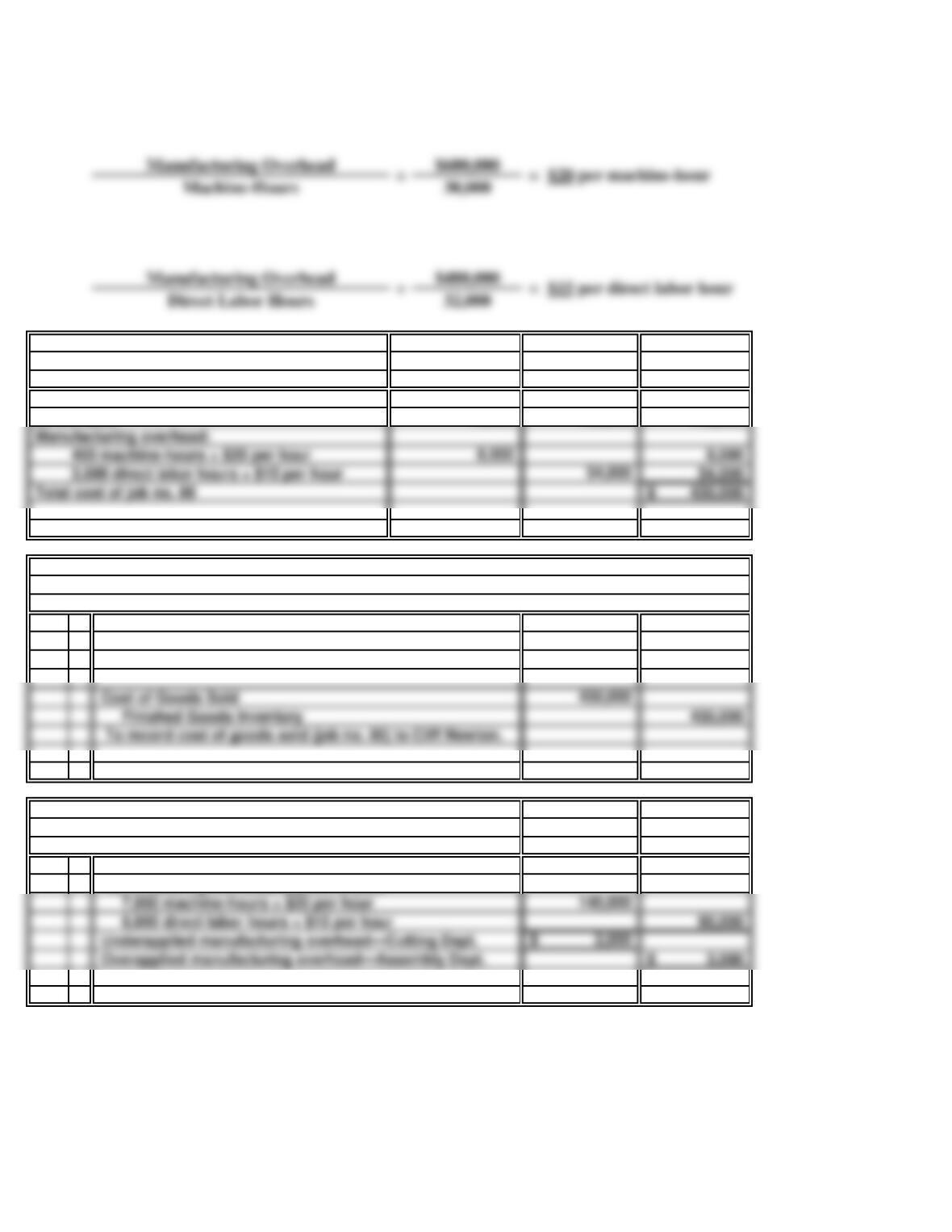
a. Cutting Department overhead application rate based on machine-hours:
Assembly Department overhead application rate based on direct labor hours:
b. Job no. 80
Total
Direct materials 250,000$
Direct labor
118,000
Manufacturing overhead:
Total cost of job no. 80 430,000$
c.
General Journal
Accounts Receivable (Cliff Newton)
Sales 602,000
To record revenue from sale to Cliff Newton.
Cost of Goods Sold
To record cost of goods sold (job no. 80) to Cliff Newton.
430,000
d.
Assembly
Department
Actual manufacturing overhead for first quarter 87,000$
Manufacturing overhead applied to jobs:
Cutting
Department
142,000$
Assembly
108,000
602,000
150,000$
Department
Department
100,000$
10,000
Cutting
30 Minutes, Medium
PROBLEM 17.4B
MONARK ELECTRONICS
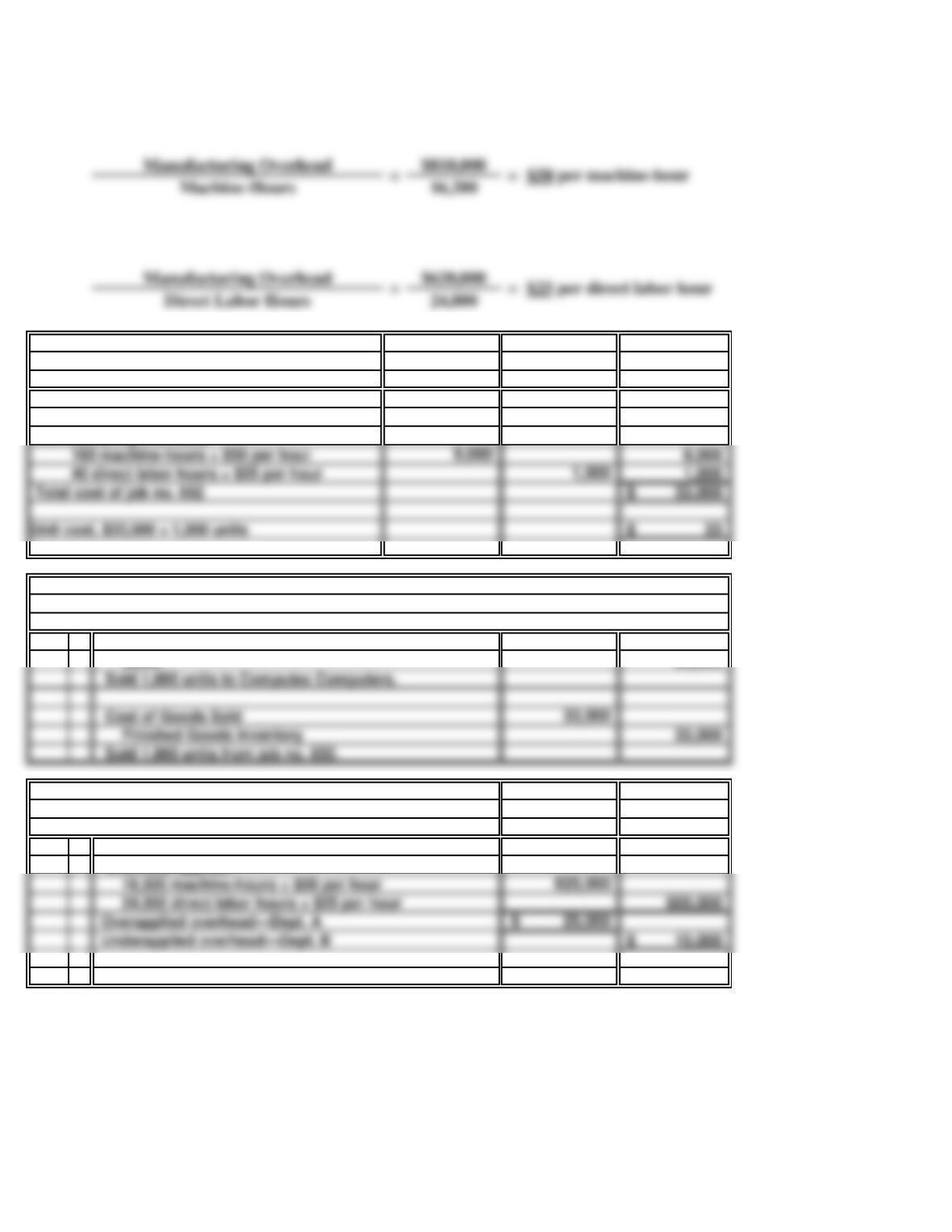
a. Department A overhead application rate:
Department B overhead application rate:
b. Job no. 652
Total
Direct materials 20,750$
Direct labor
2,250
Manufacturing overhead:
Total cost of job no. 652 33,000$
Unit cost, $33,000 ÷ 1,000 units 33$
1,000
9,000
c.
General Journal
Accounts Receivable (Computex Computers)
Sales 50,000
Sold 1,000 units to Computex Computers.
Cost of Goods Sold
Sold 1,000 units from job no. 652.
d.
Dept. B
Actual overhead for the year 615,000$
Overhead applied:
25,000$
50,000
800,000$
Dept. A
750
Dept. B
19,000$
1,750$
1,500
Dept. A
35 Minutes, Medium
PROBLEM 17.5B
BIG BOOMERS
a. (1)
180,000$
b. (1)
300$
276
144
Total cost of Job 1 720$
100$
36
Total cost of Job 2 196$
Job 2:
Direct labor costs
Direct materials used
Overhead applied (3 hours × $12 per hour)
(2)
300$
276
72
Total cost of Job 1 648$
100$
72
Total cost of Job 2 232$
Overhead applied ($72 per job)
Job 2:
Direct materials used
Direct labor
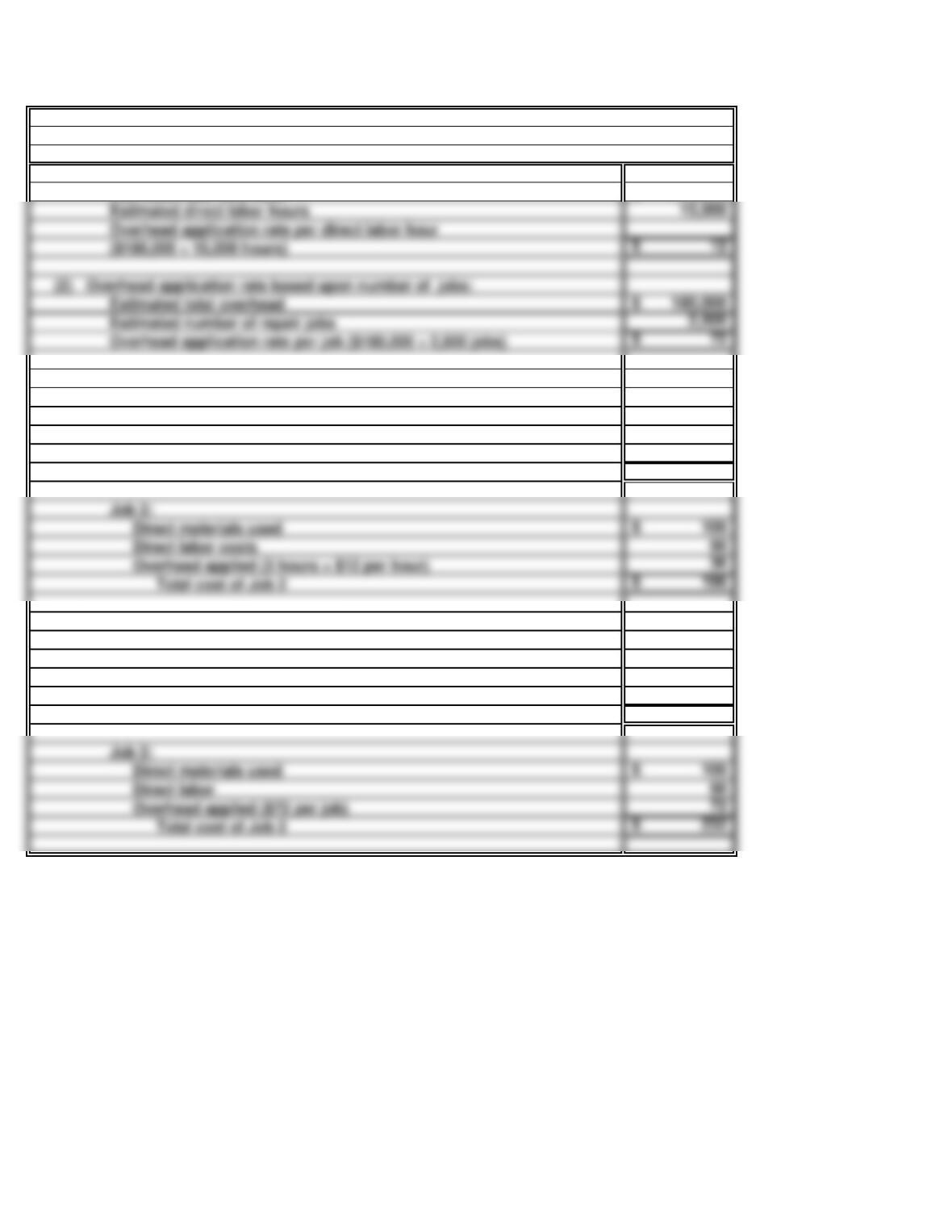
Overhead application rate based on direct labor hours:
Estimated total overhead
Direct labor costs
Overhead applied on a per-job basis:
Job 1:
Direct materials used
Direct labor costs
Overhead applied (12 hours × $12 per hour)
Overhead applied using direct labor hours:
Job 1:
Direct materials used
Overhead applied ($72 per job)
(2)
180,000$
Overhead application rate based upon number of jobs:
Estimated total overhead
Estimated number of repair jobs
Estimated direct labor hours
($180,000 ÷ 15,000 hours)
Overhead application rate per direct labor hour
Overhead application rate per job ($180,000 ÷ 2,500 jobs)

PROBLEM 17.5B
BIG BOOMERS (concluded)
c.
Allocating overhead based upon the number of jobs assumes that each job should be
charged with an equal amount ($72) of overhead. This allocation method ignores the fact
Comments on the alternative overhead applications:
30 Minutes, Medium
PROBLEM 17.6B
LOGAN PHARMACEUTICAL
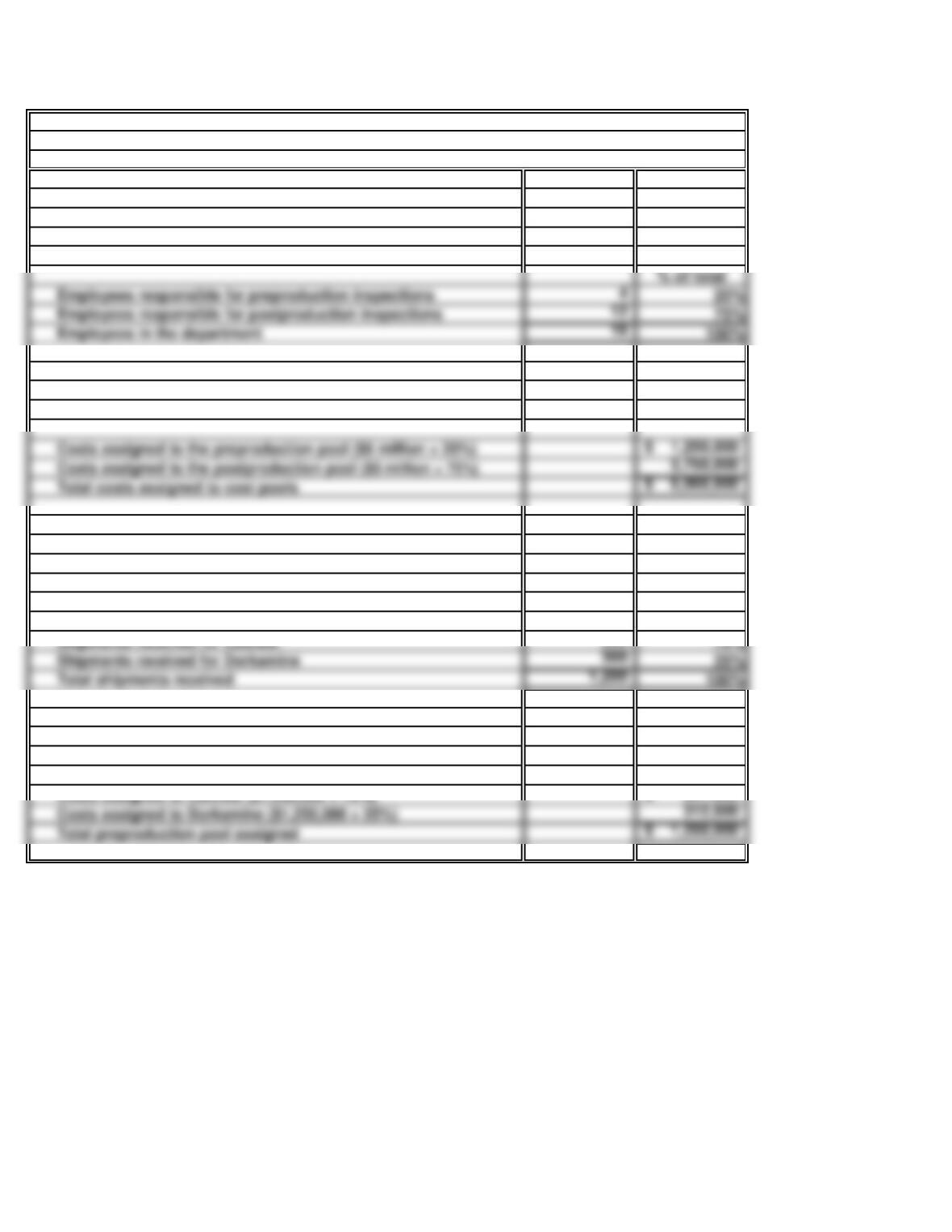
a.
Costs assigned to the postproduction pool ($5 million × 75%)
Costs assigned to the preproduction pool ($5 million × 25%)
Total costs assigned to cost pools
b.
% of total
900 75%
Shipments received for Caltrate
Shipments received for Dorkamine
Total shipments received
937,500$
Costs assigned to Caltrate ($1,250,000 × 75%)
Costs assigned to Dorkamine ($1,250,000 × 25%)
Total preproduction pool assigned
Assigning quality control department costs to activity pools:
Step 1:
Establish the percent of the department’s costs
to be assigned to each activity cost pool using the
number of employees as an activity base.
Step 2:
Assign the department’s total costs of $5 million
percentages computed in step 1.
to each product line using the number of
to each activity cost pool based on the
materials shipments received as an activity base.
Step 1:
Allocation of preproduction cost pool:
Establish the percent of the pool to be allocated
Step 2:
Allocate the preproduction pool to each product
line based on the percentages computed in step 1.
Employees responsible for preproduction inspections
Employees responsible for postproduction inspections
Employees in the department
PROBLEM 17.6B
LOGAN PHARMACEUTICAL (concluded)
c.
% of total
d.
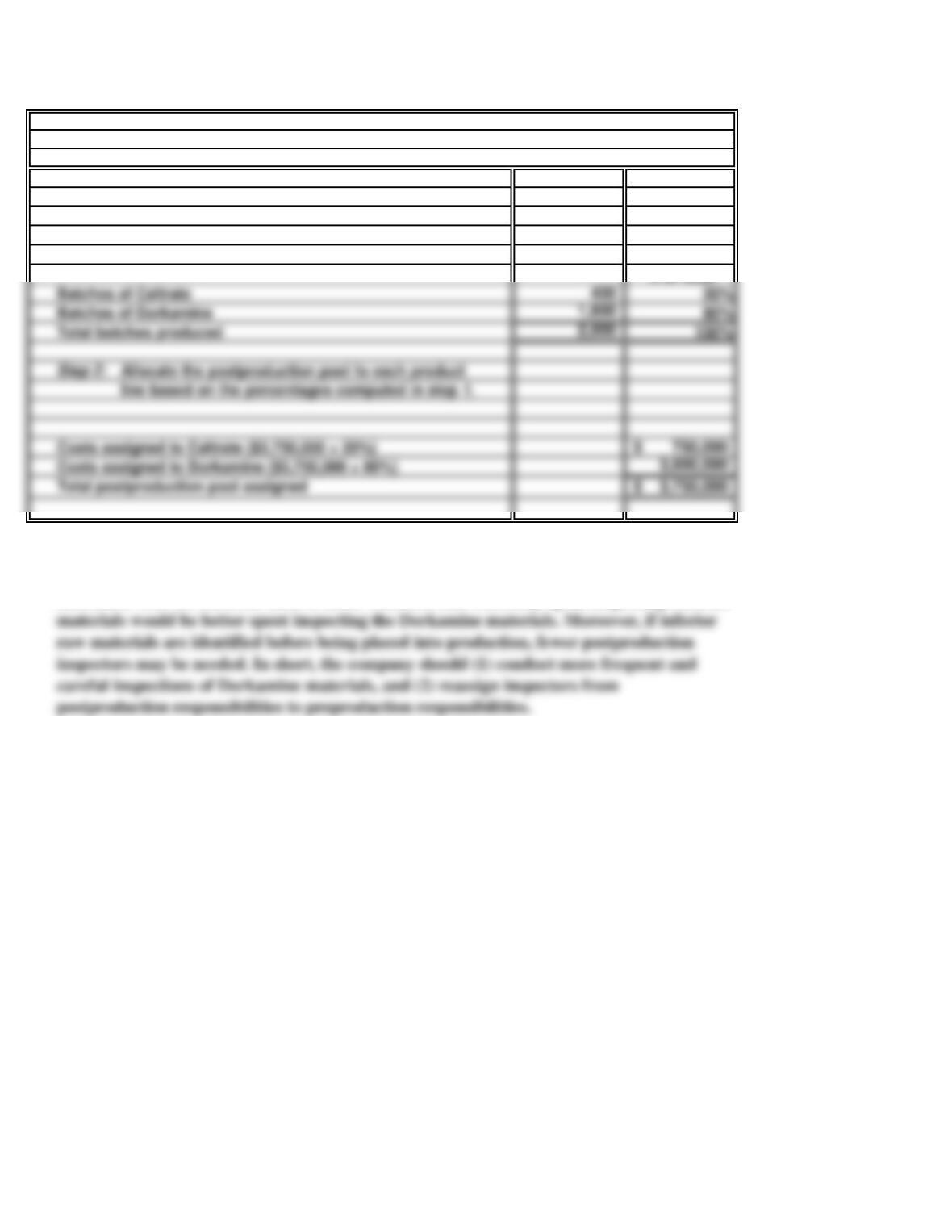
Allocation of postproduction cost pool:
Step 1:
Establish the percent of the pool to be allocated
to each product line using the number of batches
produced as an activity base.
The company should consider reassigning its inspectors so that more time and effort is
spent inspecting shipments of Dorkamine materials. If relatively few problems are
associated with the material used to make Caltrate, time currently spent inspecting Caltrate
Batches of Dorkamine
Total batches produced
Costs assigned to Caltrate ($3,750,000 × 20%)
Batches of Caltrate
Step 2:
Costs assigned to Dorkamine ($3,750,000 × 80%)
Allocate the postproduction pool to each product
line based on the percentages computed in step 1.
45 Minutes, Strong
PROBLEM 17.7B
DOWNHILL FAST
a.
5,000 MH
10,000 MH
35,000 MH
50,000 MH
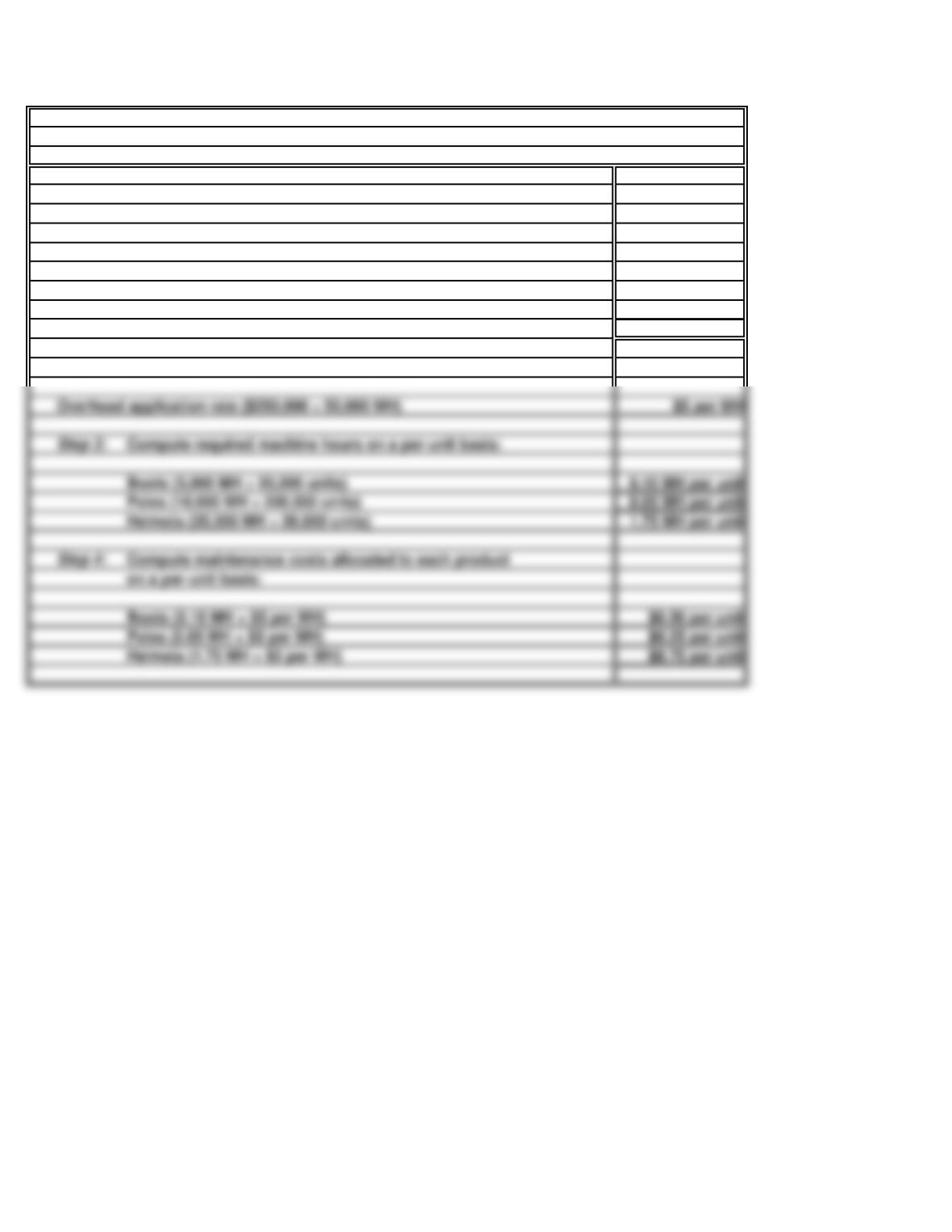
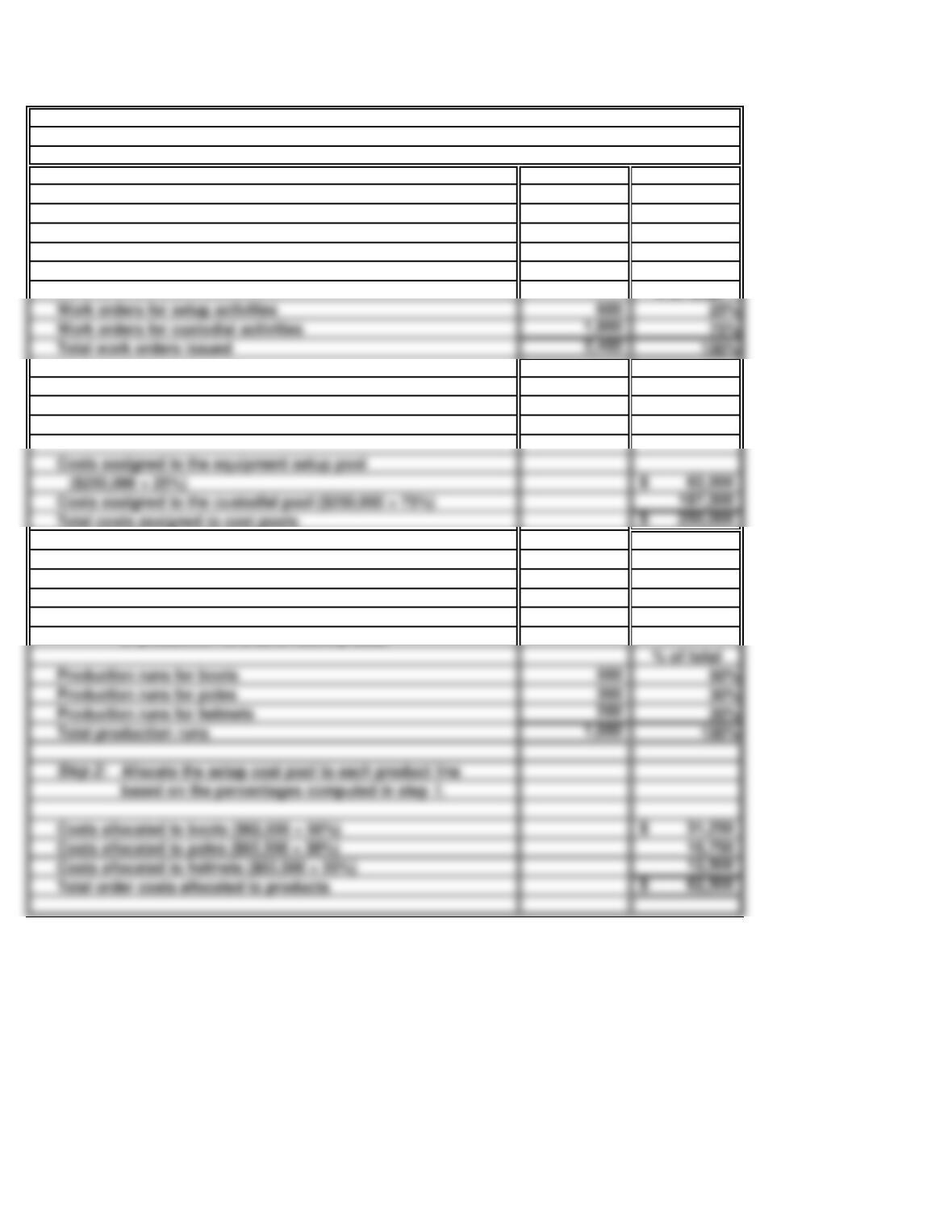
Compute the overhead application rate per MH:
Maintenance department costs allocated to each product line on a
per-unit basis using machine hours (MH):
Compute total MH at “normal” production levels:
Poles
Helmets
Step 2:
Step 1:
Boots
Total MH at normal production levels
Overhead application rate ($250,000 ÷ 50,000 MH)
Step 3:
Helmets (1.75 MH × $5 per MH)
Compute maintenance costs allocated to each product
Step 4:
Boots (5,000 MH ÷ 50,000 units)
Poles (10,000 MH ÷ 200,000 units)
Helmets (35,000 MH ÷ 20,000 units)
Boots (0.10 MH × $5 per MH)
Poles (0.05 MH × $5 per MH)
on a per-unit basis:
PROBLEM 17.7B
DOWNHILL FAST (continued)
b.
% of total
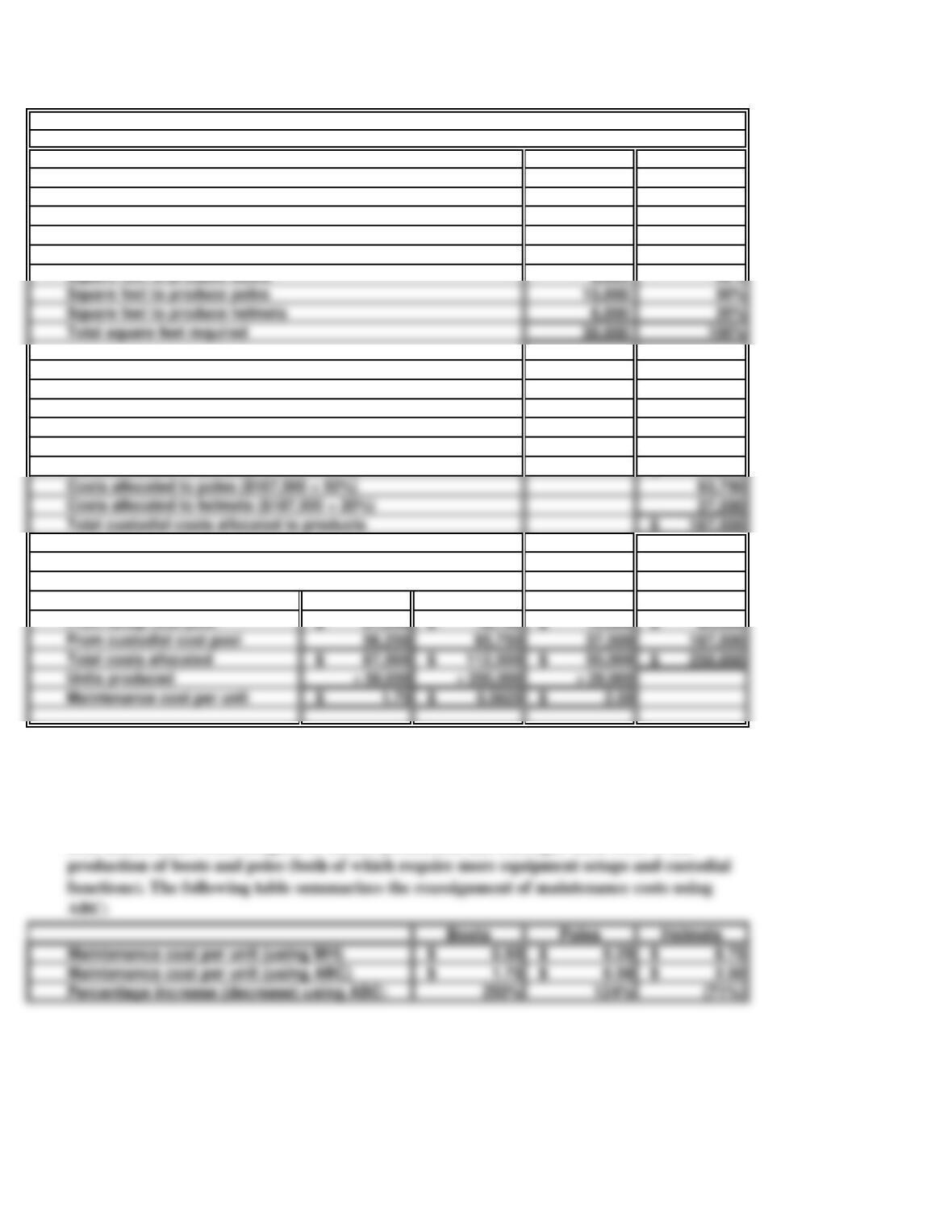
Costs assigned to the custodial pool ($250,000 × 75%)
Total costs assigned to cost pools
Costs assigned to the equipment setup pool
% of total
Costs allocated to helmets ($62,500 × 20%)
Total order costs allocated to products
Costs allocated to poles ($62,500 × 30%)
Total production runs
Step 2:
based on the percentages computed in step 1.
Production runs for helmets
Costs allocated to boots ($62,500 × 50%)
Allocate the setup cost pool to each product line
Production runs for poles
Production runs for boots
Assigning maintenance department costs to activity pools:
each activity cost pool based on the percentages
using the number of work orders as an
activity base.
Step 2:
Step 1:
Assign total maintenance department costs to
Establish the percent of maintenance department
costs to be assigned to each activity cost pool
Establish the percent of setup cost pool to be
allocated to each product line using the number
Allocating equipment setup pool to products:
Step 1:
computed in step 1.
of production runs as an activity base.
Work orders for setup activities
Work orders for custodial activities
Total work orders issued
PROBLEM 17.7B
DOWNHILL FAST (concluded)
% of total
$ 56,250
93,750
37,500
$ 187,500
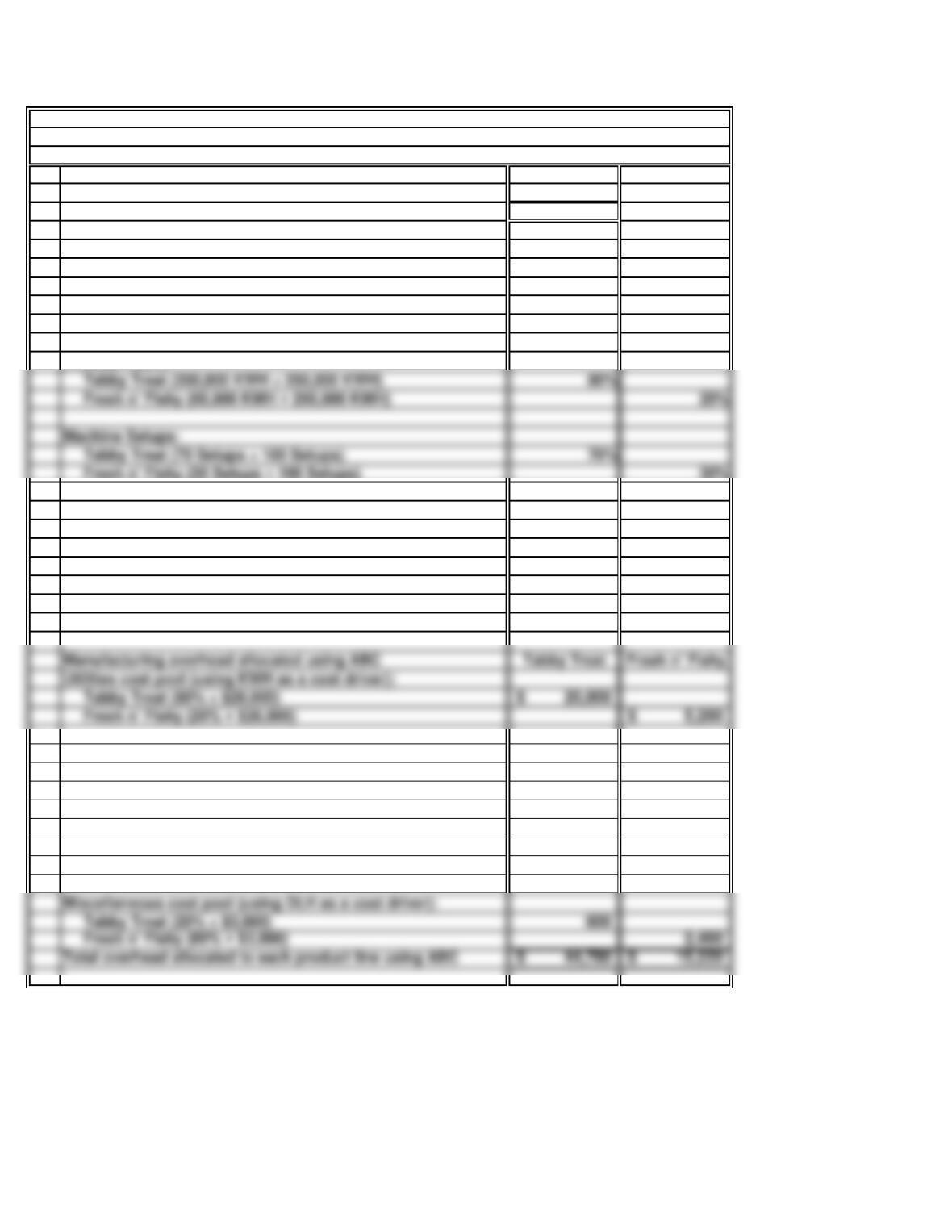
Costs allocated to helmets ($187,500 × 20%)
Costs allocated to poles ($187,500 × 50%)
Total custodial costs allocated to products
Boots Poles Helmets Total
Units produced
Maintenance cost per unit
Total costs allocated
From custodial cost pool
c.
Using machine hours as a single activity base is likely to result in significant cost distortions
for this company. While helmet production consumes the most machine hours, only 20% of
the company’s total maintenance cost is attributed to helmet production when activity-base
costing (ABC) is used ($50,000 out of a $250,000 total). Using ABC decreases the amount of
total maintenance costs assigned to helmet production and reassigns these costs to the
Square feet to produce boots
Allocating custodial cost pool to product lines:
Establish the percent of custodial cost pool to be
allocated to each product line using square
footage occupied as an activity base.
Step 1:
Step 2:
Allocate the custodial cost pool to each product
line based on the percentages computed
From setup cost pool
Determining maintenance costs per unit using ABC:
in step 1.
Costs allocated to boots ($187,500 × 30%)
Square feet to produce helmets
Total square feet required
Square feet to produce poles
45 Minutes, Strong
PROBLEM 17.8B
HAPPY CAT, INC.
a. Budgeted manufacturing overhead 60,000$
Budgeted direct labor hours (DLH) ÷ 15,000
Manufacturing overhead application rate $4 per DLH
Manufacturing overhead allocated using DLH Tabby Treat Fresh n’ Fishy
75,000 bags × 0.04 DLH per bag × $4 per DLH 12,000$
48,000 cases × 0.25 DLH per case × $4 per DLH 48,000$
b. Percent of cost driver assigned to each product line Tabby Treat Fresh n’ Fishy
Kilowatt hours:
Fresh n’ Fishy (30 Setups ÷ 100 Setups) 30%
Square feet occupied:
Tabby Treat (42,000 Sq. Ft. ÷ 50,000 Sq. Ft.) 84%
Fresh n’ Fishy (8,000 Sq. Ft. ÷ 50,000 Sq. Ft.) 16%
Direct labor hours:
Tabby Treat (3,000 DLH ÷ 15,000 DLH) 20%
Fresh n’ Fishy (12,000 DLH ÷ 15,000 DLH) 80%
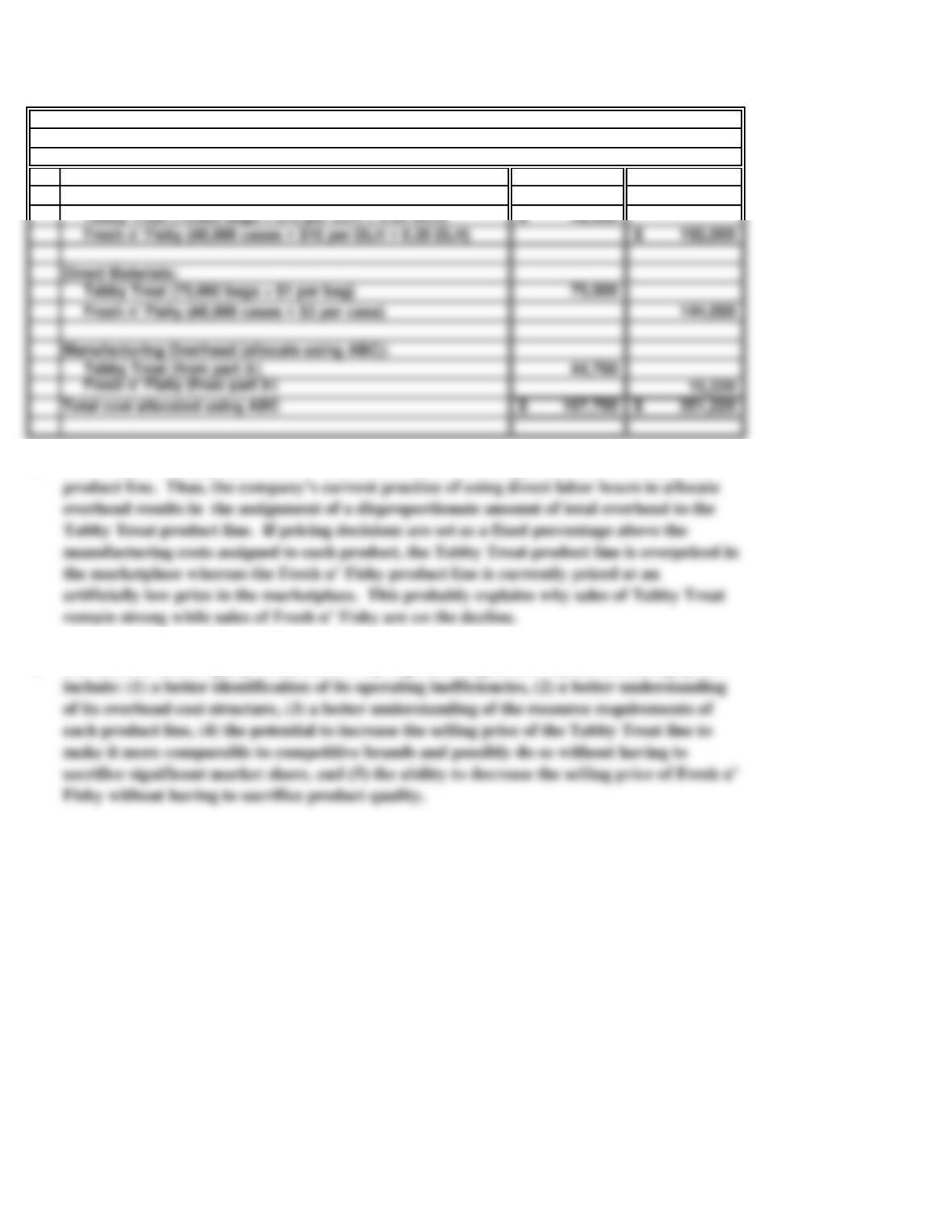
Manufacturing overhead allocated using ABC Tabby Treat Fresh n’ Fishy
Utilities cost pool (using KWH as a cost driver):
Tabby Treat (80% × $26,000) 20,800$
Fresh n’ Fishy (20% × $26,000) 5,200$
Maintenance cost pool (using setups as a cost driver):
Tabby Treat (70% × $19,000) 13,300
Fresh n’ Fishy (30% × $19,000) 5,700
Depreciation cost pool (using Sq. Ft. as a cost driver):
Tabby Treat (84% × $12,000) 10,080
Fresh n’ Fishy (16% × $12,000) 1,920
Tabby Treat (20% × $3,000) 600
Total overhead allocated to each product line using ABC 44,780$ 15,220$
Tabby Treat (200,000 KWH ÷ 250,000 KWH) 80%
Fresh n’ Fishy (50,000 KWH ÷ 250,000 KWH) 20%
Machine Setups:
Tabby Treat (70 Setups ÷ 100 Setups) 70%
PROBLEM 17.8B
HAPPY CAT, INC. (concluded)
c. Total manufacturing costs allocated to each product line
Tabby Treat Fresh n’ Fishy
Direct Labor:
d.
e.
The Fresh n’ Fishy product line is very labor intensive in comparison to the Tabby Treat
The benefits the company would achieve by implementing an activity-based costing system
Direct Materials:
Manufacturing Overhead (allocate using ABC):
SOLUTIONS TO CRITICAL THINKING CASES
CASE 17.1
CLASSIC CABINETS
a.
b.
c.
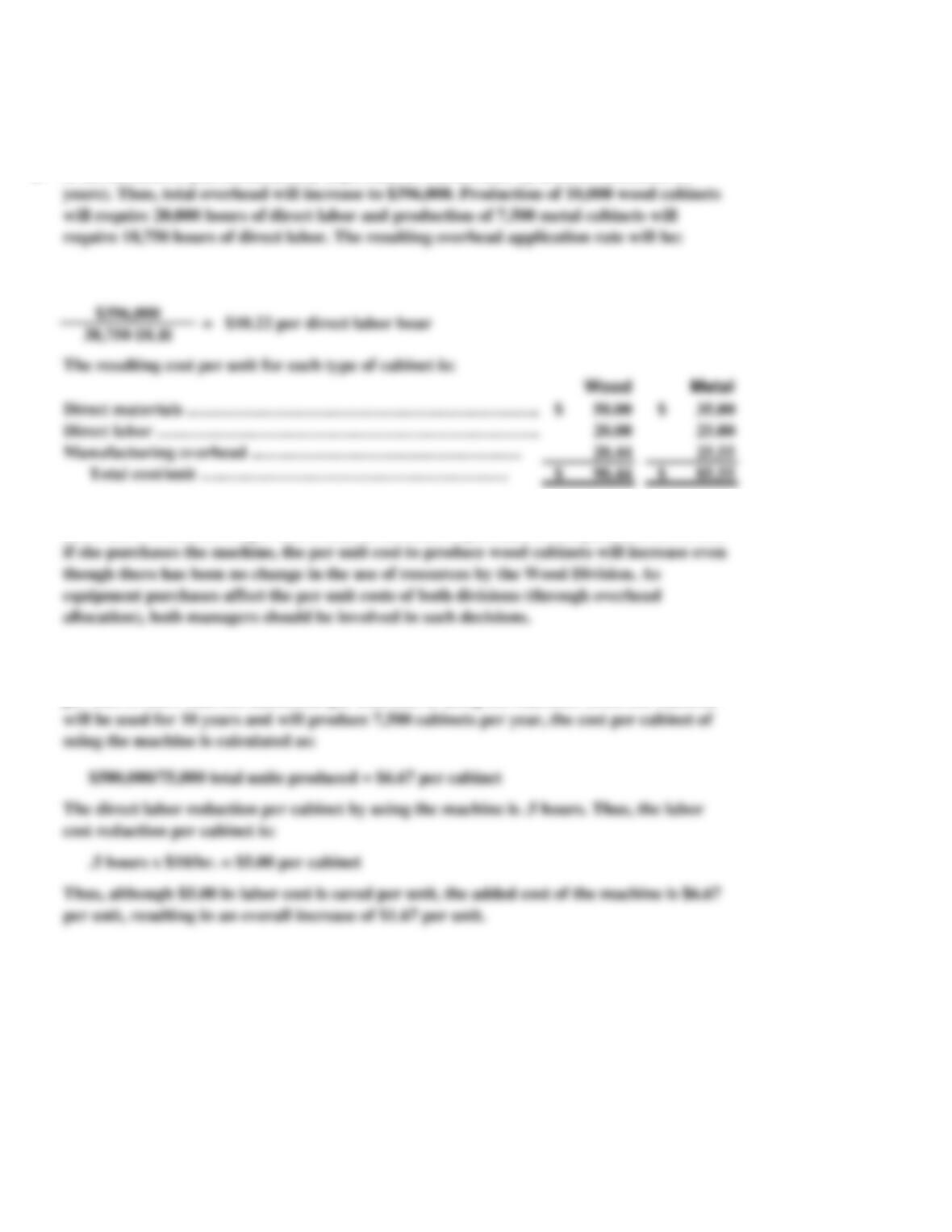
From Mary’s point of view, her per unit costs will decrease if the machine is purchased.
Since she is evaluated on per unit costs, the decision to purchase seems justified. However,
The information needed to evaluate the purchase is whether the direct labor costs saved
per unit is more than the additional per unit cost of using the machine. Since the machine
35 Minutes, Medium
If the machine is purchased, yearly depreciation will increase by $50,000 ($500,000/10

CASE 17.1
CLASSIC CABINETS (concluded)
d.
If each manager’s performance evaluation is based on the unit costs calculated in part a,

10 Minutes, Easy CASE 17.2
MICA CORPORATION
Under the current bonus system, unethical production managers could increase their bonuses
by purposely understating the square footage occupied by their respective product lines. To

25 Minutes, Medium CASE 17.3
THE BIDDING WARS
ETHICS, FRAUD & CORPORATE GOVERNANCE
It is tempting to say that underbidding is an unethical practice. But on the other hand, if it is
the standard and accepted practice, a company that does not “play the game” will win no

CASE 17.4
C. ERICKSON AND SONS, INC.
INTERNET
a.
c.
It is likely that job order costing is used for construction projects since each building is
Examples from the Web site of projects include: restaurants, building conversions, building
renovations, law offices, corporate headquarters, and a hospital, community center.
10 Minutes, Easy