17-57
17-58
SOLUTION EXHIBIT 17-39A
17-59
SOLUTION EXHIBIT 17-39B
17-60
17-40 (45 min.) Transferred-in costs, weighted-average and FIFO methods.
Portland Pale Ale, Inc., makes a variety of specialty beers at its main brewery in Oregon.
Production of beer occurs in three main stages: mashing, boiling, and fermenting. Consider the
fermenting department, where direct materials (bottles and other packaging) are added at the end
of the process. Conversion costs are added evenly during the process.
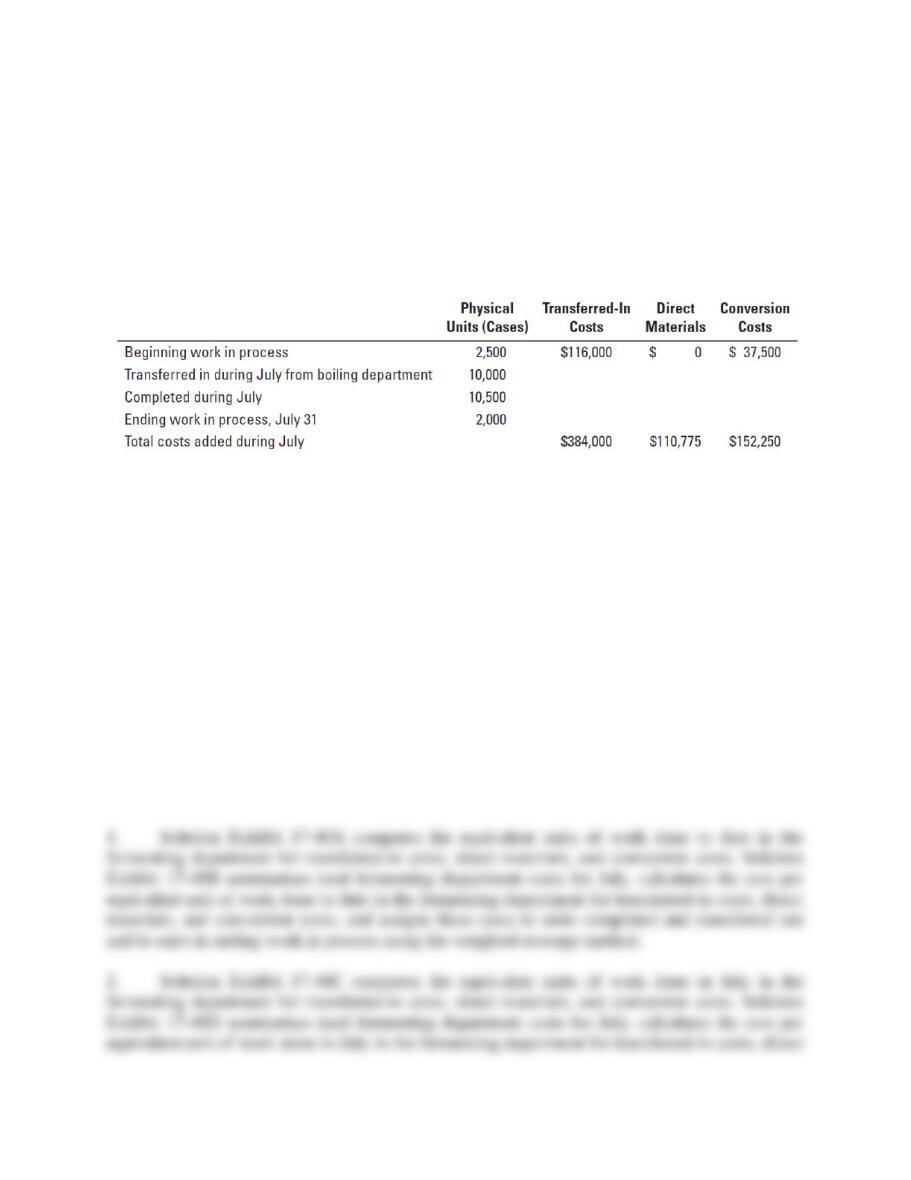
Portland Pale Ale provides the following information related to its top-selling Gypsum Ale
for the fermenting department for the month of July:
The units in beginning work in process are 25% complete for conversion costs, while the
units in ending inventory are 50% complete for conversion costs.
Required:
1. Using the weighted-average method, summarize the total fermenting department costs for
July, and assign costs to units completed (and transferred out) and to units in ending work in
process.
2. Assume that the FIFO method is used for the fermenting department. Under FIFO, the
transferred-in costs for work-in-process beginning inventory in July are $115,680 (instead of
$116,000 under the weighted-average method), and the transferred-in costs during July from
the boiling department are $376,000 (instead of $384,000 under the weighted-average
method). All other data are unchanged. Summarize the total fermenting department costs for
July, and assign costs to units completed and transferred out and to units in ending work in
process using the FIFO method.
SOLUTION
17-61
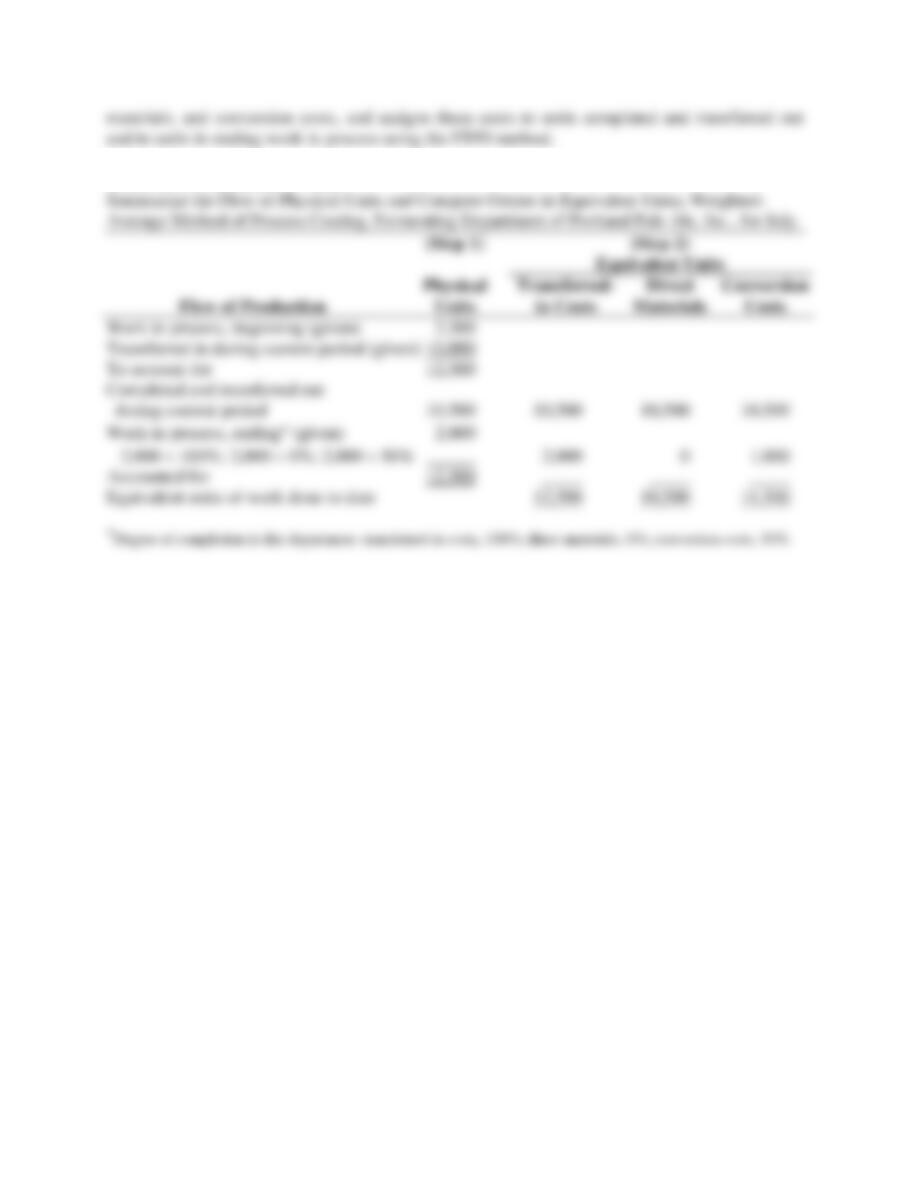
SOLUTION EXHIBIT 17-40A
17-62
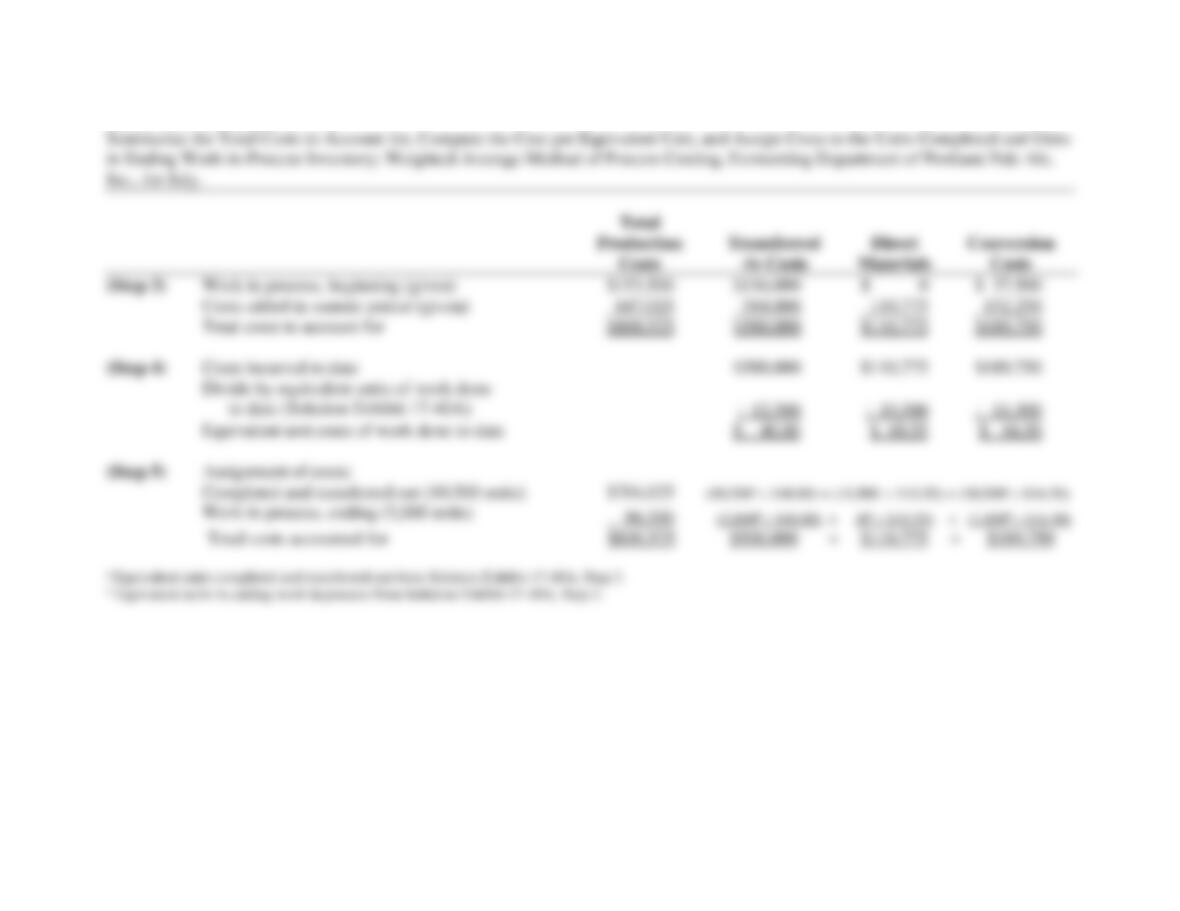
SOLUTION EXHIBIT 17-40B
17-63
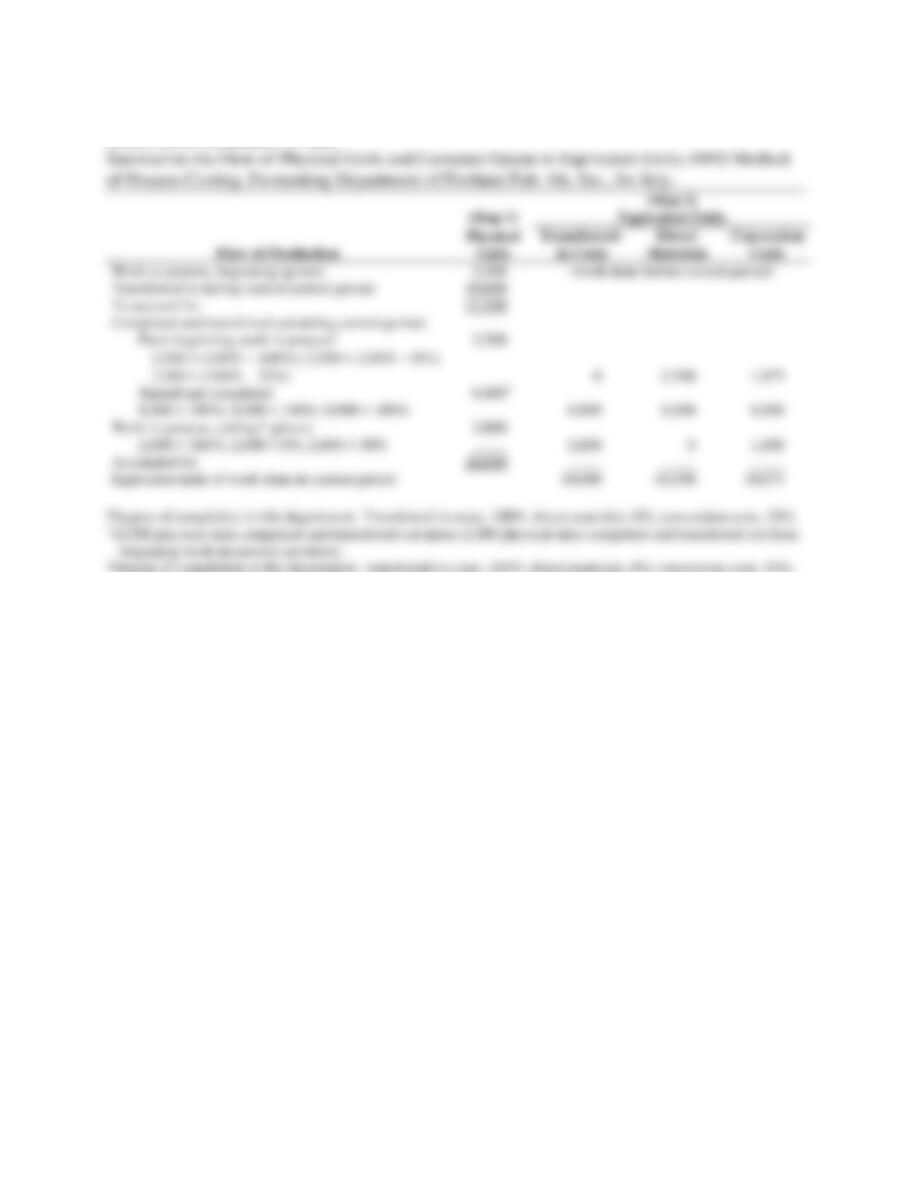
SOLUTION EXHIBIT 17-40C
*Degree of completion in this department: transferred-in costs, 100%; direct materials, 0%; conversion costs, 50%.
17-64
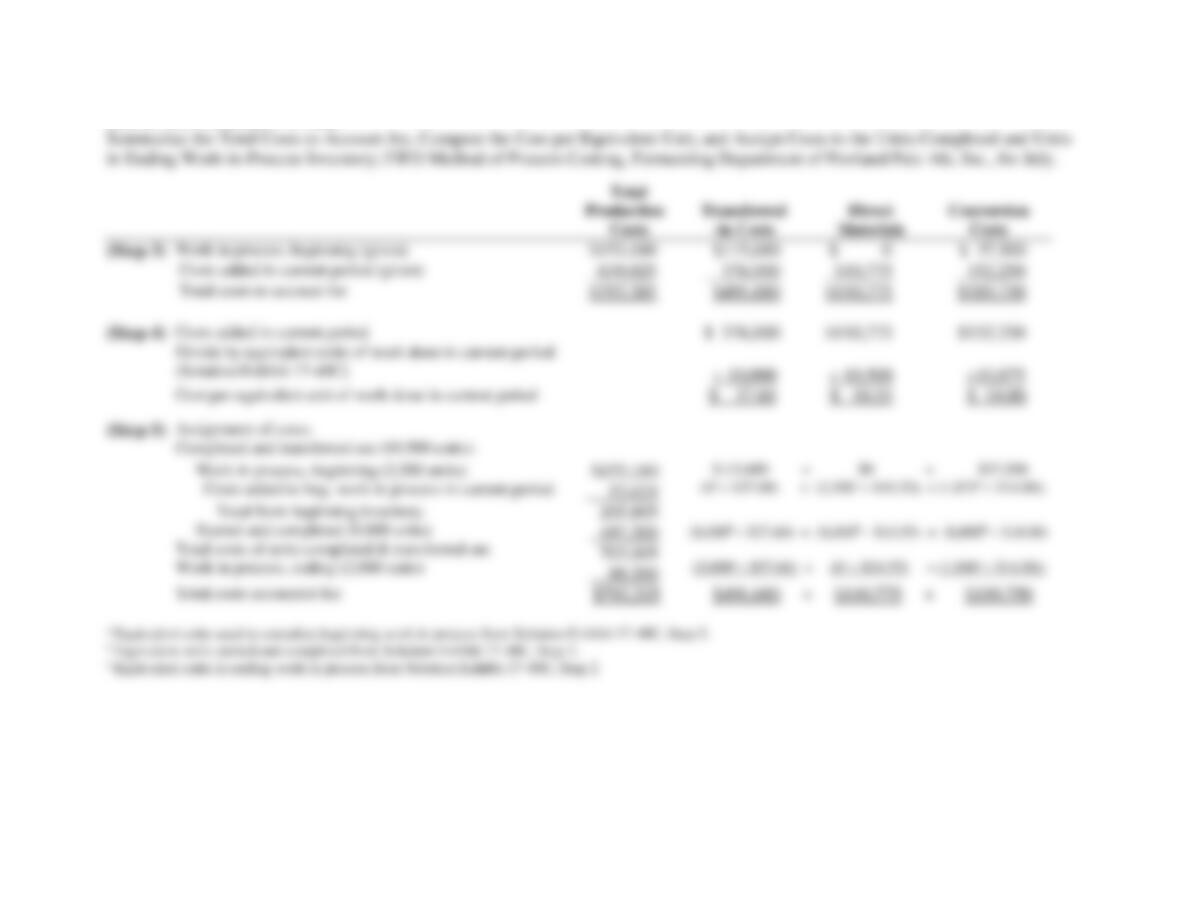
SOLUTION EXHIBIT 17-40D
17-65
17-41 (25 min.) Multiple processes or operations, costing.
The Sedona Company is dedicated to making products that meet the needs of customers in a
sustainable manner. Sedona is best known for its KLN water bottle, which is a BPA-free,
dishwasher-safe, bubbly glass bottle in a soft silicone sleeve.
The production process consists of three basic operations. In the first operation, the glass is
formed by remelting cullets (broken or refuse glass). In the second operation, the glass is
assembled with the silicone gasket and sleeve. The resulting product is finished in the final
operation with the addition of the polypropylene cap.
Consulting studies have indicated that of the total conversion costs required to complete a
finished unit, the forming operation requires 60%, the assembly 30%, and the finishing 10%.
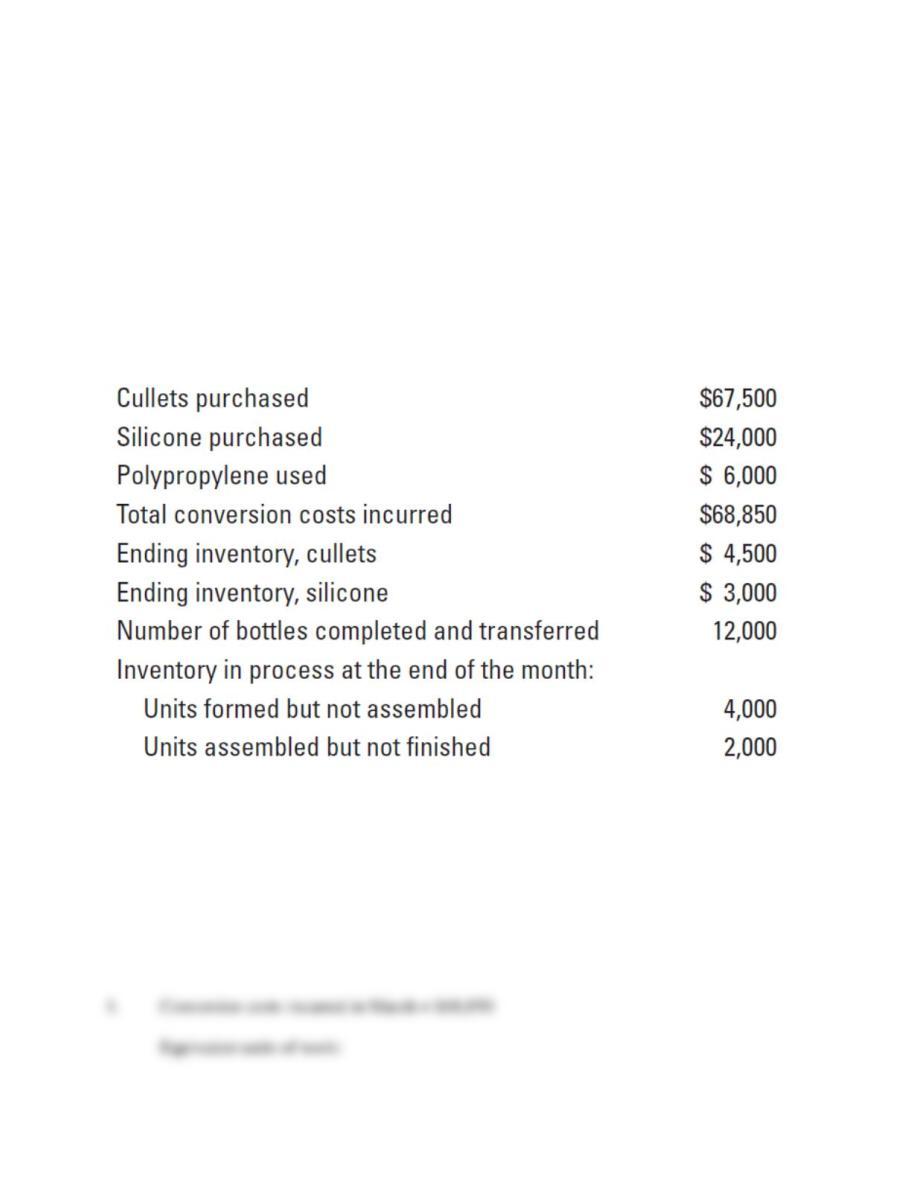
The following data are available for March 2014 (there is no opening inventory of any kind):
Required:
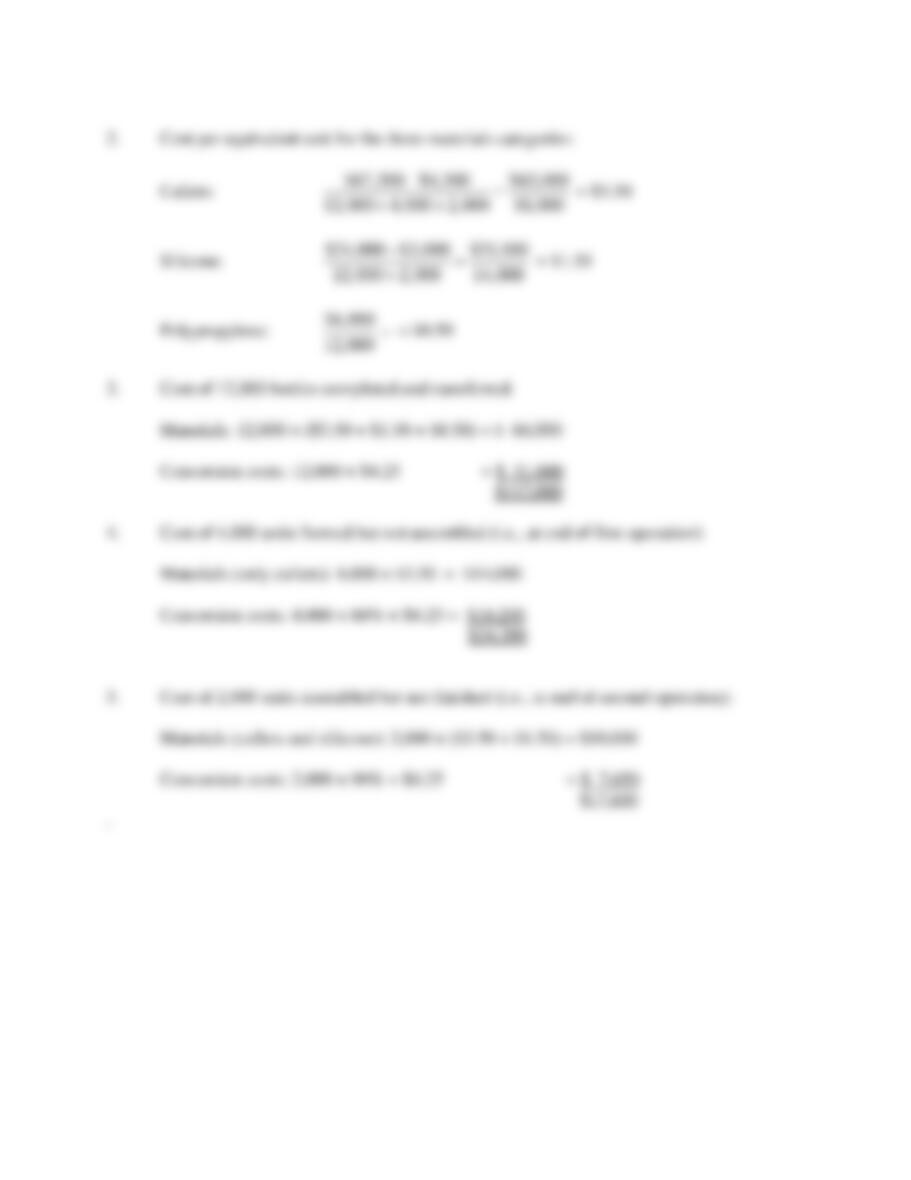
1. What is the cost per equivalent unit for conversion costs for KLN bottles in March 2014?
2. Compute the cost per equivalent unit with respect to each of the three materials: cullets,
silicone, and polypropylene.
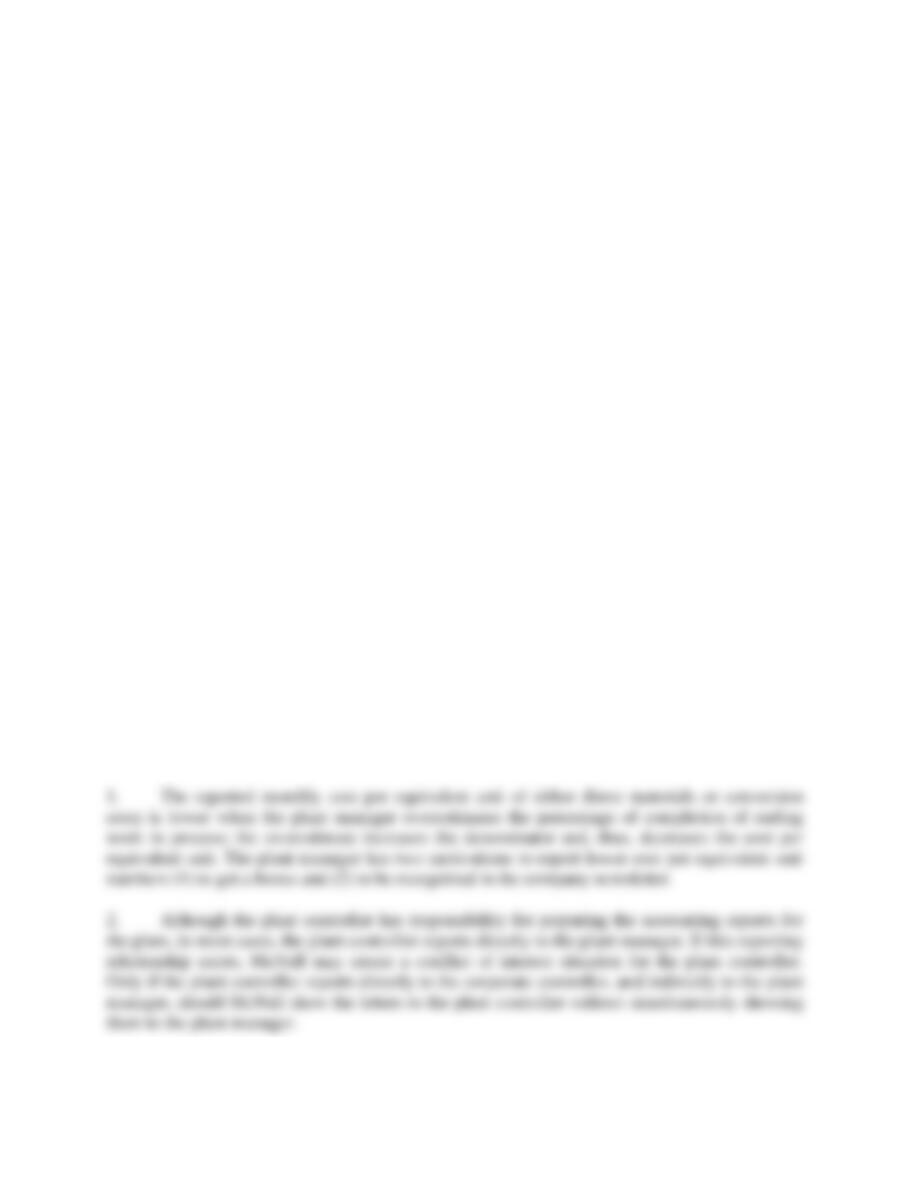
3. What is the cost of goods completed and transferred out?
4. What is the cost of goods formed but not assembled?
5. What is the cost of goods assembled but not finished?
SOLUTION

17-66
17-67
17-68
17-42 (20 min.) Benchmarking, ethics.
Amanda McNall is the corporate controller of Scott Quarry. Scott Quarry operates 12 rock–
crushing plants in Scott County, Kentucky, that process huge chunks of limestone rock extracted
from underground mines.
Given the competitive landscape for pricing, Scott’s managers pay close attention to costs.
Each plant uses a process-costing system, and at the end of every quarter, each plant manager
submits a production report and a production-cost report. The production report includes the
plant manager’s estimate of the percentage of completion of the ending work in process as to
direct materials and conversion costs, as well as the level of processed limestone inventory.
McNall uses these estimates to compute the cost per equivalent unit of work done for each input
for the quarter. Plants are ranked from 1 to 12, and the three plants with the lowest cost per
equivalent unit for direct materials and conversion costs are each given a bonus and recognized
in the company newsletter.
McNall has been pleased with the success of her benchmarking program. However, she has
recently received anonymous emails that two plant managers have been manipulating their
monthly estimates of percentage of completion in an attempt to obtain the bonus.
Required:
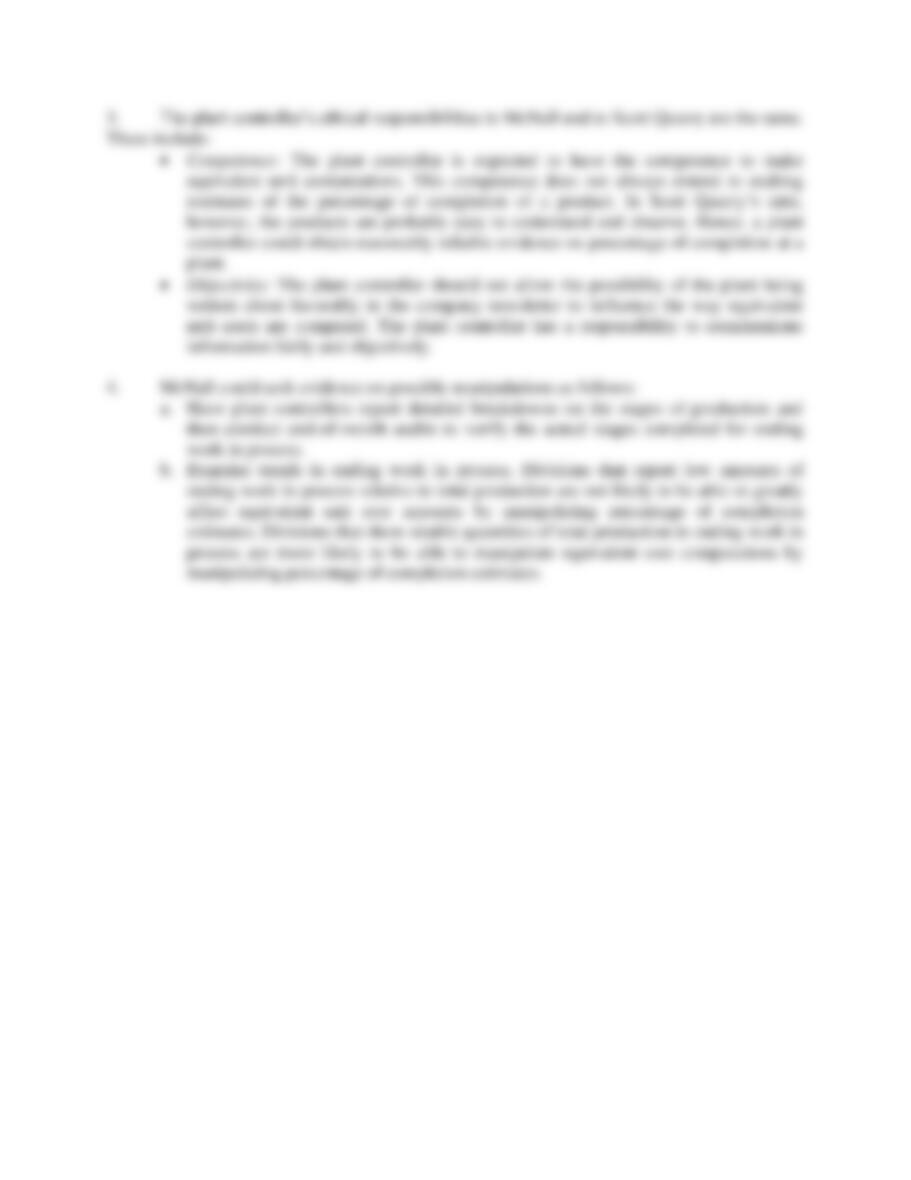
1. Why and how might managers manipulate their monthly estimates of percentage of
completion and level of inventory?
2. McNall’s first reaction is to contact each plant controller and discuss the problem raised by
the anonymous communications. Is that a good idea?
3. Assume that each plant controller’s primary reporting responsibility is to the plant manager
and that each plant controller receives the phone call from McNall mentioned in requirement
2. What is the ethical responsibility of each plant controller (a) to Amanda McNall and (b) to
Scott Quarry in relation to the equivalent-unit and inventory information each plant provides?
4. How might McNall learn whether the data provided by particular plants are being
manipulated?
SOLUTION
17-69
17-70
17-71
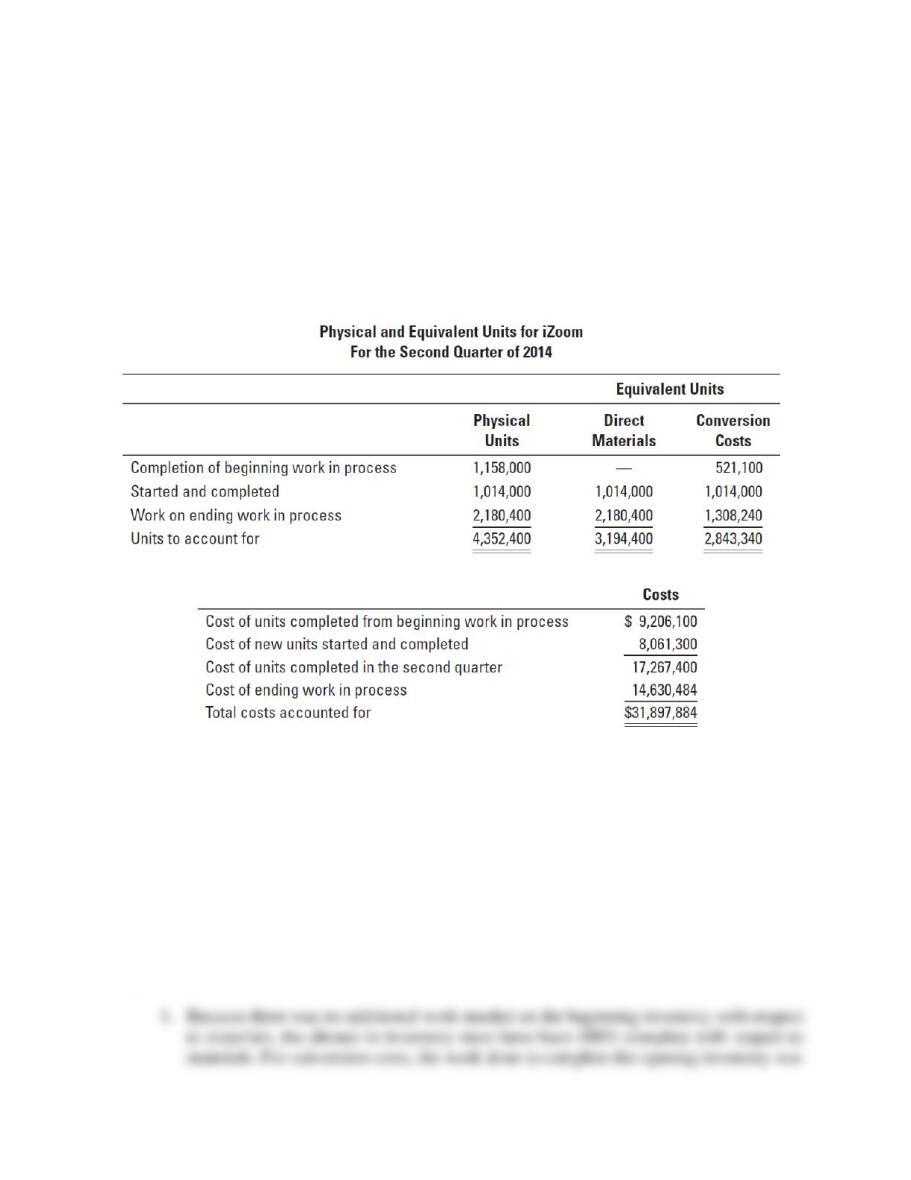
17-43 (30 min.) Standard-costing method.
Hi-sense Technologies produces stripped-down phones for sale to customers in frontier
economies. The firm purchases used or obsolete models of specific smartphone models. It
removes nonstandard applications, installs open source Android software, and unlocks the phone
so it can operate on GSM networks. Hi-sense’s most popular offering is the iZoom phone.
Given the importance of scaling and cost control for the success of its business model, Hi–
sense uses a standard-costing system. The following information is available for the second
quarter of 2014 (April 1–June 30):
Required:
1. What are the completion percentages of iZoom phones in beginning work-in-process
inventory with respect to the two inputs?
2. What are the completion percentages of iZoom phones in ending work-in-process inventory
with respect to the two inputs?
3. What are the standard costs per unit for direct materials and conversion costs?
4. What is the total cost of work-in-process inventory as of April 1, 2014 (the start of the second
quarter)?
SOLUTION
17-72