17-1
CHAPTER 17
PROCESS COSTING
17-1 Industries using process costing in their manufacturing areas include chemical
processing, oil refining, pharmaceuticals, plastics, brick and tile manufacturing, semiconductor
chips, beverages, and breakfast cereals.
17-3 Equivalent units is a derived amount of output units that takes the quantity of each input
(factor of production) in units completed or in incomplete units in work in process and converts
the quantity of input into the amount of completed output units that could be made with that
quantity of input. Each equivalent unit is comprised of the physical quantities of direct materials
or conversion costs inputs necessary to produce output of one fully completed unit. Equivalent
unit measures are necessary because all physical units are not completed to the same extent at the
same time.
17-4 The accuracy of the estimates of completion depends on the care and skill of the
estimator and the nature of the process. Semiconductor chips may differ substantially in the
finishing necessary to obtain a final product. The amount of work necessary to finish a product
may not always be easy to ascertain in advance.
17-6 Three inventory methods associated with process costing are
• weighted average.
• first-in, first-out.
• standard costing.
17-2
17-8 FIFO computations are distinctive because they assign the cost of the previous
accounting period’s equivalent units in beginning work–in-process inventory to the first units
completed and transferred out of the process and assign the cost of equivalent units worked on
during the current period first to complete beginning inventory, next to start and complete new
units, and finally to units in ending work-in-process inventory. In contrast, the weighted-average
method costs units completed and transferred out and in ending work in process at the same
average cost.
17-11 The journal entries in process costing are basically similar to those made in job-costing
systems. The main difference is that, in process costing, there is often more than one work-in–
process account––one for each process.
17-13 There are two reasons why the accountant should distinguish between transferred-in
costs and additional direct materials costs for a particular department:
(a) All direct materials may not be added at the beginning of the department process.
(b) The control methods and responsibilities may be different for transferred-in items and
materials added in the department.
17-14 No. Transferred-in costs or previous department costs are costs incurred in a previous
department that have been charged to a subsequent department. These costs may be costs
incurred in that previous department during this accounting period or a preceding accounting
period.
17-3
17-16 (25 min.) Equivalent units, zero beginning inventory.
Candid, Inc., is a manufacturer of digital cameras. It has two departments: assembly and testing.
In January 2014, the company incurred $800,000 on direct materials and $805,000 on conversion
costs, for a total manufacturing cost of $1,605,000.
Required:
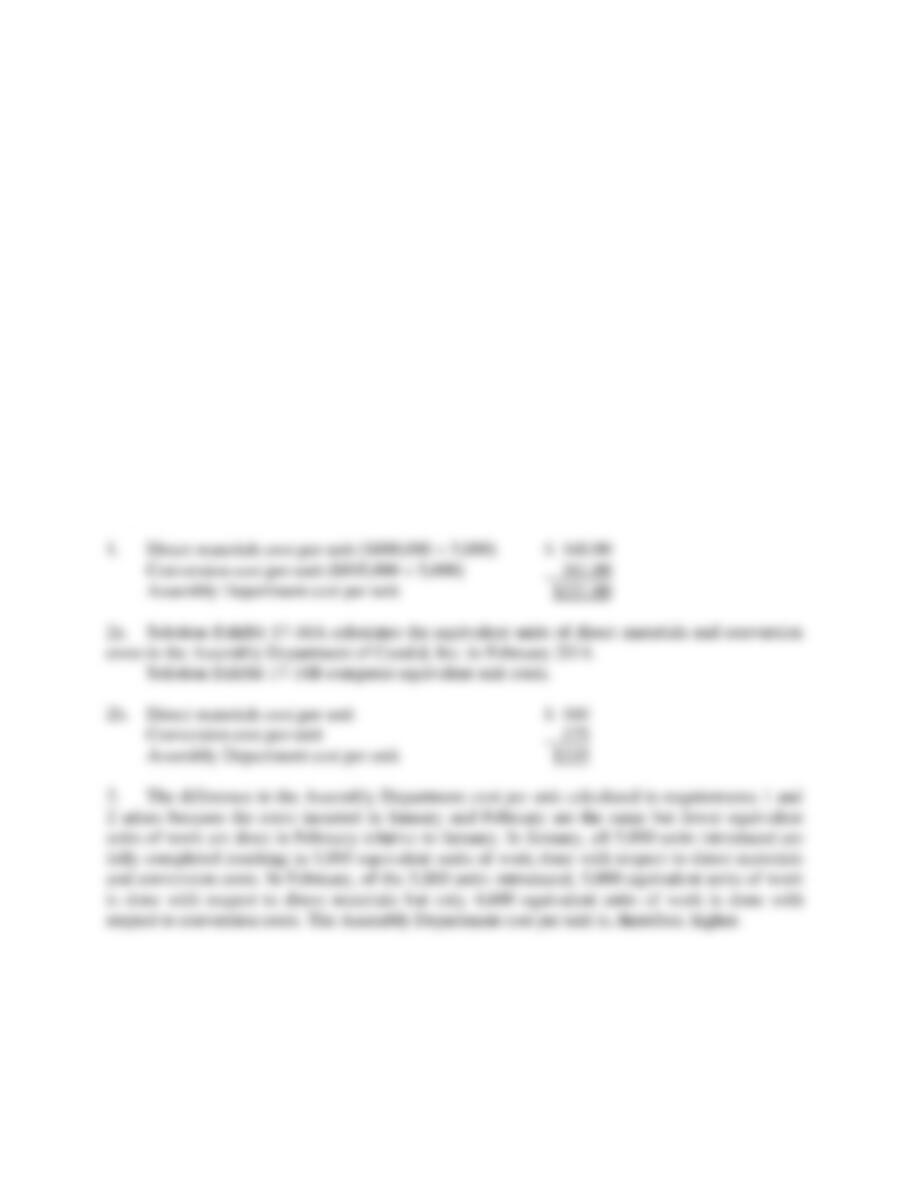
1. Assume there was no beginning inventory of any kind on January 1, 2014. During January,
5,000 cameras were placed into production and all 5,000 were fully completed at the end of
the month. What is the unit cost of an assembled camera in January?
2. Assume that during February 5,000 cameras are placed into production. Further assume the
same total assembly costs for January are also incurred in February, but only 4,000 cameras
are fully completed at the end of the month. All direct materials have been added to the
remaining 1,000 cameras. However, on average, these remaining 1,000 cameras are only
60% complete as to conversion costs. (a) What are the equivalent units for direct materials
and conversion costs and their respective costs per equivalent unit for February? (b) What is
the unit cost of an assembled camera in February 2014?
3. Explain the difference in your answers to requirements 1 and 2.
SOLUTION

17-4
SOLUTION EXHIBIT 17-16A
Summarize the Flow of Physical Units and Compute Output in Equivalent Units;
Assembly Department of Candid, Inc., for February 2014.
(Step 2)
(Step 1)
Equivalent Units
Physical
Direct
Conversion
Flow of Production
Units
Materials
Costs
Work in process, beginning (given) 0
Started during current period (given) 5,000
To account for 5,000
Completed and transferred out
during current period 4,000 4,000 4,000
Work in process, ending* (given) 1,000
1,000 100%; 1,000 60% 1,000 600
Accounted for 5,000
Equivalent units of work done in current period 5,000 4,600
*Degree of completion in this department: direct materials, 100%; conversion costs, 60%.
17-5
SOLUTION EXHIBIT 17-16B
Compute the Cost per Equivalent Unit,
Assembly Department of Candid, Inc., for February 2014.
Total
Production
Costs
Direct
Materials
Conversion
Costs
(Step 3) Costs added during February
$1,605,000
$800,000
$805,000
Divide by equivalent units of work done
in current period (Solution Exhibit 17-l6A)
5,000
4,600
Cost per equivalent unit
$ 160
$ 175
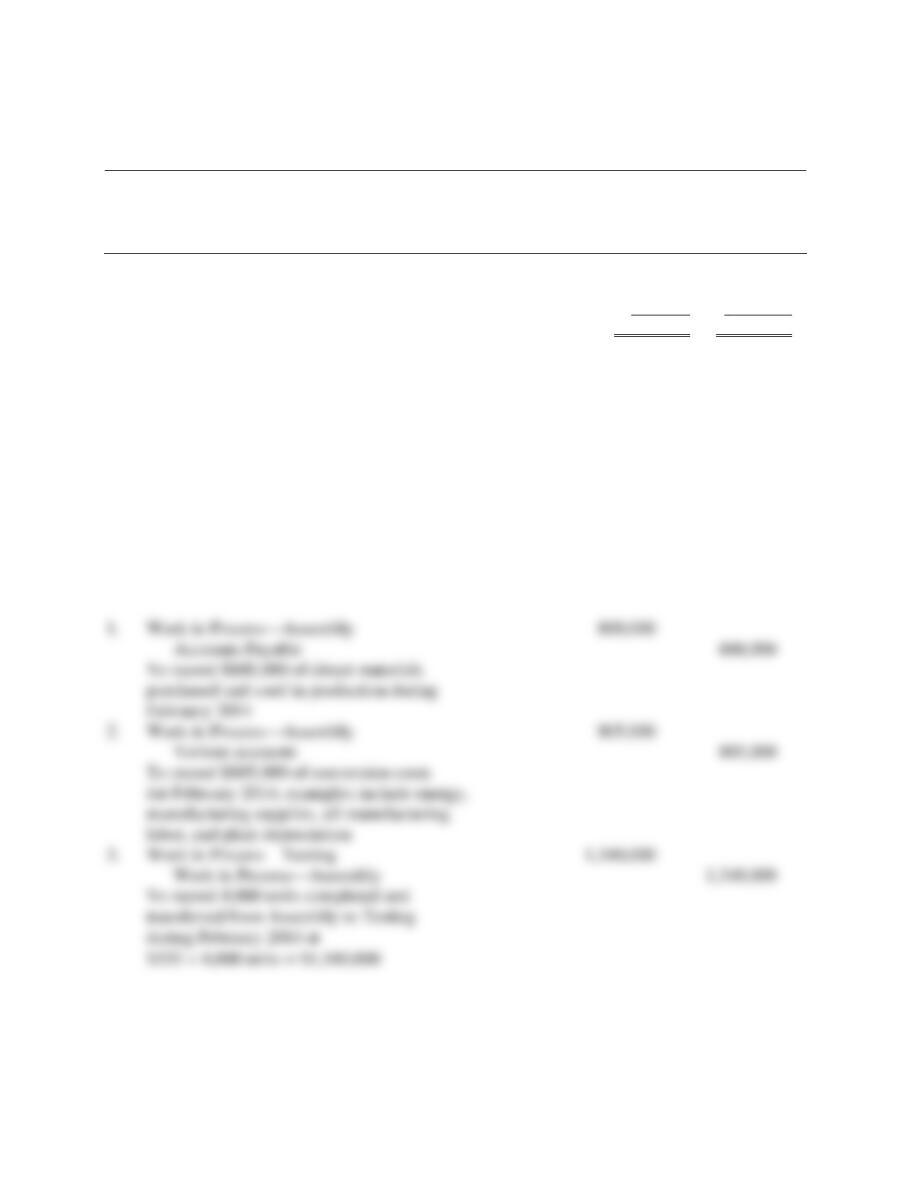
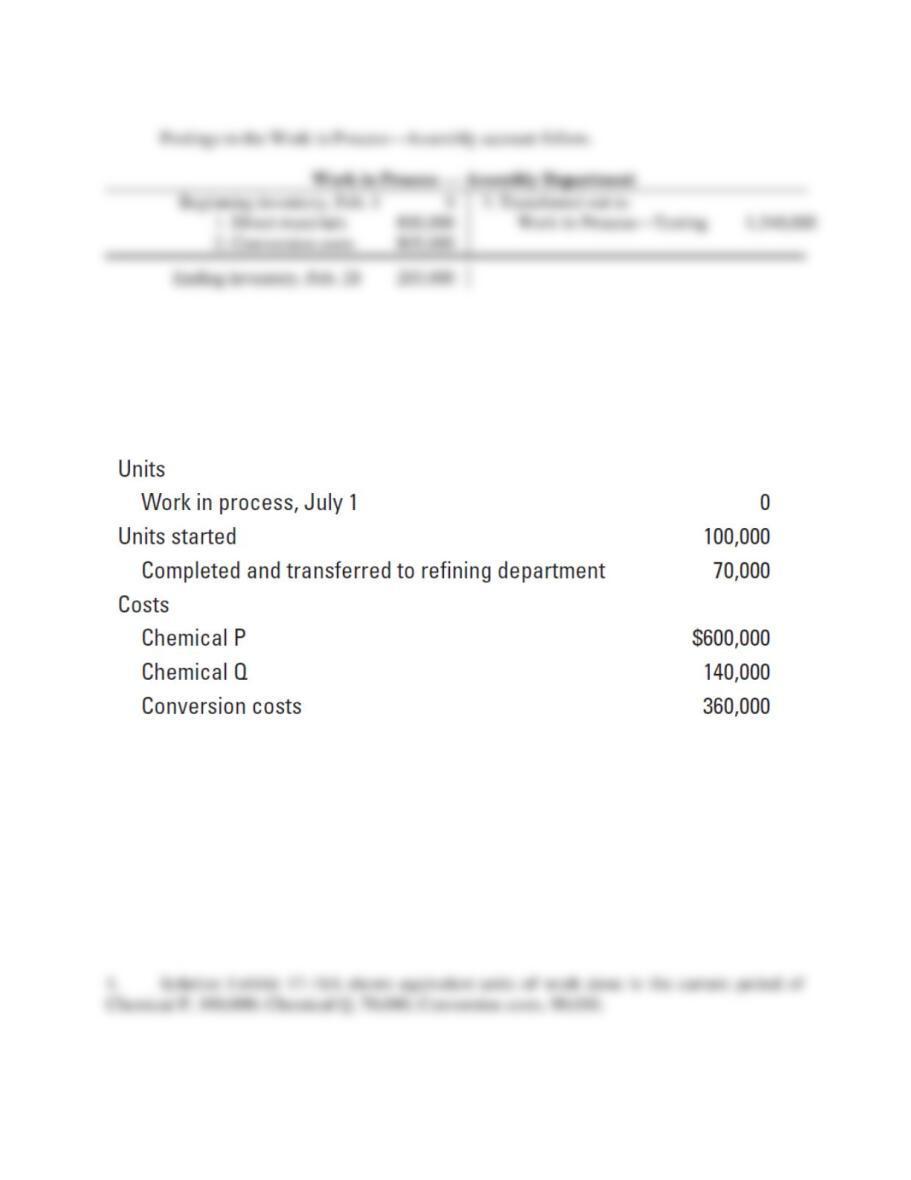
17-17 (20 min.) Journal entries (continuation of 17-16).
Refer to requirement 2 of Exercise 17-16.
Required:
Prepare summary journal entries for the use of direct materials and incurrence of conversion
costs. Also prepare a journal entry to transfer out the cost of goods completed. Show the postings
to the Work in Process account.
SOLUTION
17-6
17-18 (25 min.) Zero beginning inventory, materials introduced in middle of process.
Pilar Chemicals has a mixing department and a refining department. Its process-costing system
in the mixing department has two direct materials cost categories (chemical P and chemical Q)
and one conversion costs pool. The following data pertain to the mixing department for July
2014:
Chemical P is introduced at the start of operations in the mixing department, and chemical Q is
added when the product is three-fourths completed in the mixing department. Conversion costs
are added evenly during the process. The ending work in process in the mixing department is
two-thirds complete.
Required:
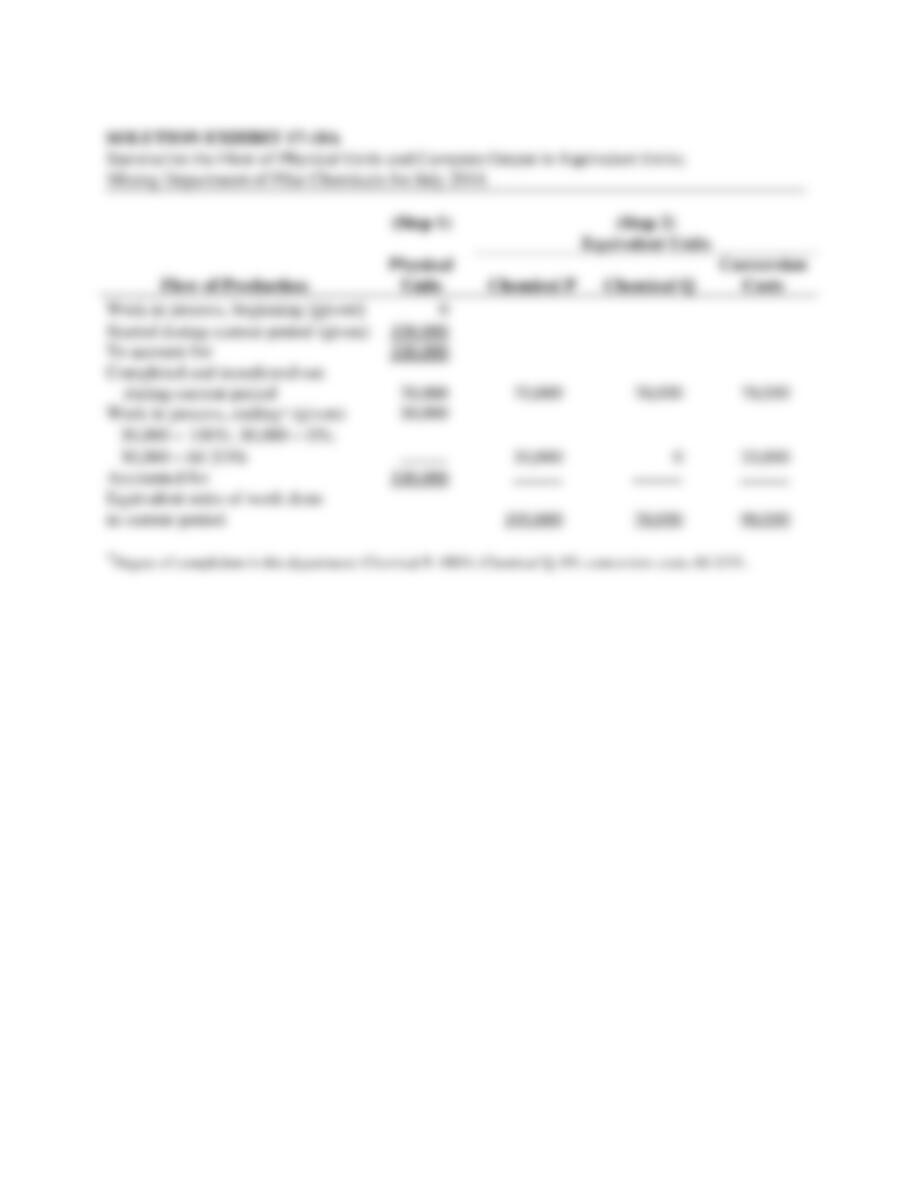
1. Compute the equivalent units in the mixing department for July 2014 for each cost category.
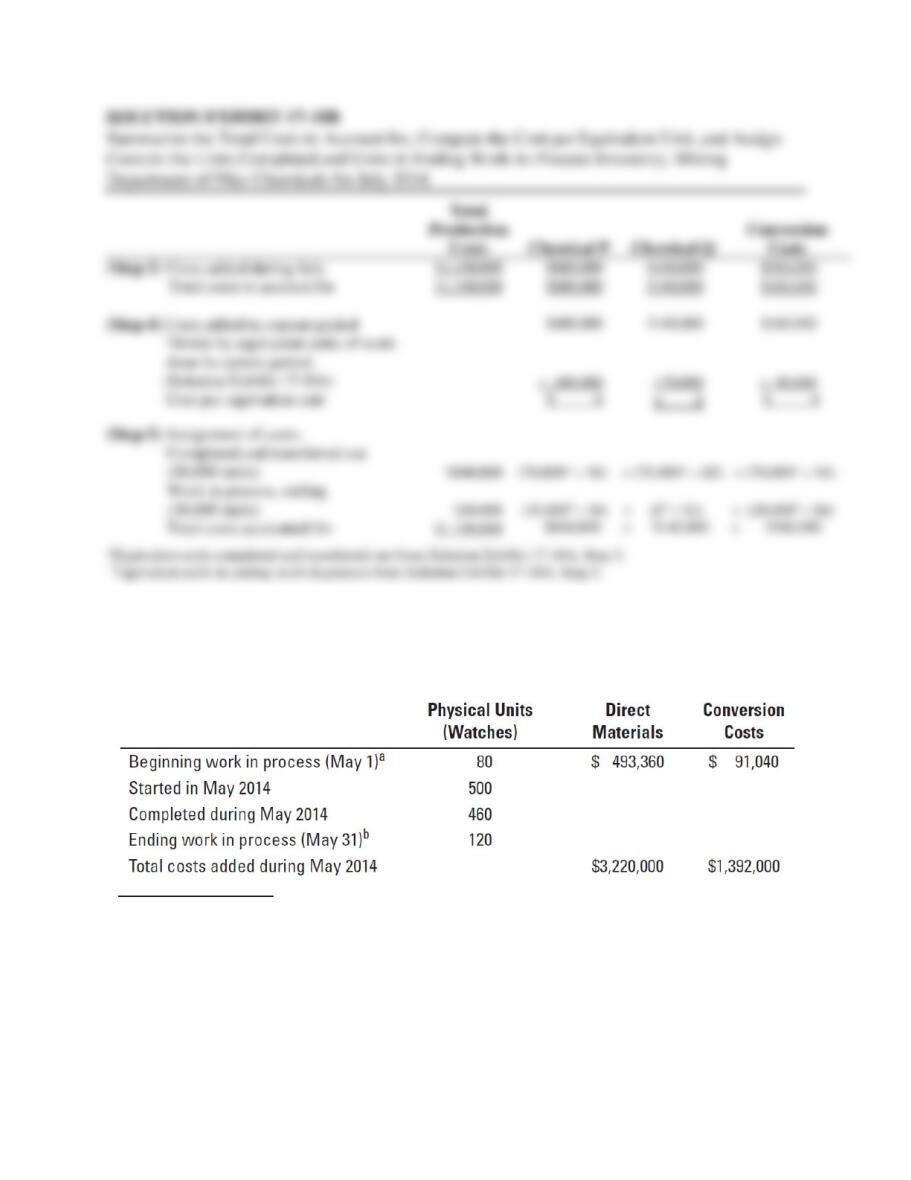
2. Compute (a) the cost of goods completed and transferred to the refining department during
July and (b) the cost of work in process as of July 31, 2014.
SOLUTION

17-7
17-8
17-9
17-19 (15 min.) Weighted-average method, equivalent units.
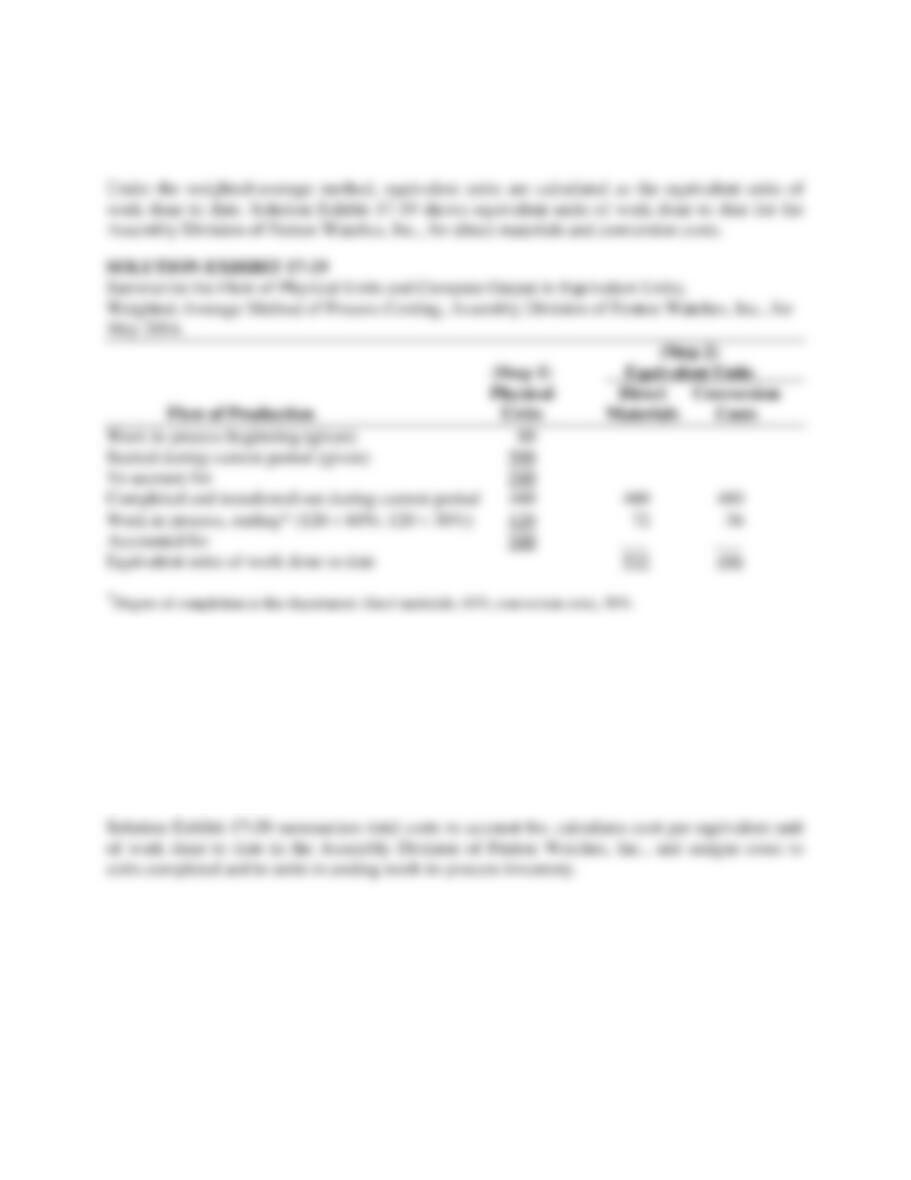
The assembly division of Fenton Watches, Inc., uses the weighted-average method of process
costing. Consider the following data for the month of May 2014:
aDegree of completion: direct materials, 90%; conversion costs, 40%.
bDegree of completion: direct materials, 60%; conversion costs, 30%.
Required:
Compute equivalent units for direct materials and conversion costs. Show physical units in the
first column of your schedule.
17-10
SOLUTION
17-20 (20 min.) Weighted-average method, assigning costs (continuation of 17-19).
Required:
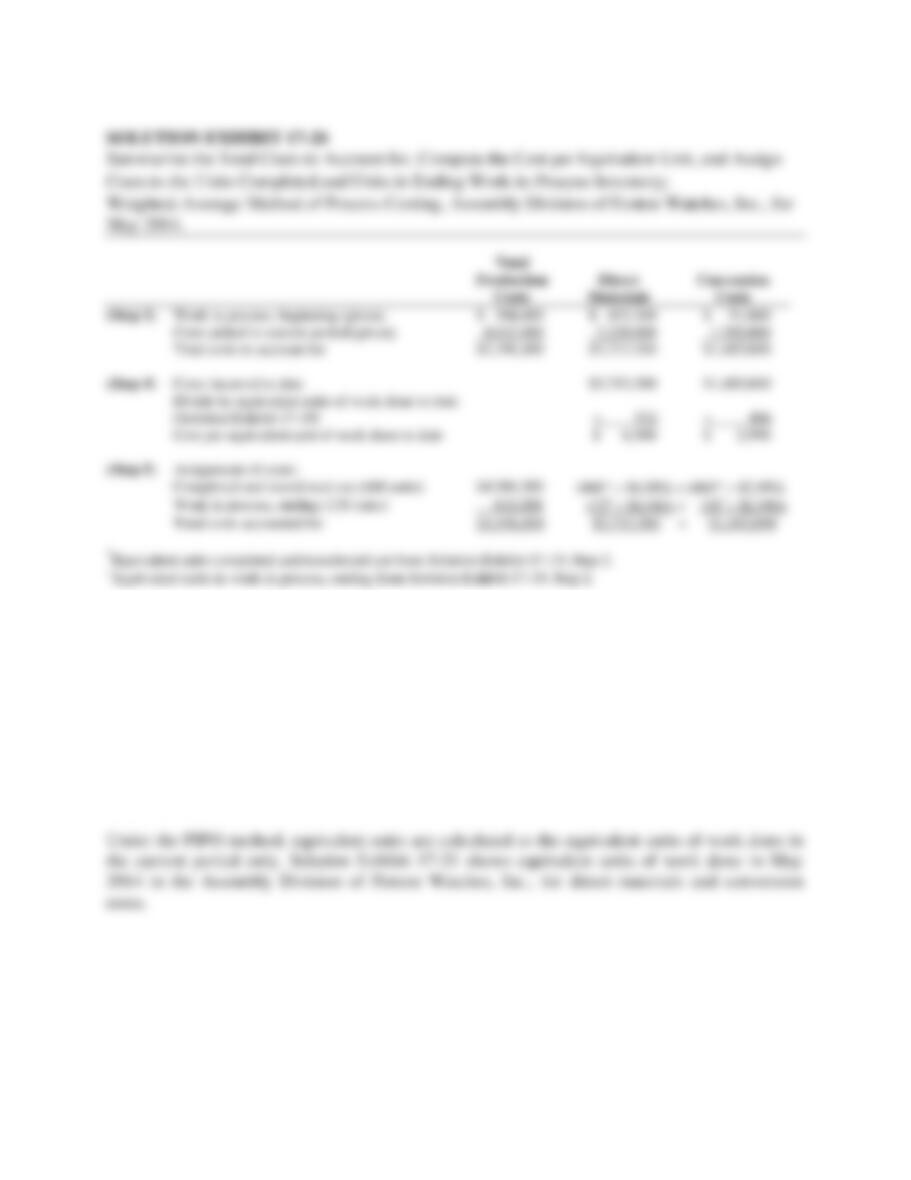
For the data in Exercise 17-19, summarize the total costs to account for, calculate the cost per
equivalent unit for direct materials and conversion costs, and assign costs to the units completed
(and transferred out) and units in ending work in process.
SOLUTION
17-11
17-21 (15 min.) FIFO method, equivalent units.
Refer to the information in Exercise 17-19. Suppose the assembly division at Fenton Watches,
Inc., uses the FIFO method of process costing instead of the weighted-average method.
Required:
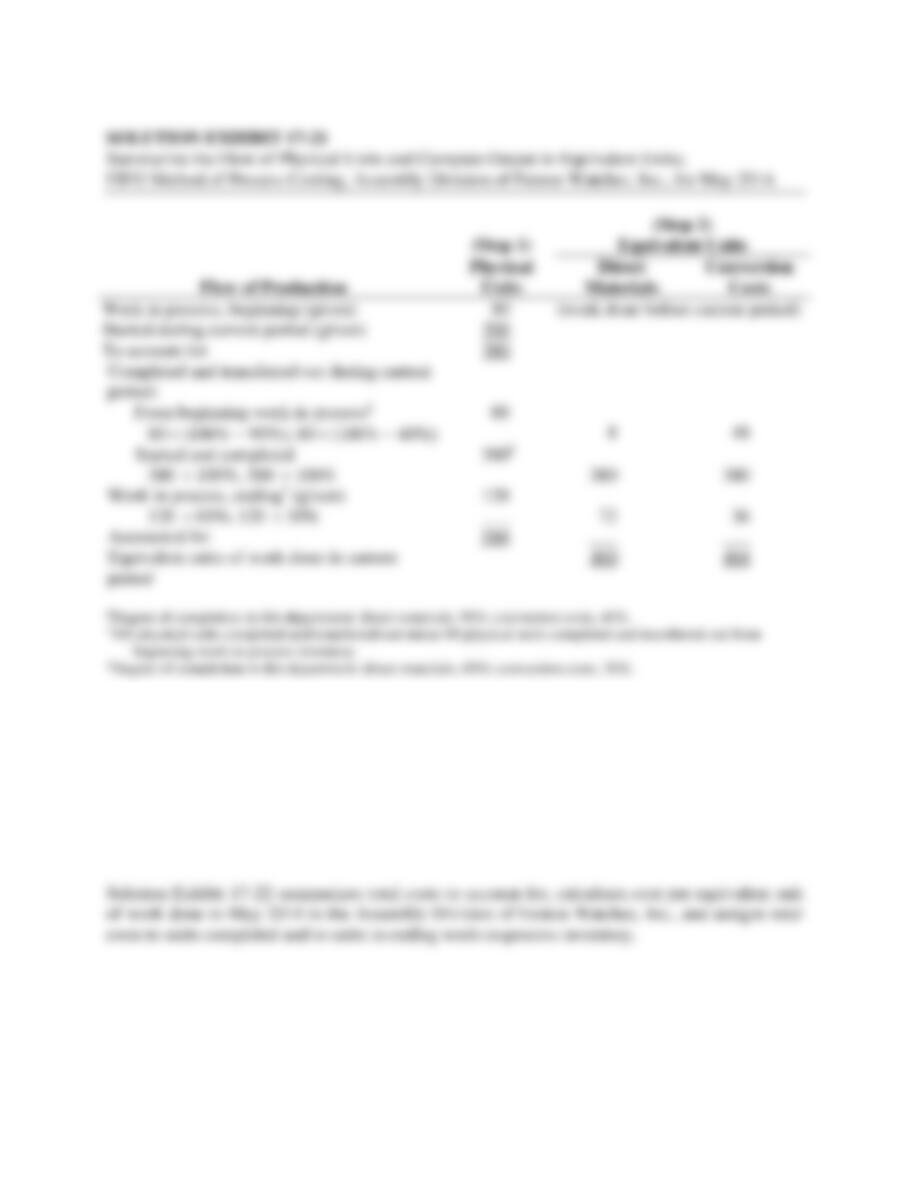
Compute equivalent units for direct materials and conversion costs. Show physical units in the
first column of your schedule.
SOLUTION
17-12
17-22 (20 min.) FIFO method, assigning costs (continuation of 17-21).
Required:
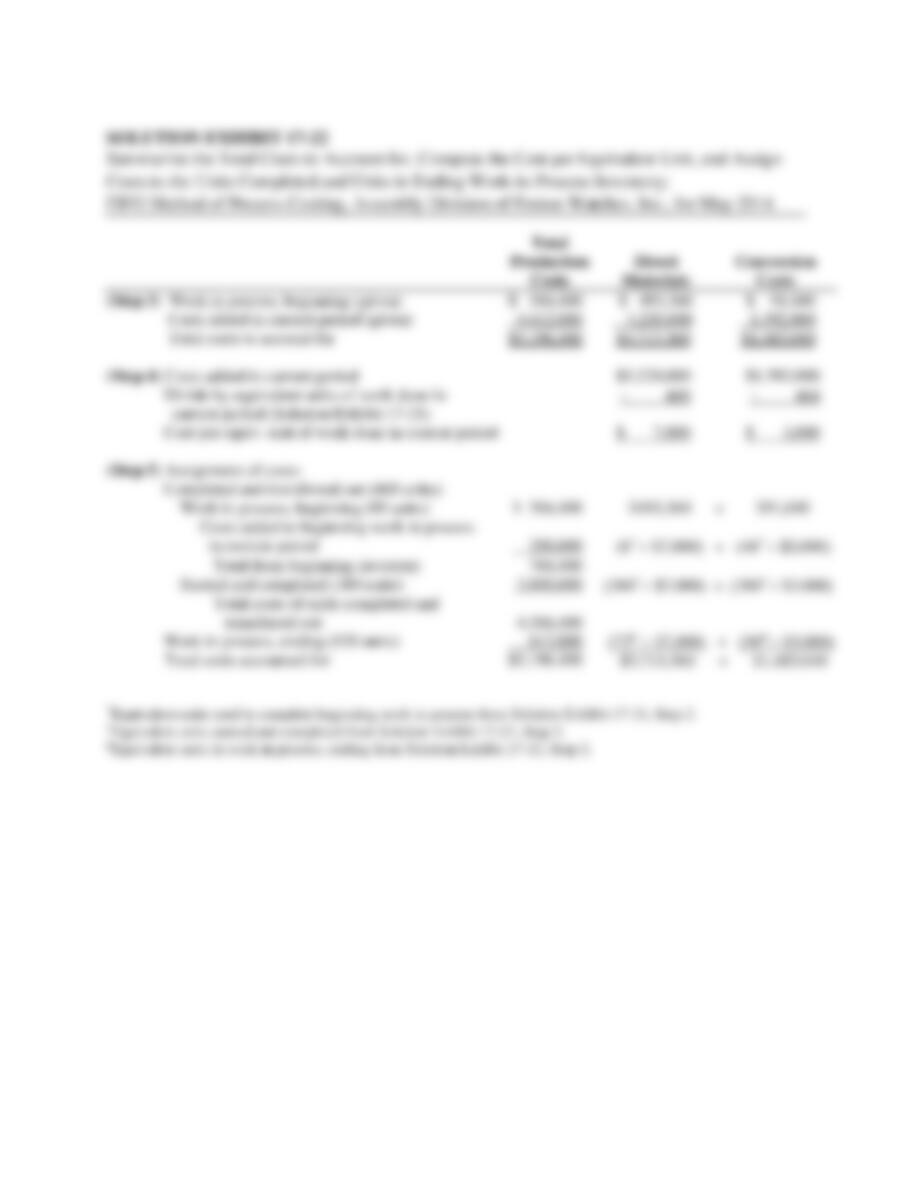
For the data in Exercise 17-19, use the FIFO method to summarize the total costs to account for,
calculate the cost per equivalent unit for direct materials and conversion costs, and assign costs
to units completed (and transferred out) and to units in ending work in process.
SOLUTION
17-13
17-14
17-23 (20-25 min.) Operation costing.
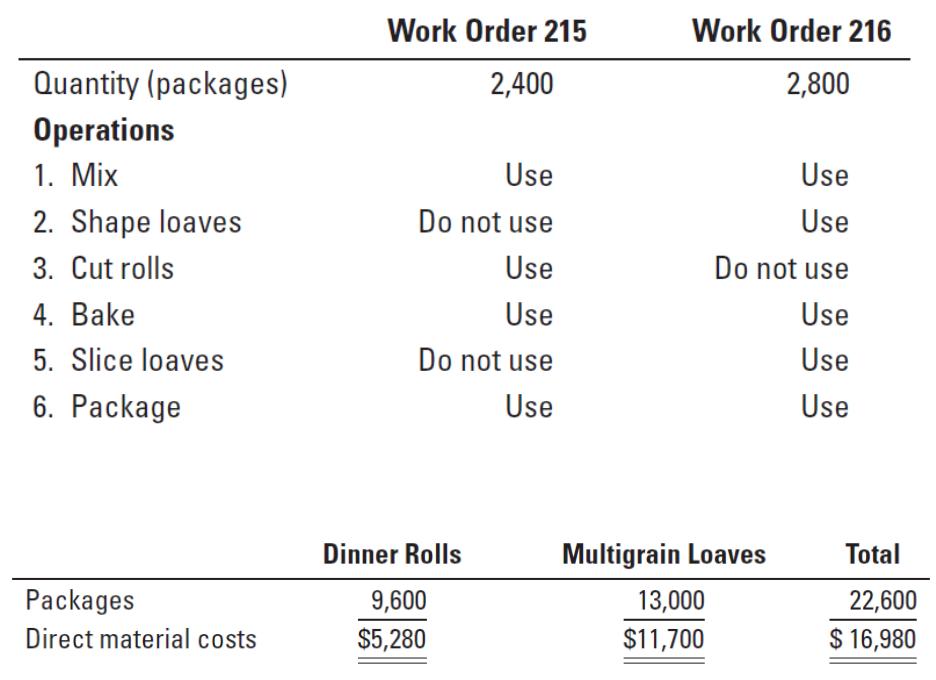
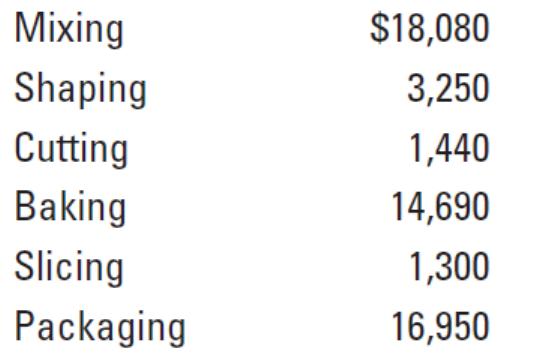
Whole Goodness Bakery needs to determine the cost of two work orders for the month of June.
Work order 215 is for 2,400 packages of dinner rolls, and work order 216 is for 2,800 loaves of
multigrain bread. Dinner rolls are mixed and cut into individual rolls before being baked and
then packaged. Multigrain loaves are mixed and shaped before being baked, sliced, and
packaged. The following information applies to work order 215 and work order 216:
Selected budget information for June follows:
Budgeted conversion costs for each operation for June follow:
17-15
Required:
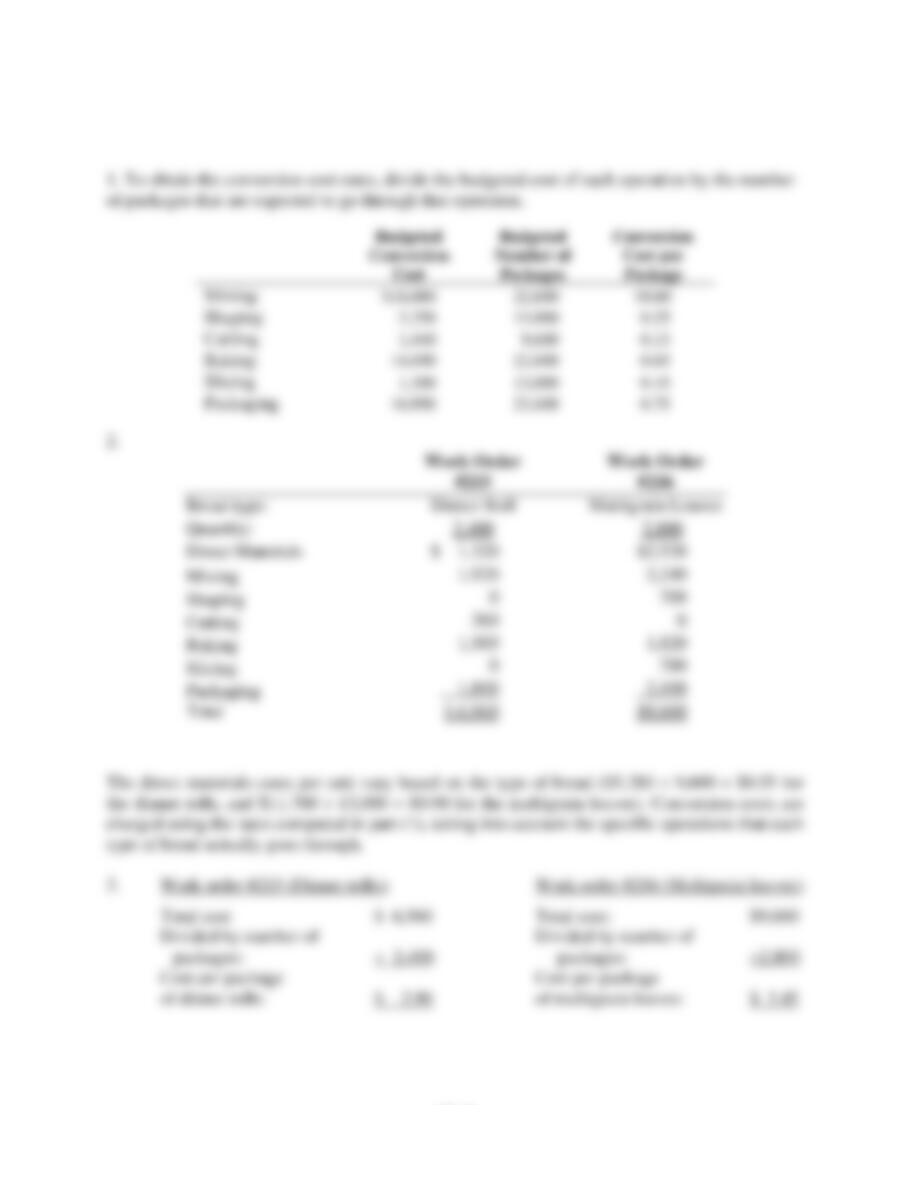
1. Using budgeted number of packages as the denominator, calculate the budgeted conversion-
cost rates for each operation.
2. Using the information in requirement 1, calculate the budgeted cost of goods manufactured
for the two June work orders.
3. Calculate the cost per package of dinner rolls and multigrain loaves for work order 215 and
216.
17-16
SOLUTION
17-17
17-24 (25 min.) Weighted-average method, assigning costs.
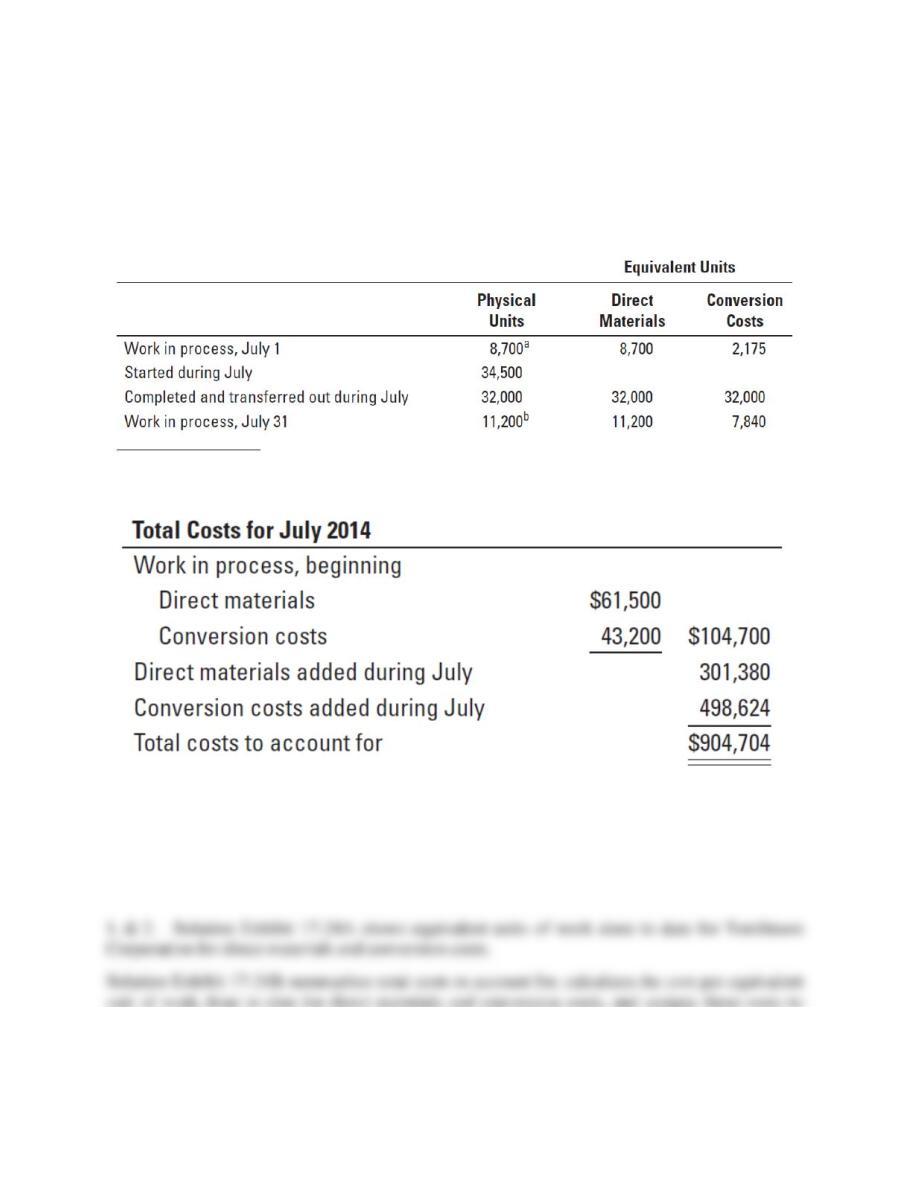
Tomlinson Corporation is a biotech company based in Milpitas. It makes a cancer-treatment drug
in a single processing department. Direct materials are added at the start of the process.
Conversion costs are added evenly during the process. Tomlinson uses the weighted-average
method of process costing. The following information for July 2014 is available.
aDegree of completion: direct materials, 100%; conversion costs, 25%.
bDegree of completion: direct materials, 100%; conversion costs, 70%.
Required:
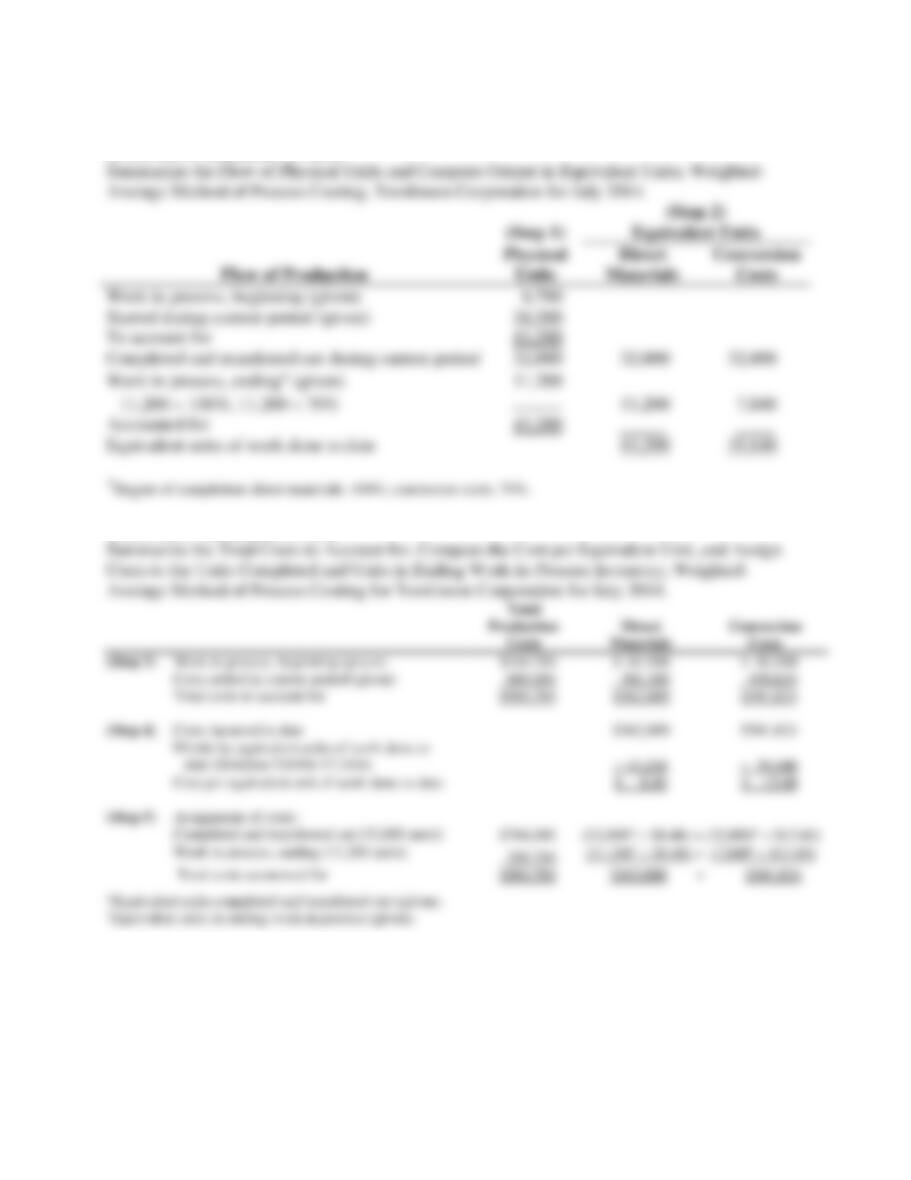
1. Calculate the cost per equivalent unit for direct materials and conversion costs.
2. Summarize the total costs to account for, and assign them to units completed (and transferred
out) and to units in ending work in process.
SOLUTION
unit of work done to date for direct materials and conversion costs, and assigns these costs to
units completed and transferred out and to units in ending work-in-process inventory.
17-18
SOLUTION EXHIBIT 17-24A
SOLUTION EXHIBIT 17-24B
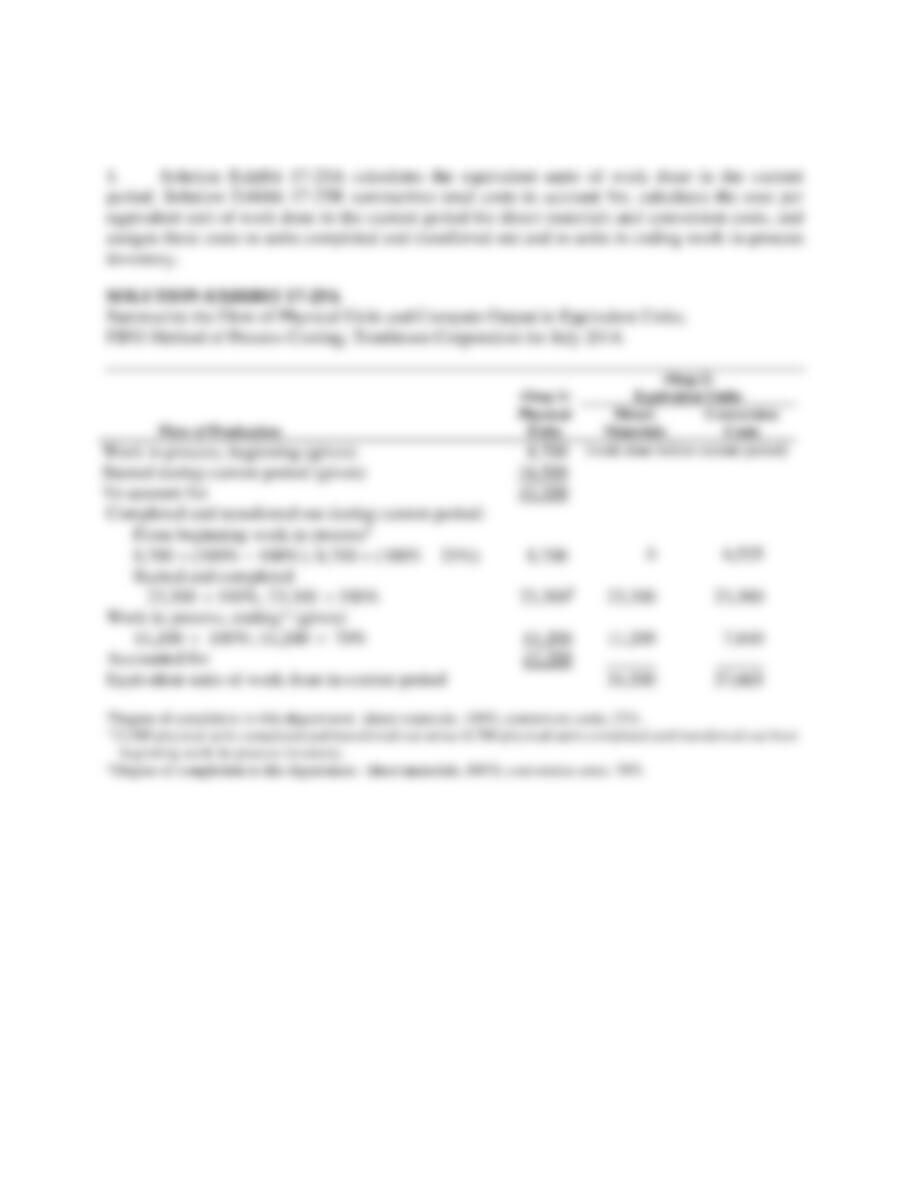
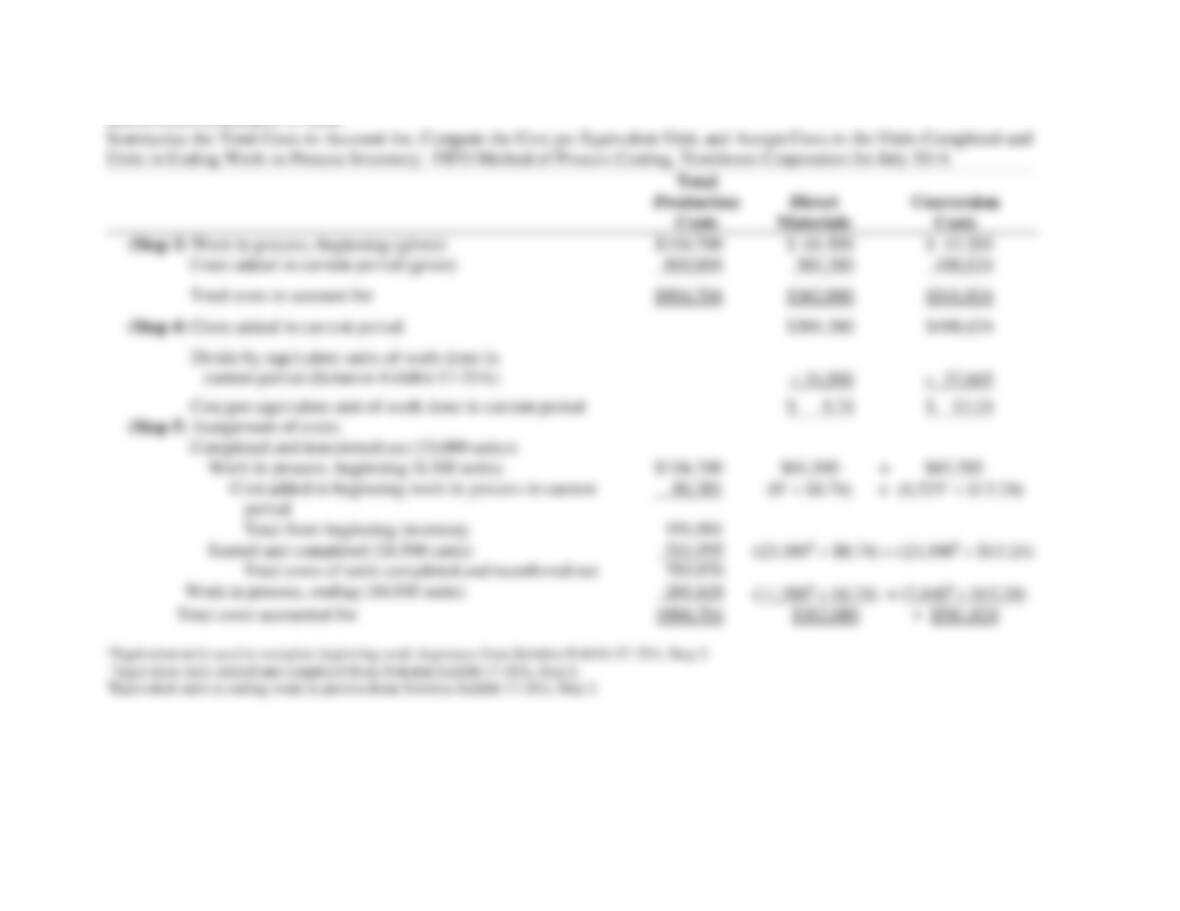
17-25 (30 min.) FIFO method, assigning costs.
Required:
1. Do Exercise 17-24 using the FIFO method.
2. Tomlinson’s management seeks to have a more consistent cost per equivalent unit. Which
method of process costing should the company choose and why?
17-19
SOLUTION
17-20
SOLUTION EXHIBIT 17-25B