
17-1
CHAPTER 17
ACTIVITY RESOURCE USAGE MODEL
AND TACTICAL DECISION MAKING
DISCUSSION QUESTIONS
1. Tactical decision making is choosing among
alternatives with an immediate or limited end
in mind.
2. Tactical decisions should support the overall
strategic objectives of an organization. Often,
the strategic objectives are served by small-
scale actions. For example, making a part
instead of buying it may lower costs of
production and thus serve the strategic cost
leadership objective. Or it may serve the
objective of differentiation by helping to
produce a higher-quality final product than
produced by competitors.
3. Tactical cost analysis is the use of relevant
cost data to identify the alternative that pro-
vides the greatest benefit to the organiza-
tion. Steps 3–5 are the major components of
tactical cost analysis: Predicting costs, com-
paring relevant costs, and selecting the low-
est cost alternative (or alternative with the
greatest benefit).
4. Answers will vary. I (second author) have
used this as a writing assignment for several
years. It has been very successful; students
enjoy analyzing their own decisions, whether
it is buying a car, moving from the dorm into
an apartment, or getting a puppy. Some-
times, the application of the model leads to
new insights into their problems.
5. Relevant costs and revenues are future
costs and revenues that differ across alter-
natives. Depreciation on an existing asset
represents an allocation of a past cost. Past
costs are never relevant.
6. A future cost that is not relevant is a future
cost that does not differ across the alterna-
tives being considered. For example, rent on
a factory in a keep-or-drop decision is a fu-
ture cost, but it will be there whether one of
the factory’s products is dropped or kept.
7. No. Relevant costs are just part of the
overall tactical decision-making model.
Strategic effects and other qualitative factors
may affect the decision. The effect may be
such that a higher-cost alternative may be
chosen.
8. Yes, direct materials can be irrelevant. In a
make-or-buy decision, any direct materials
already in inventory are irrelevant. In a
make-or-buy decision, the salary of the
production supervisor would be fixed but
relevant to the decision. Leasing equipment
is relevant if it is a future cost that differs
across alternatives. In most cases, this
would not be a factor because it entails the
acquisition of multiperiod capacity and really
belongs to the capital expenditure decision
domain.
9. The only role of past costs is predictive.
They can be used to help predict future
costs.
10. Flexible resources are relevant whenever
the demand for an activity changes across
alternatives. Resource spending will differ
across alternatives, making the cost of the
activity relevant.
11. Typically, committed resources acquired
through implicit contracting are acquired in
lumpy amounts and are not formal commit-
ments. Thus, if changes in demand across
alternatives produce a change in resource
supply, then resource spending will also
change, making the cost relevant. Usually,
the cost of committed resources is a sunk
cost (since they are acquired in advance).
Reductions in demand typically do not lead
to reductions in resource spending. Increas-
es in demand beyond the activity capacity
usually mean a major resource expendi-
ture—a decision that is outside the domain
of tactical decision making and more in the
domain of strategic analysis.
12. A functional-based make-or-buy analysis
focuses on unit-level activities and directly
attributable fixed cost and assumes that the
costs of all other non-unit-level activities are
irrelevant. An activity-based analysis

17-2
exploits activity cost behavior to identify
relevant costs.
13. Activity-based segmented reports trace
costs to segments using activity drivers and
provide a more accurate assessment of
profitability. Additionally, the use of the activ-
ity resource usage model allows a manager
to more fully assess the changes in resource
spending that will occur if a segment is
dropped.
14. Joint costs are present whether the product
is processed further or sold at split-off and
are not relevant.
15. If a firm has unused production capacity and
sufficient unused activity capacity, a one–
time special order may bring in more reve-
nues than the increase in resource spending
needed to fill the order. In this case, short-
term profits will increase.

CORNERSTONE EXERCISES
Cornerstone Exercise 17.1
1. The alternatives are to make the part in house or buy the part externally.
2. The relevant costs of making the part are: direct materials, direct labor, and
variable factory overhead. The relevant cost of buying the part is the purchase
price.
3. Make Buy Difference
Direct materials …………………… $ 14,040 $ 0 $ 14,040
Direct labor …………………………. 6,120 0 6,120
Variable overhead ……………….. 2,340 0 2,340
Purchase price ……………………. 0 24,840 (24,840)
Totals ……………………………… $ 22,500 $ 24,840 $ (2,340)
Because the fixed overhead is not relevant, the analysis shows a $2,340 ad-
vantage in favor of making the part in house.
4. Make Buy Difference
Direct materials …………………… $ 14,040 $ 0 $ 14,040
Direct labor …………………………. 6,120 0 6,120
Variable overhead ……………….. 2,340 0 2,340
Equipment rental …………………. 18,540 0 18,540
Purchase price ……………………. 0 24,840 (24,840)
Totals ……………………………… $ 41,040 $ 24,840 $ 16,200
Part of fixed overhead (equipment rental) is relevant; the analysis shows a
$16,200 advantage in favor of buying the part from the external supplier.
17-4
Cornerstone Exercise 17.2
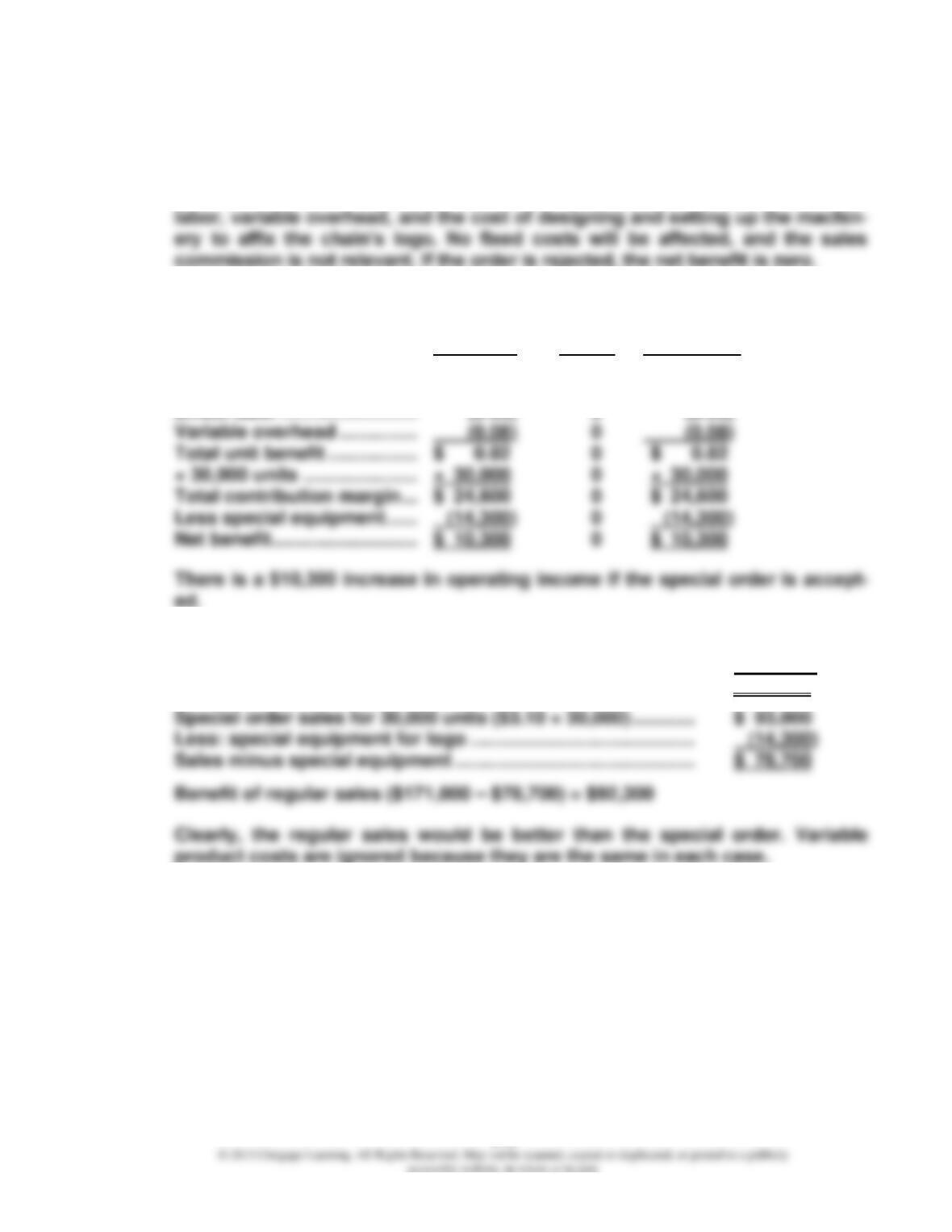
1. Model 1 Model 2 Model 3 Total
Sales …………………………. $ 246,000 $ 578,000 $ 634,600 $1,458,600
Less variable COGS ……. (93,500) (164,160) (348,000) (605,660)
Less commissions ……… (5,000) (28,000) (21,750) (54,750)
Contribution margin .. $ 147,500 $ 385,840 $ 264,850 $ 798,190
Less traceable
fixed expenses:
2. The reformulated income statement shows a loss for Model 1. Now the alter-
3. If only 175 hours of engineering time can be avoided, the amount traceable to
Model 1 is $5,250 ($30 × 175) and the remaining $18,750 is part of common
fixed overhead. Similarly, if only 5,000 setup hours can be avoided by elimi-
17-5
Cornerstone Exercise 17.3
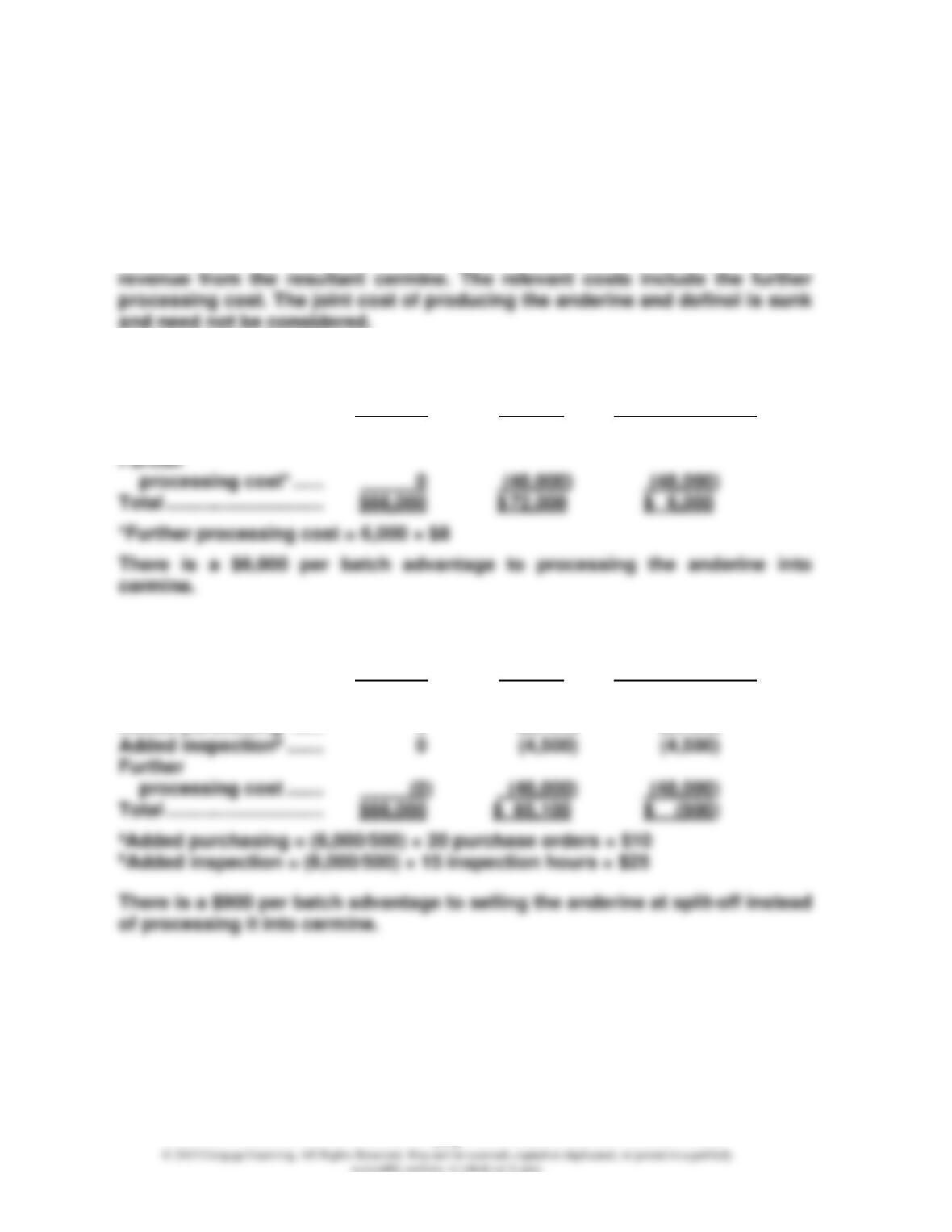
1. The two alternatives are to accept or reject the special order. The relevant ben-
efits and costs of accepting the order include: revenue, direct materials, direct
2. Differential
Amount
Accept Reject to Accept
Special order price ………….. $ 3.10 $0 $ 3.10
Direct materials ………………. (1.87) 0 (1.87)
Direct labor …………………….. (0.33) 0 (0.33)
3. Regular sales for 30,000 units ($6 × 30,000) …………………….. $180,000
Less commission (0.05 × $180,000) …………………………………. (9,000)
Sales minus commission ……………………………………………….. $171,000
17-6
Cornerstone Exercise 17.4
1. The two alternatives are to sell the anderine at split-off or process it further
into cermine.
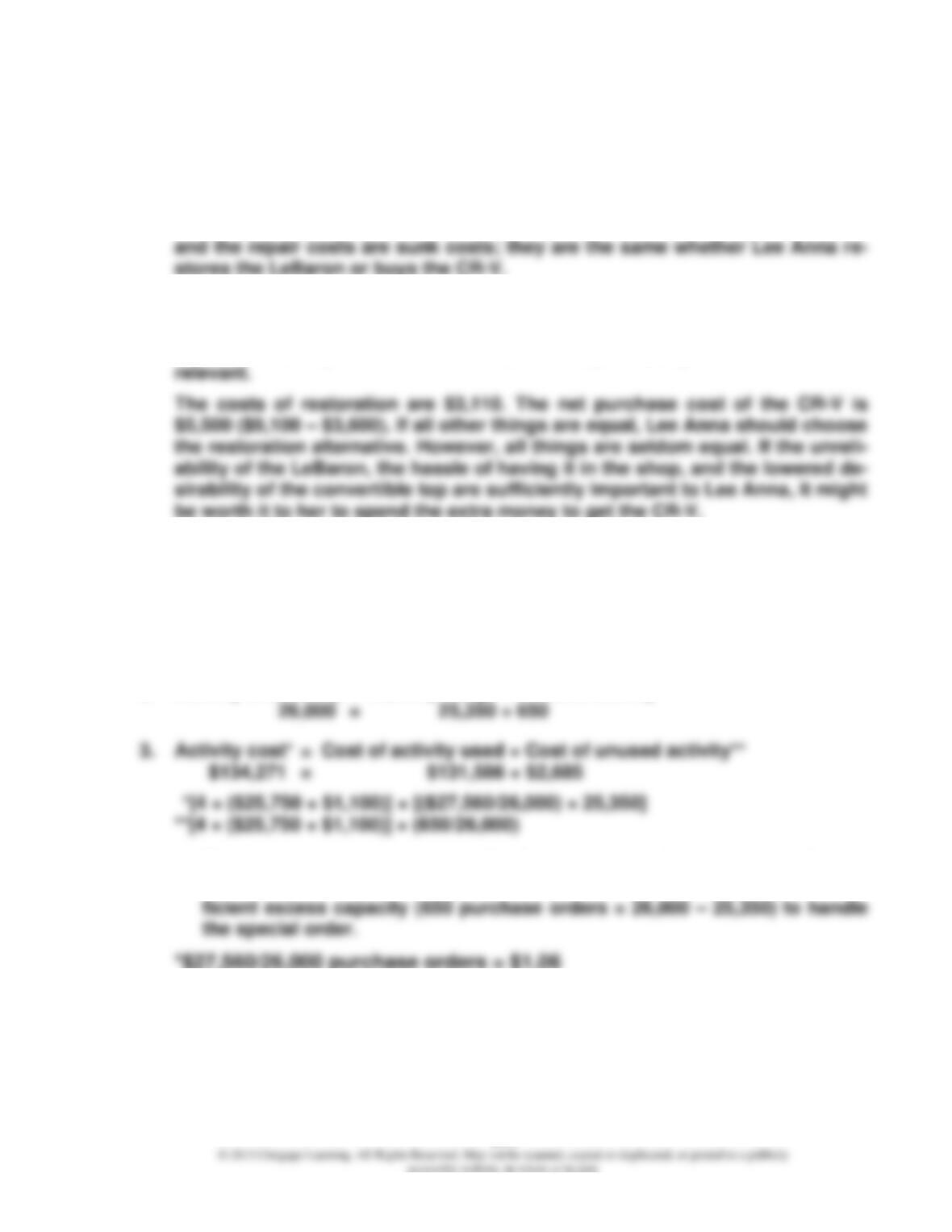
2. If the anderine is sold at split-off, the relevant benefit is the amount of sales
revenue. If the anderine is processed further, the relevant benefit is the sales
3. Differential
Sell at Process Amount to
Split-Off Further Process Further
Sales revenue …………… $66,000 $120,000 $54,000
4. Differential
Sell at Process Amount to
Split-Off Further Process Further
Sales revenue …………… $66,000 $ 120,000 $ 54,000
Added purchasinga …… 0 (2,400) (2,400)
17-7
EXERCISES
Exercise 17.5
1. The money already spent on the LeBaron is not relevant. The purchase price
2. All future costs that differ across alternatives are relevant. The alternatives
facing Lee Anna are restoration and buying the CR-V. Thus, all costs of resto-
ration, the sales price of the LeBaron, and the purchase price of the CR-V are
Exercise 17.6
1. Flexible resources: Forms, postage, and other supplies
Committed resources: Clerks, PC system
2. Activity availability = Activity usage + Unused activity
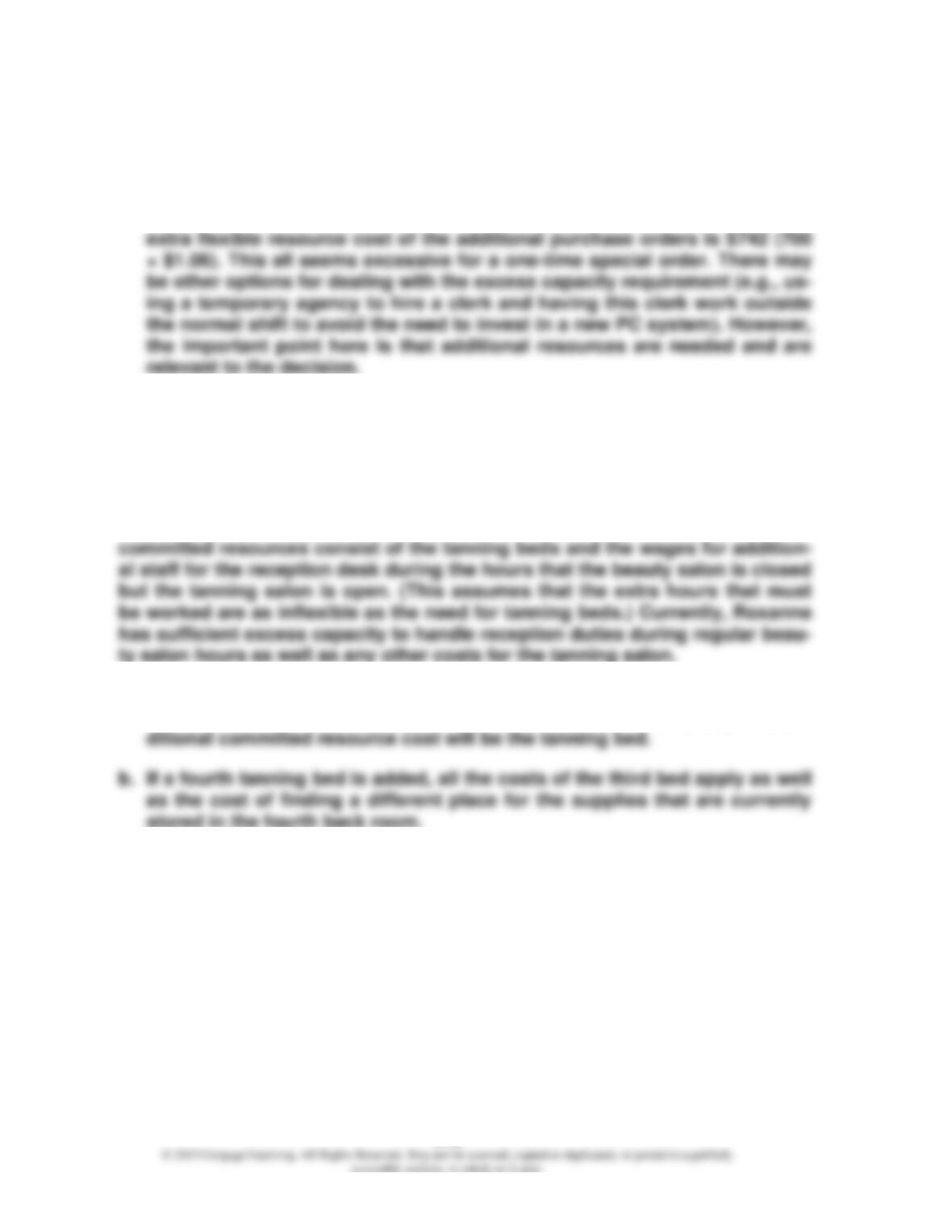
4. a. Since demand changes for the flexible resources, the cost of supplies in-
creases by $530 ($1.06* × 500). For the committed resources, there is suf-
17-8
Exercise 17.6 (Concluded)
4. b. If the special order requires 700 purchase orders, there is not sufficient
excess capacity to handle it. An additional clerk must be hired (at $25,750)
and an additional PC system must be obtained (annual cost of $1,100). The
Exercise 17.7
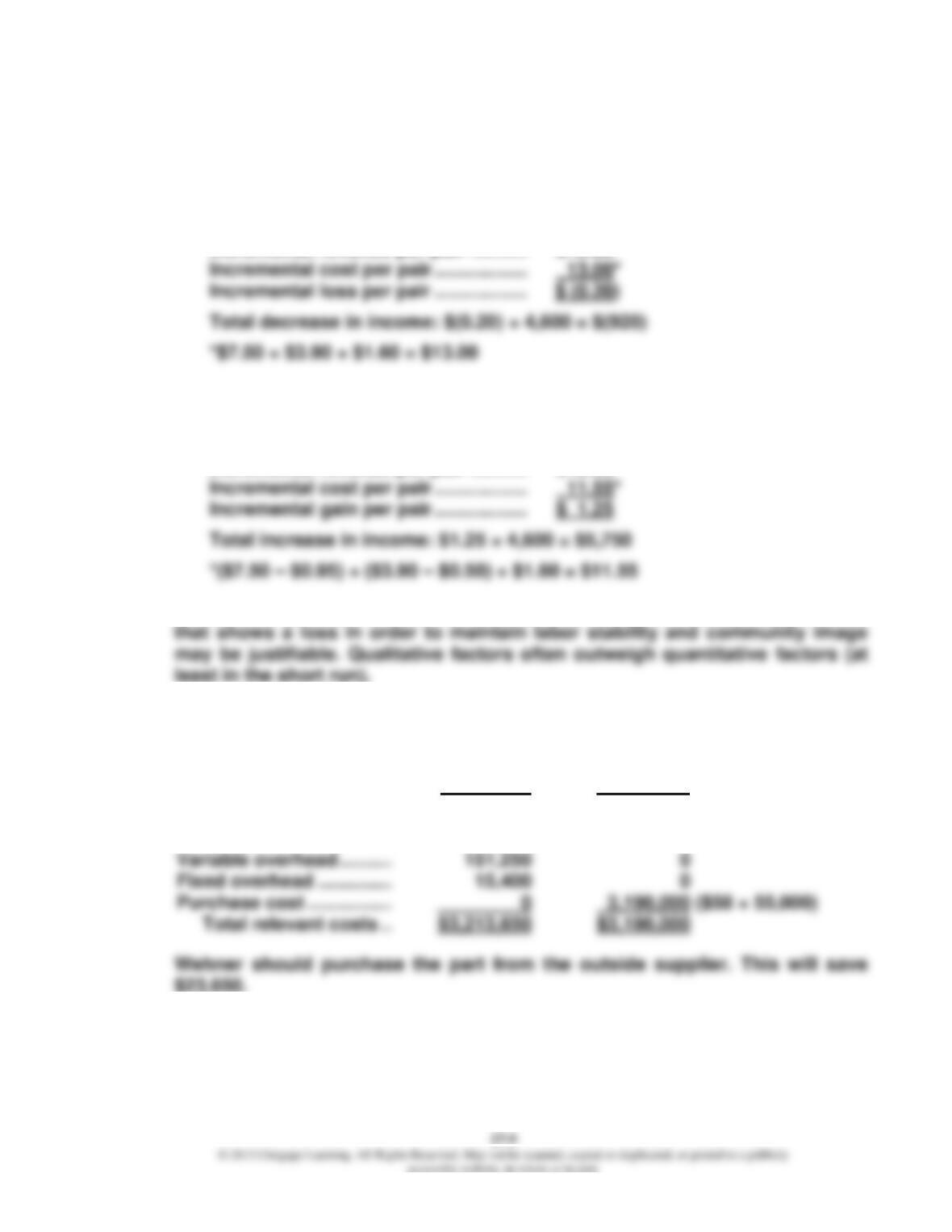
1. The flexible resources for the new tanning salon include: the supplies at $450
per month and the additional electricity at $100 per month. The use of each of
these resource categories will vary with the number of tanning visits. The
2. a. If Roxanne decides to add a third tanning bed, the only additional flexible
resource cost will be the additional use of supplies and electricity. The ad-
Exercise 17.8
1. The company should reject the offer as the additional revenue is less than the
additional costs (assuming fixed overhead is allocated and will not increase
with the special order):
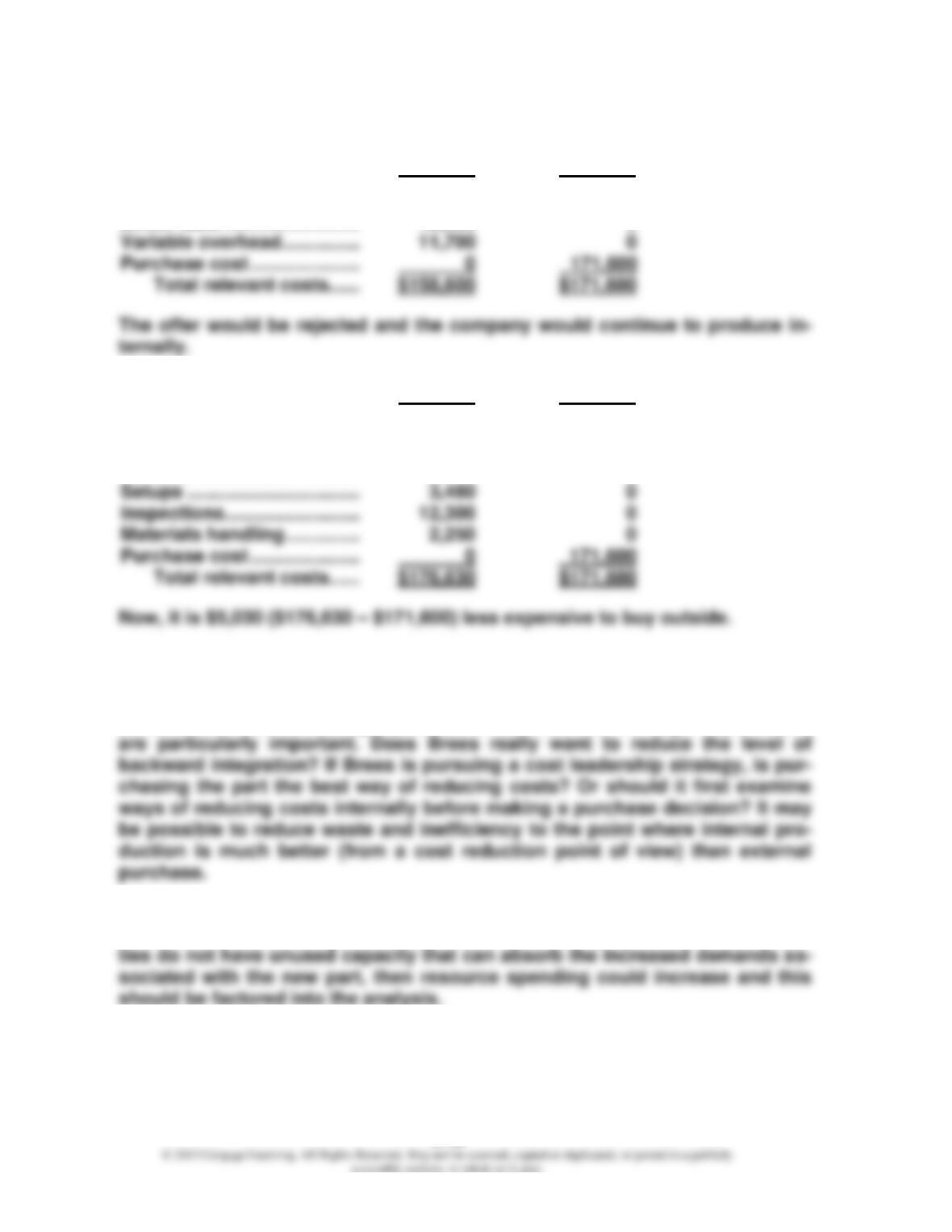
Incremental revenue per pair ……….. $12.80
2. Now the company should accept the offer as the additional revenue is greater
than the additional costs (assuming fixed overhead is allocated and will not
increase with the special order):
Incremental revenue per pair ……….. $12.80
3. If the idle capacity is viewed as a temporary state, then accepting an order
Exercise 17.9
1. Make Buy
Direct materials ………….. $2,508,000 $ 0
Direct labor ………………… 539,000 0
2. Maximum price = $3,213,650/55,000 = $58.43
17–10
Exercise 17.10
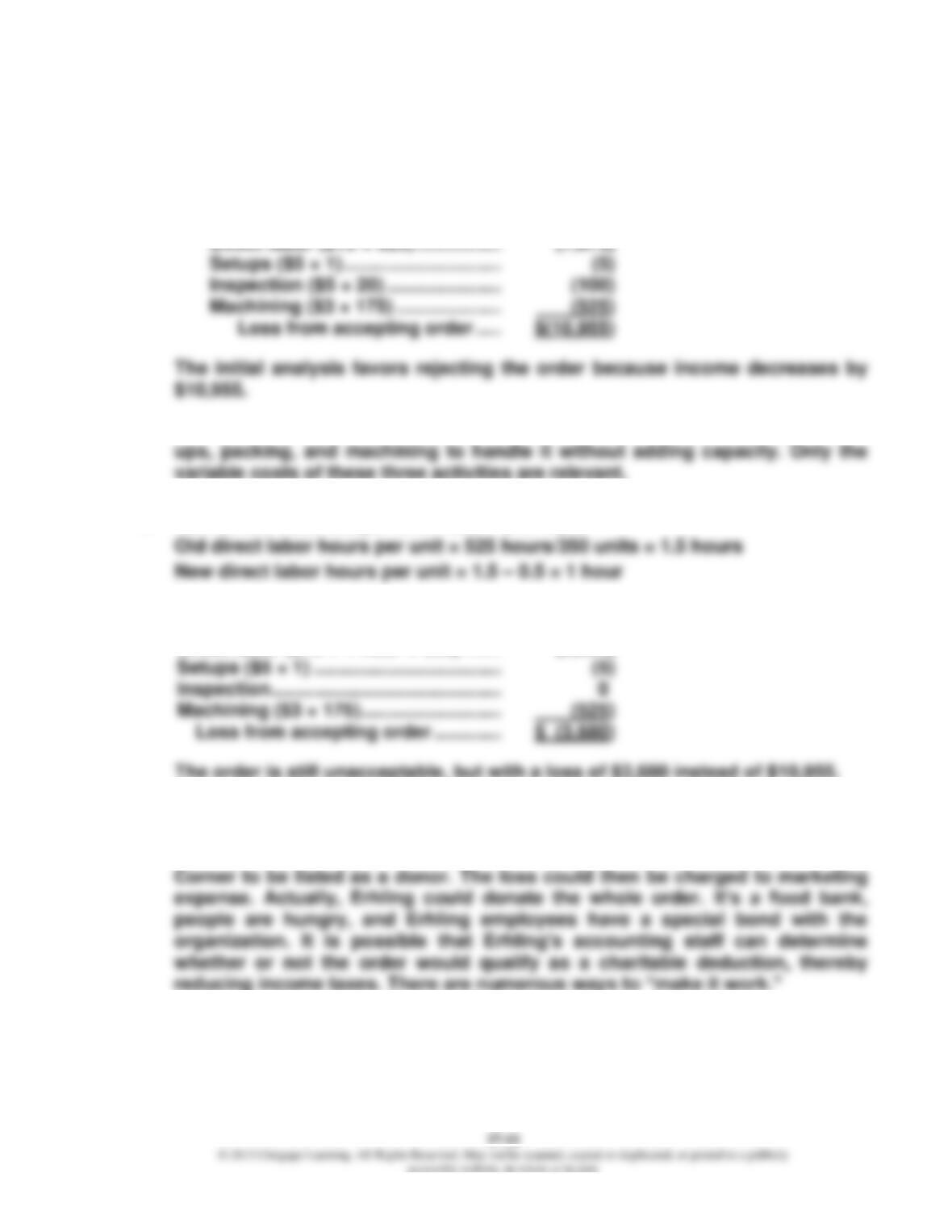
1. Make Buy
Direct materials ………………. $104,000 $ 0
Direct labor…………………….. 42,900 0
2. Make Buy
Direct materials ………………. $104,000 $ 0
Direct labor…………………….. 42,900 0
Variable overhead …………… 11,700 0
3. In making this decision Brees should consider such qualitative factors as the
quality of the part, the reliability of the supplier, the effect of labor reductions
on employee morale, the possibility of price increases in the future, and the
effect on the overall strategic position of the firm. The strategic implications
4. The controller does have a point. Purchasing the part will affect a number of
other activities such as purchasing, receiving, and paying bills. If these activi-
Exercise 17.11
1. Income effect:
Revenues ($75 × 350) ………………. $ 26,250
Direct materials ($82 × 350) ……… (28,700)
2. The special order is so small that there is sufficient excess capacity for set-
3. New direct materials per unit = $82 – $13 = $69
Revenues ($75 × 350) …………………….. $ 26,250
Direct materials ($69 × 350) …………… (24,150)
Direct labor ($15 × 1 hour × 350) ……. (5,250)
The order is still unacceptable, but with a loss of $3,680 instead of $10,955.
4. The company may still accept the order. This is a charitable organization and
the company may have funds dedicated to making contributions.
Alternatively, perhaps the Marketing Department could work with Carly’s
17–12
Exercise 17.12
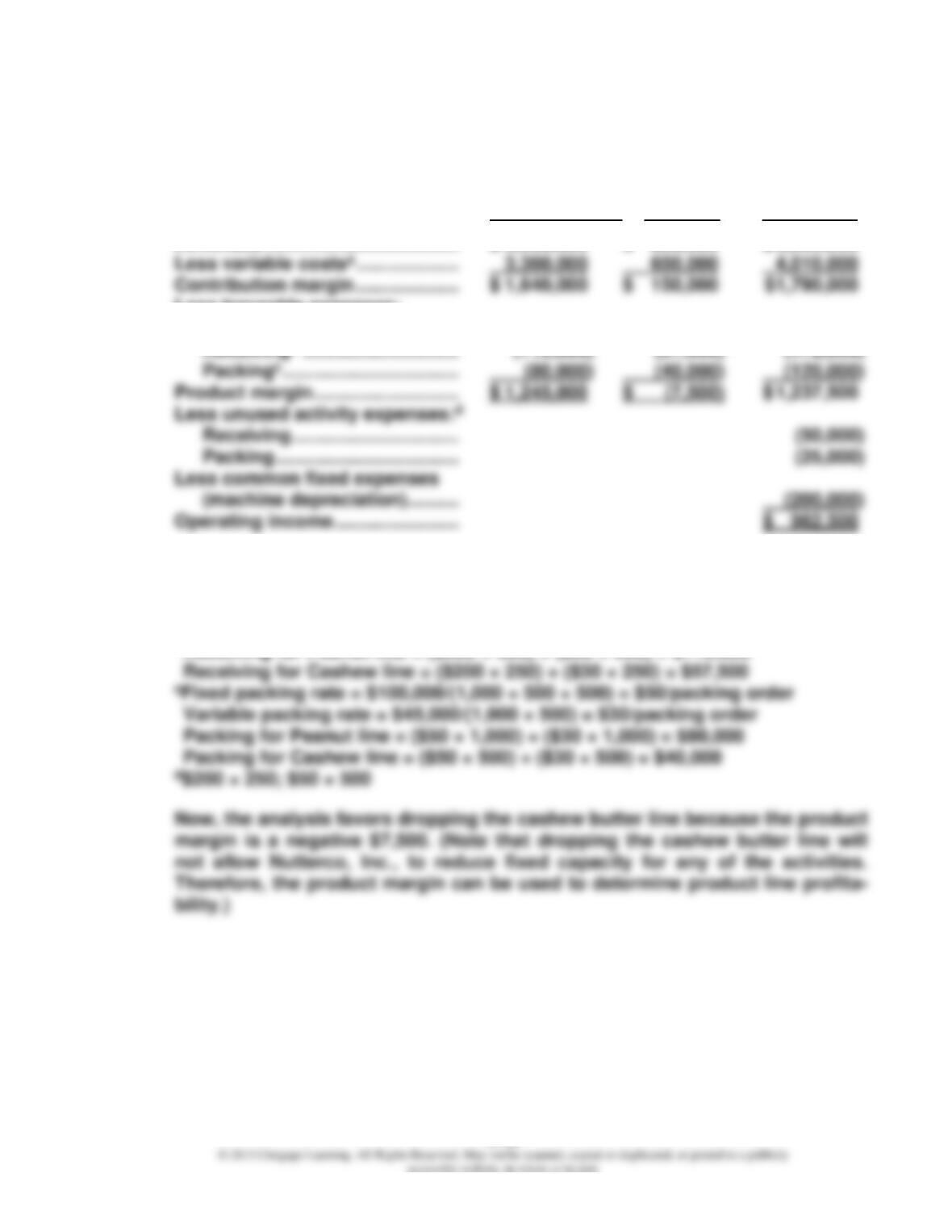
1. Traditional income statement:
Peanut Cashew
Butter Butter Total
Revenues………………………………… $ 5,000,000 $ 800,000 $ 5,800,000
Less variable expenses:
Direct materials …………………. (2,500,000) (480,000) (2,980,000)
Direct labor ……………………….. (500,000) (80,000) (580,000)
aOnly direct labor benefits and machine costs vary with direct labor hours. All
other overhead costs are fixed with respect to this driver.
Variable OH rate = (Direct labor benefits + Variable machine overhead)/DLH
= ($200,000 + $250,000)/(40,000 hours + 10,000 hours)
17–13
Exercise 17.12 (Concluded)
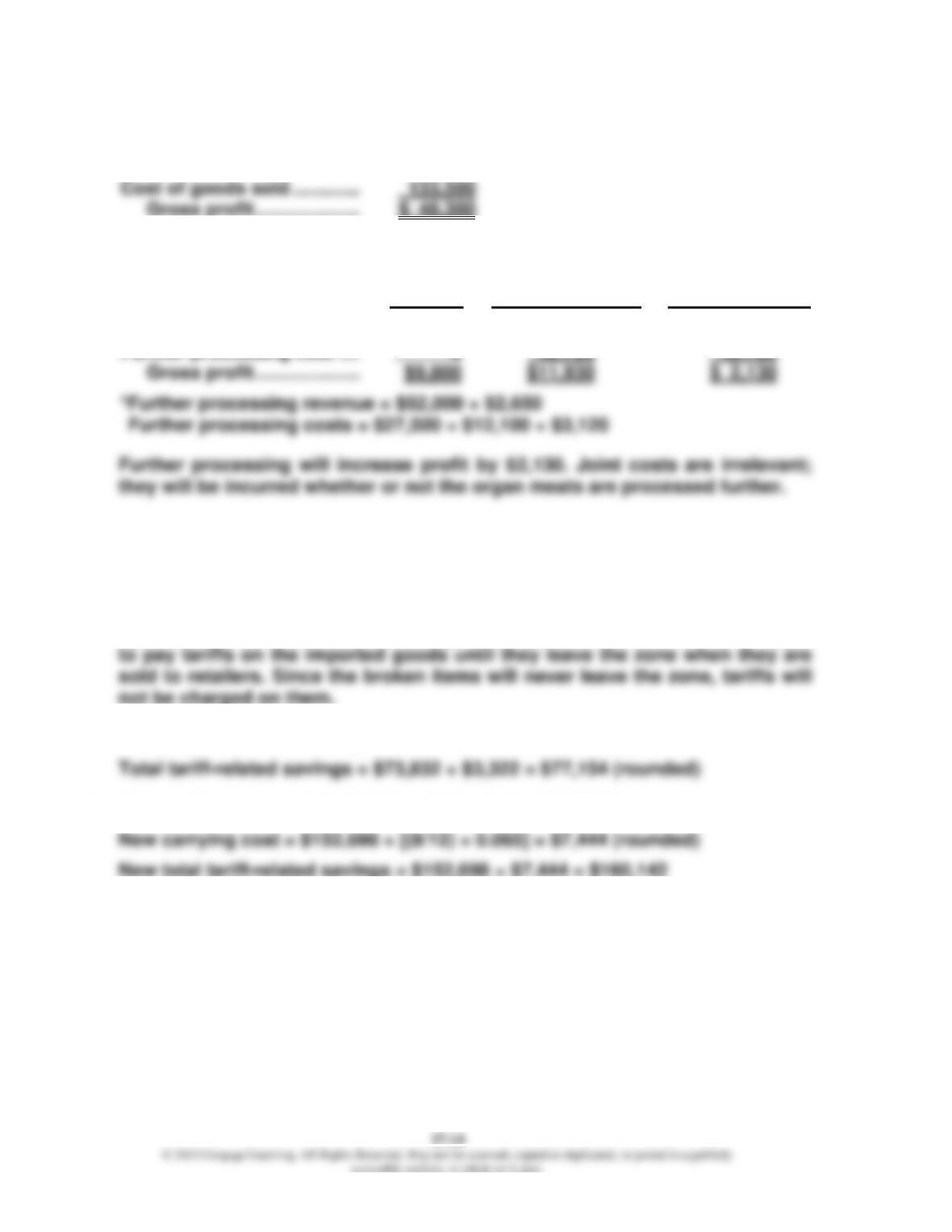
2. Activity-based statement:
Peanut Cashew
Butter Butter Total
Revenues ………………………………. $ 5,000,000 $ 800,000 $ 5,800,000
Less traceable expenses:
Advertising ……………………….. (200,000) (60,000) (260,000)
a(Direct materials + Direct labor + Variable overhead) as shown on the tradi-
tional income statement.
bFixed receiving rate = $200,000/(500 + 250 + 250) = $200/receiving order
Variable receiving rate = $22,500/750 = $30/receiving order
Receiving for Peanut line = ($200 × 500) + ($30 × 500) = $115,000
Exercise 17.13
1. Sales ……………………………… $181,800
2. Differential
Sell at Amount to
Split-Off Process Further* Process Further
Revenues……………………….. $9,800 $54,650 $44,850
Further processing cost …. 0 42,720 42,720
Exercise 17.14
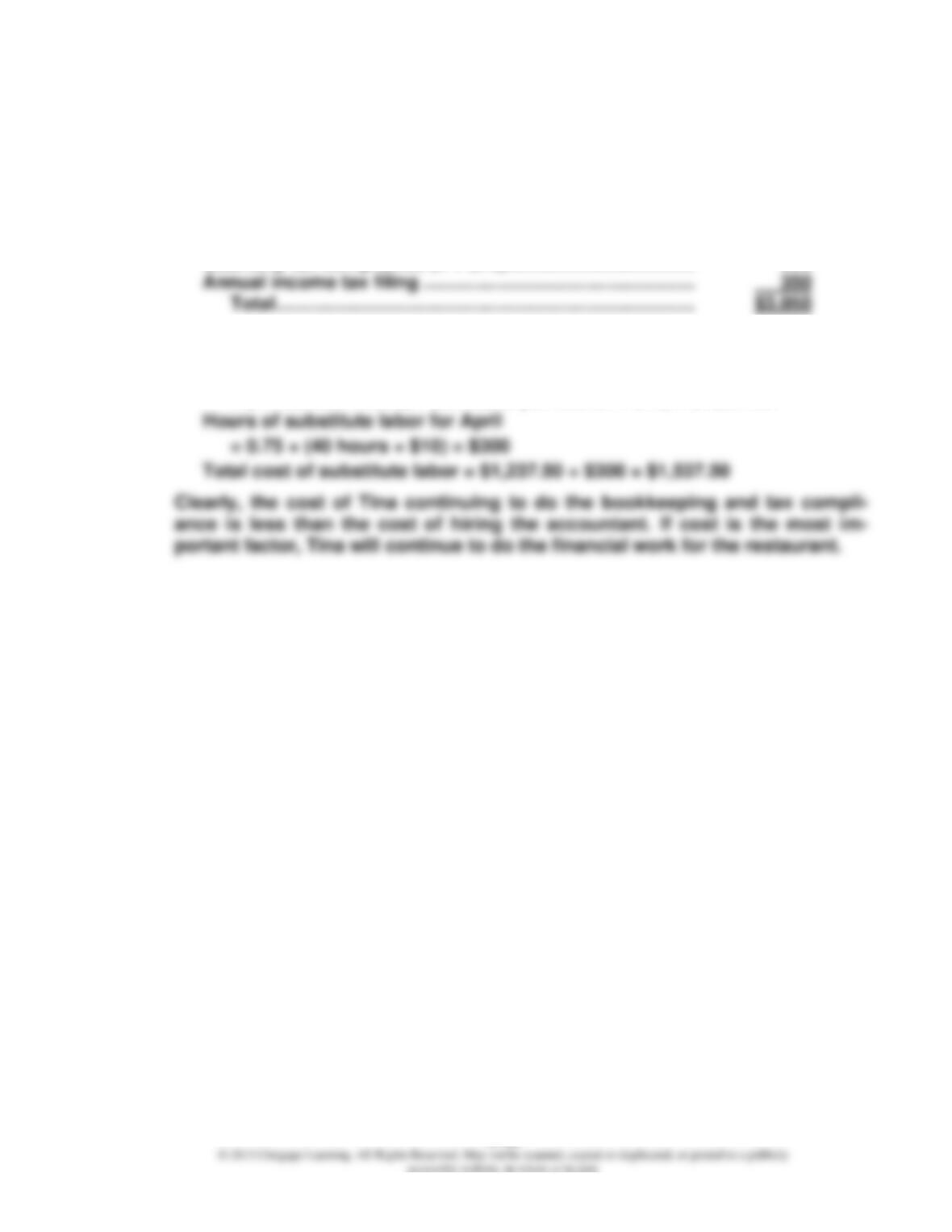
1. Tariff savings = $16,780,000 × 0.08 × 0.055 = $73,832
By locating the warehouse in a foreign trade zone, Global Reach will not have
2. Carrying cost = $73,832 × [(9/12) × 0.06] = $3,322 (rounded)
3. New tariff savings = $16,780,000 × 0.07 × 0.13 = $152,698
17–15
Exercise 17.15
1. Annual cost:
If the outside accountant is hired:
Bookkeeping cost (12 × $25 × 8 hours per month) ………. $2,400
Quarterly tax compliance (4 × $75) ……………………………… 300
If Tina continues to do the financial work:
Hours of substitute labor for all months except April
= (11 months × 0.75) × (15 hours per month × $10) = $1,237.50
2. There are many qualitative factors to be considered. Does Tina enjoy the
bookkeeping and tax work? Would she prefer working more hours in the res-
taurant? Would the couple prefer that Tina spend more time taking care of
LJ? How accurate is the tax work? Could an accountant actually save money
by suggesting alternative tax strategies for them? How badly do they need
the extra storage that would be provided by the current office? How easy is it
to find additional part-time labor to cover for Tina while she is doing the fi-
nances? Any or all of these could turn the decision from keeping the financial
work in house to outsourcing it.