PROBLEM SET A
Problem 17-1A (45 minutes)
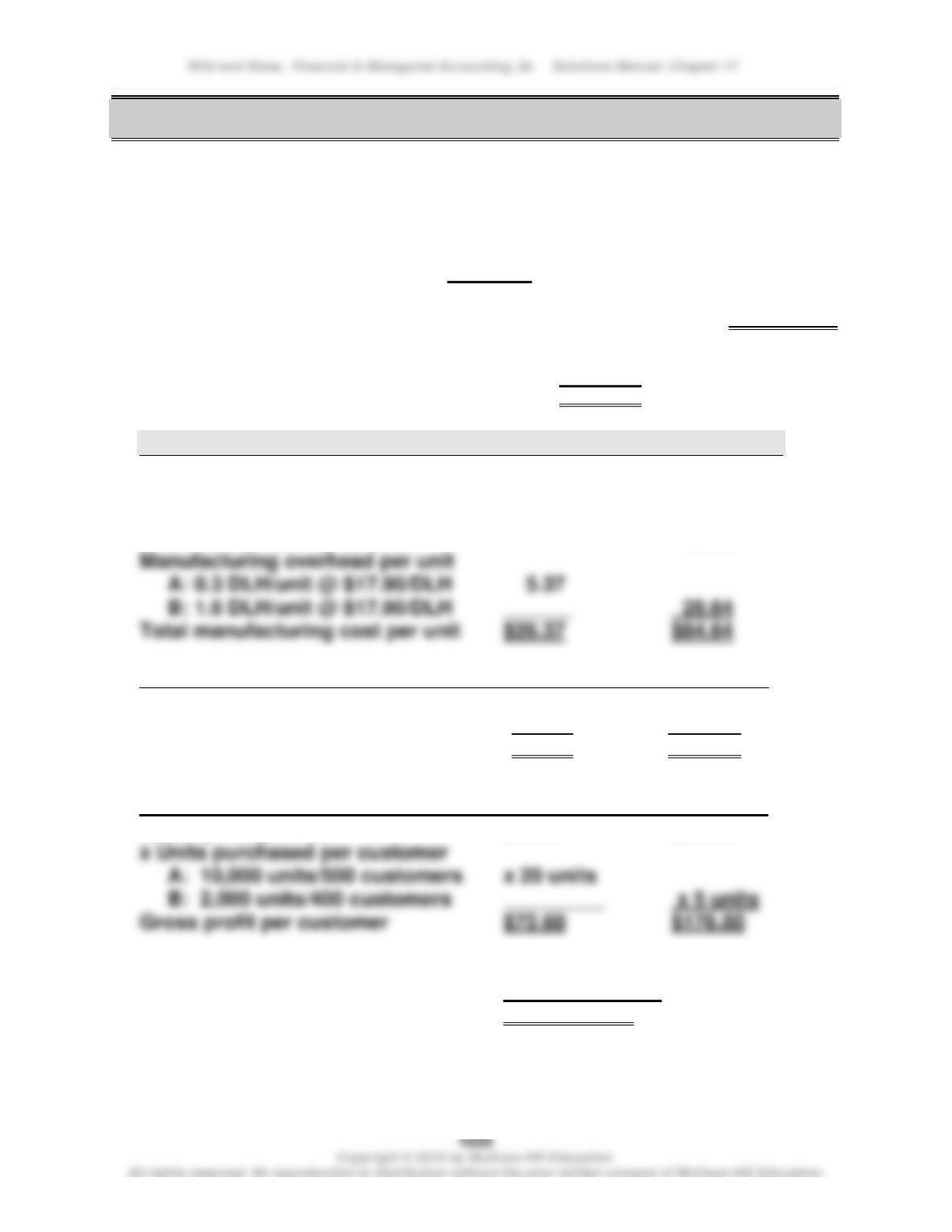
1. Plantwide rate
Engineering support $ 24,500
Electricity 34,000
Setup costs 52,500
Total manufacturing overhead $111,000
÷ 6,200* direct labor hours = $17.90/DLH
* Product A 10,000 units x 0.3 DLH/unit = 3,000 DLH
Product B 2,000 units x 1.6 DLH/unit = 3,200 DLH
6,200 DLH
Product A Product B
Direct materials per unit $15.00 $24.00
Direct labor per unit
A: 0.3 DLH/unit @ $20/DLH 6.00
B: 1.6 DLH/unit @ $20/DLH 32.00
Product A
Product B
Selling price per unit……………
$30.00
$120.00
Manufacturing cost per unit…..
26.37
84.64
Gross profit per unit………….
$ 3.63
$ 35.36
2. Product A Product B
Gross profit per unit $ 3.63 $35.36
3. Total customer service cost $81,000
÷ number of customers ÷ 900 customers
Customer service cost per customer $90/customer
Problem 17-1A (continued)
For the instructor: The gross margin per customer from Product A ($72.60) does not
cover the cost of providing service to customers of this product ($90). It appears that
the company is incurring a loss of $17.40 ($72.60 – $90) associated with each
customer of Product A.
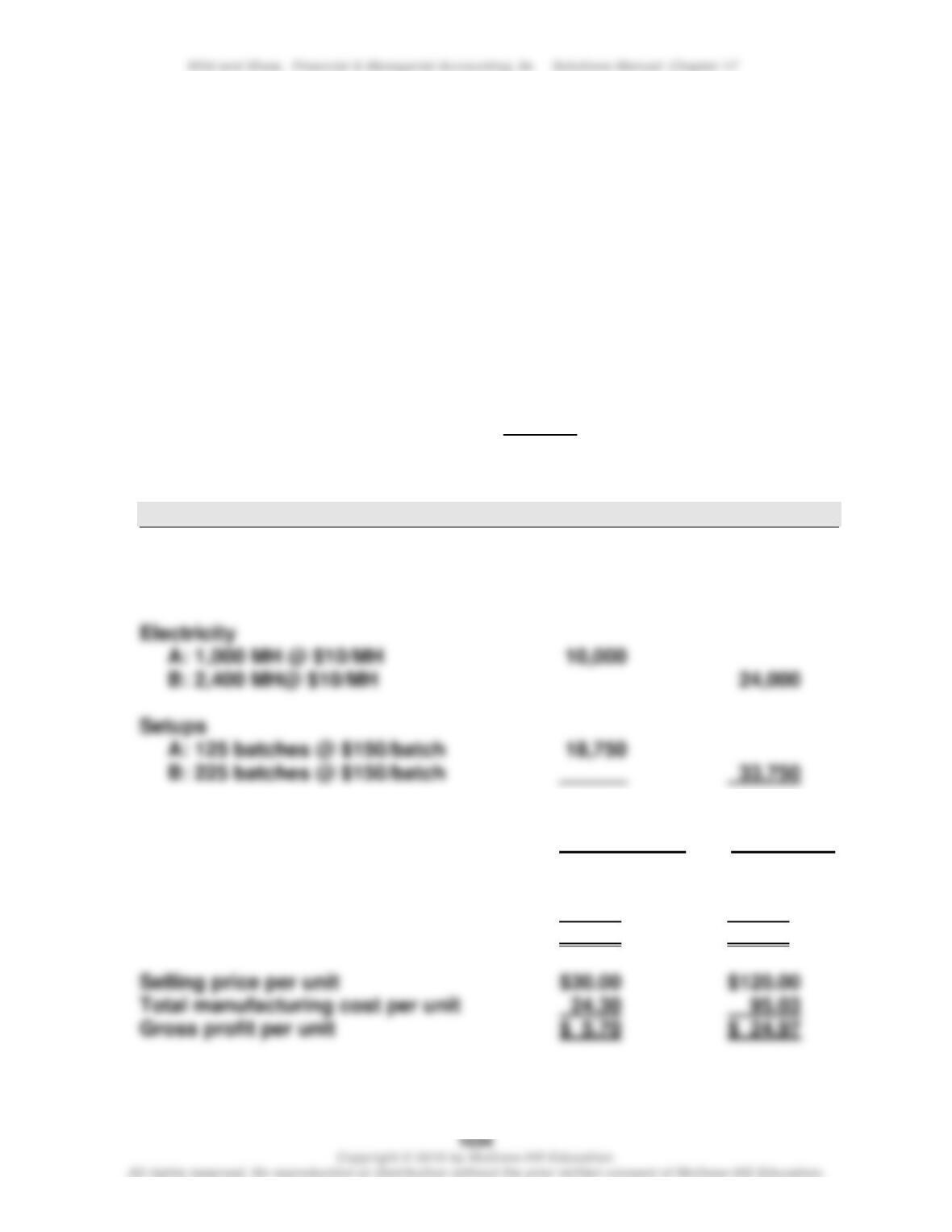
4. Compute overhead allocation rates for each activity
Engineering Support $24,500/(12 + 58) modifications $350/modification
Electricity $34,000/3,400* machine hours $10/MH
Setup $52,500/(125 + 225) batches $150/batch
*Product A 10,000 units x 0.1 MH/unit = 1,000 MH
Product B 2,000 units x 1.2 MH/unit = 2,400 MH
3,400 MH
Assign overhead costs to products
Product A Product B
Engineering support
A: 12 modifications @ $350 $ 4,200
B: 58 modifications @ $350 $20,300
Total overhead cost by product line $32,950 $78,050
÷ Number of units ÷10,000 units ÷2,000 units
Overhead cost per unit (rounded) $ 3.30 $39.03
Direct materials cost per unit 15.00 24.00
Direct labor cost per unit (part 1) 6.00 32.00
Total manufacturing cost per unit $24.30 $95.03
Problem 17-1A (concluded)
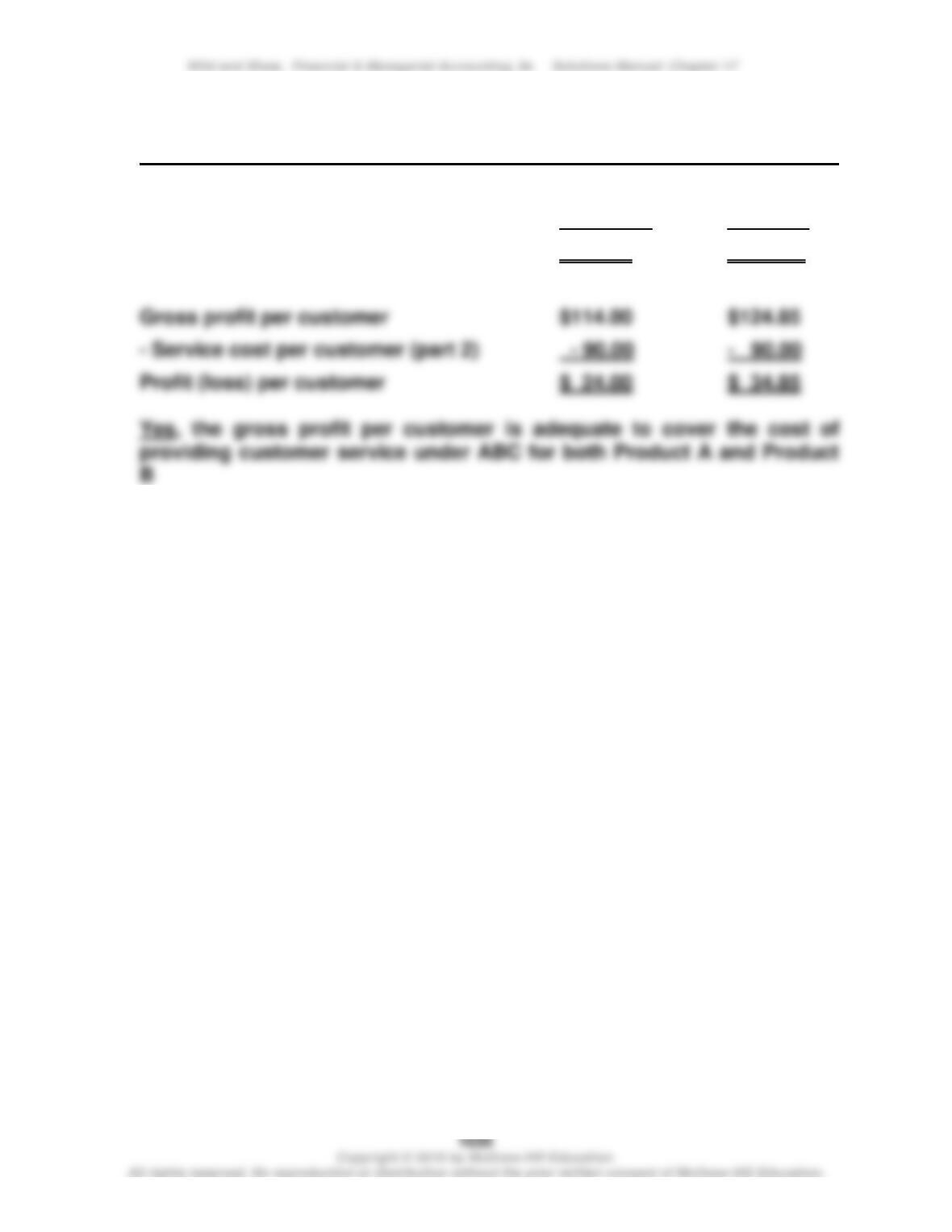
5. Product A Product B
Gross profit per unit (from above) $5.70 $24.97
x units per customer (part 2) x 20 units x 5 units
Gross profit per customer $114.00 $ 124.85
Problem 17-2A (25 minutes)
2. The company may be charging less for its low-volume, custom-order
products than the competitors because the company is using a volume–
based costing system, which understates the true cost of producing
low-volume products. It could be that competitors know that custom–
order products consume relatively more resources per unit than high–
volume, commodity-type products and know that a higher price should
be charged on those custom-order products to cover their greater costs.
3. While prices are really set in the marketplace based on customer
4. Custom-order furniture requires handling special fabrics, buying in
smaller quantities (which may be more expensive than buying “in bulk”),
consulting with customers about their needs and preferences,
modifying pieces to suit an individual customer, and other activities that
are not necessary for mass-market furniture.
Problem 17-3A (40 minutes)
1. Grinding ……………………………………………………………………. Unit level
Polishing …………………………………………………………………… Unit level
Product modification …………………………………………………. Product level
Providing power ………………………………………………………… Facility level
System calibration …………………………………………………….. Batch level
2. Compute overhead allocation rates for each activity
3. Assign overhead costs to jobs
Job 3175
Job 4286
Grinding & polishing
550 MH x $35
$19,250
5,500 MH x $35
$192,500
Product modification
26 Eng.hrs. x $400
10,400
32 Eng. hr. x $400
12,800
Providing power
4,375 DLH x $15
65,625
Total cost of job
$383,425
4. Job 3175 Job 4286
Total overhead cost of job $74,650 $383,425
÷ Number of units in job ÷200 units ÷2,500 units
Average overhead cost per unit $373.25 $153.37
Problem 17-3A (concluded)
5. Plantwide rate:
Grinding ……………………………………………………………………. $ 320,000
Polishing …………………………………………………………………… 135,000
Product modification …………………………………………………. 600,000
Job 3175 Job 4286
Overhead
500 DLH x $106.47 $ 53,235
4,375 DLH x $106.47 $ 465,806
÷ units in each job ÷200 units ÷2,500 units
Average overhead cost per unit* $ 266.18 $ 186.32
*rounded
6. Average overhead cost
Job 3175 Job 4286
Using ABC $ 373.25 $ 153.37
Using plantwide rate $ 266.18 $ 186.32
Problem 17-4A (25 minutes)
1. Compute overhead allocation rates for each activity
Liquid materials $2,304/(1,400 + 37,000) gallons $0.06/gallon
Dry materials $6,941/(620 + 12,000) pounds $0.55/pound*
Assign costs to products
Hi-Voltage
EasySlim
Liquid material
1,400 gal x $0.06
$ 84
37,000 gal x $0.06
$ 2,220
Dry material
620 pounds x $0.55
341
12,000 pounds x $0.55
6,600
Utilities
200 MH x $0.36
72
3,750 MH x $0.36
1,350
Bottling
12,500 btls x $0.40
5,000
180,000 btls x $0.40
72,000
Labeling
37,500 labels x $0.03
1,125
180,000 labels x $0.03
5,400
Machine setup
500 setups x $25
12,500
300 setups x $25
7,500
Product cost
$19,122
$95,070
2. Hi-Voltage EasySlim
Total cost of line $19,122 $95,070
÷ Production volume ÷12,500 bottles ÷180,000 bottles
Average cost per bottle* $1.53/bottle $0.53/bottle
*rounded
Problem 17-5A (45 minutes)
1. Plantwide overhead rate:
2.
Extra Fine Family Style
Direct materials + Direct Labor $ 6.00 $ 5.00
Overhead 4.82 4.82
Manufacturing cost per case $10.82 $ 9.82
3.
Extra Fine Family Style
Selling price per case $18.00 $ 9.00
Manufacturing cost per case 10.82 9.82
Gross profit (loss) per case $ 7.18 $(0.82)
No, it appears that Family Style salsa is not profitable. The company
may be inclined to stop producing Family Style if the costs cannot be
reduced (or price cannot be increased) to a profitable level.
Problem 17-5A (concluded)
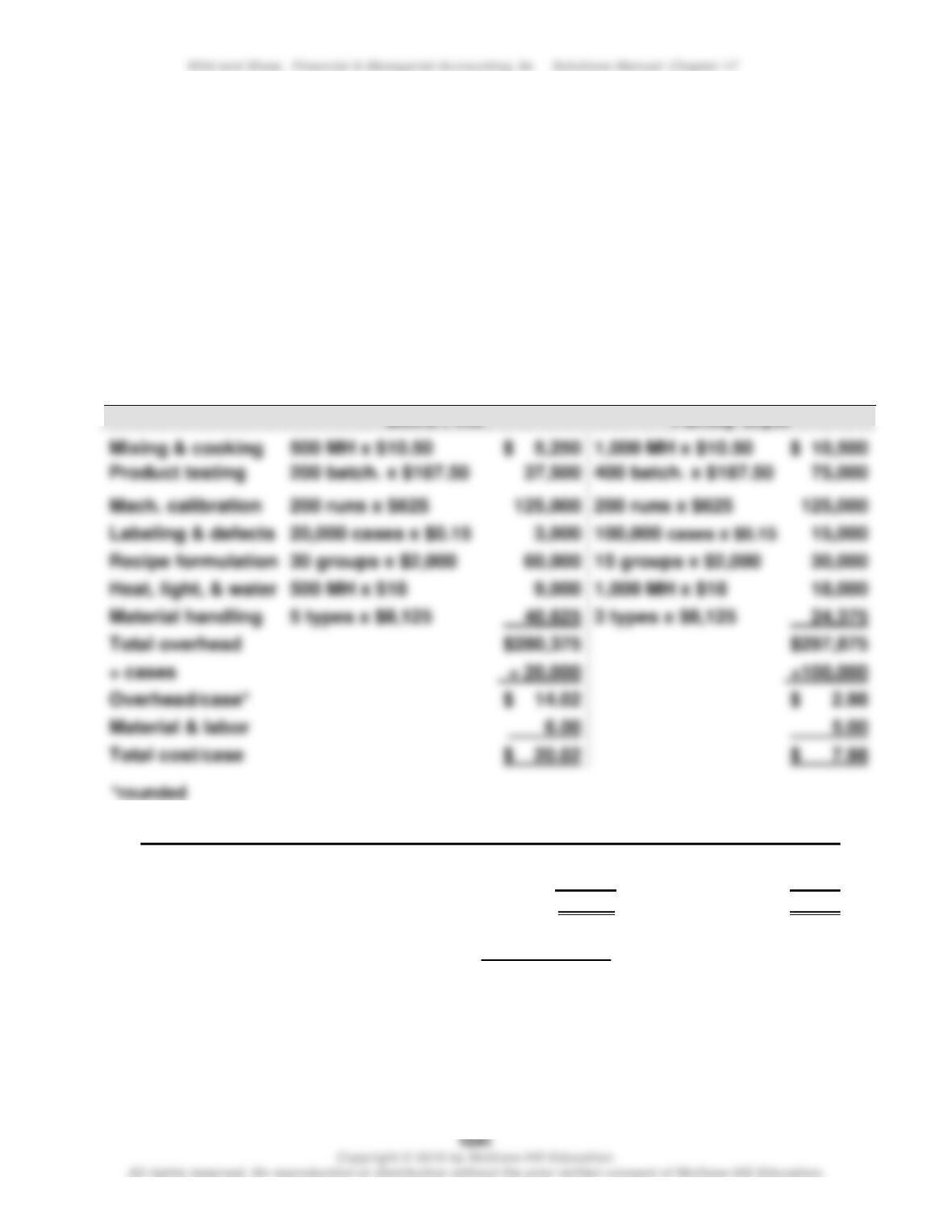
4. Compute overhead allocation rates for each activity
Mixing & Cooking ($4,500 + $11,250)/1,500 MH $10.50/MH
Product testing $112,500/600 batches $187.50/batch
Machine calibration $250,000/400 production runs $625/run
Labeling & Defects ($12,000 + $6,000)/120,000 cases $0.15/case
Recipe formulation $90,000/45 focus groups $2,000/group
Heat, light and water $27,000/1,500 machine hours $18/MH
Material handling $65,000/8 container types $8,125/type
Assign costs to products
5. Extra Fine Family Style
Selling price per case $18.00 $9.00
Manufacturing cost per case 20.02 7.98
Gross margin (loss) per case $(2.02) $1.02
Using ABC, the Extra Fine salsa is not profitable, but the Family Style is
profitable; this conclusion is opposite to the one that we would make if
the plantwide rate was used for assigning cost.
PROBLEM SET B
Problem 17-1B (45 minutes)
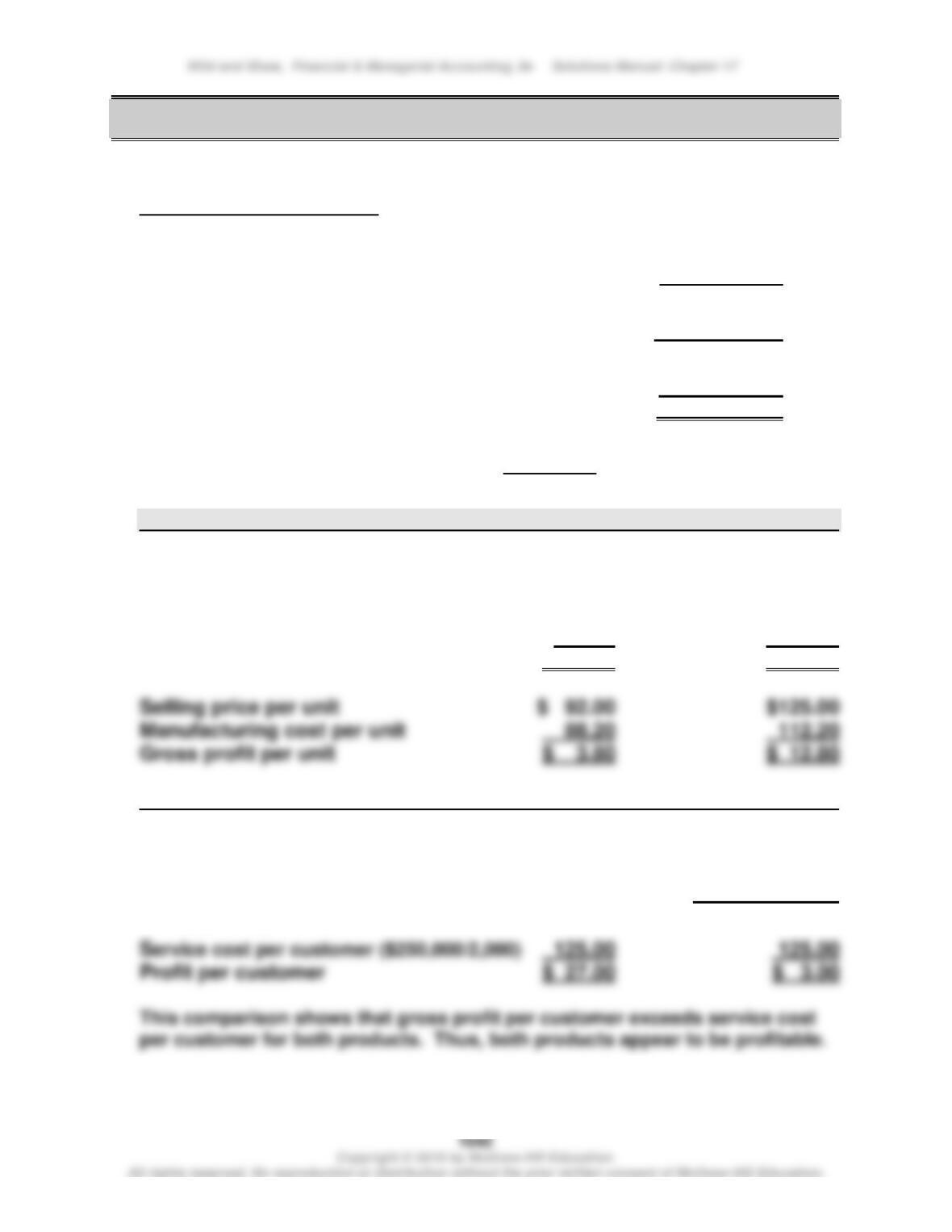
1. Plantwide overhead rate:
Engineering support $ 56,250
Electricity 112,500
Setup costs 41,250
Total overhead cost $ 210,000
÷ machine hours ÷150,000* MH
Plantwide overhead rate/MH $ 1.40/MH
x machine hours/unit x 3 MH/unit
Overhead cost per unit $ 4.20/unit
*Standard: 40,000 units x 3 MH/unit = 120,000 MH
Deluxe: 10,000 units x 3 MH/unit = 30,000 MH
Total machine hours 150,000 MH
Standard Deluxe
Direct materials cost per unit $ 4.00 $ 8.00
Direct labor cost per unit
Standard: 4 DLH x $20/DLH 80.00
Deluxe: 5 DLH x $20/DLH 100.00
Overhead cost per unit 4.20 4.20
Manufacturing cost per unit $ 88.20 $112.20
2. Profit per customer Standard Deluxe
Gross profit per unit $3.80 $ 12.80
x units per customer
Standard (40,000 units/1,000 cust.) x 40 units/cust.
Deluxe (10,000 units/1,000 cust.) ___________ x 10 units/cust.
Gross profit per customer $152.00 $128.00
Problem 17-1B (concluded)
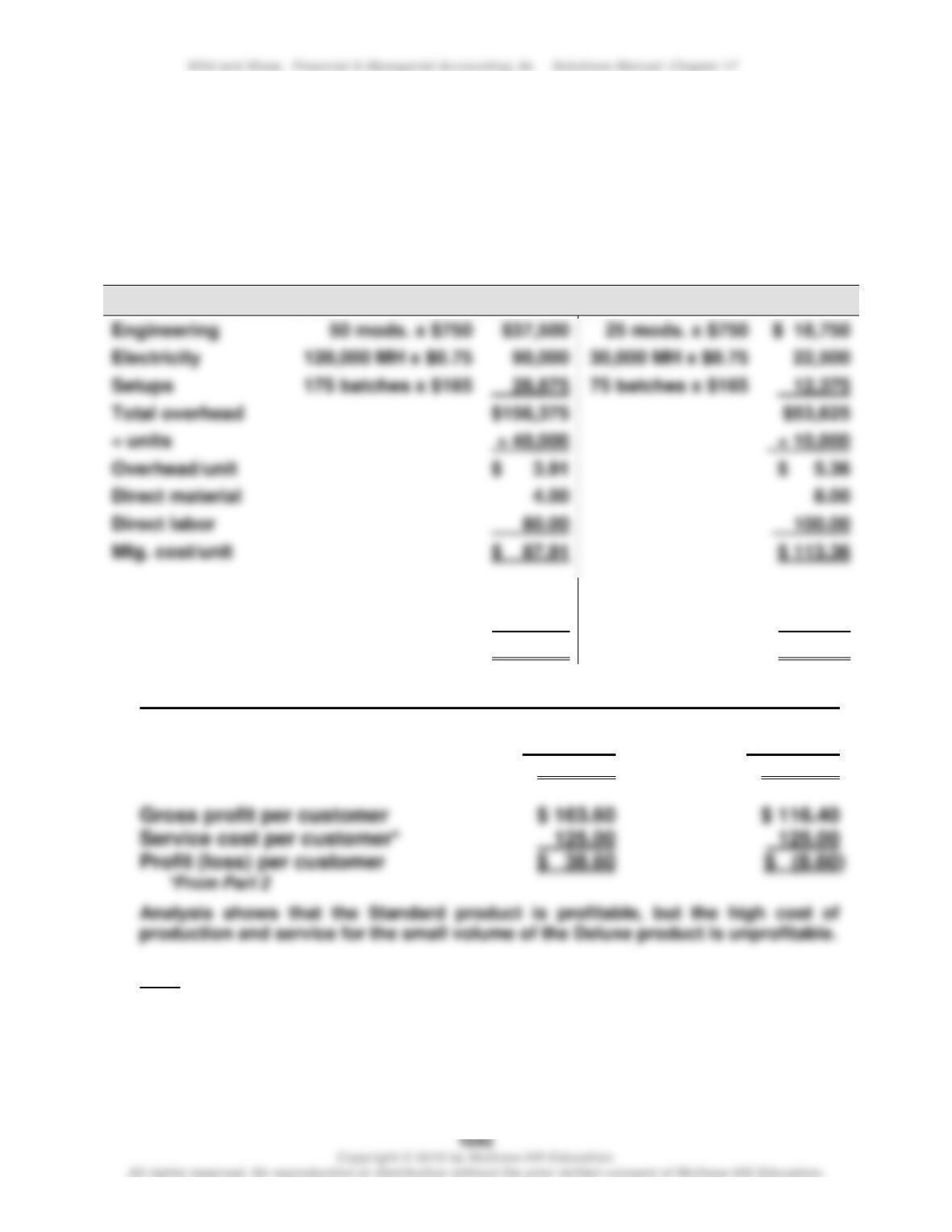
3. Compute overhead allocation rates for each activity
Eng. support $56,250/(50 + 25) modifications = $750/modification
Electricity $112,500/150,000* machine hours = $0.75/machine hour
Setup $41,250/(175 + 75) batches = $165/batch
* From part 1
Assign overhead costs to products
Standard
Deluxe
Engineering
Electricity
Setups
28,875
12,375
Total overhead
$156,375
÷ units
÷ 40,000
Overhead/unit
$ 3.91
$ 5.36
Direct material
Direct labor
Mfg. cost/unit
$ 87.91
Selling price
$ 92.00
$ 125.00
Mfg. cost/unit
87.91
113.36
Gross profit/unit
$ 4.09
$ 11.64
4. Standard Deluxe
Gross profit per unit $ 4.09 $ 11.64
x units per customer* x 40 units x 10 units
Gross profit per customer $ 163.60 $ 116.40
5. ABC gives more appropriate information to managers because it identifies the
resources consumed by each product line, and assigns the costs of these
activities accordingly. Using volume-based methods such as the plantwide
rate distorts product cost because the focus of these methods is on the
number of units of output, which may not be the main factor causing costs to
be incurred.
Problem 17-2B (25 minutes)
1. The major costs of making the boxes are designing the boxes, setting
up machines to make the right cuts, cutting the cardboard, printing
the boxes, obtaining the cardboard material, labor, and utilities, and
shipping the boxes. Some of the costs, such as design and setup,
are not related to volume, but are related to number of different
products or number of batches. Some of the costs, such as materials
and labor, are volume-driven.
4. Possibly. If ABC had been used rather than a volume-based system,
Midwest would have realized that small customers who want custom–
designed and custom-made boxes require different activities than
than those required by existing large-volume customers. With ABC
the costs of activities associated with the special orders would be
assigned only to those orders, rather than being shared by all orders.
Midwest might have been using inaccurate cost information in setting
its selling prices.
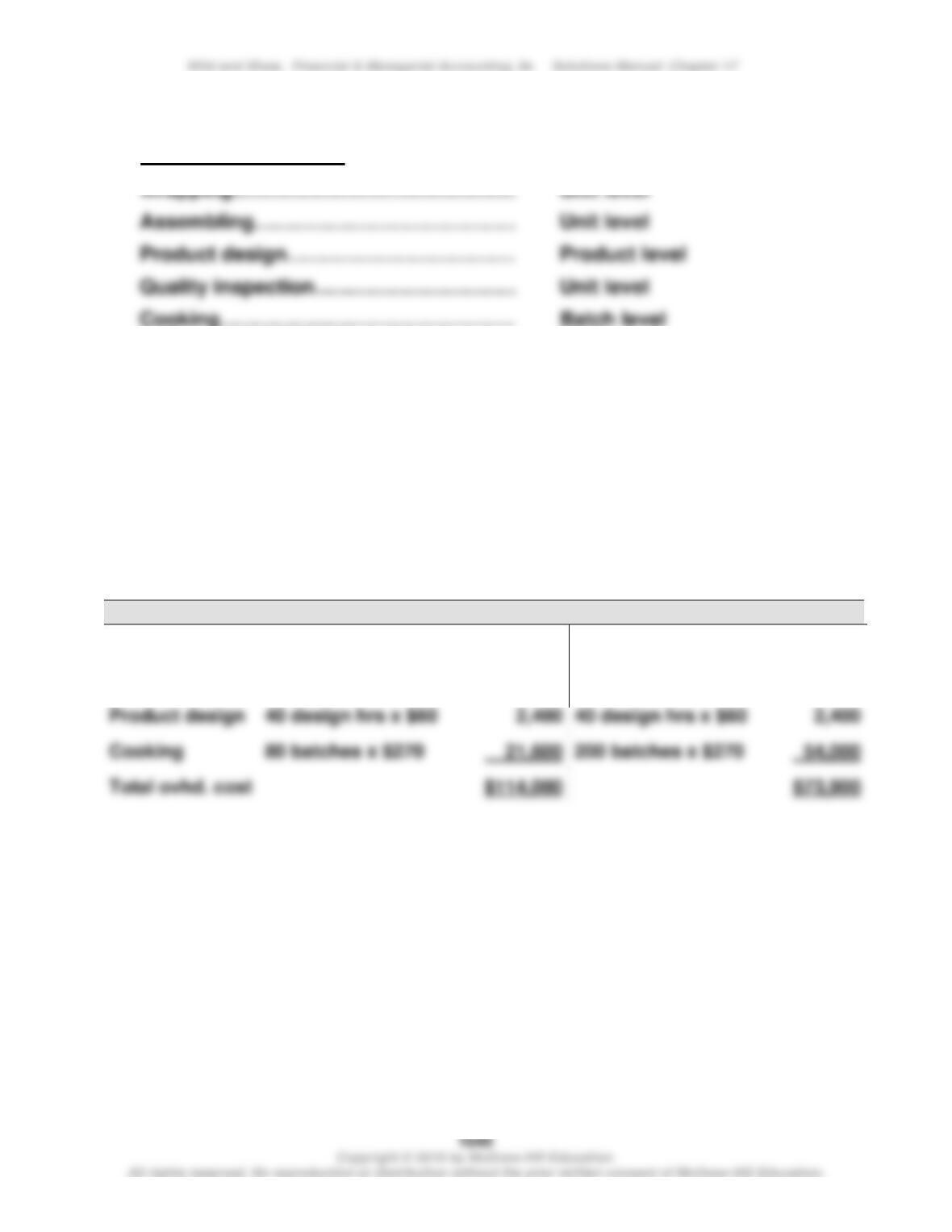
Problem 17-3B (45 minutes)
1. Classify each activity
2. Compute overhead allocation rates for each activity
Wrapping $500,000/100,000 units $5/unit
Assembling/Quality $500,000/20,000 direct labor hours $25/DLH
inspection
Product design $180,000/3,000 design hours $60/des. hr.
Cooking $270,000/1,000 batches $270/batch
3. Assign overhead costs to products
Holiday Basket
Executive Basket
Wrapping
8,000 units x $5
$ 40,000
1,000 units x $5
$ 5,000
Assembly & QI
2,000 DLH x $25
50,000
500 DLH x $25
12,500
Product design
40 design hrs x $60
40 design hrs x $60
2,400
Cooking
80 batches x $270
200 batches x $270
Total ovhd. cost