CHAPTER 17
Statement of Cash Flows
ASSIGNMENT CLASSIFICATION TABLE
Learning Objectives
Questions
Brief
Exercises
Do It!
Exercises
A
Problems
*1. Discuss the usefulness and
format of the statement of
cash flows.
1, 2, 3, 4, 5,
6, 7, 8, 9, 15,
16, 17
1, 2, 3
1
1, 2, 3
1A
*2. Prepare a statement of cash
flows using the indirect
method.
10, 11, 12,
13, 14
4, 5, 6, 7
2
4, 5, 6,
7, 8, 9
2A, 3A, 5A,
7A, 9A, 11A
*3. Analyze the statement of
8, 9, 10, 11
3
7, 9
7A, 8A
*4. Prepare a statement of cash
8, 18, 19, 20,
12, 13, 14
10, 11,
4A, 6A, 8A,
ASSIGNMENT CHARACTERISTICS TABLE
Problem
Number
Description
Difficulty
Level
Time
Allotted (min.)
1A
Distinguish among operating, investing, and financing
activities.
Simple
10–15
2A
Determine cash flow effects of changes in equity accounts.
Simple
10–15
3A
Prepare the operating activities section—indirect method.
Simple
20–30
*4A
Prepare the operating activities section—direct method.
Simple
20–30
5A
Prepare the operating activities section—indirect method.
Simple
20–30
Prepare the operating activities section—direct method.
Simple
20–30
7A
Prepare a statement of cash flows—indirect method, and
compute free cash flow.
Moderate
40–50
*8A
Prepare a statement of cash flows—direct method, and
compute free cash flow.
Moderate
40–50
9A
Prepare a statement of cash flows—indirect method.
Moderate
40–50
*10A
Prepare a statement of cash flows—direct method.
Moderate
40–50
*12A
Prepare a worksheet—indirect method.
Moderate
40–50
WEYGANDT ACCOUNTING PRINCIPLES 12E
CHAPTER 17
STATEMENT OF CASH FLOWS
Number
LO
BT
Difficulty
Time (min.)
BE1
1
AP
Simple
3–5
BE2
1
C
Simple
2–4
BE3
1
AP
Simple
3–5
BE4
2
AP
4–6
BE5
2
AP
Simple
3–5
BE6
2
AP
Simple
4–6
BE7
2
AN
Moderate
3–5
BE8
3
AN
Simple
2–4
BE9
3
AN
Simple
2–3
BE10
3
AN
Simple
2–3
BE11
3
AN
Simple
4–6
*BE12
4
AP
Simple
2–4
*BE13
4
AP
Simple
3–5
*BE14
4
AP
Moderate
3–5
*BE15
5
AP
Simple
4–6
DI1
1
C
Simple
2–4
DI2
2
AP, C
Simple
4–6
DI3
3
AN, C
Simple
4–6
EX1
1
C
Simple
5–7
EX2
1
C
Simple
6–8
EX3
1
AP
Simple
8–10
EX4
2
AP
Simple
5–7
EX5
2
AP
Simple
6–8
EX6
2
AN
Moderate
10–12
EX7
2, 3
AP
Simple
12–14
EX8
2
AP
Simple
10–12
EX9
2, 3
AP
Simple
12–14
EX10
4
AP
Moderate
6–8
EX11
4
AP
Moderate
6–8
*EX12
4
AP
Simple
5–7
*EX13
4
AP
Moderate
6–8
STATEMENT OF CASH FLOWS (Continued)
Number
LO
BT
Difficulty
Time (min.)
*EX14
5
AP
Moderate
16–20
P1A
1
C
Simple
10–15
P2A
2
AN
Simple
10–15
P3A
2
AP
Simple
20–30
*P4A
4
AP
Simple
20–30
P5A
2
AP
Simple
20–30
*P6A
4
AP
Simple
20–30
P7A
Moderate
40–50
*P8A
Moderate
40–50
P9A
2
AP
Moderate
40–50
*P10A
4
AP
Moderate
40–50
P11A
2
AP
Moderate
40–50
*P12A
5
AP
Moderate
40–50
BYP1
1
AN
Simple
15–20
BYP2
3
AP, E
Simple
8–12
BYP3
3
AP, E
Simple
8–12
BYP4
2
C
Simple
15–20
BYP5
—
C
Simple
10–15
BYP6
—
AP
Moderate
25–30
BYP7
1
AP
Simple
10–15
BYP8
1
E
Simple
10–15
BYP9
—
E
Simple
15–20
BYP10
1
AP
Moderate
10–15
BLOOM’ S TAXONOMY TABLE
Correlation Chart between Bloom’s Taxonomy, Learning Objectives and End–of-Chapter Exercises and Problems
Learning Objective
Knowledge
Comprehension
Application
Analysis
Synthesis
Evaluation
1. Discuss the usefulness and
format of the statement of cash
flows.
Q17-4
Q17-6
Q17-1
Q17-2
Q17-3
Q17-5
Q17-7
Q17-8
Q17-9
Q17-15
Q17-16
Q17-17
BE17-2
DI17-1
E17-1
E17-2
P17-1A
BE17-1
BE17-3
E17-2
E17-3
2. Prepare a statement of cash
Q17-13
Q17-10
BE17-4
E17-8
BE17-7
3. Analyze the statement of
cash flows.
Dl17-3
E17-7
E17-9
P17-7A
P17-8A
BE17-8
BE17-9
BE17-10
BE17-11
DI17-3
P17-7A
P17-8A
*4. Prepare a statement of cash
flows using the direct
method.
Q17-8
Q17-18
Q17-21
Q17-19
Q17-20
BE17-12
E17-12
E17-13
P17-4A
P17-8A
*5 Use a worksheet to prepare the
statement of cash flows
using the indirect method.
Q17-22
BE17-15
E17-14
P17-12A
Broadening Your Perspective
Real-World Focus
Comparative Analysis
Decision Making Across
the Organization
Communication
FASB Codification
Financial Reporting
Comp. Analysis
Decision Making
Across the
Organization
Ethics Case
All About You
ANSWERS TO QUESTIONS
1. (a) The statement of cash flows reports the cash receipts, cash payments, and net change in cash
resulting from the operating, investing, and financing activities of a company during a
period.
(b) Disagree. The statement of cash flows is required. It is the fourth basic financial statement.
2. The statement of cash flows answers the following questions about cash: (a) Where did the cash
come from during the period? (b) What was the cash used for during the period? and (c) What was
the change in the cash balance during the period?
3. The three types of activities are:
Operating activities include the cash effects of transactions that create revenues and expenses
and thus enter into the determination of net income.
Investing activities include: (a) acquiring and disposing of investments and property, plant and
equipment and (b) lending money and collecting loans.
Financing activities include: (a) obtaining cash from issuing debt and repaying amounts borrowed
and (b) obtaining cash from stockholders, repurchasing shares, and paying dividends.
5. The statement of cash flows presents investing and financing activities so that even noncash
transactions of an investing and financing nature are disclosed in the financial statements. If they
affect financial conditions significantly, the FASB requires that they be disclosed in either a separate
schedule at the bottom of the statement of cash flows or in a separate note or supplementary
schedule to the financial statements.
6. Examples of significant noncash activities are: (1) issuance of stock for assets, (2) conversion of
bonds into common stock, (3) issuance of bonds or notes for assets, and (4) noncash exchanges
of property, plant, and equipment.
7. Comparative balance sheets, a current income statement, and certain transaction data all provide
information necessary for preparation of the statement of cash flows. Comparative balance sheets
indicate how assets, liabilities, and equities have changed during the period. A current income
statement provides information about the amount of cash provided or used by operations. Certain
transactions provide additional detailed information needed to determine how cash was provided
or used during the period.
Questions Chapter 17 (Continued)
9. When total cash inflows exceed total cash outflows, the excess is identified as a “net increase in cash”
near the bottom of the statement of cash flows.
10. The indirect method involves converting accrual net income to net cash provided by operating activities.
This is done by starting with accrual net income and adding or subtracting noncash items included
in net income. Examples of adjustments include depreciation and other noncash expenses, gains
and losses on the disposal of noncurrent assets, and changes in the balances of current asset
and current liability accounts from one period to the next.
12. A number of factors could have caused an increase in cash despite the net loss. These are (1) high
cash revenues relative to low cash expenses; (2) sales of property, plant, and equipment; (3) sales
of investments; (4) issuance of debt or capital stock, and (5) differences between cash and accrual
accounting, e.g. depreciation.
13. Depreciation expense.
Gain or loss on disposal of a noncurrent asset.
Increase/decrease in accounts receivable.
Increase/decrease in inventory.
Increase/decrease in accounts payable.
14. Under the indirect method, depreciation is added back to net income to reconcile net income to net
cash provided by operating activities because depreciation is an expense but not a cash payment.
15. The statement of cash flows is useful because it provides information to the investors, creditors,
and other users about: (1) the company’s ability to generate future cash flows, (2) the company’s ability
to pay dividends and meet obligations, (3) the reasons for the difference between net income and
net cash provided by operating activities, and (4) the cash investing and financing transactions
during the period.
16. This transaction is reported in the note or schedule entitled “Noncash investing and financing activities”
as follows: “Retirement of bonds payable through issuance of common stock, $1,700,000.”
Questions Chapter 17 (Continued)
+ Decrease in accounts receivable
*19.
(a)
Cash receipts from customers = Revenues from sales
– Increase in accounts receivable
+ Increase in inventory
(b)
Purchases = Cost of goods sold
– Decrease in inventory
+ Decrease in accounts payable
Cash payments to suppliers = Purchases
– Increase in accounts payable
*21. Depreciation expense is not listed in the direct method operating activities section because it is not
a cash flow item—it does not affect cash.
*22. A worksheet is desirable because it allows the accumulation and classification of data that will
SOLUTIONS TO BRIEF EXERCISES
BRIEF EXERCISE 17-1
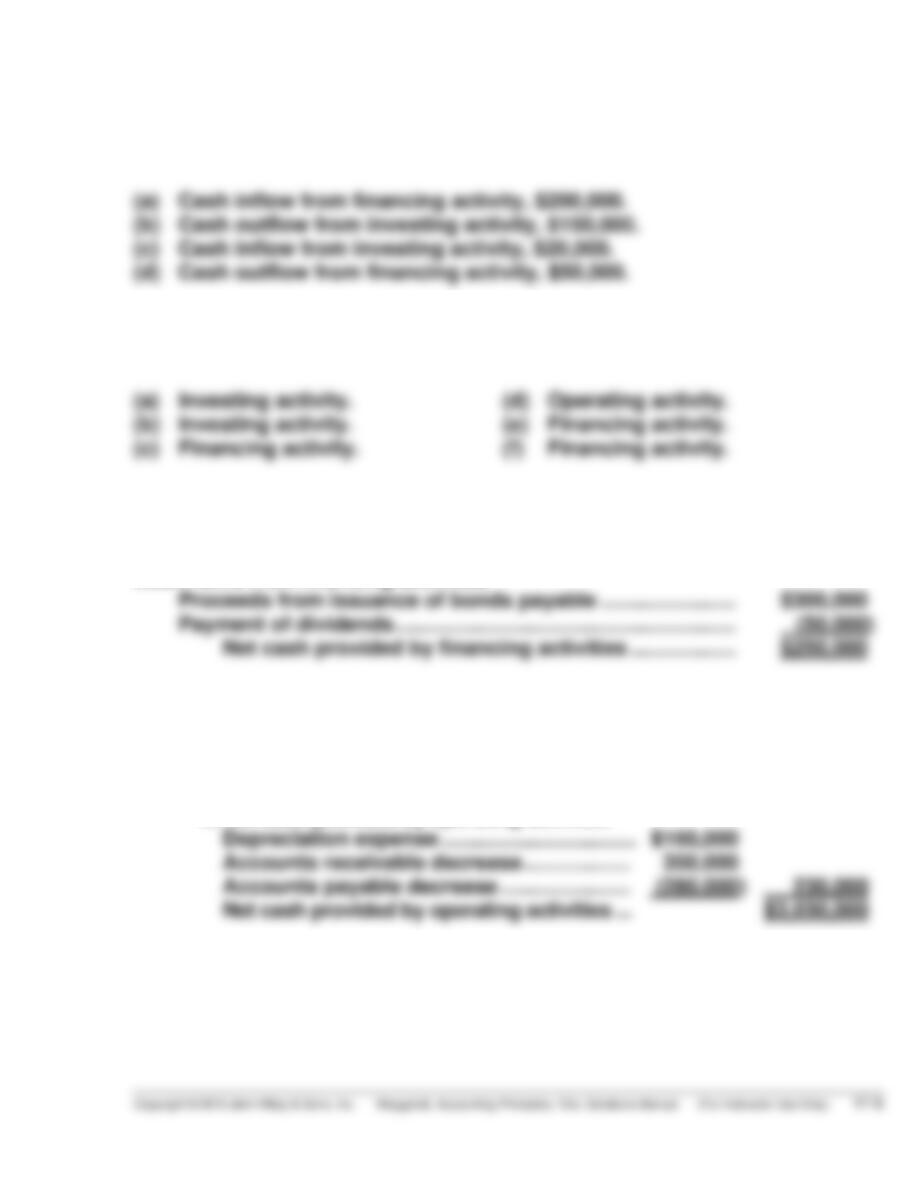
(a) Cash inflow from financing activity, $200,000.
BRIEF EXERCISE 17-2
(a) Investing activity. (d) Operating activity.
(b) Investing activity. (e) Financing activity.
(c) Financing activity. (f) Financing activity.
BRIEF EXERCISE 17-3
BRIEF EXERCISE 17-4
Net income …………………………………………………. $2,800,000
Adjustments to reconcile net income
to net cash provided by operating activities
Depreciation expense …………………………... $160,000
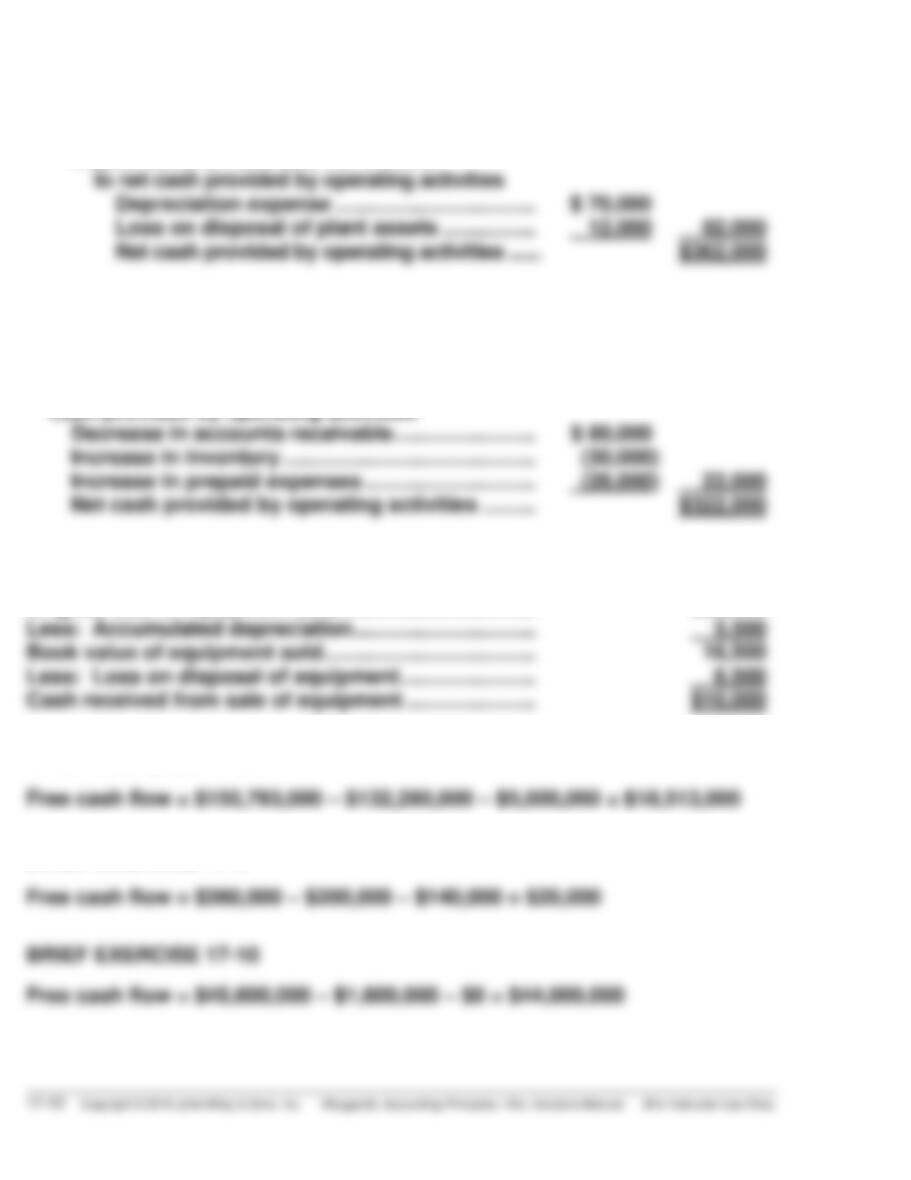
BRIEF EXERCISE 17-5
Cash flows from operating activities
Net income ………………………………………………….. $280,000
Adjustments to reconcile net income
to net cash provided by operating activities
BRIEF EXERCISE 17-6
Net income …………………………………………………………. $300,000
Adjustments to reconcile net income to net
cash provided by operating activities
Decrease in accounts receivable …………………… $ 80,000)
BRIEF EXERCISE 17-7
Original cost of equipment sold …………………………... $22,000
Less: Accumulated depreciation …………………………. 5,500
Book value of equipment sold ……………………………… 16,500
BRIEF EXERCISE 17-8
Free cash flow = $155,793,000 – $132,280,000 – $5,000,000 = $18,513,000
BRIEF EXERCISE 17-9
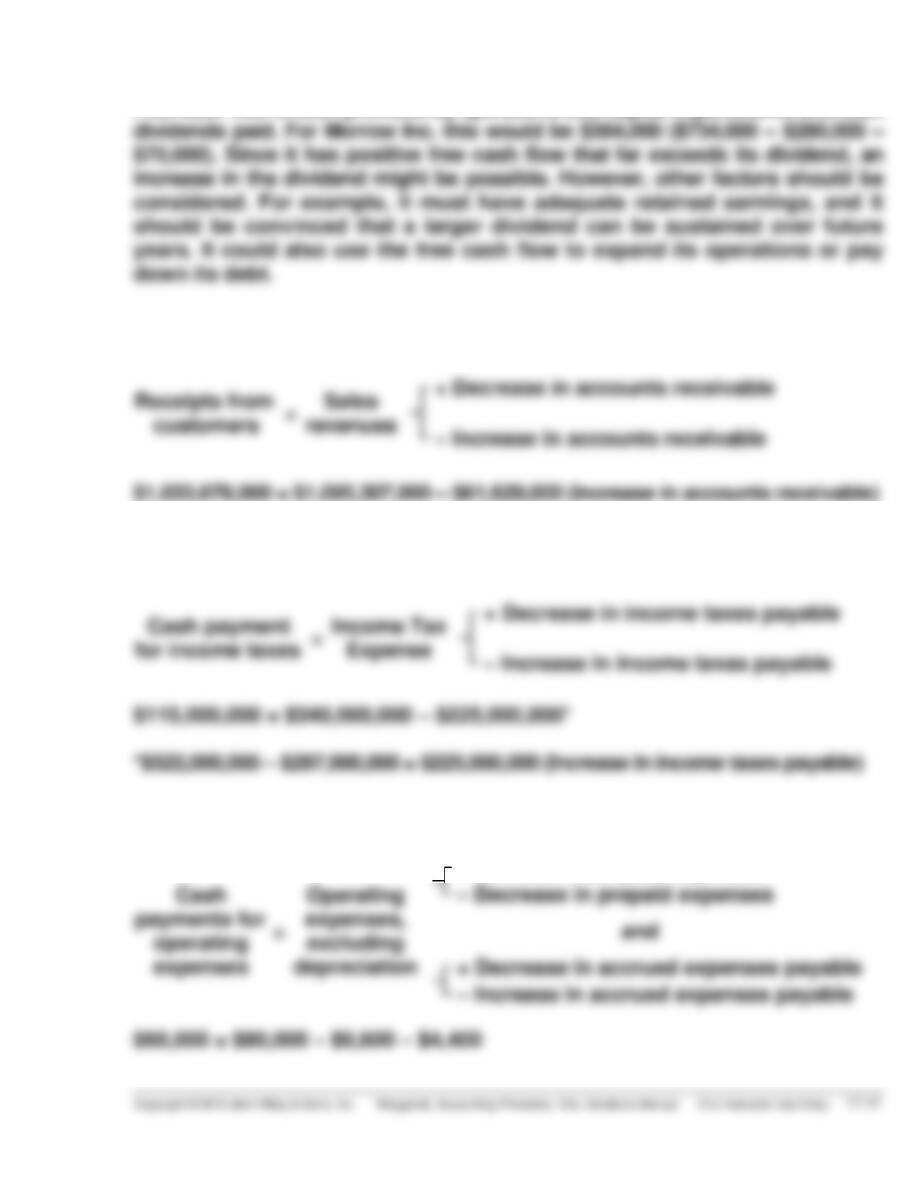
BRIEF EXERCISE 17-11
Free cash flow is cash provided by operations less capital expenditures and cash
dividends paid. For Morrow Inc. this would be $384,000 ($734,000 – $280,000 –
$70,000). Since it has positive free cash flow that far exceeds its dividend, an
increase in the dividend might be possible. However, other factors should be
considered. For example, it must have adequate retained earnings, and it
should be convinced that a larger dividend can be sustained over future
years. It could also use the free cash flow to expand its operations or pay
down its debt.
*BRIEF EXERCISE 17-12
+ Decrease in accounts receivable
Receipts from
customers
=
Sales
revenues
– Increase in accounts receivable
$115,000,000 = $340,000,000 – $225,000,000*
*BRIEF EXERCISE 17-14
+ Increase in prepaid expenses
– Increase in accrued expenses payable
Cash
payments for
operating
=
Operating
expenses,
excluding
– Decrease in prepaid expenses
and
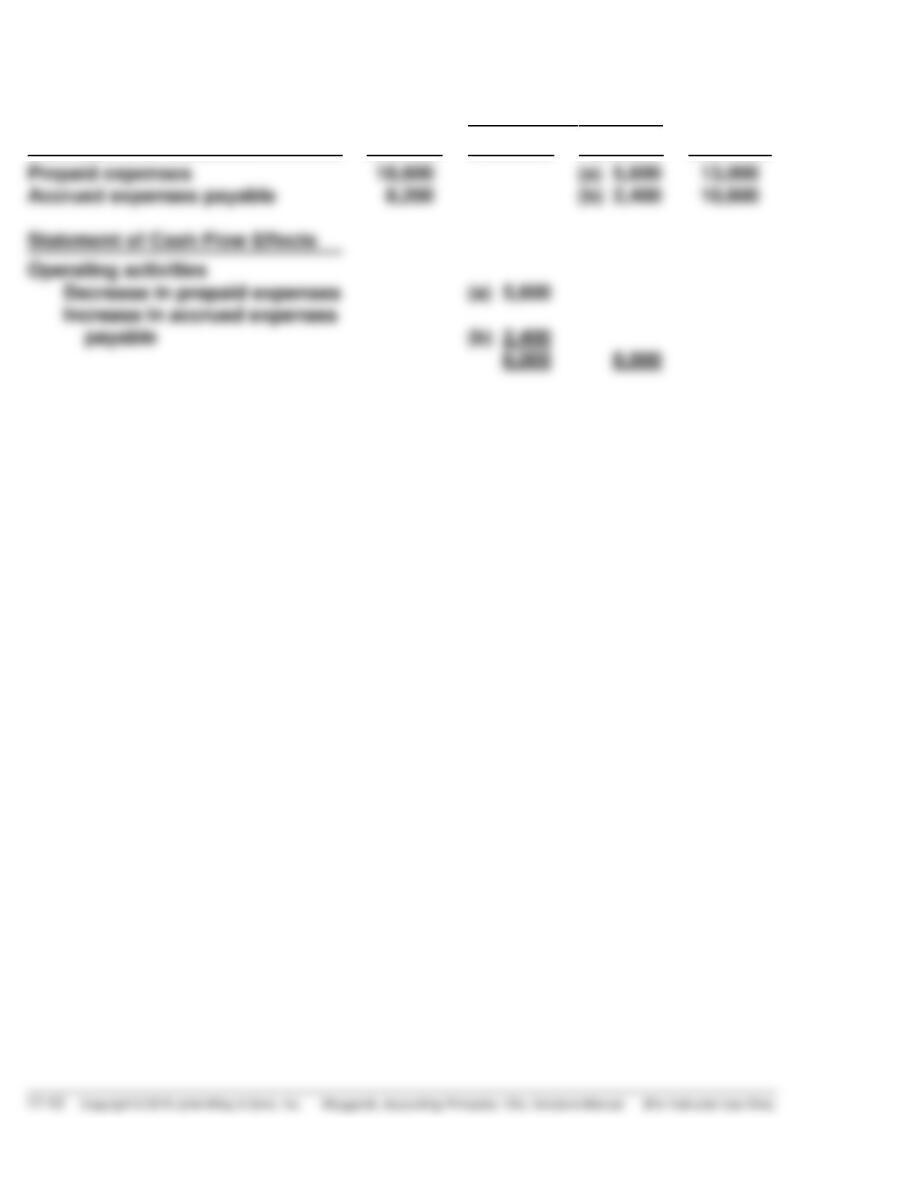
*BRIEF EXERCISE 17-15
Balance
1/1/17
Reconciling Items
Balance
12/31/17
Balance Sheet Accounts
Debit
Credit
Prepaid expenses
Accrued expenses payable
18,600
8,200
(a) 5,600
(b) 2,400
13,000
10,600
Statement of Cash Flow Effects
Operating activities
SOLUTIONS TO DO IT! REVIEW EXERCISES
DO IT! 17-1
1. Financing activity
2. Operating activity
DO IT! 17-2
Cash flows from operating activities
Net income ……………………………………………………. $130,000
Adjustments to reconcile net income to net
cash provided by operating activities:
Depreciation expense ……………………………… $6,000
DO IT! 17-3
(a) Free cash flow = $73,700 – $27,000 – $15,000 = $31,700
(b) Cash provided by operating activities fails to take into account that a
SOLUTIONS TO EXERCISES
EXERCISE 17-1
(a) Financing activities.
(b) Noncash investing and financing activities.
(c) Noncash investing and financing activities.
EXERCISE 17-2
(a)
(b)
Operating activity.
Noncash investing and
(i)
(j)
Operating activity.
Noncash investing and financing
EXERCISE 17-3
1. (a) Cash ………………………………………………….. 15,000
Land……………………………………………. 12,000
Gain on Disposal of Plant Assets ….. 3,000
2. (a) Cash ………………………………………………….. 20,000
Common Stock ……………………………. 20,000
EXERCISE 17-3 (Continued)
4. (a) Salaries and Wages Expense …………………………. 9,000
Cash ……………………………………………………… 9,000
5. (a) Equipment ……………………………………………………… 8,000
Common Stock ……………………………………….. 1,000
Paid-in Capital in Excess of Par—
Common Stock ……………………………………. 7,000
6. (a) Cash ……………………………………………………………… 1,200
Loss on Disposal of Plant Assets ……………………. 1,800
Accumulated Depreciation—Equipment …………… 7,000
Equipment ………………………………………………. 10,000
EXERCISE 17-4
GUTIERREZ COMPANY
Partial Statement of Cash Flows
For the Year Ended December 31, 2017
Cash flows from operating activities
Net income …………………………………………………….. $225,000
Adjustments to reconcile net income to net
cash provided by operating activities
Depreciation expense ………………………………. $45,000
EXERCISE 17-5
SCOGGIN INC.
Partial Statement of Cash Flows
For the Year Ended December 31, 2017
Cash flows from operating activities
Net income …………………………………………………. $153,000
Adjustments to reconcile net income to net
cash provided by operating activities
Depreciation expense …………………………... $24,000)
Increase in accounts receivable …………….. (21,000)
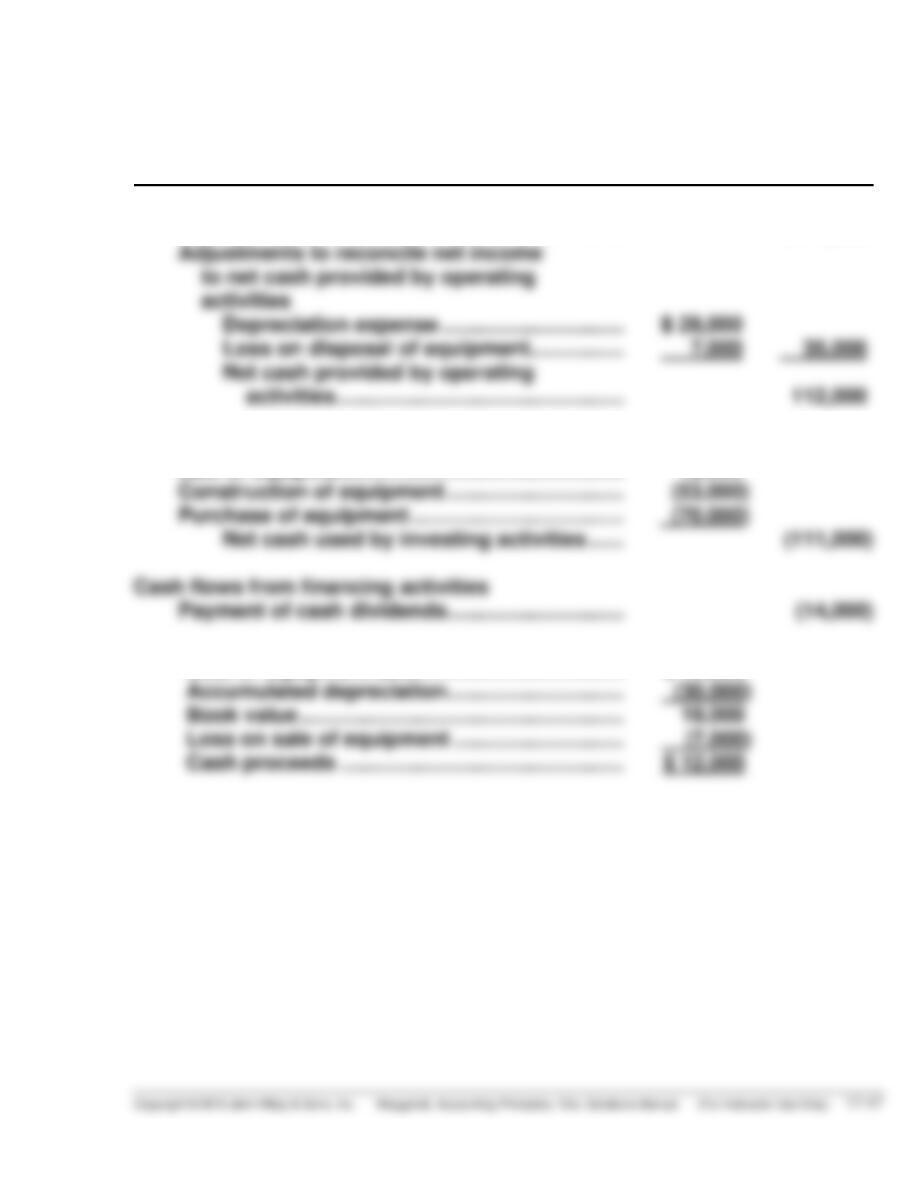
EXERCISE 17-6
HERRICK CORP
Partial Statement of Cash Flows
For the Year Ended December 31, 2017
Cash flows from operating activities
Net income ……………………………………………….. $ 77,000)
Cash flows from investing activities
Sale of equipment ……………………………………… 12,000*
Construction of equipment ………………………… (53,000)
Purchase of equipment ……………………………… (70,000)
Net cash used by investing activities …… (111,000)
Cash flows from financing activities
Payment of cash dividends ………………………… (14,000)
*Cost of equipment sold …………………………….. $ 49,000)
EXERCISE 17-7
(a) ROJAS CORPORATION
Statement of Cash Flows
For the Year Ended December 31, 2017
Cash flows from operating activities
Net income …………………………………………………. $ 22,630)
Adjustments to reconcile net income
to net cash provided by operating activities
Depreciation expense …………………………... $ 5,000
)
Cash flows from investing activities
Sale of land ………………………………………………… 4,900
Cash flows from financing activities
Issuance of common stock ………………………….. $ 6,000
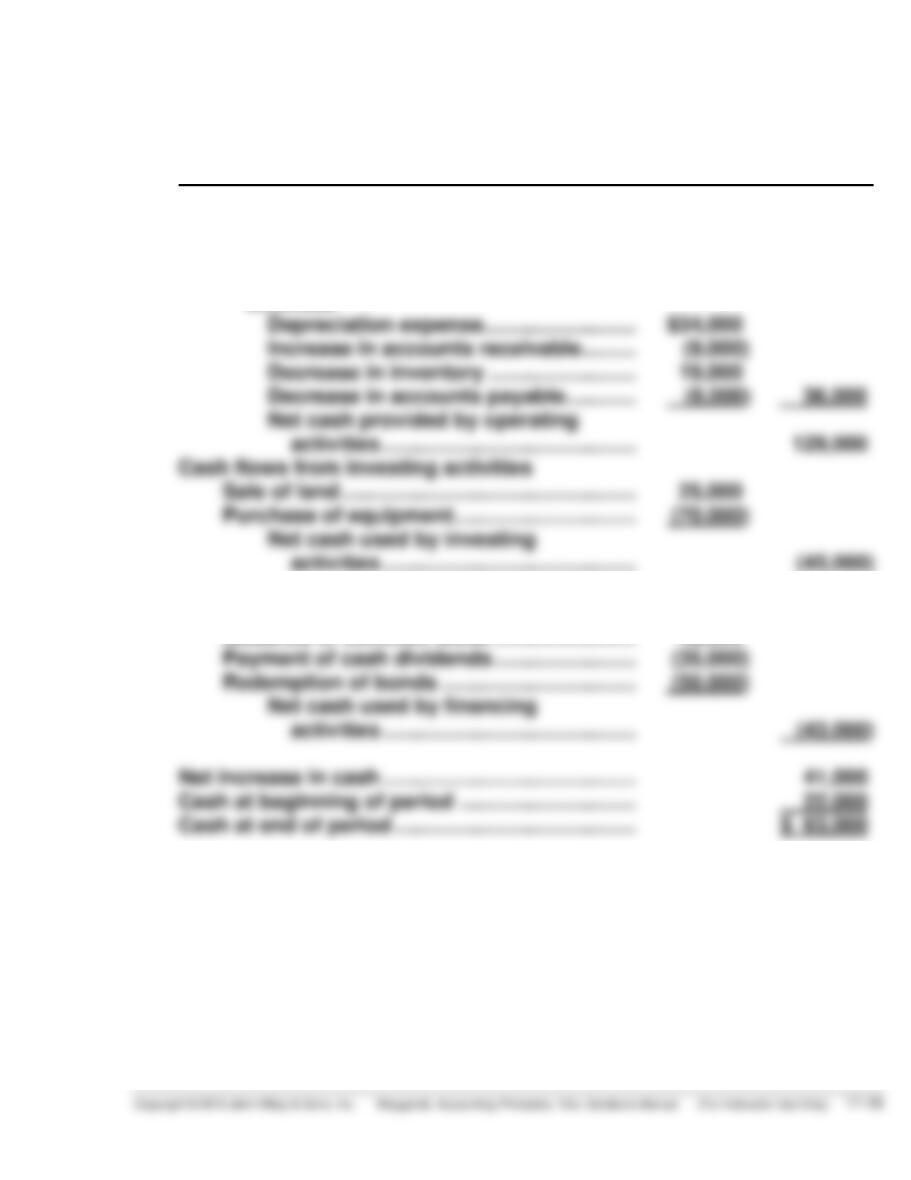
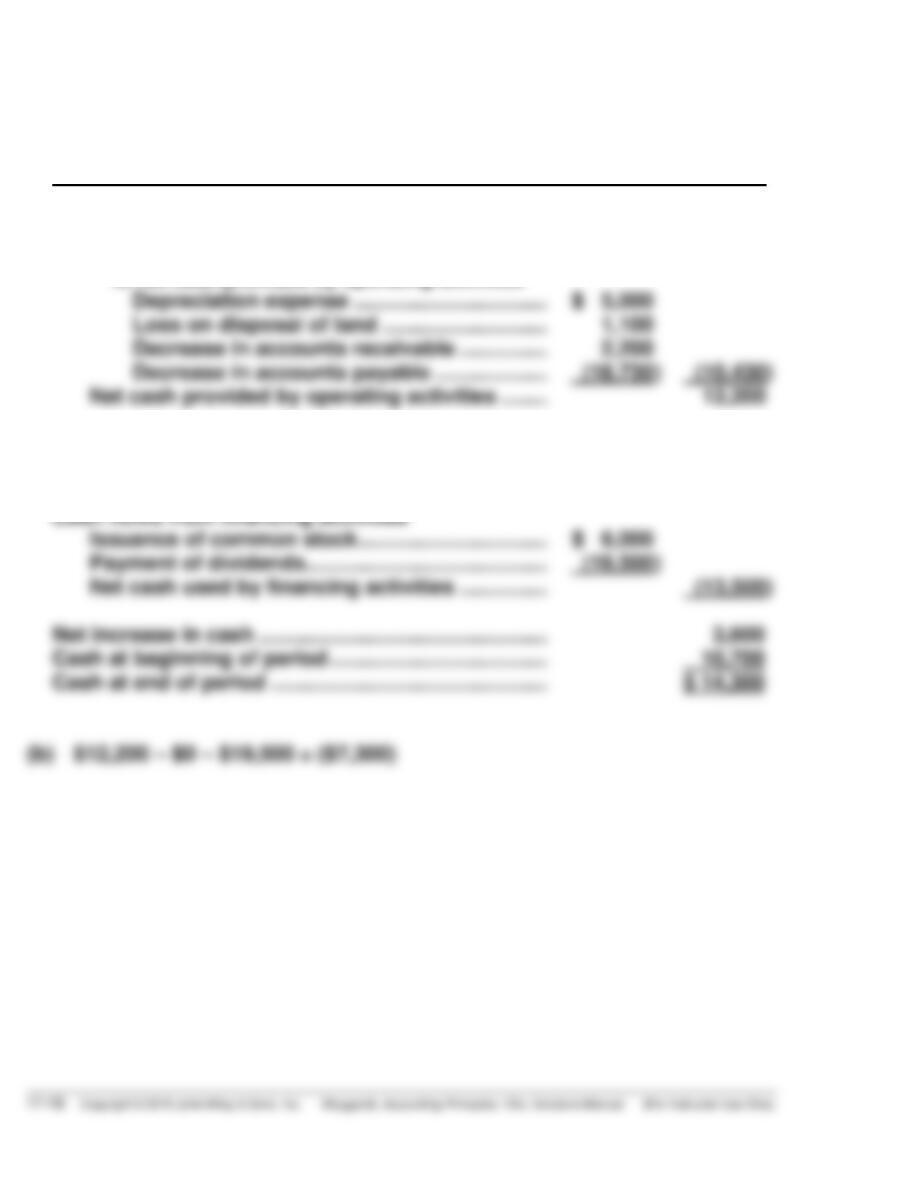
EXERCISE 17-8
VELO COMPANY
Statement of Cash Flows
For the Year Ended December 31, 2017
Cash flows from operating activities
Net income …………………………………………… $93,000)
Adjustments to reconcile net income
to net cash provided by operating
activities
activities ……………………………………. 129,000)
Cash flows from investing activities
Sale of land ………………………………………….. 25,000)
Purchase of equipment …………………………. (70,000)
Net cash used by investing
activities ……………………………………. (45,000)
Cash flows from financing activities
Net increase in cash ……………………………………. 41,000)
Cash at beginning of period ………………………… 22,000)
Cash at end of period ………………………………….. $ 63,000)
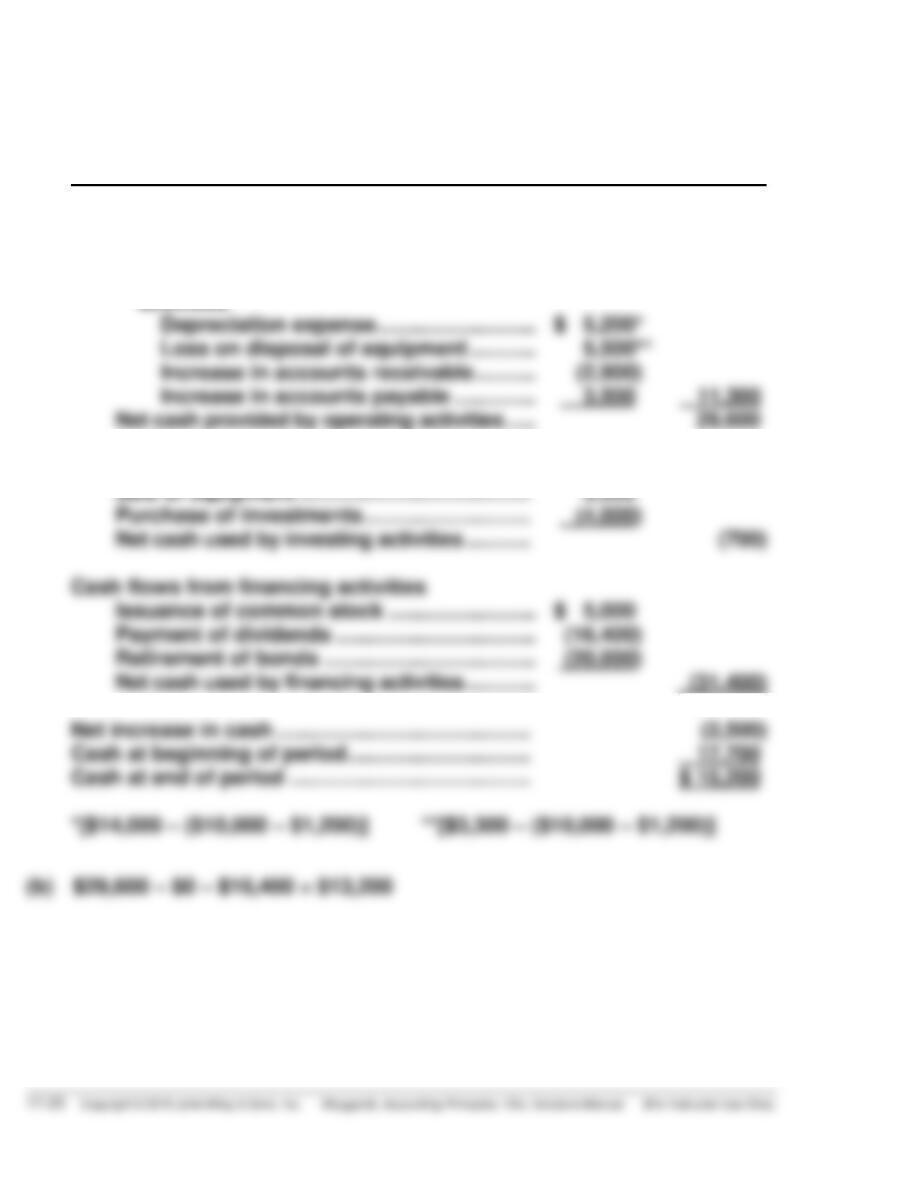
EXERCISE 17-9
(a) RODRIQUEZ CORPORATION
Statement of Cash Flows
For the Year Ended December 31, 2017
Cash flows from operating activities
Net income …………………………..………………. $ 18,300)
Adjustments to reconcile net income
to net cash provided by operating
activities
Depreciation expense ……………………… $ 5,200* )
Cash flows from investing activities
Sale of equipment ………………………………… 3,300)
Purchase of investments ………………………. (4,000)
Net cash used by investing activities ……….. (700)
Cash flows from financing activities
Net increase in cash ……………………………………. (2,500))
Cash at beginning of period …………………………. 17,700
Cash at end of period ………………………………….. $ 15,200