
Auditing: A Risk Based Approach to Conducting a Quality Audit, 10e
Solutions for Chapter 17
True/False Questions
17-2 T
17-4 T
17-6 F
17-8 F
17-10 T
17-12 F
17-14 T
Multiple-Choice Questions
17-16 C
17-18 A
17-20 B
17-22 E
17-24 D
17-26 E
17-28 A
17-2
Review and Short Case Questions
17-29
The subject matter of a nonaudit attestation engagement can be quite varied, and may
include the following types of topics or issues:
17-30
The following are examples from audit firms’ web sites that illustrate the vast array of
nonaudit services that audit firms, large and small, provide:
PwC
• Accounting advisory services (for example, advice on derivatives, fair value
assessments, income tax accounting, and revenue recognition)
• Capital market services (e.g., debt-offering services, bankruptcy and fresh start
KPMG
• Internal audit services
• Risk and compliance services
• Financial and business due diligence
Baker Tilly
• Employee benefit plan audits
• Fraud and forensics
CliftonLarsonAllen
• Reviews
17-3
• Forecasting
17-31
International and U.S. standard setters identify two levels of assurance that can be
provided in an attestation engagement: positive assurance and limited assurance. Positive
assurance is provided when conducting an examination, while limited assurance
(sometimes referred to as negative assurance) is provided when conducting reviews. In
17-32
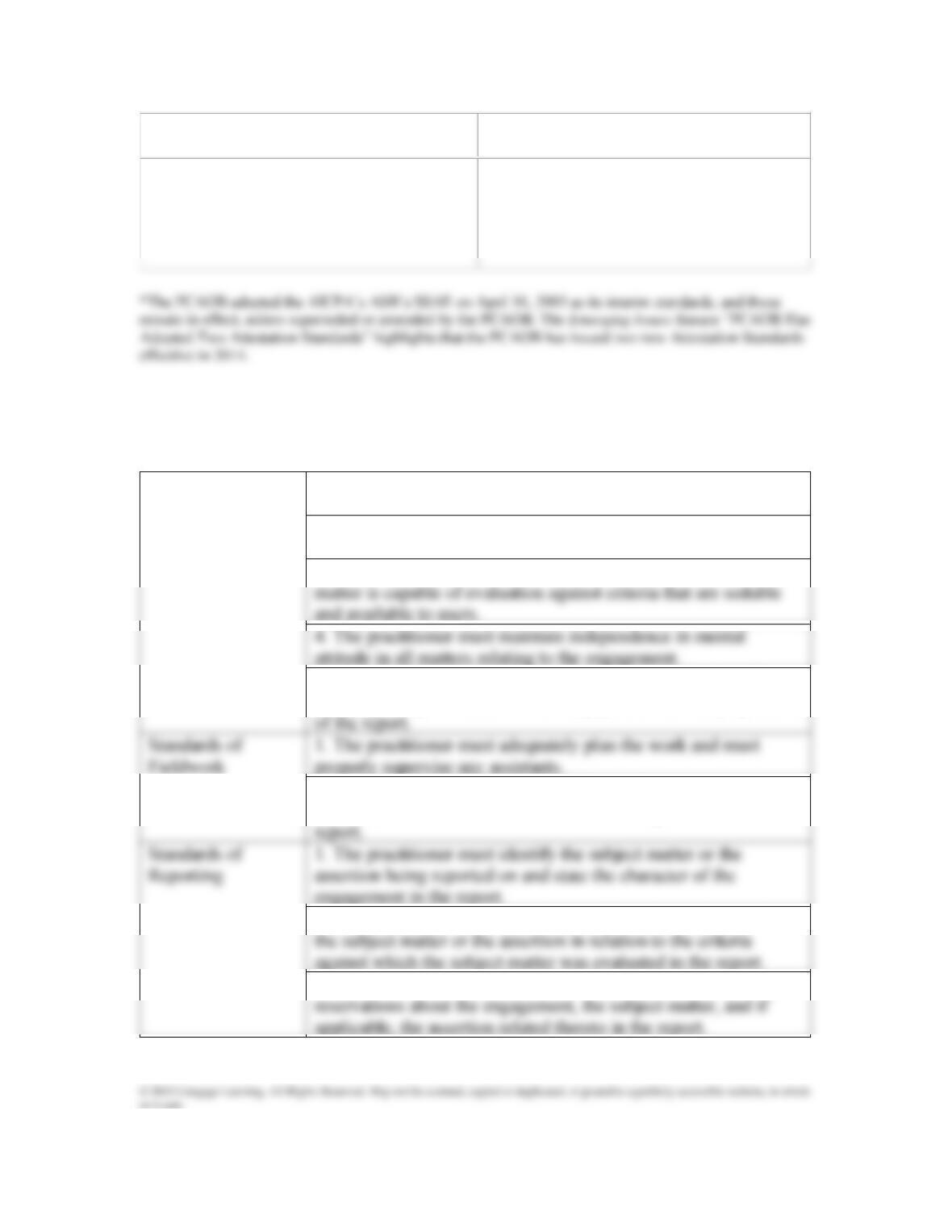
United States and International Attestation (Assurance) Standards
U.S. Attestation Standards (AICPA) *
International Attestation (Assurance)
Standards (IAASB)
Statements on Standards for Attestation
Engagements (SSAE, referenced as AT)
International Standards on Assurance
Engagements (ISAEs)
Statements on Standards for Accounting and
Review Services (SSARS, referenced as
AR)
• Engagements to review financial
statements
International Standards on Review
Engagements (ISREs)
• Engagements to review financial
statements
17-4
U.S. Attestation Standards (AICPA) *
International Attestation (Assurance)
Standards (IAASB)
• Engagements to perform agreed-
upon procedures regarding financial
information
17-33
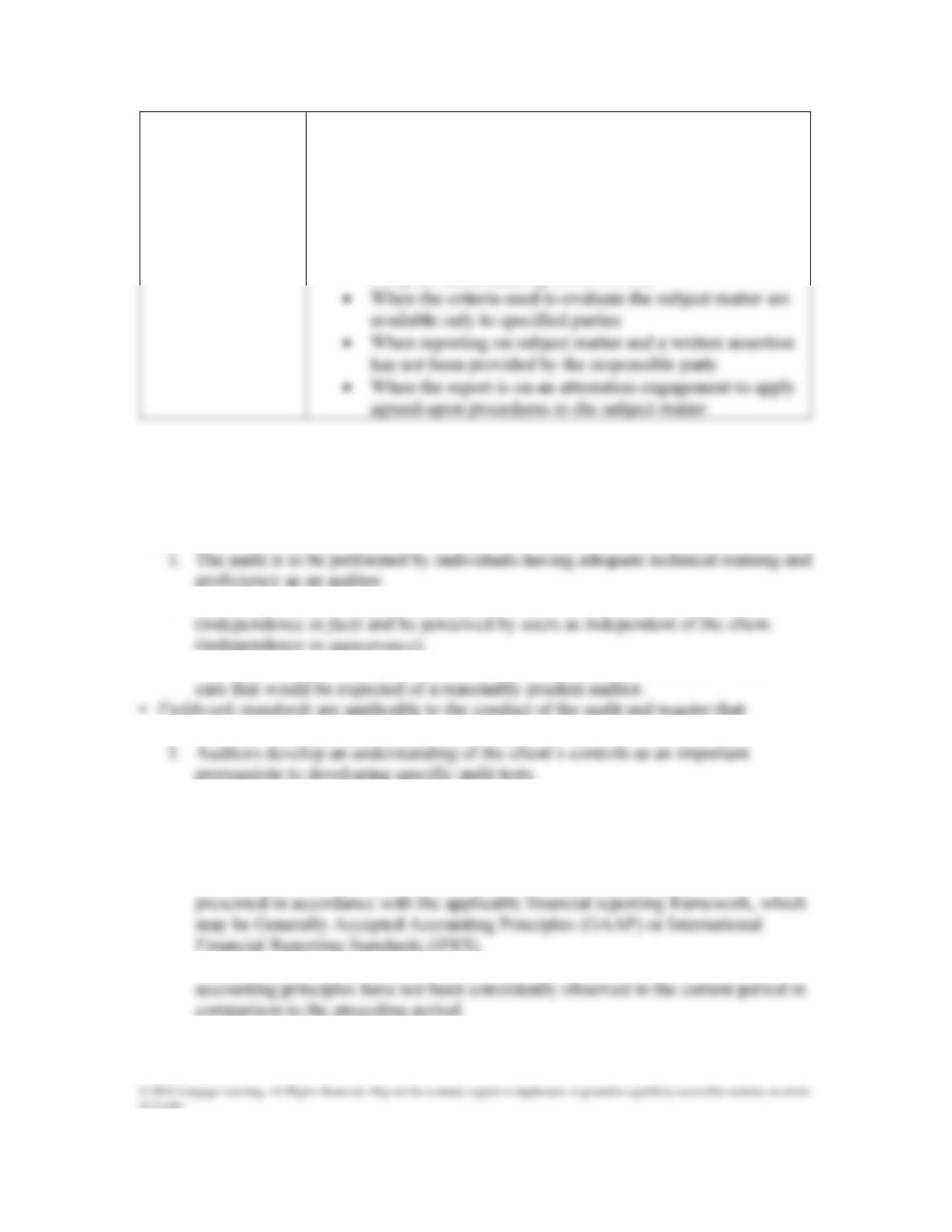
General Standards
1. The practitioner must have adequate technical training and
proficiency to perform the attestation engagement.
2. The practitioner must have adequate knowledge of the subject
matter.
matter is capable of evaluation against criteria that are suitable
and available to users.
3. The practitioner must have reason to believe that the subject
of the report.
1. The practitioner must adequately plan the work and must
properly supervise any assistants.
5. The practitioner must exercise due professional care in the
planning and performance of the engagement and the preparation
report.
1. The practitioner must identify the subject matter or the
assertion being reported on and state the character of the
engagement in the report.
2. The practitioner must obtain sufficient evidence to provide a
reasonable basis for the conclusions that is expressed in the
the subject matter or the assertion in relation to the criteria
against which the subject matter was evaluated in the report.
2. The practitioner must state the practitioner’s conclusion about
reservations about the engagement, the subject matter, and if
applicable, the assertion related thereto in the report.
3. The practitioner must state all of the practitioner’s significant
17-5
4. The practitioner must state in the report that the report is
intended solely for the information and use of the specified
parties under the following circumstances:
• When the criteria used to evaluate the subject matter are
determined by the practitioner to be appropriate only for
a limited number of parties who either participated in
their establishment or can be presumed to have an
adequate understanding of the criteria
The ten auditing standards also fall within three categories:
• General standards are applicable to the auditor and audit firm and provide guidance in
selecting and training its professionals to meet the public trust. The general standards
require the following:
2. Auditors are to be independent in their mental attitude in conducting the audit
3. The audit is to be conducted with due professional care which is a standard of
4. An audit is properly planned and supervised.
6. Auditors obtain sufficient appropriate audit evidence by performing audit
procedures to provide a reasonable basis for the audit opinion being provided.
• Reporting standards are applicable to communicating the auditor’s opinion and require
that:
7. The auditor will state explicitly whether the financial statements are fairly
8. The auditor will identify in the auditor’s report, those circumstances in which
17-6
9. The auditor will review disclosures for adequacy, and if the auditor concludes that
10. The auditor will express an opinion on the financial statements as a whole or state
that an opinion cannot be expressed.
The main similarities and differences are as follows:
• General standard #3 in the attestation services regarding available criteria is not found
in the auditing standards, but otherwise the general standards are essentially the same.
17-34
The objective of a review engagement “is to enable a practitioner to state whether, on the
basis of procedures which do not provide all the evidence that would be required in an
audit, anything has come to the practitioner’s attention that causes the practitioner to
A review is designed to obtain only limited assurance that there are no material
modifications that should be made to the financial statements in order for the statements
to be in conformity with the applicable financial reporting framework. A review differs
from a financial statement audit in a variety of important ways. A review does not
involve:
• Obtaining an understanding of the organization’s internal control
• Does not involve assessing fraud risk
17-35
Standard procedures for conducting a review include the following:
• Obtain a written engagement letter regarding the specific services to be performed
so as to avoid potential misunderstandings with the client.
17-7
conformity with GAAP or other comprehensive basis of accounting.
• Inquire about any changes in the business activities or accounting principles and
practices and events subsequent to the date of the financial statements that would
have a material effect on the financial statements.
• Obtain or prepare a trial balance of the general ledger and foot and reconcile it to
the general ledger.
17-36
The review procedures differ from the audit procedures for these accounts in that there is
17-37
Exhibit 17.5 contains an example of the standard review report for U.S. nonpublic
companies. It has four paragraphs. The first paragraph identifies what was reviewed and
17-38
According to the IAASB, as part of a compilation engagement, management requests that
management in the preparation and presentation of financial information in accordance
with an applicable financial reporting framework based on information provided by
management” (ISRS 4410 (Revised), paragraph 16 (a)). The AICPA defines a
compilation engagement in a complementary manner, as a “service, the objective of
which is to assist management in presenting financial information in the form of financial
statements without undertaking to obtain or provide any assurance that there are no
material modifications that should be made to the financial statements in order for the
statements to be in conformity with the applicable financial reporting framework”
(SSARS, AR 60, paragraph .05).
In terms of common procedures performed in a compilation, the practitioner should have
a general knowledge of the organization’s industry, the nature of its accounting records,
the accounting basis to be used (GAAP or a special-purpose framework other than
GAAP), and the form and content of the financial statements. Such an understanding is
17-39
The practitioner will modify the standard compilation report in three situations. These
include:
1. Omission of Disclosures for Compilations. The responsible party, management, may
request the practitioner to compile financial statements that omit substantially all of the
required disclosures. This request may be honored if the practitioner believes that such
2. Compilation Report Not Required. Practitioners may prepare the financial
statements without a compilation report when these are intended for use by the client
17-9
3. Practitioner Lacks Independence. If the practitioner is not independent of the client,
a separate paragraph should be added to the compilation report stating:
I am [We are] not independent with respect to [client’s name].
17-40
For an audit, an auditor should, for example,
• obtain an understanding of the internal control structure relating to the inventory,
• observe the taking of the physical count and account for all inventory tags and
count sheets used, take some test counts and compare to the final inventory
summary,
• confirm inventory in the hands of consignees and public warehousemen,
It should be noted that in a review, the practitioner does not have to obtain an
understanding of internal controls (unless it is a public company) or obtain evidence to
corroborate the information obtained through inquiry unless it is suspect.
For a compilation, the practitioner is not required to have an understanding of ICFR,
make inquiries or perform other procedures to verify, corroborate, or review information
supplied by the client. The practitioner basically takes the information from the client’s
accounting records and prepares the financial statements.
17-41
Deficiencies in the report on the compiled financial statements are as follows:
Within the first paragraph:
17-10
• The financial statements are not properly identified.
• The second sentence should be modified to indicate the disclaimer of opinion or
assurance.
The second paragraph should be modified to indicate the responsibilities of management.
The third paragraph should:
• Describe the objective of a compilation.
• Refer to the standards the accountant is following.
The third paragraph as included should be modified as follows and included after the
conclusion paragraph:
Management has elected to omit substantially all of the disclosures required
by accounting principles generally accepted in the United States of
17-42
a. Review procedures would include inquiry concerning:
• procedures used to take the latest physical inventory and date taken.
• procedures for rolling inventory forward or backward from date of physical
inventory to date of financial statements.
Analytical procedures:
• compute inventory turnover rate based on average inventory divided into cost of
sales and compare to prior years.
• compute the gross margin percent and compare with prior years.
17-11
b. If these procedures do not support the client’s inventory values or disclosures, it
may be necessary for the auditor to select a sample of inventory items to test count and
perform a price test. For the test counts, the auditor will need to reconcile the counts with
c. Your level of professional skepticism does not need to be as high for a review
engagement compared to an audit engagement. In a review engagement, you
acknowledge limited assurance regarding the depth to which you have investigated and
17-43
Interim financial information is reported in quarterly financial statements. The SEC
requires publicly owned companies to (1) file quarterly financial information with the
SEC on Form 10-Q within 40 to 45 days (depending on the company size) after the end
17-44
The auditor should perform review procedures (a) on the quarterly information contained
in the annual report to shareholders and (b) when engaged to review the quarterly
information issued at the end of each of the first three quarters of the fiscal year. These
procedures are similar to those required by the SSARSs for reviews of financial
statements of nonpublic companies:
• Making inquiries
• Performing analytical procedures
• Reading the minutes of board of directors’ meetings
• Reading the interim information to consider whether it appears to conform to
GAAP
17-12
In addition, the auditor should obtain written representations from management
concerning such things as their responsibility for the financial information, the
17-45
The standard report on a review of separately issued interim statements of public
companies identifies the information reviewed, indicates that the standards of the
PCAOB were followed in performing the review, explains the nature of a review,
disclaims an opinion, and provides negative assurance that the auditor is not aware of any
material departures from GAAP.
The disclosure and reporting requirements for interim financial statements differ from
those for annual financial statements. Accruals, such as estimates of bad debt and income
17-46
A “special purpose framework is a financial reporting framework other than GAAP that
is one of the following bases of accounting:
• Cash basis. A basis of accounting that the entity uses to record cash receipts and