Problem 17-3B (concluded)
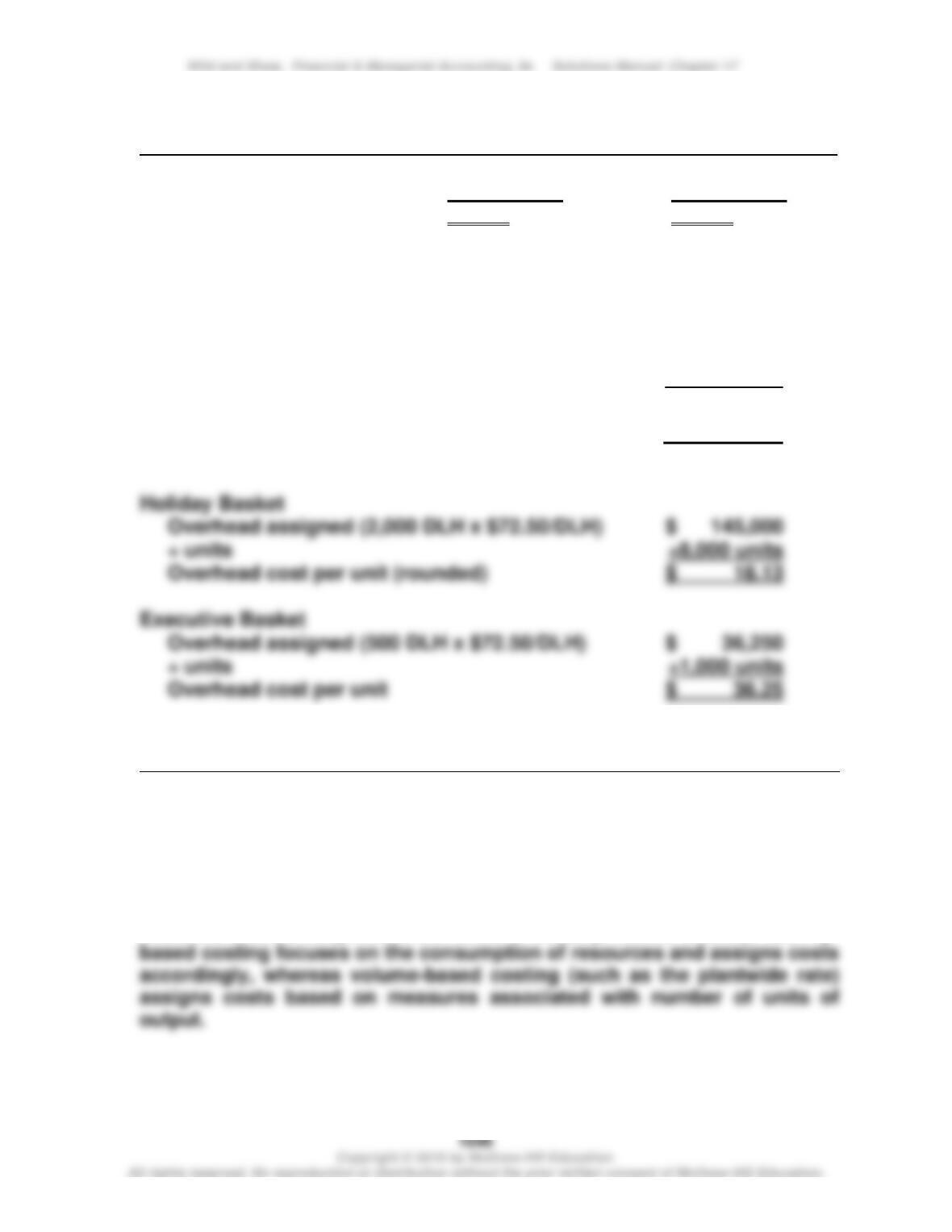
4. Cost per unit Holiday Basket Executive Basket
Total overhead cost $114,000 $73,900
÷ Units produced ÷8,000 units ÷1,000 units
Overhead cost per unit $14.25 $73.90
5. Plantwide overhead rate
Wrapping ($300,000 + $200,000) $ 500,000
Assembling 400,000
Product Design 180,000
Obtaining business license 100,000
Cooking ($150,000 + $120,000) 270,000
Total overhead $ 1,450,000
÷ Total direct labor hours ÷20,000 DLH
Overhead rate per DLH $ 72.50
6.
Holiday Basket Executive Basket
Activity-based cost per unit $14.25 $73.90
Plantwide cost per unit $18.13 $36.25
The plantwide overhead rate assigns too much cost to the Holiday Basket
(which is a comparatively high-volume product) and understates the cost
of the Executive Basket because it is a low-volume product. The ABC
costs more accurately reflect the costs of these products because activity–
Problem 17-4B (30 minutes)
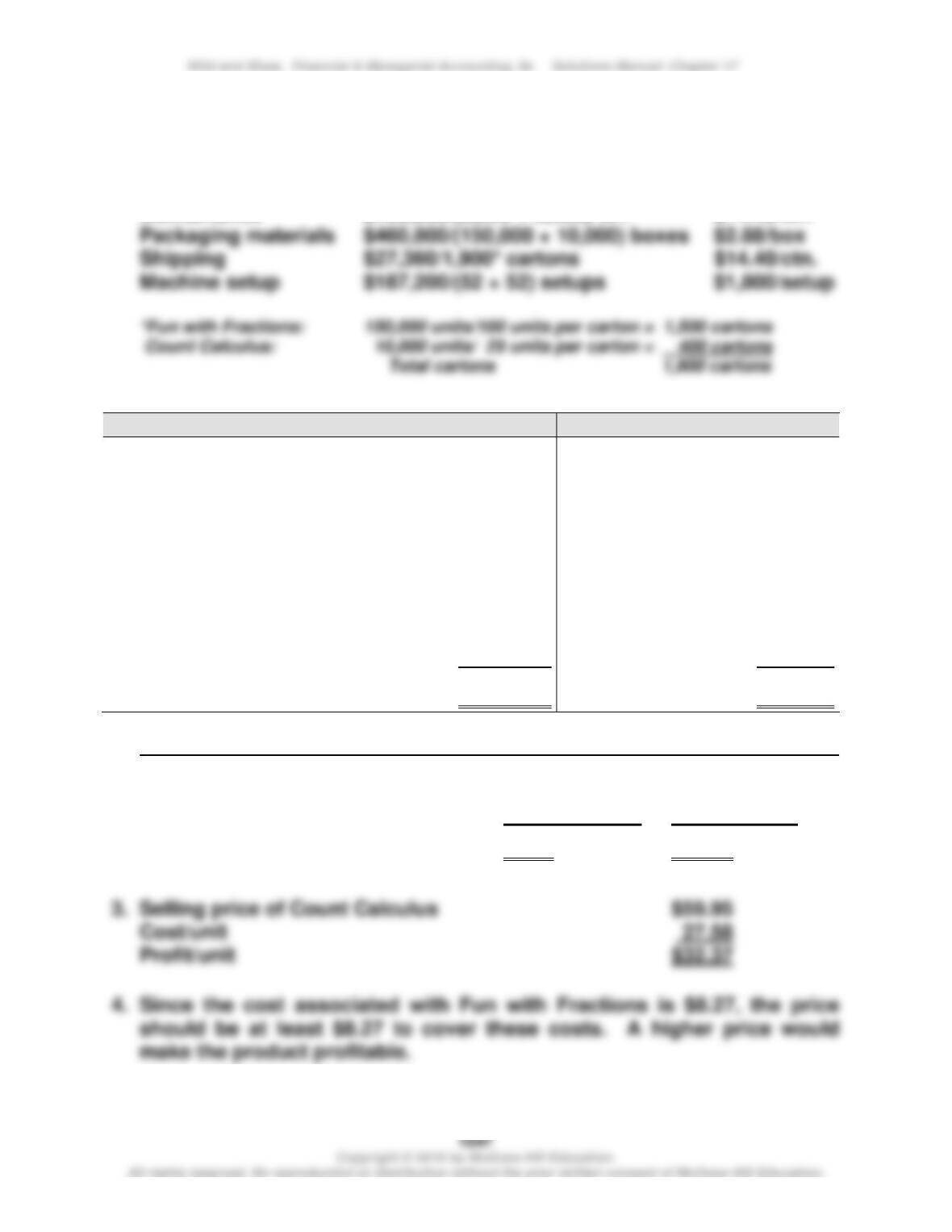
1. Compute overhead allocation rates for each activity
Components $495,000/(450,000 + 100,000) parts $0.90/part
Assembly labor $244,800/(15,000 + 2,000) DLH $14.40/DLH
Assign overhead costs to products
Fun with Fractions
Count Calculus
Components
450,000 parts x $0.90
$ 405,000
100,000 parts x $0.90
$ 90,000
Assembly
15,000 DLH x $14.40
216,000
2,000 DLH x $14.40
28,800
Maintenance
5,000 MH x $14.40
72,000
2,000 MH x $14.40
28,800
Packaging
150,000 boxes x $2.88
432,000
10,000 boxes x $2.88
28,800
Shipping
1,500 cartons x $14.40
21,600
400 cartons x $14.40
5,760
Set-ups
52 set-ups x $1,800
93,600
52 set-ups x $1,800
93,600
Total cost
$1,240,200
$275,760
2. Cost per unit Fun with Fractions Count Calculus
Total manufacturing cost $1,240,200 $275,760
÷ number of units ÷150,000 units ÷10,000 units
Average manufacturing cost per unit $8.27 $27.58
Problem 17-5B (50 minutes)
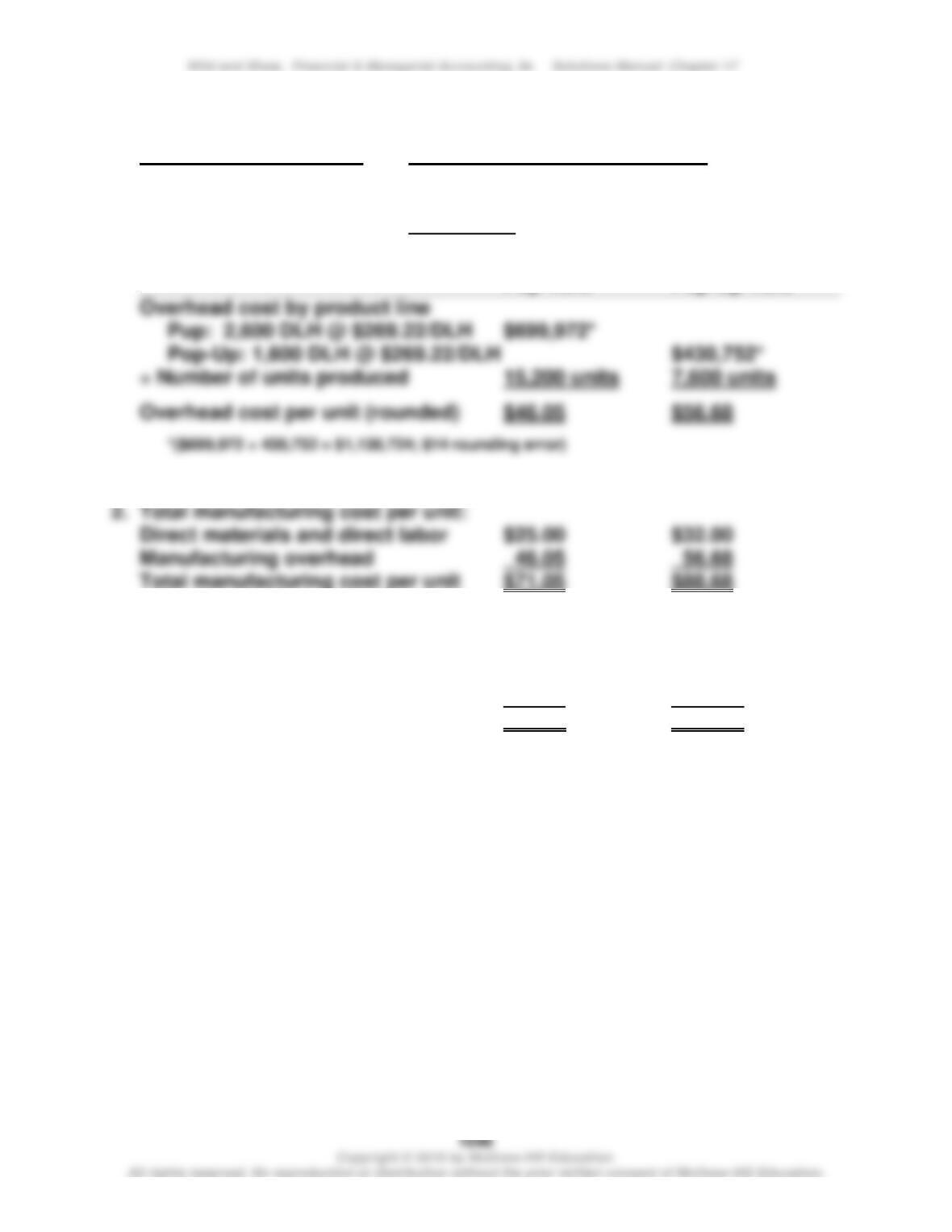
1. Total overhead = $215,630 + $399,480 + $515,600
Total direct labor hours 2,600 DLH + 1,600 DLH
= $1,130,710 = $269.22/DLH (rounded)
4,200 DLH
Pup Tent Pop-Up Tent
3. Gross profit per unit
Selling price per unit $65.00 $200.00
Manufacturing cost per unit 71.05 88.68
Gross profit (loss) per unit $ (6.05) $111.32
It appears that the Pup Tent is not profitable and management may
decide to eliminate this product line if it cannot reduce cost (or raise the
selling price) to generate a profit.
Problem 17-5B (continued)
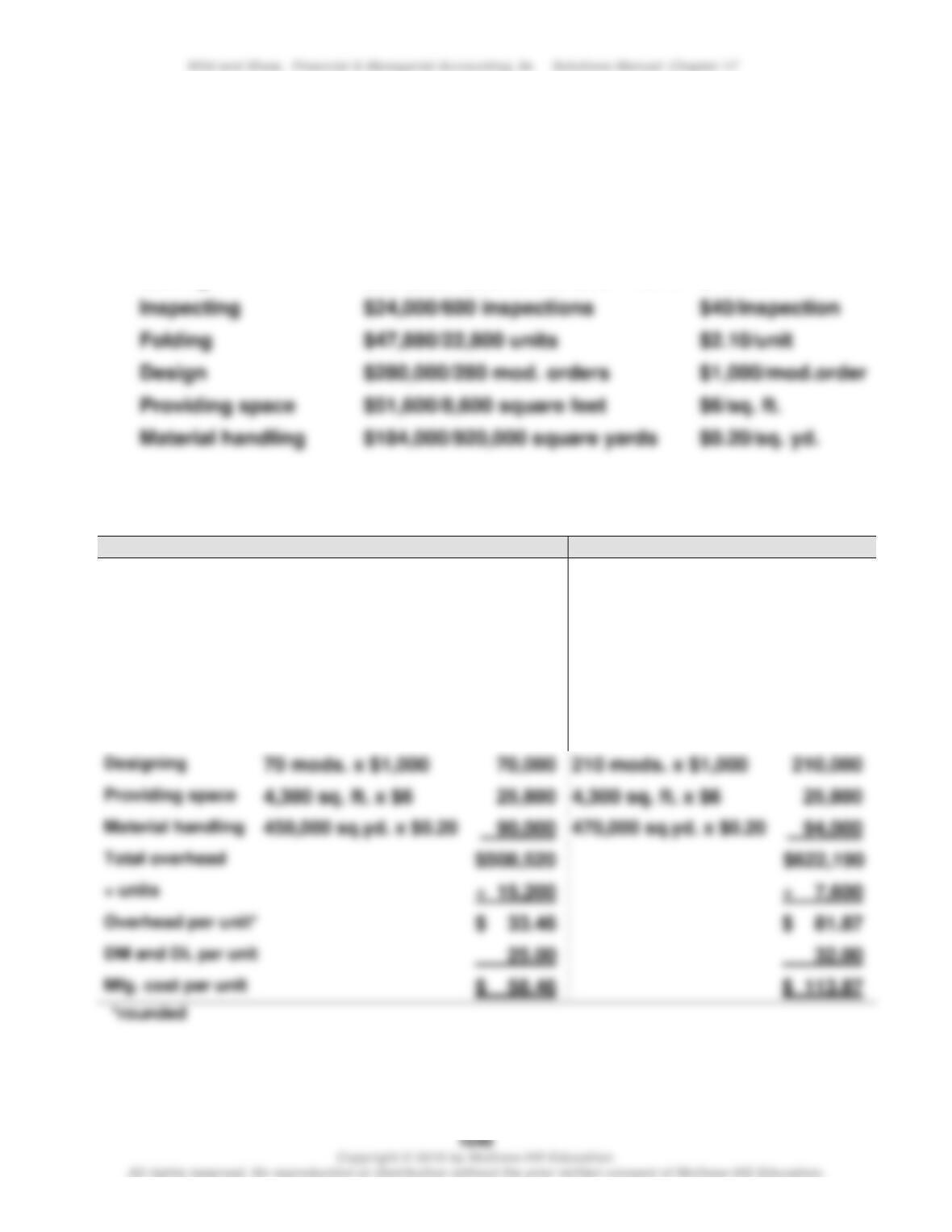
4. Compute overhead allocation rates for each activity
Pattern alignment $64,400/560 batches $115/batch
Cutting $50,430/12,300 machine hours $4.10/MH
Moving product $100,800/2,400 moves $42/move
Sewing $327,600/4,200 direct labor hours $78/DLH
Assign overhead costs to products
Pup Tent
Pop-Up Tent
Pattern alignment
140 batches x $115
$ 16,100
420 batches x $115
$ 48,300
Cutting
7,000 MH x $4.10
28,700
5,300 MH x $4.10
21,730
Moving product
800 moves x $42
33,600
1,600 moves x $42
67,200
Sewing
2,600 DLH x $78
202,800
1,600 DLH x $78
124,800
Inspecting
240 insp. x $40
9,600
360 insp. x $40
14,400
Folding
15,200 units x $2.10
31,920
7,600 units x $2.10
15,960
Designing
70 mods. x $1,000
210 mods. x $1,000
210,000
Providing space
4,300 sq. ft. x $6
4,300 sq. ft. x $6
25,800
Material handling
Total overhead
$622,190
÷ units
Overhead per unit*
DM and DL per unit
Mfg. cost per unit
Problem 17-5B (concluded)
5.
Pup Tent Pop-Up Tent
Selling price $65.00 $200.00
Manufacturing cost per unit 58.46 113.87
Gross profit per unit $ 6.54 $ 86.13
6. Departmental overhead rates based on direct labor hours and machine
hours are still volume-based measures and would not improve the
Serial Problem — SP 17
1. Setting up machines Batch level
Inspecting components Unit level
Providing utilities Facility level
2. Direct materials $2,500
Direct labor 3,500
Overhead (50% of direct labor) 1,750
Total manufacturing cost $7,750
3. Compute overhead allocation rates for each activity
Setting up machines = $20,000/25 batches
= $800/batch
Inspecting components $7,500/5,000 parts $1.50/part
Providing utilities $10,000/5,000 machine hours $2.00/MH
Company Analysis — AA 17-1
1. If overhead is assigned based on sales, the iPhone line would be
assigned the highest amount of overhead costs in 2017.
2. If overhead is assigned based on sales, the “Other” line would be
assigned the lowest amount of overhead costs in 2017.
Comparative Analysis — AA 17-2
1.
APPLE
For Year Ended ($ millions)
Sep. 30, 2017
Revenues ……………………………………………………….
$229,934
Costs* ……………………………………………………….
167,890
Costs/Revenues ………………………………………………….
0.730
*Cost of sales plus total operating expenses
2.
GOOGLE
For Year Ended ($ millions)
Dec. 31, 2017
Revenues ……………………………………………………….
$110,855
Costs* ……………………………………………………….
Costs/Revenues ………………………………………………….
0.764
3. Google has a higher ratio of costs to revenues in 2017.
Global Analysis — AA 17-3
1. and 2.
SAMSUNG
For Year Ended (millions of Korean won)
Dec. 31
2017
Dec. 31,
201
3. Samsung’s ratio of costs to revenues was higher in 2016.
Ethics Challenge — BTN 17-1
1. Employees have the responsibility to be honest when asked for
information by a superior. As a member of the organization it is an
employee’s responsibility to help the organization achieve its goals.
2. Depending on your position, it may be appropriate to determine if the
redundancy is justified. This would certainly be the responsibility of
a manager who is attempting to improve efficiency, or help others
accomplish this task. An operational employee may not have the
responsibility to investigate.
Communicating in Practice — BTN 17-2
TO: [Name], CEO
FROM: [Student name], Cost Analyst
RE: Activity Based Costing
Traditional methods of product costing have typically assigned
manufacturing overhead costs based on direct labor hours, direct labor
cost, or machine hours. These bases are all highly correlated with the
volume of output. Plantwide and departmental overhead rates based on
these measures are therefore appropriately referred to as “volume–based.”
An advantage of ABC is that it more accurately divides the total costs
among various product lines based on the resources that go into those
products. Disadvantage of ABC are that it can be difficult and costly to
implement.
Taking It to the Net — BTN 17-3
Activity-based costing is tested on Part 1 “Financial Reporting, Planning,
Performance, and Control.” Major topics for this part of the exam include
external financial reporting decisions; planning, budgeting, and
forecasting; performance management; cost management; and internal
controls.
Teamwork in Action — BTN 17-4
Instructor note: Student answers to this problem will depend on the restaurant visited.
1-2. Filling an order at a typical fast-food establishment may involve
several people:
• Someone will take the order and receive payment.
• Another person may obtain drinks from the fountain.
3. Some costs in a fast-food restaurant:
• Ingredients
• Paper products
• Utilities
• Salary of manager
• Wages of employees who perform various tasks
Entrepreneurial Decision — BTN 17-5
1. Sycamore Brewing would need to:
• Create the product (or contract with someone to do this)
• Evaluate alternative ingredients
• Evaluate alternative methods of manufacturing
2. Generally, we would want to assign the costs associated with product–
specific activities to the products that consumed them, so we would not
Hitting the Road — BTN 17-6
Refer to the TEAMWORK IN ACTION assignment. Students could make
individual observations about various fast-food restaurants and pool their
information. Alternatively, groups could go together to observe operations
and prepare reports based on their combined efforts.