Financial and Managerial Accounting, 8th Edition
17-1
CHAPTER 17
ACTIVITY-BASED COSTING AND ANALYSIS
Related Assignment Materials
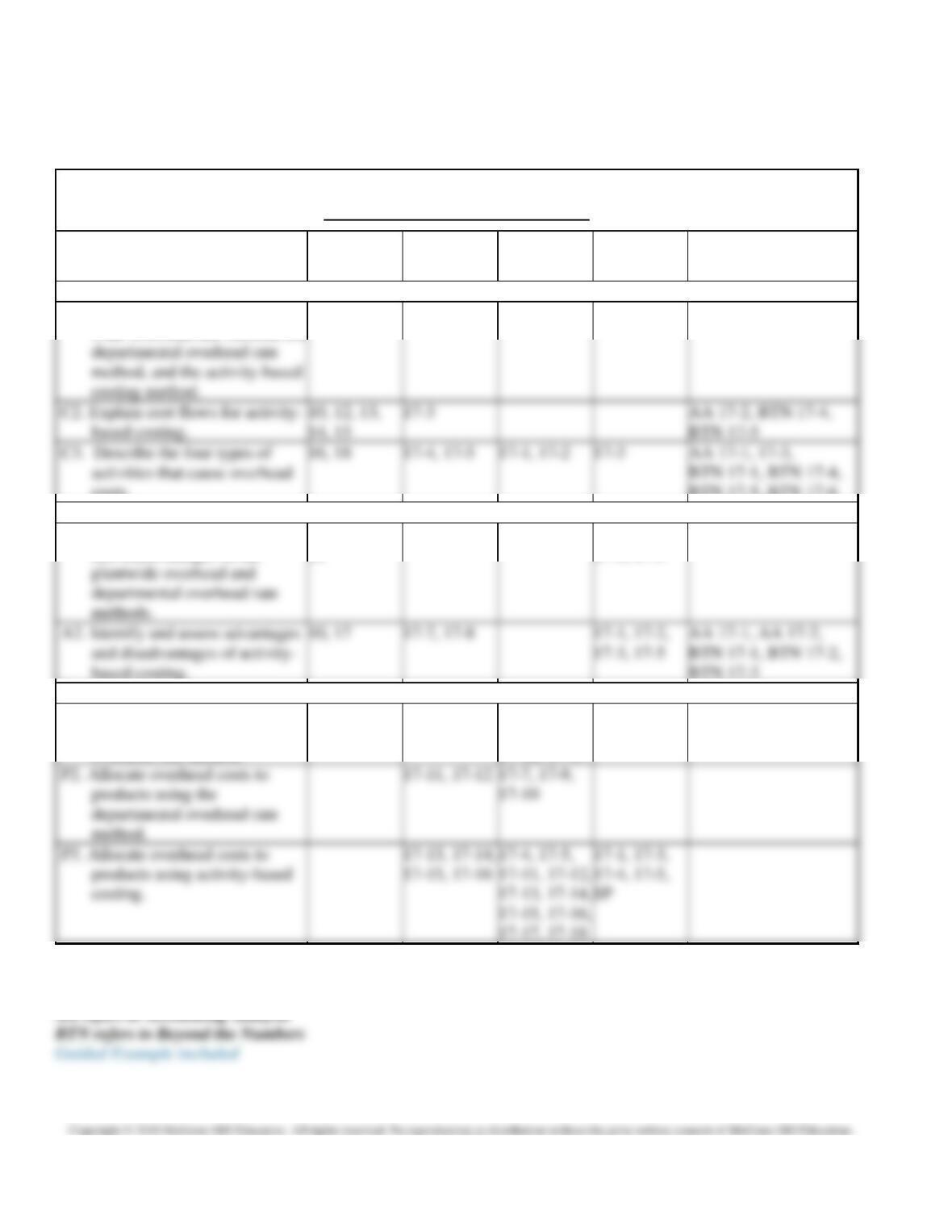
Student Learning Objectives
Discussion
Questions
Quick
Studies*
Exercises*
Problems*
AA and
BTN
Conceptual objectives:
costing method.
C2. Explain cost flows for activity-
based costing.
10, 12, 13,
14, 15
17-3
AA 17-2, BTN 17-4,
BTN 17-5
C3. Describe the four types of
16, 18
17-4, 17-5
17-1, 17-2
17-3
AA 17-1, 17-3,
C1. Distinguish between the plant-
wide overhead rate method, the
1, 2, 3, 4
17-1, 17-2
costs.
BTN 17-5, BTN 17-6
Analytical objectives:
and disadvantages of activity-
based costing.
17-3, 17-5
BTN 17-1, BTN 17-2,
BTN 17-3
A1. Identify and assess advantages
and disadvantages of the
5, 6, 7, 8, 9,
11
17-6
17-1, 17-2,
17-3, 17-5
Procedural objectives:
P1. Allocate overhead costs to
products using the plantwide
overhead rate method.
17-9, 17-10
17-3, 17-6,
17-8, 17-10,
17-12, 17-13
17-1, 17-3,
17-5
departmental overhead rate
method.
17-10
P3. Allocate overhead costs to
17-13, 17-14,
17-4, 17-5,
17-1, 17-3,
*See additional information on next page that pertains to these quick studies, exercises and problems.
SP refers to the Serial Problem
C3
Financial and Managerial Accounting, 8th Edition
Additional Information on Related Assignment Material
See Chapter 1 of the Instructor’s Resource Manual for more information on materials for this text available in
Connect.
Connect
Available on the instructor’s course-specific website, Connect:
• All numerical Quick Studies, all Exercises and Problems Set A.
Hints/Guided Examples
Please note that the Guided Examples are labeled as “Hints” in Connect assignments. The animated PowerPoints without
Need-to-Know Videos
LO
Need–to-Know
Title
Time
Concept Overview Videos
LO
Title
Time
C1
C2
Financial and Managerial Accounting, 8th Edition
17-3
Synopsis of Chapter Revision
NEW opener – GrandyOats and entrepreneurial assignment.
Revised discussion of why overhead costs must be assigned.
Revised discussion of plantwide and departmental methods.
Financial and Managerial Accounting, 8th Edition
17-4
Chapter Outline
I. Assigning Overhead Costs
Product pricing, product mix decisions, and cost control depend on accurate product cost information.
A. Plantwide Overhead Rate Method
1. Cost Flows Under Plantwide Overhead Rate Method. This method is also referred to as the
single plantwide overhead rate method or the plantwide overhead rate method.
2. Applying the Plantwide Overhead Rate Method
a. Total budgeted overhead costs are divided by the chosen allocation base to arrive at a single
B. Departmental Overhead Rate Method—use of a single plantwide overhead rate can produce cost
assignments that do not reflect the cost to manufacture products.
1. Cost Flows Under Departmental Overhead Rate Method
a. Use of multiple overhead rates can result in better overhead cost allocations and improve
management decisions.
2. Applying the Departmental Overhead Rate Method—4-step process.
a. Step 1: Assign overhead costs to departmental cost pools.
b. Step 2: Select an allocation base for each department. If overhead costs are common to
C. Assessing the Plantwide and Departmental Overhead Rate Methods
1. Advantages:
Financial and Managerial Accounting, 8th Edition
17-5
2. Disadvantage—overhead costs are too complex to be explained by one factor, like direct labor
or machine hours.
3. Usefulness of the single plantwide overhead rate depends on two assumptions:
a. Overhead costs change with the allocation base.
4. The departmental overhead rate method assumes that:
a. Different products are similar in volume, complexity, and batch size, and
b. Departmental overhead costs are directly proportional to the department allocation base.
D. Activity-Based Costing
1. Cost Flows Under Activity-Based Costing Method. Activity-based costing (ABC) attempts to
more accurately assign overhead costs by focusing on activities.
a. Basic principle is that activities, which are tasks, operations, or procedures, cause costs to be
incurred.
b. All activities of an organization can be linked to use of resources.
differs from the departmental method in that it focuses on activities rather than departments.
II. Applying Activity-Based Costing—Activity-based costing accumulates overhead costs into activity
cost pools and then allocates those costs to products using activity rates.
A. Step 1: Identify Activities and the Costs They Cause
B. Step 2: Trace overhead costs to activity cost pools.
Financial and Managerial Accounting, 8th Edition
17-6
III. Assessing Activity-Based Costing
A. Advantages of Activity-Based Costing
1. More Effective Overhead Cost Control—can be used to identify activities that can benefit from
B. Disadvantages of Activity-Based Costing
1. Costs to Implement and Maintain ABC. Collecting and analyzing cost data is expensive, and so
is maintaining an ABC system.
IV. Activity Levels and Cost Management
A. Activity Levels—activities can be separated into four levels:
1. Unit level activities—performed on each product unit. Costs tend to change with the number of
units produced
B. Costs of quality—costs resulting from manufacturing defective products or providing services that
do not meet customer expectations. Costs of quality include prevention, appraisal, internal failure
and external failure costs. Can be summarized in a cost of quality report.
C. Lean Manufacturing—focusing on activities is common in lean manufacturing which strives to
eliminate waste while satisfying customers. Common features include:
1. Just-in-time (JIT) inventory systems to reduce costs of moving and storing inventory.

Financial and Managerial Accounting, 8th Edition
17-7
IV. Decision Analysis: Customer Profitability. Companies cause the ABC method to analyze their customer

Financial and Managerial Accounting, 8th Edition
17-8
Chapter 17 Alternate Demo Problem
Windy River Float Trips uses activity-based costing to compute the cost of the river
raft trips. Each raft holds six customers and a guide. The costs for these float trips are
as follows:
Activities (cost driver) Costs
Trailer rent fee (trip) $127 per trip
Financial and Managerial Accounting, 8th Edition
17-9
Chapter 17 Solution: Alternate Demo Problem
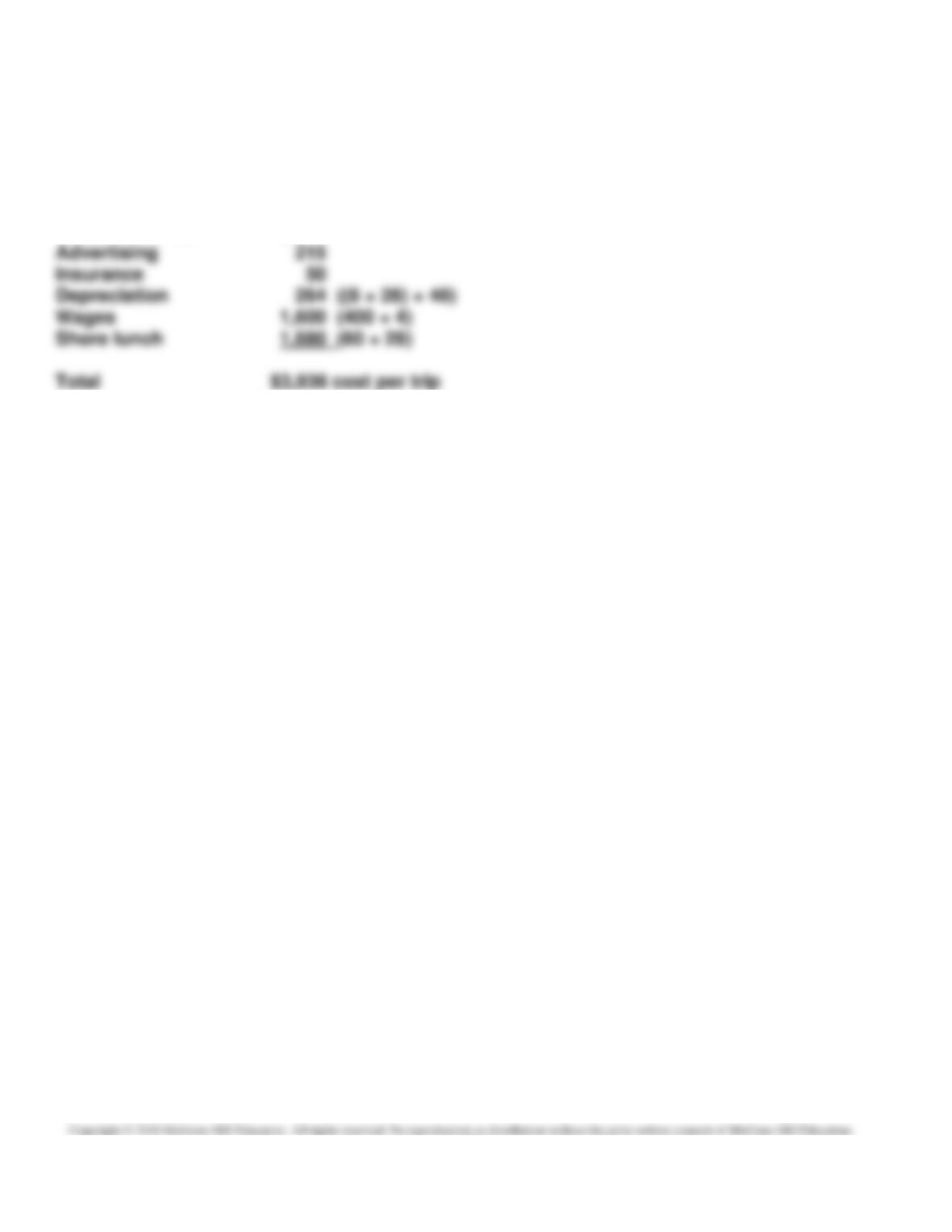
Activities River Float Trips
Trailer Rent Fee $ 127