IFRS17.11
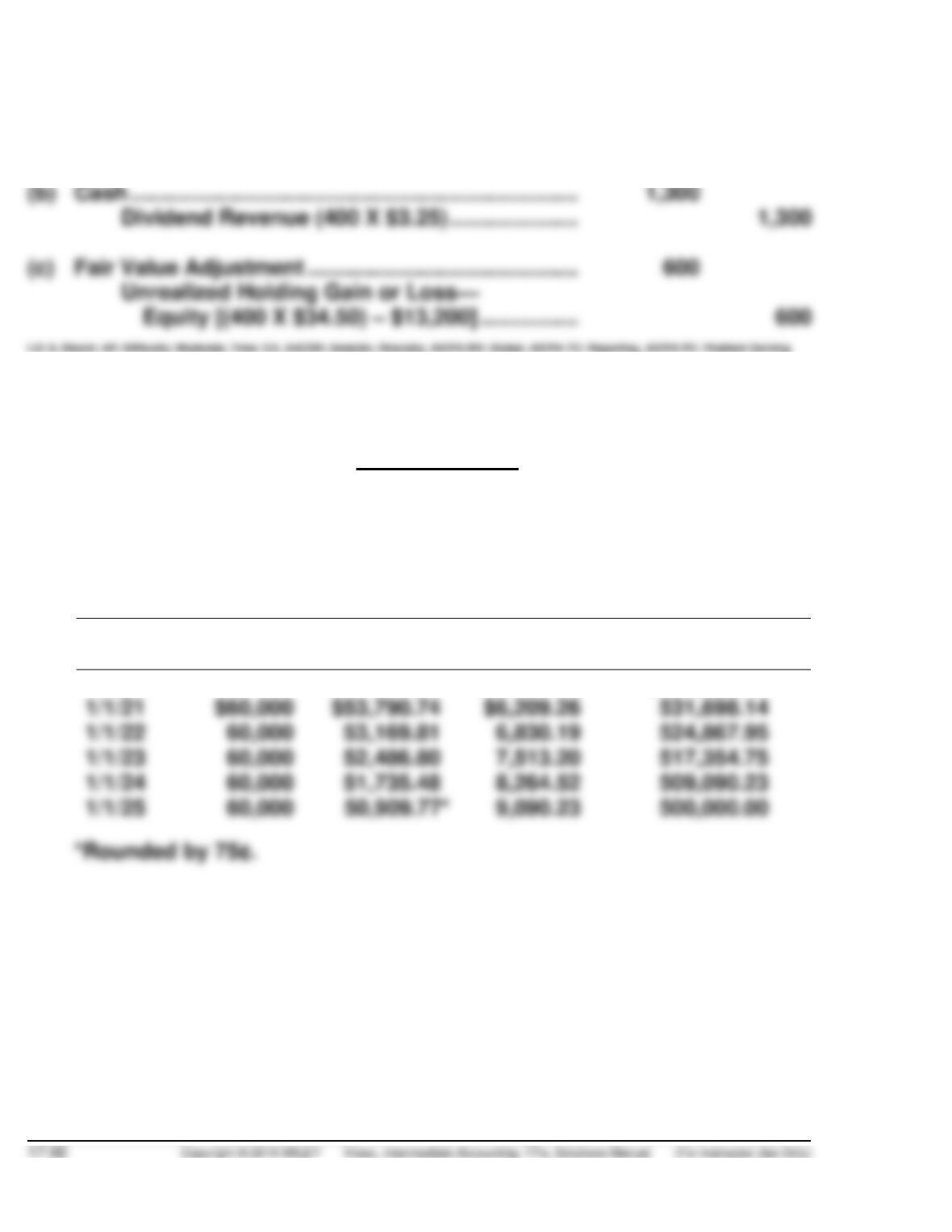
(a) Equity Investments …………………………………………. 13,200
Cash ……………………………………………………….. 13,200
IFRS17.12
(a) January 1, 2020
Debt Investments ………………………………………. 537,907.40
Cash ………………………………………………….. 537,907.40
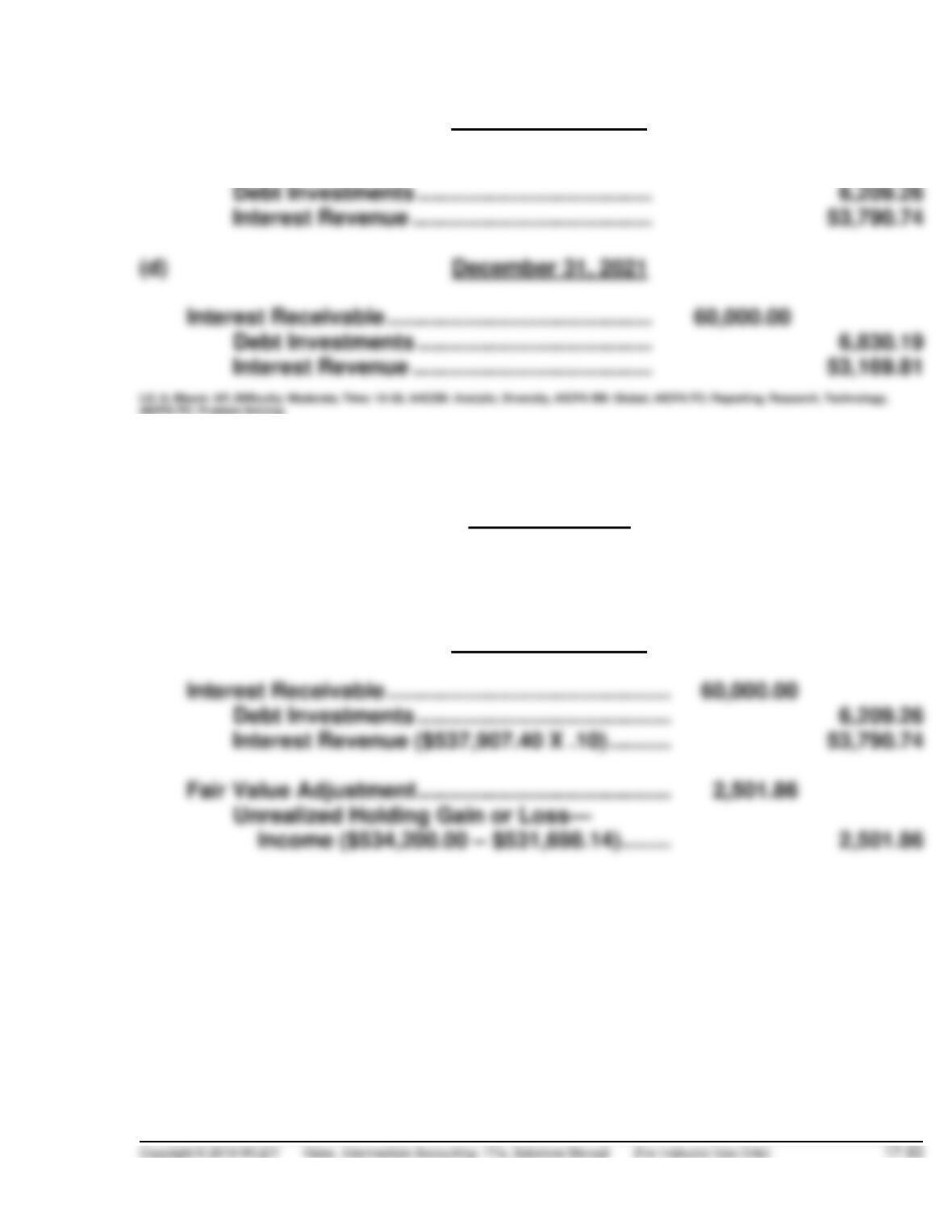
(b) Schedule of Interest Revenue and Bond Premium Amortization
12% Bonds Sold to Yield 10%
Date
Cash
Received
Interest
Revenue
Premium
Amortized
Carrying Amount
of Bonds
1/1/20
—
—
—
$537,907.40
1/1/21
1/1/22
IFRS17.12 (Continued)
(c) December 31, 2020
Interest Receivable ……………………………………. 60,000.00
IFRS17.13
(a) January 1, 2020
Debt Investments ………………………………………. 537,907.40
Cash ………………………………………………….. 537,907.40
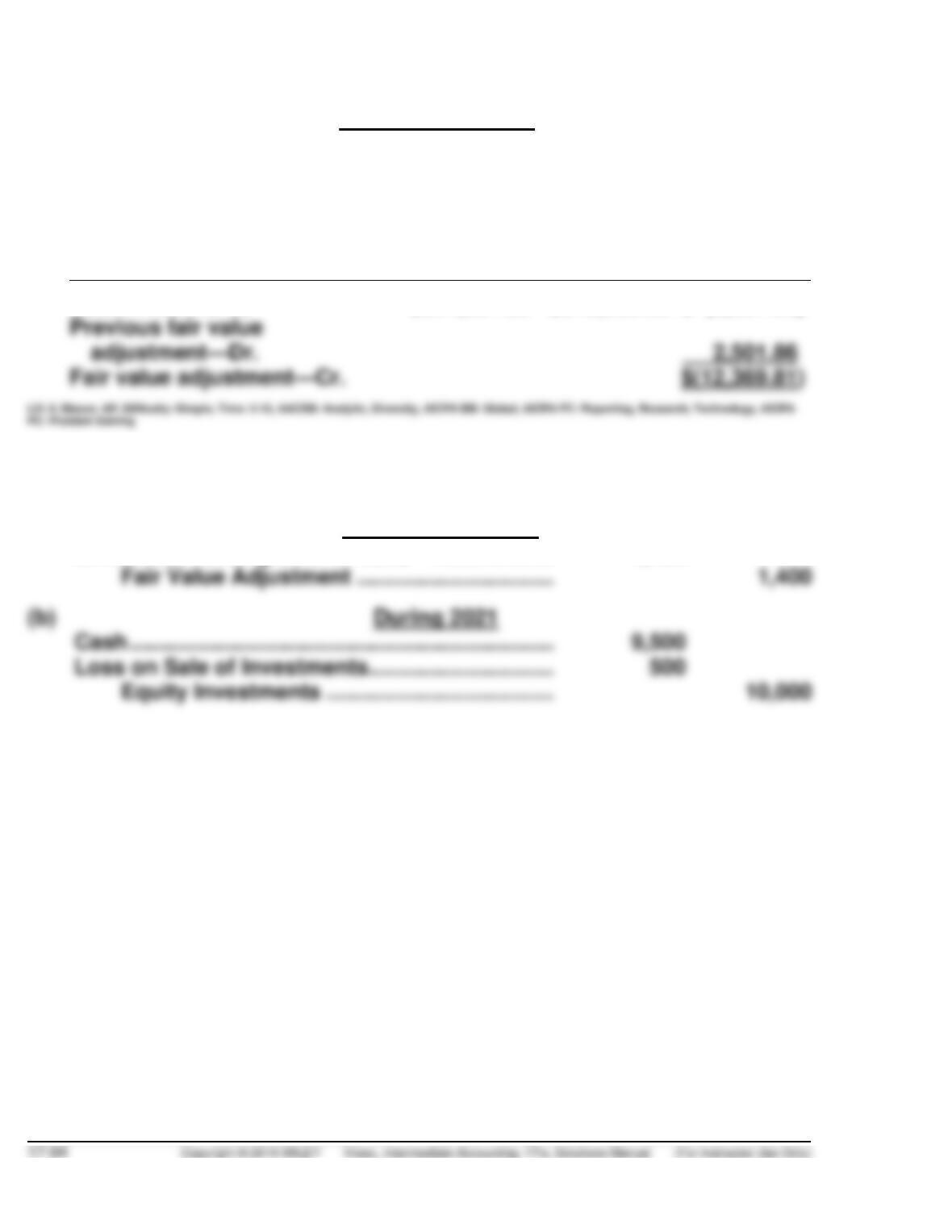
(b) December 31, 2020
IFRS17.13 (Continued)
(c) December 31, 2021
Unrealized Holding Gain or Loss—Income ……. 12,369.81
Fair Value Adjustment ………………………….. 12,369.81
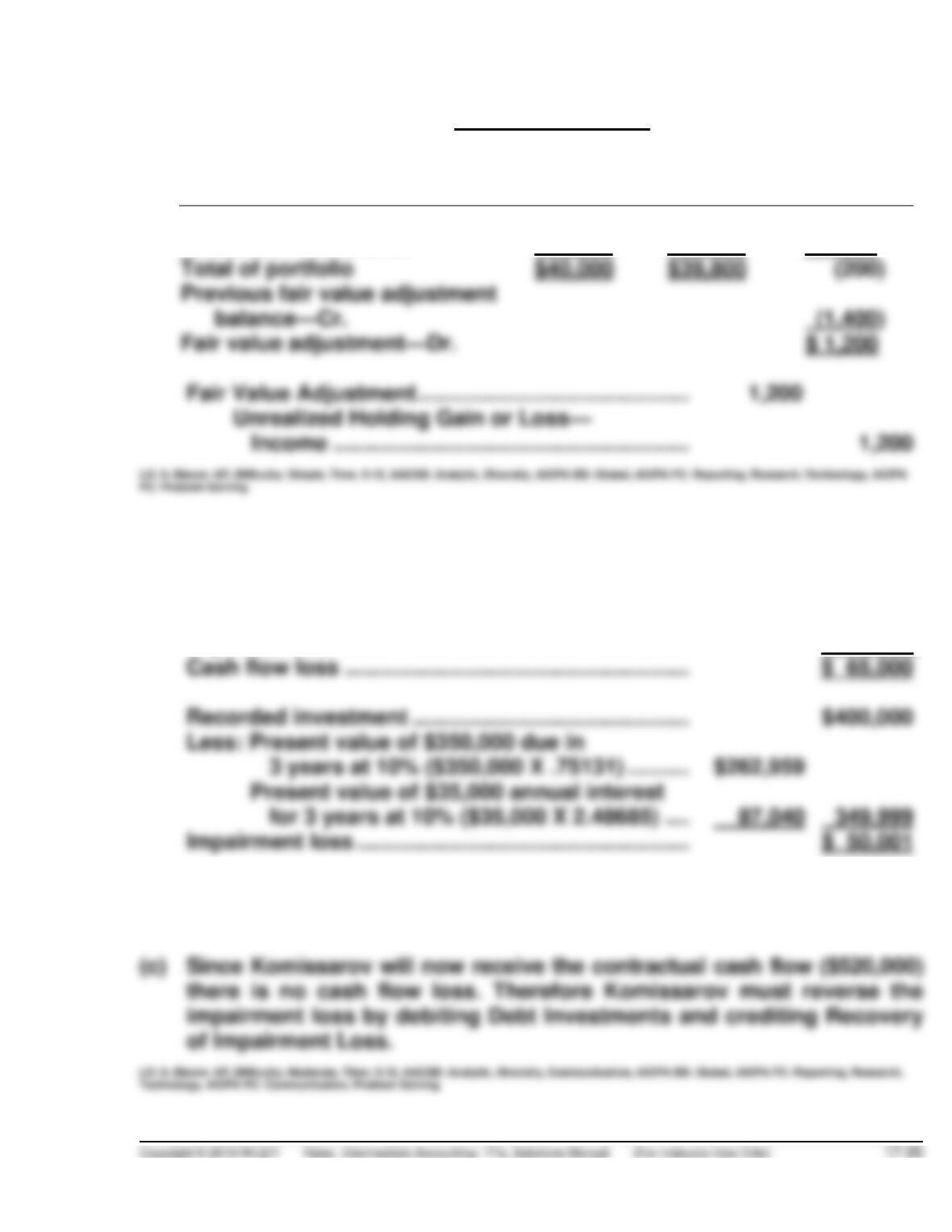
Amortized
Cost
Fair Value
Unrealized
Gain (Loss)
Debt investments
$524,867.95
$515,000.00
$ (9,867.95)
Previous fair value
IFRS17.14
(a) December 31, 2020
Unrealized Holding Gain or Loss—Income ……. 1,400
IFRS17.14 (Continued)
(c) December 31, 2021
Investments
Cost
Fair Value
Unrealized
Gain (Loss)
Stargate Corp. shares
$20,000
$19,300
$ (700)
Vectorman Co. shares
20,000
20,500
500)
IFRS17.15
(a) Contractual cash flow
[($400,000 X .10 X 3) + $400,000]……………………. $520,000
Expected cash flow ………………………………………… (455,000)
(b) Loss on Impairment ………………………………………… 50,001
Debt Investments …………………………………….. 50,001
IFRS17.16
(a) According to IAS 39, paragraph AG71, “A financial instrument is
regarded as quoted in an active market if quoted prices are readily
(b) According to IFRS 9, paragraph B4.3,
Although the objective of an entity’s business model may be to hold
financial assets in order to collect contractual cash flows, the entity
need not hold all of those instruments until maturity. Thus an entity’s
business model can be to hold financial assets to collect contractual
cash flows even when sales of financial assets occur. For example,
the entity may sell a financial asset if:
1. the financial asset no longer meets the entity’s investment policy
(e.g., the credit rating of the asset declines below that required by
IFRS17.17
(a) M&S reports an investment in a non-current joint venture of £7
million, other investments of £3 million, and derivatives financial
(b) In note 1 (Accounting Policies), M&S reports the following:
Financial instruments
Financial assets and liabilities are recognised in the Group’s statement of
financial position when the Group becomes a party to the contractual
provisions of the instrument.
A. Trade and other receivables Trade receivables are recorded
initially at fair value and subsequently measured at amortised
cost. Subsequently, this results in their recognition at nominal
value less any allowance for any doubtful debts.
B. Other financial assets Other financial assets consist of
investments in debt and equity securities and short-term
investments and are classified as either ‘available-for-sale’ or ‘fair
value through profit and loss’. Available-for-sale financial assets
are initially measured at fair value, including transaction costs
IFRS17.17 (Continued)
C. Classification of financial liabilities and equity Financial liabilities
and equity instruments are classified according to the substance
of the contractual arrangements entered into. An equity
instrument is any contract that evidences a residual interest in
the assets of the Group after deducting all of its liabilities.
D. Bank borrowings Interest-bearing bank loans and overdrafts are
initially recorded at fair value, which equals the proceeds
E. Loan notes Long-term loans are initially measured at fair value
net of direct issue costs and are subsequently held at amortised
cost unless the loan is designated in a hedge relationship, in
which case hedge accounting treatment will apply.
F. Trade payables Trade payables are recorded initially at fair value
(c) M&S has the following discussion of derivatives in note 1 (Accounting
Policies):
Derivative financial instruments and hedging activities The Group primarily
uses interest rate swaps, cross-currency swaps and forward foreign
IFRS17.17 (Continued)
The Group designates certain hedging derivatives as either:
➢ A hedge of a highly probable forecast transaction or change in the
At the inception of a hedging relationship, the hedging instrument and the
hedged item are documented, along with the risk management objectives
and strategy for undertaking various hedge transactions and prospective
A. Cash flow hedges Changes in the fair value of derivative financial
instruments that are designated and eff ective as hedges of future cash fl
ows are recognised in other comprehensive income in the hedging reserve
and any ineff ective portion is recognized immediately in the income
statement. If the firm commitment or forecast transaction that is the subject
IFRS17.17 (Continued)
B. Fair value hedges Changes in the fair value of a derivative instrument
designated in a fair value hedge, or, for non-derivatives the foreign
C. Net investment hedges Changes in the fair value of derivative or non–
derivative financial instruments that are designated and effective as
hedges of net investments are recognised in other comprehensive income
D. Discontinuance of hedge accounting Hedge accounting is discontinued
when the hedging instrument expires or is sold, terminated, or exercised,
the hedge relationship no longer qualifies for hedge accounting, the
forecast transaction is no longer expected to occur or the Group de–
designates the hedge relationship.
IFRS17.17 (Continued)
instrument recognised in other comprehensive income is reclassified to
the income statement only on disposal of the net investment.
The Group does not use derivatives to hedge income statement translation