Wild and Shaw, Financial and Managerial Accounting 9e Solutions Manual: Chapter 17
1105
Problem 17-4B (25 minutes)
1. Fabricating department overhead rate = $120,000 = $30 per MH
4,000 MH
2. Overhead cost per unit using departmental overhead rates
ProPower
Crunch
Department
Departmental
Overhead Rate
Hours
per Unit
Overhead
Allocated
Hours per
Unit
Overhead
Allocated
Fabricating ……
$30 per MH
3.0 MH
$ 90
2.0 MH
$60
Assembly ……..
1.5 DLH
1.0 DLH
3. Product cost per unit using departmental overhead rates
Per Unit
Direct
Materials
Direct
Labor
Overhead
Product Cost
per Unit
ProPower ….
$25
$30
$108
$163
4. Gross profit per unit (selling price per unit minus product cost per unit)
Per Unit
Selling Price
Product Cost
Gross Profit
ProPower …..
Wild and Shaw, Financial and Managerial Accounting 9e Solutions Manual: Chapter 17
1106
Problem 17-5B (25 minutes)
1. Compute overhead activity rates for each activity
Activity
Budgeted Cost
Budgeted Activity Usage
Activity Rate
Clerical support …..
$80,000
2,000 documents
$40 per doc.
Facility services ….
$320 per case
Building cost ………
6,000 square feet
$16 per sq. ft.
2. Compute overhead costs per case using activity-based costing
LITIGATION SUPPORT
Activity Usage
Activity Rate
Allocated Cost
Clerical support …………….
1,500 docs.
$40 per doc.
$ 60,000
Facility services ……………
120 cases
$320 per case
38,400
Building cost ………………..
4,275 sq. ft.
$16 per sq. ft.
Overhead cost per case …
FRAUD INVESTIGATION
Activity Usage
Activity Rate
Allocated Cost
Clerical support ……………
500 docs.
$40 per doc.
$ 20,000
Facility services …………..
80 cases
$320 per case
25,600
Building cost ……………….
1,725 sq. ft.
$16 per sq. ft.
27,600
Number of cases ………….
Wild and Shaw, Financial and Managerial Accounting 9e Solutions Manual: Chapter 17
1107
SERIAL PROBLEM — SP 17
1.
Setup ……………………………………………
Batch level
Batch level
Utilities …………………………………………
2. Plantwide overhead rate = $37,500 = $7.50 per MH
5,000 MH
Allocate overhead to Job 615 using plantwide rate
Department
Plantwide
Overhead Rate
Machine
Hours Used
Overhead
Allocated
Job 615 ………………
Direct
Materials
Overhead
Job 615 …………….
3. a. Compute overhead activity rates
Activity
Budgeted Cost
Budgeted Activity
Activity Rate
Setup ……………………….
$20,000
25 setups
$800 per setup
Inspection ………………..
7,500
5,000 parts
$1.50 per part
Utilities …………………….
10,000
5,000 mach. hrs.
$2 per MH
b. Allocate overhead to Job 615 based on actual activity usage
Activity
Activity Usage
Activity Rate
Allocated Cost
Setup ……………………….
2 setups
$800 per setup
$1,600
$1.50 per part
Total allocated cost ….
c. Total product cost of Job 615 based on activity-based costing
Direct
Materials
Direct
Labor
Overhead
Product
Cost
Job 615 …………….
Wild and Shaw, Financial and Managerial Accounting 9e Solutions Manual: Chapter 17
1108
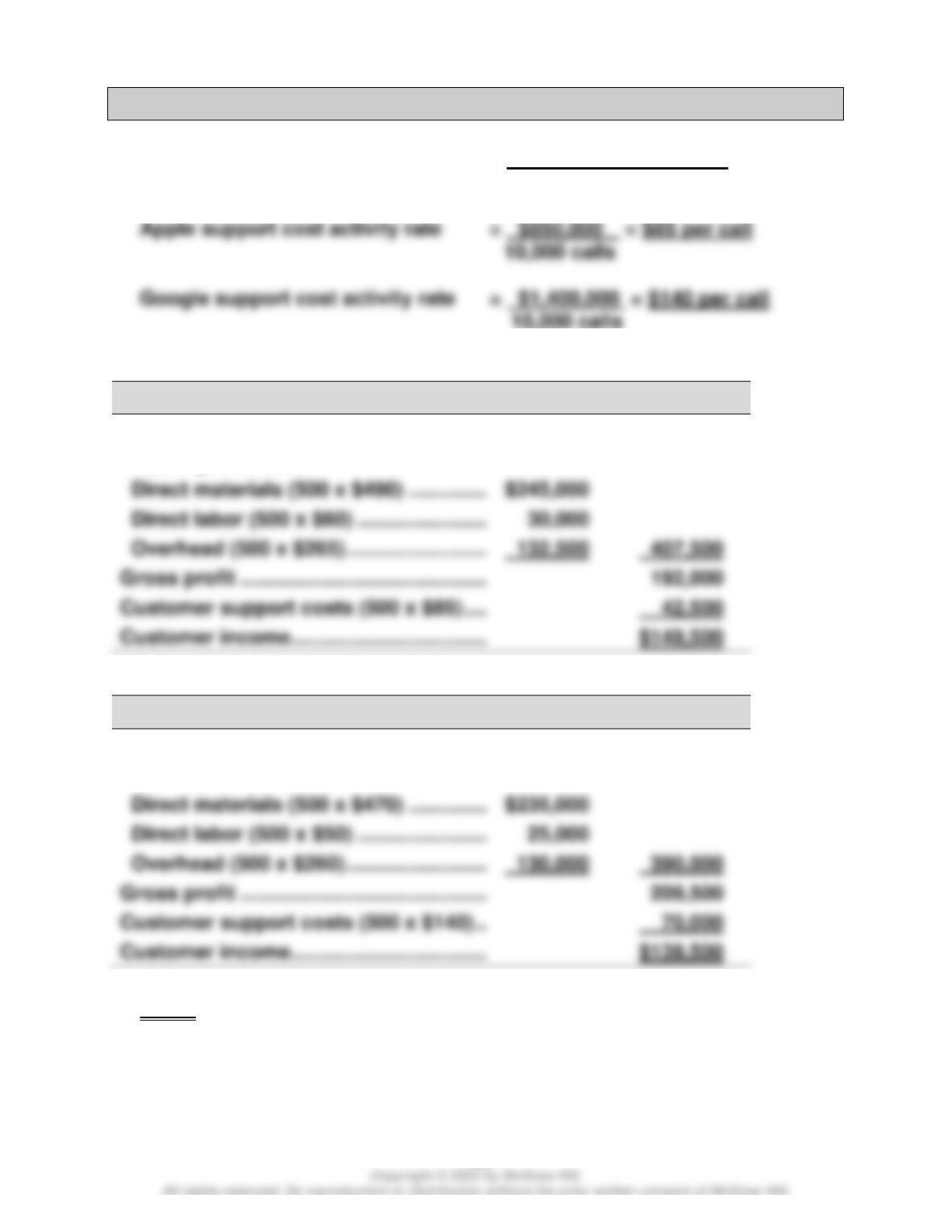
Company Analysis — AA 17-1
1. Customer support cost activity rate = Budgeted support cost
2.
Customer Profitability Report
Sales (500 x $1,199) …………………………..……..
$599,500
Cost of goods sold
Direct materials (500 x $490) …………………..
$245,000
Wild and Shaw, Financial and Managerial Accounting 9e Solutions Manual: Chapter 17
1109
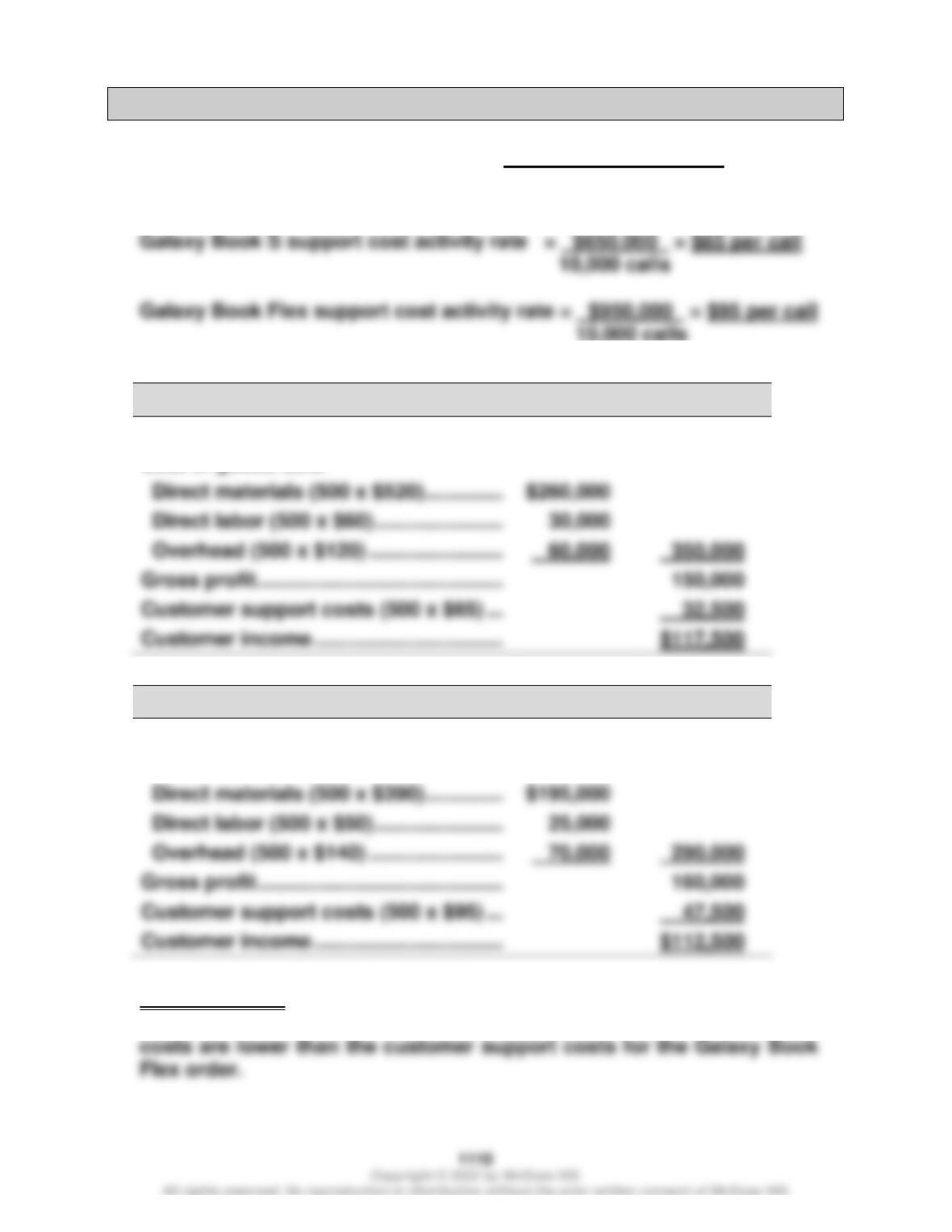
Comparative Analysis — AA 17-2
1. Customer support cost activity rate = Budgeted support cost
Budgeted support calls
2.
$245,000
Gross profit ……………………………………..
Customer support costs (500 x $85) ….
Customer income……………………………..
$235,000
Customer support costs (500 x $140) ..
Customer income……………………………..
3. Apple. Apple would earn more income from this customer. Even
though Apple’s product costs are higher, its customer support costs
are lower than Google’s.
Customer Profitability Report—Apple
Sales (500 x $1,199) ………………………….
$599,500
Cost of goods sold
Customer Profitability Report—Google
Sales (500 x $1,199) ………………………….
$599,500
Cost of goods sold
Wild and Shaw, Financial and Managerial Accounting 9e Solutions Manual: Chapter 17
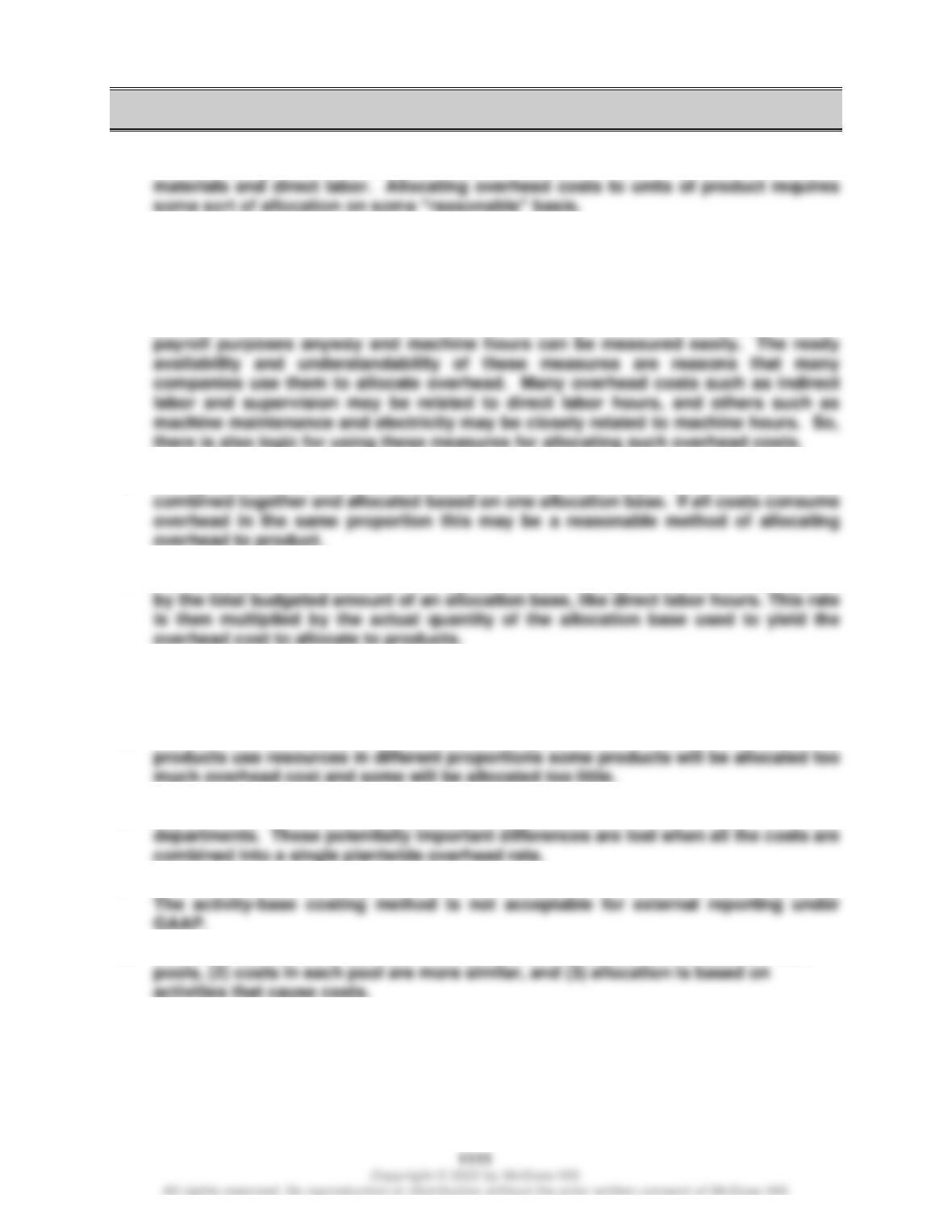
Extended Analysis — AA 17-3
1. Customer support cost activity rate = Budgeted support cost
Budgeted support calls
2.
$260,000
Gross profit ……………………………………..
Customer support costs (500 x $65) …
Customer income …………………………….
Gross profit ……………………………………..
Customer support costs (500 x $95) …
Customer income …………………………….
3. Galaxy Book S. The Galaxy Book S order earns more income. Even
though the S model’s product costs are higher, its customer support
Customer Profitability Report—Galaxy Book S
Sales (500 x $1,000) …………………………
$500,000
Cost of goods sold
Customer Profitability Report—Galaxy Book Flex
Sales (500 x $900) …………………………...
$450,000
Cost of goods sold
Wild and Shaw, Financial and Managerial Accounting 9e Solutions Manual: Chapter 17
DISCUSSION QUESTIONS
1. Manufacturing overhead costs cannot be traced to units of product like direct
2. Overhead is commonly allocated to products using (a) a plantwide overhead rate, (b)
departmental overhead rates, or (c) activity based costing.
3. Direct labor hours and machine hours are commonly used to allocate overhead costs
because they are readily available. Companies keep track of direct labor hours for
4. A single plantwide overhead rate is easy to use. All the budgeted overhead costs are
5. The single plantwide overhead rate equals the total budgeted overhead cost divided
6. Anything to which costs would be allocated is considered a “cost object.” Common
cost objects are units of product, product lines, departments, activities, and projects.
7. If not all overhead costs are related to the single base there will be distortions, or if
8. Departmental overhead rates reflect the unique costs and cost drivers in various
9. Both the plantwide and departmental rate methods can be used for external reporting.
10. Overhead allocation under ABC is more accurate because (1) there are more cost
11. An activity cost driver is the measure of the activity that causes costs to be incurred.
For instance, the activity driver for the activity “purchasing” might be number of
purchase orders.
12. The first step in ABC is to identify the activities that cause costs to be incurred.
Wild and Shaw, Financial and Managerial Accounting 9e Solutions Manual: Chapter 17
13. Unit level activities: Activities that must be performed for each unit of product.
Batch level activities: Activities that are related to the number of batches, lots, or
14. Value-added activities are those that increase the value of a product or service.
15. This statement is false. Activity-based costing may be used in any type of
organization. The premise of ABC is that activities cause costs. Since all
organizations engage in activities, these activities may be associated with costs they
Wild and Shaw, Financial and Managerial Accounting 9e Solutions Manual: Chapter 17
Ethics Challenge — BTN 17-1
1. Employees have the responsibility to be honest when asked for
2. Your responsibility is to report accurately and objectively. If there are
3. Consider:
• Are you being objective?
• Is the activity you observed happening on a regular basis, or was it
Wild and Shaw, Financial and Managerial Accounting 9e Solutions Manual: Chapter 17
1114
Communicating in Practice — BTN 17-2
TO: [Name], CEO
FROM: [Student name], Cost Analyst
RE: Activity Based Costing
Traditional methods of product costing have typically allocated overhead
costs based on direct labor hours, direct labor cost, or machine hours.
These bases are all highly correlated with the volume of output. Plantwide
and departmental overhead rates based on these measures are therefore
appropriately referred to as “volume–based.”
Traditional methods of cost allocation pool together all the costs other than
direct materials and direct labor and spread these to products as if all those
costs were consumed by products in the same proportion. When this
assumption is not true, significant distortions in cost allocation may occur.
Wild and Shaw, Financial and Managerial Accounting 9e Solutions Manual: Chapter 17
Teamwork in Action — BTN 17-3
Instructor note: Student answers to this problem will depend on the restaurant visited.
1.-2. Filling an order at a typical fast-food establishment may involve
several people:
• Someone will take the order and receive payment.
3. Some costs in a fast-food restaurant:
• Ingredients
• Paper products
• Utilities
Entrepreneurial Decision — BTN 17-4
1. Grimm Artisanal Ales would need to:
• Create the product (or contract with someone to do this)
• Evaluate alternative ingredients
• Test-market the new product line
2. Generally, we would want to allocate the costs associated with product-
specific activities to the products that consumed them, so we would not
want the cost of new products to be allocated to existing products. If

Wild and Shaw, Financial and Managerial Accounting 9e Solutions Manual: Chapter 17
1116