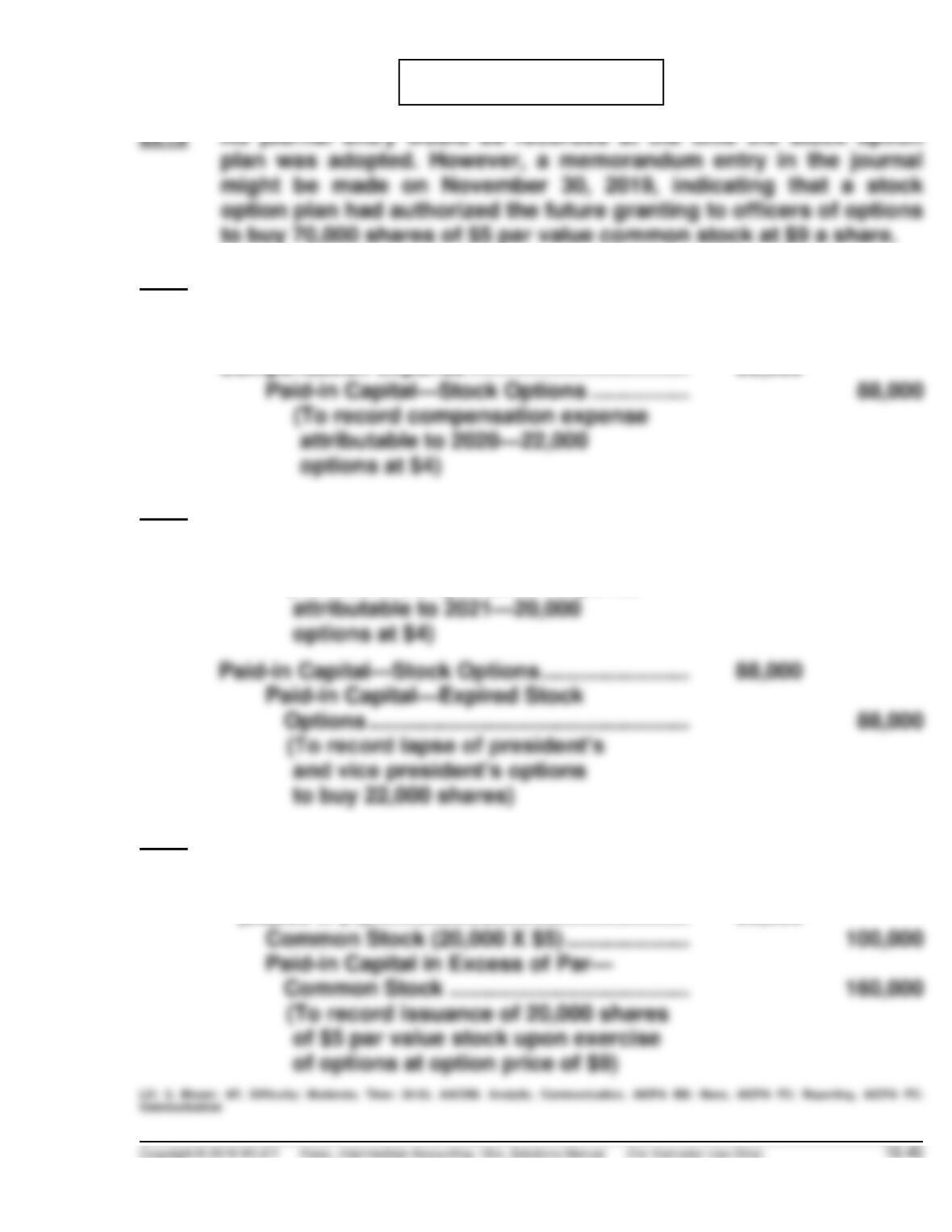
PROBLEM 16.1 (Continued)
5. Compensation Expense* …………………………... 100,000
6. For options exercised:
Cash (9,000 X $30) ……………………………………. 270,000
For options lapsed:
Paid-in Capital—Stock Options …………………. 10,000
Compensation Expense ……………………… 10,000
(Note to instructor: This entry provides an opportunity to indicate
(b) Stockholders’ Equity:
Paid-in Capital:
Common Stock, $10 par value, authorized
PROBLEM 16.1 (Continued)
Calculations:
Common Stock
Paid-in Capital
in Excess of Par
At beginning of year …………………..
300,000 shares
$ 600,000
From stock rights (entry #3) ……….
From stock warrants (entry #4) …..
Total …………………………………..
320,100 shares
$1,123,800
PROBLEM 16.2
(a) Entries at August 1, 2021
Bonds Payable ………………………………………………… 250,000
Discount on Bonds Payable (Schedule 1) …… 4,815*
Common Stock (8 X 250 X $100) ………………… 200,000
Interest Payable ………………………………………………. 2,500
Cash ($250,000 X .12 X 1/12) ……………………… 2,500
(b) Entries at August 31, 2021
Interest Expense……………………………………………… 405*
(c) Entries at December 31, 2021
(Same as August 31, 2021, and the following closing entry)
PROBLEM 16.2 (Continued)
Schedule 1
Monthly Amortization Schedule
Unamortized discount on bonds payable:
Amount to be amortized over 120 months …………………………..…. $54,000
Amount of monthly amortization ($54,000 ÷ 120) …………………….. $ 450
Schedule 2
Interest Expense Schedule
Amortization of bond discount charged to bond interest expense in 2021
would be as follows:
7 months X $450 …………………………. $3,150
5 months X $405 …………………………. 2,025
Total ……………………………………. $5,175
Interest on Bonds:
Total interest
Amortization of discount ……………… $ 5,175
Cash interest paid ……………………….. 287,500
PROBLEM 16.3
2020 January 2
No entry
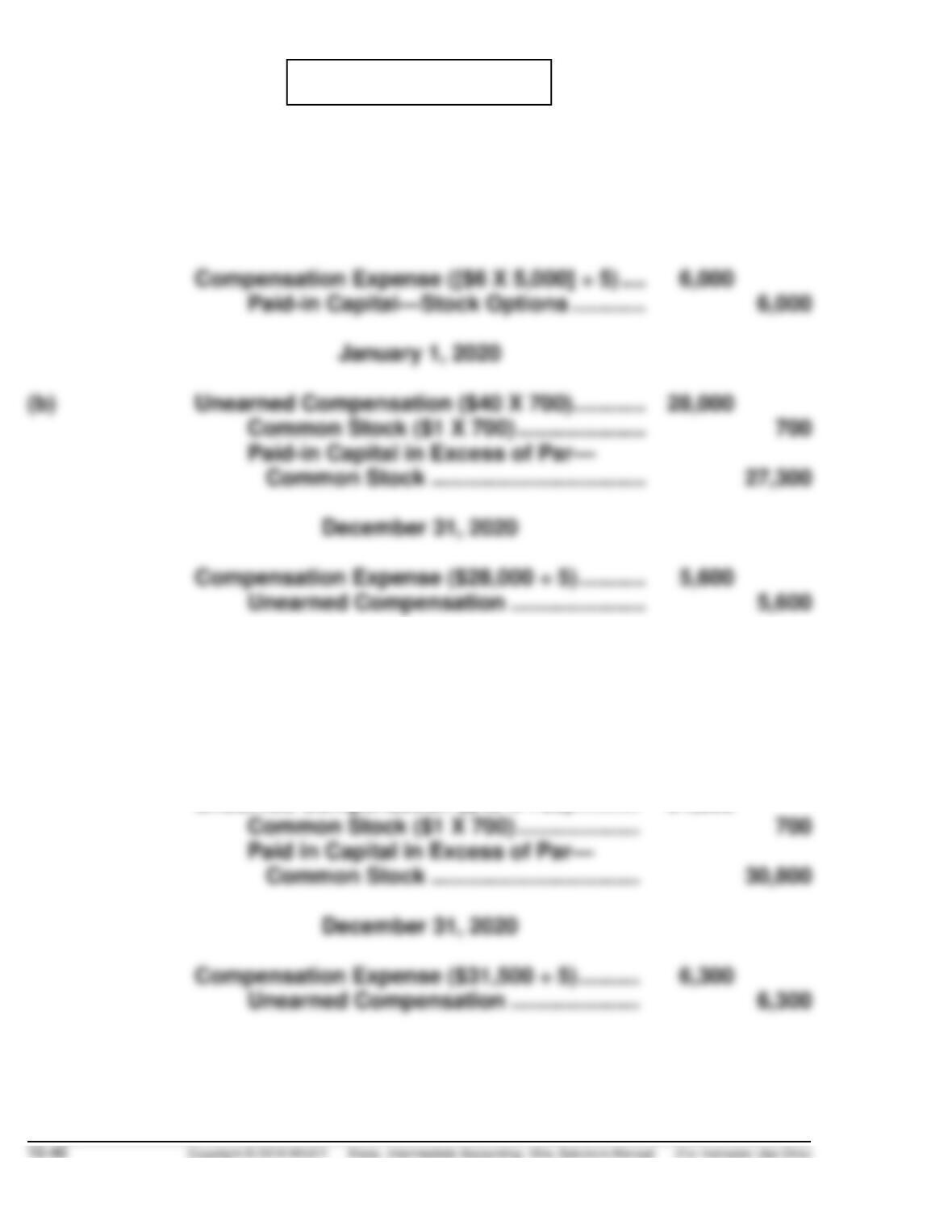
December 31
Compensation Expense ……………………………… 88,000
2021 December 31
Compensation Expense ……………………………… 80,000
Paid-in Capital—Stock Options ……………. 80,000
(To record compensation expense
2022 December 31
Cash (20,000 X $9) ……………………………………… 180,000
Paid-in Capital—Stock Options
(20,000 X $4) ……………………………………………. 80,000
PROBLEM 16.4
January 1, 2020
(a) No entry
December 31, 2020
(c) No change for part (a), unless the fair value of the options change.
For part (b):
January 1, 2020
Unearned Compensation ($45 X 700)……….. 31,500

PROBLEM 16.4 (Continued)
(d) Numbers (1) substantially all employees may participate; (2) The
discount from market is small (less than 5%); and (3) The plan offers
PROBLEM 16.5
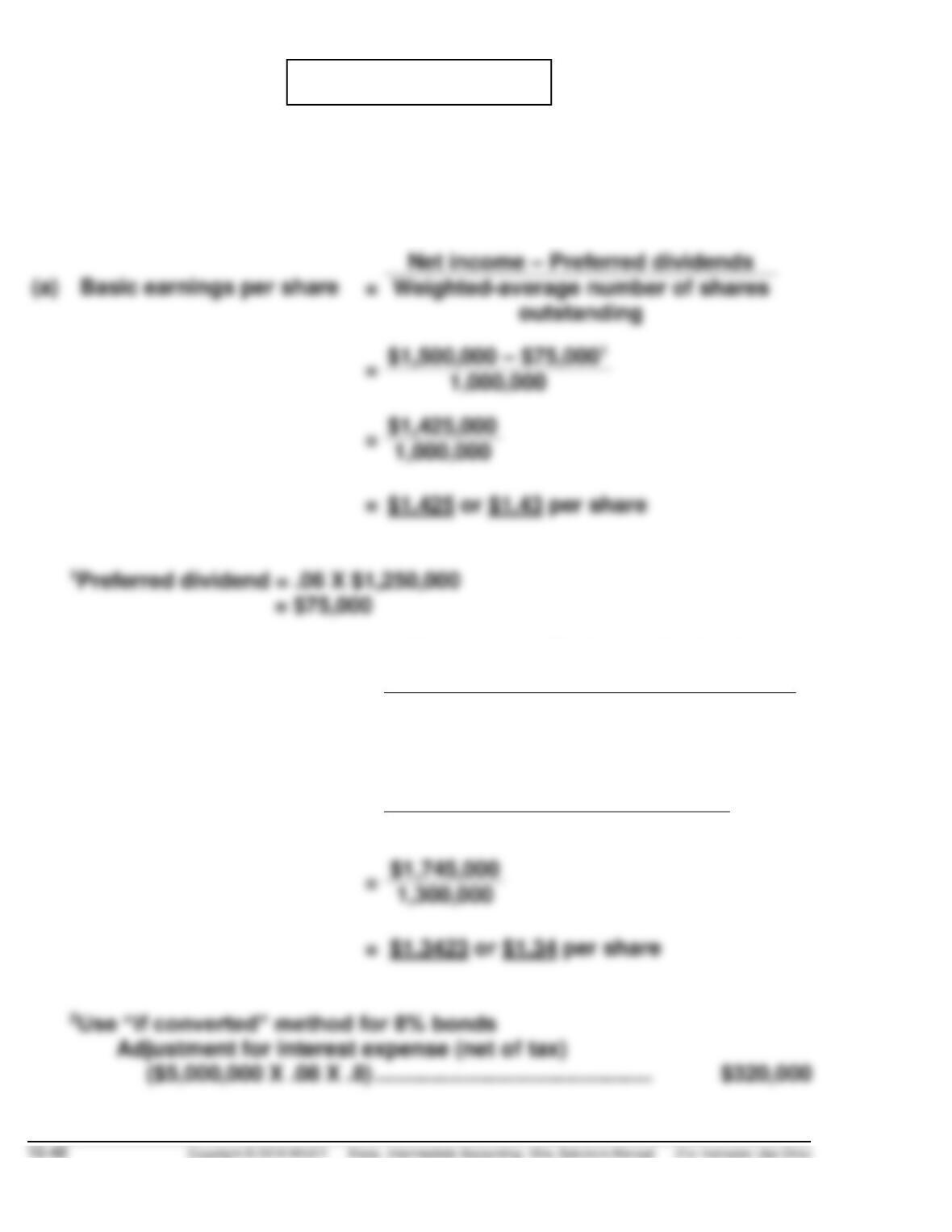
The computation of Fitzgerald Pharmaceutical Industries’ basic earnings
per share and the diluted earnings per share for the fiscal year ended June
30, 2020, are shown below.
(b)
Diluted earnings per share
=
Net income – Preferred dividends +
Interest (net of tax)
Weighted-average number of shares
outstanding + Potentially dilutive
common shares
=
$1,500,000 – $75,000 + $320,0002
1,000,000 + 250,0003 + 50,0004
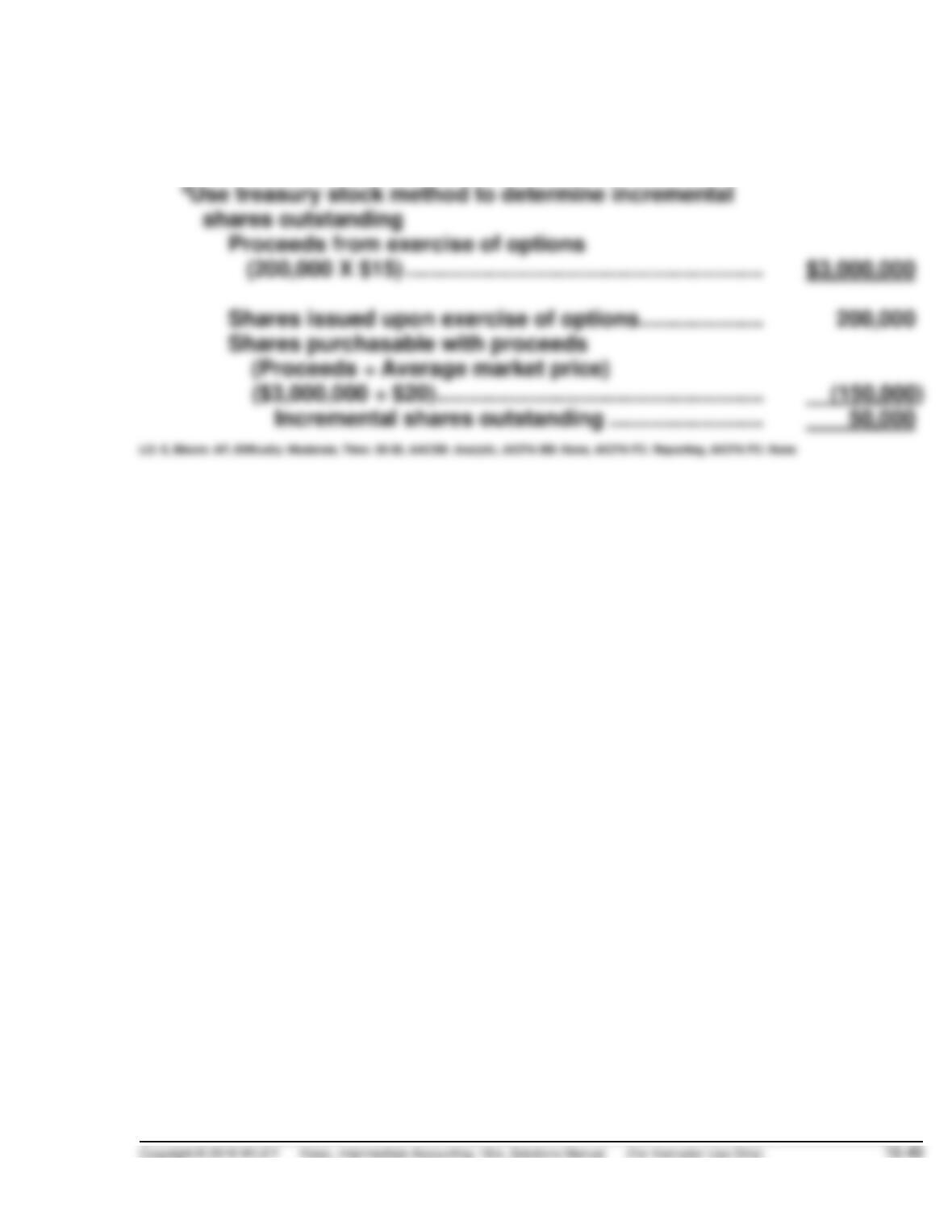
PROBLEM 16.5 (Continued)
3Shares assumed to be issued if converted
$5,000,000 ÷ $1,000/bond X 50 shares …………………… 250,000
PROBLEM 16.6
(a) Melton Corporation has a simple capital structure since it does not
have any potentially dilutive securities.
(b) The weighted–average number of shares outstanding that Melton
Corporation would use in calculating earnings per share for the fiscal
years ended May 31, 2020, and May 31, 2021, is 1,600,000 and 2,200,000
respectively, calculated as follows:
Event
Dates
Outstanding
Shares
Outstanding
Restatement
Fraction
of Year
Weighted
Shares
PROBLEM 16-6 (Continued)
(c) MELTON CORPORATION
Comparative Income Statement
For Fiscal Years Ended May 31, 2020 and 2021
2020
2021
Income from operations ……………………………………
$1,800,000
$2,500,000
Interest expense1 …………………………..…………………
240,000
240,000
Income before taxes …………………………………………
Income taxes at 20% …………………………………………
Net income ………………………………………………………
Income from continuing operations
Net income ………………………………………………..
Earnings per share (May 31, 2020)
Net income ………………………………………………..
$ 0.742
Earnings per share (May 31, 2021)
Net income ………………………………………………..
PROBLEM 16.6 (Continued)
1Interest expense = $2,400,000 X .10
= $240,000
*Preferred dividends = (No. of Shares X Par Value X Dividend %)
= (20,000 X $50 X .06)
= $60,000 per year
3Earnings per share
=
($1,808,000 – $60,000)
2,200,000
=
$0.79 per share
=
5Earnings per share
=
=
PROBLEM 16.7
(a) The number of shares used to compute basic earnings per share is
4,951,000, as calculated below.
Event
Dates
Outstanding
Shares
Outstanding
Restatement
Fraction
of Year
Weighted
Shares
Conversion of
1,260,000
Issued shares for
building
1,335,000
Beginning Balance,
(b) The number of shares used to compute diluted earnings per share is
5,791,000, as shown below.
Number of shares to compute
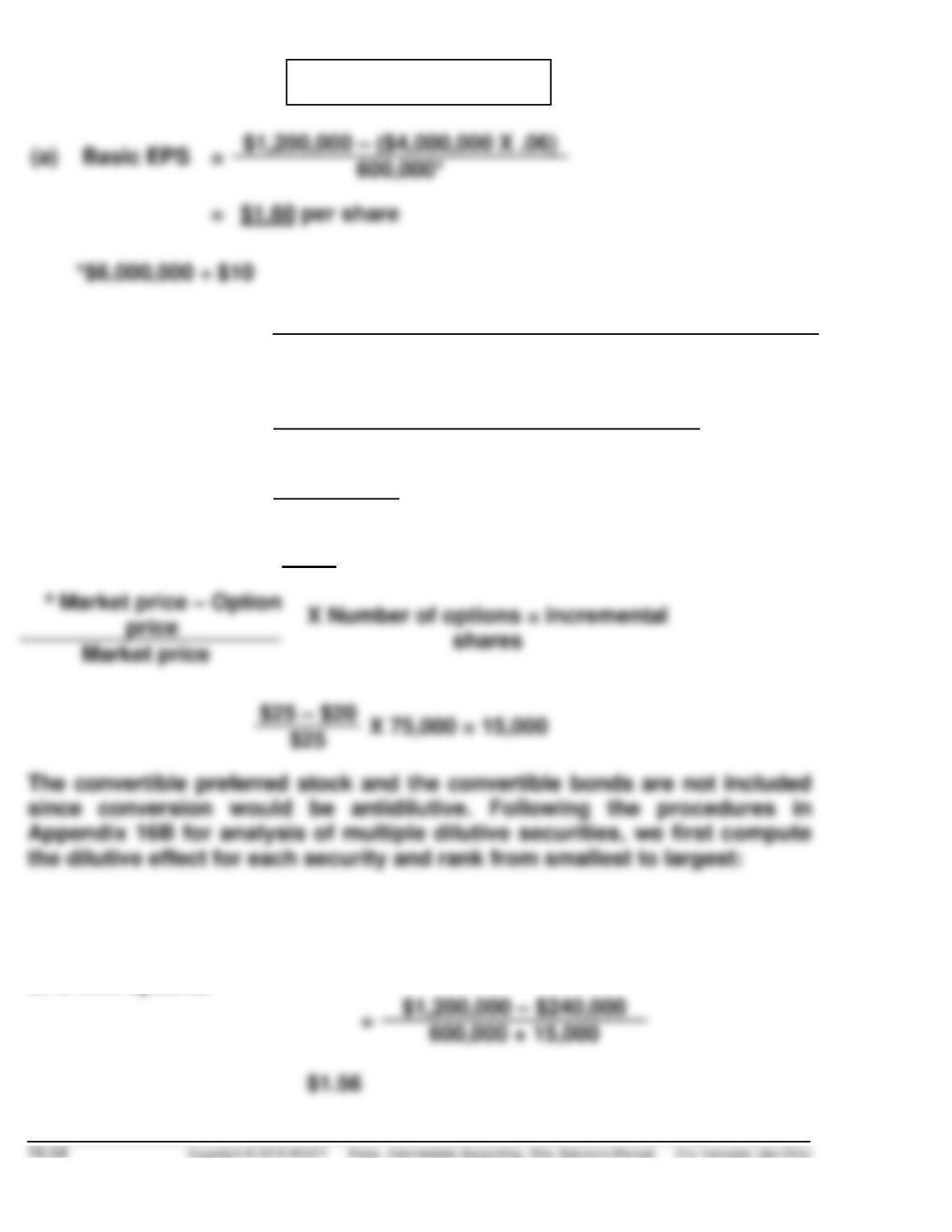
(c) The adjusted net income to be used as the numerator in the basic
earnings per share calculation for the year ended December 31, 2021, is
$10,350,000, as computed below.
After-tax net income ……………………………………. $11,550,000
PROBLEM 16.8
=
$1.60 per share
(b)
Diluted EPS
=
(Net income – Preferred dividends)
Weighted-average number of shares outstanding +
Potentially dilutive common shares
=
$1,200,000 – $240,000
600,000 + 15,000a
=
$960,000
615,000
=
$1.56 per share
Options: $0/15,000 = $0
Convertible bonds: $112,000/60,000 = $1.87
Preferred: $240,000/120,000 = $2
EPS with options:
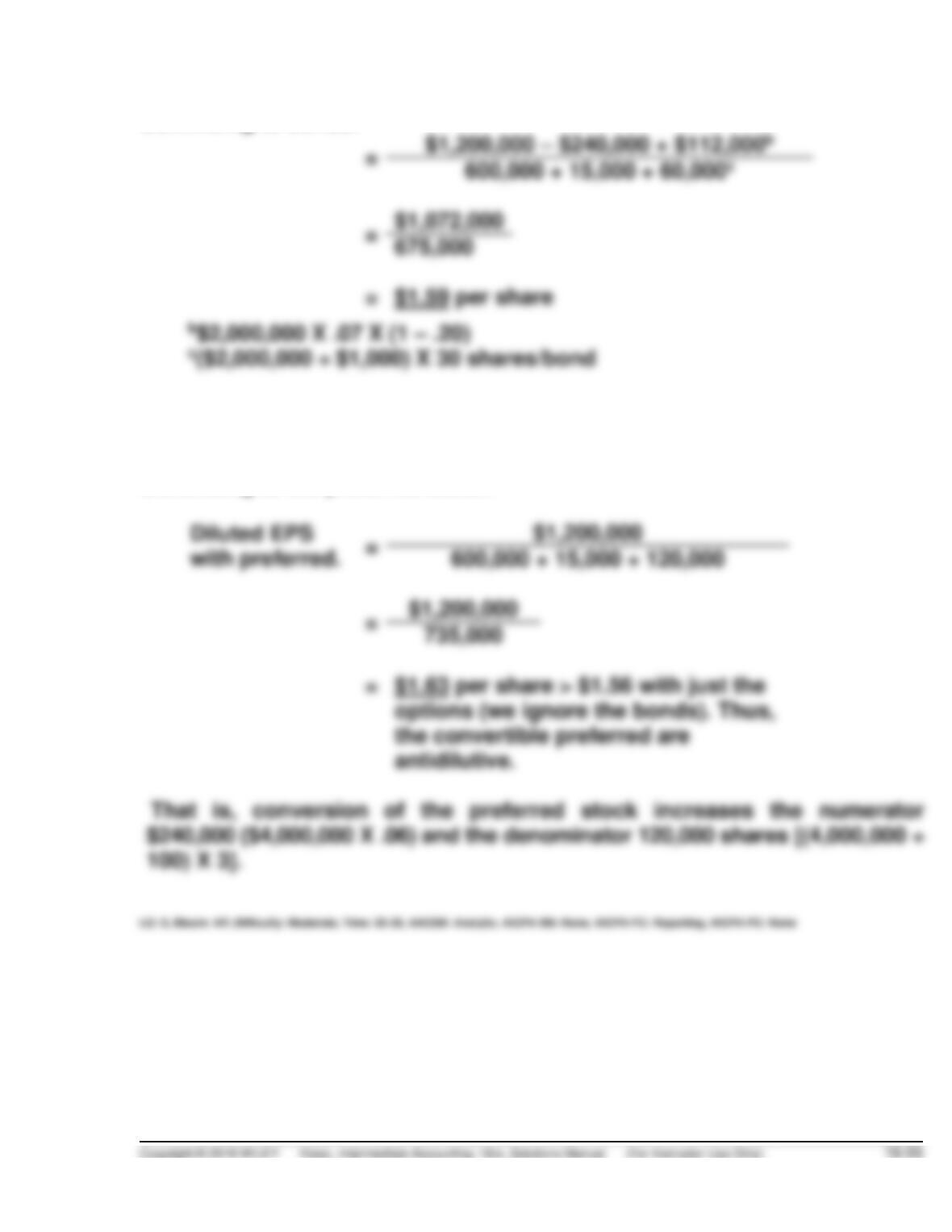
This is less than basic EPS.
Continuing to bonds:
$1.59 > $1.56, which is greater than diluted EPS with the options. Thus, we
exclude the convertible bonds from EPS calculations.
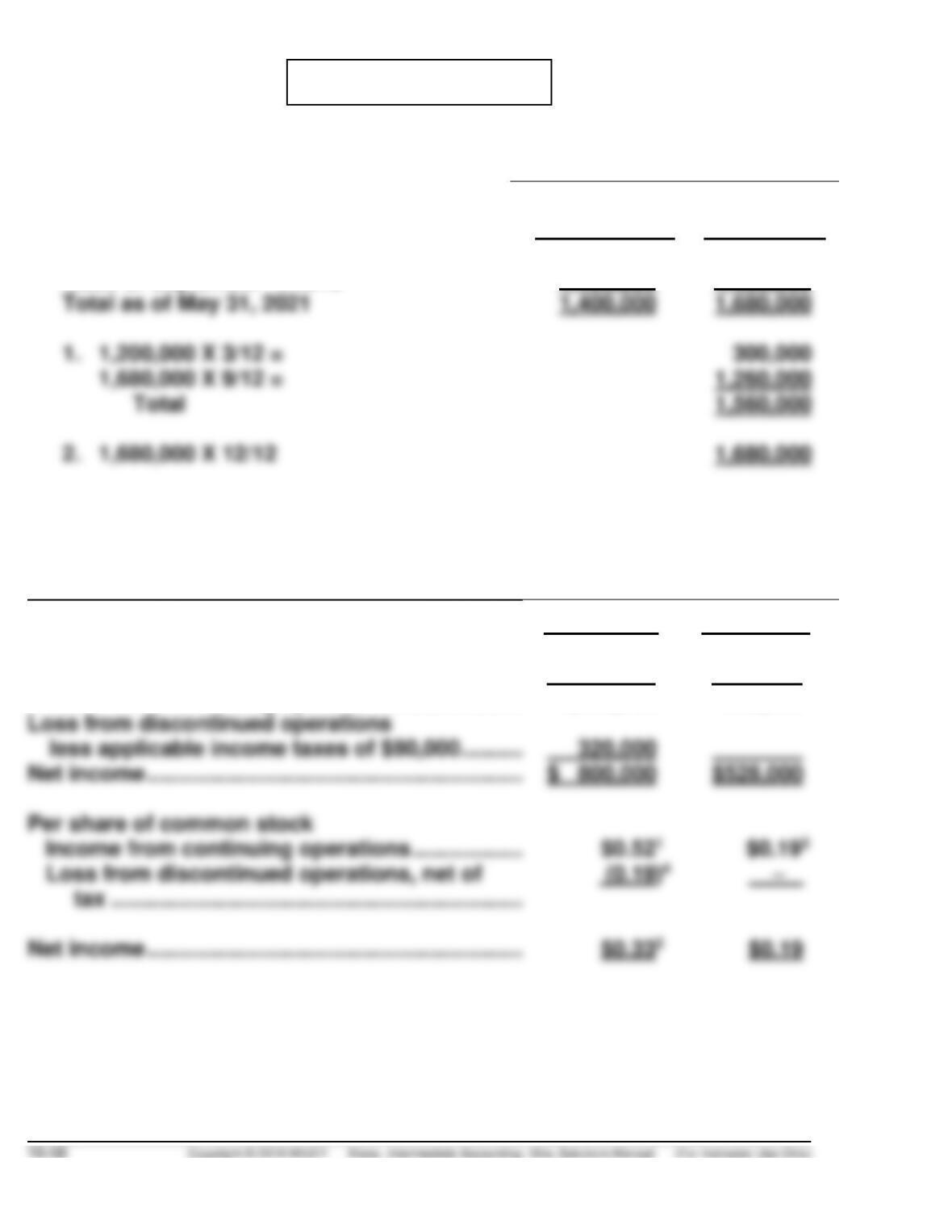
Continuing to the preferred stock:
PROBLEM 16.9
(a)
Weighted-Average Shares
Before Stock
Dividend
After Stock
Dividend
Total as of June 1, 2019
1,000,000
1,200,000
Issue of September 1, 2019
400,000
480,000
Total as of May 31, 2021
1,400,000
1,680,000
Total
1,560,000
1,680,000
(b) CHRISTINA CORPORATION
Comparative Income Statement
For the Years Ended May 31, 2021 and 2020
2021
2020
Income from operations before income taxes …..
$1,400,000
$660,000
Income taxes ………………………………………………….
280,000
132,000
Income from continuing operations …………………
1,120,000
528,000
Net income …………………………..………………………..
$ 800,000
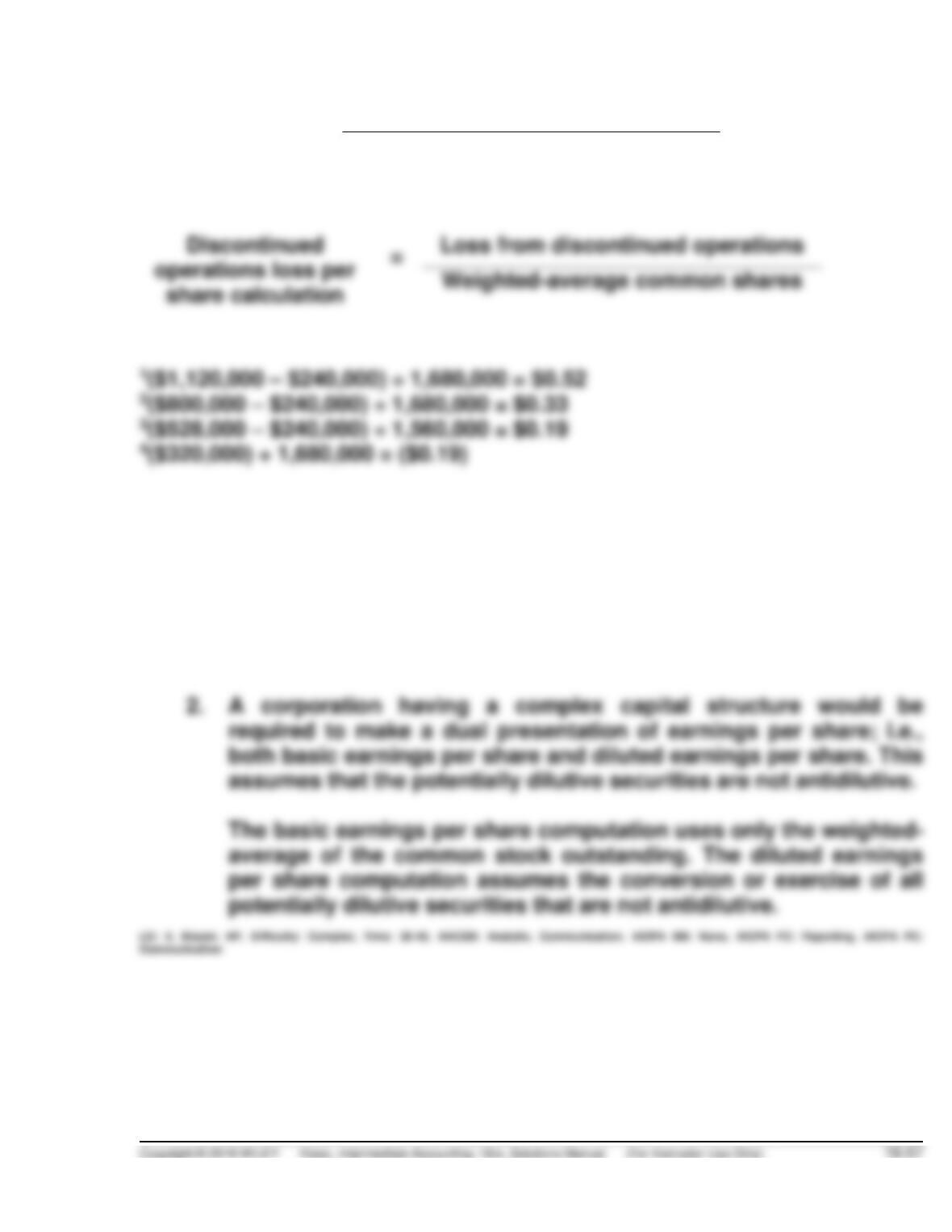
Per share of common stock
Income from continuing operations ………………
Net income …………………………..………………………..
PROBLEM 16.9 (Continued)
EPS calculations =
Net income – Preferred dividends
Weighted-average common shares
Preferred dividends = 40,000 X $100 X .06 = $240,000
(c) 1. A corporation’s capital structure is regarded as simple if it
consists only of common stock and includes no potentially dilutive
securities. Christina Corporation has a simple capital structure
because it has not issued any convertible securities, warrants, or
stock options, and there are no existing rights or securities that
are potentially dilutive of its earnings per common share.
TIME AND PURPOSE OF CONCEPTS FOR ANALYSIS
CA 16.1 (Time 20–25 minutes)
Purpose—to provide the student with an understanding of the underlying rationale behind the
CA 16.2 (Time 15–20 minutes)
Purpose—to provide the student with an opportunity to discuss the ethical issues related to an earnings–
based compensation plan.
CA 16.3 (Time 15–20 minutes)
Purpose—to provide the student with an understanding of the proper accounting and conceptual merits
CA 16.4 (Time 25–35 minutes)
CA 16.5 (Time 25–35 minutes)
Purpose—to provide the student with an understanding of how earnings per share is affected by
CA 16.6 (Time 25–35 minutes)
Purpose—to provide the student with an opportunity to articulate the concepts and procedures related
SOLUTIONS TO CONCEPTS FOR ANALYSIS
CA 16.1
(a) (1) When the debt instrument and the option to acquire common stock are inseparable, as in
the case of convertible bonds, the entire proceeds of the bond issue should be allocated to
the debt and the related premium or discount accounts.
(2) In the case of convertible debt there are two principal reasons why all the proceeds should
be ascribed to the debt. First, the option is inseparable from the debt. The investor in such
securities has two mutually exclusive choices: be a creditor and later receive cash for the
(3) Arguments have been advanced that accounting for convertible debt should be the same as
for debt issued with detachable stock purchase warrants. Convertible debt has features of
debt and stockholders’ equity, and separate recognition should be given to those
characteristics at the time of issuance. Difficulties encountered in separating the relative
(b) Cash ………………………………………………………………………………… 20,040,000
Discount on Bonds Payable ($18,000,000 X 22%) ………………….. 3,960,000
Bonds Payable ……………………………………………………………. 18,000,000
Paid-in Capital—Stock Warrants ……………………………………. 6,000,000
CA 16.2
(a) Devers recognizes that altering the estimate will benefit Adkins and other executive officers of the
company. Current stockholders and investors will be forced to pay out the bonuses, with the
CA 16.3
(a) 1. The objective of issuing warrants to existing stockholders on a pro-rata basis is to raise new
2. The purpose of issuing stock warrants to certain key employees, usually in the form of a
non-qualified stock option plan, is to increase their interest in the long-term growth and
3. Warrants to purchase shares of its common stock may be issued to purchasers of a
(b) 1. Because the purpose of issuing warrants to existing stockholders is to raise new equity
2. Warrants may be offered to key employees below, at, or above the market price of the stock
on the day the rights are granted except for incentive stock-option plans. If a stock-option
plan is to provide a strong incentive, warrants that can be exercised shortly after they are