
CA 16.3 (Continued)
3. Income tax laws impose no restrictions on the exercise price of warrants issued to purchasers
of a company’s bonds. The exercise price may be above, equal to, or below the current
(c) 1. Financial statement information concerning outstanding stock warrants issued to a
company’s stockholders should include a description of the stock being offered for sale, the
option price, the time period during which the rights may be exercised, and the number of
rights needed to purchase a new share.
CA 16.4
(a) In 2004, FASB issued an accounting standard related to stock compensation plans.
Generally, the rule indicates that employee stock options be treated like all other types of
compensation and that their value be included in financial statements as part of the costs of
employee services. The rule requires that all types of stock options be recognized as
(b) According to Ciesielski’s commentary, the bill in Congress would only record expense for the
options granted to the top five executives. They also are recommending that the SEC conduct
further study of the issue and therefore delay the implementation of the new standard. From a
comparability standpoint, it is highly unlikely that recording expense on only some options would
CA 16.4 (Continued)
The FASB often hears that it should take a broader view, that it must consider the economic
consequences of a new accounting standard. The FASB should not act, critics maintain, if a new
accounting standard would have undesirable economic consequences. We have been told that
the effects of accounting standards could cause lasting damage to American companies and their
There is a common element in those assertions. The goals are desirable but the means require
that the Board abandon neutrality and establish reporting standards that conceal the financial
impact of certain transactions from those who use financial statements. Costs of transactions
exist whether or not the FASB mandates their recognition in financial statements. For example,
not requiring the recognition of the cost of stock options or ignoring the liabilities for retiree health
care benefits does not alter the economics of the transactions. It only withholds information from
investors, creditors, policy makers, and others who need to make informed decisions and,
eventually, impairs the credibility of financial reports.
Neutrality does not mean that accounting should not influence human behavior. We expect that
changes in financial reporting will have economic consequences, just as economic
consequences are inherent in existing financial reporting practices. Changes in behavior naturally
follow from more complete and representationally faithful financial statements. The fundamental
question, however, is whether those who measure and report on economic events should
somehow screen the information before reporting it to achieve some objective. In FASB
CA 16.5
(a) Dividends on outstanding preferred stock must be subtracted from net income or added to net loss
for the period before computing EPS on the common shares. This generalization will be modified
by the various features and different requirements preferred stock may have with respect to
(b) When options and warrants to buy common stock are outstanding and their exercise price (i.e.,
proceeds the corporation would derive from issuance of common stock pursuant to the warrants
and options) is less than the average price at which the company could acquire its outstanding
shares as treasury stock, the treasury stock method is generally applicable. In these
CA 16.6
Dear Mr. Dolan:
I hope that the following brief explanation helps you understand why your warrants were not included in
Rhode’s earnings per share calculations.
Earnings per share (EPS) provides income statement users a quick assessment of the earnings that
were generated for each common share outstanding over a given period. When a company issues only

CA 16.6 (Continued)
In order not to mislead users of financial information, the accounting profession insists that EPS
calculations be transparent. Thus, a security which might dilute EPS must be figured into EPS
calculations as though it had been converted into common stock. Basic EPS assumes a weighted-
average of common stock outstanding while diluted EPS assumes that any potentially dilutive security
has been converted.
Sincerely,
Ms. Smart Student
Accountant
FINANCIAL REPORTING PROBLEM
(a) (1) Under P&G’s stock-based compensation plan (Note 7), 21,425,000
options were granted during 2017.
(4) The total stock – based compensation expense for stock options
was 216,000,000, 199,000,000 and 223,000,000 for 2017, 2016 and
2015, respectively. Total compensation expense for restricted
(b)
(In millions—except per share)
2017
2016
2015
Weighted-average common shares
2,740.4
2,844.4
2,883.6
Diluted earnings per share
$5.59
$3.69
$2.44
COMPARATIVE ANALYSIS CASE
(a) Coca-Cola sponsors restricted stock award plans, performance share
units and stock option plans under its 2014 Equity plan.
(b)
Coca-Cola
Options outstanding at year-end 2017
(c)
Coca-Cola
PepsiCo
Options granted during 2017
9,000,000
1,481,000
(d)
Coca-Cola
Options exercised during 2017
(e)
(f)
Diluted Earnings Per Share
Coca-Cola
PepsiCo
2017
$1.29
$3.38
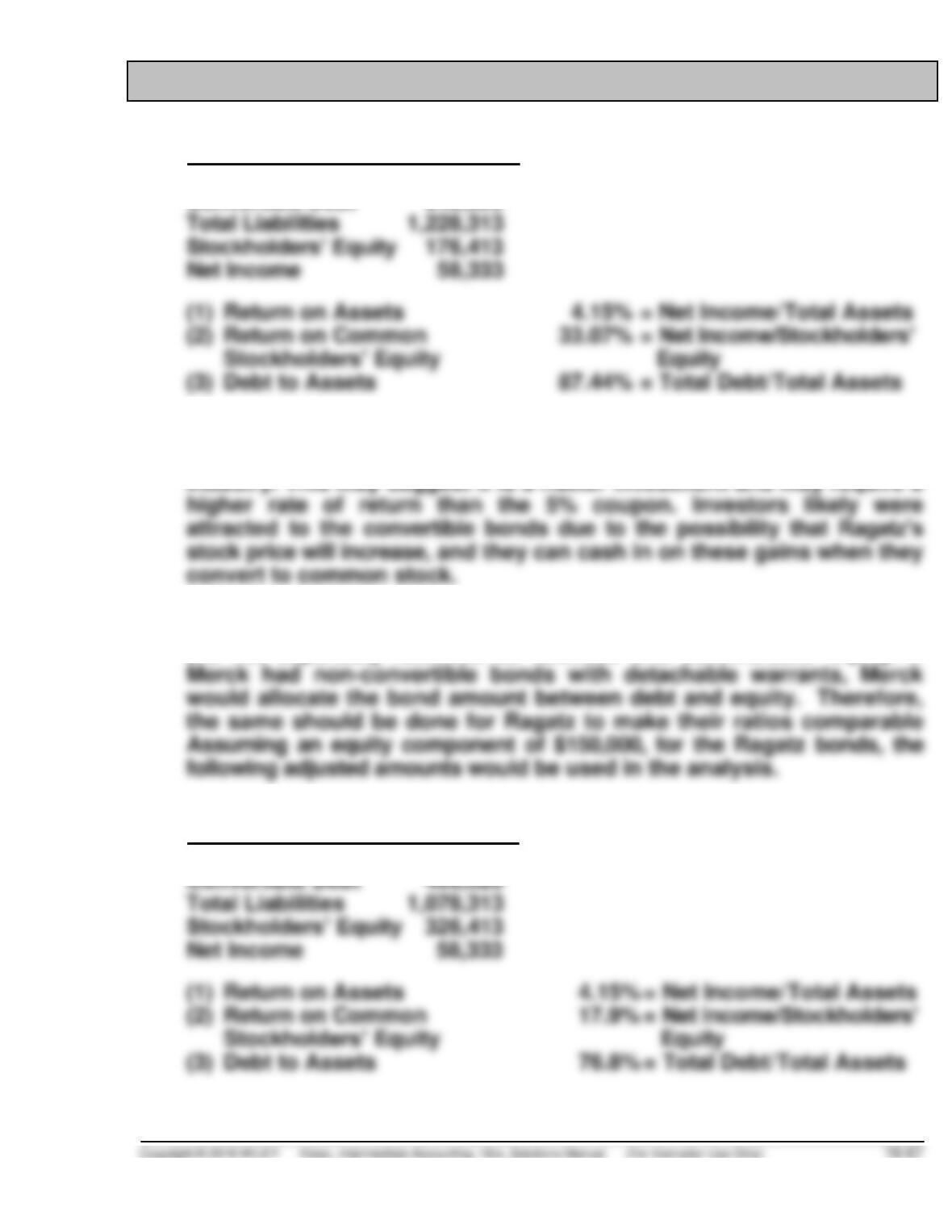
FINANCIAL STATEMENT ANALYSIS CASE
(a) Account 2020 (,000)
Current Liabilities 554,114
Convertible Debt 648,020
(b) Ragatz is doing very well. Its ROA and ROE are above the industry
average. However, its debt level is quite high, compared to the
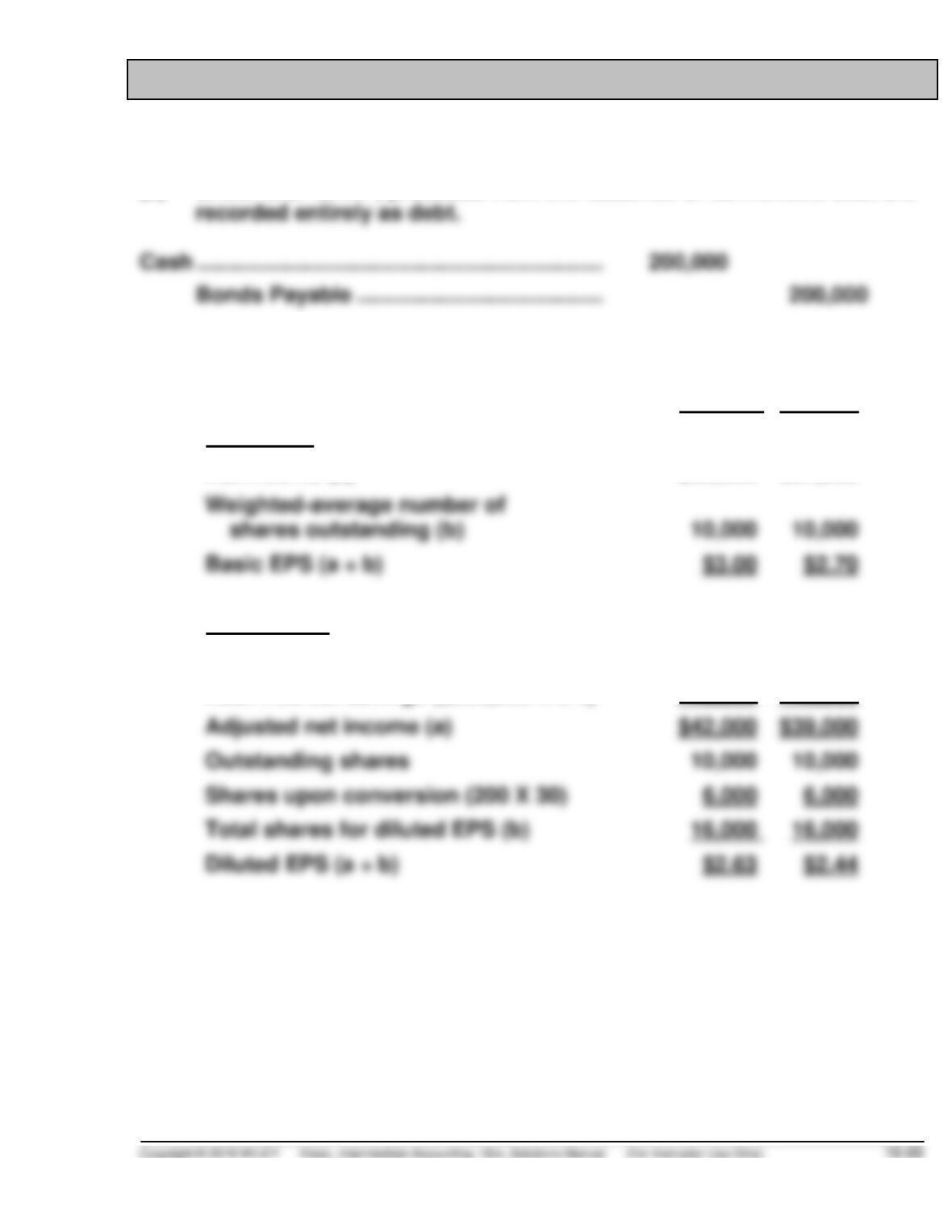
(c) Under GAAP, the debt and equity components of a convertible bond
are not separately recorded as liabilities and stockholders’ equity. If
Reclassified:
Account 2020 (,000)
Current Liabilities 554,114

FINANCIAL STATEMENT ANALYSIS CASE (Continued)
The adjustment results in Ragatz reporting a higher level of
stockholders’ equity and less debt. Although Ragatz reports the same
ACCOUNTING, ANALYSIS, AND PRINCIPLES
Accounting
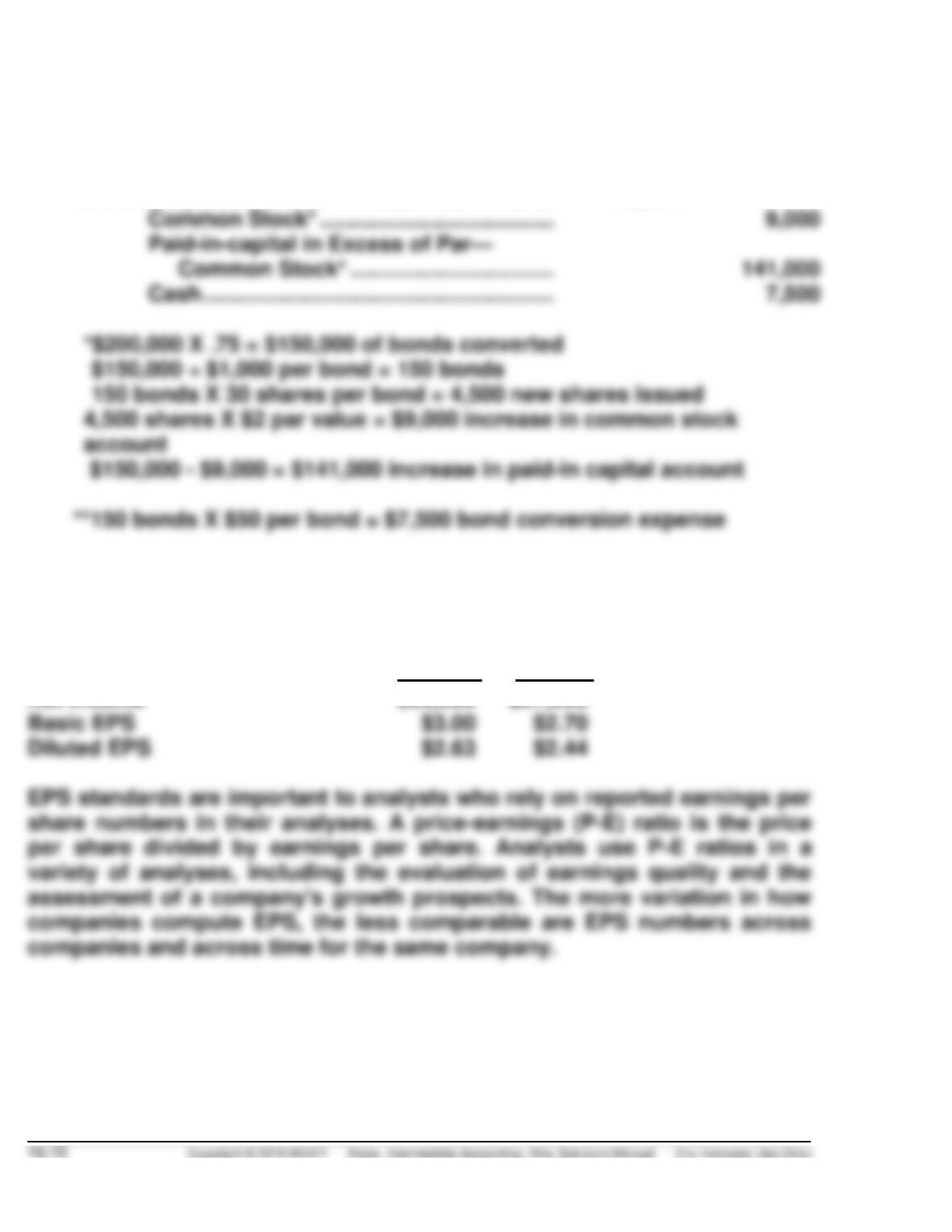
(a) Under U.S. GAAP, proceeds from the issuance of convertible debt are
(b)
2020
2019
Basic EPS
Net income (a)
$30,000
$27,000
Basic EPS (a ÷ b)
Diluted EPS
Net income
$30,000
$27,000
Add: Interest savings ($200,000 X 6%)
12,000
12,000
Adjusted net income (a)
$42,000
$39,000
Outstanding shares
Shares upon conversion (200 X 30)
Total shares for diluted EPS (b)
ACCOUNTING, ANALYSIS, AND PRINCIPLES (Continued)
(c)
Bond Conversion Expense** ……………………….
7,500
Bonds Payable ……………………………………………
150,000
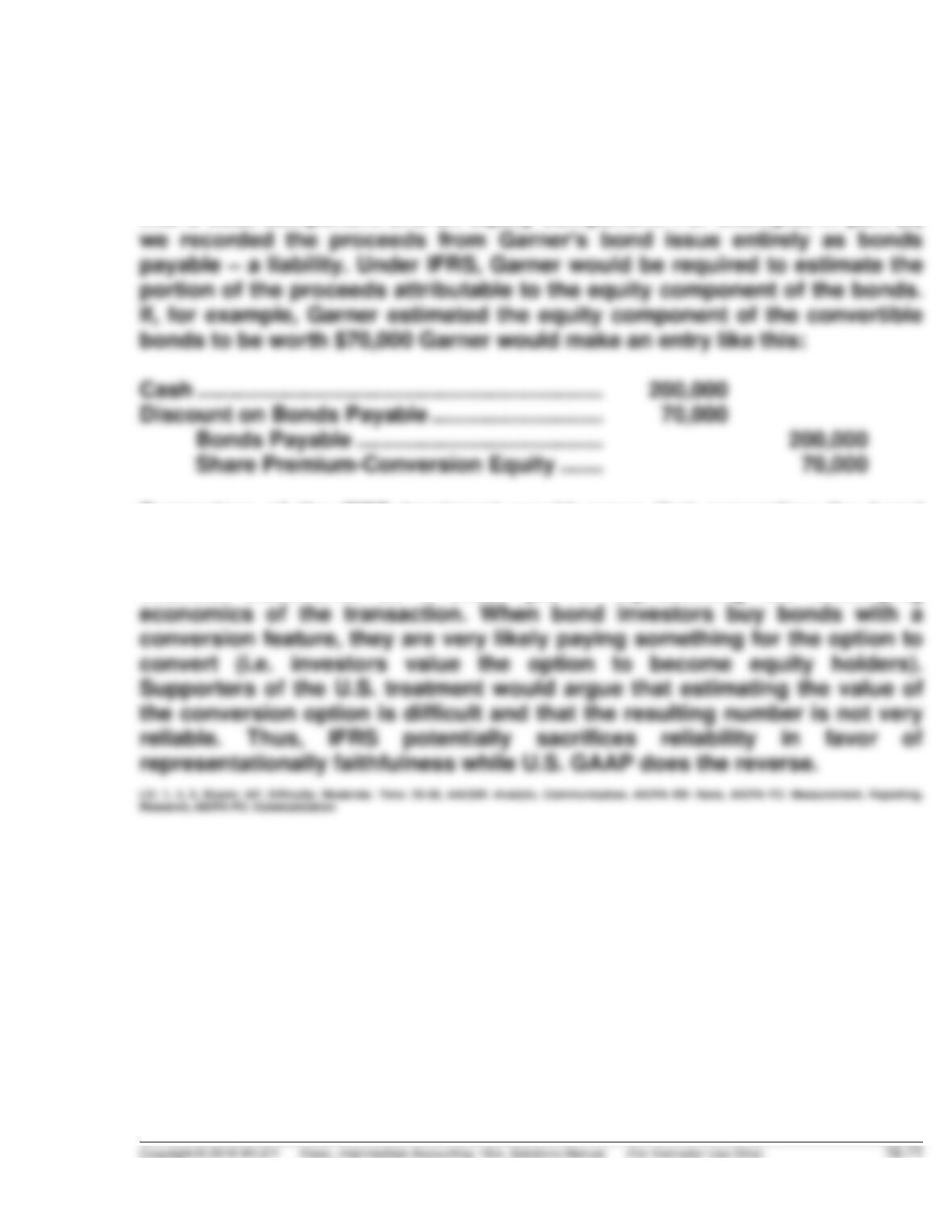
Analysis
EPS Presentation:
2020 2019
ACCOUNTING, ANALYSIS, AND PRINCIPLES (Continued)
Principles
IFRS for convertible debt primarily differs from U.S. GAAP on convertible
debt in that IFRS requires that companies split the proceeds from issuance
into a debt component and an equity component. For example, in part (a)
Supporters of the IFRS treatment would argue that separating the bond
issue into liability and equity components provides more representational
faithful information into the financial statements. That is, the resulting
financial statements do a better job of representing the underlying
CE16-1
Master Glossary
(a) The amount of earnings for the period available to each share of common stock outstanding
during the reporting period.
(d) The date at which an employer and an employee reach a mutual understanding of the key terms
and conditions of a share-based payment award. The employer becomes contingently obligated
on the grant date to issue equity instruments or transfer assets to an employee who renders the
CE16-2
According to FASB ASC 260-10–45-7 (Earnings Per Share—Other Presentation Matters):