Chapter 16: Leases Instructor Manual
Accounting Theory (9
th
edition) Page 1 of 17
CHAPTER HIGHLIGHTS
Lease capitalization is one of the most interesting policy areas in accounting. This is because of
the gradual evolution of policy over a long period of time (nearly 40 years). Such a long
evolution permits a ready analysis of the theoretical rationale behind the successive accounting
Given the large number of successive lease accounting standards, the chapter presents a
historical development of the arguments pertaining to lease capitalization. This review also
illustrates the importance of definitions of accounting elements. The trend toward increased
capitalization is closely related to the broadening of asset and liability definitions over the same
time period.
The final point to be highlighted concerns the incentives to circumvent capitalization, and the
economic consequences of mandatory lease capitalization. Survey evidence indicates a
management preference for noncapitalization in order to achieve “off-balance-sheet” financing.
There is some evidence that the market was “fooled” by hidden lease contracts: a study of APB
Opinion No. 31 by Ro (1978) found evidence that its adoption had “information content” and
that security price responses were negative. This could be explained in terms of the revelation of
hidden debt. Another study (Pfeiffer, 1980) also found a negative price response to securities
during the FASB’s public hearings in late 1974. It was argued that debt covenants would have
affected stockholders wealth due to dividend and other restrictions relating to debt levels. In
spite of the apparent market effects earlier, there was no evidence that the actual implementation
of SFAS No. 13 affected security prices (Abdel-Khalik, 1981).
Chapter 16: Leases Instructor Manual
Accounting Theory (9
th
edition) Page 2 of 17
serious consequences in terms of debt covenants and debt-equity ratios. In short, there was
ample time to restructure leases to avoid capitalization.
Finally, the continued behavior by management to defeat the SFAS No. 13 tests are quite
interesting and warrant an explanation. Agency theory arguments concerning debt covenants are
one possibility.
QUESTIONS
Q-1 What is the argument for finite uniformity in accounting for leases? Why is finite
uniformity difficult to achieve? Explain what the relevant circumstances are in
accounting for different types of leases.
The argument reduces to this: some leases are, by analogy, the equivalent of purchases (or sales
to a lessor), while others are the equivalent of simple rentals. Finite uniformity is difficult
because leases do not naturally fall into these two categories. The criteria (relevant
Q-2 Why is the aspect of conveyance of leases emphasized in capital leases and the
contractual element emphasized in operating leases?
In law, leases have both elements. Obviously, the conveyancing aspect (purchase/sale) dominates
Chapter 16: Leases Instructor Manual
Accounting Theory (9
th
edition) Page 3 of 17
Q-3 What are the similarities and differences between leases and other means of property
acquisition? How can these similarities and differences be reported in the financial
statements?
Some leases are very similar to conditional sales agreements (title passes at end of payments).
Title passes immediately under other types of sales, regardless of financing aspects. Remedies
Q-4 Is the executory nature of lease contracts important in assessing lease accounting? How
have leases been interpreted? Why might noncancellability override the executory
nature?
The answer depends on how you regard the executory contract argument. If the executor
argument is accepted, then leases should not be capitalized (to be consistent). If the executor
Q-5 Review the evolution of capitalization criteria in lease accounting standards. Why did
APB Opinion No. 5 have little impact? What impact has SFAS No. 13 had? Has there
been an underlying theme in the development of lease accounting?
The broad criterion has always been the “in-substance-purchase” argument. Each standard has
developed specific (and different) tests. ARB 38 took a legal approach and restricted
capitalization to leases that were de facto conditional sales (installment sales). APB Opinion No.
Q-6 Does it matter if capital leases are reported in a footnote or in the body of the balance
sheet? What research evidence exists to help evaluate this question?
A simple answer would be no. Disclosure is disclosure; form is unimportant. However, this
Chapter 16: Leases Instructor Manual
Accounting Theory (9
th
edition) Page 4 of 17
Q-7 Does symmetry exist between lessors and lessees under SFAS No. 13? Should symmetry
be a goal of lease accounting?
There are two causes of asymmetry. First, traditional sales-type tests apply to lessors. These tests
concern the uncertainty of cash collection. Second, the interest rate used for present value
Q-8 How is representational faithfulness achieved in the capitalization requirements of SFAS
No. 13?
In the sense that the measurement may not be representationally faithful (see the previous
question), the rules themselves are fairly objective. Key terms (for example, lease life) are open
Q-9 Is there a measurement reliability (verifiability) problem with lease capitalization?
Q-10 Evaluate the manner in which initial direct lease costs are accounted for under SFAS No.
13.
In going from true “off-balance-sheet” financing, as was the case prior to APB Opinion No. 31,
to supplemental disclosure of noncapitalized leases, new information was clearly disclosed, and
Chapter 16: Leases Instructor Manual
Accounting Theory (9
th
edition) Page 5 of 17
Q-11 Why was there reason to expect some negative economic consequences arising from
lease capitalization? What is the role of neutrality in such a situation? What is the
response based on research findings to date?
The Ro (1978) and Pfeiffer (1980) studies, plus surveys of analysts, support the notion that lease
capitalization is useful. Costs exist because of the compliance cost (i.e., accounting costs).
Q-12 Does the reporting of capital leases appear to have value to users of financial statements?
Why are there costs of reporting capital leases?
Because of the potential material effect on the balance sheet, the four-year transitional period
permitted companies to restructure their leases, or capital structure generally. This political
Q-13 What considerations may have motivated the FASB to grant a four-year transitional
period in capitalizing pre-1977 leases meeting the capitalization tests of SFAS No. 13?
What other political behavior is evident in the evolution of lease accounting?
Because of the potential material effect on the balance sheet, the four-year transitional period
Q-14 Should valuable lease options of lessees be capitalized?
Q-15 Why is the G4+1 like the Big Ten (a.k.a. Western Athletic Conference)?
The G4+1 has six members and the Big Ten football conference in the USA has eleven

Chapter 16: Leases Instructor Manual
Accounting Theory (9
th
edition) Page 6 of 17
Q-16 Why is the IASB standard (IAS 7) substantially shorter than the FASB’s standard (SFAS
No. 13)?
Q-17 Current discussions by the Boards leave room open for two Accounting for Leases
Standards; one for lessee and another one for lessor. Should two Accounting for Leases
Standards be issued? Support your response?
Q-18 Current discussions by the Boards point to a possibility that a converged standard on
leases will not be achieved. How will lack of converged standard on leases affect the
Boards’ Joint Project?
Chapter 16: Leases Instructor Manual
Accounting Theory (9
th
edition) Page 7 of 17
CASES, PROBLEMS, AND WRITING ASSIGNMENTS
1. Human Genome Sciences, Inc., a biopharmaceutical company, discovers, develops, and
markets new gene and protein-based drugs. Its 1998 annual report showed property,
plant, and equipment net of accumulated depreciation of $20,965,000 with total net assets
of $244,247,000.
A note on operating leases revealed the following:
Operating Leases
2001 6,197,186
2002 6,278,051
2003 5,353,707
Thereafter (2004–2017)
35,001,144
$64,895,833
Required:
a. Assume that the company’s cost of capital is 10 percent and that operating
lease payments between 2004 and 2017 are equal amounts per year. By how
much would Human Genome Sciences’ property, plant, and equipment and its
total net assets increase by on December 31, 1998 if these leases were
capitalized?
b. Assume that the company’s net income for 1998 was $20 million. What was
its return on assets (ROA) (a) before and (b) after capitalizing the operating
leases? Use straight-line depreciation over 14 years for the capitalized leases.
Operating lease expense for 1998 is $5,900,000.
(a)
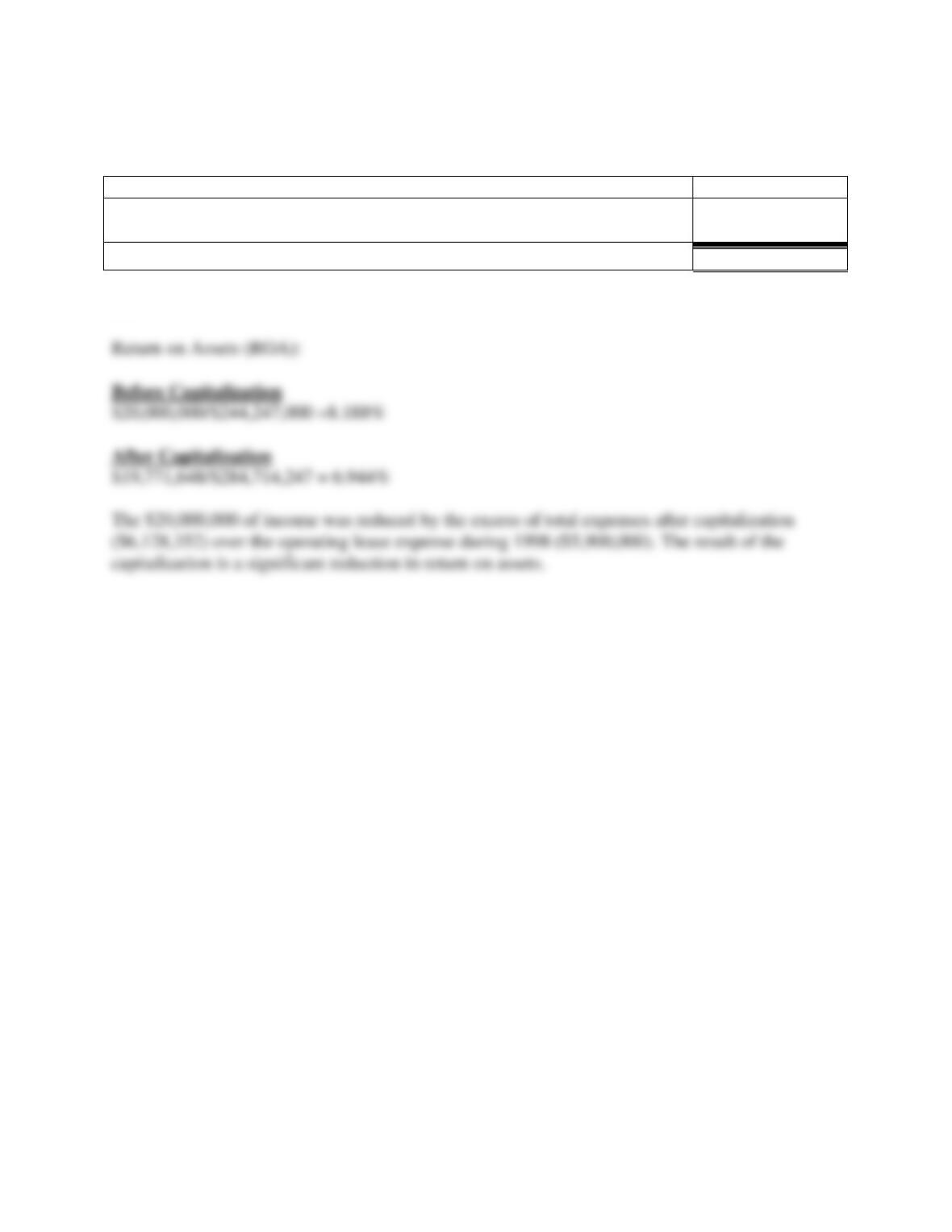
First determine the present value of the future lease payments using 8% discount rate. We use
the present value of $1 for the first five years and then an annuity for the remaining nine years:
Year Amount PV Factor PV Amount
1 $5,990,790 0.92593 $5,547,052
2 $6,074,955 0.85734 $5,208,302
Chapter 16: Leases Instructor Manual
Accounting Theory (9
th
edition) Page 8 of 17
(b)
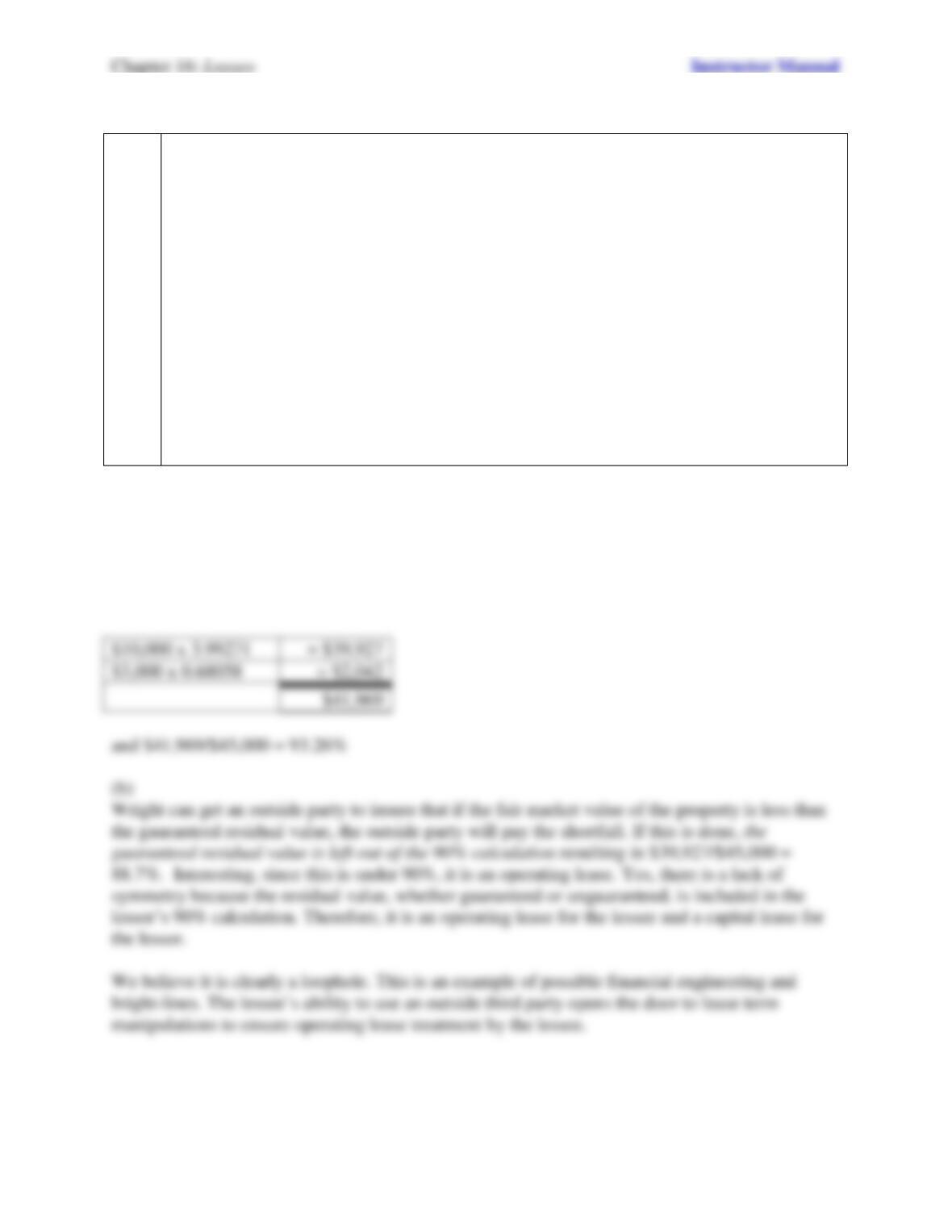
Interest Expense would be 8% × $40,467,277 $3,237,832
Depreciation on a straight-line basis for the newly capitalized leases would
be: $40,467,277 ÷ 14 $2,890,520
Total Expenses $6,128,352
(c)
Accounting Theory (9
th
edition) Page 9 of 17
2. Wright Company leases an asset for five years on December 31, 2000. Annual lease cost
of $10,000 is payable on each December 31 beginning with the year 2001. In addition to
the annual lease cost, the lease contract calls for a guaranteed residual value of $3,000.
The asset has an economic life of seven years. Wright’s incremental borrowing rate is 8
percent. The asset has an acquisition cost of $45,000. There are no purchase options.
Required:
a. As things now stand, is this a capital lease or an operating lease? Show
figures.
b. What can Wright do to convert this lease to an operating lease? Explain and
show figures.
c. Will lessee and lessor’s accounting for this lease be symmetrical (capital lease
for both lessor and lessee or operating lease for both lessor and lessee)?
Explain.
d. Do you think that Wright’s action in (b) represents a loophole to avoid
capitalization or is it a useful part of the present leasing rules? Explain.
(a)
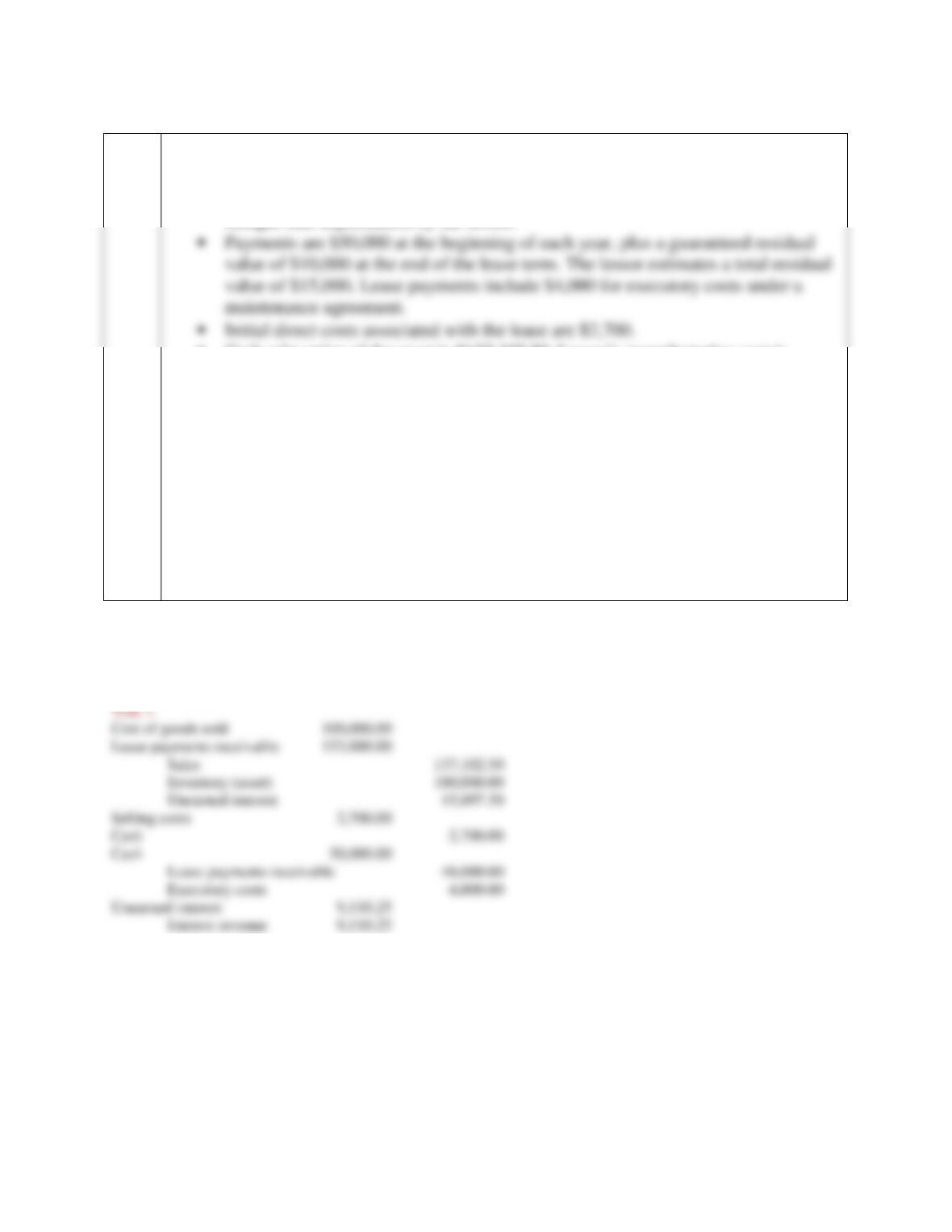
As it stands now, this is a capital lease. The lease period is less than 75% (five years out of a
total economic life of seven years), but the present value of the five year’s worth of lease
payments plus the guaranteed residual value exceeds 90% of the fair market value of the
property:
Chapter 16: Leases Instructor Manual
Accounting Theory (9
th
edition) Page 1 of 17
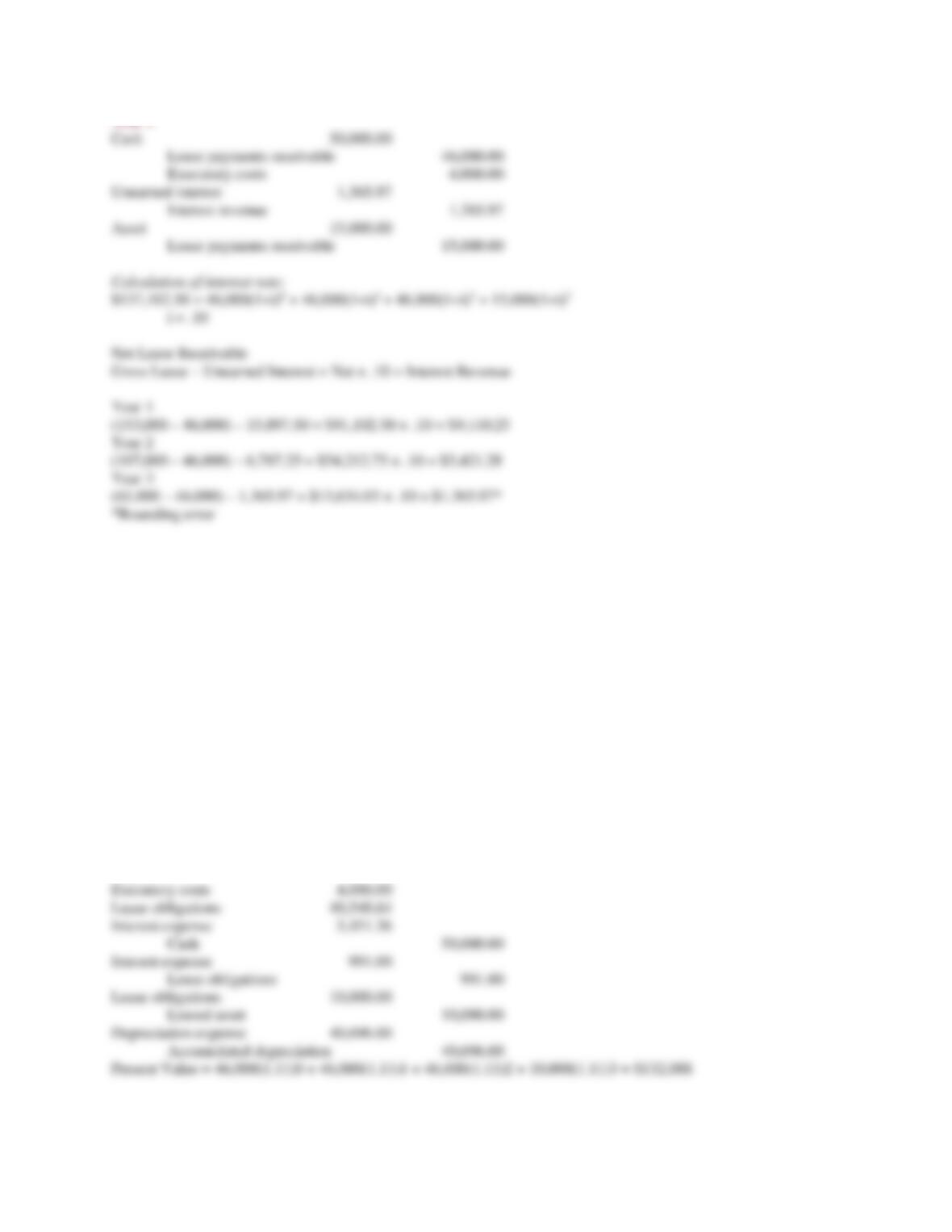
3. Assume the following facts concerning a sales-type lease:
• The lease term is three years and qualifies as a capital lease for both lessor and
lessee. The asset reverts to the lessor at the end of the lease term. Assume
• Cash sales price of the asset is $137,102.50. Lessor’s manufacturing cost is
$100,000.
• The lessee does not know the lessor’s implicit rate, but its own incremental
borrowing rate is 11 percent.
Required:
a. Prepare the accounting entries for both lessor and lessee for the three
years. What happens in Year 3 if residual value is only $8,000?
b. Assume the same facts as before except that the asset is first sold to a
finance company, which then leases the asset to the lessee. Prepare the
required entries in all three years for lessor and lessee.
c. Evaluate the differences between requirements (a) and (b) as well as the
differences between lessor and lessee.
This is a comprehensive numerical exercise. Depending on the nature of the course, instructors
may wish to exclude it.
Part (a) Lessor:
Year 2
Cash 50,000.00
Lease payments receivable 46,000.00
Executory costs 4,000.00
Unearned interest 5,421.28
Interest revenue 5,421.28
Chapter 16: Leases Instructor Manual
Accounting Theory (9
th
edition) Page 2 of 17
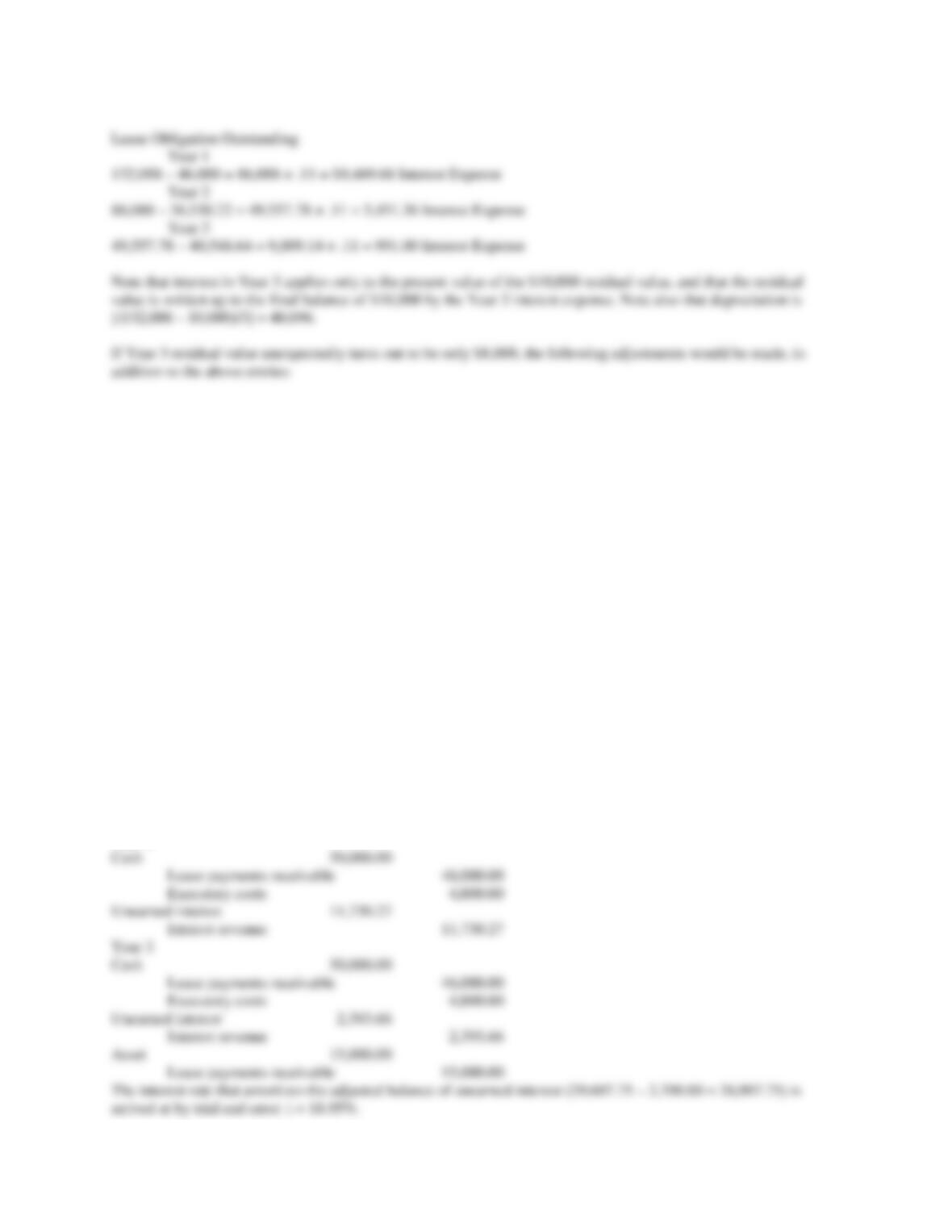
Part (a) Lessee:
Year 1
Leased asset 132,088.00
Leased obligations 132,088.00
Executory costs 4,000.00
Lease obligations 46,000.00
Cash 50,000.00
Depreciation expense 40,696.00
Accumulated depreciation 40,696.00
Year 2
Executory costs 4,000.00
Lease obligations 36,530.32
Interest expense 9,469.68
Cash 50,000.00
Depreciation expense 40,696.00
Accumulated depreciation 40,696.00
Year 3
Chapter 16: Leases Instructor Manual
Accounting Theory (9
th
edition) Page 3 of 17
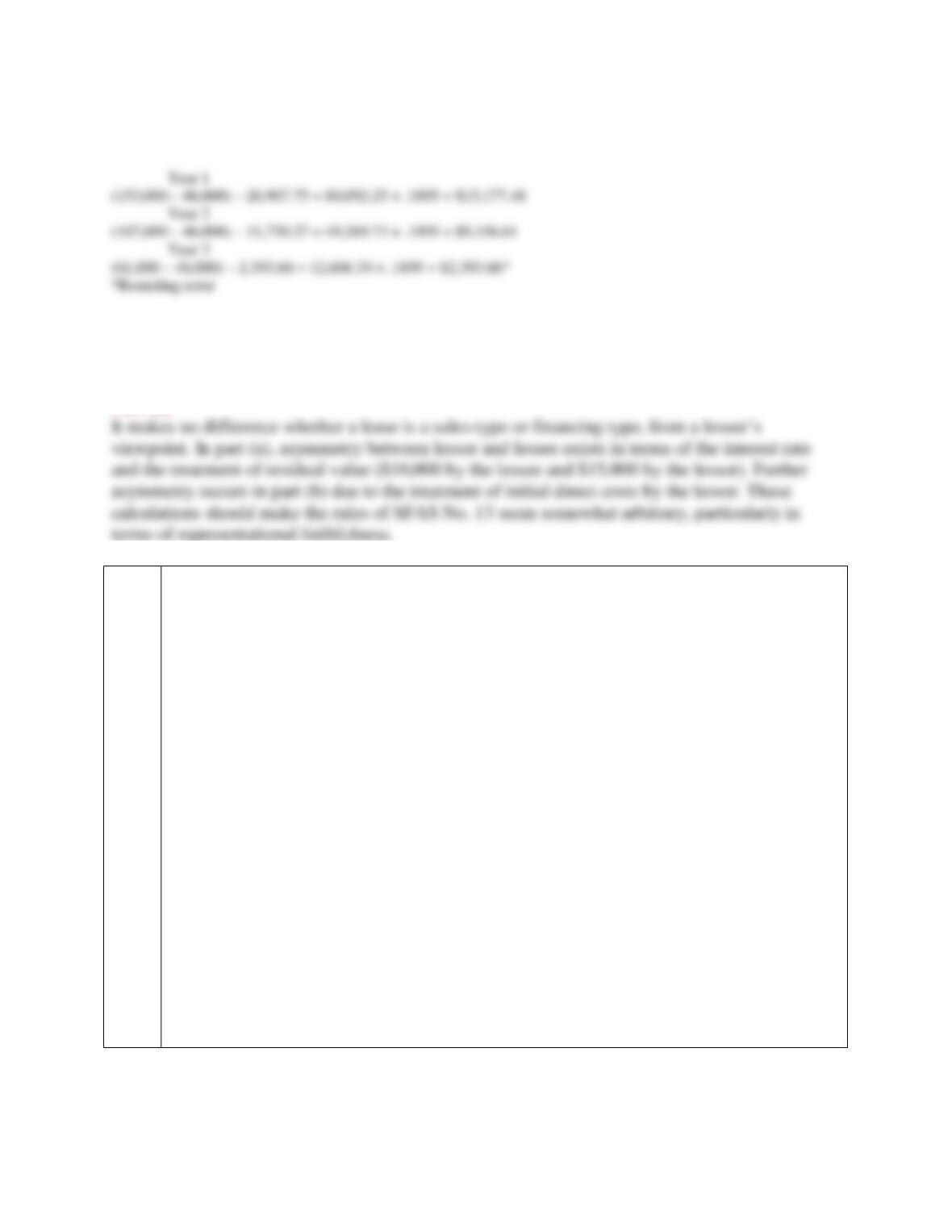
Lessor
Cash 2,000
Loss 5,000
Asset 7,000
Lessee
Loss 2,000
Cash 2,000
Part (b)
Lessor:
Year 1
Asset 137,102.50
Cash 137,102.50
Lease payments receivable 153,000.00
Taxes Payable 13,710.25
Asset 137,102.50
Unearned interest 29,607.75
Unearned interest 2,700.00
Cash (initial direct costs) 2,700.00
Cash 50,000.00
Lease payments receivable 46,000.00
Executory costs 4,000.00
Unearned interest 15,177.48
Interest revenue 15,177.48
Year 2
Chapter 16: Leases Instructor Manual
Accounting Theory (9
th
edition) Page 4 of 17
Net Lease Receivable
Gross Lease Unearned Interest = Net × .1895 = Interest Revenue
Part (b)
Lessee:
Entries the same as for part (a)
4. One of the four capitalization tests of SFAS No. 13 is that the lease term is 75 percent or
more of the asset’s remaining economic life. Lease term is defined as follows in SFAS
No. 13 (as amended by SFAS No. 98, para. 22a):
The fixed noncancellable term of the lease plus (i) all periods, if any, covered by bargain
renewal options, (ii) all periods, if any, for which failure to renew the lease imposes a
penalty on the lessee in an amount such that renewal appears, at the inception of the
lease, to be reasonably assured, (iii) all periods, if any, covered by ordinary renewal
options during which a guarantee by the lessee of the lessor’s debt related to the leased
property is expected to be in effect, (iv) all periods, if any, covered by ordinary renewal
options preceding the date as of which a bargain purchase option is exercisable, and (v)
all periods, if any, representing renewals or extensions of the lease at the lessor’s option;
however, in no case shall the lease term extend beyond the date a bargain purchase
option becomes exercisable. A lease which is cancellable (i) only upon the occurrence of
some remote contingency, (ii) only with the permission of the lessor, (iii) only if the
lessee enters into a new lease with the same lessor, or (iv) only upon payment by the
lessee of a penalty in an amount such that continuation of the lease appears, at inception,
reasonably assured shall be considered “noncancellable” for purposes of this definition.
Required:
How can this test be circumvented through either the structuring of the lease contract or
interpretation of the test? What are other ways in which lease capitalization could be
avoided through the structuring of lease terms or interpretation of the tests? What
problem does this exercise illustrate?
In interpreting “lease term,” judgment is required concerning whether a bargain purchase option
or renewal option exists. This determination will affect the derivation of lease term for applying

Chapter 16: Leases Instructor Manual
Accounting Theory (9
th
edition) Page 5 of 17
the 75 percent test. Of course, the test could also be manipulated through the estimated economic
life. In short, even the 75 percent rule is far from being an objective test. Another way mentioned
5. This problem shows the importance of considering the importance of converting
operating leases to capital leases for the purpose of financial statement analysis. It is
based upon the techniques developed and illustrated in Imhoff, Lipe, and Wright (1991
and 1997) though it is much simplified from their presentation.
See the text for details related to McAdoo Restaurants.
Required:
a. Convert the operating lease to a capital lease which is 1 year old (Hint: Use
the present value of a 10-year ordinary annuity). Assume that straight-line
depreciation is used for both book and tax purposes. There would be a zero
salvage value.
b. Determine the net income after taxes if the leases are treated as capital leases.
c. Determine the return on assets under the (a) operating lease assumption and
(b) capital lease assumption.
d. Determine the debt-equity ratio under the (a) operating lease assumption and
(b) capital lease assumption.
e. Do you think it is useful to convert operating leases to capital leases for
financial statement analysis purposes? Discuss.
(a)
We determine the capitalized amount of the lease as both an asset and liability by adding to the
Jan. 1, 2001 balance sheet the following amount: $3,000 × 6.14457 = $18,434
Chapter 16: Leases Instructor Manual
Accounting Theory (9
th
edition) Page 6 of 17
6. SFAS No. 98, which contained some amendments to SFAS No. 13, passed by a 4 to 3
vote. The following dissent to the opinion was made:
Please refer to the text for the details of this lengthy question.
Required:
Using the perspective on uniformity developed in Chapter 9, analyze the rigid versus
finite uniformity approach to the distinction between the two positions.
This is a complex area and, among other pronouncements, SFAS No. 98 modifies parts of SFAS
No. 13 and SFAS No. 66 and is itself rather complex. Hence, much can be done with this case,
including the assignment of term papers evaluating different treatments of sales of real estate and
the handling of sale-leaseback transactions.
Limiting the scope of this case to issues of comparability and uniformity is still quite revealing.
SFAS No. 98 does, at least in part, reasonably employ finite uniformity. Those “sale-leaseback”
transactions that do not qualify for sale-leaseback treatment do involve differential cash flow
alternatives from ordinary sale-leasebacks. Some of these factors mentioned in paragraphs 11
and 12 of SFAS No. 98 are:
Chapter 16: Leases Instructor Manual
Accounting Theory (9
th
edition) Page 7 of 17
CRITICAL THINKING AND ANALYSIS
1. ”All leases beyond a year be capitalized!” Evaluate this position.
The short answer is “Yes, all leases should be capitalized.” It does not make sense that an
arbritrary bright-line should require 100% or zero percent to be capitalized. Proportionally
capitalization of all leases is a more reasonable route to take.
From a legal standpoint we believe that the reality of the situation is that the lessor, by providing
the property to the lessee, does not result in a mutually unperformed contract. The fact that the
2. Bauman and Francis (2011) propose several improvements to lease accounting standards.
Evaluate their proposals and add ones that they may have missed.
Bauman, Mark P. and Richard N. Francis (June 2011). “Issues in Lessor Accounting: The
Forgotten Half of Lease Accounting,” Accounting Horizons, 247–266.
This should be a good class discussion paper. From its abstract about the FASB and IASB 2010

Chapter 16: Leases Instructor Manual
Accounting Theory (9
th
edition) Page 8 of 17
3. Zechman (2010) studies firms using synthetic leases. How might her findings influence
the setting of lease accounting standards?
Zechman, Sarah L. C. (June 2010). “The Relationship Between Voluntary Disclosure and
Financial Reporting: Evidence From Synthetic Leases,” Journal of Accounting Research,
725–765.