16-41
SOLUTION
16-42
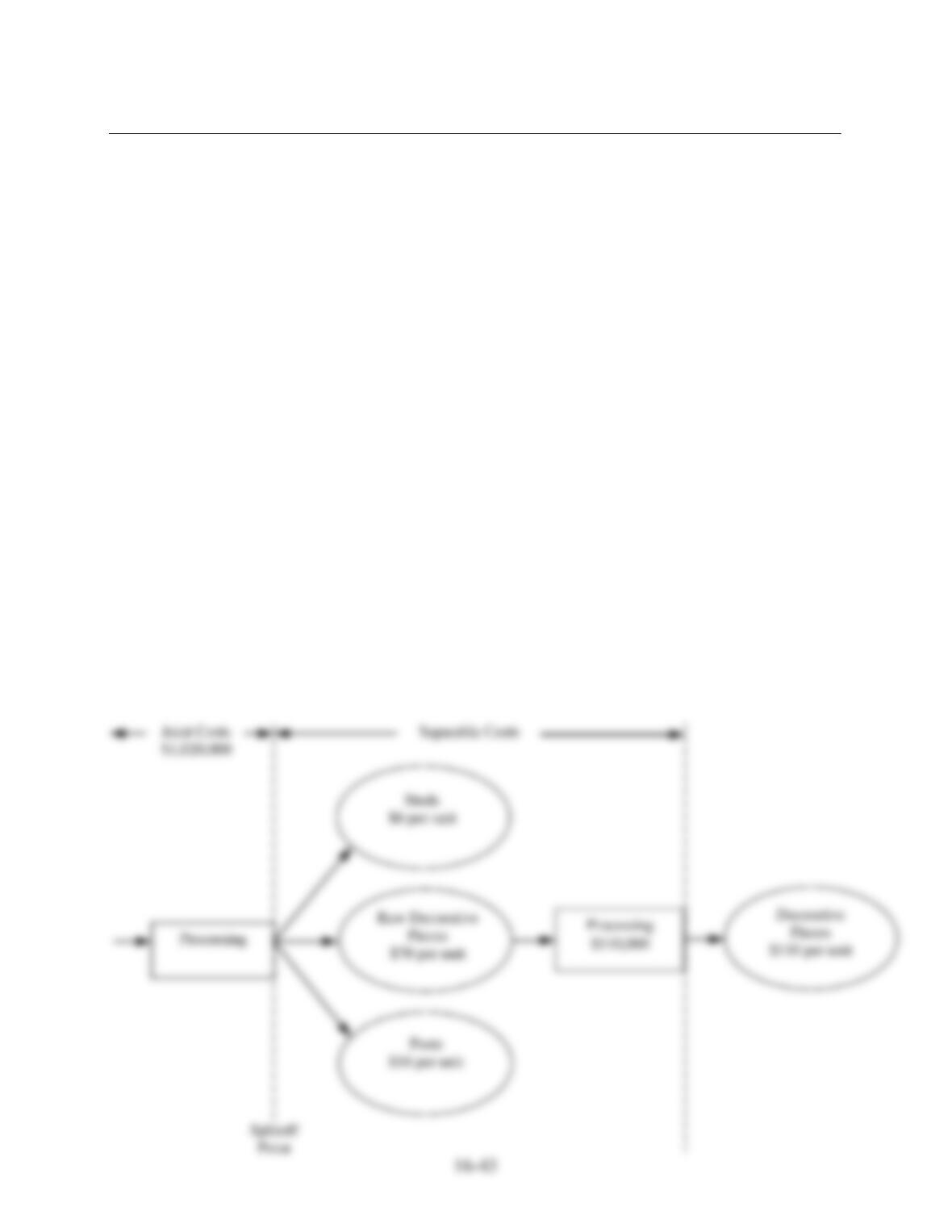
SOLUTION EXHIBIT 16-30
16-31 (40 min.) Joint-cost allocation.
Clover Dairy Products Corp. buys one input, full-cream milk, and refines it in a churning
process. From each gallon of milk Clover produces three cups of butter and nine cups of
buttermilk. During May 2014, Clover bought 12,000 gallons of milk for $44,500. Clover spent
another $18,860 on the churning process to separate the milk into butter and buttermilk. Butter
could be sold immediately for $4.40 per pound and buttermilk could be sold immediately for
$2.40 per quart (note: two cups = one pound; four cups = one quart).
Clover chooses to process the butter further into spreadable butter by mixing it with canola
oil, incur- ring an additional cost of $3.20 per pound. This process results in two tubs of
spreadable butter for each pound of butter processed. Each tub of spreadable butter sells for
$4.60.
Required:
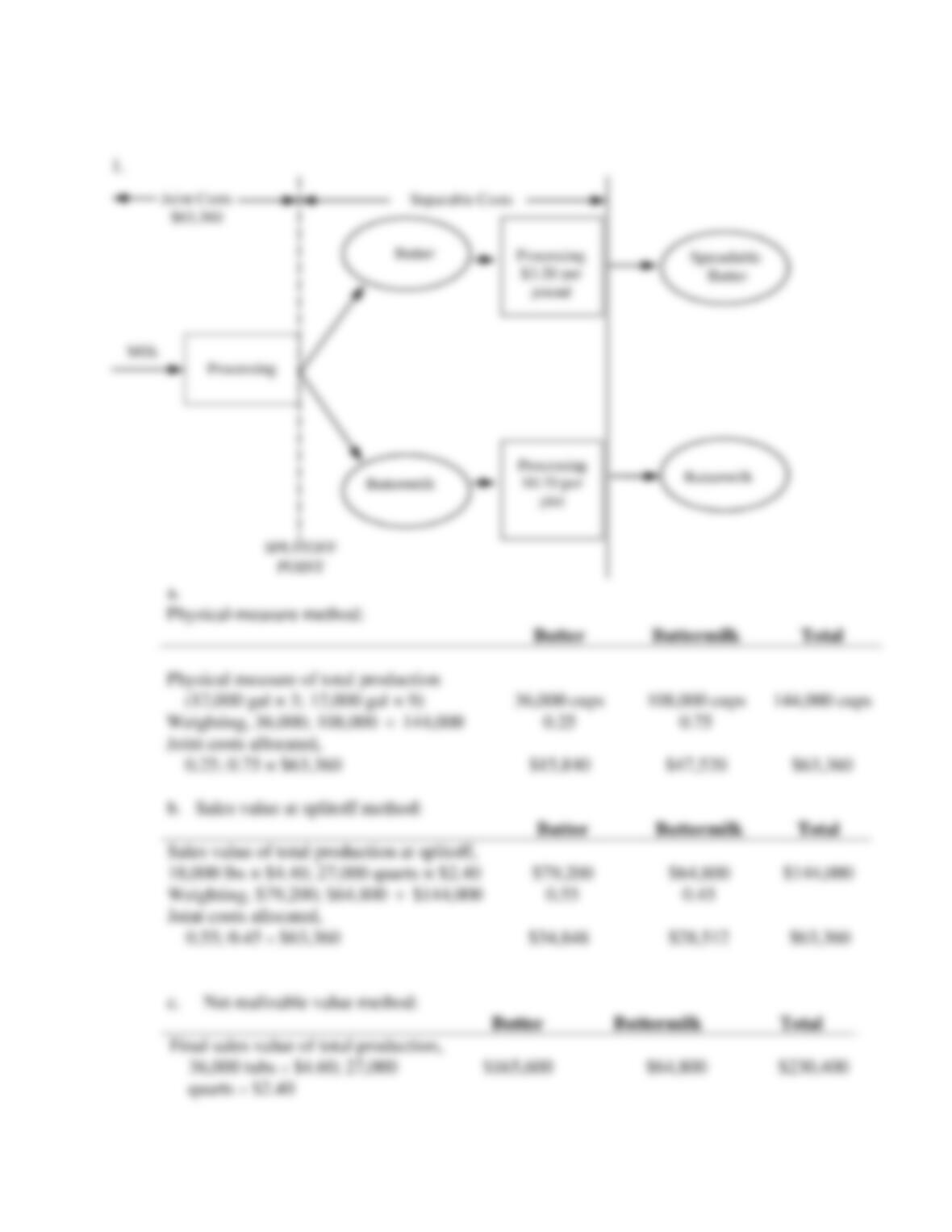
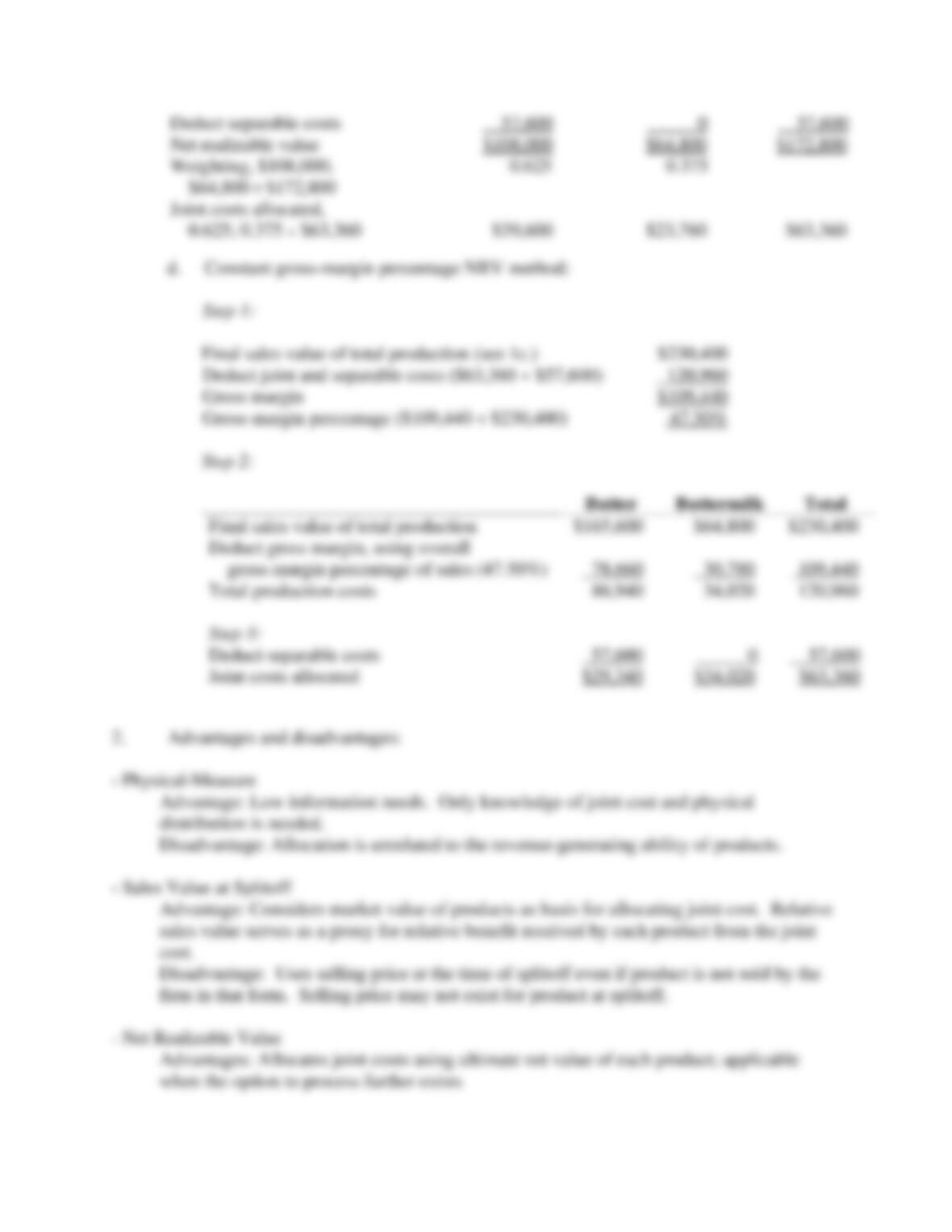
1. Allocate the $63,360 joint cost to the spreadable butter and the buttermilk using the
following:
a. Physical-measure method (using cups) of joint cost allocation
b. Sales value at splitoff method of joint cost allocation
c. NRV method of joint cost allocation
d. Constant gross margin percentage NRV method of joint cost allocation
2. Each of these measures has advantages and disadvantages; what are they?
3. Some claim that the sales value at splitoff method is the best method to use. Discuss the logic
behind this claim.
SOLUTION
16-44
16-45
16-46
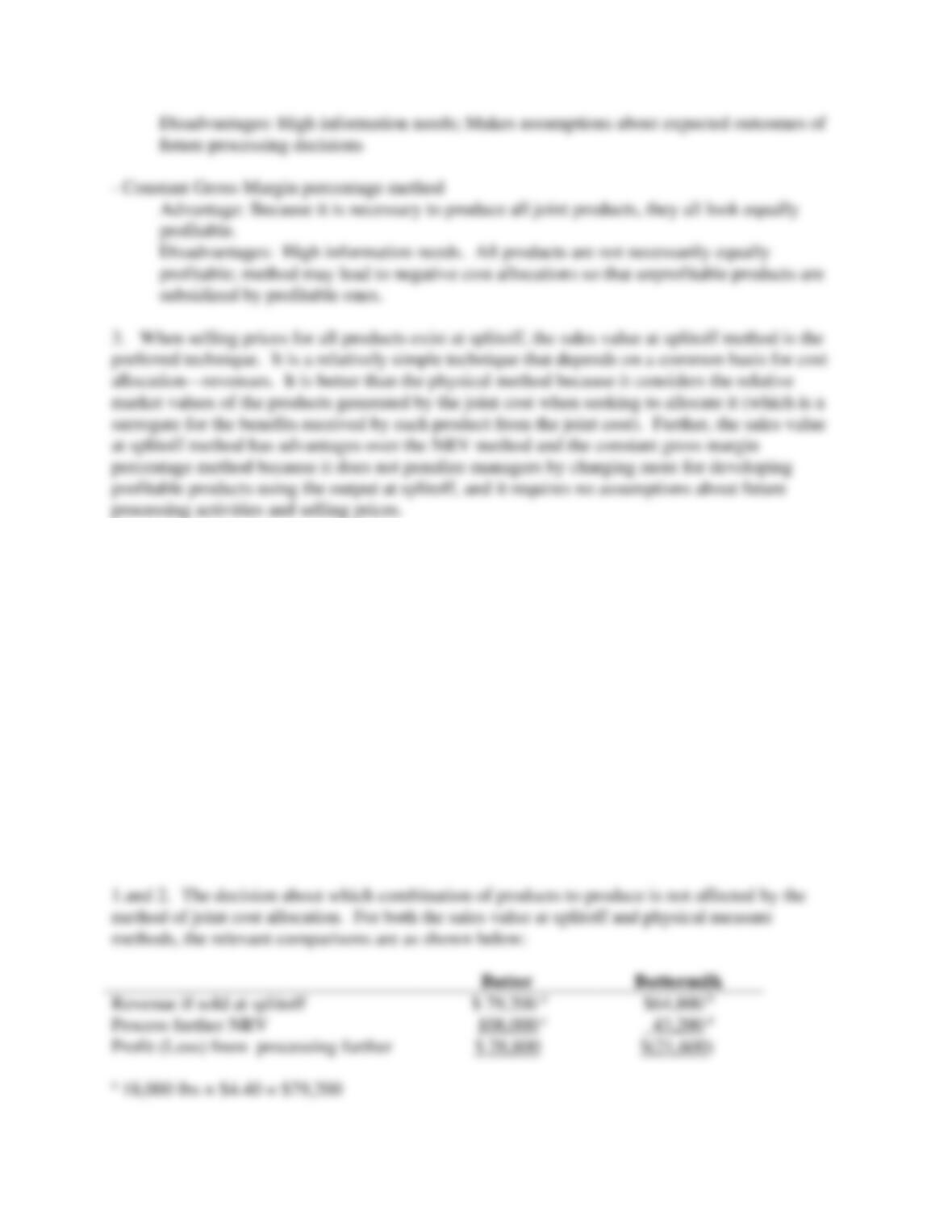
16-32 (10 min.) Further processing decision (continuation of 16-31).
Clover has decided that buttermilk may sell better if it was marketed for baking and sold in pints.
This would involve additional packaging at an incremental cost of $0.70 per pint. Each pint
could be sold for $1.50 (note: one quart = two pints).
Required:
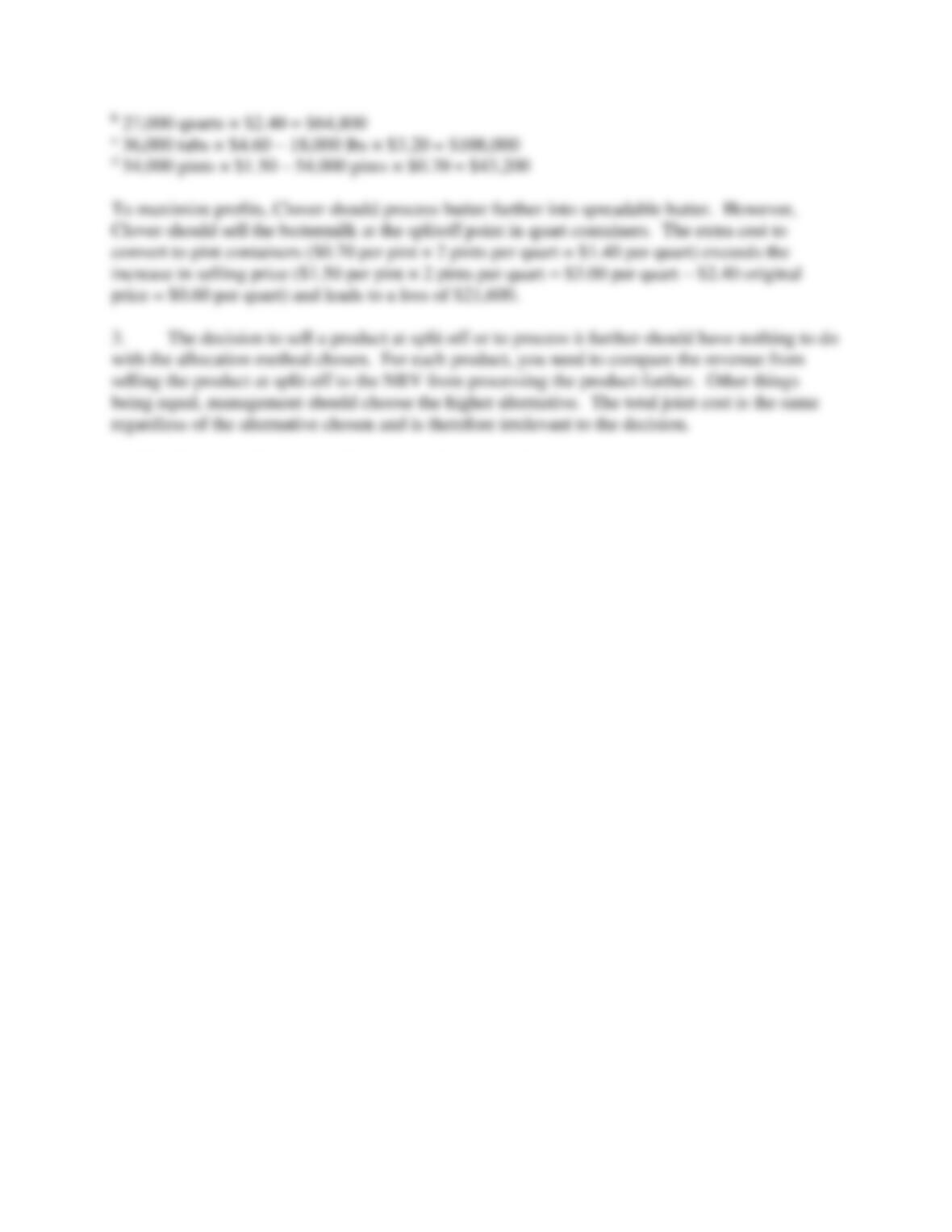
1. If Clover uses the sales value at splitoff method, what combination of products should Clover
sell to maximize profits?
2. If Clover uses the physical-measure method, what combination of products should Clover
sell to maximize profits?
3. Explain the effect that the different cost allocation methods have on the decision to sell the
products at splitoff or to process them further.
SOLUTION
16-47
16-33 (20 min.) Joint-cost allocation with a byproduct.
Mat Place purchases old tires and recycles them to produce rubber floor mats and car mats. The
company washes, shreds, and molds the recycled tires into sheets. The floor and car mats are cut
from these sheets. A small amount of rubber shred remains after the mats are cut. The rubber
shreds can be sold to use as cover for paths and playgrounds. The company can produce 25 floor
mats, 75 car mats, and 40 pounds of rubber shreds from 100 old tires.
In May, Mat Place, which had no beginning inventory, processed 125,000 tires and had joint
production costs of $600,000. Mat Place sold 25,000 floor mats, 85,000 car mats, and 43,000
pounds of rubber shreds. The company sells each floor mat for $12 and each car mat for $6. The
company treats the rubber shreds as a byproduct that can be sold for $0.70 per pound.
Required:
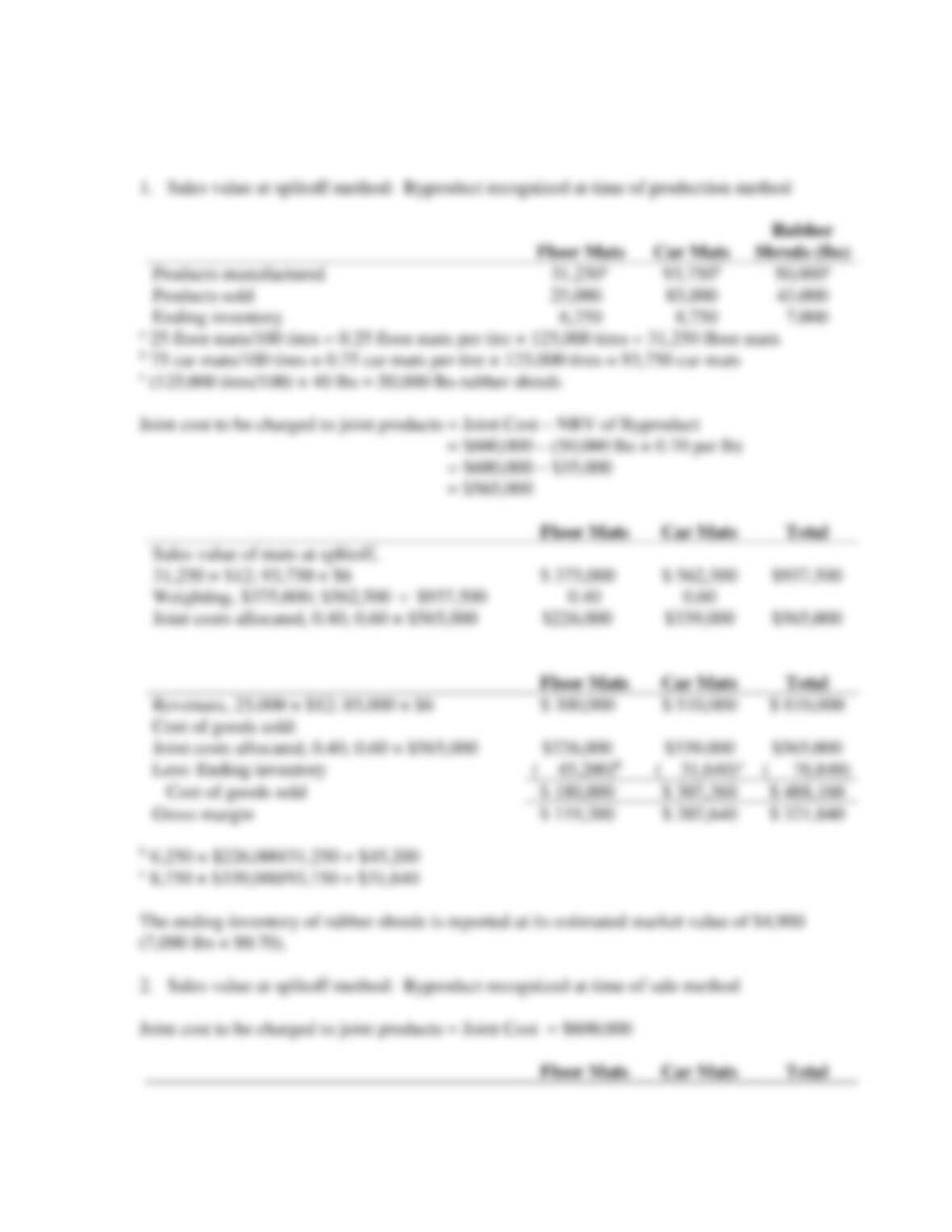
1. Assume that Mat Place allocates the joint costs to floor mats and car mats using the sales
value at splitoff method and accounts for the byproduct using the production method. What is
the ending inventory cost for each product and gross margin for Mat Place?
2. Assume that Mat Place allocates the joint costs to floor mats and car mats using the sales
value at splitoff method and accounts for the byproduct using the sales method. What is the
ending inventory cost for each product and gross margin for Mat Place?
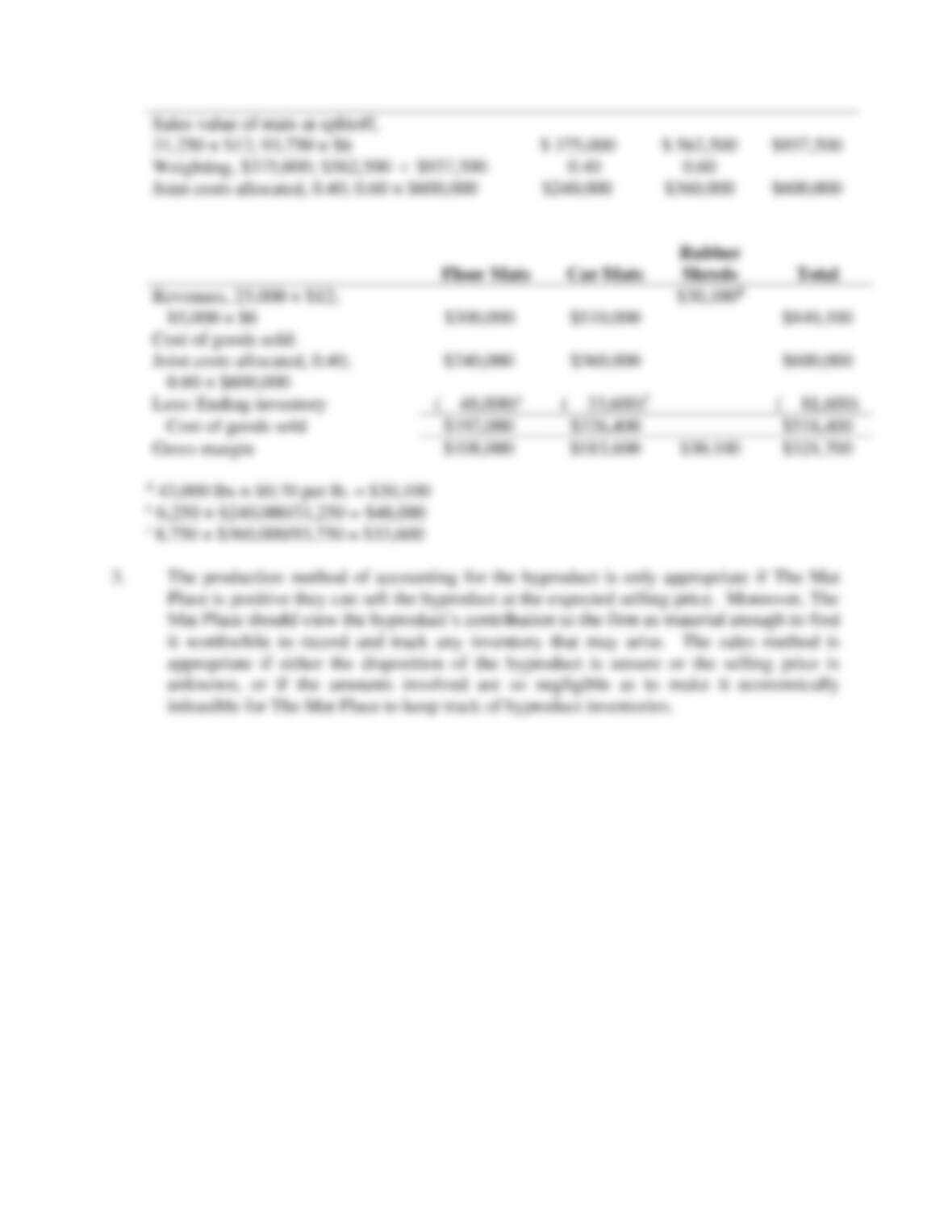
3. Discuss the difference between the two methods of accounting for byproducts, focusing on
what conditions are necessary to use each method.
16-48
SOLUTION
16-49
16-34 (15 min.) Byproduct-costing journal entries (continuation of 16-33).
The Mat Place’s accountant needs to record the information about the joint and byproducts in the
general journal, but is not sure what the entries should be. The company has hired you as a
consultant to help its accountant.
Required:
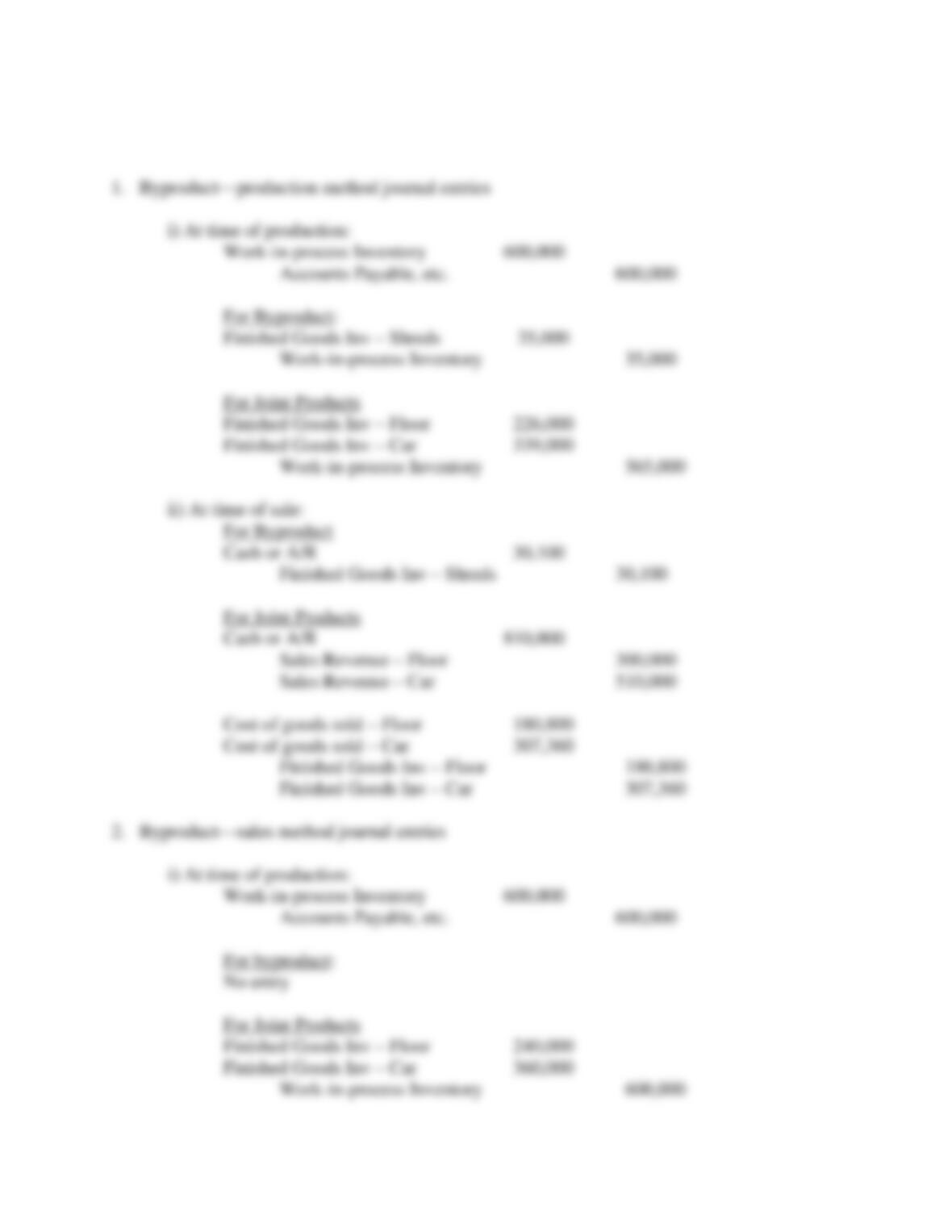
1. Show journal entries at the time of production and at the time of sale assuming the Mat Place
accounts for the byproduct using the production method.
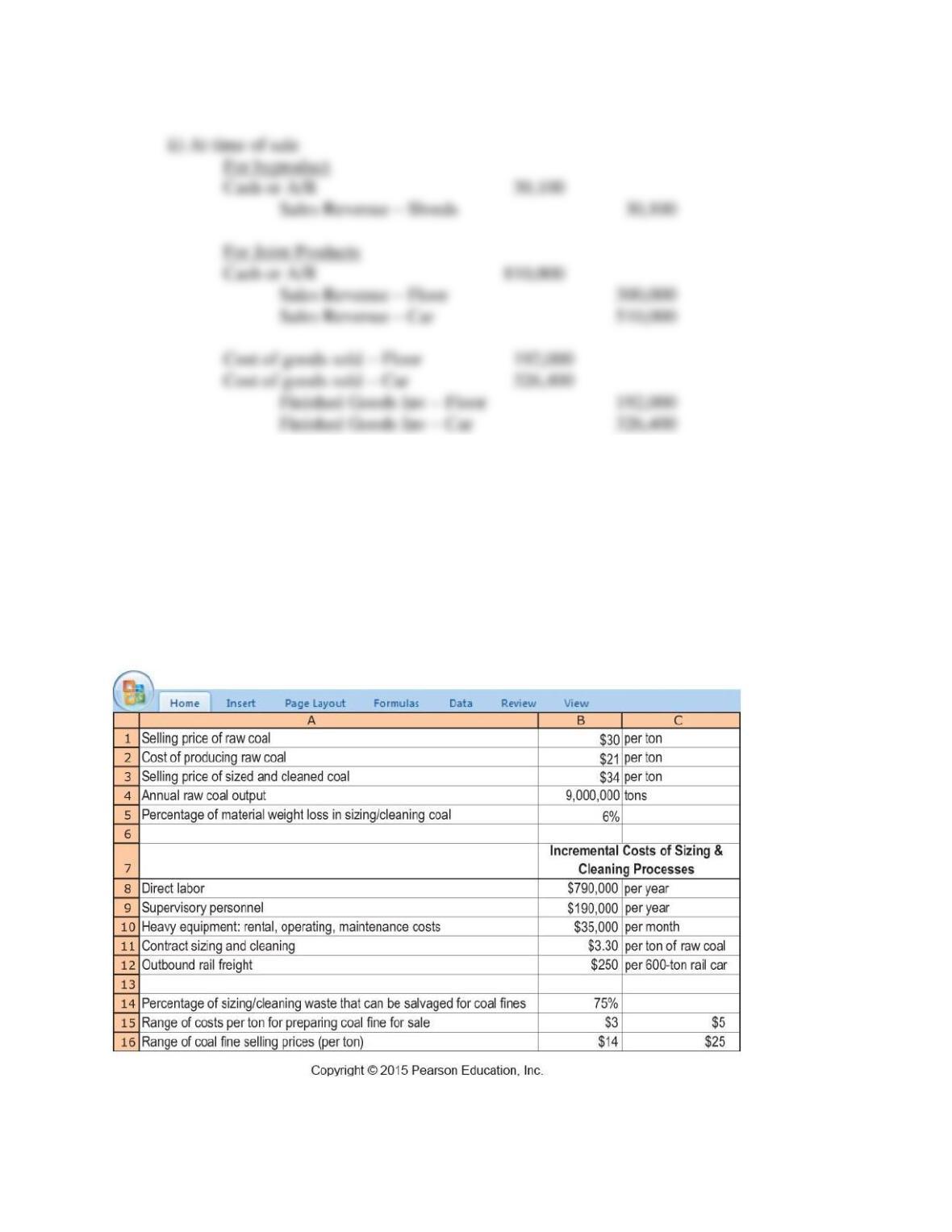
2. Show journal entries at the time of production and at the time of sale assuming the Mat Place
accounts for the byproduct using the sales method.
16-50
SOLUTION
16-51
16-35 (40 min.) Process further or sell, byproduct.
(CMA, adapted) Newcastle Mining Company (NMC) mines coal, puts it through a one-step
crushing process, and loads the bulk raw coal onto river barges for shipment to customers.
NMC’s management is currently evaluating the possibility of further processing the raw coal
by sizing and cleaning it and selling it to an expanded set of customers at higher prices. The
option of building a new sizing and cleaning plant is ruled out as being financially infeasible.
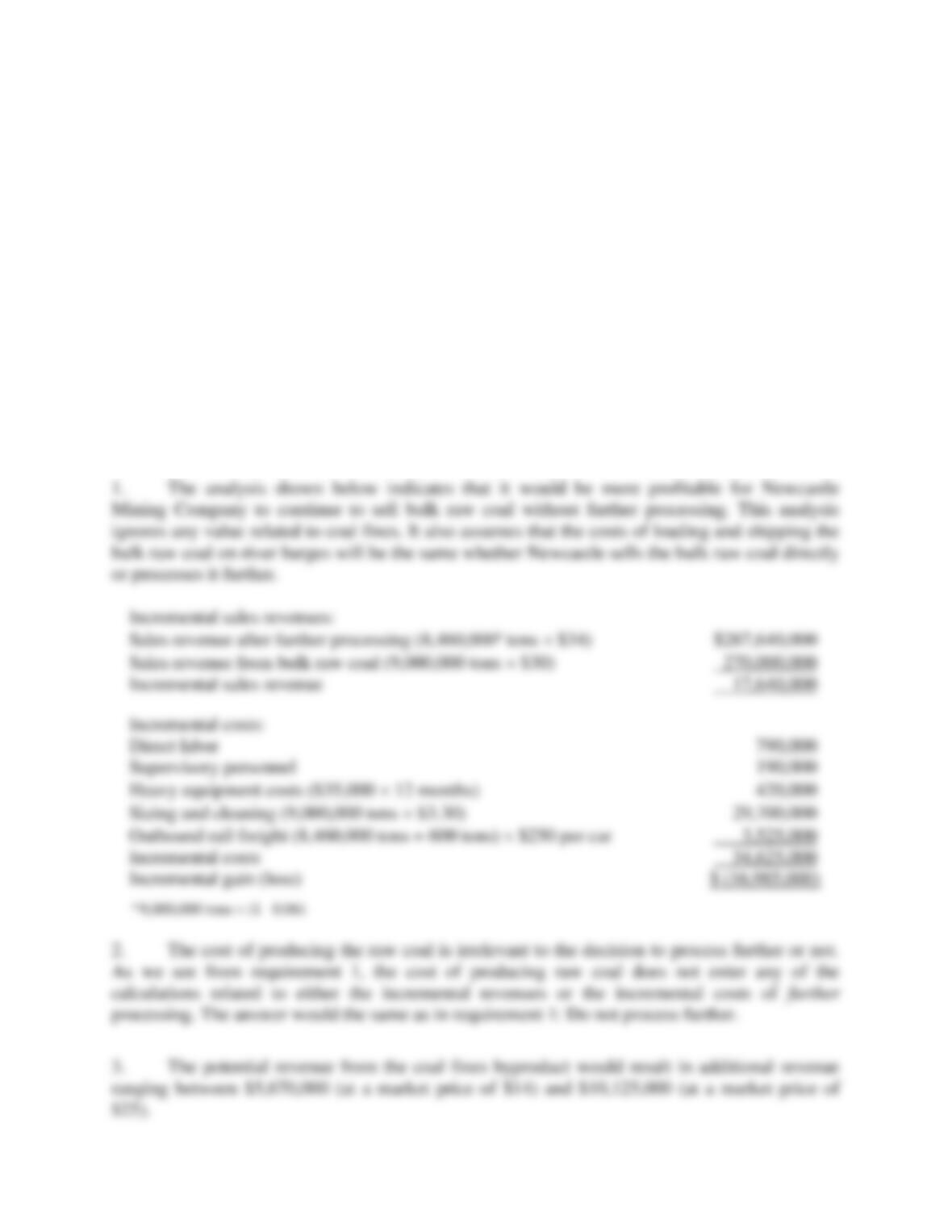
Instead, Amy Kimbell, a mining engineer, is asked to explore outside-contracting arrangements
for the cleaning and sizing process. Kimbell puts together the following summary:
16-52
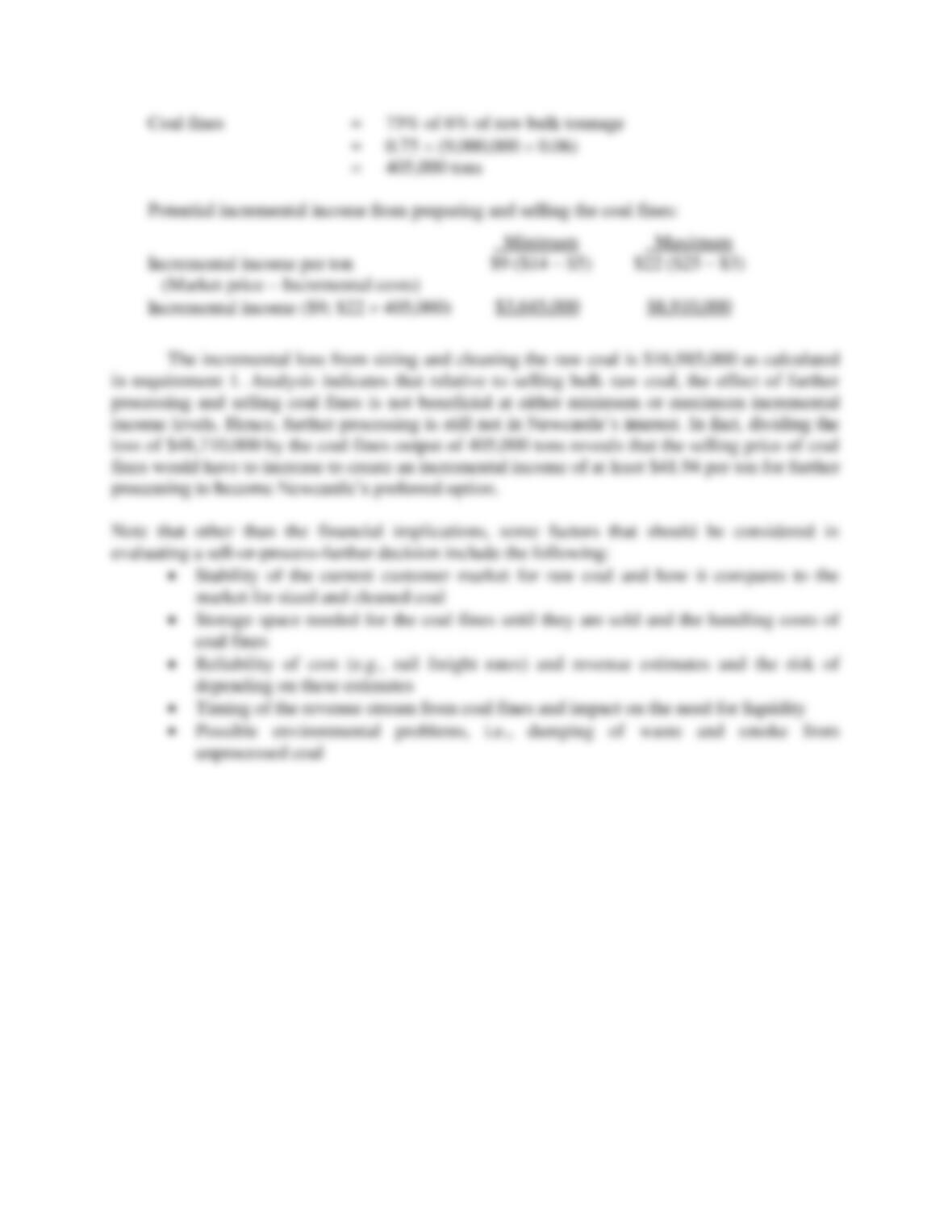
Kimbell also learns that 75% of the material loss that occurs in the cleaning and sizing process
can be salvaged as coal fines, which can be sold to steel manufacturers for their furnaces. The
sale of coal fines is erratic and NMC may need to stockpile them in a protected area for up to one
year. The selling price of coal fines ranges from $14 to $25 per ton and costs of preparing coal
fines for sale range from $3 to $5 per ton.
Required:
1. Prepare an analysis to show whether it is more profitable for NMC to continue selling raw
bulk coal or to process it further through sizing and cleaning. (Ignore coal fines in your
analysis.)
2. How would your analysis be affected if the cost of producing raw coal could be held down to
$20 per ton?
3. Now consider the potential value of the coal fines and prepare an addendum that shows how
their value affects the results of your analysis prepared in requirement 1.
SOLUTION
16-53
16-36 (30 min.) Joint-cost allocation, process further or sell.
Iridium Technologies manufactures a variety of flash memory chips at its main foundry in
Anam, Korea. Some chips are sold by Iridium to makers of electronic equipment while others are
embedded into consumer products for sale under Iridium’s house label, Celeron. At Anam,
Iridium produces three chips that arise from a common production process. The first chip, Apple,
is sold to a maker of smartphones and personal computers. The second chip, Broadcom, is
intended for a wireless and broadband communication firm. Iridium uses the third chip to
manufacture and market a solid-state device under the Celeron name.
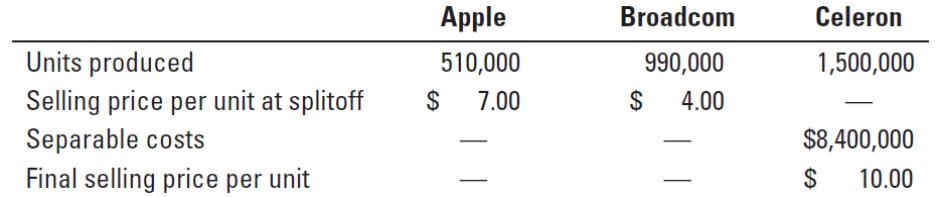
Data regarding these three products for the fiscal year ended June 30, 2014, are given below.
16-54
Iridium incurred joint product costs up to the splitoff point of $10,800,000 during the fiscal
year.
The head of Iridium, Amala Peterman, is considering a variety of alternatives that would
potentially change the way the three products are processed and sold. Proposed changes for each
product are as follows:
▪ Apple chips can be incorporated into Iridium’s own memory stick. However, this
additional processing causes a loss of 55,000 units of Apple. The separable costs to further
process Apple chips are estimated to be $1,500,000 annually. The memory stick would sell
for $11 per unit.
▪ Iridium’s R&D unit has recommended that the company process Broadcom further into a
3D vertical chip and sell it to a high-end vendor of datacenter products. The additional
processing would cost $2,000,000 annually and would result in 25% more units of product.
The 3D vertical chip sells for $5.00 per unit.
▪ The third chip is currently incorporated into a solid-state device under the Celeron name.
Galaxy Electronics has approached Iridium with an offer to purchase this chip at the
splitoff point for $4.75 per unit.
Required:
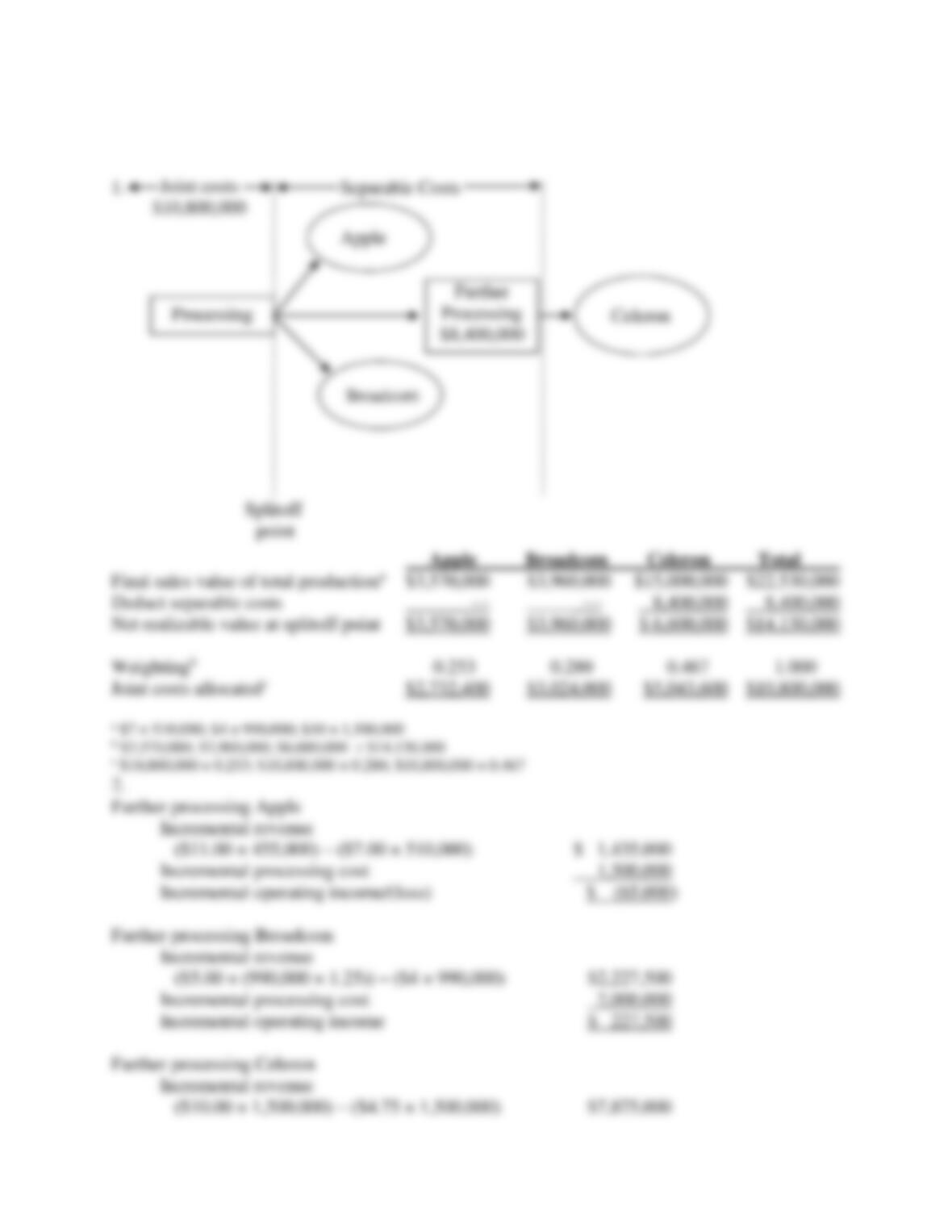
1. Allocate the $10,800,000 joint production cost to Apple, Broadcom, and Celeron using the
NRV method.
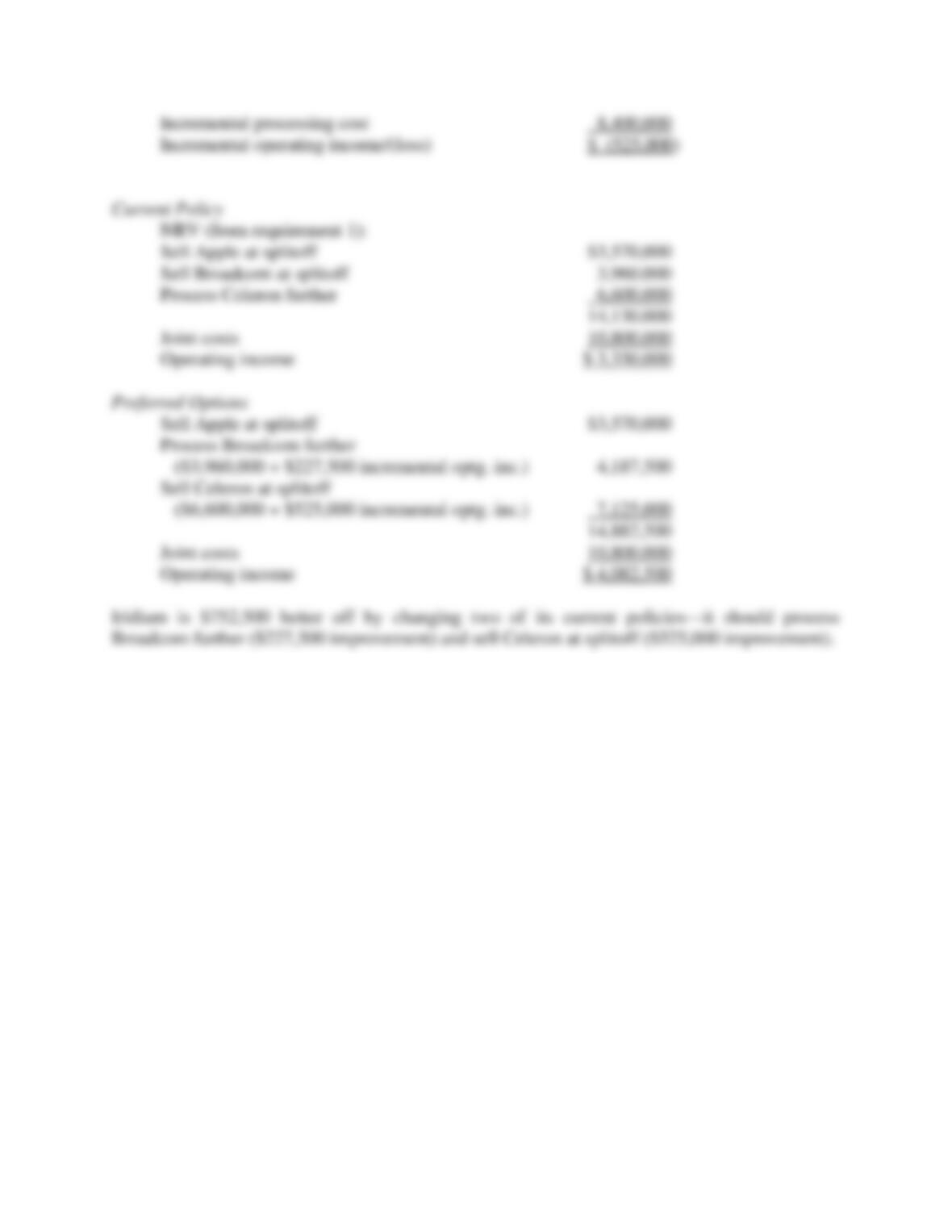
2. Identify which of the three joint products Iridium should sell at the splitoff point in the future
and which of the three the company should process further to maximize operating income.
Support your decisions with appropriate computations.
16-55
SOLUTION
16-56
16-37 (60 min.) Methods of joint-cost allocation, comprehensive.
Kardash Cosmetics purchases flowers in bulk and processes them into perfume. From a certain
mix of petals, the firm uses Process A to generate Seduction, its high-grade perfume, as well as a
certain residue. The residue is then further treated, using Process B, to yield Romance, a
medium-grade perfume. An ounce of residue typically yields an ounce of Romance.
In July, the company used 25,000 pounds of petals. Costs involved in Process A, i.e.,
reducing the petals to Seduction and the residue, were:
Direct Materials – $440,000; Direct Labor – $220,000; Overhead Costs – $110,000.
The additional costs of producing Romance in Process B were:
Direct Materials – $22,000; Direct Labor – $50,000; Overhead Costs – $40,000.
During July, Process A yielded 7,000 ounces of Seduction and 49,000 ounces of residue.
From this, 5,000 ounces of Seduction were packaged and sold for $109.50 an ounce. Also,
28,000 ounces of Romance were processed in Process B and then packaged and sold for $31.50
an ounce. The other 21,000 ounces remained as residue. Packaging costs incurred were $137,500
for Seduction and $196,000 for Romance. The firm has no beginning inventory on July 1.
If it so desired, the firm could have sold unpackaged Seduction for $56 an ounce and the
residue from Process A for $24 an ounce.
Required:
16-57
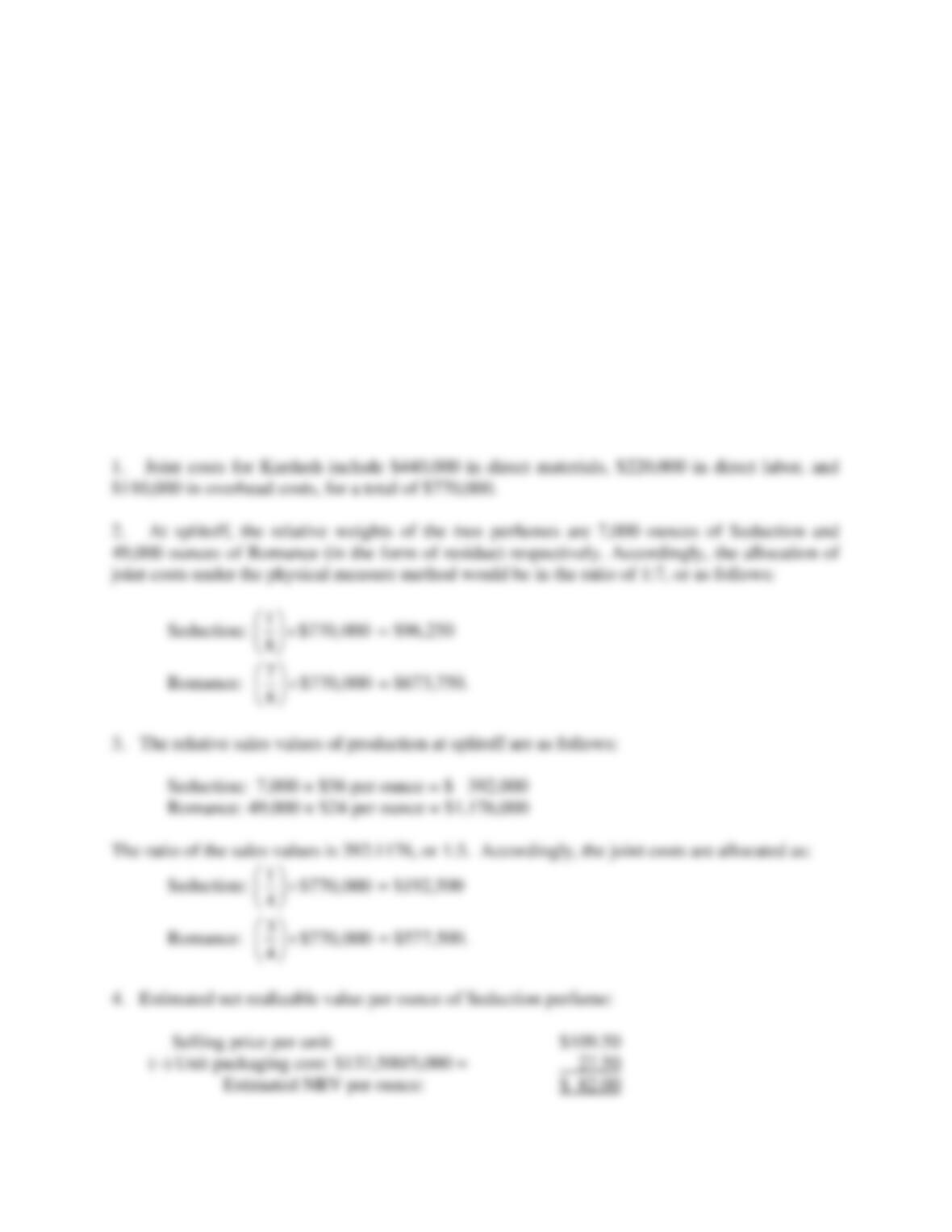
1. What is the joint cost of the firm to be allocated to Seduction and Romance?
2. Under the physical measure method, how would the joint costs be allocated to Seduction and
Romance?
3. Under the sales value at splitoff method, what portion of the joint costs would be allocated to
Seduction and Romance, respectively?
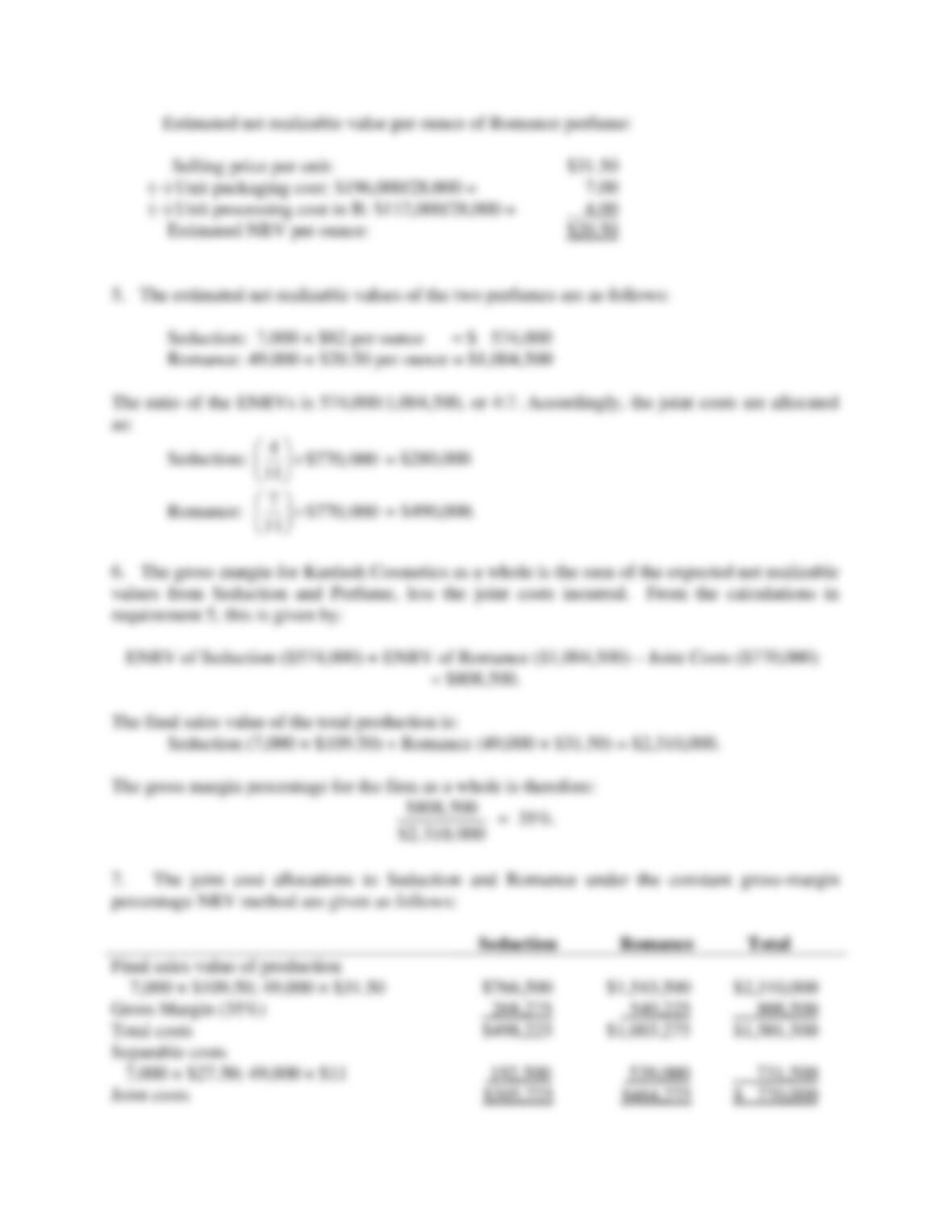
4. What is the estimated net realizable value per ounce of Seduction and Romance?
5. Under the net realizable value method, what portion of the joint costs would be allocated to
Seduction and Romance, respectively?
6. What is the gross margin percentage for the firm as a whole?
7. Allocate the joint costs to Seduction and Romance under the constant gross-margin
percentage NRV method.
8. If you were the manager of Kardash Cosmetics, would you continue to process the petal
residue into Romance perfume? Explain your answer.
SOLUTION
16-58

16-59