PROBLEM 16-44 (40 MINUTES)
1. Net present-value analysis:
Old machine:
Annual costs:
Variable 300,000 $.38 ……………………………………………………….
$(114,000
)
Fixed ……………………………………………………………………………………
(21,000
)
$(135,000
)
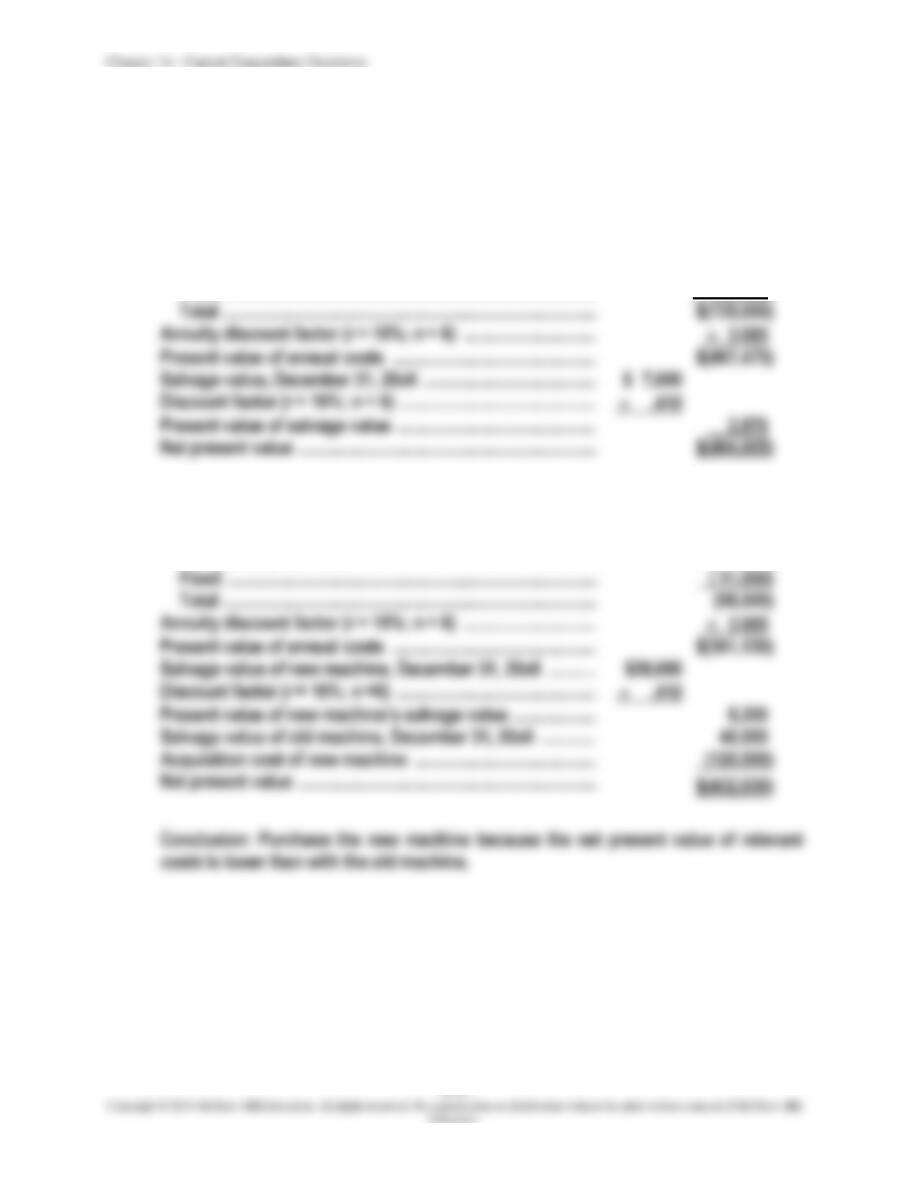
Annuity discount factor (r = 16%; n = 6) …………………………..
Present value of annual costs ……………………………………………………….
$(497,475
)
Salvage value, December 31, 20×6 ……………………………………………………….
Present value of salvage value ……………………………………………………….
Net present value ……………………………………………………………………………………
$(494,605
)
New machine:
Annual costs:
Variable 300,000 $.29 ……………………………………………………….
$(87,000
)
)
)
Present value of annual costs ……………………………………………………….
$(361,130
)
Salvage value of new machine, December 31, 20×6 …………………………..
Salvage value of old machine, December 31, 20×0 …………………………..
Acquisition cost of new machine ……………………………………………………….
)
$(432,930
)
PROBLEM 16-44 (CONTINUED)
2.
Memorandum
Date:
Today
To:
President, Special People Industries
From:
I.M. Student
Subject:
Cookie machine replacement decision
The nonquantitative factors that are important to the decision include the following:
• The lower operating costs (variable and fixed) of the new machine would enable
Special People Industries to meet future competitive or inflationary pressures to
a greater degree than the old machine.
PROBLEM 16-45 (25 MINUTES)
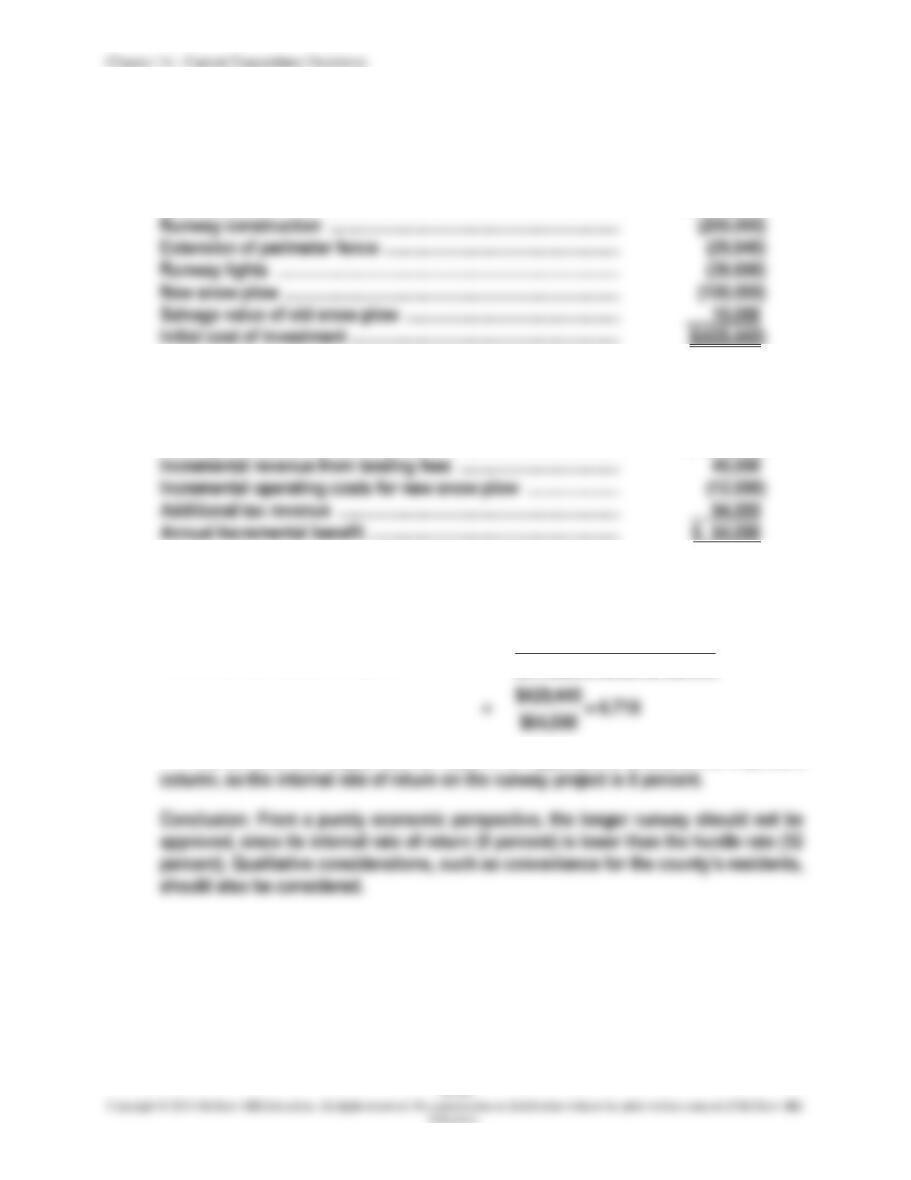
1. Initial cost of investment in a longer runway:
Land acquisition ……………………………………………………………………………………
$ (70,000
)
Runway construction ……………………………………………………………………………………
)
Extension of perimeter fence ……………………………………………………….
)
Runway lights ……………………………………………………………………………………
)
New snow plow ……………………………………………………………………………………
)
Salvage value of old snow plow ……………………………………………………….
Initial cost of investment ……………………………………………………….
)
2. Annual net incremental benefit from runway:
Runway maintenance ……………………………………………………………………………………
$ (28,000
)
Incremental revenue from landing fees ……………………………………………………….
Incremental operating costs for new snow plow …………………………..
)
Additional tax revenue ……………………………………………………….
Annual incremental benefit ……………………………………………………….
3. Internal rate of return:
Annuity discount factor associated
with the internal rate of return
=
benefit lincrementa annual
investment ofcost initial
Find 6.710 in the 10-year row of Table IV of Appendix A. It falls in the 8 percent
Chapter 16 – Capital Expenditure Decisions
PROBLEM 16-46 (45 MINUTES)
1. Net present-value analysis:
Runway maintenance ……………………………………………………………………………………
$ (28,000
)
Incremental revenue from landing fees ……………………………………………………….
40,000
Incremental operating costs for new snow plow …………………………..
)
Additional tax revenue ……………………………………………………….
Annual incremental benefit ……………………………………………………….
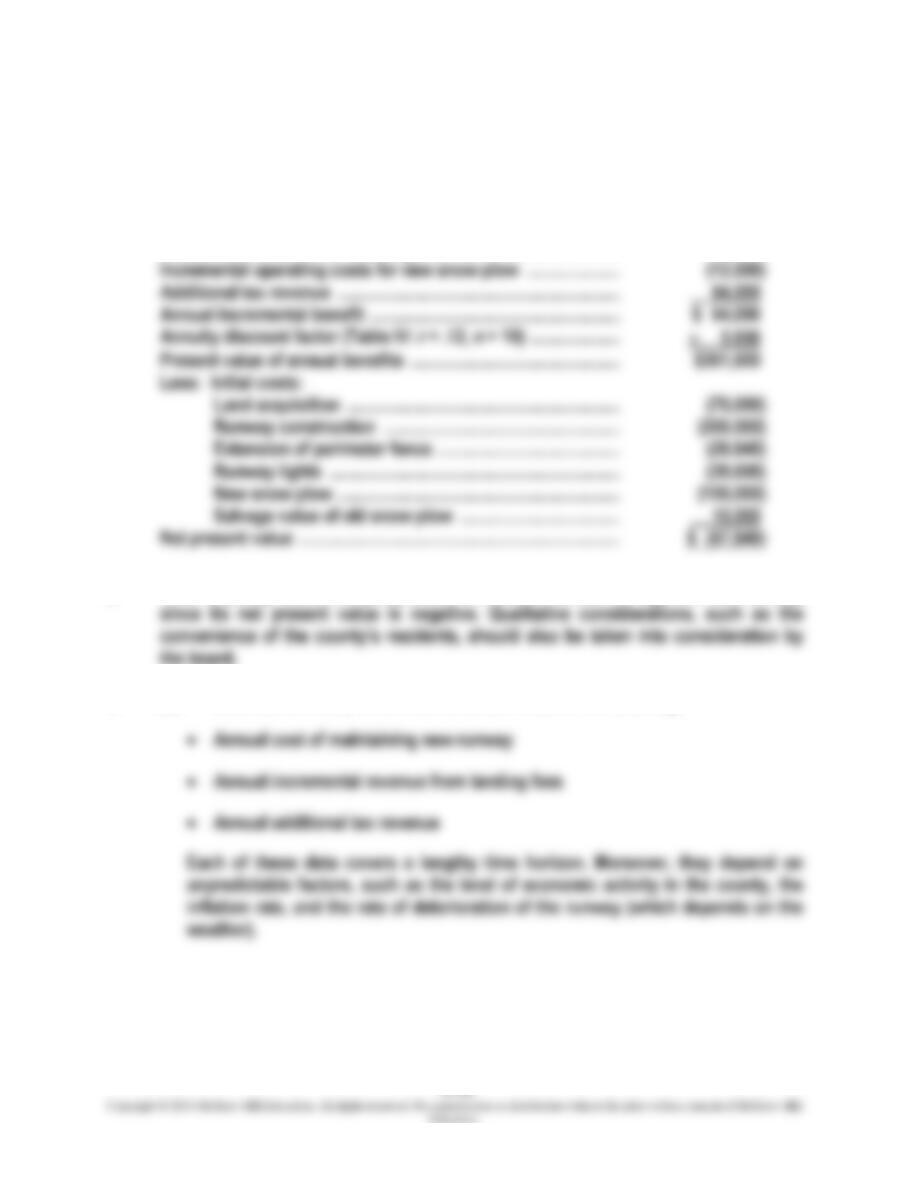
Present value of annual benefits ……………………………………………………….
Less: Initial costs:
Land acquisition ……………………………………………………….
)
Runway construction ……………………………………………………….
)
Extension of perimeter fence ……………………………………………………….
)
Runway lights ……………………………………………………………………………………
)
New snow plow ……………………………………………………….
)
Salvage value of old snow plow ……………………………………………………….
Net present value ……………………………………………………………………………………
$ (67,840
)
2. From a purely economic perspective, the board should not approve the runway,
3. (a) Data that are likely to be most uncertain include the following:
Chapter 16 – Capital Expenditure Decisions
PROBLEM 16-46 (CONTINUED)
(b) The least uncertain data would likely include the following:
• Cost of acquiring land
PROBLEM 16-47 (30 MINUTES)
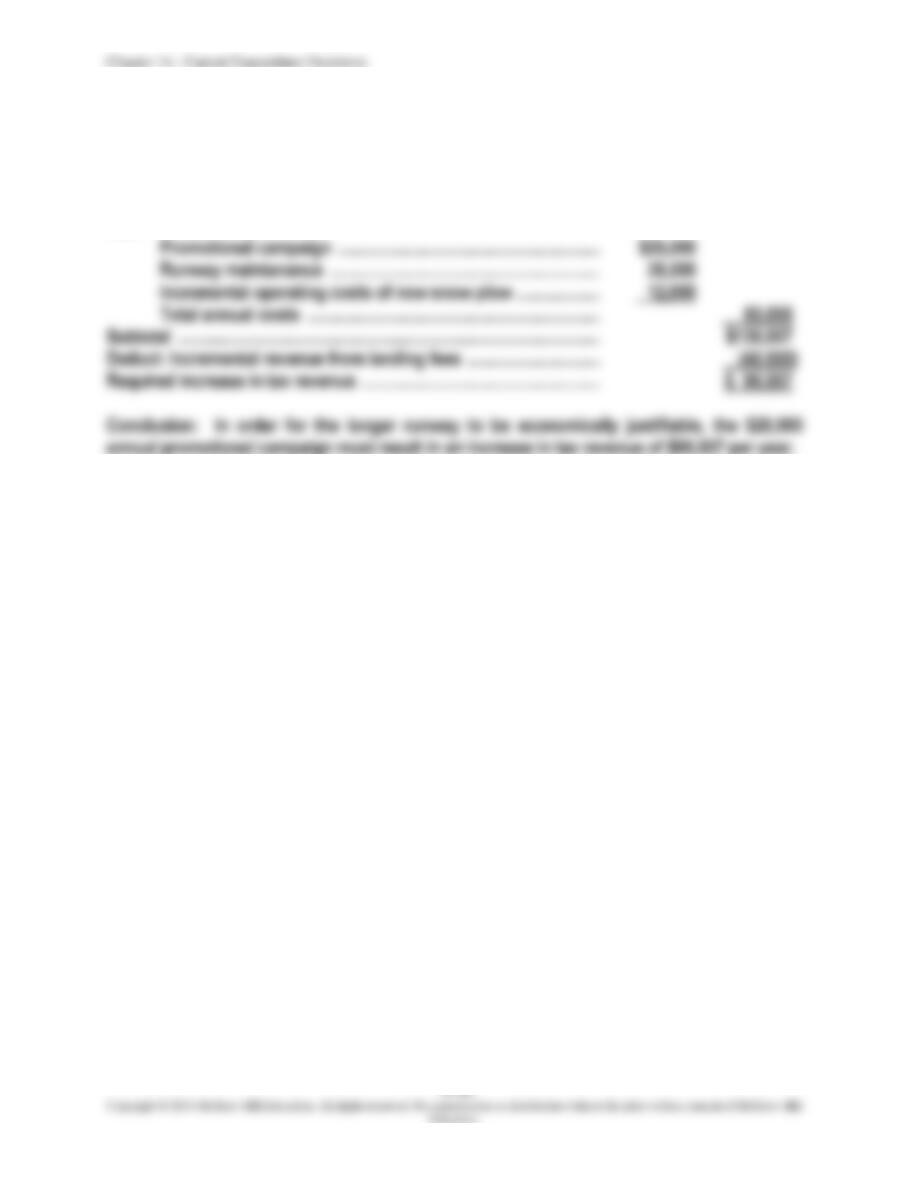
Annuity discount factor associated
with the internal rate of return
=
benefit lincrementa annual
investment ofcost initial
For the internal rate of return to be 12 percent, the annuity discount factor must be 5.650
(Table IV in Appendix A: r = .12, n = 10). Therefore:
benefit lincrementa annual
benefit lincrementa annual
PROBLEM 16-47 (CONTINUED)
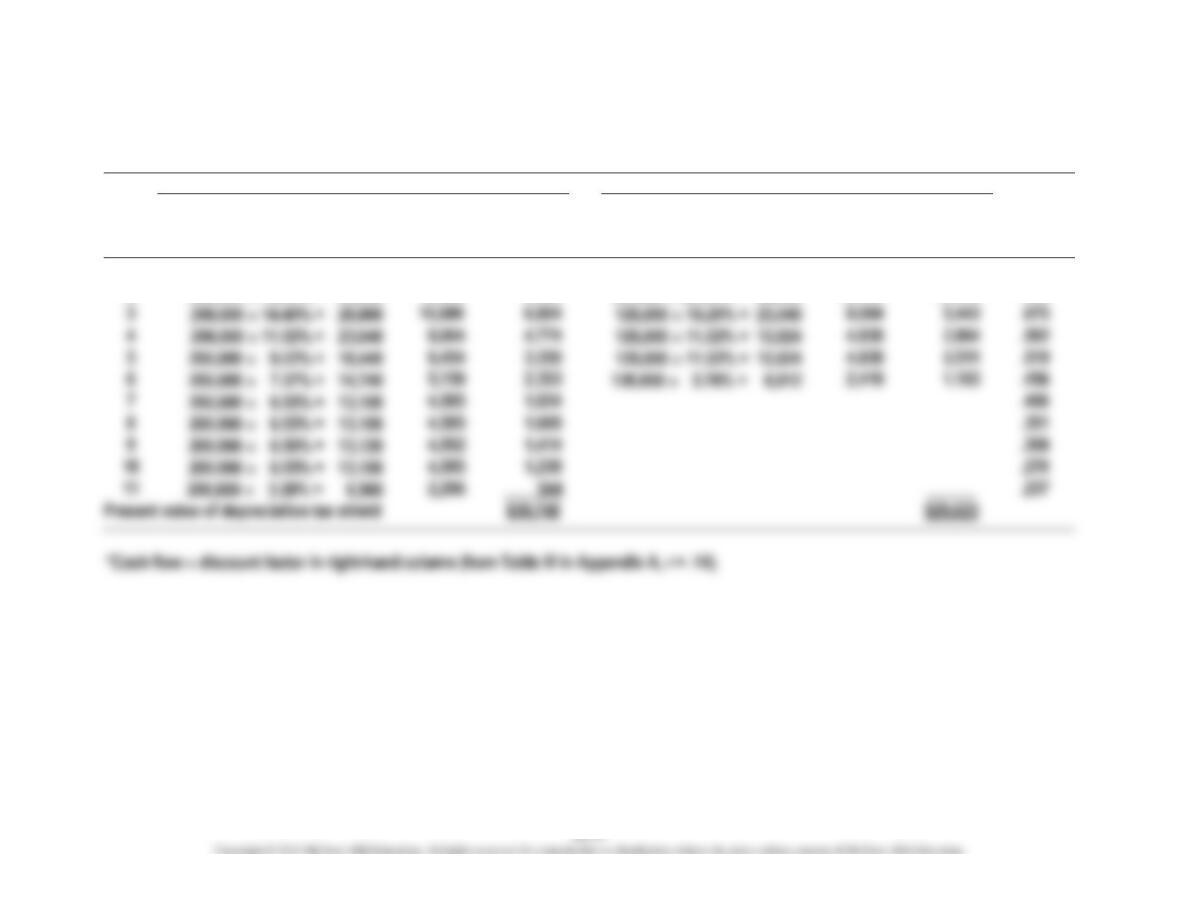
We calculate the required increase in annual tax revenue as follows:
Required incremental benefit ……………………………………………………….
$ 76,007
Add: Annual costs to cover:
Promotional campaign ……………………………………………………….
Runway maintenance ……………………………………………………….
Incremental operating costs of new snow plow …………………………..
Total annual costs ……………………………………………………….……………………..
Subtotal ……………………………………………………………………………………
Deduct: Incremental revenue from landing fees …………………………..
)
Required increase in tax revenue ……………………………………………………….
$ 96,007
Chapter 16 – Capital Expenditure Decisions
PROBLEM 16-48 (45 MINUTES)
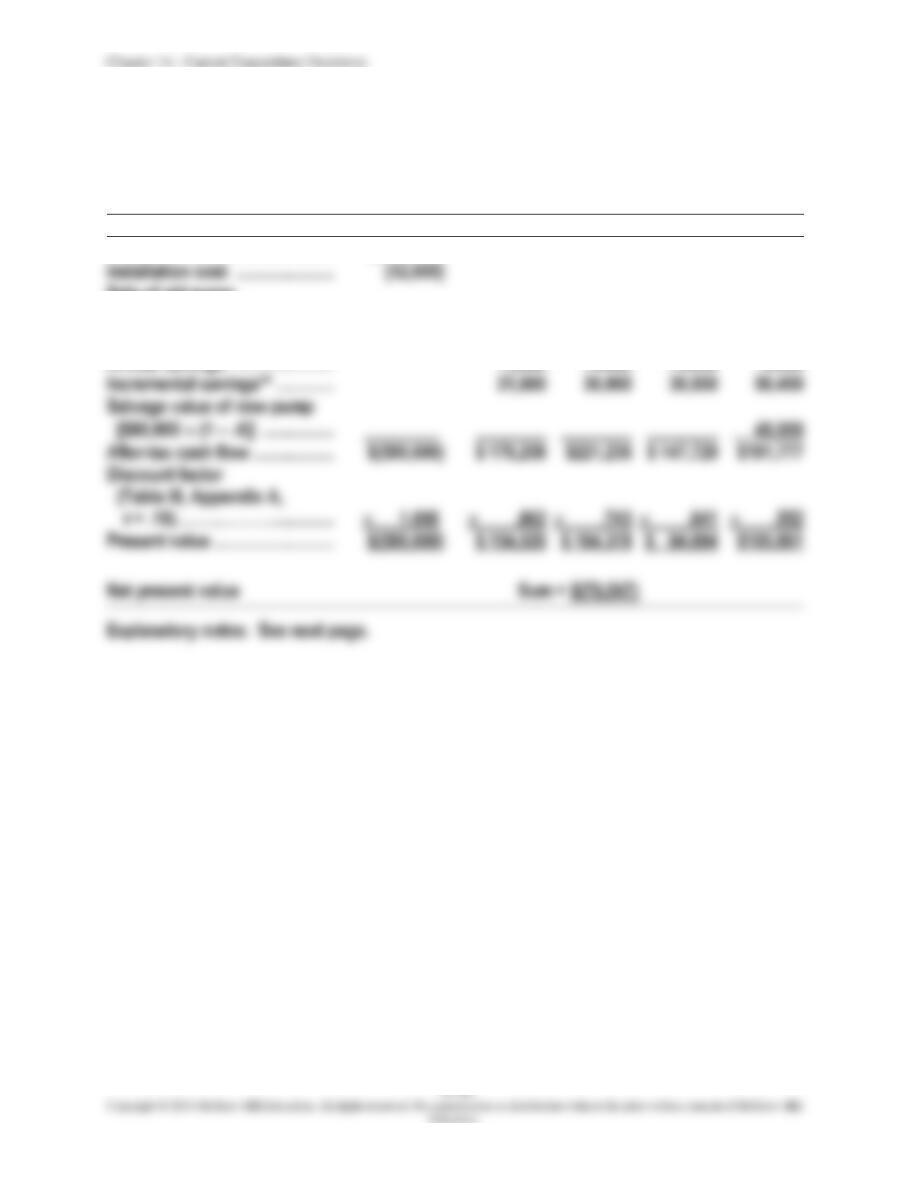
Storage Racks
Forklift
Year
MACRS
Depreciation
Cash Flow:
Tax Savings
(Depr. .35)
Present
Value*
MACRS
Depreciation
Cash Flow:
Tax Savings
(Depr. .35)
Present
Value*
Discount
Factor
1
$200,000 10.00% = $20,000
$ 7,000
$ 6,139
$120,000 20.00% = $24,000
$ 8,400
$ 7,367
.877
2
200,000 18.00% = 36,000
12,600
9,689
120,000 32.00% = 38,400
13,440
10,335
.769
3
200,000 14.40% = 28,800
10,080
6,804
5,443
.675
4
200,000 11.52% = 23,040
4,774
2,864
.592
5
3,350
2,511
.519
6
2,353
1,103
.456
7
1,834
.400
8
1,609
.351
9
1,414
.308
1,238
.270
544
.237
PROBLEM 16-49 (40 MINUTES)
1. MicroTest Technology, Inc. should not purchase the new pump because the net
present value is a negative amount, $(70,547), as calculated in the following table:
20×2
20×3
20×4
20×5
20×6
Equipment cost …………………..
$(608,000
)
Installation cost ………………….
)
Sale of old pump
[$50,000 (1 – .4)] …………….
30,000
Depreciation tax shield* ………
$ 82,658
$110,236
$ 36,729
$ 18,377
Annual savings† …………………..
75,000
75,000
75,000
75,000
Incremental savings** ………….
21,600
36,000
36,000
50,400
Salvage value of new pump
[$80,000 (1 – .4)] …………….
________
________
________
After-tax cash flow ………………
$(590,000
)
$ 179,258
$221,236
$ 147,729
$191,777
Present value ………………………
$(590,000
)
$ 154,520
$ 164,378
$105,861
PROBLEM 16-49 (CONTINUED)
Explanatory notes:
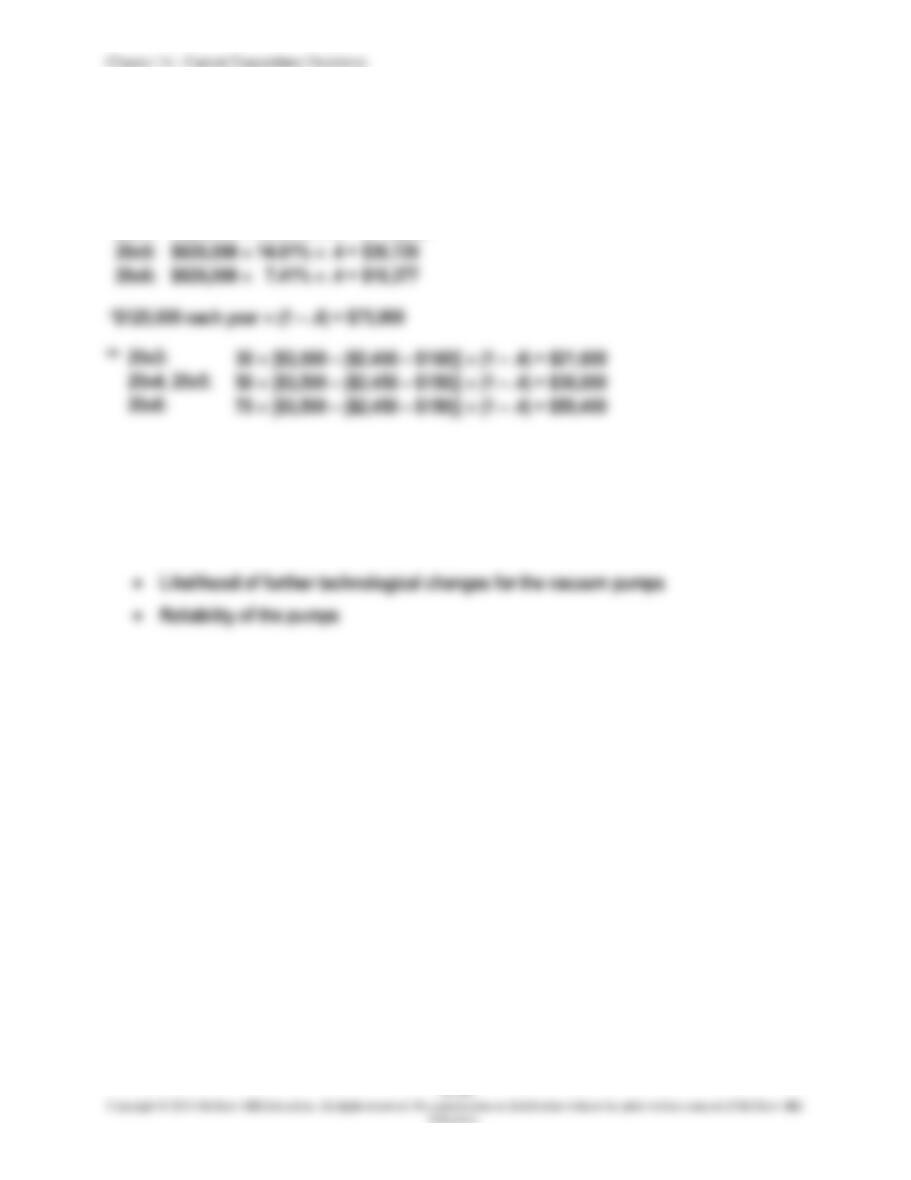
*20×3: $620,000 33.33% .4 = $82,658
20×4: $620,000 44.45% .4 = $110,236
2. Factors other than the net present value that management should consider before
making the pump replacement decision include the following:
• Availability of any necessary financing
Chapter 16 – Capital Expenditure Decisions
PROBLEM 16-50 (45 MINUTES)
1. Net-present-value analysis:
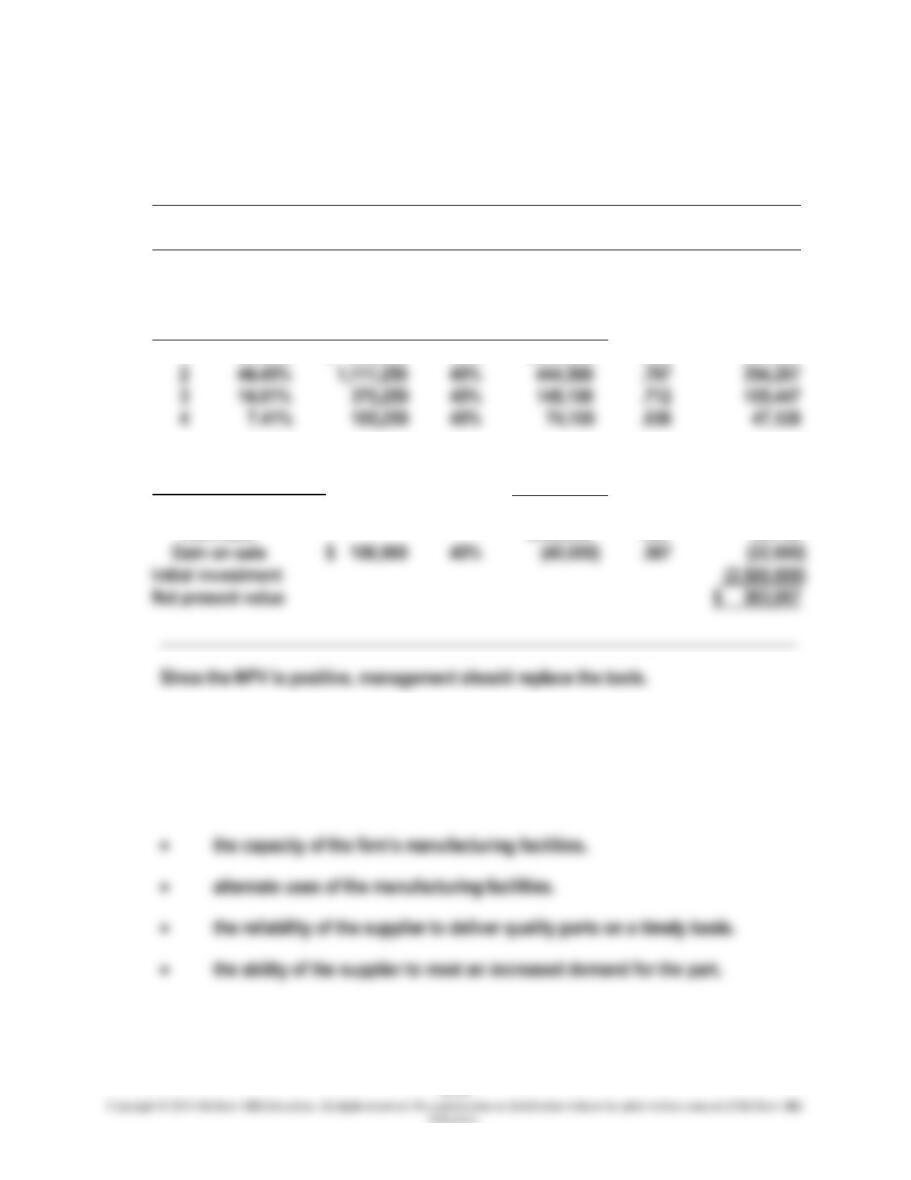
(a) Cost savings from manufacturing pressure fittings:
Per
Unit
Total
Cost to purchase pressure fittings from outside supplier ……………………….
$20.00
$1,600,000
Incremental costs of manufacturing the pressure fittings*
Total incremental costs ……………………………………………………….
Cost savings from manufacturing pressure fittings …………………………..
$11.70
Taxes (40%) ……………………………………………………………………………………
Chapter 16 – Capital Expenditure Decisions
PROBLEM 16-50 (CONTINUED)
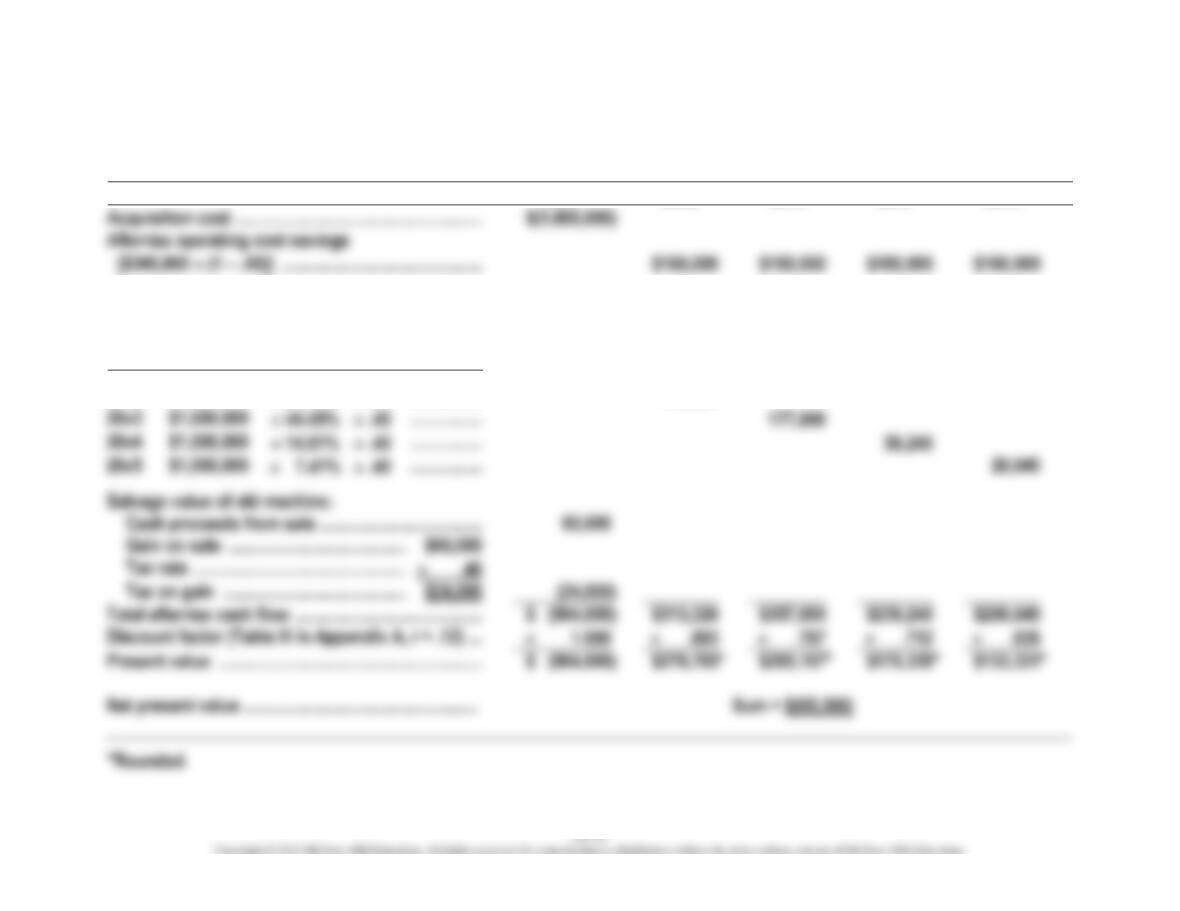
(b) Discounted-cash-flow analysis:
Cash
Flow
Discount
Factor
Present
Value
Annual cost savings
$561,600
3.605
$2,024,568
MACRS depreciation tax shield:
Year
MACRS
Percentage
MACRS
Depreciation
Tax
Rate
Tax
Shield
1
33.33%
$ 833,250
40%
$333,300
.893
297,637
2
44.45%
40%
.797
354,267
3
14.81%
40%
.712
105,447
4
40%
.636
47,128
Salvage Value of Tools
Cash
Flow
Cash proceeds
from sale
$100,000
.567
56,700
$ 100,000
40%
.567
)
Initial investment
)
2. Factors that LifeLine Corporation’s management should consider in addition to the
discounted-cash-flow analysis before a decision is made to replace the tools or
purchase the pressure fittings from an outside supplier include:
• the possibility of negotiating a lower price for the pressure fittings.
Chapter 16 – Capital Expenditure Decisions
PROBLEM 16-51 (45 MINUTES)
1. Net-present value analysis of the machine replacement:
20×1
20×2
20×3
20×4
20×5
Acquisition cost ……………………………………………….
)
Depreciation tax shield:
Year
Acquisition
Cost
MACRS
Percentage
Tax
Rate
20×2:
$1,000,000
33.33%
.40
…………………………..
133,320
20×3
$1,000,000
…………………………..
20×4
$1,000,000
14.81%
.40
…………………………..
.40
Salvage value of old machine:
60,000
)
Total after-tax cash flow ……………………………………
)
Discount factor (Table III in Appendix A, r = .12) …
Present value …………………………………………………..
)
*
*
*
*
Chapter 16 – Capital Expenditure Decisions
PROBLEM 16-51 (CONTINUED)
2. The machine replacement’s internal rate of return is between 6% and 8%. The
project’s net present value is positive if a 6% discount rate is used, but it is negative
if an 8% discount rate is used.
Year
Total After-Tax
Cash Flow
(from
requirement 1)
6%
Discount
Factor
Present
Value
(using 6%)
8%
Discount
Factor
Present
Value
(using 8%)
20×1 ……………..
$(964,000
)
1.000
$(964,000
)
1.000
$(964,000
)
20×2 ……………..
20×3 ……………..
20×4 ……………..
20×5 ……………..
3. The payback period on the machine replacement is between three and four years.
Year
Total After-Tax
Cash Inflow
(from requirement 1)
20×2 …………………………………..
$ 313,320
20×3 …………………………………..
357,800
20×5 …………………………………..
Chapter 16 – Capital Expenditure Decisions
PROBLEM 16-51 (CONTINUED)
4. With a salvage value of zero on the new machine, the machine replacement’s net
present value is $(95,368). Thus, the after-tax discounted cash flow from the salvage
X – .40X
=
$149,950
=
$249,917 (rounded)
Chapter 16 – Capital Expenditure Decisions
PROBLEM 16-52 (35 MINUTES)
1. (a) Mall restaurant:
Net after-tax cash inflows ……………………………………………………………………..
$ 50,000
Present value of annual cash flows ……………………………………………………….
Cash outflow at time 0 ………………………………………………………………………….
(b) Downtown restaurant:
Net after-tax cash inflows ……………………………………………………………………..
$ 35,800
Present value of annual cash flows ……………………………………………………….
Cash outflow at time 0 ………………………………………………………………………….
2. Profitability index =
investment initial
investment initial of exclusive flows, cash of valuepresent
(a) Mall restaurant:
4. The two proposed restaurant projects have different lives, which makes it