
Auditing: A Risk Based Approach to Conducting a Quality Audit, 10e
Solutions for Chapter 16
True/False Questions
16-2 F
16-4 F
16-6 T
16-8 F
16-10 T
16-12 T
16-14 F
Multiple-Choice Questions
16-16 D
16-18 D
16-20 C
16-22 D
16-24 A
16-26 D
16-28 C
16-2
Review and Short Case Questions
16-29
Yes, and in fact, it is the auditor’s responsibility to question the acceptability of the
client’s judgments. To evaluate the client’s judgments, the auditor should determine
16-30
Yes, inventory, accounts receivable, and property, plant, and equipment are all subject to
fair value estimates because all of these accounts are either subject to “lower of cost or
16-31
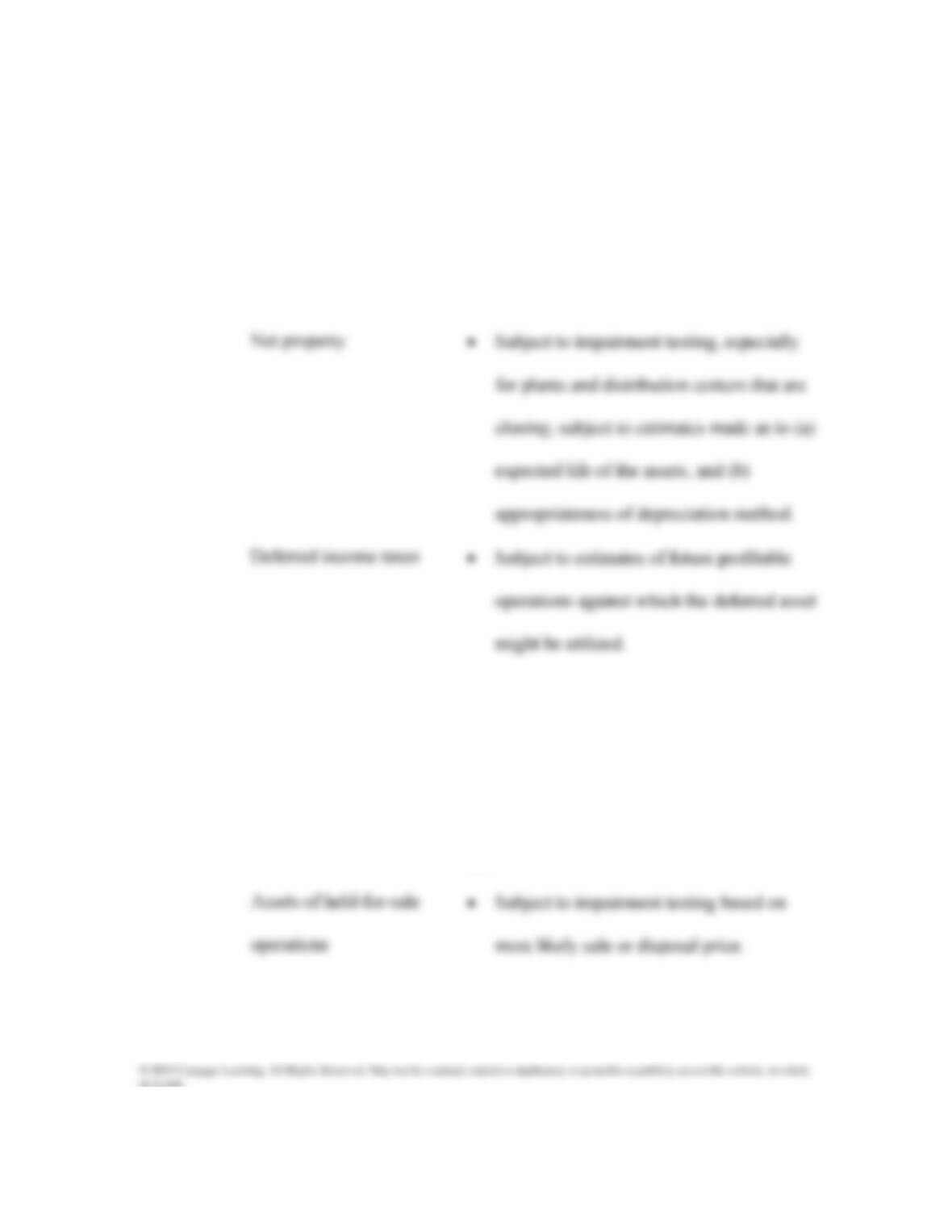
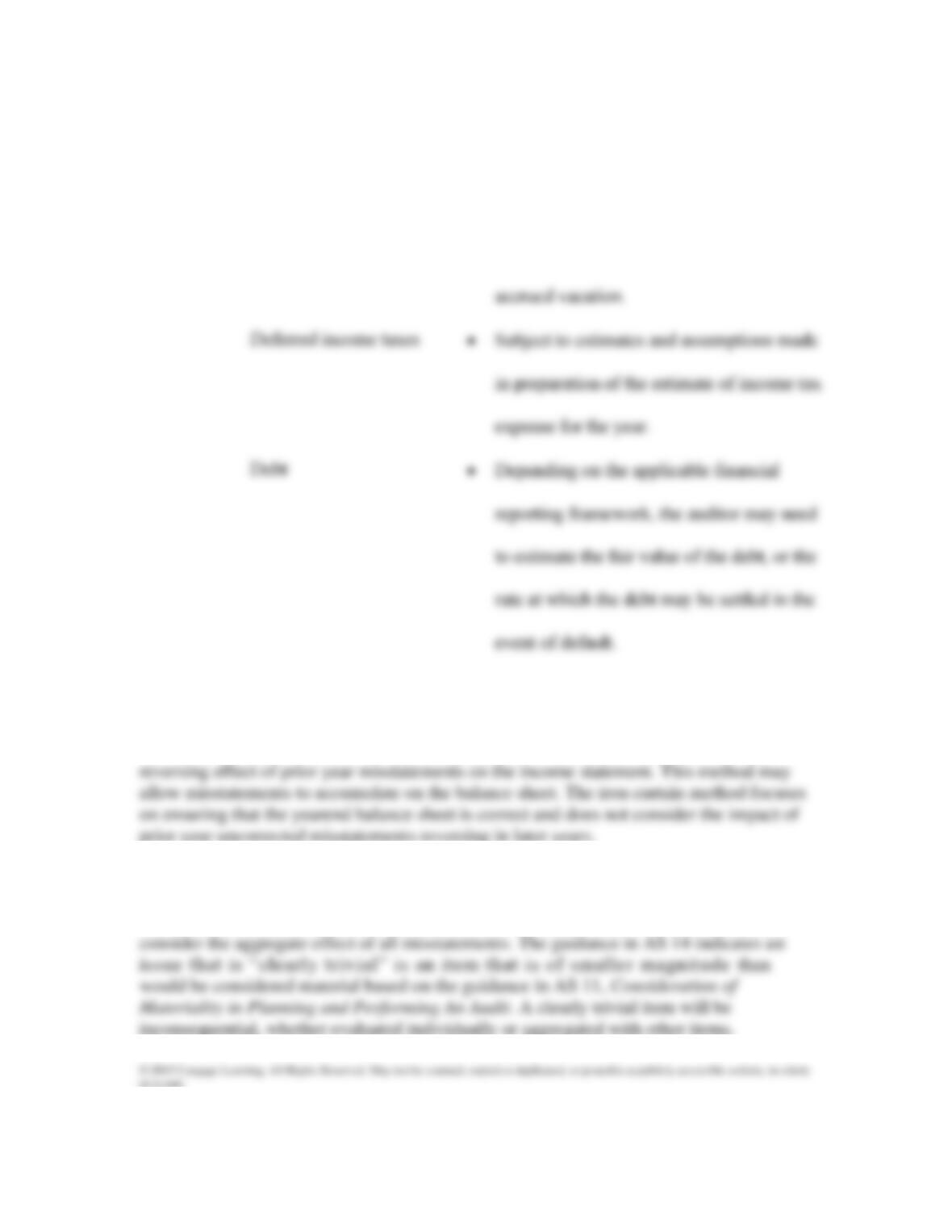
Examples of Balance Sheet Accounts Requiring Subjective Judgments
Assets
Nature of Judgment
16-3
Net investment in operating
leases
• Subject to impairment testing if plants are
closing or equipment is not used.
Inventories
• Subject to lower of cost or market
impairments, including an allowance for
obsolescence.
expected life of the assets, and (b)
appropriateness of depreciation method.
Goodwill and other
intangible assets
Subject to impairment testing based on (a)
current market values, (b) projected cash flows
related to the assets and/or (c) current market
value of the segment to which the goodwill
applies.
Assets of held-for-sale
operations
• Subject to impairment testing based on
most likely sale or disposal price.
Liabilities
Nature of Judgment
16-4
Accrued liabilities and
deferred revenue
in preparation of the estimate of income tax
reporting framework, the auditor may need
to estimate the fair value of the debt, or the
• Subject to estimates regarding amount of
revenue that is properly deferred, as well as
the basis for the liability accrual—for
example, pensions, warranty liabilities, and
16-32
The rollover method focuses on the materiality of current year misstatements and the
16-33
The auditor should evaluate each misstatement individually, and the auditor should
16-5
16-34
A quantitatively small misstatement might be considered material if the misstatement:
• arises from an item capable of precise measurement or whether it arises from an
estimate and, if so, the degree of imprecision inherent in the estimate
• masks a change in earnings or other trends
• hides a failure to meet analysts’ consensus expectations for the enterprise
• changes a loss into income or vice versa
16-35
Because of the importance of cash flows to investment decisions, the statement of cash
16-36
a. Under the rollover method, the current-year effect would be the amount by which
the current year income statement is misstated (that is, $20). Under the iron curtain
b. The adjusting entry should fix both the income statement and the balance sheet to
reflect accurate amounts, adjusting the difference to Retained Earnings to reflect prior-
year income effects as follows:
Debit: Liability $100
Credit: Expense $20 (current year income effect)
Credit: Retained Earnings $80 (prior years’ income effects)
16-6
16-37
a. The rollover approach offsets the $10 million understatement of current year sales
that resulted from the prior year late cutoff with the $12 million overstatement that
resulted from the current year late cutoff, and thus determines that the misstatement
would be a net $2 million overstatement. The iron curtain approach focuses on the
misstatements in the balance sheet (accounts receivable, equity) at the end of the period
and determines the misstatement to be a $12 million dollar overstatement.
The differences between approaches are driven by misstatement from the prior period
that were waived. Further, the relation between prior period and current period
misstatement determines which of the two approaches would yield the higher materiality.
NOTE: This problem was adapted from Nelson, M. W., S. D. Smith, and Z. Palmrose.
16-38
a. When auditors detect an intentional misstatement, they should do the following:
(1) reconsider the level of audit risk for the client, (2) consider revising the nature,
timing, and extent of audit procedures, and (3) evaluate whether to resign from the audit
engagement. The detection of an intentional misstatement likely signals the existence of
an internal control material weakness and certainly speaks to control environment
problems involving the tone at the top of the organization. The auditor must discuss the
matter with the audit committee.
b. If the client corrects the misstatement, there is no need to report the misstatement
to outside parties. The financial statements are fairly presented and the auditor’s task is to
16-7
If the client is a public organization, then the intentional misstatement is clearly a
material weakness in internal control. The misstatement was corrected only because the
16-39
a. No, the auditor cannot assume the financial statements are free of material
misstatements. The auditor must consider all aspects of the factors leading to the
percentages. This question comes directly from the SEC’s SAB No. 99. The entirety of
SAB 99 is meant to address this question. The following excerpt from SAB No. 99
highlights the key points with respect to this scenario and suggests that the auditor should
not just make a quantitative assessment but should also consider qualitative factors.
The [SEC] staff is aware that certain registrants, over time, have developed
quantitative thresholds as “rules of thumb” to assist in the preparation of their
financial statements, and that auditors also have used these thresholds in their
evaluation of whether items might be considered material to users of a
registrant’s financial statements. One rule of thumb in particular suggests that the
16-8
likelihood that a reasonable person would consider it important. In its Statement
of Financial Accounting Concepts No. 2, the FASB stated the essence of the
concept of materiality as follows:
The omission or misstatement of an item in a financial report is material if, in the
b. Additional factors the auditor should consider in evaluating materiality include:
• Trends in earnings – both at the segment level and the consolidated level
• The extent management was involved in the misstatement
16-40
a. We do not agree with the statement. The range of materiality should not vary with
the subjectivity of the account balance. While there is uncertainty whenever subjective
estimates are made, the auditor should apply a systematic process that should lead to a
conclusion on whether or not a material misstatement in the account balance may be
likely. An important point is that the estimate may turn out to be correct or incorrect, but
the auditor’s estimate (as well as management’s estimate) ought to be based on the best
information available at the time of the preparation of the financial statements and the
b. The auditor’s comment merits thoughtful consideration. Students may agree or
disagree with the statement – the quality of their argument is important. Regarding each
point, the author’s opinions are as follows:
i. No Need for Auditor Judgment. We disagree as there is always a need for some
auditor judgment because not every factor can be precisely measured or modeled.
There is an expectation that an audit partner will consider all other factors, e.g.
ii. Verifying the Soundness of the Model. The auditor should consider:
16-9
o Accuracy of predictions in the past
o The statistical precision of the model
o Consistency over time
o Changes in the economy or in the organization’s business
iii. Overruling the Computational Model. The auditor is responsible for applying the
accumulation of knowledge gained over time on all audits, as well as a detailed
16-41
Estimates that must be made:
a. warranty reserves – must understand the nature of the warranty, previous
results on similar product or same product, estimated cost of each repair, the
frequency of failure, and the time limit of the warranty.
b. pension obligations – the nature of the plan, i.e., defined benefit or defined
contribution, the nature of the coverage, the estimated life of retirees, the current
16-42
Outside specialists are used in estimating pension obligations in performing the
16-10
• determining the amounts that have to be invested to meet future payment
16-43
a. An information system that would be used to develop a warranty estimate would
include:
• a tracking system of all trucks produced and sold during specific time periods
• a tracking system that identifies the length and nature of the warranty provided on
each truck
• a tracking system that identifies all warranty claims and matches the claims to the
b. An audit program would include the following steps:
• Develop an understanding of the information system used by the client, and
consider the need to test the controls that are part of this system.
• Take a sample of warranty claims and determine (a) the proper accounting for the
c. The warranty is shorter, but more importantly, the organization does not have as
much data regarding military vehicles used in deserts. The auditor needs to determine the
procedures used by the organization to update the estimates for these trucks. The
organization should define component parts that have a record of failing more often and
should identify the estimated cost of repairs. The rate of failure should then be used to
project a failure rate for all warranted items and the warranty liability should be adjusted
accordingly.
16-11
d.
i. The liability has grown. The auditor would look for the following to
determine if the liability is likely overstated:
• evidence of any changes in warranty claims
• changes in product failure rates
• changes in warranty
If there are no significant changes, the client’s statistical projection should
show the need for a lower warranty liability.
ii. If the account is materially overstated, the liability should be reduced to
the best estimate of the actual liability. It could be argued that the estimate
occurred because too much expense had been charged to previous years
16-44
Audits of acquisitions and mergers are considered risky for the following reasons:
• It is often difficult to obtain objective evidence on the proper valuation of physical
assets and liabilities acquired in the audit; for example appraisals of plant and
equipment, or current value of liabilities.
• A number of accounts are valued based on subjective judgments – especially longer
16-45
WorldCom used restructuring reserves extensively to smooth and enhance reported
earnings. WorldCom engaged in a number of acquisitions. At the end of each acquisition,
they would announce that they would restructure activities and set up a large reserve for
the restructuring costs. They viewed the restructuring costs as part of the acquisition and
often debited goodwill for the asset. They would almost always overestimate the reserve,
i.e., estimate far greater expenses that they thought they would incur. Then, at some time
16-12
16-46
Costs associated with a merger and the valuation issues are as follows:
• Assets – valued at current market value. This is usually determined by an appraisal
for fixed assets. Current assets are usually determined through normal audit-type
procedures, e.g. estimating current market value of inventory, collectability of
receivables, etc.
• Current liabilities – valued at market value. Typical audit procedures can be used to
identify amounts eventually paid, or to discover unrecorded assets. The acquiring
organization can use these same procedures.
16-47
Goodwill is a residual that represents the excess of purchase price paid for an
organization above the net fair market value of all other identifiable tangible and
intangible assets and liabilities. Goodwill may represent a number of things such as a
16-48
The auditor does not necessarily need to hire an independent appraiser to test the
16-13
• the auditor can test the appraiser’s processes as a basis for reaching a conclusion
about the appraisal results
16-49
Fair value is defined as: “the price that would be received to sell an asset or paid to
transfer a liability in an orderly transaction between market participants at the
measurement date”.
Fair value measurements are applied when they are dictated by underlying accounting
principles. The most likely times that fair value measurements are applied occur when:
16-50
The FASB has set a hierarchy of inputs to consider in assessing fair value:
i. Level 1 is quoted prices for identical items in active, liquid and visible markets such
as stock exchanges. An example would be a recent trade on the NYSE of a stock or a
bond.
16-51
The FASB has outlined a two-step approach that includes:
16-14
• Comparing the fair value (FV) of the reporting unit with the unit’s carrying
amount (CV) including goodwill.
Since 2011, organizations had the option of first performing a qualitative assessment to
determine whether the two-step approach needs to be performed.
The difficult judgment is determining the fair value of the reporting unit, i.e., the acquired
organization that led to the creation of the goodwill. That organization may change over
time as other companies are acquired and integrated into operations. The auditor’s task is
to determine whether or not the unit is operating profitably and the likelihood the unit
will continue to generate cash flows in excess of cash outflows. Sometimes there may be
16-52
Factors that might signal the potential impairment of goodwill include:
• declining operating results in the division or organization acquired
• product obsolescence because of technological changes
16-15
16-53
Determining fair value of goodwill:
a. Reporting unit is full organization and is publicly traded – determine the total market
capitalization of the organization. Subtract the net sum of total tangible and intangible
assets (less goodwill) less liabilities and invested capital from the market capitalization.
b. Reporting unit is the full organization, not publicly-traded. If there is an estimate of
market value, e.g. from an investment banker, the approach is the same as described
above for a public-traded organization. If such information does not exist, the auditor
will most likely look at the factors in the text and make a judgment about potential
impairment.
c. Reporting unit is an operating segment. The auditor will primarily look at the factors
described in in the text and make a judgment about the decline in operations. The
16-54
Once goodwill is impaired, it is not written up to a greater value. Thus, if the decline in
16-55
a. The inherent risks in this write-down include:
16-16
b. Audit evidence would include:
• Support for the assumptions management used to estimate future cash flows.
• Information about the independence and competence of the professional
c. The auditor could hire the services of an independent appraiser to test the fair
values of the original appraisers, perhaps on a sampling basis.
16-56
a. An operating segment is a component of an organization that is a profit center,
has discrete financial information, and whose results are reviewed regularly for purposes
of performance assessment and resource allocation.
Criteria that an auditor might utilize to determine an operating segment include:
• separate physical operations
• separate management
• distinct product line and operations
• separate markets
• separate reporting and evaluation by management
b. Assuming that (a) the decision was made to integrate the operations of the two
previously separated entities into one operating segment at the time that the two
purchases were made, and (b) management has continued to operate and evaluate the two
entities as if they were one operating segment, then it would be appropriate to look at the
16-17
c. The potential problems with measuring the impairment of the goodwill for the food
product and design segment include:
• consistently defining and measuring the operating unit
• evaluating management’s strategic plans for the unit; for example, are the losses
for the CCD operations due to heavy investments in new marketplace
development that are expected to yield increased returns in the future
• determining fair value of the reporting entity, especially when a separate
marketplace for the reporting entity might not exist
• projecting future net cash flows from operations as a basis for determining the fair
value of the entity
d. In most situations, if the profitability and the cash flows from the acquired entity
exceed the budget utilized in determining the purchase price for the entity, there would
not be an impairment of goodwill. The auditor, however, would need to be alert to
changes in market conditions or changes in management’s strategic plans as a basis to
determine if more detailed work needs to be performed in determining whether or not an
impairment of the asset has taken place.
16-57
a. A reporting unit is an internal division of an organization with which the goodwill
16-18
b. In using the quantitative approach, the first step in determining whether there is a
need for a goodwill impairment to be recorded is for the auditor to compare the total
market value of the firm with the book value of the organization.
c. An outline of an audit program for the storage solutions reporting unit follows.
• Review the assumptions made by management regarding new product
introductions, profit margins, and industry position. Compare those assumptions
with external and internal information available regarding new product
introductions and competitor actions.
• Test client computations based on the assumptions made by the client. Compare
16-58
Newer financial instruments differ from more traditional financial instruments in that
16-19
Most financial instruments are subject to two major risks: (1) default risk; and (2) interest
rate risk. Many of the new financial instruments are ostensibly developed to minimize
one or the other risk for the investor. However, the market has learned that although the
16-59
The following controls are appropriate if an organization wishes to become an investor in
newer, and more complex, financial instruments:
• Developing Corporate Policies and Procedures.
Companies should have explicit policies, preferably in writing, defining the
• Extending and Monitoring Credit
This control provides guidelines to assist corporate management from taking on
undue risks.
• Trading Procedures, including types of securities and trading limits.
Same as above. Many organizations got into trouble in the past because management,
seeking to obtain higher returns, invested in securities that carried unusual amounts of
risk that eventually led to the downfall of both the issuing organization and the
organization making the investment.
• Maintaining custody or safekeeping of securities and collateral.
The rationale for maintaining custody or safekeeping of securities has long been
understood as a method to ensure realizability of the asset, i.e. payment on the
underlying promise contained in the financial instrument. Many organizations,
however, did not extend that same concept to underlying collateral when the
likelihood of default was sufficient that the status and realizability of the underlying
• Documenting investment, financing, and hedging transactions.
Developing proper documentation is fundamental to the control of any accounting
transaction.
• Establishing limits over financial instruments, counterparties and traders in an
effort to reduce credit risk through diversification.