Accounting Information Systems
CHAPTER 16
GENERAL LEDGER AND REPORTING SYSTEM
SUGGESTED ANSWERS TO DISCUSSION QUESTIONS
16.1 Although XBRL facilitates the electronic exchange of financial information, some
external users do not think it goes far enough. They would like access to the entire
general ledger, not just to XBRL-tagged financial reports that summarize general
ledger accounts. Should companies provide external users with such access? Why or
why not?
No, companies should not provide access to their general ledger. Providing external
16.2 How can responsibility accounting and flexible budgets improve morale?
Responsibility accounting improves morale by holding managers accountable only for the
rate less than or equal to the proportionate increase in activity.
16.3 Why is the audit trail an important control?
The audit trail is a detective control used to verify the accuracy and completeness of
transaction processing. Tracing a set of source documents forward through the journal
Ch. 16: General Ledger and Reporting System
16-2
16.4 The balanced scorecard measures organizational performance along four
dimensions. Is it possible that measures on the customer, internal operations, and
innovation and learning dimensions could be improving without any positive change
in the financial dimension? If so, what are the implications of such a pattern?
It may indeed be possible for measures on three dimensions of the balanced scorecard to
improve, but for financial results to deteriorate. This may occur because the 3 other areas
16.5 Do you think that mandatory standards should be developed for the design of
graphs of financial data that are included in annual reports and other periodic
communications to investors? Why or why not?
There is no right answer here but it should generate a good discussion. It may be helpful
to start the discussion off by talking about the reporting standards of the SEC and FASB.
Accounting Information Systems
SUGGESTED ANSWERS TO THE PROBLEMS
16.1 Match the term in the left column with its appropriate definition from the right
column:
1. __d__ journal voucher file
a. an individual financial statement item
2. __k__ instance document
b. evaluating performance based on controllable costs
3. __a__ XBRL element
c. evaluating performance by computing standards in
light of actual activity levels
4. __f__ Balanced Scorecard
d. the set of journal entries that updated the general
ledger
5. __l__ XBRL extension taxonomy
e. a set of files that defines XBRL elements and specifies
the relationships among them
6. __i__ audit trail
f. a multi-dimensional performance report
7. __e__ XBRL taxonomy
g. a file that defines relationships among XBRL elements
8. __g__ XBRL linkbase
h. a file that defines the attributes of XBRL elements
documents
10. __j__ XBRL style sheet
j. a file that explains how to display an XBRL instance
document
11. __b__ responsibility accounting
k. a file that contains specific data values for a set of
XBRL elements for a specific time period or point in
time
organization
Ch. 16: General Ledger and Reporting System
16-4
16.2 Which control procedure would be most effective in addressing the following
problems?
a. When entering a journal entry to record issuance of new debt, the treasurer
inadvertently transposes two digits in the debit amount.
• Use a cross-footing balance check to test the equality of debits and credits
c. The controller forgot to make an adjusting entry to record depreciation.
• Create a set of standard adjusting entries
e. The general ledger master file is stored on disk. For some reason, the disk is no
longer readable. It takes the accounting department a week to reenter the past
month’s transactions from source documents in order to create a new general
ledger master file.
• Backup files more frequently.
• Create two copies of the backup files and store one on-site and the other off-site.
Accounting Information Systems
• Train users on the proper use of the taxonomy to prevent this..
• Audit or validate the instance document prior to submission to detect this.

Ch. 16: General Ledger and Reporting System
16-6
16.3 Explain the components of an audit trail for verifying changes to accounts payable.
Your answer should specify how those components can be used to verify the
accuracy, completeness, and validity of all purchases, purchase returns, purchase
discounts, debit memos, and cash disbursements.
The sum of all amounts owed to individual vendors would be computed and compared to
the balance in the general ledger accounts payable control account.
Accounting Information Systems
16.4 As manager of a local pizza parlor, you want to develop a balanced scorecard so you
can more effectively monitor the restaurant’s performance.
a. Propose at least two goals for each dimension, and explain why those goals are
important to the overall success of the pizza parlor. One goal should be purely
performance-oriented and the other should be risk-related.
b. Suggest specific measures for each goal developed in part a.
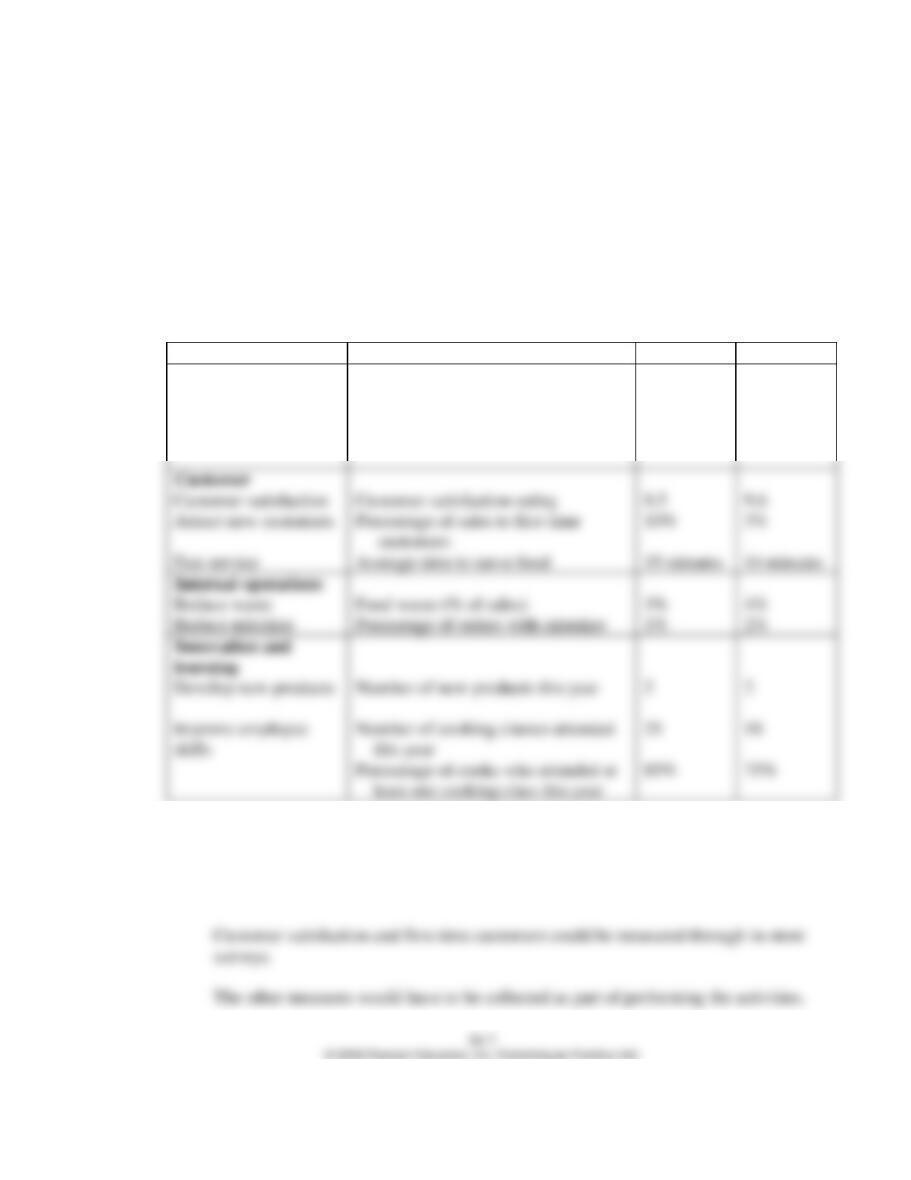
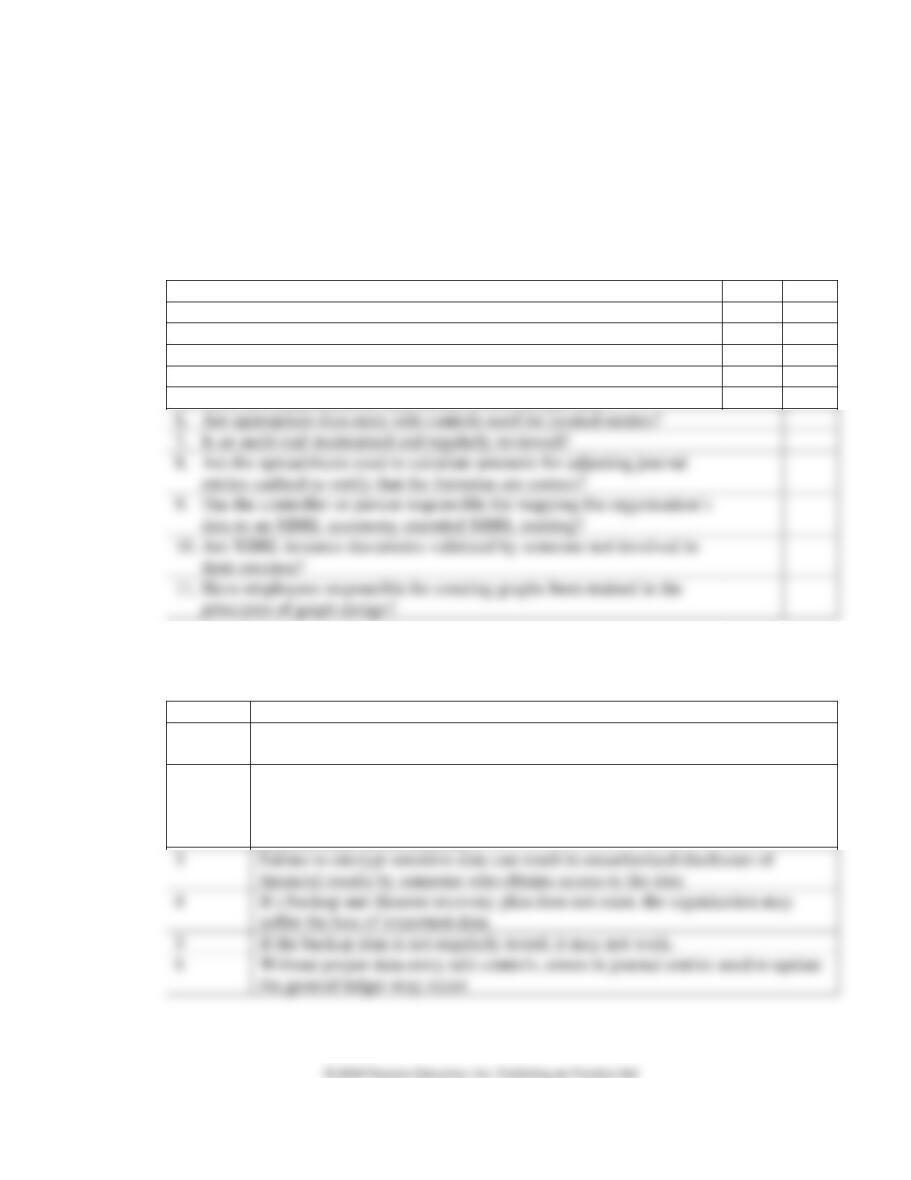
Below is a sample of a balanced scorecard containing goals and measures.
Dimension Goals
Measure
Target
Actual
Customer
Customer satisfaction rating
Percentage of sales to first time
customers
9.5
10%
9.6
3%
Number of cooking classes attended
this year
Percentage of cooks who attended at
25
85%
18
75%
Financial
Increase sales
Profitability
Percentage change in sales
Operating margin
5%
12%
4%
13.5%
c. Explain how to gather the data needed for each measure developed in part b.
Financial measures would be generated by the accounting system.
Ch. 16: General Ledger and Reporting System
16-8
16.5 Use Table 16-1 to create a questionnaire checklist that can be used to evaluate
controls in the general ledger and reporting cycle.
a. For each control issue, write a Yes/No question such that a “No” answer
represents a control weakness. For example, one question might be “Is access to
the general ledger restricted?”
A wide variety of questions is possible. Below is a sample list:
Question
Yes
No
1. Is access to the general ledger restricted?
2. Is the general ledger regularly reviewed and all changes investigated?
3. Is sensitive data encrypted while stored in the database?
4. Does a backup and disaster recovery plan exist?
5. Have backup procedures been tested within the past year?
6. Are appropriate data entry edit controls used for journal entries?
7. Is an audit trail maintained and regularly reviewed?
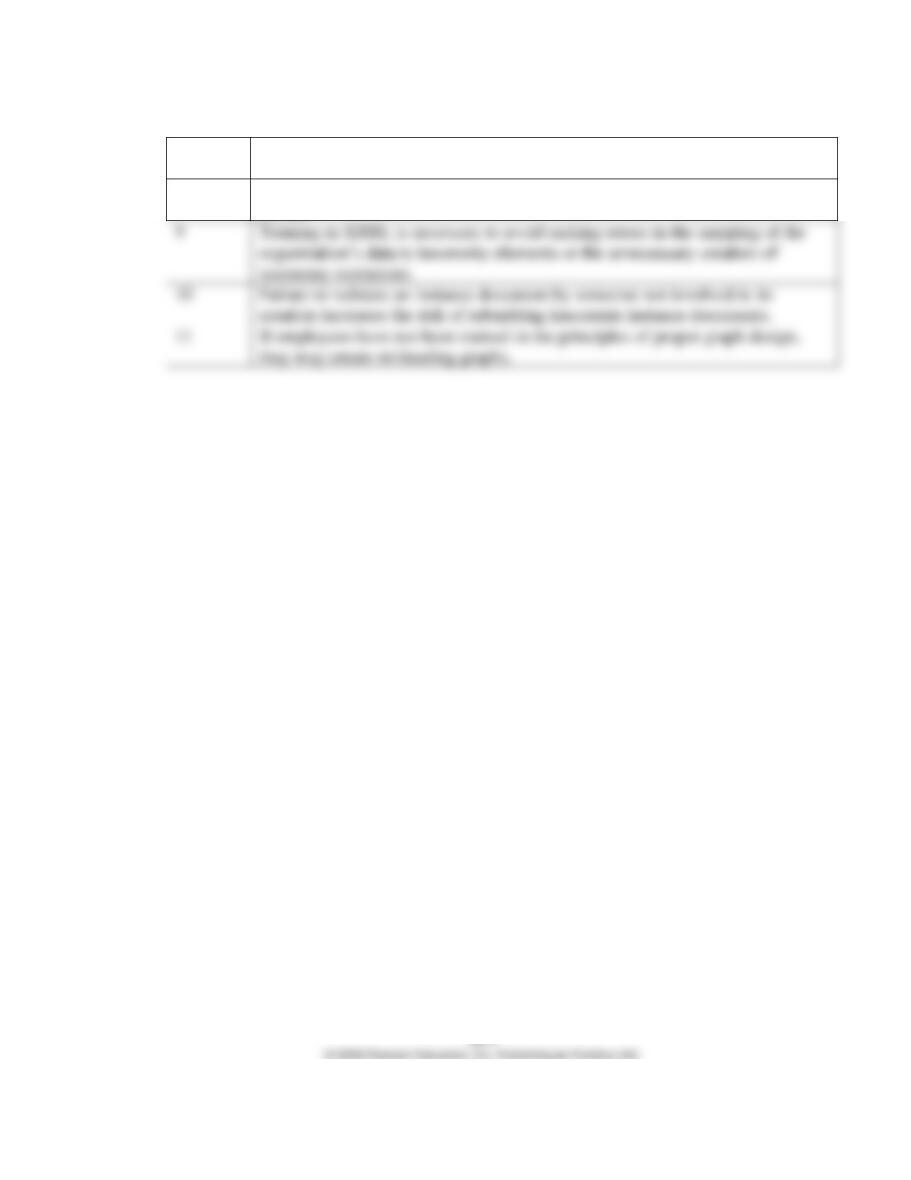
b. For each Yes/No question, write a brief explanation of why a “No” answer
represents a control weakness.
Question
Reason a “No” answer represents a weakness
1
Unrestricted access to the general ledger could facilitate fraud or the
unauthorized disclosure of sensitive data
2
Failure to investigate all changes to the general ledger may allow fraud to occur
because unauthorized master records (e.g., fake suppliers, non-existent
employees, etc.) may not be detected. Also, unauthorized changes to account
balances may not be detected.
4
If a backup and disaster recovery plan does not exist, the organization may
suffer the loss of important data.
5
If the backup plan is not regularly tested, it may not work.
6
Without proper data entry edit controls, errors in journal entries used to update
the general ledger may occur
Accounting Information Systems
7
Without an audit trail, it is not possible to verify the completeness and accuracy
of all changes to the general ledger.
8
Failure to audit spreadsheets for errors increases the risk of erroneous adjusting
entries
taxonomy extensions
10
Failure to validate an instance document by someone not involved in its
creation increases the risk of submitting inaccurate instance documents.
11
If employees have not been trained in the principles of proper graph design,
they may create misleading graphs.

Ch. 16: General Ledger and Reporting System
16.6 Visit the SEC website (www.sec.gov) and explore what is available in terms of
interactive data (the SEC’s term for XBRL reports). Use the SEC’s viewer software
and examine the annual reports for two companies.
16.7 Obtain the annual report of a company assigned by your professor. Read the
management discussion and analysis section, and develop a balanced scorecard that
reflects that company’s vision, mission, and strategy. Create both performance–
oriented and risk-based goals and measures for each section of the balanced
scorecard.
The key to this assignment is the appropriateness of the goals and measures developed for
the Balanced Scorecard in light of management’s discussion about the mission, vision,
Accounting Information Systems
16.8 Excel Problem Objective: Practice graph design principles.
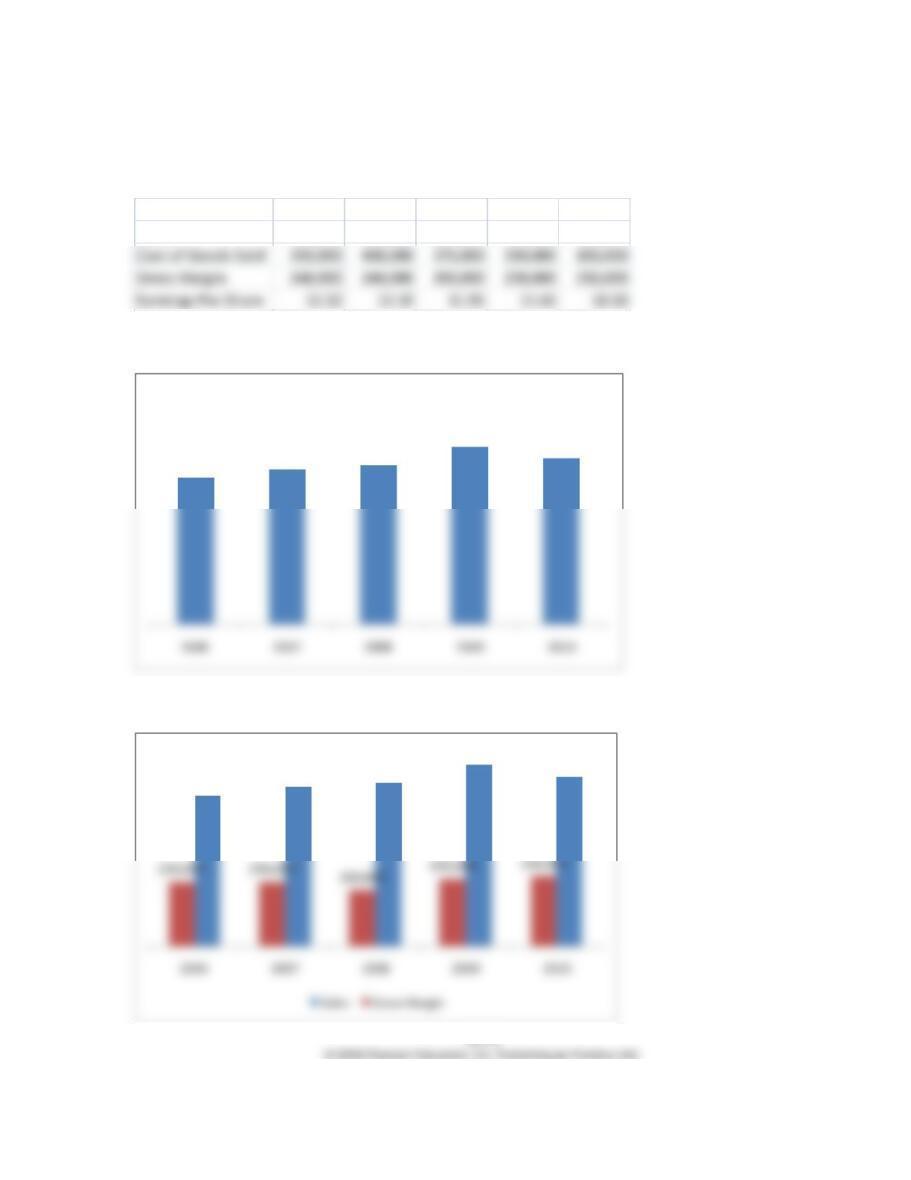
Use the data in Table 16-3 to create the following graphs:
2010 2009 2008 2007 2006
Sales 598,000 640,000 575,000 560,000 530,000
a. Sales
598,000
640,000
575,000
560,000
530,000
Sales
b. Sales and Gross Margin
598,000
640,000
575,000
560,000
530,000
248,000
Ch. 16: General Ledger and Reporting System
16–12
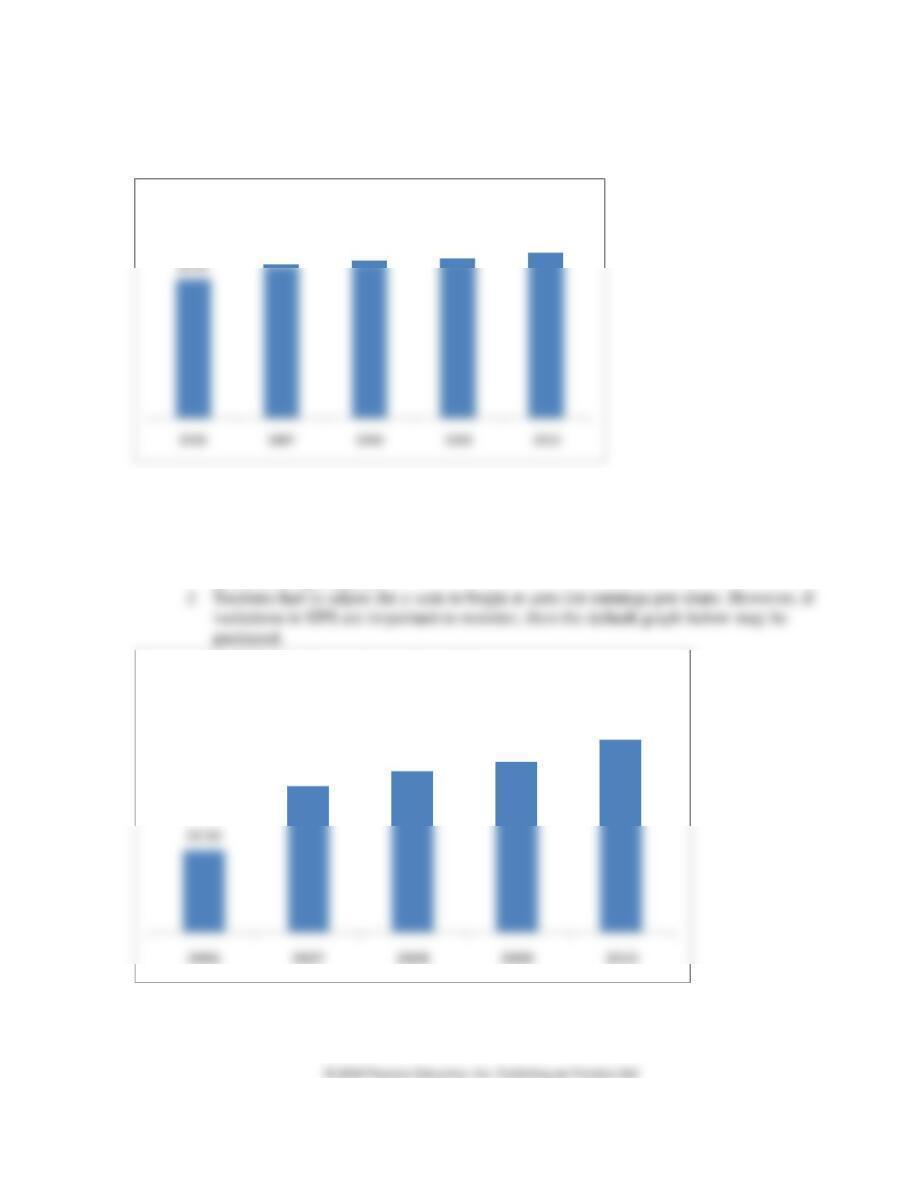
c. Earnings per share
12.52
12.10
11.95
11.66
Earnings Per Share
d. Which principles of graph design, if any, did you have to manually implement to
over-ride the default graphs created by Excel?
1. Students had to reverse the x-axis, which automatically followed the sequence of
years in the spreadsheet.
12.52
12.10
11.95
11.66
Earnings Per Share
Accounting Information Systems
16.9 Excel Problem Objective: Create pivot tables for what-if analysis
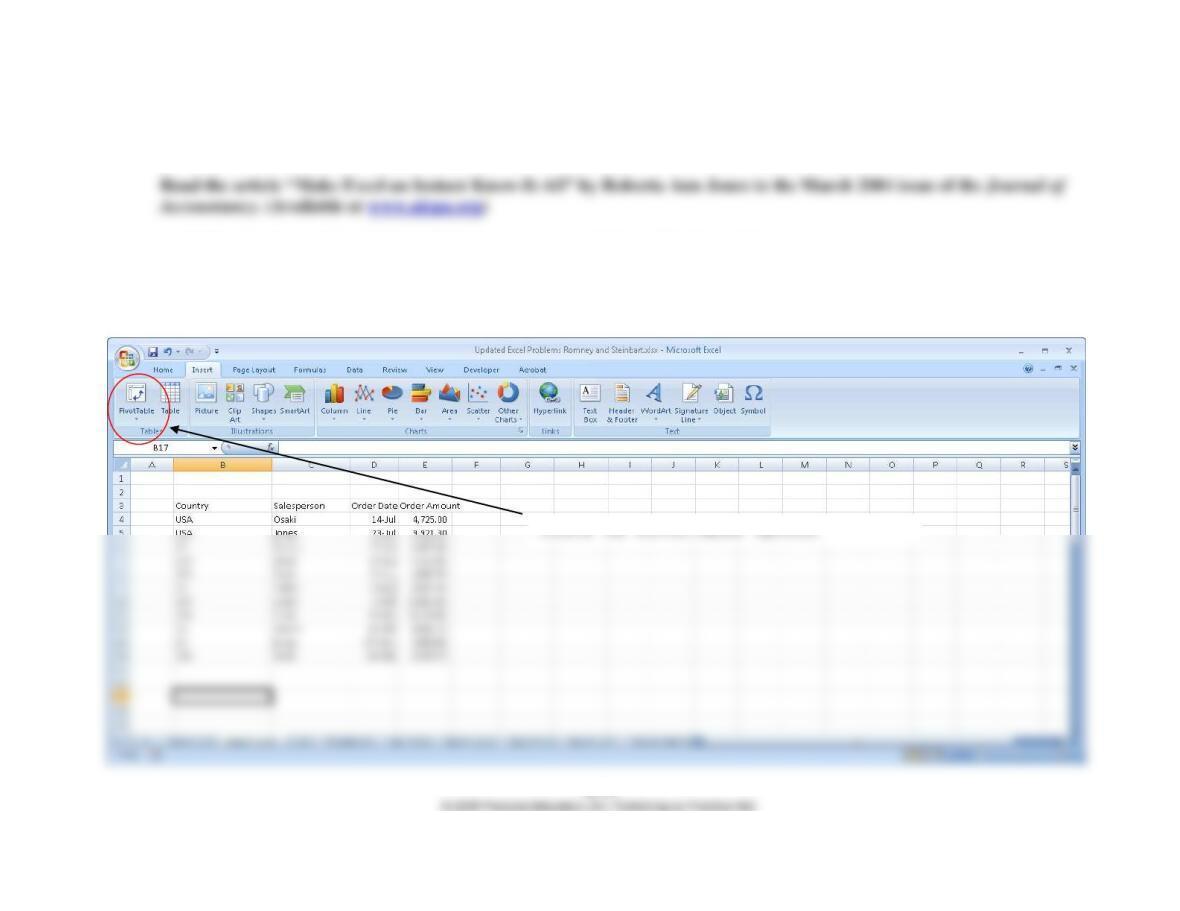
a. Follow the instructions in the article to create a spreadsheet with pivot tables.
First, create the spreadsheet. Then, to create the Pivot Table, position your cursor in a cell where you want the Pivot Table to
appear. Then click on the Insert Tab, and then click on the Pivot Table choice.