chapter
16
Statement of Cash Flows
______________________________________________
OPENING COMMENTS
This chapter demonstrates that the statement of cash flows is necessary for a complete picture of a
company’s financial condition. Both the direct and indirect methods of preparing a statement of cash
flows are presented.
If course timing is restrictive, you may want to cover only one of the two methods of preparing the
statement of cash flows. The indirect method is the most commonly used method for reporting cash
flows. It is very easy to cover only this method since the entire statement of cash flows (including
operating, investing, and financing activities) is presented in Objective 2.
The direct method reports each of the major categories of operating cash receipts and cash payments. If
you choose to cover only the direct method, be aware that Objective 3 illustrates only the operating
activities section of the statement of cash flows. You will still need to refer students to the information on
financing and investing activities in Objective 2.
The chapter ends with a description and illustration of the value of evaluating a company’s free cash flow.
An appendix follows, describing how to use an electronic spreadsheet to develop a statement of cash
flows using the indirect method.
After studying the chapter, your students should be able to:
2. Prepare a statement of cash flows, using the indirect method.
4. Describe and illustrate the use of free cash flow in evaluating a company’s cash flow.

278 Chapter 16 Statement of Cash Flows
STUDENT FAQS
• Why do most preparers of cash flow statements prefer the indirect method?
• I just don’t see a need for the cash flow statement. Who cares about the cash flow statement since it
tells the reader only where the company’s money came from and where the company’s money was
spent?
• Why does the cash flow statement have to equal the change in the cash account?
• Why does only the Operating section of the cash flow statement change when preparing the
statement under the two different methods?
• If the cash flow statement is so important and helpful, why don’t we prepare all the financial
statements on a cash basis?
• Why do we have to prepare a schedule of important noncash items to accompany this statement?
After all, this is the statement that is based on the cash inflows and outflows.
• Why are there two methods to prepare the statement of cash flows?
• Why are gains and losses on disposals of assets treated as adjustments to the cash flows from
operations but the cash part of the transaction is a source of funds under investing? Shouldn’t it all go
under one section?
• Why can’t you assume that a company is financially healthy and liquid if it has a positive cash flow?
OBJECTIVE 1
Describe the cash flow activities reported in the statement of cash flows.
KEY TERMS
Cash Flows from Financing Activities Direct Method
Cash Flows from Investing Activities Indirect Method
Cash Flows from Operating Activities Statement of Cash Flows
Cash Flow per Share
SUGGESTED APPROACH
Provided below is a Writing Exercise to introduce the statement of cash flows. The exercise asks students
to evaluate financial data from two companies. The goal is to point out that a firm’s profits do not paint a
total picture of its operations; cash flow data is also needed. Follow the Writing Exercise (Transparency
Master [TM] 16-1) by reviewing TM 16-2, which lists the benefits of a statement of cash flows. A
Lecture Aid is also provided here for reviewing the content of each section of the cash flow statement.
Chapter 16 Statement of Cash Flows 279
WRITING EXERCISE — Importance of the Statement of Cash Flows
TM 16-1 presents financial information taken from the accounting records of two companies. These
companies have the same net incomes but very different cash flows. Even though both companies have
the same sales, Company B did not collect as much cash from its customers. In addition, Company B did
not invest as much cash in fixed assets; this could inhibit future growth.
Show this data to your students and ask them to comment, in writing, on any strengths or weaknesses they
see in the two companies. After giving them a few minutes to study the information and write their
comments, review their responses.
Possible response: Company B has maintained its cash position by selling fixed assets, while Company
LECTURE AID — Statement of Cash Flows
TMs 16-3 and 16-4 list the three sections of the statement of cash flows and the transactions included in
each section. TM 16-5 defines the content of the schedule of noncash investing and financing activities.
After reviewing these TMs, you may want to discuss the treatment of interest on debt and
interest/dividends on investments in the statement of cash flows. These transactions can be called the
“three foolers,” because students typically want to identify them as financing and investing activities
instead of operating activities. Use TM 16-6 for this purpose.
Have students identify cash flows from operating, investing, and financing activities from their personal
experiences. Some examples are listed below:
Operating activities: Cash inflows from a job, cash outflows for food or rent
Financing activities: Cash inflow from a student loan
Investing activities: Cash outflow for an automobile; cash inflow from selling a motorcycle
OBJECTIVE 2
Prepare a statement of cash flows, using the indirect method.
SUGGESTED APPROACH
Open your discussion of the indirect method with a basic outline of the reconciliation prepared in the
Operating Activities section. TM 16-7 presents an overview of the reconciliation process. You will also
want to illustrate this process by preparing a statement of cash flows as a demonstration problem.
280 Chapter 16 Statement of Cash Flows
LECTURE AID — Indirect Method
During your discussion of TM 16-7 (the reconciliation of net income to net cash flows from operating
activities), stress the following points:
1. Noncash expenses must be added to remove these expenses from net income. They must be removed
from net income because they did not cause cash to be paid out.
Ask your students to identify examples of noncash items reported on the income statement and
whether they would be added to or deducted from net income to determine cash flows from operating
activities. Several examples are listed below.
Noncash Item Treatment
Depreciation Added to net income
2. Any gains or losses on investing and financing activities affect the amount of cash that was received
from selling investments or the amount of cash paid when settling debts. Because these activities are
reported in the investing and financing sections of the statement of cash flows, the gain or loss
3. Changes in current assets and current liability accounts related to operating activities must be
considered to remove the effects of accrual accounting from net income and return to a cash-basis
DEMONSTRATION PROBLEM — Preparing a Statement of Cash Flows:
Indirect Method
Because of the amount of data required to prepare a statement of cash flows, it is appropriate to use a
problem from the text to demonstrate the preparation of the statement of cash flows. If you plan to cover
the direct method of reporting cash flows, use Problem 16-1A or 16-1B to demonstrate the indirect
method. Next, use Problems 16-5A or 16-5B to illustrate the Operating Activities section on a direct
method statement of cash flows. Problems 16-5A and 16-5B provide the additional information needed to
do a direct statement for the same company in 16-1A and 16-1B. Therefore, you can save class time by
Chapter 16 Statement of Cash Flows 281
doing the entire statement under the indirect method but only the Operating Activities section under the
direct method.
Instruct your students to complete a couple of preparatory steps before attacking a cash flow problem.
First, ask them to calculate the increase or decrease for every account on the balance sheet and write it in
the margin of the text. When working through a demonstration problem, give them a few minutes of class
time to complete this step on their own.
You may want to use the following algebraic proof to demonstrate why students need to calculate the
amount by which each account on the balance sheet has increased or decreased:
Assets = Liabilities + Stockholders’ Equity
Cash + Noncash Assets = Liabilities + Stockholders’ Equity
Therefore,
Change in Change in Change in Change in
Cash + Noncash Assets = Liabilities + Stockholders’ Equity
or
Change in Change in Change in Change in
Cash = Liabilities + Stockholders’ Equity – Noncash Assets
If you can explain what caused your Noncash Assets, Liabilities, and Stockholders’ Equity account
balances to change, you have explained what caused the Cash account balance to change.
The second preparatory step is to go through the balance sheet accounts and note where the change in
each account balance will be reported (“O” for operating activities, “I” for investing activities, and “F” for
financing activities). A few accounts, namely Retained Earnings and Accumulated Depreciation, must be
considered when preparing two sections of the statement of cash flows.
You will probably want to lead students through this step, instructing them to place an O, I, or A by each
account title in the example problem. The accounts in Problem 16-1A or 16-1B would be coded as
follows:
Cash (no code—this is the number we are trying to explain)
Accounts Receivable—O
Inventories—O
282 Chapter 16 Statement of Cash Flows
Now your students are ready to attack the problem, beginning with the Operating Activities section.
Students should be encouraged to use a “check–off” method in completing the statement of cash flows.
The basics of the check-off method are as follows: When the total change in an account has been
explained, check it off. Once an account has been checked off, you don’t need to look at it again.
For example, the first step in the operating activities section is to show the amount of net income. This
information is obtained from the income statement or, in accounting class, from the “additional
The next step in the Operating Activities section is to add back any depreciation, amortization, or
depletion. What account on the balance sheet would contain the depreciation for the year? (Answer:
Accumulated Depreciation) However, that account is also affected by entries to remove fixed assets when
At this time, instruct your students to review the additional information given with the problem to look
for any gains and losses on investing and financing activities. Remind them that gains and losses occur
only when assets are sold and liabilities settled. Problem 16-1A has a $30,000 gain on the sale of
investments that must be deducted from net income.
Ask your students to answer the following questions: (1) If there had been a loss of $20,000 on the sale of
investments, how would this be reported in the Operating Activities section of the statement of cash
Now it is time to look at the current assets and current liabilities related to operations. Instruct your
students to go through the accounts coded with “O” and write down whether each account increased or
decreased and by what amount. Then, ask your students to determine whether the change had a positive or
negative effect on cash. Many students want to cling to text Exhibit 4 to assist with this task, so try to give
them a logical approach to determine how account changes affect cash.
The suggested explanations are overly simplified and, therefore, not “totally” accurate. However, most of
your students will find them useful. For example, accounts receivable in Problems 16-1A and 16-1B
increased. A simplified explanation of how this affects cash flows follows:
If accounts receivable went up, did you sell more or less on credit? More. If you sold more on credit, did
you sell more or less for cash? Less. If you sold less on cash, what was the effect on the Cash account? It
decreased. Therefore, the change in accounts receivable is subtracted.
Chapter 16 Statement of Cash Flows 283
When accounts receivable decrease, your explanation is the inverse: The company sold less on credit, so
it sold more for cash and the Cash account is increased. Explanations for changes in other accounts
follow:
1. Increase in Inventory: The company bought more inventory, so it has to pay for more inventory. Cash
is decreased.
3. Increase in Prepaid Expense: The company has prepaid more expenses using its cash. Cash is
decreased.
5. Increase in Accounts Payable: The company has bought more on credit, so it has bought less with
cash. Cash is increased.
6. Decrease in Accounts Payable: The company has bought less on credit, so it is buying more with
cash. Cash is decreased.
OBJECTIVE 3
Prepare a statement of cash flows, using the direct method.
SUGGESTED APPROACH
The direct method of preparing a statement of cash flows is another topic that can be presented effectively
through a Demonstration Problem. If you have already covered the indirect method, you need only to
illustrate the Operating Activities section.
Prior to beginning the Demonstration Problem, stress that the Operating Activities section is the only
portion of the statement of cash flows that varies between the direct and indirect methods. The direct and
indirect methods will report the same amount of net cash flows from operating activities, but the
information is presented in a different format.
When a company chooses to prepare the direct statement of cash flows, it must present the reconciliation
of net income to net cash flows from operating activities (the heart of the indirect method) in a supporting
284 Chapter 16 Statement of Cash Flows
DEMONSTRATION PROBLEM — Preparation of a Statement of Cash Flows:
Direct Method
The direct method presents the major classes of cash receipts and payments from operating activities. To
prepare a direct statement of cash flows, an income statement is needed in addition to comparative
balance sheets. Problems 16-5A and 16-5B repeat the information presented in Problems 16-1A and 16-
1B, plus give an income statement.
When completing a direct statement of cash flows, ask your students to complete the same preparatory
steps discussed in Objective 2—computing changes in account balances and coding accounts with an O, I,
or F (for operating, investing, or financing). The check-off method described previously is also
appropriate when preparing a direct statement of cash flows.
TM 16-8 are a shortcut approach. Students usually need a complete explanation of the calculations for
cash received from customers and cash paid for purchases in order to understand these shortcuts.
For example, Problem 16-5A presents the following data:
Sales $5,261,701 Beg. accounts receivable $156,720
Under the direct method, you must determine the cash collected from customers. The sales reported on
the income statement do not represent cash collections for two reasons: (1) The sales figure includes
credit sales that have not been collected and (2) the sales figure does not include collections on last year’s
credit sales made during the current year. Therefore, sales must be adjusted as follows:
Sales $5,261,701
Again, discourage your students from trying to memorize rules on whether to add or subtract changes in
accounts receivable. Give them a methodology to think through the changes.
The methodology presented under Objective 2 will also work in the direct method. The previous
calculation could be explained as follows:
Chapter 16 Statement of Cash Flows 285
Accounts receivable increased, so the company is selling more on credit and selling less for cash.
Therefore, the effect on cash receipts is negative.
Or:
Accounts receivable increased, indicating that credit sales on account were $14,160 more than cash
collections. Therefore, the increase must be subtracted from sales to get cash receipts.
Under the direct method, you must also determine the cash paid for purchases. Before you can determine
cash paid for purchases, you must know the cost of merchandise purchased. The income statement in
Problem 16-5A does not show the detailed calculation of cost of merchandise sold; therefore, the cost of
merchandise purchased cannot be determined just by looking at the income statement. However, it can be
determined as follows:
Beginning Inventory
Using data from Problem 16-5A:
The cost of merchandise purchased must be adjusted to determine cash payments for purchase:
Cost of merchandise purchased $3,256,450
– Credit purchases not yet paid for (ending balance of
286 Chapter 16 Statement of Cash Flows
Explain that the increase in inventories can be interpreted as increasing cash payments because more
inventory was purchased. The increase in accounts payable can be interpreted as decreasing cash
payments because the company made more purchases on account.
Continue with the problem, demonstrating the calculations of cash paid for operating expenses and cash
paid for income taxes. When you have completed the Operating Activities section, remind students that
the net cash flow is the same number as computed under the indirect method.
Optional discussion: International Financial Reporting Standards (IFRSs). The statement of cash flows
is required under IRFSs and is similar to that required by GAAP. While there are differences, they are
minor in nature. For more information, consult page 744 of the text.
OBJECTIVE 4
Describe and illustrate the use of free cash flow in evaluating a company’s cash flow.
KEY TERMS
Free Cash Flow
SUGGESTED APPROACH
After explaining the concept of free cash flow, calculate free cash flow for Problem 16-1A (or the
problem you used to demonstrate preparing the statement of cash flows.)
DEMONSTRATION PROBLEM — Free Cash Flow
Free cash flow is the amount of operating cash flows left after paying dividends and paying for assets
needed to maintain productive capacity. Free cash flow recognizes that operations must generate
sufficient cash to replace assets used in operations. It also recognizes that shareholders want to see
companies maintain steady dividend payments. The formula for free cash flow is:
If the calculation of free cash flow yields a negative number, a company’s operations cannot support asset
replacement.
Ask your students to review the data given in Problem 16-1A and the completed statement of cash flows
(which should be in their notes) to answer the following questions:
1. What is Charles Inc.’s cash flow from operating activities for 2013? (Answer: $148,280)
2. How much cash was used to pay dividends in 2014? (Answer: $72,000)
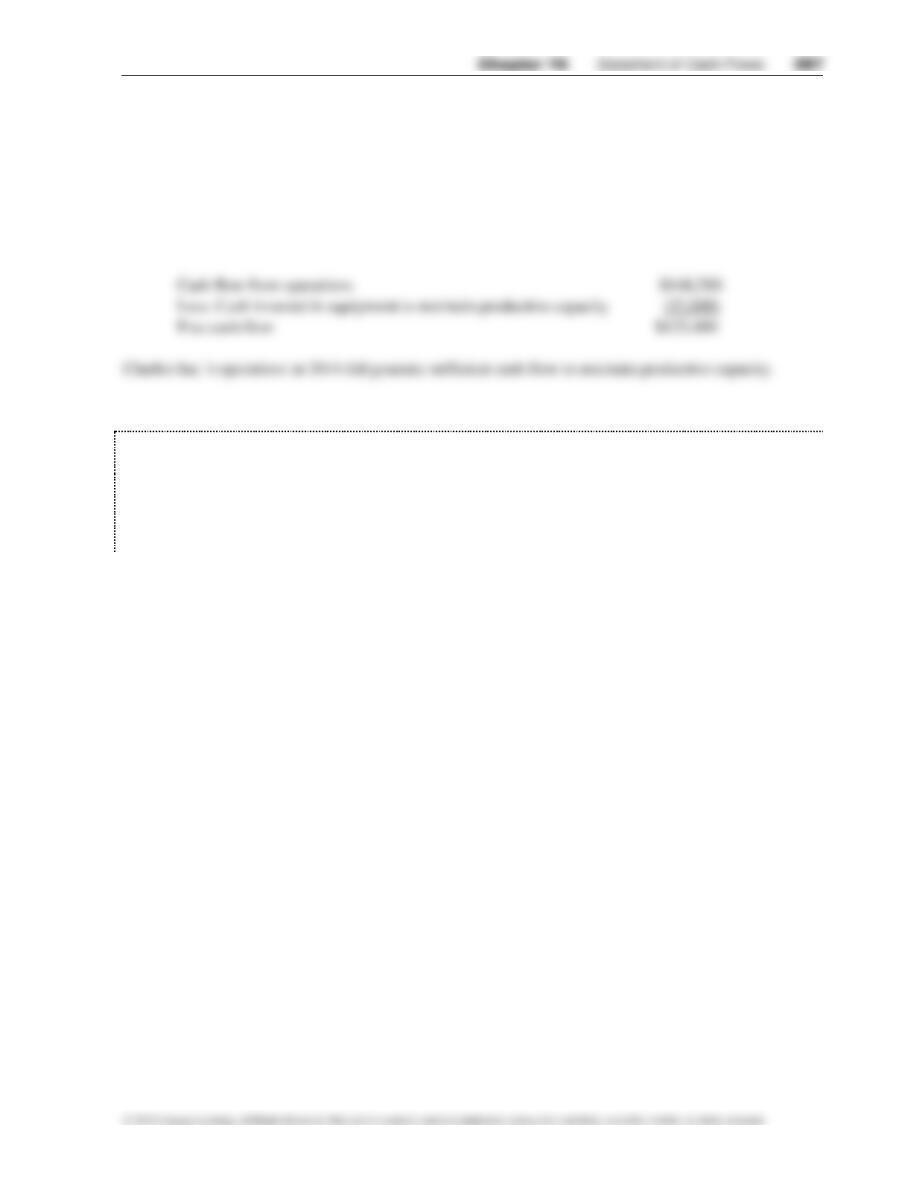
3. What amount of cash was paid to purchase equipment? (Answer: $114,000)
4. Can we assume all of the equipment purchases were to maintain productive capacity? (Answer: No.)
Ask your students to assume that 20 percent of the asset purchases were to maintain productive capacity;
the remaining purchases were made to expand operations. Also, ask your students to assume that the
purchase of land was made to expand operations. Based on these assumptions, free cash flow would be
calculated as follows:
APPENDIX: SPREADSHEET (WORK SHEET)
FOR STATEMENT OF CASH FLOWS — THE
INDIRECT METHOD
SUGGESTED APPROACH
A spreadsheet (work sheet) is a tool that can be used to gather data for preparing a statement of cash
flows. It is an alternative to the “check–off” method presented under Objectives 2 and 3.
The spreadsheet also lends itself to an in-class demonstration. Choose one of the cash flow problems at
the end of the text (such as Problem 16-5A or 16-5B), and ask your students to bring the working papers
for that problem to class. The working papers include a cash flow spreadsheet. Demonstrate completion
of that spreadsheet using the steps outlined in the chapter appendix.
Emphasize that entries recorded on a cash flow spreadsheet are not recorded as journal entries or posted
to the ledger. These entries are made to analyze past transactions and provide data for preparing a
statement of cash flows.
DIFFICULTY BUSPROG AICPA AICPA ACBSP BLOOM’S TIME
Problem
Learning
Objective
Description Primary
Broad
Business
Functional Primary
Spread-
sheet
GL
DQ16-1 16-3 Easy Analytic Measurement Statement of Cash Flows Knowledge 5 min.
DQ16-2 16-2 Easy Analytic Measurement Statement of Cash Flows Knowledge 5 min.
DQ16-3 16-1 Easy Analytic Measurement Statement of Cash Flows Knowledge 5 min.
DQ16-4 16-2 Easy Analytic Measurement Statement of Cash Flows Knowledge 5 min.
DQ16-5 16-2 Easy Analytic Measurement Statement of Cash Flows Knowledge 5 min.
DQ16-7 16-1 Easy Analytic Measurement Statement of Cash Flows Knowledge 5 min.
DQ16-8 16-1 Easy Analytic Measurement Statement of Cash Flows Knowledge 5 min.
DQ16-9 16-2, 16-3 Easy Analytic Measurement Statement of Cash Flows Knowledge 5 min.
DQ16-10 16-1, 16-3 Easy Analytic Measurement Statement of Cash Flows Knowledge 5 min.
PE16-1A 16-1 Classifying cash flows Easy Analytic Measurement Statement of Cash Flows Knowledge 5 min.
PE16-1B 16-1 Classifying cash flows Easy Analytic Measurement Statement of Cash Flows Knowledge 5 min.
PE16-2A 16-2
Adjustments to net
income—indirect method
Easy Analytic Measurement Statement of Cash Flows Application 5 min.
PE16-2B 16-2
income—indirect method
Easy Analytic Measurement Statement of Cash Flows Application 5 min.
Changes in current operating assets
Adjustments to net
PE16-3A 16-2
and liabilities—indirect method
Easy Analytic Measurement Statement of Cash Flows Application 5 min.
PE16-3B 16-2
Changes in current operating assets
and liabilities—indirect method
Easy Analytic Measurement Statement of Cash Flows Application 5 min.
PE16-4A 16-2
Cash flows from operating
activities—indirect method
Easy Analytic Measurement Statement of Cash Flows Application 10 min.
PE16-4B 16-2
Easy Analytic Measurement Statement of Cash Flows Application 10 min.
Land transactions on the statement
Cash flows from operating
PE16-5A 16-2
of cash flows
Easy Analytic Measurement Statement of Cash Flows Application 5 min.
PE16-5B 16-2
Land transactions on the statement
of cash flows
Easy Analytic Measurement Statement of Cash Flows Application 5 min.
PE16-6A 16-3
Cash received from
customers—direct method
Easy Analytic Measurement Statement of Cash Flows Application 5 min.
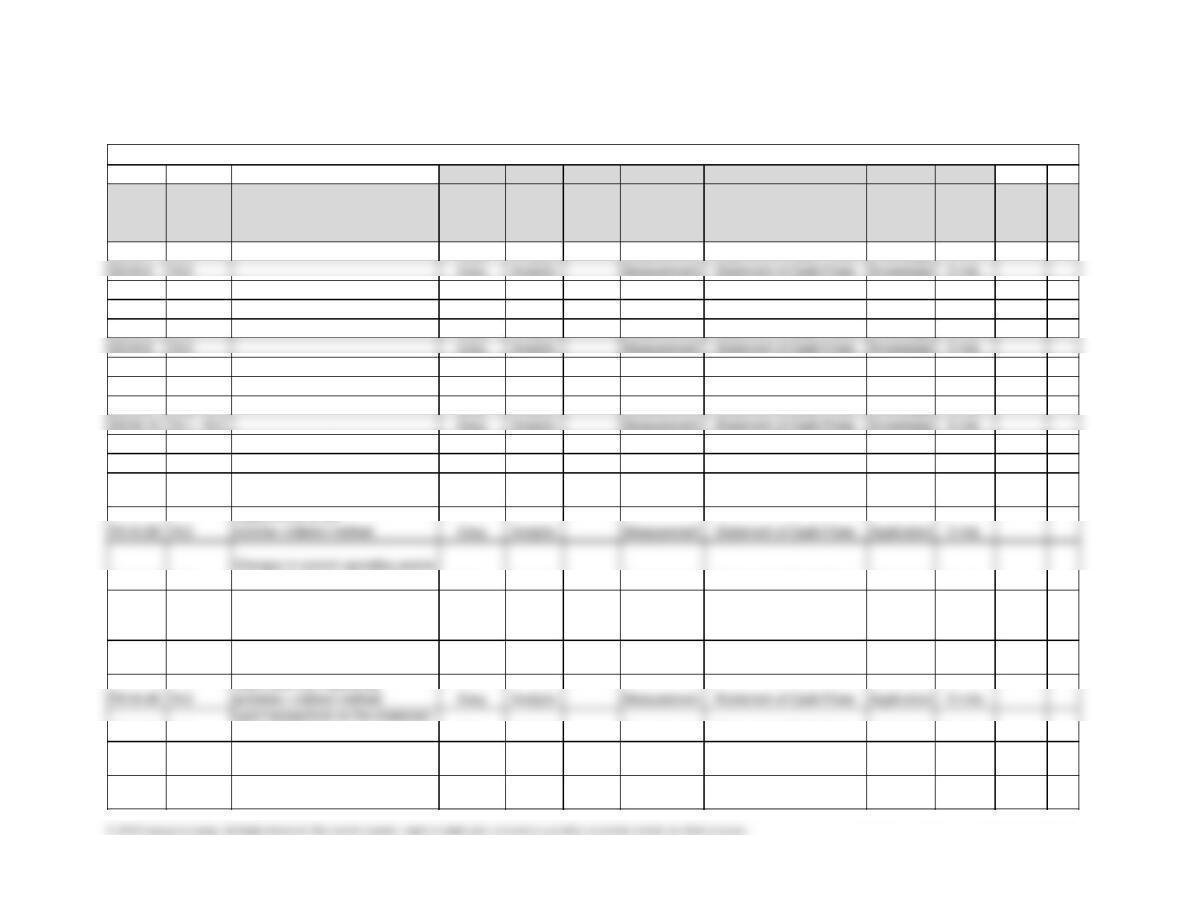
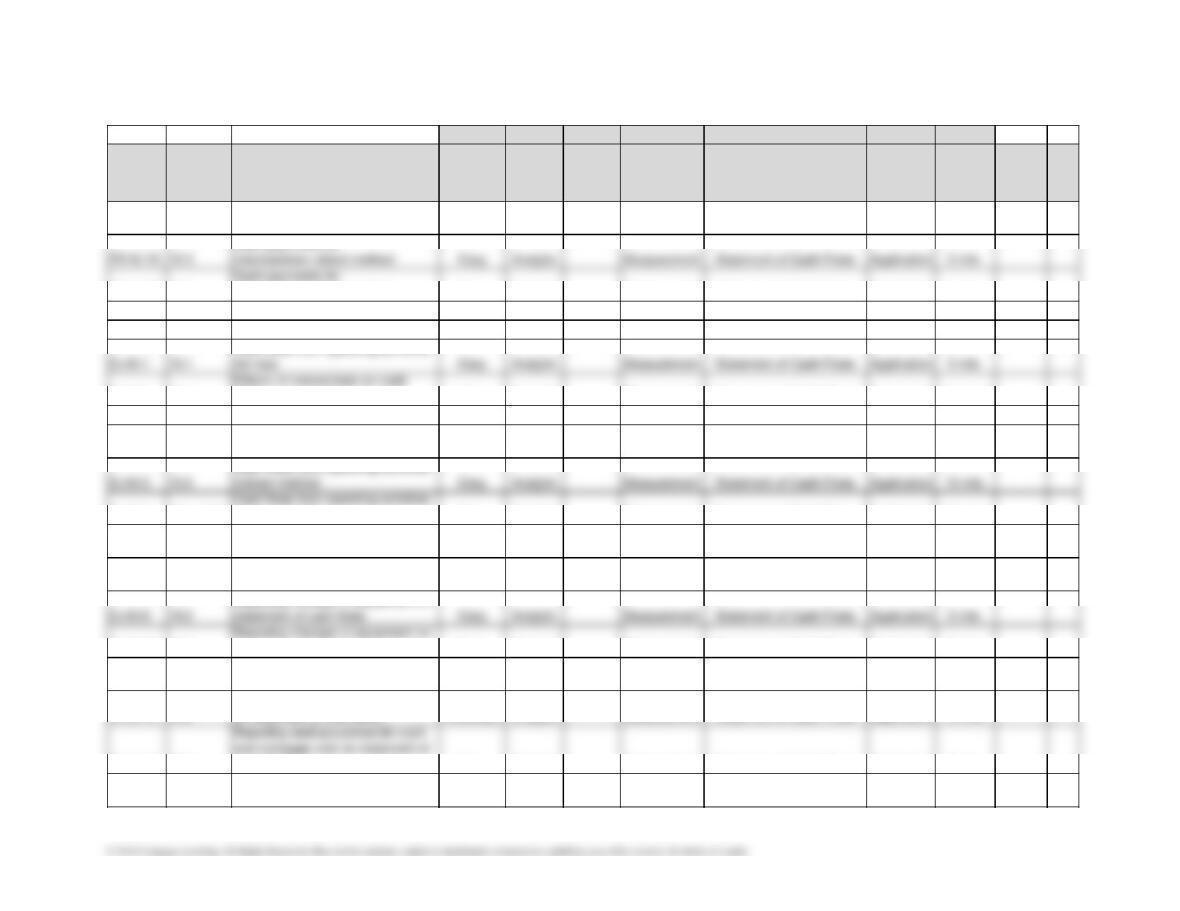
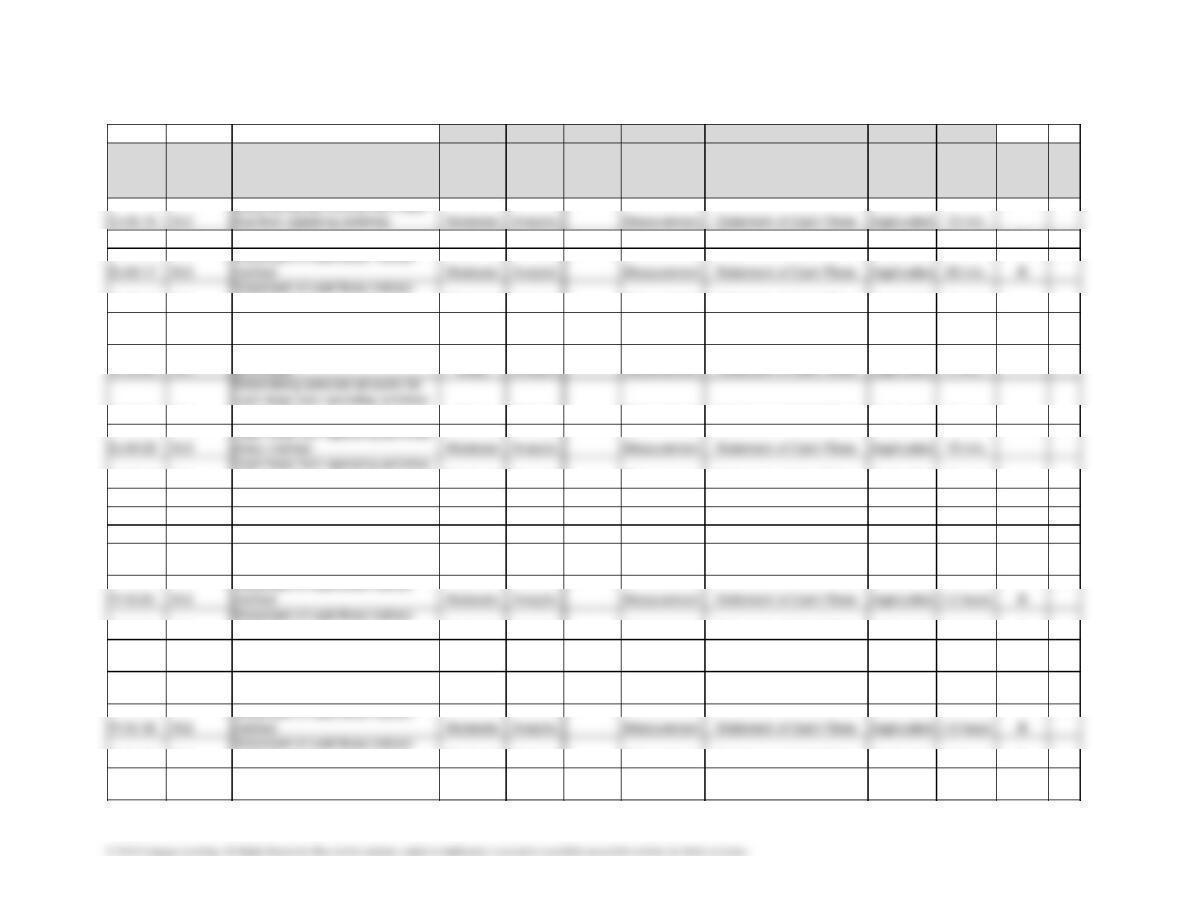
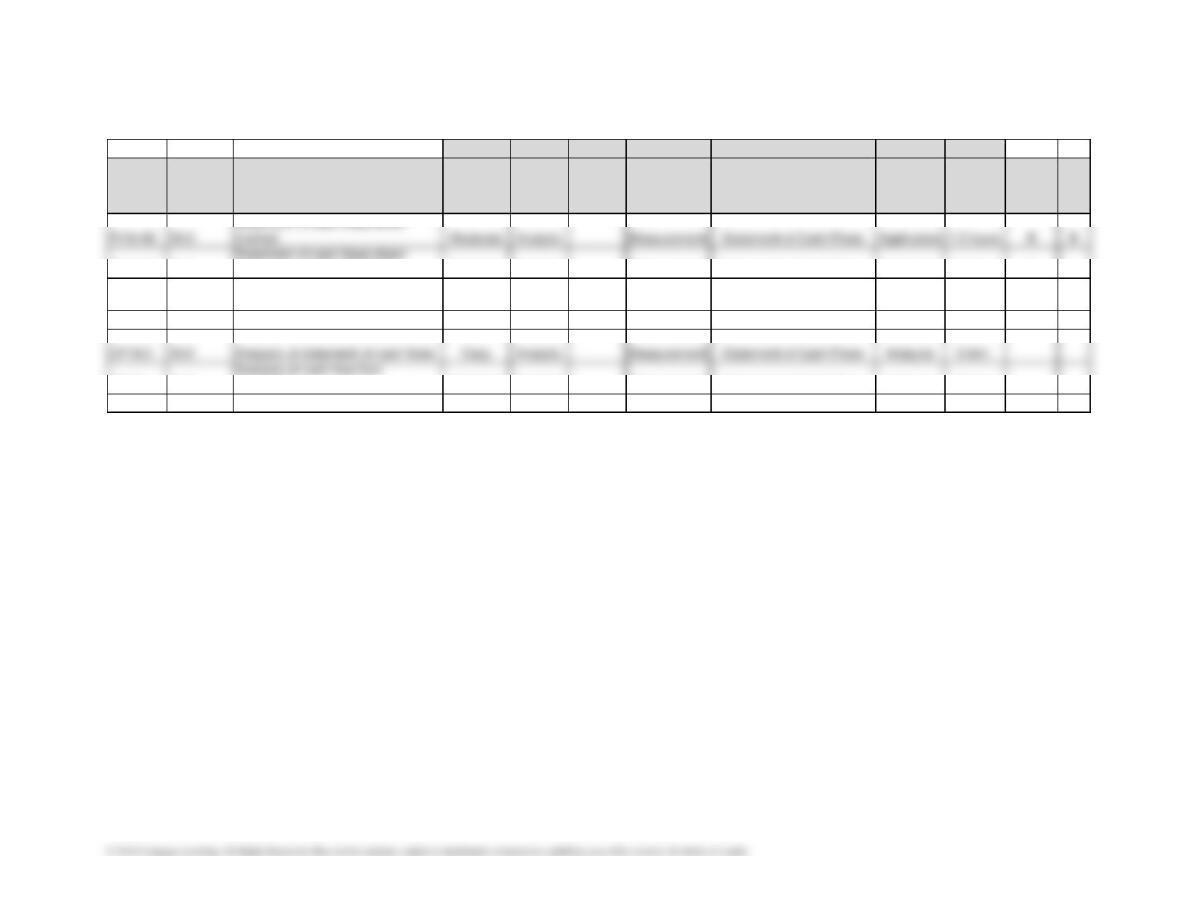
HOMEWORK CHART WITH LEARNING OUTCOMES TAGGING
DIFFICULTY BUSPROG AICPA AICPA ACBSP BLOOM’S TIME
Problem
Learning
Objective
Description Primary
Broad
Business
Functional Primary
Spread-
sheet
GL
PE16-6B 16-3
Cash received from
customers—direct method
Easy Analytic Measurement Statement of Cash Flows Application 5 min.
PE16-7A 16-3
merchandise—direct method
Easy Analytic Measurement Statement of Cash Flows Application 5 min.
Cash payments for
Cash payments for
PE16-7B 16-3
merchandise—direct method
Easy Analytic Measurement Statement of Cash Flows Application 5 min.
PE16-8A 16-4 Free cash flow Easy Analytic Measurement Statement of Cash Flows Application 5 min.
PE16-8B 16-4 Free cash flow Easy Analytic Measurement Statement of Cash Flows Application 5 min.
Ex16-1 16-1
net loss
Easy Analytic Measurement Statement of Cash Flows Application 5 min.
Cash flows from operating activities-
Ex16-2 16-1
flows Easy Analytic Measurement Statement of Cash Flows Application 10 min.
Ex16-3 16-1 Classifying cash flows Easy Analytic Measurement Statement of Cash Flows Knowledge 10 min.
Ex16-4 16-2
Cash flows from operating activities-
indirect method
Easy Analytic Measurement Statement of Cash Flows Knowledge 10 min.
Ex16-5 16-2
indirect method
Easy Analytic Measurement Statement of Cash Flows Application 10 min.
Cash flows from operating activities-
Cash flows from operating activities-
Ex16-6 16-1, 16-2
indirect method
Easy Analytic Measurement Statement of Cash Flows Application 10 min.
Ex16-7 16-1, 16-2
Cash flows from operating activities-
indirect method
Easy Analytic Measurement Statement of Cash Flows Application 10 min.
Ex16-8 16-2
Determining cash payments to
stockholders
Easy Analytic Measurement Statement of Cash Flows Application 5 min.
Ex16-9 16-2
statement of cash flows
Easy Analytic Measurement Statement of Cash Flows Application 5 min.
Reporting changes in equipment on
Reporting changes in equipment on
Ex16-10 16-2
statement of cash flows
Easy Analytic Measurement Statement of Cash Flows Application 5 min.
Ex16-11 16-2
Reporting land transactions on
statement of cash flows
Easy Analytic Measurement Statement of Cash Flows Application 5 min.
Ex16-12 16-2
Reporting stockholders‘ equity items
on statement of cash flows
Moderate Analytic Measurement Statement of Cash Flows Application 10 min.
Ex16-13 16-2
and mortgage note on statement of
cash flows
Easy Analytic Measurement Statement of Cash Flows Application 5 min.
Ex16-14 16-2
Reporting issuance and retirement
of long-term debt
Moderate Analytic Measurement Statement of Cash Flows Application 10 min.
DIFFICULTY BUSPROG AICPA AICPA ACBSP BLOOM’S TIME
Problem
Learning
Objective
Description Primary
Broad
Business
Functional Primary
Spread–
sheet
GL
flow from operating activities
Cash flows from operating activities-
Determining net income from cash
Ex16-16 16-2
indirect method
Moderate Analytic Measurement Statement of Cash Flows Application 15 min. X
Ex16-17 16-2
Statement of cash flows– indirect
method
Moderate Analytic Measurement Statement of Cash Flows Application 20 min. X
Statement of cash flows-indirect
Ex16-18 16-2
method
Moderate Analytic Measurement Statement of Cash Flows Application 15 min.
Ex16-19 16-3
Cash flows from operating activities-
direct method
Easy Analytic Measurement Statement of Cash Flows Application 5 min.
Ex16-20 16-3
Cash paid for merchandise
purchases
Easy Analytic Measurement Statement of Cash Flows Application 5 min.
Ex16-21 16-3
cash flows from operating activities–
direct method
Easy Analytic Measurement Statement of Cash Flows Application 10 min.
Ex16-22 16-3
Cash flows from operating activities-
direct method
Moderate Analytic Measurement Statement of Cash Flows Application 15 min.
Cash flows from operating activities-
Ex16-23 16-3
direct method
Moderate Analytic Measurement Statement of Cash Flows Application 15 min.
Ex16-24 16-4 Free cash flow Easy Analytic Measurement Statement of Cash Flows Application 5 min.
Ex16-25 16-4 Free cash flow Easy Analytic Measurement Statement of Cash Flows Application 5 min.
Ex16-26 16-4 Free cash flow Easy Analytic Measurement Statement of Cash Flows Application 5 min.
Pr16-1A 16-2
Statement of cash flows-indirect
method
Moderate Analytic Measurement Statement of Cash Flows Application 1.5 hours X
Pr16-2A 16-2
method
Moderate Analytic Measurement Statement of Cash Flows Application 1.5 hours X
Statement of cash flows-indirect
Statement of cash flows-indirect
Pr16-3A 16-2
method
Moderate Analytic Measurement Statement of Cash Flows Application 1.5 hours X
Pr16-4A 16-3
Statement of cash flows-direct
method
Moderate Analytic Measurement Statement of Cash Flows Application 1.5 hours X X
Pr16-5A 16-3
Statement of cash flows-direct
method applied to PR 16-1A
Moderate Analytic Measurement Statement of Cash Flows Application 1.5 hours X
Pr16-1B 16-2
Statement of cash flows-indirect
method
Moderate Analytic Measurement Statement of Cash Flows Application 1.5 hours X
Statement of cash flows-indirect
Pr16-2B 16-2
method
Moderate Analytic Measurement Statement of Cash Flows Application 1.5 hours X
Pr16-3B 16-2
Statement of cash flows-indirect
method
Moderate Analytic Measurement Statement of Cash Flows Application 1.5 hours X
DIFFICULTY BUSPROG AICPA AICPA ACBSP BLOOM’S TIME
Problem
Learning
Objective
Description Primary
Broad
Business
Functional Primary
Spread-
sheet
GL
Pr16-5B 16-3
method applied to PR 16-1B
Moderate Analytic Measurement Statement of Cash Flows Application 1.5 hours X
CP16-1 16-1
Ethics and professional conduct in
business
Easy Ethics Industry Statement of Cash Flows Analysis 5 min.
CP16-2 16-1 Using the statement of cash flows Easy Analytic Measurement Statement of Cash Flows Analysis 5 min.
CP16-3 16-2 Analysis of statement of cash flows Easy Analytic Measurement Statement of Cash Flows Analysis 5 min.
CP16-4 16-2
operations
Moderate Analytic Measurement Statement of Cash Flows Analysis 20 min.
CP16-5 16-4 Statement of cash flows Moderate Analytic Measurement Statement of Cash Flows Application 45 min.