16-21
SOLUTION
16-22
16-23 (20 min.) Joint cost allocation: sell immediately or process further.
Illinois Soy Products (ISP) buys soybeans and processes them into other soy products. Each ton
of soybeans that ISP purchases for $340 can be converted for an additional $190 into 575 pounds
of soy meal and 160 gallons of soy oil. A pound of soy meal can be sold at splitoff for $1.24 and
soy oil can be sold in bulk for $4.25 per gallon.
ISP can process the 575 pounds of soy meal into 725 pounds of soy cookies at an additional
cost of $380. Each pound of soy cookies can be sold for $2.24 per pound. The 160 gallons of soy
oil can be packaged at a cost of $240 and made into 640 quarts of Soyola. Each quart of Soyola
can be sold for $1.35.
16-23
Required:
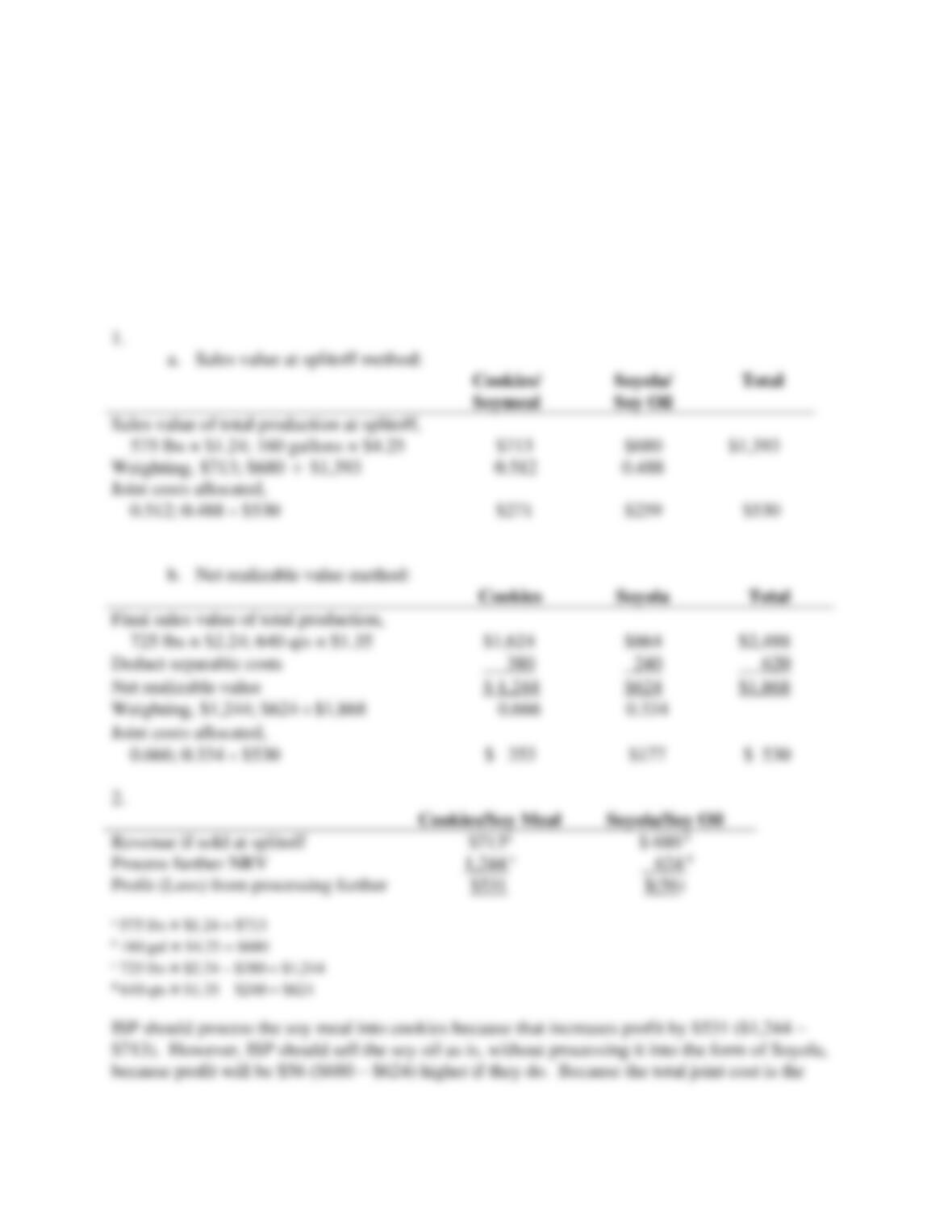
1. Allocate the joint cost to the cookies and the Soyola using the following:
a. Sales value at splitoff method
b. NRV method
2. Should ISP have processed each of the products further? What effect does the allocation
method have on this decision?
SOLUTION
16-24
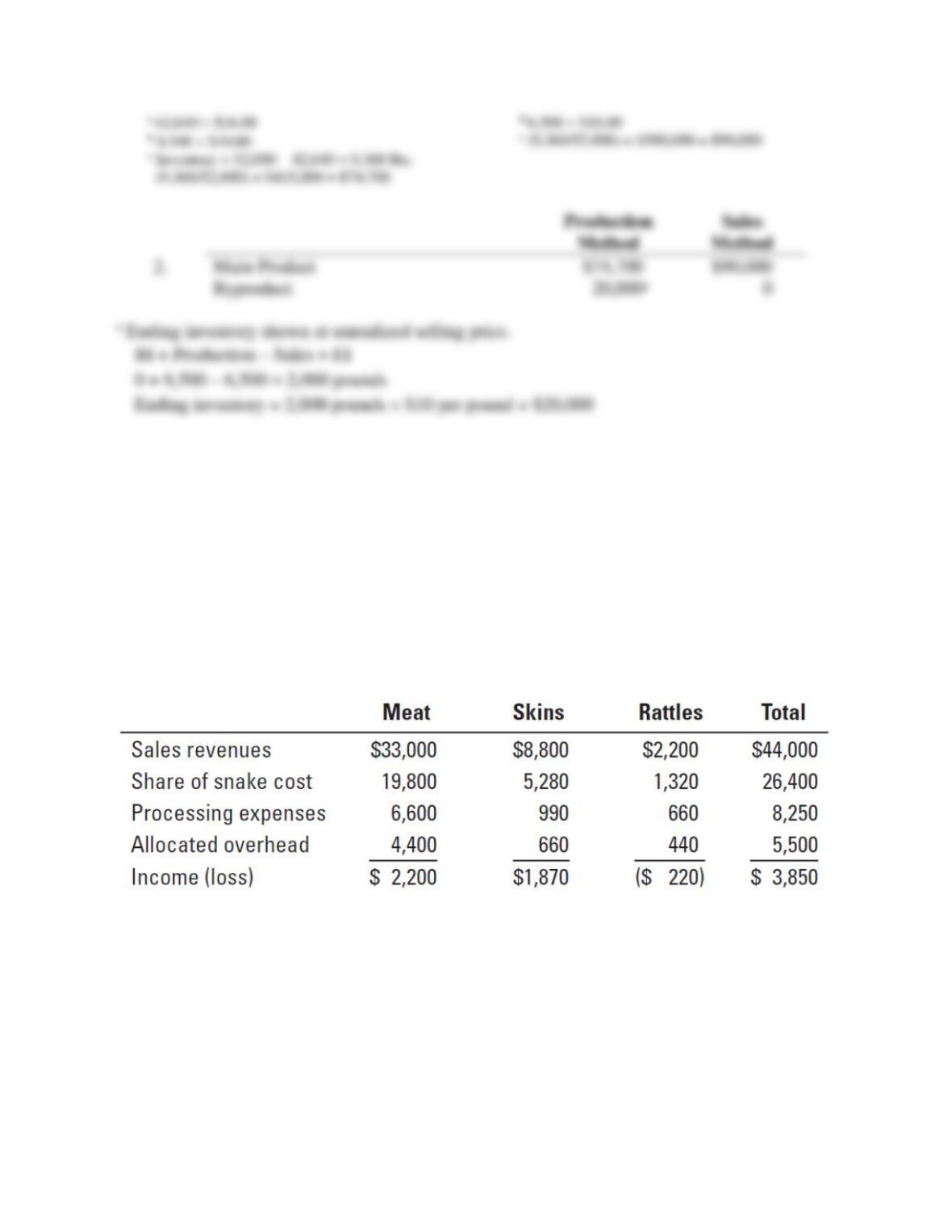
16-24 (30 min.) Accounting for a main product and a byproduct.
(Cheatham and Green, adapted) Tasty, Inc., is a producer of potato chips. A single production
process at Tasty, Inc., yields potato chips as the main product and a byproduct that can also be
sold as a snack. Both products are fully processed by the splitoff point, and there are no
separable costs.
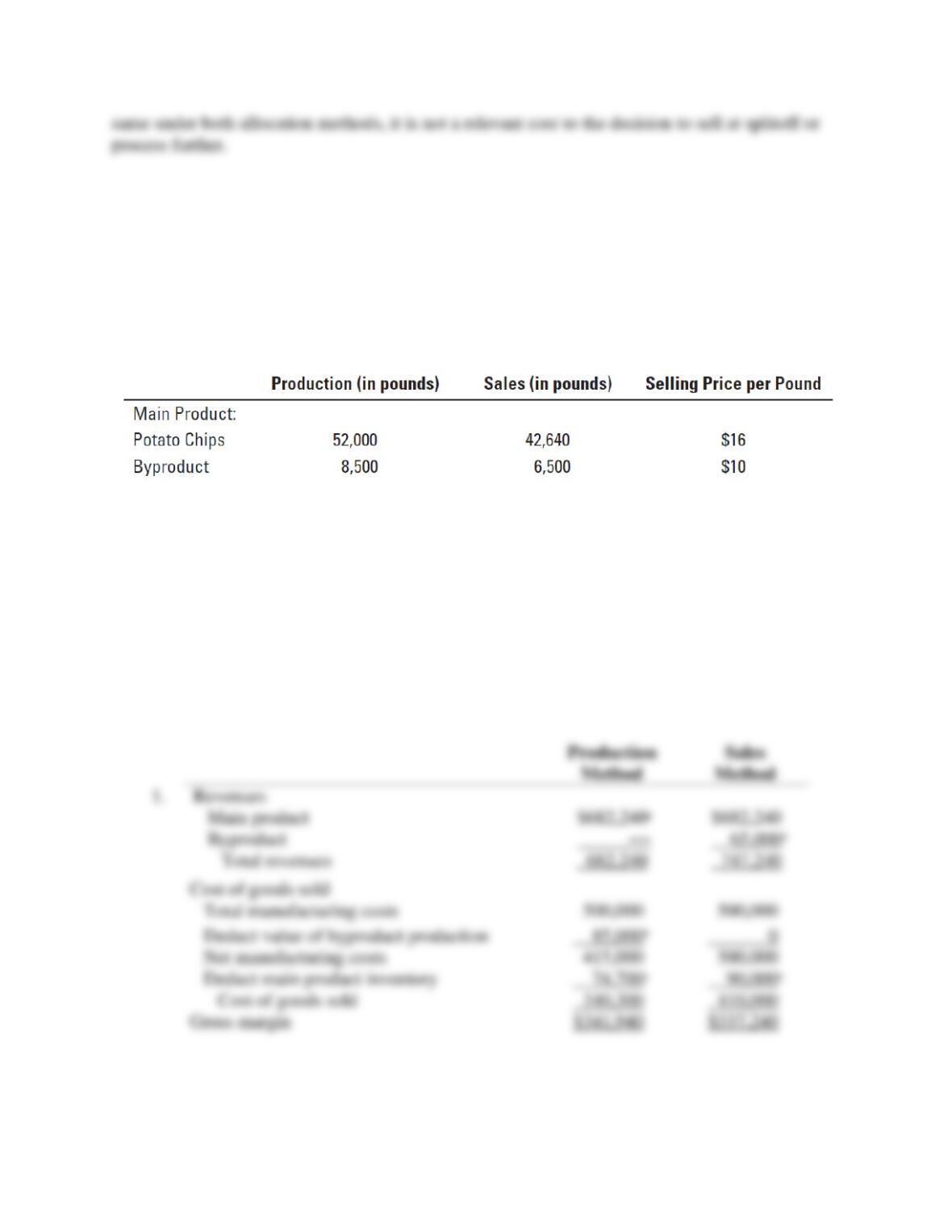
For September 2014, the cost of operations is $500,000. Production and sales data are as
follows:
There were no beginning inventories on September 1, 2014.
Required:
1. What is the gross margin for Tasty, Inc., under the production method and the sales method
of byproduct accounting?
2. What are the inventory costs reported in the balance sheet on September 30, 2014, for the
main product and byproduct under the two methods of byproduct accounting in requirement
1?
SOLUTION
16-25
16-25 (20 min.) Joint costs and decision making.
Jack Bibby is a prospector in the Texas Panhandle. He has also been running a side business for
the past couple of years. Based on the popularity of shows such as “Rattlesnake Nation,” there
has been a surge of interest from professionals and amateurs to visit the northern counties of
Texas to capture snakes in the wild. Jack has set himself up as a purchaser of these captured
snakes.
Jack purchases rattlesnakes in good condition from “snake hunters” for an average of $11 per
snake. Jack produces canned snake meat, cured skins, and souvenir rattles, although he views
snake meat as his primary product. At the end of the recent season, Jack Bibby evaluated his
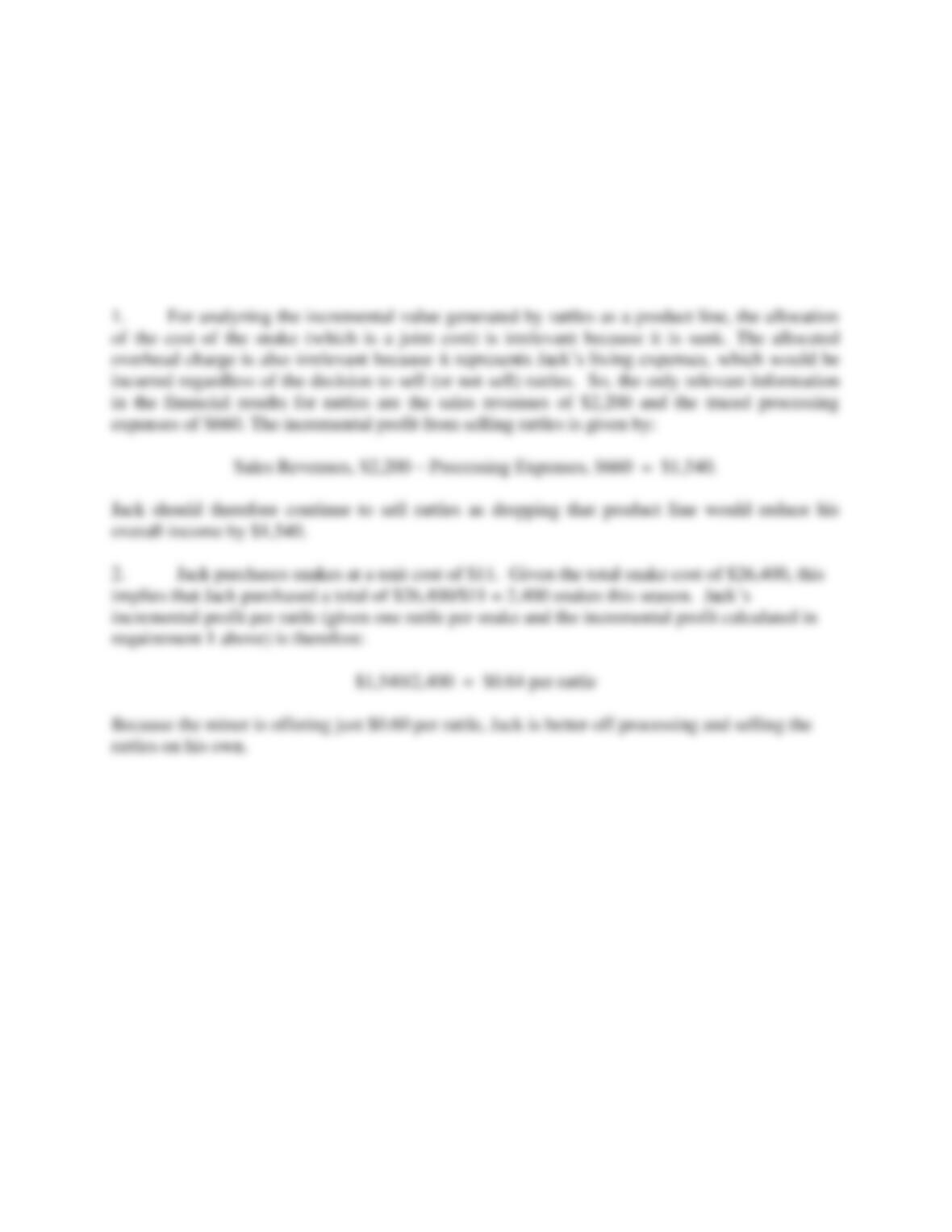
financial results:
The cost of snakes is assigned to each product line using the relative sales value of meat,
skins, and rattles (i.e., the percentage of total sales generated by each product). Processing
expenses are directly traced to each product line. Overhead costs represent Jack’s basic living
expenses. These are allocated to each product line on the basis of processing expenses.
Jack has a philosophy of every product line paying for itself and is determined to cut his
losses on rattles.
Required:
16-26
1. Should Jack Bibby drop rattles from his product offerings? Support your answer with
computations.
2. An old miner has offered to buy every rattle “as is” for $0.60 per rattle (note: “as is” refers to
the situation where Jack only removes the rattle from the snake and no processing costs are
incurred). Assume that Jack expects to process the same number of snakes each season.
Should he sell rattles to the miner? Support your answer with computations.
SOLUTION
16-26 (35-45 min.) Joint costs and byproducts.
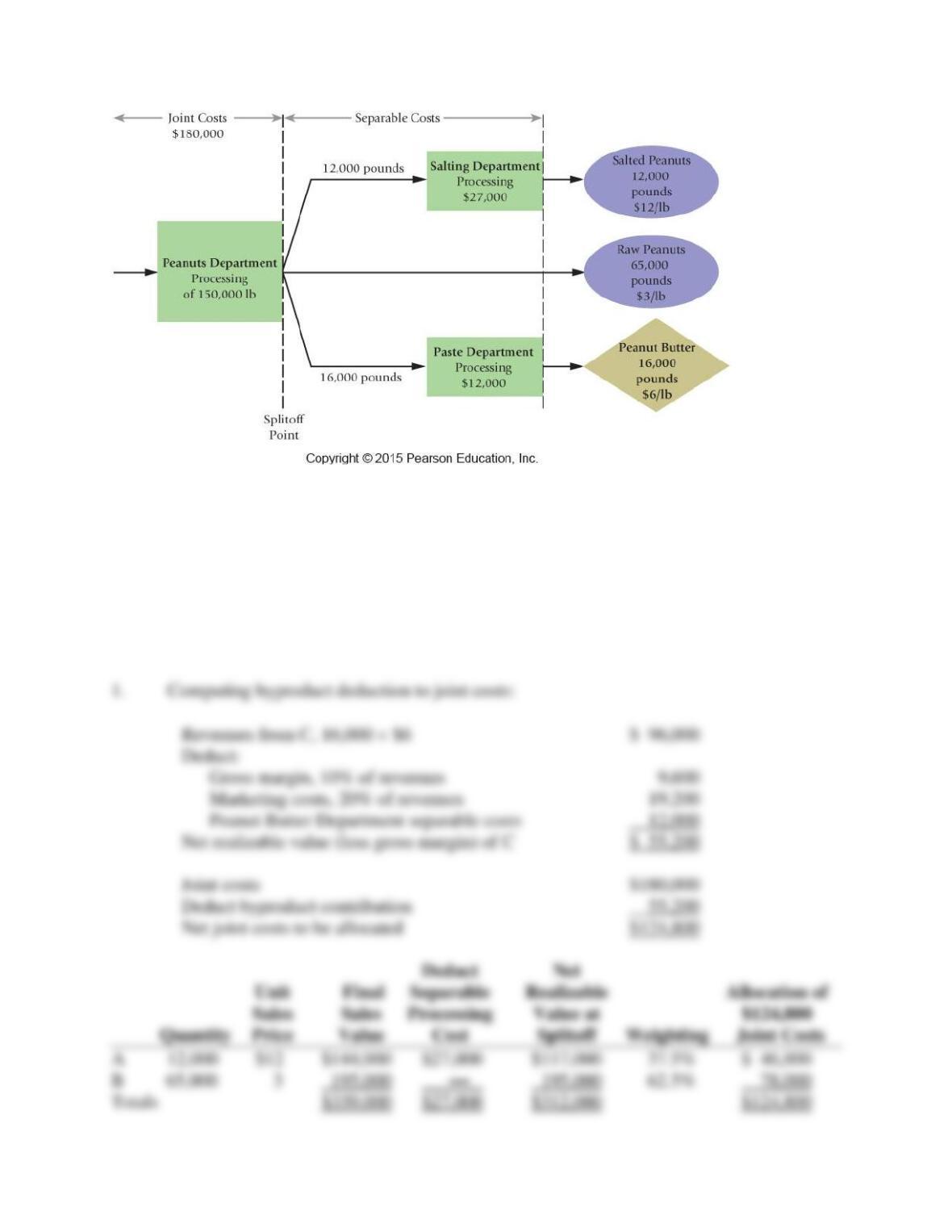
(W. Crum adapted) Royston, Inc., is a large food-processing company. It processes 150,000
pounds of peanuts in the peanuts department at a cost of $180,000 to yield 12,000 pounds of
product A, 65,000 pounds of product B, and 16,000 pounds of product C.
▪ Product A is processed further in the salting department to yield 12,000 pounds of salted
peanuts at a cost of $27,000 and sold for $12 per pound.
▪ Product B (raw peanuts) is sold without further processing at $3 per pound.
▪ Product C is considered a byproduct and is processed further in the paste department to yield
16,000 pounds of peanut butter at a cost of $12,000 and sold for $6 per pound.
The company wants to make a gross margin of 10% of revenues on product C and needs to allow
20% of revenues for marketing costs on product C. An overview of operations follows:
16-27
Required:
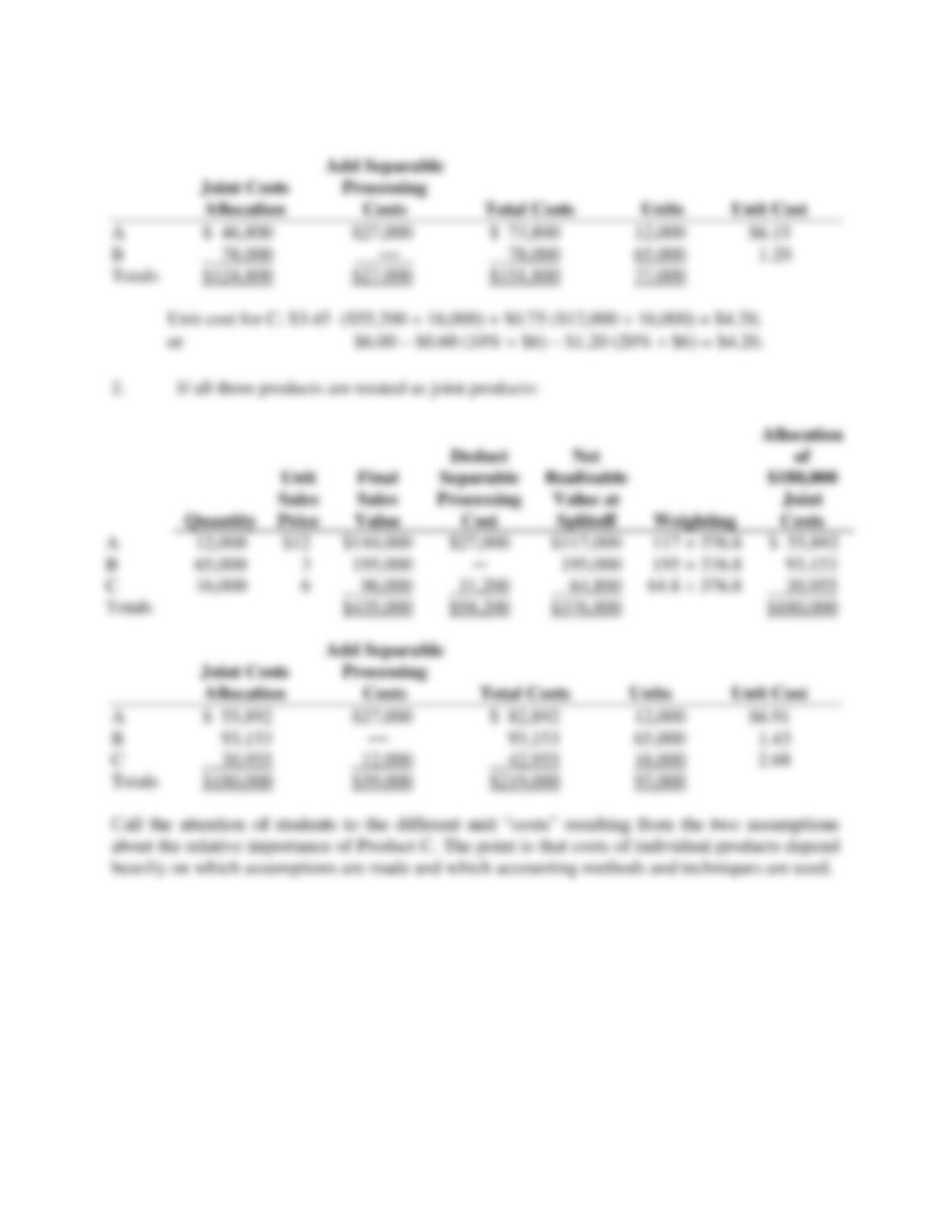
1. Compute unit costs per pound for products A, B, and C, treating C as a byproduct. Use the
NRV method for allocating joint costs. Deduct the NRV of the byproduct produced from the
joint cost of products A and B.
2. Compute unit costs per pound for products A, B, and C, treating all three as joint products
and allocating joint costs by the NRV method.
SOLUTION
16-28
16-27 (25 min.) Methods of joint-cost allocation, ending inventory.
Tivoli Labs produces a drug used for the treatment of hypertension. The drug is produced in
batches. Chemicals costing $60,000 are mixed and heated, creating a reaction; a unique
separation process then extracts the drug from the mixture. A batch yields a total of 2,500 gallons
of the chemicals. The first 2,000 gallons are sold for human use while the last 500 gallons, which
contain impurities, are sold to veterinarians.
The costs of mixing, heating, and extracting the drug amount to $90,000 per batch. The output
sold for human use is pasteurized at a total cost of $120,000 and is sold for $585 per gallon. The
16-29
product sold to veterinarians is irradiated at a cost of $10 per gallon and is sold for $410 per
gallon.
In March, Tivoli, which had no opening inventory, processed one batch of chemicals. It sold
1,700 gallons of product for human use and 300 gallons of the veterinarian product. Tivoli uses
the net realizable value method for allocating joint production costs.
Required:
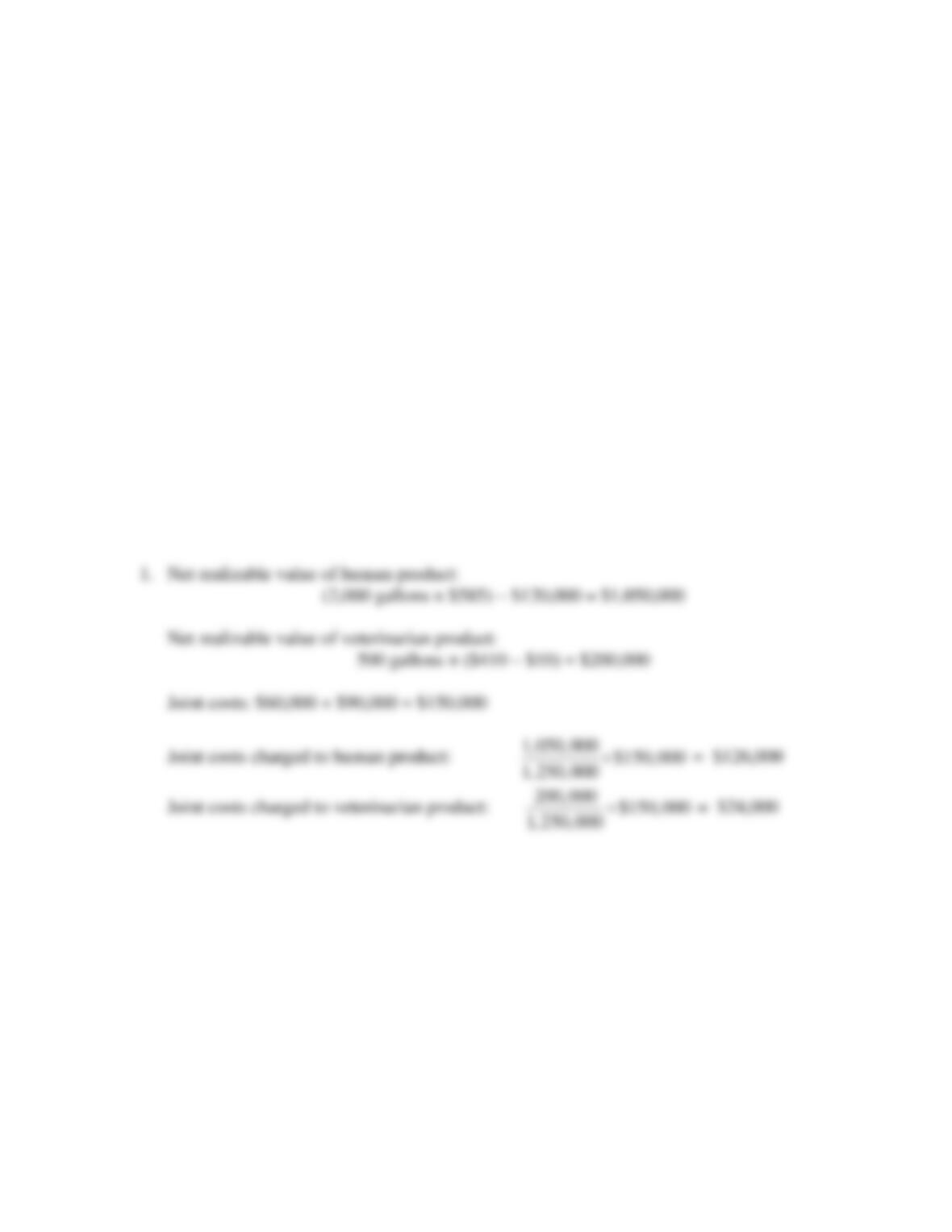
1. How much in joint costs does Tivoli allocate to each product?
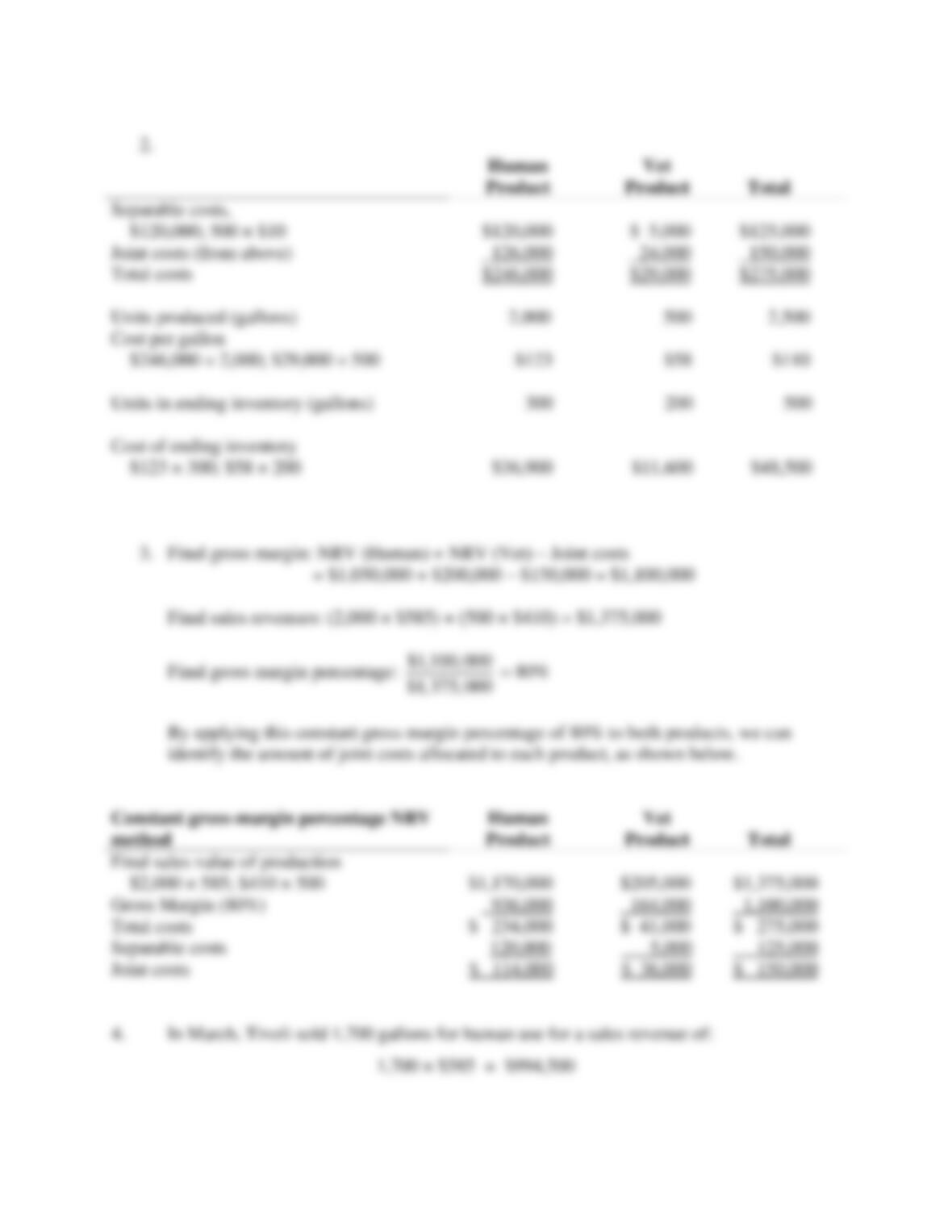
2. Compute the cost of ending inventory for each of Tivoli’s products.
3. If Tivoli were to use the constant gross-margin percentage NRV method instead, how would
it allocate its joint costs?
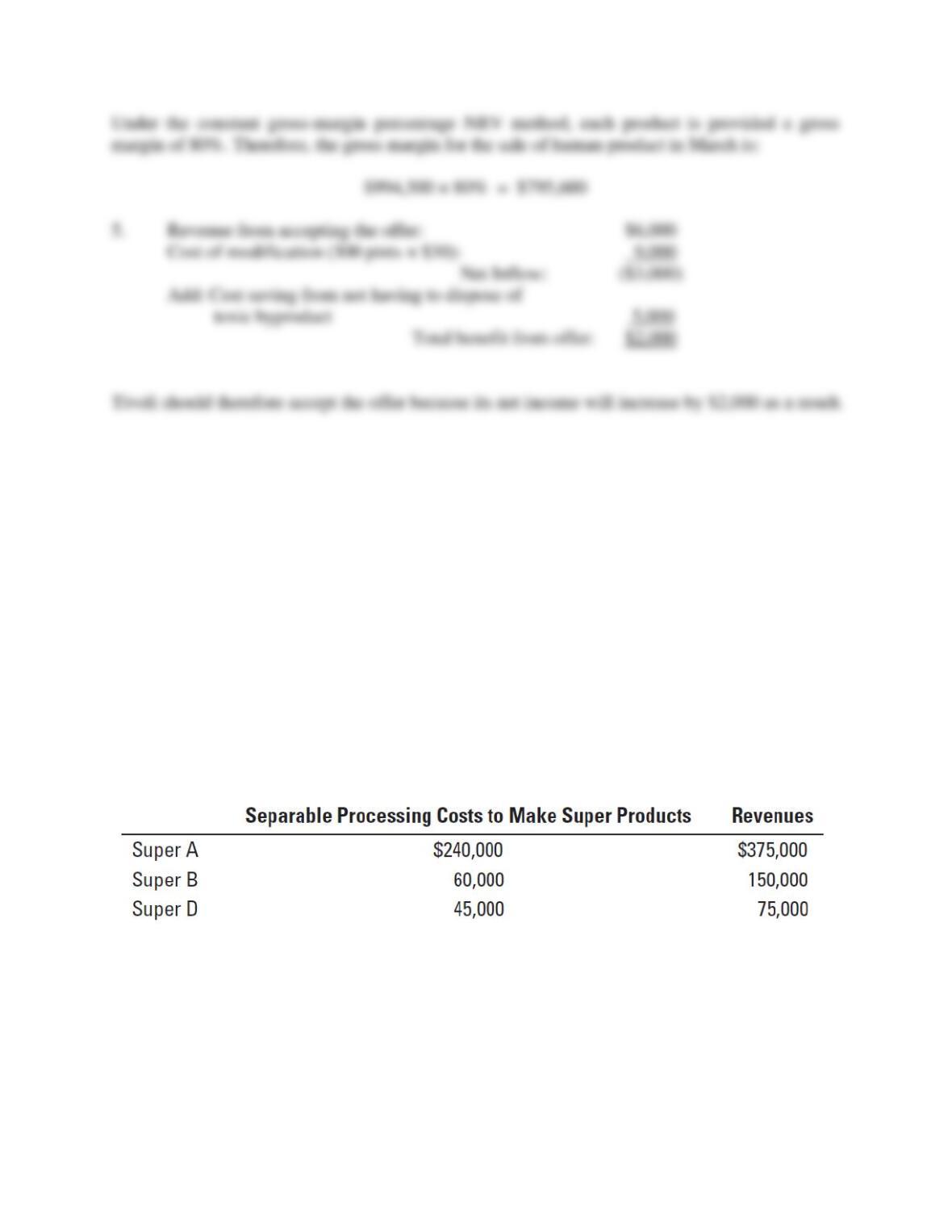
4. Calculate the gross margin on the sale of the product for human use in March under the
constant gross-margin percentage NRV method.
5. Suppose that the separation process also yields 300 pints of a toxic byproduct. Tivoli
currently pays a hauling company $5,000 to dispose of this byproduct. Tivoli is contacted by
a firm interested in purchasing a modified form of this byproduct for a total price of $6,000.
Tivoli estimates that it will cost about $30 per pint to do the required modification. Should
Tivoli accept the offer?
SOLUTION
16-30
16-31
16-28 (40 min.) Alternative methods of joint-cost allocation, product-mix decisions.
The Eastern Oil Company buys crude vegetable oil. Refining this oil results in four products at
the splitoff point: A, B, C, and D. Product C is fully processed by the splitoff point. Products A,
B, and D can individually be further refined into Super A, Super B, and Super D. In the most
recent month (December), the output at the splitoff point was as follows:
▪ Product A, 275,000 gallons
▪ Product B, 100,000 gallons
▪ Product C, 75,000 gallons
▪ Product D, 50,000 gallons
The joint costs of purchasing and processing the crude vegetable oil were $105,000. Eastern had
no beginning or ending inventories. Sales of product C in December were $45,000. Products A,
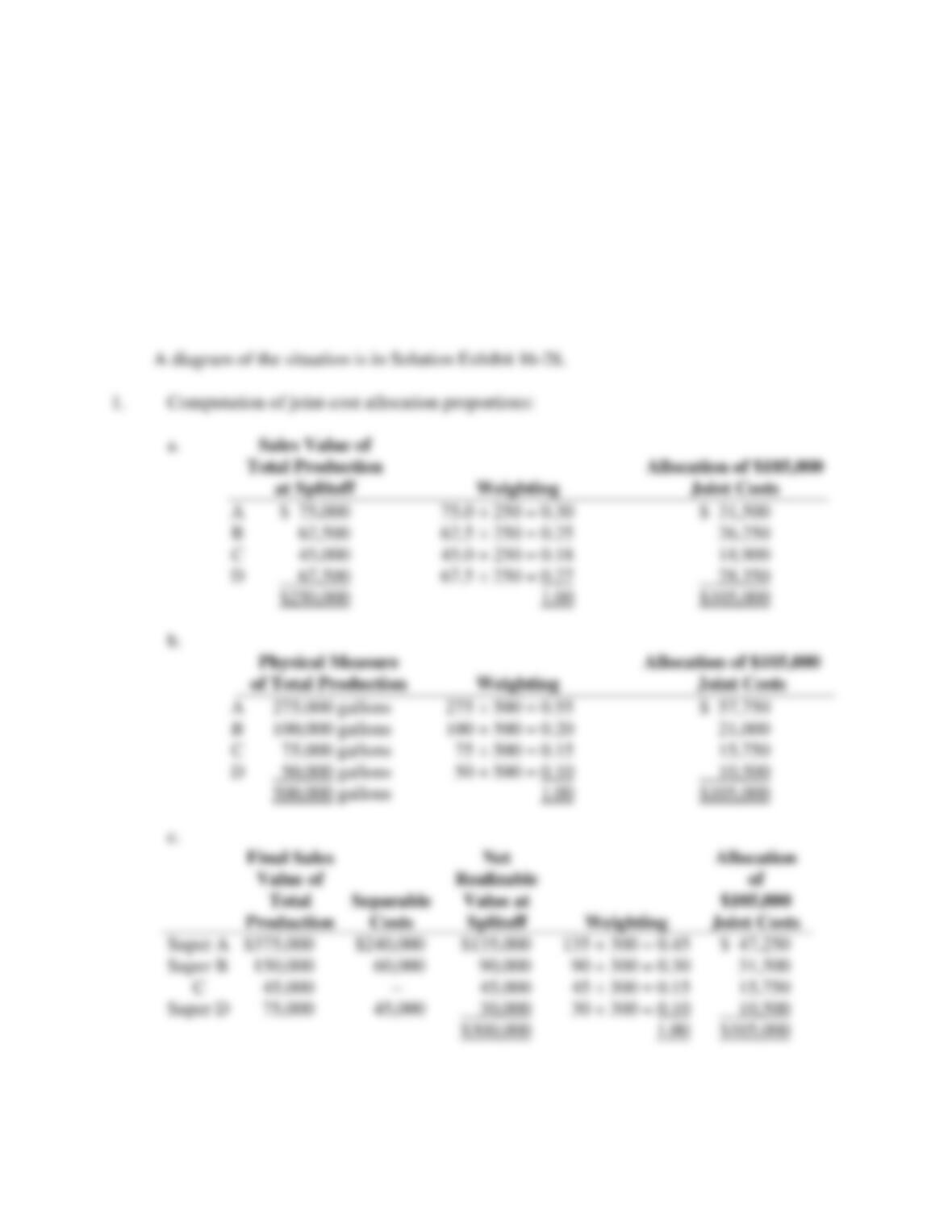
B, and D were further refined and then sold. Data related to December are as follows:
Eastern had the option of selling products A, B, and D at the splitoff point. This alternative
would have yielded the following revenues for the December production:
▪ Product A, $75,000
▪ Product B, $62,500
▪ Product D, $67,500
Required:
16-32
1. Compute the gross-margin percentage for each product sold in December, using the
following methods for allocating the $105,000 joint costs:
a. Sales value at splitoff
b. Physical-measure
c. NRV
2. Could Eastern have increased its December operating income by making different decisions
about the further processing of products A, B, or D? Show the effect on operating income of
any changes you recommend.
SOLUTION
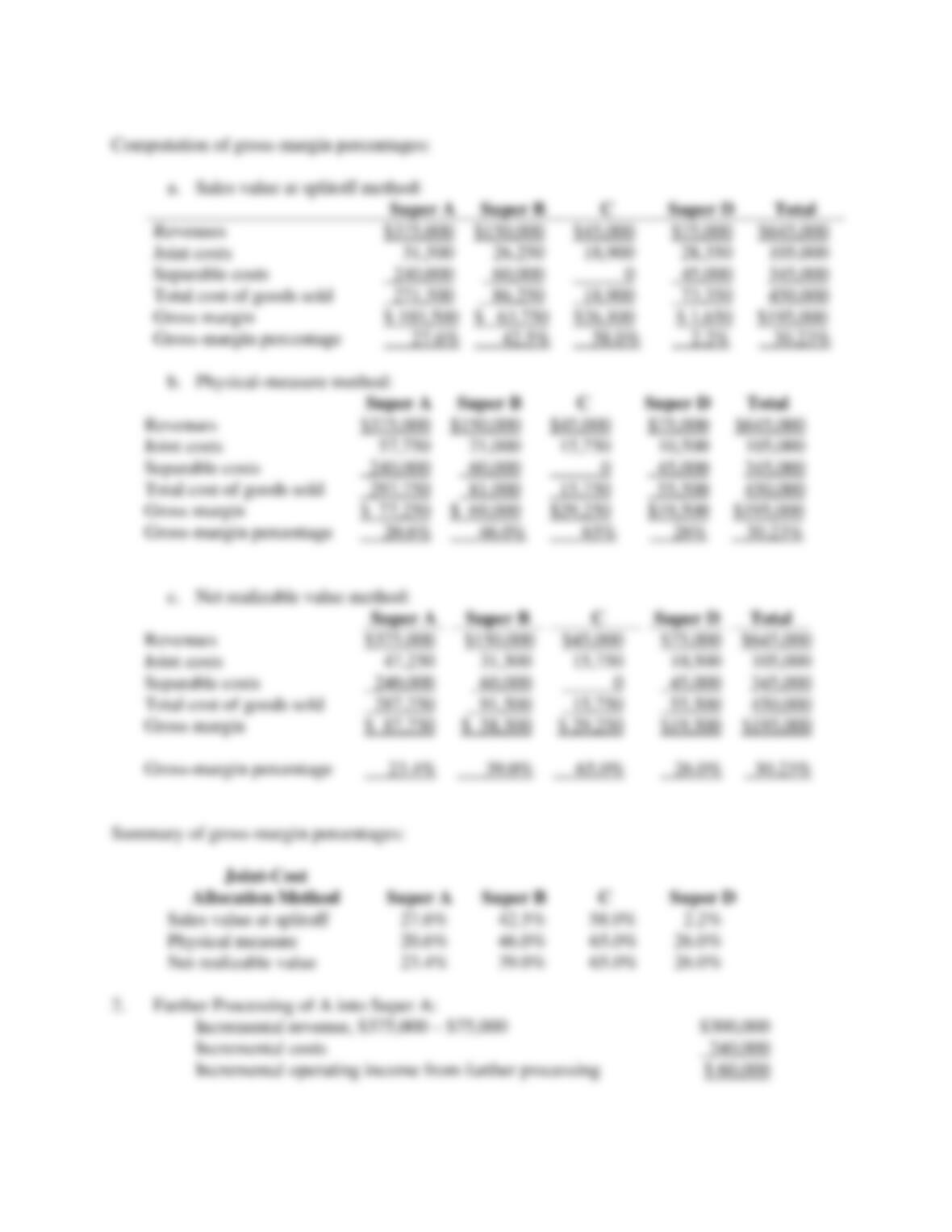
16-33
16-34
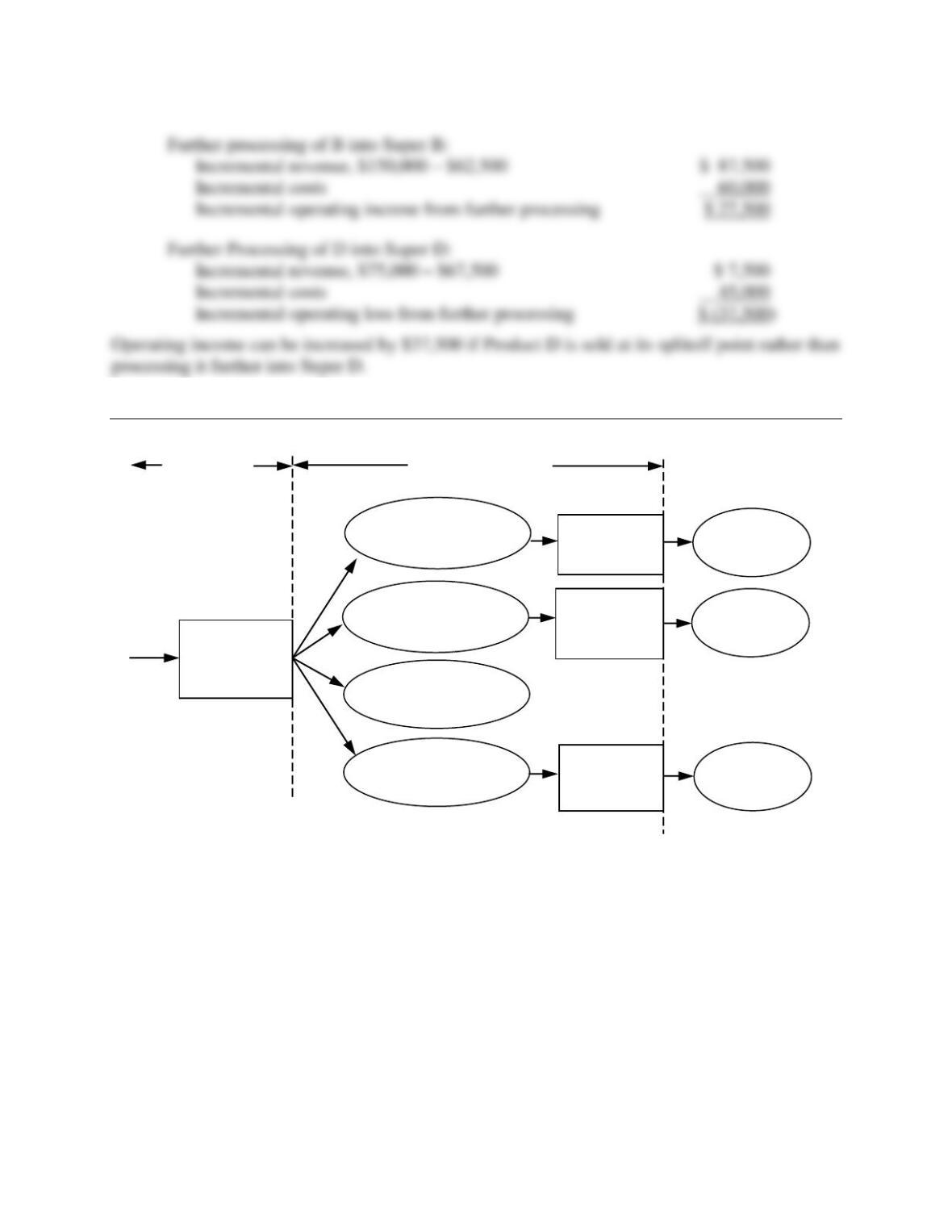
SOLUTION EXHIBIT 16-28
Processing
$105000
A, 275000 gallons
Revenue = $75000
B, 100000 gallons
Revenue = $62500
D, 50000 gallons
Revenue = $67500
C, 75000 gallons
Revenue = $45000
Joint Costs
Revenues at Splitoff
and Separable Costs
Processing
$240000
Processing
$60000
Processing
$45000
Super A
$375000
Super B
$150000
Super D
$75000
Splitoff
Point
16-29 (40–60 min.) Comparison of alternative joint-cost allocation methods, further-
processing decision, chocolate products.
The Cocoa Factory manufactures and distributes chocolate products. It purchases cocoa beans
and processes them into two intermediate products: chocolate-powder liquor base and milk-
chocolate liquor base. These two intermediate products become separately identifiable at a single
splitoff point. Every 2,000 pounds of cocoa beans yields 50 gallons of chocolate-powder liquor
base and 50 gallons of milk-chocolate liquor base.
The chocolate-powder liquor base is further processed into chocolate powder. Every 50
gallons of chocolate-powder liquor base yield 650 pounds of chocolate powder. The milk–

16-35
chocolate liquor base is further processed into milk chocolate. Every 50 gallons of milk–
chocolate liquor base yield 1,070 pounds of milk chocolate.
Production and sales data for August 2014 are as follows (assume no beginning inventory):
▪ Cocoa beans processed, 28,000 pounds
▪ Costs of processing cocoa beans to splitoff point (including purchase of beans), $62,000
Cocoa Factory fully processes both of its intermediate products into chocolate powder or milk
chocolate. There is an active market for these intermediate products. In August 2014, Cocoa
Factory could have sold the chocolate-powder liquor base for $20 a gallon and the milk–
chocolate liquor base for $60 a gallon.
Required:
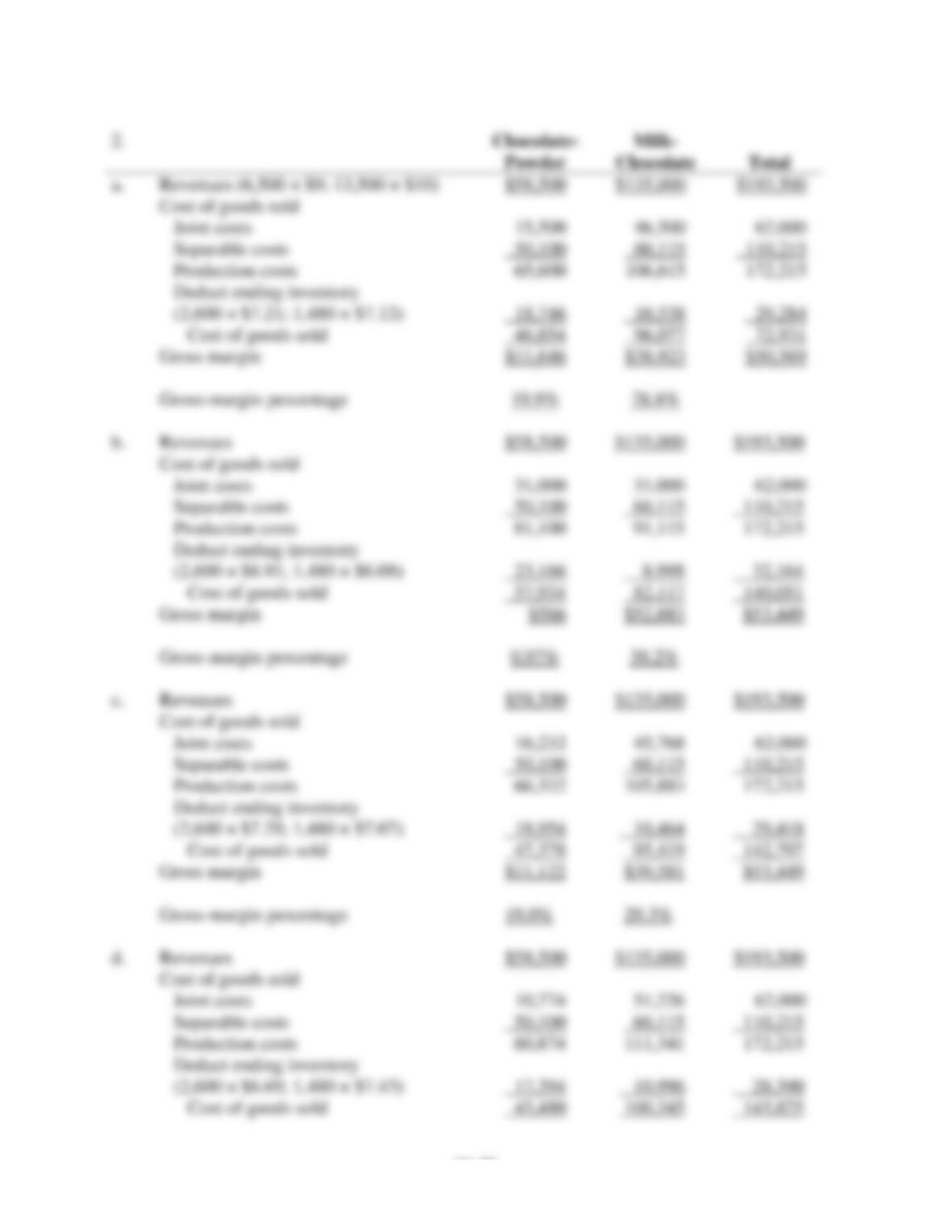
1. Calculate how the joint costs of $62,000 would be allocated between chocolate powder and
milk chocolate under the following methods:
a. Sales value at splitoff
b. Physical-measure (gallons)
c. NRV
d. Constant gross-margin percentage NRV
2. What are the gross-margin percentages of chocolate powder and milk chocolate under each
of the methods in requirement 1?
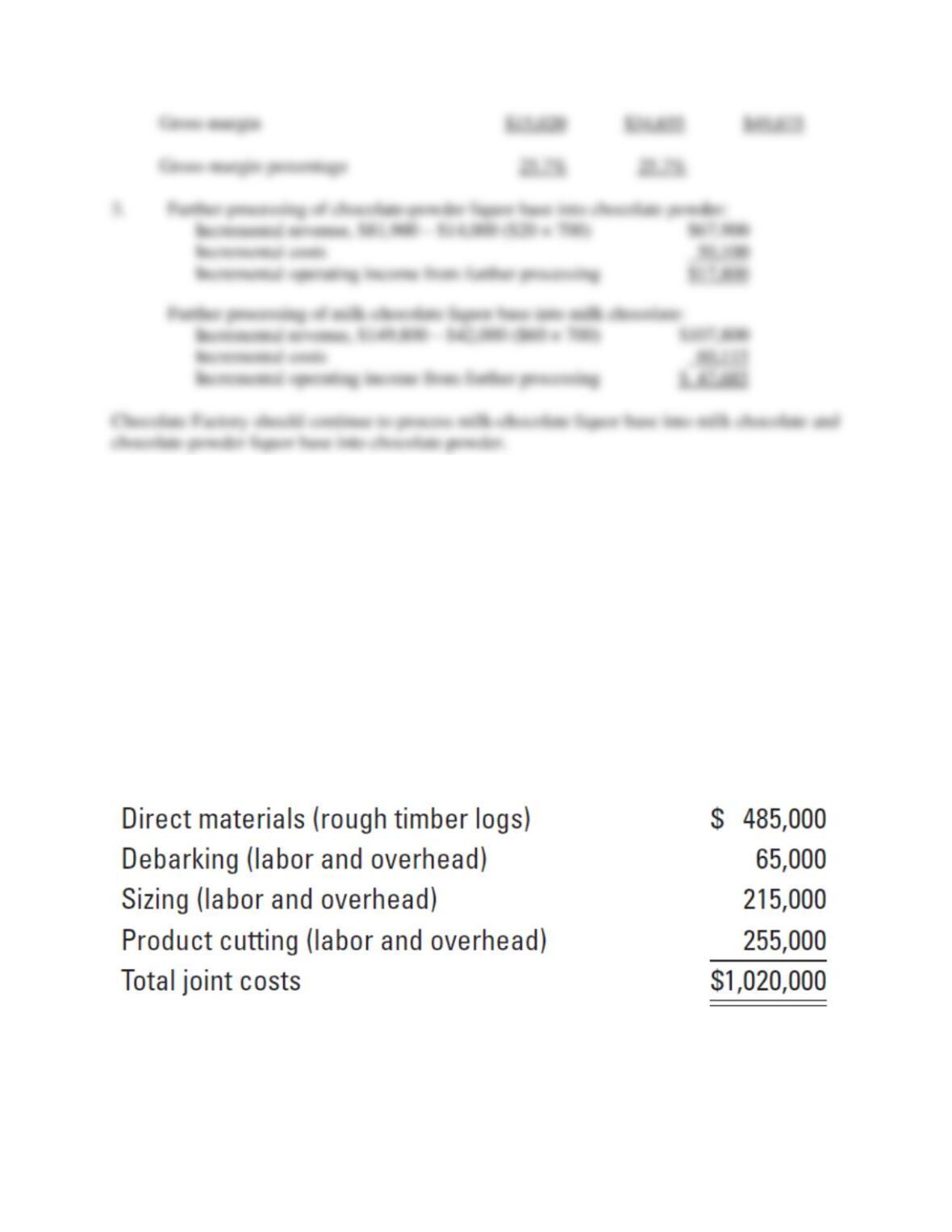
3. Could Cocoa Factory have increased its operating income by a change in its decision to fully
process both of its intermediate products? Show your computations.
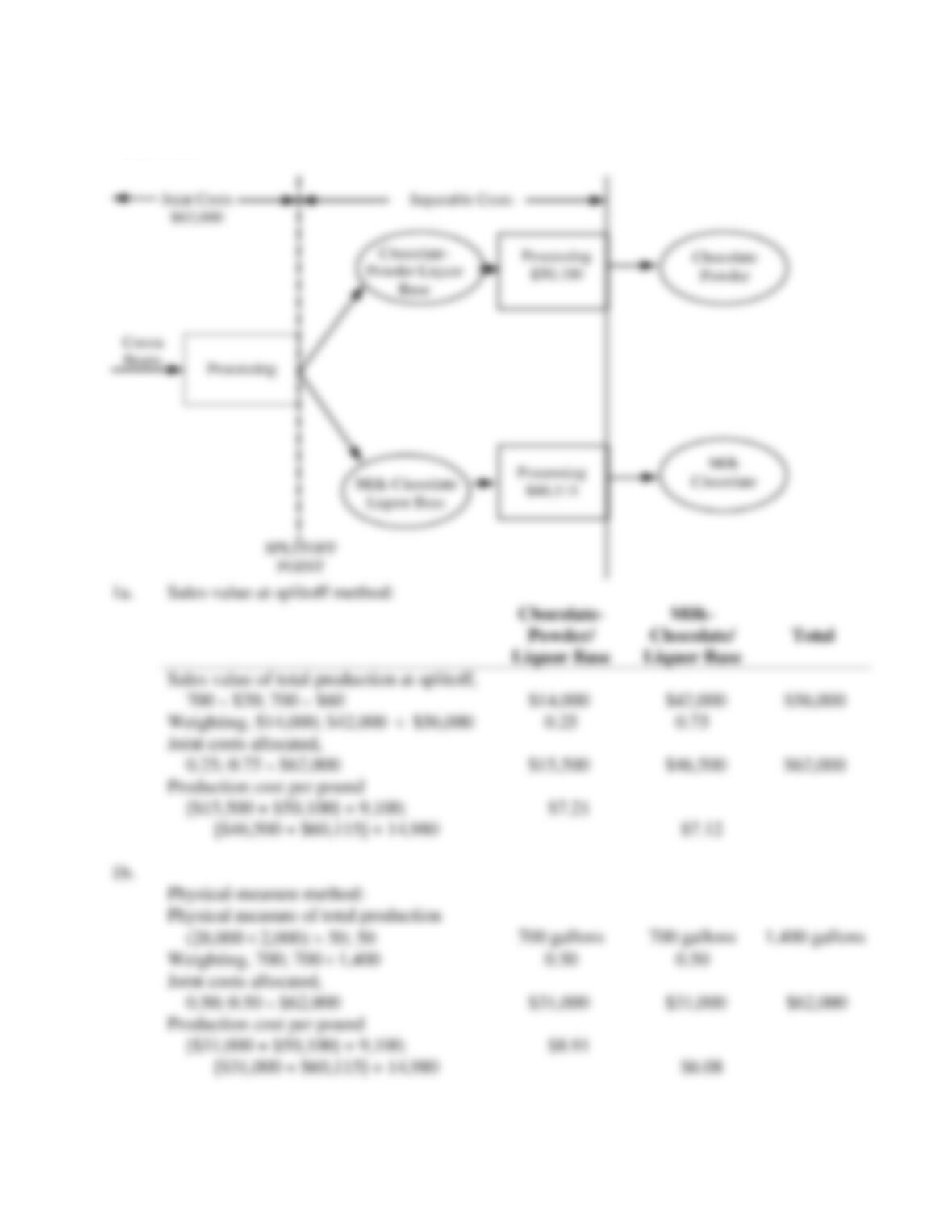
16-36
SOLUTION
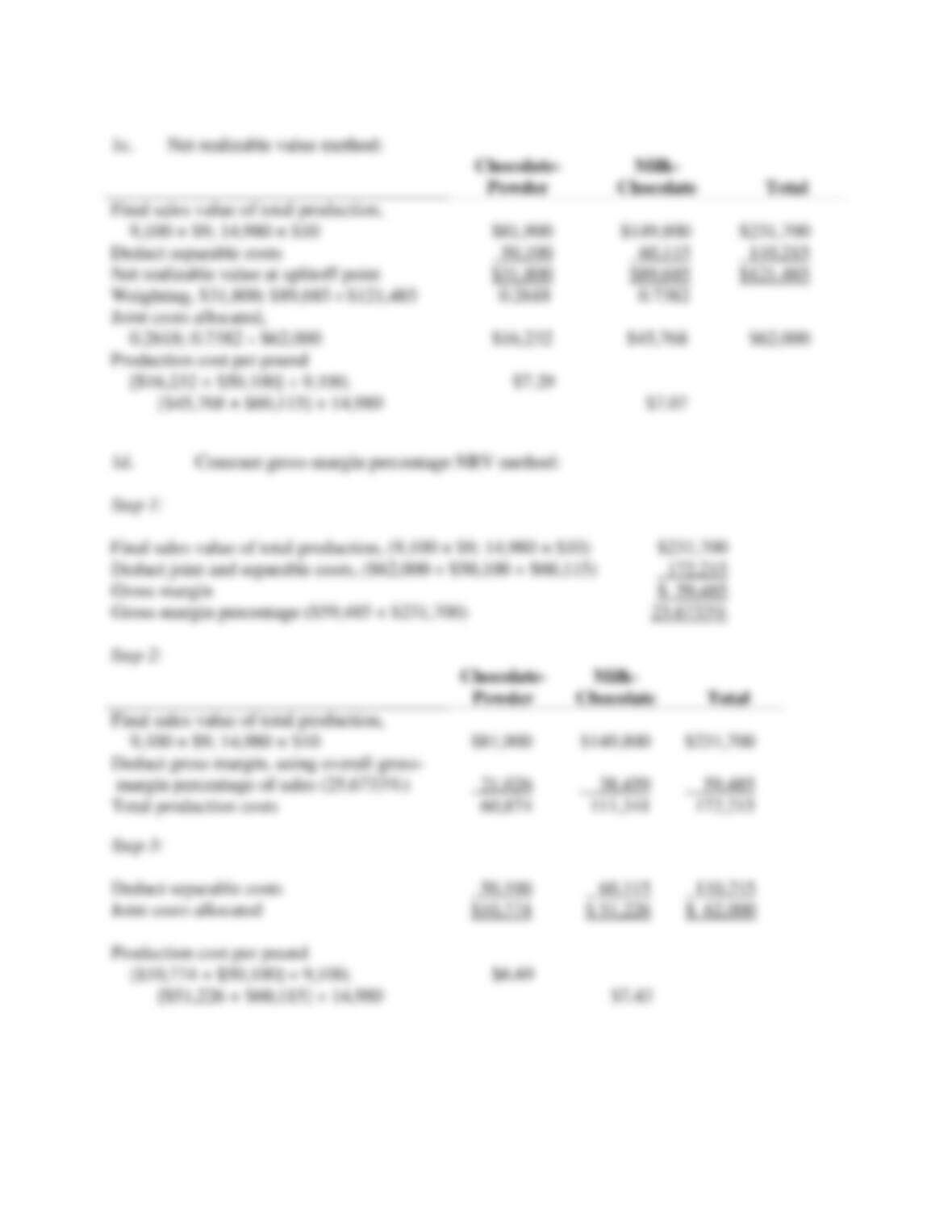
16-37
16-38
16-39
16-30 (30 min.) Joint-cost allocation, process further or sell.
(CMA, adapted) Doughty Sawmill, Inc., (DSI) purchases logs from independent timber
contractors and processes the logs into three types of lumber products:
▪ Studs for residential buildings (walls, ceilings)
▪ Decorative pieces (fireplace mantels, beams for cathedral ceilings)
▪ Posts used as support braces (mine support braces, braces for exterior fences on ranch
properties)
These products are the result of a joint sawmill process that involves removal of bark from the
logs, cutting the logs into a workable size (ranging from 8 to 16 feet in length), and then cutting
the individual products from the logs.
The joint process results in the following costs of products for a typical month:

16-40
Product yields and average sales values on a per-unit basis from the joint process are as follows:
The studs are sold as rough-cut lumber after emerging from the sawmill operation without
further processing by DSI. Also, the posts require no further processing beyond the splitoff point.
The decorative pieces must be planed and further sized after emerging from the sawmill. This
additional processing costs $110,000 per month and normally results in a loss of 10% of the units
entering the process. Without this planing and sizing process, there is still an active intermediate
market for the unfinished decorative pieces in which the selling price averages $70 per unit.
Required:
1. Based on the information given for Doughty Sawmill, allocate the joint processing costs of
$1,020,000 to the three products using:
a. Sales value at splitoff method
b. Physical-measure method (volume in units)
c. NRV method
2. Prepare an analysis for Doughty Sawmill that compares processing the decorative pieces
further, as it currently does, with selling them as a rough-cut product immediately at splitoff.
3. Assume Doughty Sawmill announced that in six months it will sell the unfinished decorative
pieces at splitoff due to increasing competitive pressure. Identify at least three types of likely
behavior that will be demonstrated by the skilled labor in the planing-and-sizing process as a
result of this announcement. Include in your discussion how this behavior could be
influenced by management.