16–18
Exercise 16.25
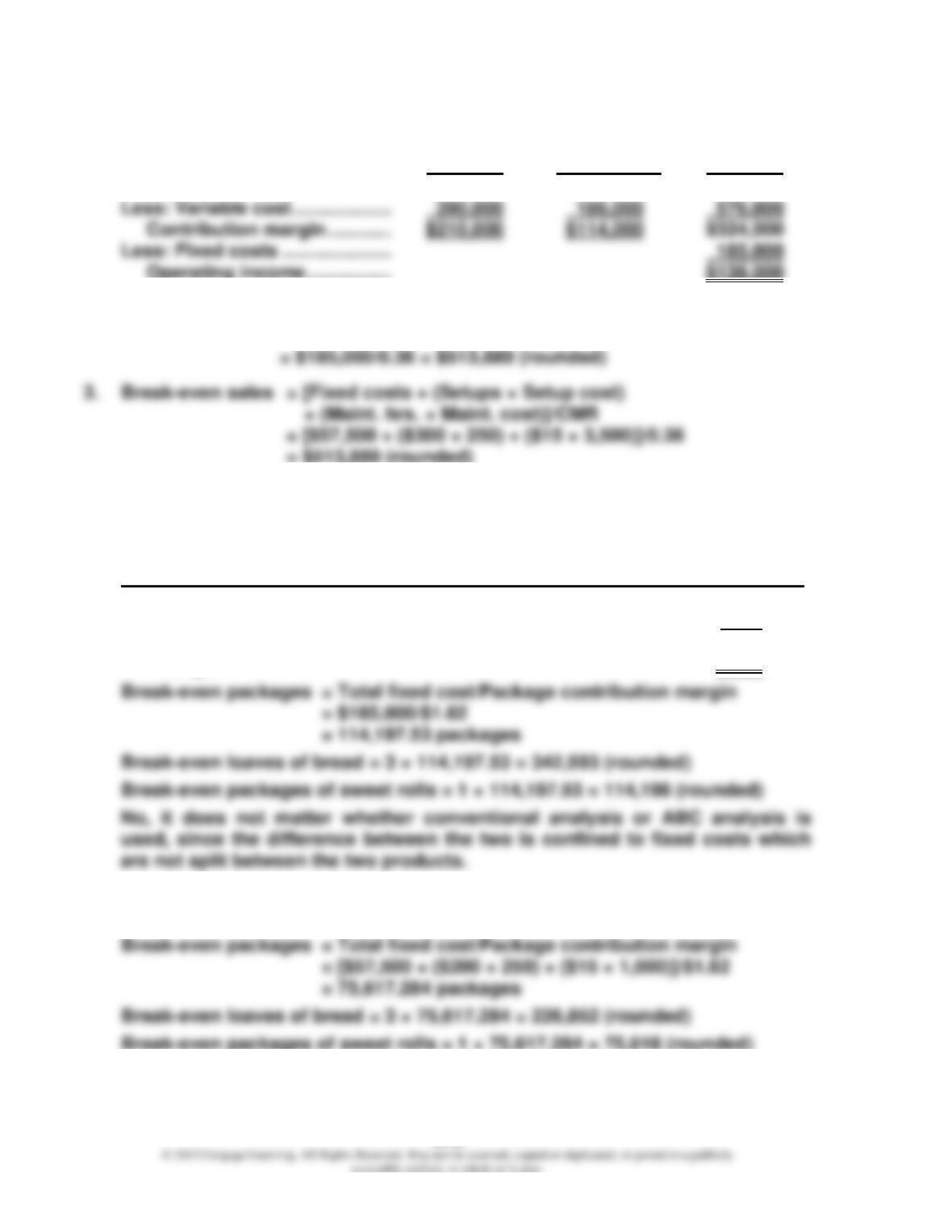
1. Bread Sweet Rolls Total
Sales …………………………………… $600,000 $300,000 $900,000
2. Contribution margin ratio = $324,000/$900,000 = 0.36, or 36%
Break-even sales = Fixed costs/Contribution margin ratio
4. The sales mix is 600,000:200,000 or 3:1.
Unit
Unit Unit Contribution
Variable Contribution Sales Margin ×
Product Price Cost Margin Mix Sales Mix
Bread $1.00 $0.65 $0.35 3 $1.05
Sweet rolls $1.50 $0.93 $0.57 1 0.57
Package contribution
margin $1.62
5. The creation of the package is the same as in Requirement 4. The change in
the activity data will affect only the fixed costs.
16–19
CPA-TYPE EXERCISES
Exercise 16.26
d.
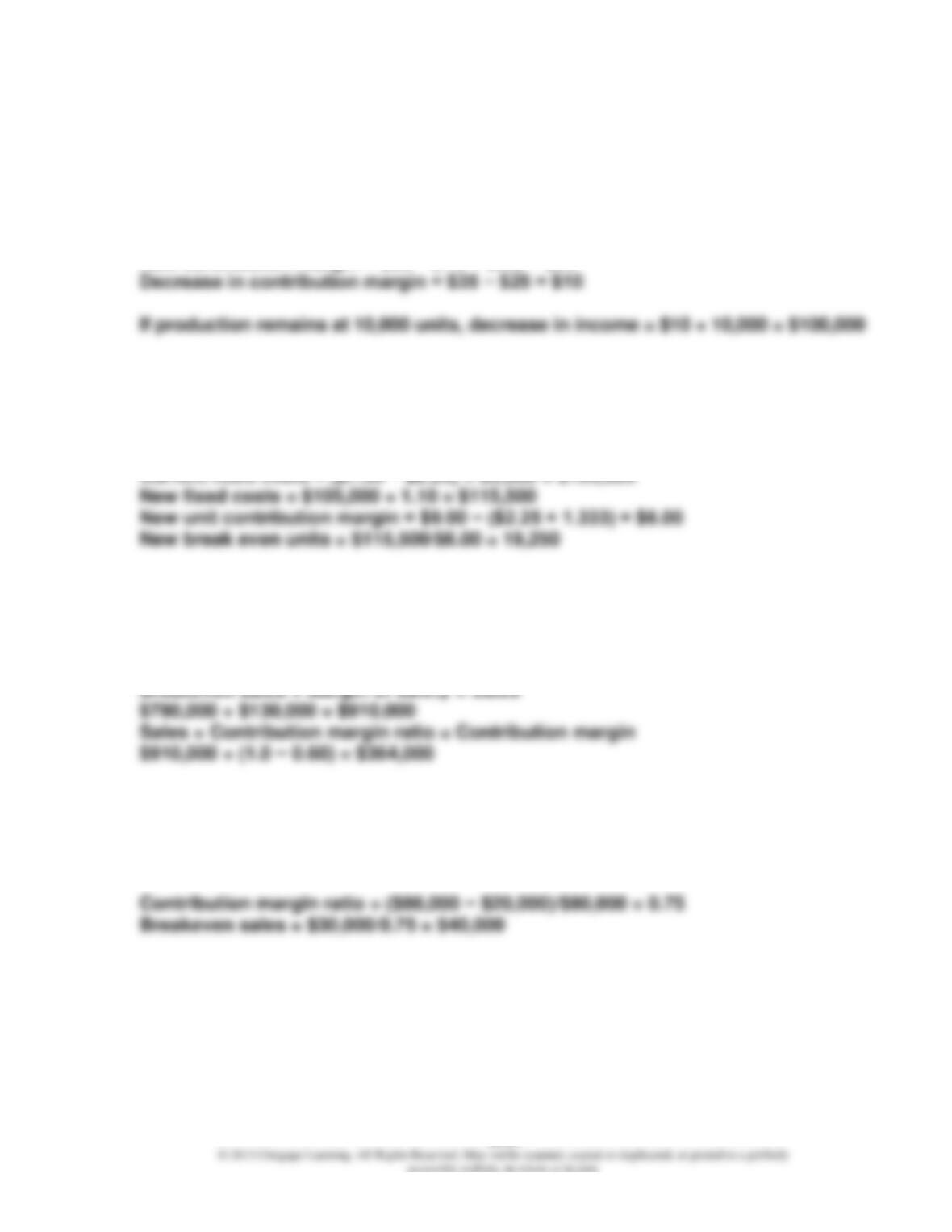
Contribution margin per unit = $85 − $50 = $35
New contribution margin = $85 − (1.2 × $50) = $25
Exercise 16.27
c.
Exercise 16.28
a.
Exercise 16.29
b.
16–20
Exercise 16.30
b.
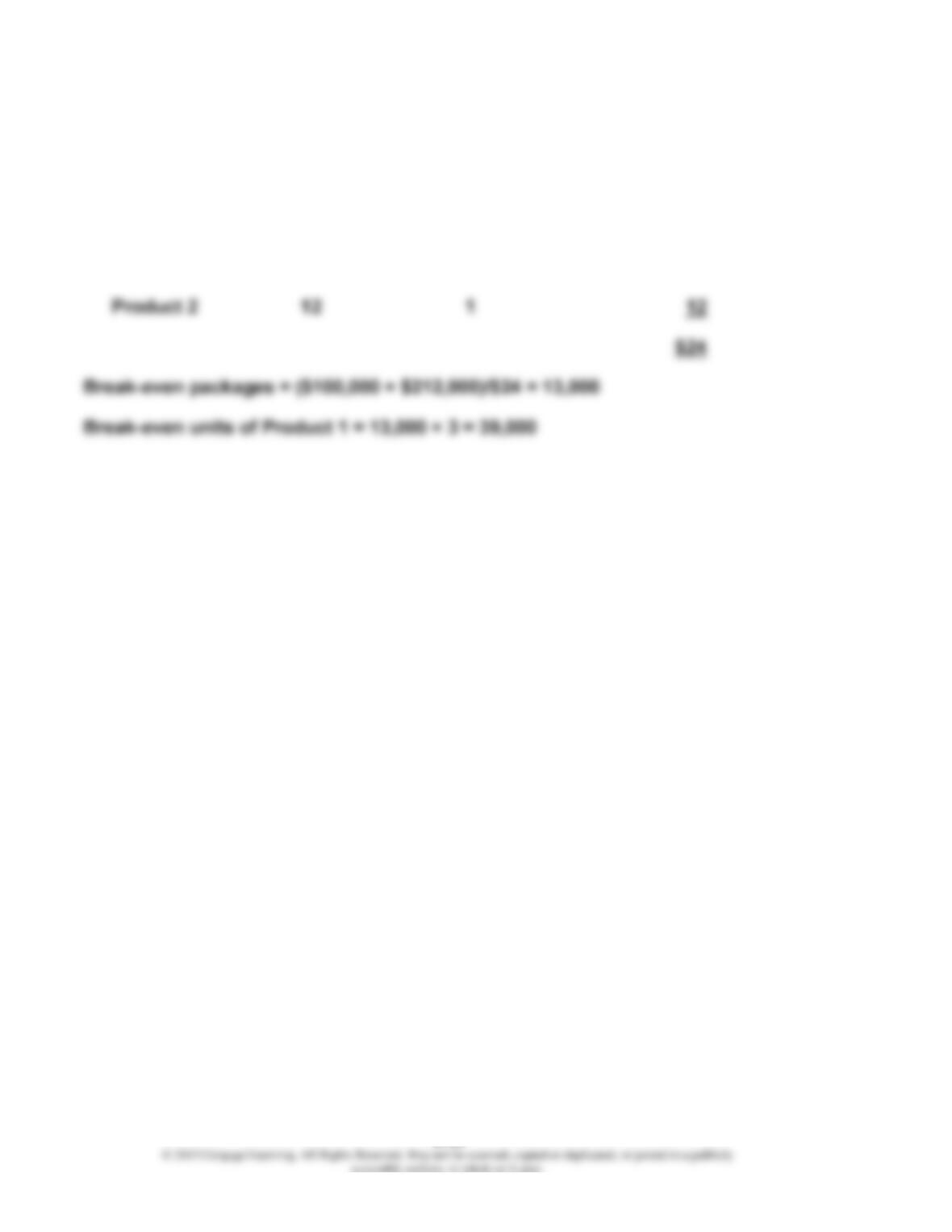
Contribution Number Package
Product Margin of Units Contribution Margin
Product 1 $4 3 $12
16–21
PROBLEMS
Problem 16.31
1. Break-even calculations for the first year of operations:
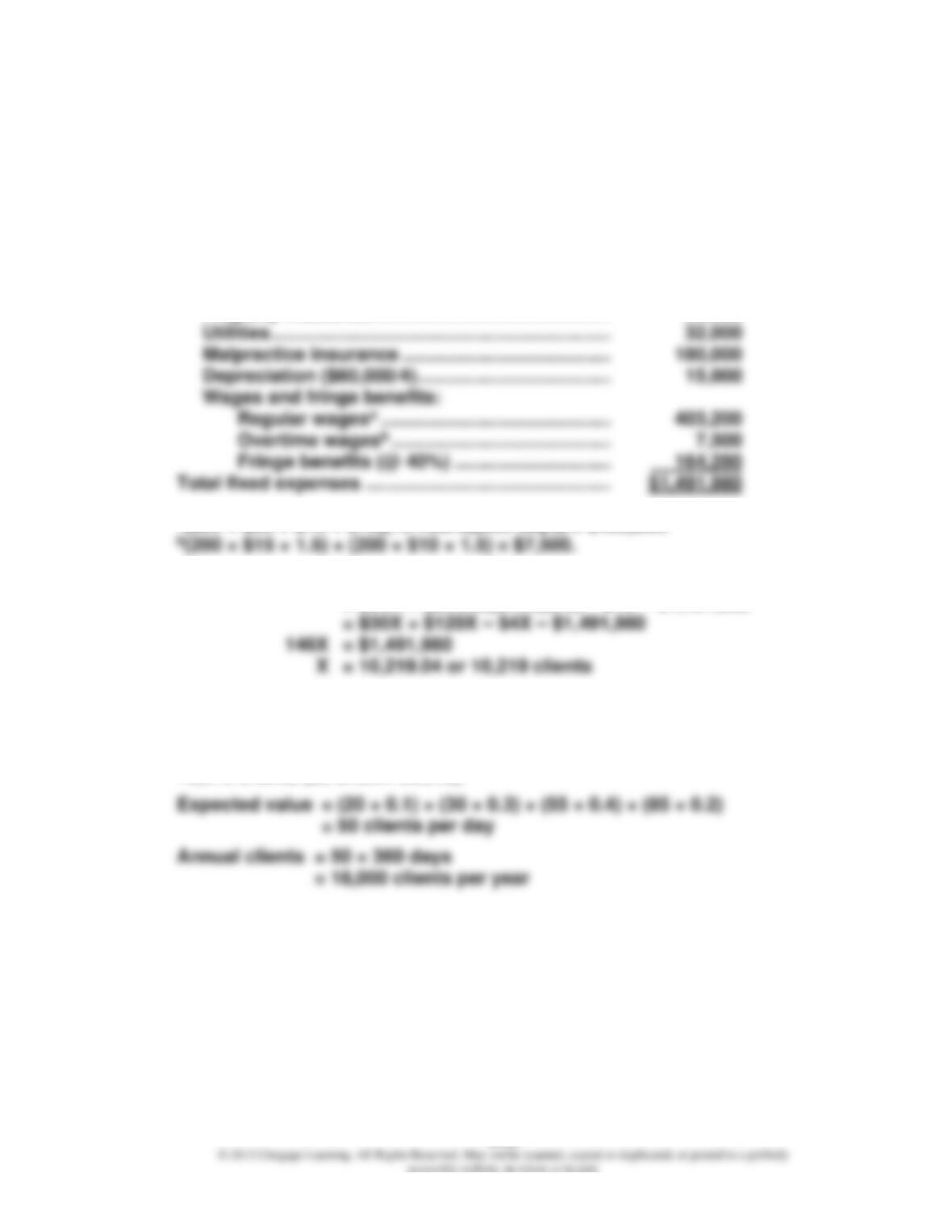
Fixed expenses:
Advertising …………………………………………………. $ 500,000
Rent (6,000 × $28) ……………………………………….. 168,000
Property insurance ……………………………………… 22,000
a($25 + $20 + $15 + $10)(16 hours)(360 days) = $403,200.
Break-even point = Revenue – Variable costs – Fixed costs
= $30X + ($2,000)(0.2X)(0.3) – $4X – $1,491,980
2. Based on the report of the marketing consultant, the expected number of new
clients during the first year is 18,000. Therefore, it is feasible for the law office
to break even during the first year of operations as the break-even point is
10,219 clients (as shown above).
16–22
Problem 16.32
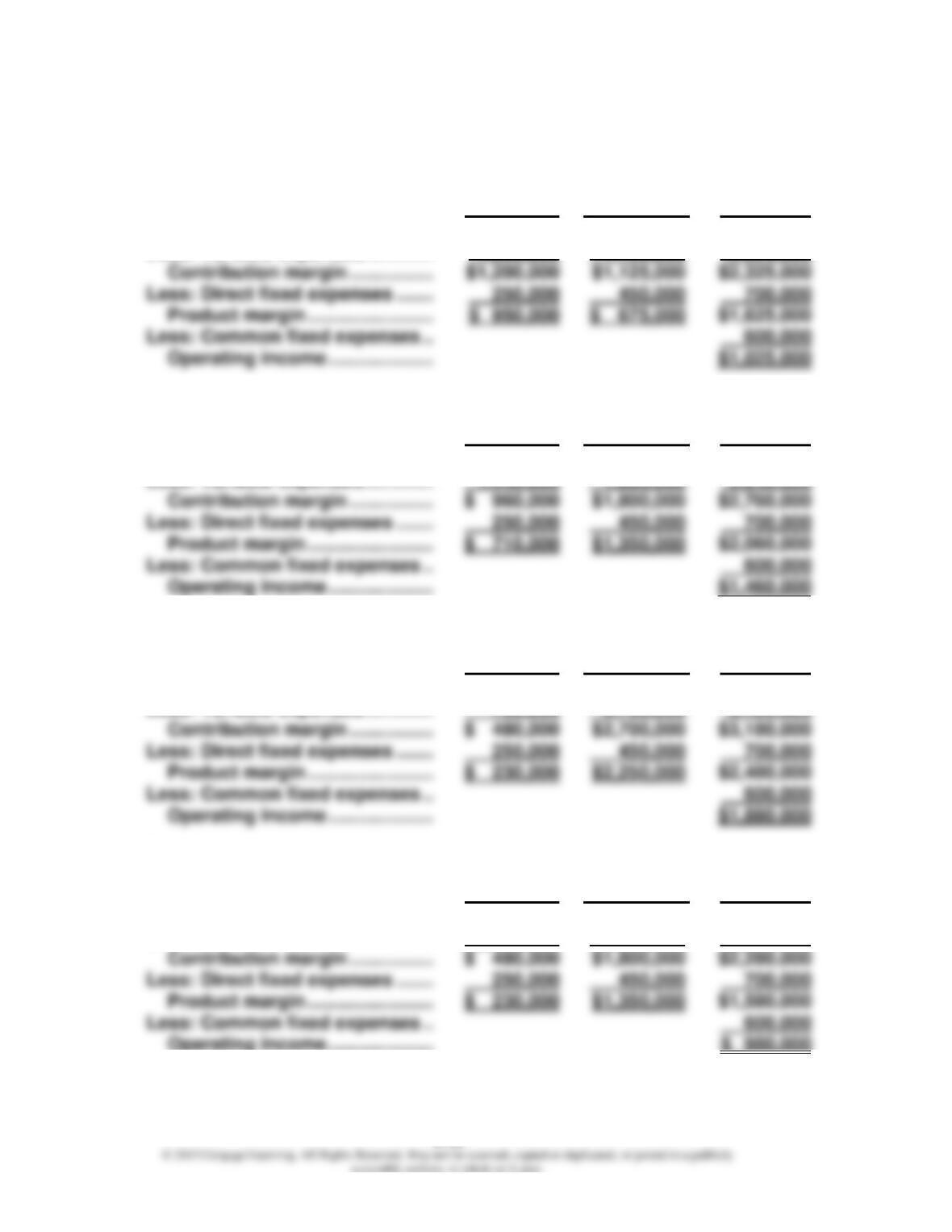
1. a. Operating income for 2:1 sales mix:
Regular
Sander Mini-Sander Total
Sales ……………………………………… $3,000,000 $2,250,000 $5,250,000
Less: Variable expenses …………. 1,800,000 1,125,000 2,925,000
b. Operating income for 1:1 sales mix:
Regular
Sander Mini-Sander Total
Sales ……………………………………… $2,400,000 $3,600,000 $6,000,000
Less: Variable expenses …………. 1,440,000 1,800,000 3,240,000
c. Operating income for 1:3 sales mix:
Regular
Sander Mini-Sander Total
Sales ……………………………………… $1,200,000 $5,400,000 $6,600,000
Less: Variable expenses …………. 720,000 2,700,000 3,420,000
d. Operating income for 1:2 sales mix:
Regular
Sander Mini-Sander Total
Sales ……………………………………… $1,200,000 $3,600,000 $4,800,000
Less: Variable expenses …………. 720,000 1,800,000 2,520,000
16–23
Problem 16.32 (Concluded)
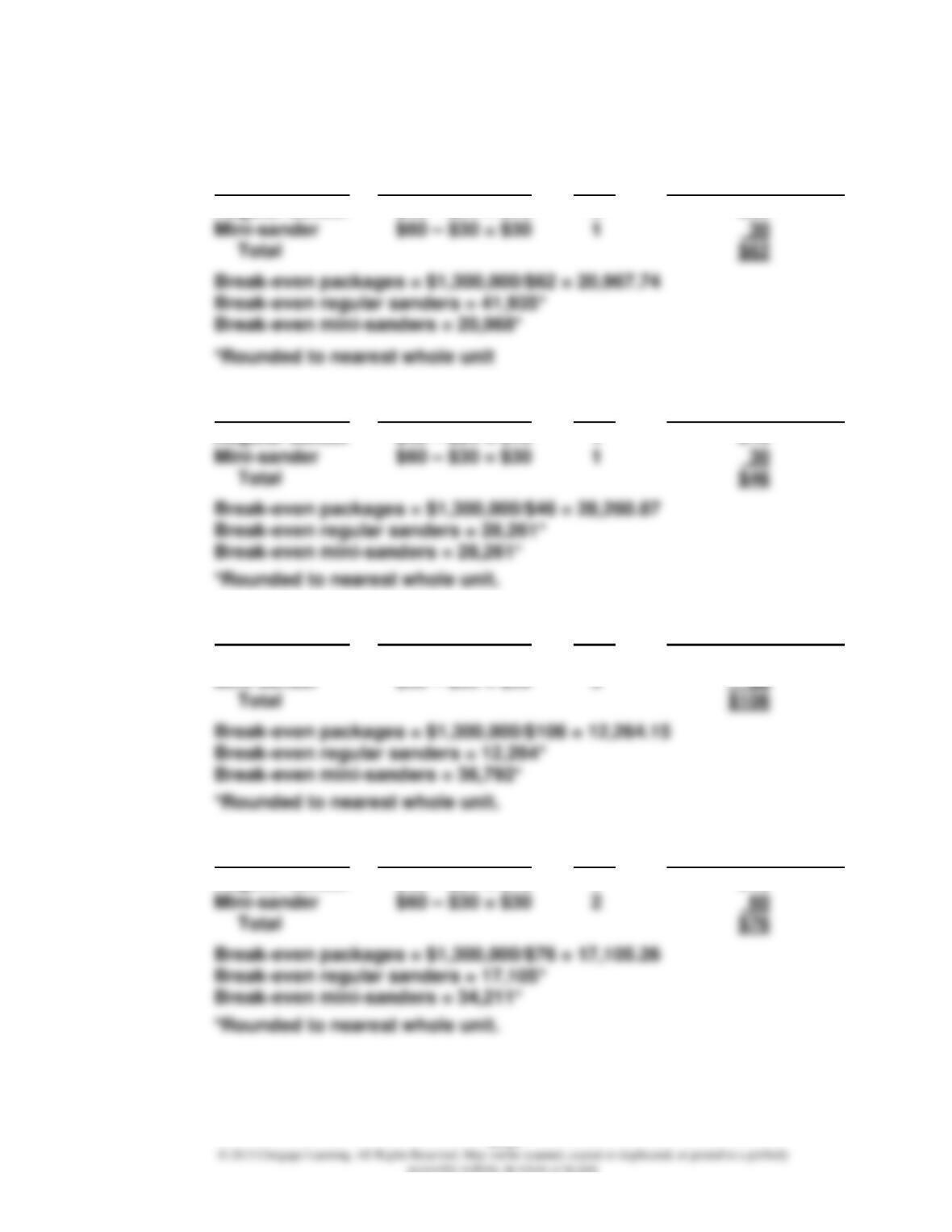
2. a. Unit Contribution Sales Package
Product Margin Mix Contribution Margin
Regular sander $40 – $24 = $16 2 $32
b. Unit Contribution Sales Package
Product Margin Mix Contribution Margin
Regular sander $40 – $24 = $16 1 $16
c. Unit Contribution Sales Package
Product Margin Mix Contribution Margin
Regular sander $40 – $24 = $16 1 $ 16
Mini-sander $60 – $30 = $30 3 90
d. Unit Contribution Sales Package
Product Margin Mix Contribution Margin
Regular sander $40 – $24 = $16 1 $16
16–24
Problem 16.33
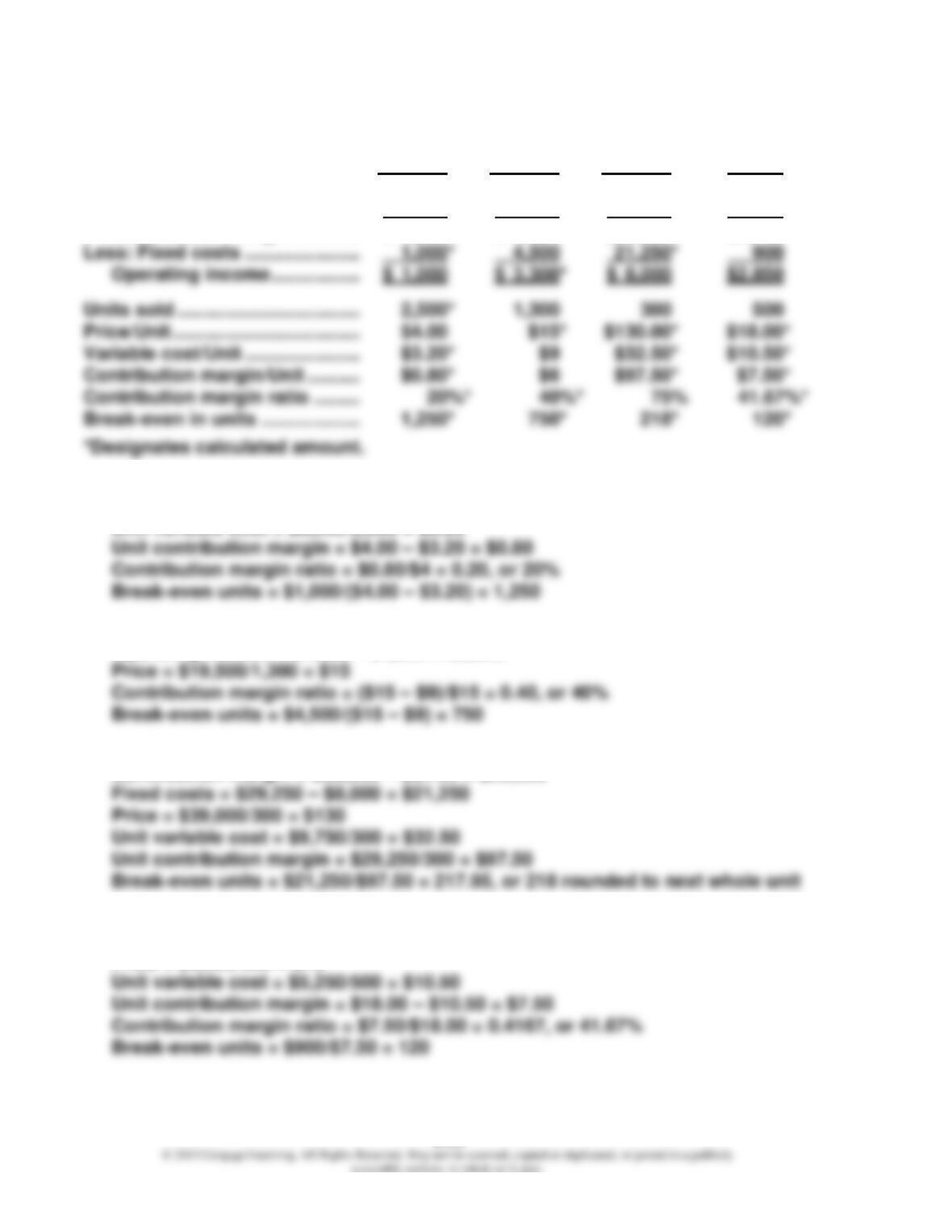
A B C D
Sales ……………………………………. $10,000 $19,500* $39,000* $9,000
Less: Variable costs ……………… 8,000 11,700 9,750 5,250*
Contribution margin …………. $ 2,000 $ 7,800 $29,250* $3,750*
A: Fixed cost = $2,000 – $1,000 = $1,000
Units sold = $10,000/$4 = 2,500
Unit variable cost = $8,000/2,500 = $3.20
B: Sales = $11,700 + $7,800 = $19,500
Operating income = $7,800 – $4,500 = $3,300
C: Sales = $9,750/(1.00 − 0.75) = $39,000
Contribution margin = $39,000 – $9,750 = $29,250
D: Contribution margin = $2,850 + $900 = $3,750
Total variable cost = $9,000 – $3,750 = $5,250
Price = $9,000/500 = $18
16–25
Problem 16.34
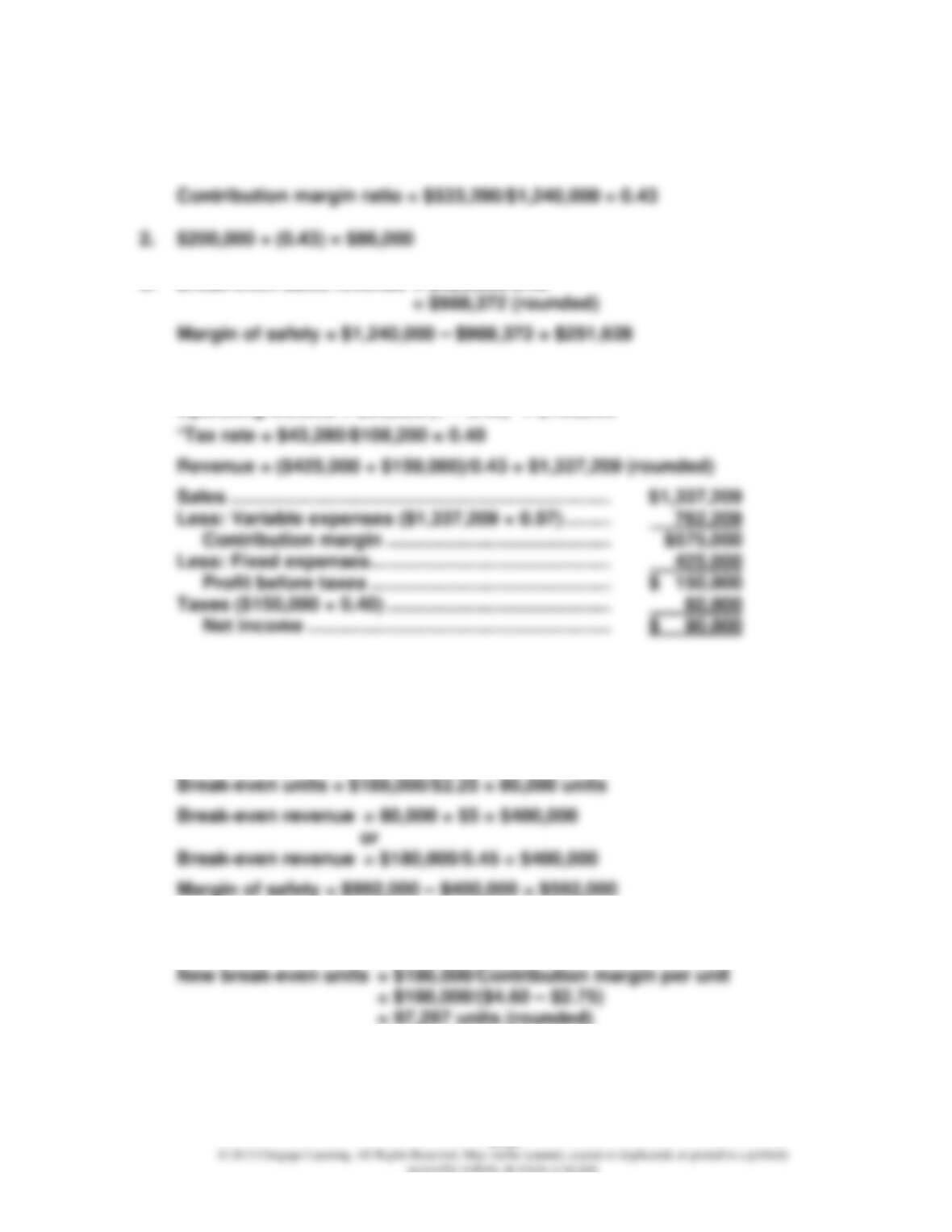
1. Variable cost ratio = $706,800/$1,240,000 = 0.57
3. Break-even sales revenue = $425,000/0.43
4. Revenue = ($425,000 + $130,000)/0.43 = $1,290,698 (rounded)
Operating income = $90,000/(1 – 0.40)* = $150,000
Problem 16.35
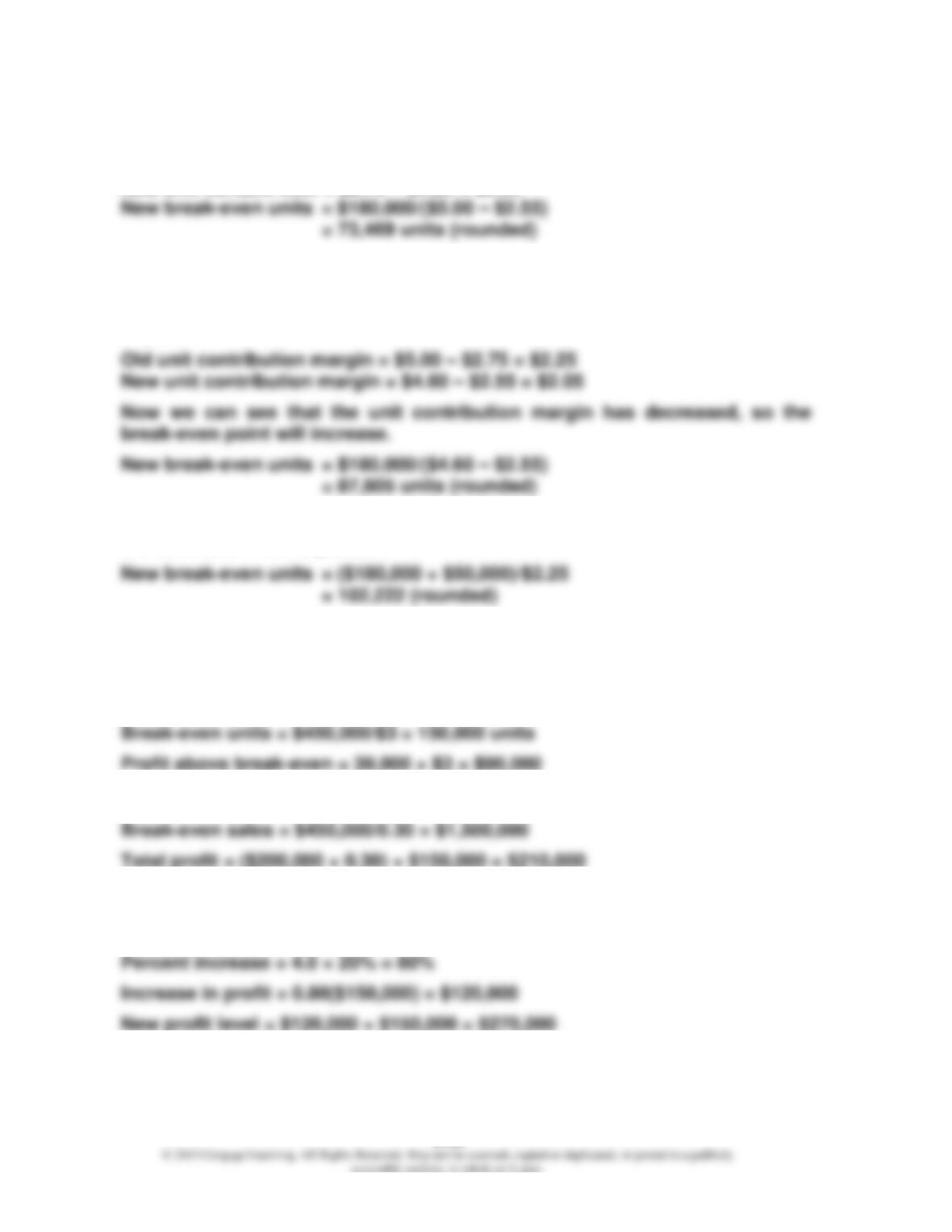
1. Contribution margin per unit = $446,400/198,400 = $2.25
Contribution margin ratio = $446,400/$992,000 = 0.45
2. The break-even point increases:
New price = $5.00 – (0.08 × $5.00) = $4.60
16–26
Problem 16.35 (Concluded)
3. The break-even point decreases:
New unit variable cost = $2.75 – $0.20 = $2.55
4. If both the price and the variable cost change in the same direction, it is difficult
to predict the direction of change in the break-even point. It is necessary to
recompute the break-even point, incorporating both changes, to see what
happens.
5. The break-even point will increase as more units will need to be sold to cover
the additional fixed expenses.
Problem 16.36
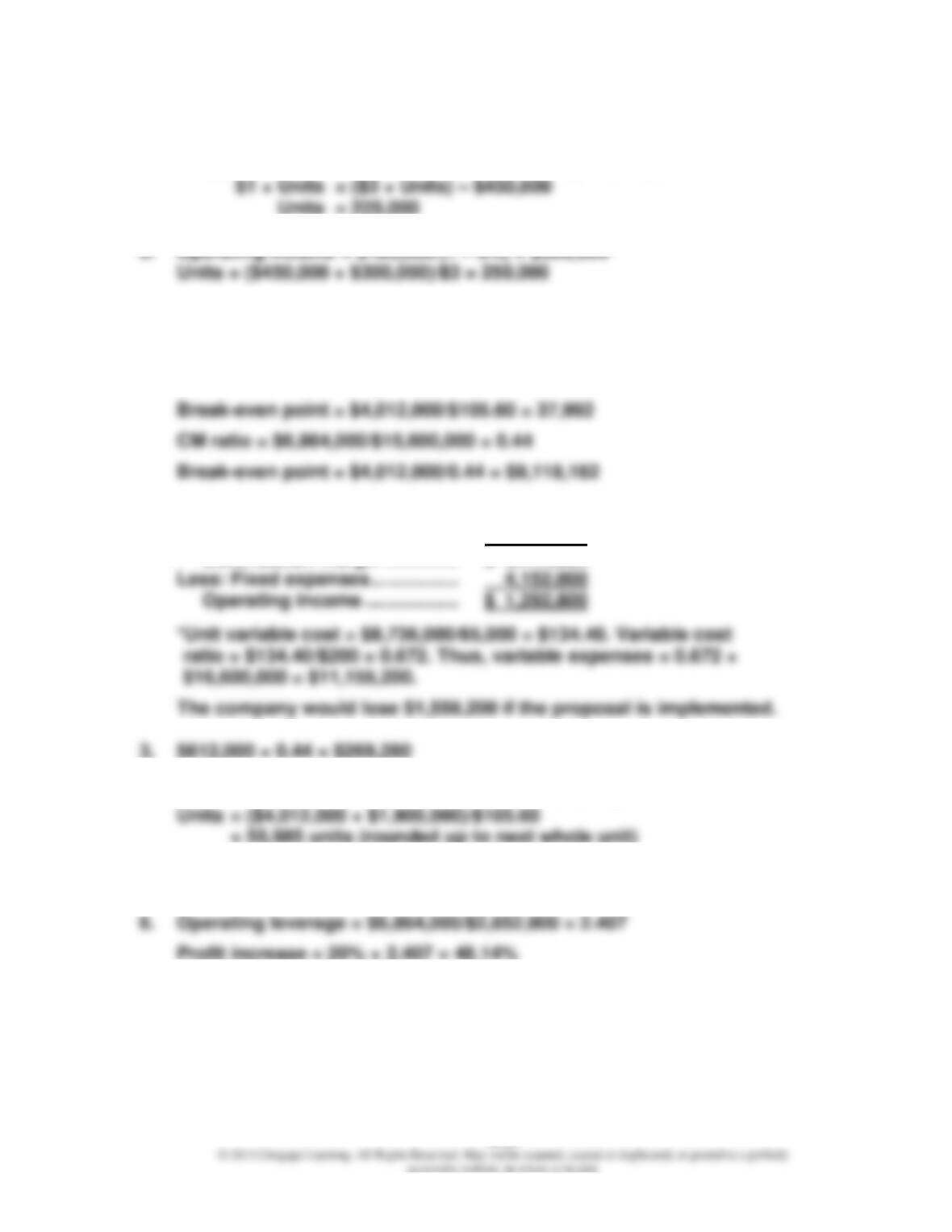
1. Unit contribution margin = $600,000/200,000 = $3
2. CM ratio = $600,000/$2,000,000 = 0.30
3. Margin of safety = $2,000,000 – $1,500,000 = $500,000
4. Operating leverage = $600,000/$150,000 = 4.0
16–27
Problem 16.36 (Concluded)
5. 0.10($10) × Units = ($10 × Units) – ($7 × Units) – $450,000
Problem 16.37
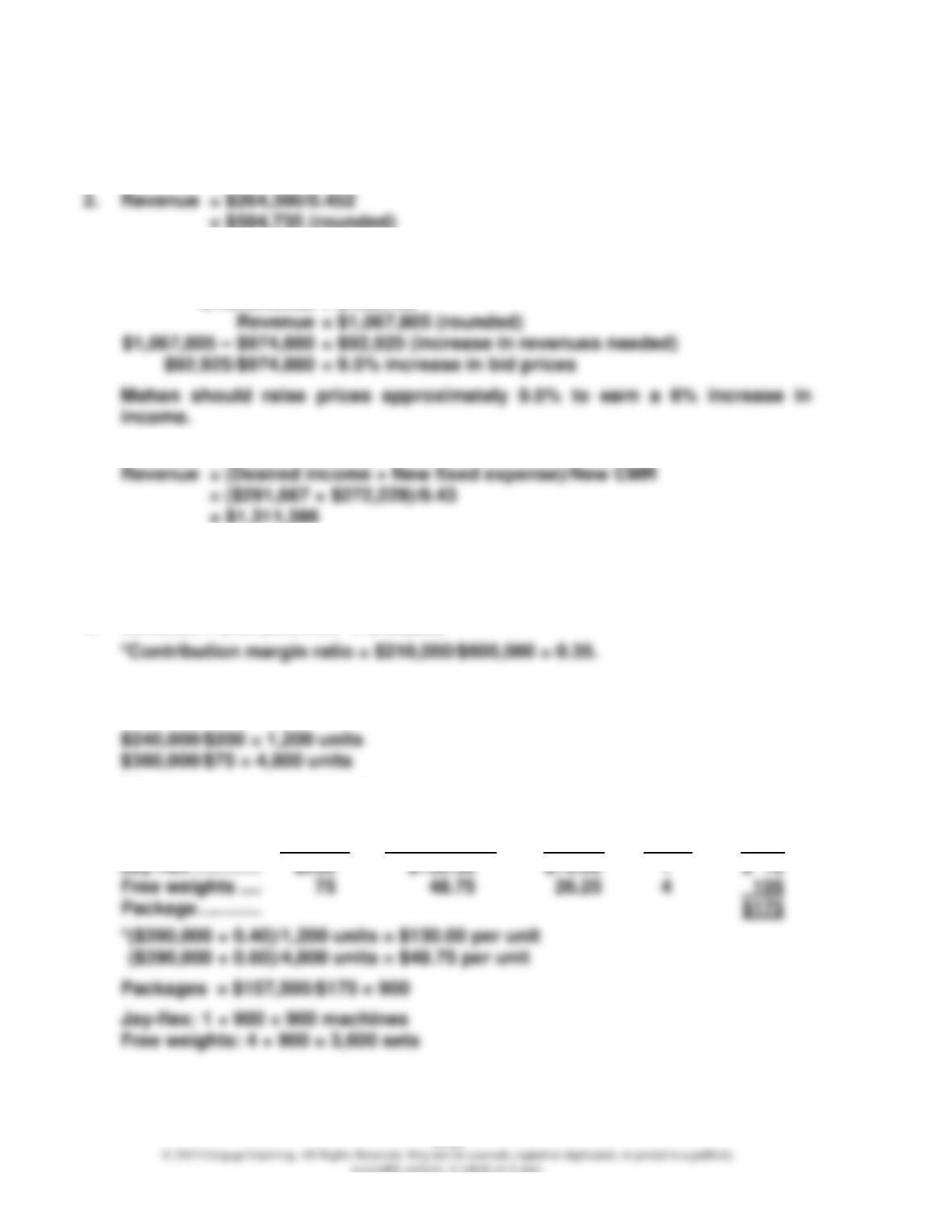
1. Unit contribution margin = $6,864,000/65,000 = $105.60
2. Sales …………………………………….. $16,600,000
Less: Variable expenses ………… 11,155,200*
Contribution margin ………….. $ 5,444,800
4. Operating income = $1,254,000/(1 – 0.34) = $1,900,000
5. Margin of safety = $15,600,000 – $9,118,182 = $6,481,818
16–28
Problem 16.38
1. Contribution margin ratio = $440,646/$974,880 = 0.452
3. 1.06($176,346) = [1 – 1.04(0.548)]Revenue – 1.03($264,300)
$186,927 = 0.43Revenue – $272,229
0.43Revenue = $459,156
4. Income = $175,000/(1 – 0.40) = $291,667
Problem 16.39
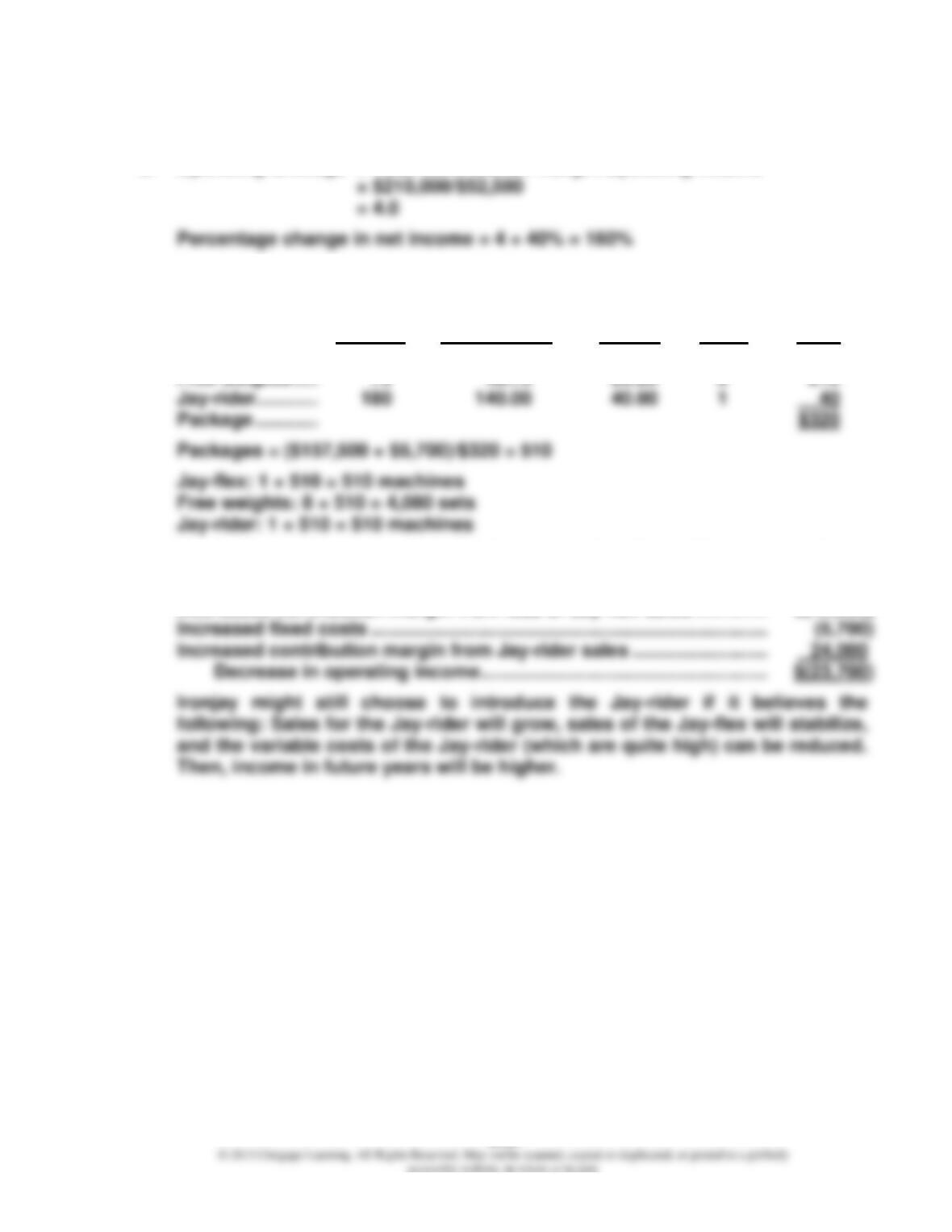
1. Revenue = $157,500/0.35* = $450,000
2. Of total sales revenue, 40 percent, or $240,000, is produced by Jay-flex
machines and 60 percent, or $360,000, by free weight sets.
Thus, the sales mix is 1 to 4.
Variable Contribution Sales
Price Cost* Margin Mix Total
16–29
Problem 16.39 (Concluded)
3. Operating leverage = Total contribution margin/Operating income
4. The new sales mix is 1 Jay-flex:8 free weight sets:1 Jay-rider.
Variable Contribution Sales
Price Cost Margin Mix Total
Jay-flex …………. $200 $130.00 $70.00 1 $ 70
Free weights ….. 75 48.75 26.25 8 210
No, in the coming year, the addition of the Jay-rider will result in a lower
operating income.
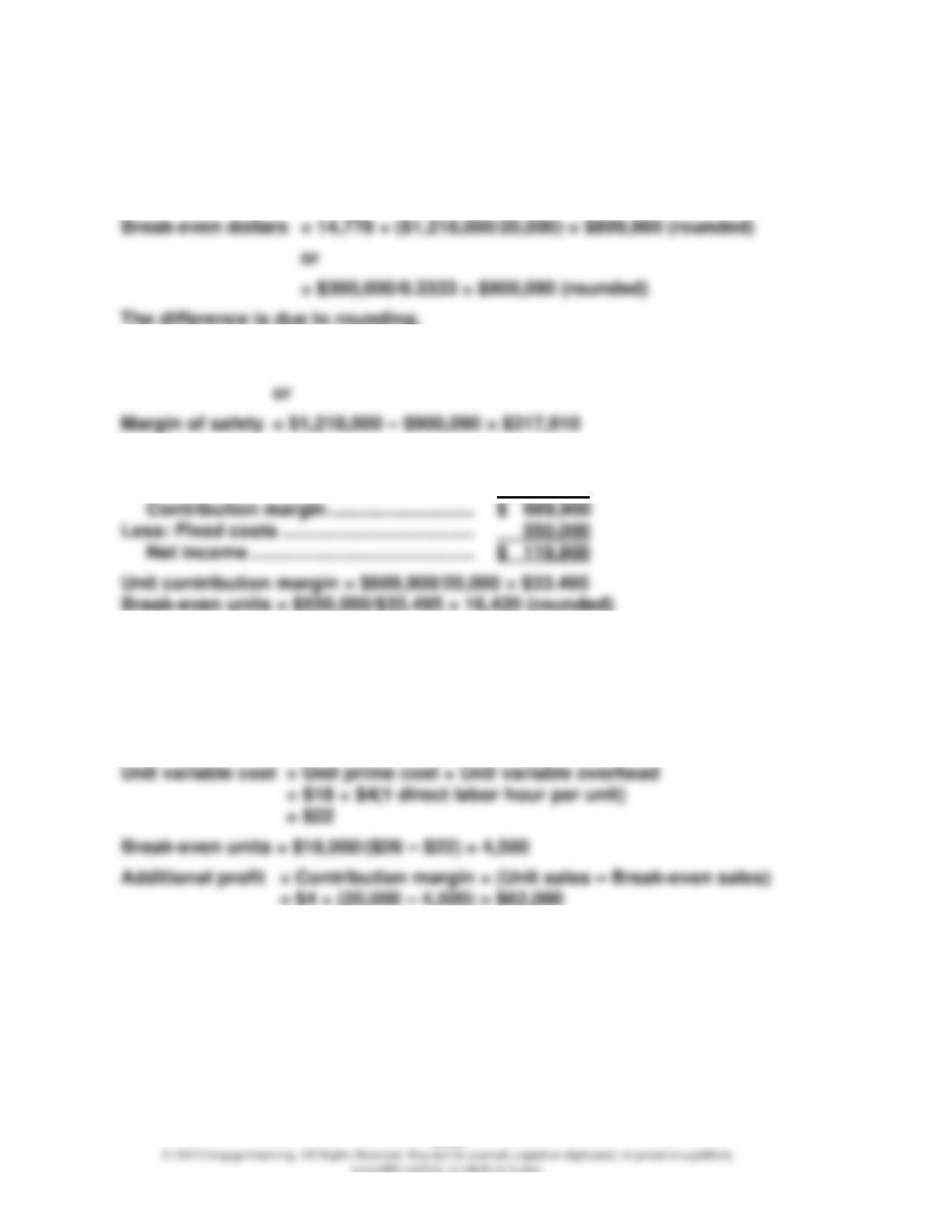
Decreased contribution margin from loss of Jay-flex sales ………….. $(42,000)
16–30
Problem 16.40
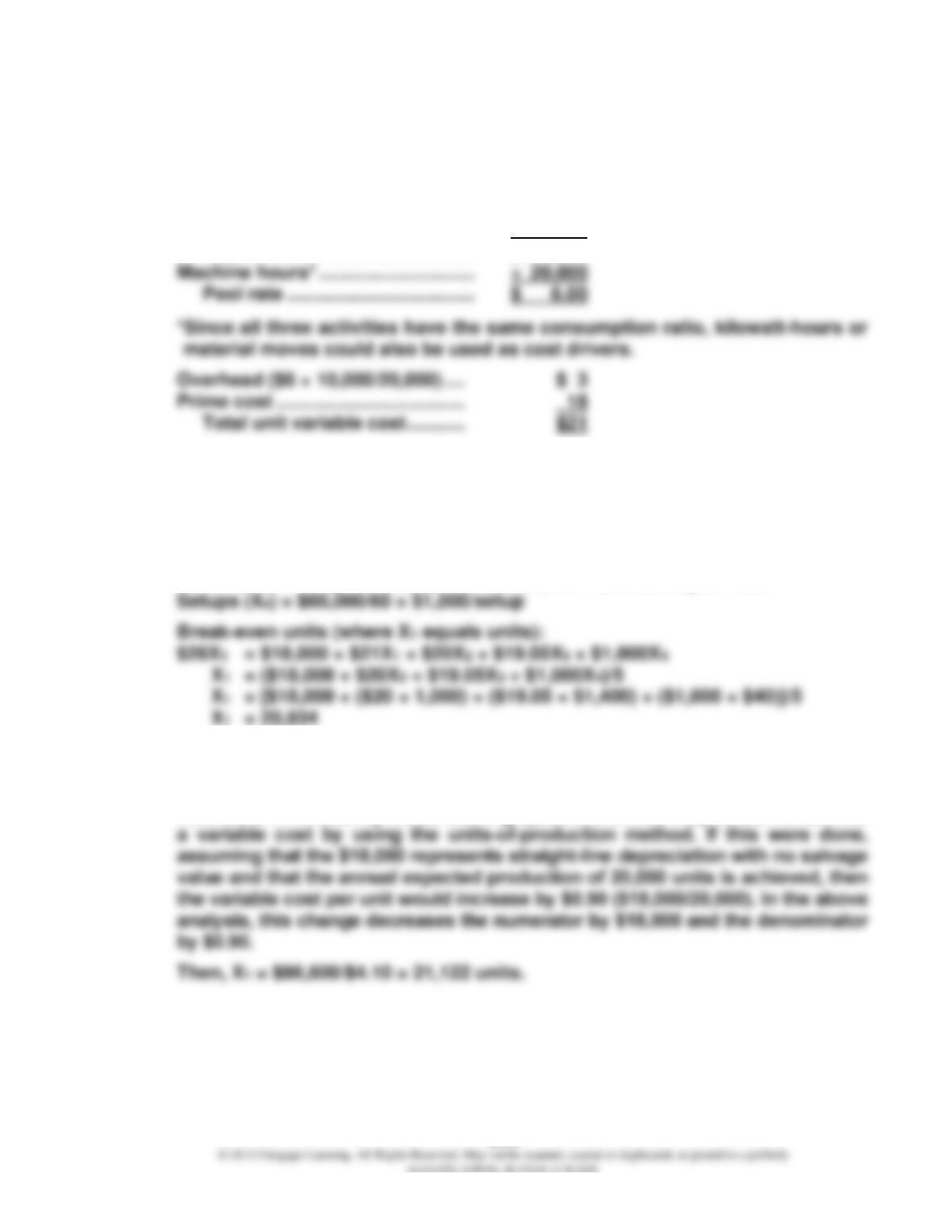
1. Unit contribution margin = $406,000/20,000 = $20.30
Break-even units = $300,000/$20.30 = 14,778 (rounded)
2. Margin of safety = $1,218,000 – $899,980 = $318,020
3. Sales …………………………………………………. $ 1,218,000
Less: Variable costs ($1,218,000 × 0.45) 548,100
Problem 16.41
1. Variable overhead rate = ($18,000 + $22,000 + $80,000)/30,000
= $4 per direct labor hour
16–31
Problem 16.41 (Continued)
2. Unit-based variable costs:
Materials handling ……………………. $ 18,000
Power ………………………………………. 22,000
Machine costs ………………………….. 80,000
Total ……………………………………. $120,000
Non-unit-based variable costs (assumes costs vary strictly with each cost
driver with no fixed components; in reality, fixed components could exist for
each activity and some method of separating fixed and variable costs should
be used):
Product-level: Engineering (X2) = $100,000/5,000 = $20/hour
Batch-level: Inspection (X3) = $40,000/2,100 = $19.05/inspec. hour
The above analysis assumes that the expected engineering hours, inspection
hours, and setups are realized. If the levels of these three activities vary, then
the break-even point will vary. The analysis also assumes that depreciation is a
fixed cost. In an activity-based costing system, this cost may be converted into
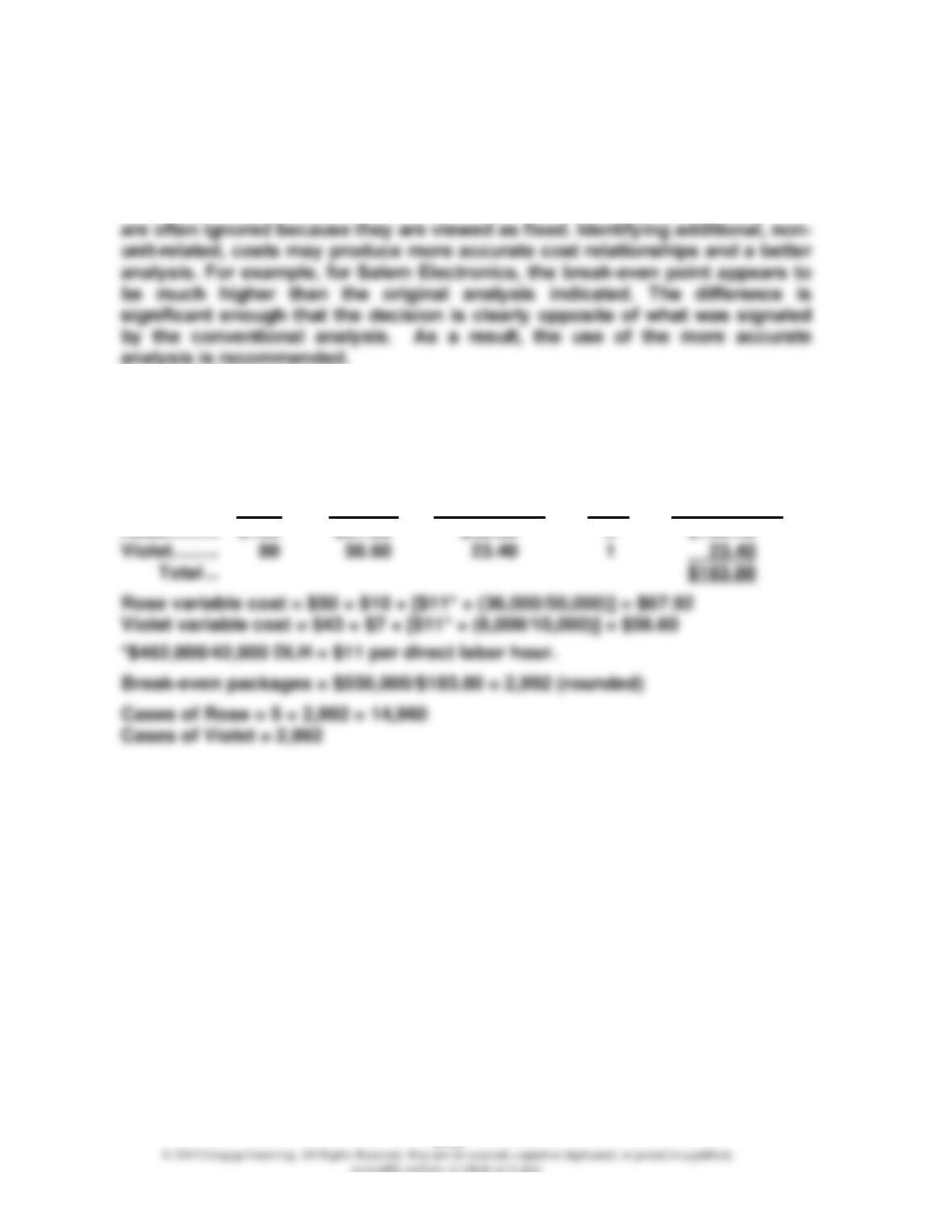
16–32
Problem 16.41 (Concluded)
3. The CVP analysis in Requirement 2 is more accurate because it recognizes
that adding a product will increase the cost of support activities like
inspection, engineering, and setups. In the conventional analysis, these costs
Problem 16.42
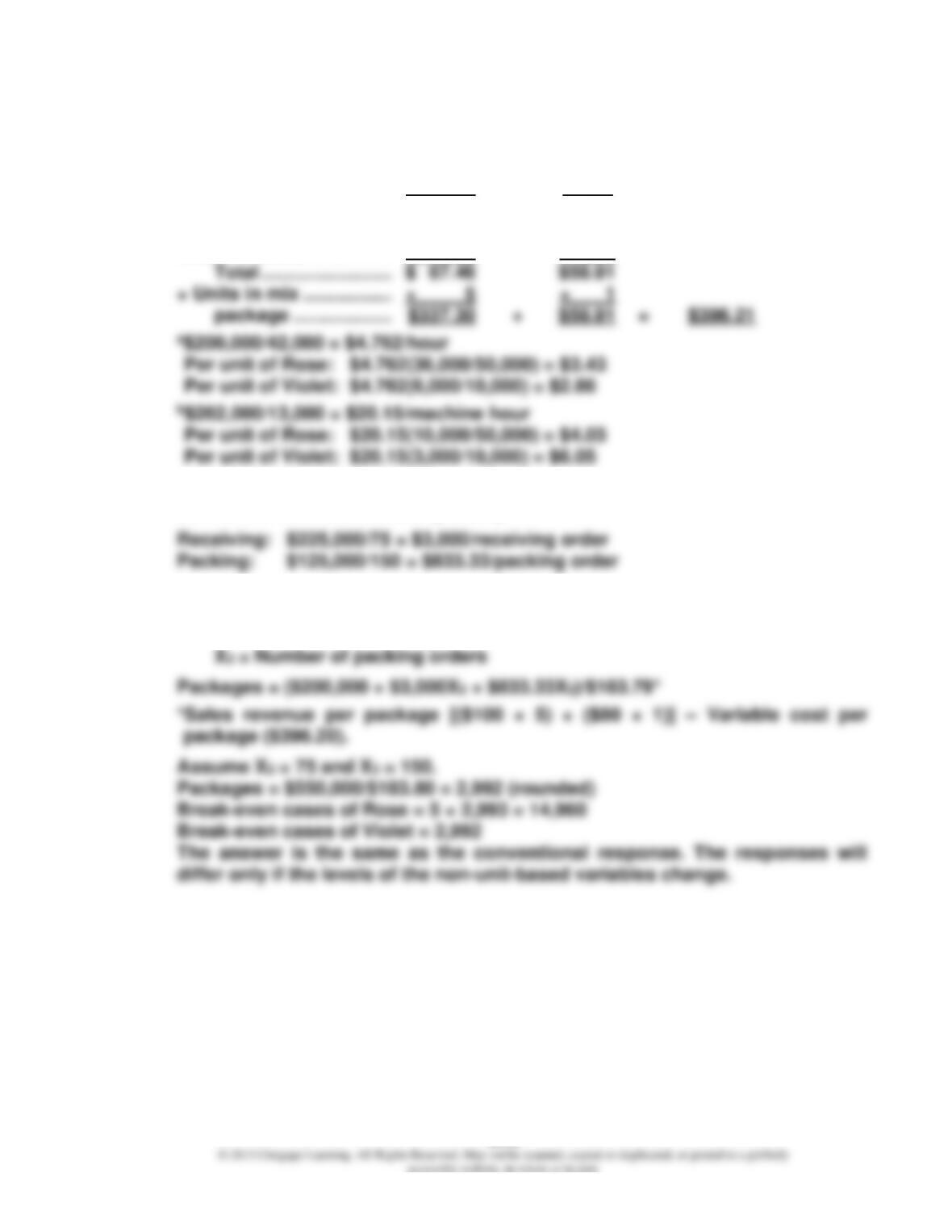
1. Total
Variable Contribution Sales Contribution
Price Cost Margin Mix Margin
16–33
Problem 16.42 (Concluded)
2. Unit-based variable costs:
Rose Violet
Prime costs ……………….. $ 60.00 $50.00
Benefitsa ……………………. 3.43 2.86
Machine costsb…………… 4.03 6.05
Non-unit-based variable costs (assumes strictly variable behavior for each
cost driver with no fixed component):
CVP analysis:
Let X1 = Number of packages
X2 = Number of receiving orders
16–34
CYBER RESEARCH CASE
16.43
Answers will vary.
The following problems can be assigned within CengageNOW and are auto-
graded. See the last page of each chapter for descriptions of these new
assignments.
• Analyzing Relationships—Practice changing Fixed Cost, Price, and Variable
Rate to see the impact on breakeven units.
• Integrative Exercise—CVP Analysis, Pricing and Profitability Analysis, Activity
Based Costing (Covers chapters 4, 16, and 18)
The Collaborative Learning Exercise Solutions can be found on the