
Chapter 16 – Accounting for Health Care Organizations
16-1
CHAPTER 16: ACCOUNTING FOR HEALTH CARE ORGANIZATIONS
OUTLINE
Number
Topic
Type/Task
Status
(re: 18/e)
Questions:
16-1
Standards-setting authority
Explain
Revised
16-2
Financial statements
List
Same
16-3
Primary revenue source
Explain
Same
16-4
Deductions from revenue
Explain
New
16-5
Performance indicators
Define
Same
16-6
Patient Protection and Affordable Care Act
Explain
16-10
16-7
Premium revenue
Discuss
16-9
16-8
Operating statements
Compare
16-6
16-9
Financial and operational performance
Explain
New
16-10
Diagnosis-related group
Explain
New
16-11
Assets limited as to use
Compare
16-8
Cases:
16-12
Charity care
Evaluate
Same
16-13
Research Case—Determining Community
Benefit
Evaluate
Revised
16-14
Patient Protection and Affordable Care Act
Determine
Same
16-16
Evaluating the financial condition
Evaluate
Revised
Exercises/Problems:
16-17
Various
Multiple Choice
Items 4, 6,
and 7 revised;
items 11-12
new.
16-18
Revenue classifications
Classify
Same
16-19
Various unrelated transactions—journalize
Apply
Revised
16-20
Various unrelated transactions—journalize
Apply
New
16-21
Performance indicators
Classify
16-20
16-22
Revenue and related transactions—
journalize
Apply
16-21 revised
16-23
Governmental hospital—journalize
Apply
16-22 revised
16-24
Not-for-profit hospital—financial
statements
Apply
16-23 revised
16-25
Not-for-profit hospital—journal entries and
financial statements
Apply
16-24 revised
16-26
NFP—statement of operations error
analysis
Analyze
16-25 revised

Chapter 16 – Accounting for Health Care Organizations
16-2
CHAPTER 16: ACCOUNTING FOR HEALTH CARE ORGANIZATIONS
Answers to Questions
16-1. Disagree. The FASB is the sole authoritative source of GAAP for nongovernmental NFP
and for-profit health care entities. The GASB is the authoritative source of GAAP for
government hospitals and health care providers. Given that different authoritative sources
of GAAP exist, accounting and reporting rules may differ, depending on whether the
health care provider is legally structured as an investor-owned, not-for-profit, or
General Problem Information: Standards-setting authority
Learning Objective: 16-1
Topic: GAAP for Health Care Providers
Bloom’s Taxonomy: Understand
Accreditation Skills tag: AACSB: Knowledge Application, AICPA: FN: Measurement
Level of Difficulty: Medium
16-2. The FASB requires not-for-profit health care entities to issue a statement of financial
position, statement of operations, and a statement of cash flows, as well as notes to the
financial statements. Additionally, information concerning changes in net assets is to be
included in a statement of changes in net assets, which may be combined with the
statement of operations or presented separately in a statement of changes in net assets.
Bloom’s Taxonomy: Remember
Accreditation Skills tag: AACSB: Knowledge Application, AICPA: FN: Reporting
Level of Difficulty: Easy
16-3. Health care organizations receive the majority of their revenue in the form of fees for
services. The principal sources of service revenue are (1) patient service revenue, (2)
premium revenue, and (3) resident service revenue.

Chapter 16 – Accounting for Health Care Organizations
16-3
Ch. 16, Answers, Question 16–3 (Cont’d)
Patient service revenues are earned based on services provided to patients. Premium
revenue, derived from capitation fees, differs from patient service revenue in that fixed
fees per person are paid periodically, regardless of services provided. Resident service
General Problem Information: Primary revenue source
Learning Objective: 16-2
Topic: Reporting and Accounting Issues
Bloom’s Taxonomy: Understand
Accreditation Skills tag: AACSB: Knowledge Application, AICPA: FN: Measurement
Level of Difficulty: Easy
16-4. Government health care entities follow GASB standards, which indicate that patient
discounts, contractual adjustments, and bad debts are considered contra-revenue
accounts. Discounts and contractual adjustments can be netted against gross patient
revenue in arriving at net patient revenue. Charity service is not reported on the statement
of operations; however, the amount as well as management’s policies regarding charity
service must be disclosed in the notes to the financial statements.
care services but is unwilling to settle the claim. Implicit price concessions are treated as
a contra-revenue. Bad debts are treated as an operating expense. Under FASB ASC 606, it
is expected that a large amount of what previously was considered Bad Debt will now be
classified as implicit price concessions. Like government health care entities, not-for-
profit health care entities do not report charity services on the face of the financial
statements, but rather disclose management’s policies regarding charity services in the
notes to the financial statements.

Chapter 16 – Accounting for Health Care Organizations
16-5. Performance indicators relate to the results of operations. An example of a performance
indicator is the excess of revenues and gains over expenses and losses. Items that would
be omitted from the performance indicator include unrealized gains/losses on other than
trading debt securities, distributions/receipts from owners, and restricted contributions.
The performance indicator, excess of revenues and gains over expenses and losses, is
intended to be comparable to income after taxes (but before discontinued items) of an
investor-owned organization.
16-6. The Patient Protection and Affordable Care Act, also referred to as the Affordable Care
Act (ACA), is a public law intended to provide health insurance reform and improved
health care for Americans. The ACA has had an important impact on the financial
reporting and financial condition of health care entities. Several provisions of the act
(increased insurance coverage, bundled medical services, and electronic recordkeeping)
have had an impact on revenues, and/or costs. The act has impacted the Form 990 filings
by NFPs, requiring increased reporting related to a community health needs assessment
that must be conducted.
General Problem Information: Patient Protection and Affordable Care Act
Learning Objective: 16-4
16-7. Premium revenue is the revenue that a health care entity receives for prepaid health plans
such as health maintenance organizations (HMOs) and preferred provider organizations
(PPOs). A health care entity recognizes premium revenue as patient service revenue in
the period in which members are entitled to receive services, although the entity may not
provide the care (incur costs) related to the revenue until a later date. This would
seemingly violate the matching concept, as the expenses will not be well matched to the
revenues, since the expenses may be incurred over more than one reporting period.
Topic: Other Health Care Issues
Bloom’s Taxonomy: Understand
Accreditation Skills tag: AACSB: Knowledge Application, AICPA: FN: Measurement
Level of Difficulty: Medium
16-5
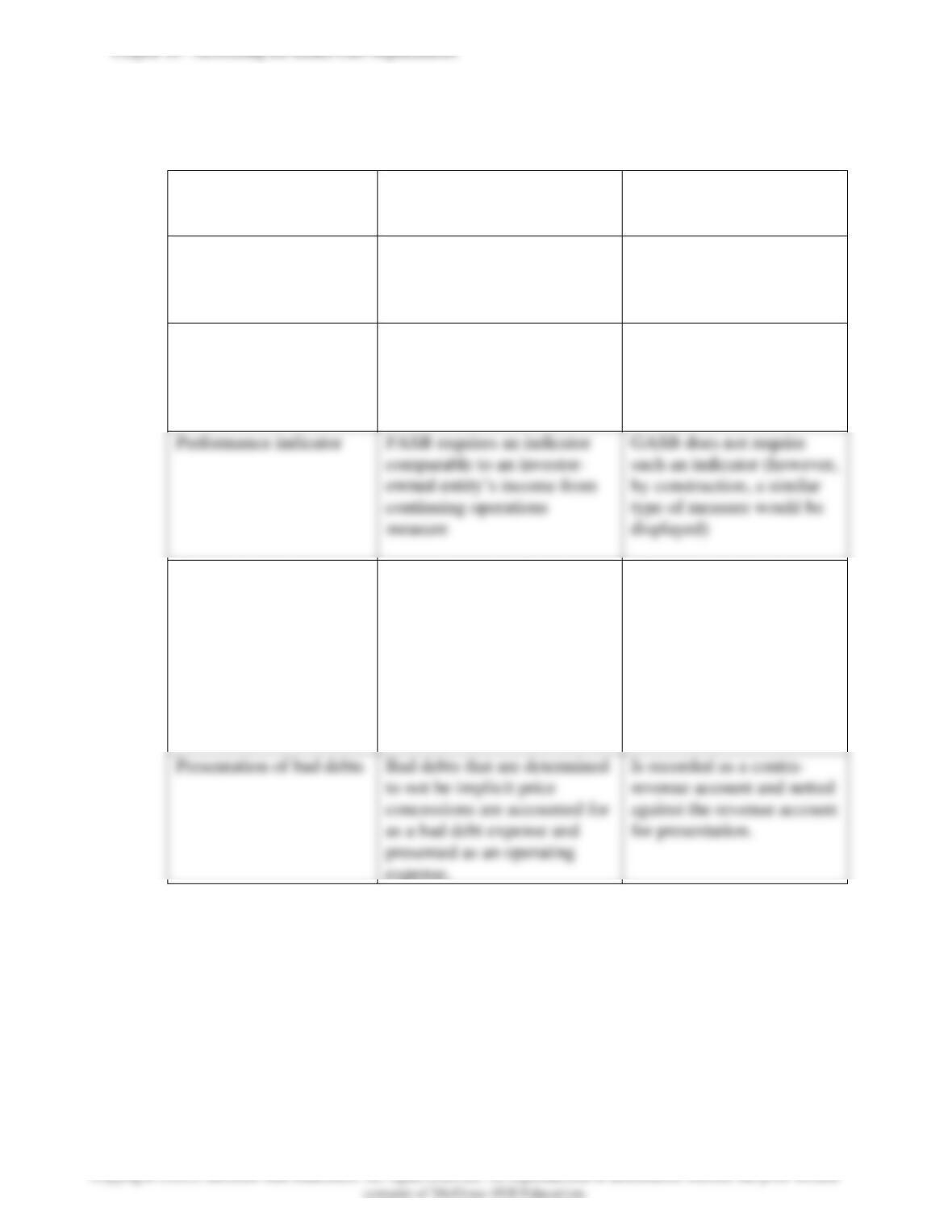
16-8. Although there are several similarities in the presentation of the statements, some of the
differences in presentation are shown on the table below.
Item
Not-For-Profit Presentation
Business-Type
Governmental
Presentation
Title
Statement of operations
Statement of revenues,
expenses, and changes in
net position
Presentation of operating
and nonoperating
activities
FASB does not require that
revenues and/or expenses be
displayed as
operating/nonoperating
GASB requires operating
and nonoperating activity
sections be displayed
continuing operations
measure
by construction, a similar
type of measure would be
displayed)
Net asset/position
classifications
Only net assets without donor
restrictions activity and net
assets released from
restrictions are presented.
(Note: The statement of
changes in net assets shows
net assets with donor
restrictions activity.)
concessions are accounted for
as a bad debt expense and
presented as an operating
expense.
against the revenue account
for presentation.
All operating activity is
presented on the statement
of revenues, expenses, and
changes in net position
General Problem Information: Operating statements
Learning Objective: 16-2
Topic: Reporting and Accounting Issues
Bloom’s Taxonomy: Understand
Accreditation Skills tag: AACSB: Knowledge Application, AICPA: FN: Reporting
Level of Difficulty: Medium

Chapter 16 – Accounting for Health Care Organizations
16-6
16-9. Illustration 16-6 lists ten key financial indicators that can be used to assess the financial
health of NFP hospitals. Examples of the key financial indicators include operating
Topic: Other Health Care Issues
Bloom’s Taxonomy: Identify
Accreditation Skills tag: AACSB: Knowledge Application, AICPA: BB: Industry
Level of Difficulty: Medium
16-10. The diagnosis-related group (DRG) is a case-mix scheme that is used to determine how
much a hospital will receive in payment for services rendered. Services that require
more intensive treatment will receive a higher DRG score. For example, the DRG for
chest pains might be 0.6, while for a kidney transplant, the DRG might be 3.15. The
Centers for Medicare & Medicaid Services (CMS) use the DRG in conjunction with
the federal standard rate to set payment amounts. The payment amounts, and not the
actual costs incurred by the hospital, impact the patient service revenue.
General Problem Information: Diagnosis-related group
16-11. The FASB recognizes assets limited as to use as unrestricted assets whose use
is limited by contract or agreements with outside parties, or by the governing body.
Restrictions imposed on assets by donors or grantors are not included in the definition of
General Problem Information: Assets limited as to use
Learning Objective: 16-2
Topic: Reporting and Accounting Issues
Bloom’s Taxonomy: Understand
Accreditation Skills tag: AACSB: Knowledge Application, AICPA: FN: Reporting
Level of Difficulty: Medium

Chapter 16 – Accounting for Health Care Organizations
Solutions to Cases
16-12. a. There are no precise guidelines discussed in the text or in Internal Revenue Service
announcements regarding the amount of charity care that must be provided in order to
retain tax-exempt status. The Burton-Hill Act of 1946 that made construction loans
available to hospitals did require that some level of care to indigent patients be
delivered; however, the act does not provide any minimum amounts of care.
b. The chart shows that if charity care alone is considered, all three hospitals fall short of
the estimated taxes the hospitals would pay if they were not tax-exempt. When
contractual adjustments are added to the charity care, all three hospitals exceed the
estimated taxes the hospitals would pay. However, it should be kept in mind that
c. The audited annual financial statements of these three hospitals would be useful. The
amount of charity care and the hospitals’ policies should be disclosed in the notes to
the financial statements. Students could also determine the difference in size and
purpose of the hospitals, which may be relevant. Students might also be able to
calculate the amount of taxes that would be paid if the organization was not tax-
exempt. Presumably the reported “estimated taxes” was based on the “excess of
revenues over expenses”; however, it is not clear whether all items on a statement of
operations would be subject to taxation, or if there are items in the statement of
changes in net assets that would be subject to taxation.
16-8
16-13. a. Students’ answers to part a will vary depending on their selection of hospitals. The
goal is to get students to look at Schedule H to see the kinds of information required
and then relate that information to organizations with which they are somewhat
familiar.
b. Students’ answers to part b will vary. The authors suggest that grading be done based
on the level of thought and analysis demonstrated in the response. The American
Hospital Association (AHA) has been reporting the average exempt hospital level of
General Problem Information: Research Case—Determining Community Benefit
Learning Objective: 16-4
Topic: Other Health Care Issues
Bloom’s Taxonomy: Evaluate
Accreditation Skills tag: AACSB: Analytical Thinking, AICPA: BB: Decision Making
Level of Difficulty: Hard
16-14. a. The primary purpose of the act is health insurance reform. Reforms required under
the act are intended to enhance the quality of health care by holding insurance
companies more accountable, lowering health care costs, and guaranteeing more
health care choices.
b. The act contains numerous provisions. Some of the major coverage provisions of the
• an end to lifetime limits on coverage.
• coverage of certain preventative care costs.
c. The Insurance Marketplace is a government website designed to make buying health
Chapter 16 – Accounting for Health Care Organizations
16-9
Ch. 16, Solutions, Case 16-14, c. (Cont’d)
The open enrollment period usually runs for about three months starting late in the
calendar year.
d. The reasons students see the purchase of insurance as controversial should generate a
good discussion, given that students tend to be younger and healthier than those who
would most immediately benefit from the enactment of the provision (older and less
healthy individuals who would see lower premiums). The controversy has generally
General Problem Information: Patient Protection and Affordable Care Act
Learning Objective: 16-4
Topic: Other Health Care Issues
Bloom’s Taxonomy: Understand
Accreditation Skills tag: AACSB: Knowledge Application, AICPA: BB: Industry
Level of Difficulty: Medium
16-15. a. The purpose of Hospital Compare is to provide consumers with information about the
quality of care for hospitals and other types of health care providers. Information on
the site can help consumers make more informed decisions about where they
get health care. Additionally, the public nature of the information encourages
hospitals and other listed providers to improve the quality of the care they provide.
c. Student explanations will vary depending on the amount of effort and creativity they
bring to this analysis. They should be able to appreciate that certain hospitals, such as
public hospitals that disproportionately serve an underprivileged populace or
hospitals with an unusually large number of Medicare patients, may have different
quality of care scores than hospitals with a more affluent, better insured, and younger
patient mix. Similarly, wealthier health care organizations are more likely to have
state-of-the-art technology and perhaps the most highly qualified medical staff.
Chapter 16 – Accounting for Health Care Organizations
16–10
Ch. 16, Solutions, Case 16-15 (Cont’d )
Those hospitals may have a comparative advantage over health care organizations
with fewer resources. Finally, research hospitals or those that specialize in difficult or
Bloom’s Taxonomy: Evaluate
Accreditation Skills tag: AACSB: Analytical Thinking, AICPA: BB: Critical Thinking
Level of Difficulty: Medium
16-16 a. Students’ answers to part a will vary depending on the hospital they select. The
objective is to get students to review the financial condition of a hospital in line with
ratios and statistics widely cited in the health care industry. The benchmark data are
sourced from “HFMA Key Hospital Financial Statistics and Ratio Medians 2019,”
which compares median statistics from three sources: Optum, Premier, Inc., and
HFMA Map App.
General Problem Information: Research Case—Evaluating financial condition
Learning Objective: 16-5
Topic: Financial and Operational Analysis
Bloom’s Taxonomy: Evaluate
Accreditation Skills tag: AACSB: Analytical Thinking, AICPA: BB: Decision Making
Level of Difficulty: Hard
Solutions to Exercises and Problems
16-17. 1. a. 6. a. 11. a.
3. c. 8. b.
5. d. 10. c.

Chapter 16 – Accounting for Health Care Organizations
16–11
Ch. 16, Solutions, Exercise 16-17 (Cont’d)
Learning Objective: 16-2
Learning Objective: 16-4
Learning Objective: 16-5
Topic: GAAP for Health Care Providers; Reporting and Accounting Issues; Other Health
Care Issues; Financial and Operational Analysis
16-18.
2. c. 7. e.
4. e. 9. e.
5. d. 10. d.
General Problem Information: Revenue classifications
Learning Objective: 16-2
Topic: Reporting and Accounting Issues
Bloom’s Taxonomy: Understand
16-19.
BUSINESS-TYPE GOVERNMENT FACILITY JOURNAL
Debits Credits
1. CASH—BOND REPAYMENT 500,000
CASH 500,000
2. ACCOUNTS AND NOTES RECEIVABLE 965,000
CONTRACTUAL ADJUSTMENTS 535,000
PATIENT SERVICE REVENUE 1,500,000
(Note charity care is not recorded in the journal.)

Chapter 16 – Accounting for Health Care Organizations
Ch. 16, Solutions, Exercise 16-19 (Cont’d)
Debits. Credits
4. A government facility would not record the donated services, since GASB standards do not
provide for recognition of donated services.
5. CASH 1,500,000
REVENUE—CONTRIBUTIONS FOR ENDOWMENT 1,500,000
6. INVESTMENTS 32,000
REVENUES—CHANGES IN FAIR VALUE OF
INVESTMENTS 32,000
7. EQUIPMENT 837,000
CASH 837,000
(Note: At the end of the reporting period, the government facility would adjust the account
Net Position—Restricted to reflect the decrease in restricted assets as a result of meeting the
purpose of the restriction.)
General Problem Information: Various unrelated transactions—journalize
Learning Objective: 16-3
Topic: Reporting and Accounting Issues

16–13
16-20.
NOT-FOR-PROFIT FACILITY JOURNAL
Debits Credits
1. ASSETS LIMITED AS TO USE—CASH 650,000
CASH 500,000
3. CONTRACTUAL ADJUSTMENTS 800,000
IMPLICIT PRICE CONCESSIONS FOR INDIVIDUAL
PAYORS 250,000
PATIENT ACCOUNTS RECEIVABLE 1,050,000
5. CASH 3,000,000
CONTRIBUTIONS—WITH DONOR RESTRICTIONS 3,000,000
7. EQUIPMENT 625,000
CASH 625,000
NET ASSETS RELEASED FROM RESTRICTIONS—

Chapter 16 – Accounting for Health Care Organizations
16–14
Ch. 16, Solutions, Exercise 16-20 (Cont’d)
Learning Objective: 16-3
Topic: Reporting and Accounting Issues
Bloom’s Taxonomy: Apply
16-21.
1. Y Unrealized gains/losses on only trading debt securities are included in the
performance indicator
2. N Operating performance relates to net assets without donor restrictions.
4. Y
6. N “Below the line items” such as discontinued operations and change in
accounting principle are not included in the performance indicator.
7. N A transfer of cash to the parent is not an operating activity.
8. N There is a purpose restriction on the grant.
10. Y
General Problem Information: Performance indicators
Learning Objective: 16-2
Topic: Reporting and Accounting Issues

Chapter 16 – Accounting for Health Care Organizations
16-22. a. EVANSTON GENERAL HOSPITAL
GENERAL JOURNAL
Debits Credits
1. PATIENT ACCOUNTS RECEIVABLE 8,222,000
2. GENERAL EXPENSES 265,000
CONTRIBUTIONS—WITHOUT DONOR
RESTRICTIONS 265,000
3. CASH 5,365,000
5. CASH 965,000
OTHER REVENUES 965,000
6. IMPLICIT PRICE CONCESSIONS FOR INDIVIDUAL PAYORS 1,170
PATIENT ACCOUNTS RECEIVABLE 1,170
b. Unrestricted revenues, gains, and other support: