Chapter 16
Process Costing and Analysis
QUESTIONS
1. The main deciding factor in choosing between a job order costing system or a
process costing system is the type of product or service. Examples where a
process costing system is likely appropriate include chemicals, cleaning fluids, mail
processing, and oil refinement. Examples where a job order costing system is likely
appropriate include home building, tax return preparation, financial planning, legal
services, and consulting. (Hybrid systems are also common.)
2. The main focus in process costing is the production department (process).
3. Yes, services can be delivered by processes. For example, Federal Express delivers
parcels by (a) picking them up from the sender, (b) transporting them to Memphis,
(c) sorting them for rerouting, (d) transporting them to their destination cities, and
(e) delivering them to the recipient.
4. The journal entries to match cost flows with product flows are primarily the same
for both process costing and job order costing. In process costing, the materials
flow into production and direct labor is applied to the product. Also, factory
overhead is measured and applied to each production department. This similarly
compares to each job in job order costing. However, process costing typically uses
more Work in Process Inventory accounts (and transfers costs across these
8. A process cost accounting system treats labor that is used entirely within one
production department as direct labor. The labor may include the software engineer
to control the equipment and the maintenance by persons who work entirely within
that department. The key is that the cost object is the process and not the job.
9. Direct labor costs flow to the Work in Process Inventory account. Then the direct
labor costs in the Work in Process Inventory account flow to the Finished Goods
Inventory and then on to Cost of Goods Sold.
10. At the end of the accounting period the Factory Overhead account should have a
zero balance. This is because any balance in Factory Overhead is closed to Cost of
Goods Sold as part of the end-of-period adjustments.
11. Yes, it is possible to have either underapplied or overapplied overhead in a process
cost accounting system. Since the overhead allocation rate is based on predictions
of overhead and other variables such as direct labor, the predicted amounts are not
likely to be exactly equal to the actual amounts incurred.
12. Equivalent units for direct materials differ from that for direct labor (and overhead) if
direct materials and direct labor (and overhead) are added at different stages in the
production process. Equivalent units are the same when direct materials, direct
labor, and factory overhead are added at the same stages of the production
process. (Also, equivalent units for both direct labor and overhead are the same
when overhead costs are applied based on direct labor.)
13. The four steps in accounting for production activity (for process operations) are: 1)
determine the physical flow of units, 2) compute equivalent units of production, 3)
compute cost per equivalent unit, and 4) assign and reconcile costs.
18. If the company is successful in reducing water usage, its raw materials cost (water)
should decline. Likewise, assuming water used in its cleaning and cooling
processes is considered overhead, factory overhead costs should decline. These
cost reductions would result in lower direct materials cost per equivalent unit and
QUICK STUDIES
Quick Study 16-1 (5 minutes)
1. Job order operation
4. Job order operation
3. Job order operation
6. Process operation
Quick Study 16-2 (5 minutes)
1. T 2. F 3. F 4. T
Quick Study 16-3 (10 minutes)
1. Process operation 6. Process operation
2. Job order operation 7. Job order operation
Quick Study 16-4 (10 minutes)
Units
Units in beginning WIP inventory
150,000
+
Units started
310,000
=
Total units to account for
460,000
Units completed and transferred out
340,000
+
Units in ending WIP inventory
120,000
=
Total units accounted for
460,000
Quick Study 16-5 (10 minutes)
Equivalent units under the weighted-average method
Equivalent
EUP for conversion—Weighted average
Units
Units completed and transferred out (340,000 x 100%) …………………
340,000
Units of ending WIP for conversion (120,000 x 25%) …………………….
30,000
Equivalent units of production …………………………………………………….
370,000
Quick Study 16-6 (10 minutes)
Equivalent units under the FIFO method
Equivalent
EUP for conversion—FIFO
Units
Equivalent units to complete beginning WIP (150,000 x 20%) ……….
30,000
Equivalent units started and completed* ……………………………………..
190,000
Equivalent units of production …………………………………………………….
250,000
Quick Study 16-7 (5 minutes)
Cost per equivalent unit of production—weighted-average method
Quick Study 16-8 (10 minutes)
Equivalent units under the weighted-average method
Equivalent
EUP for conversion—Weighted average
Units
Units completed and transferred out (680,000 x 100%) …………………
680,000
Units of ending work in process
Conversion (260,000 x 75%) ……………………………………………………..
195,000
Equivalent units of production …………………………………………………….
875,000
Quick Study 16-9 (15 minutes)
Equivalent units under the FIFO method
Equivalent
EUP for conversion—FIFO
Units
Equivalent units to complete beginning WIP (320,000 x 75%) ……….
240,000
Equivalent units started and completed* ……………………………………..
360,000
Equivalent units in ending WIP (260,000 x 75%) …………………………..
195,000
Equivalent units of production …………………………………………………….
795,000
* Units completed – Units in beginning work in process = Units started and completed
680,000 – 320,000 = 360,000
Quick Study 16-10 (15 minutes)
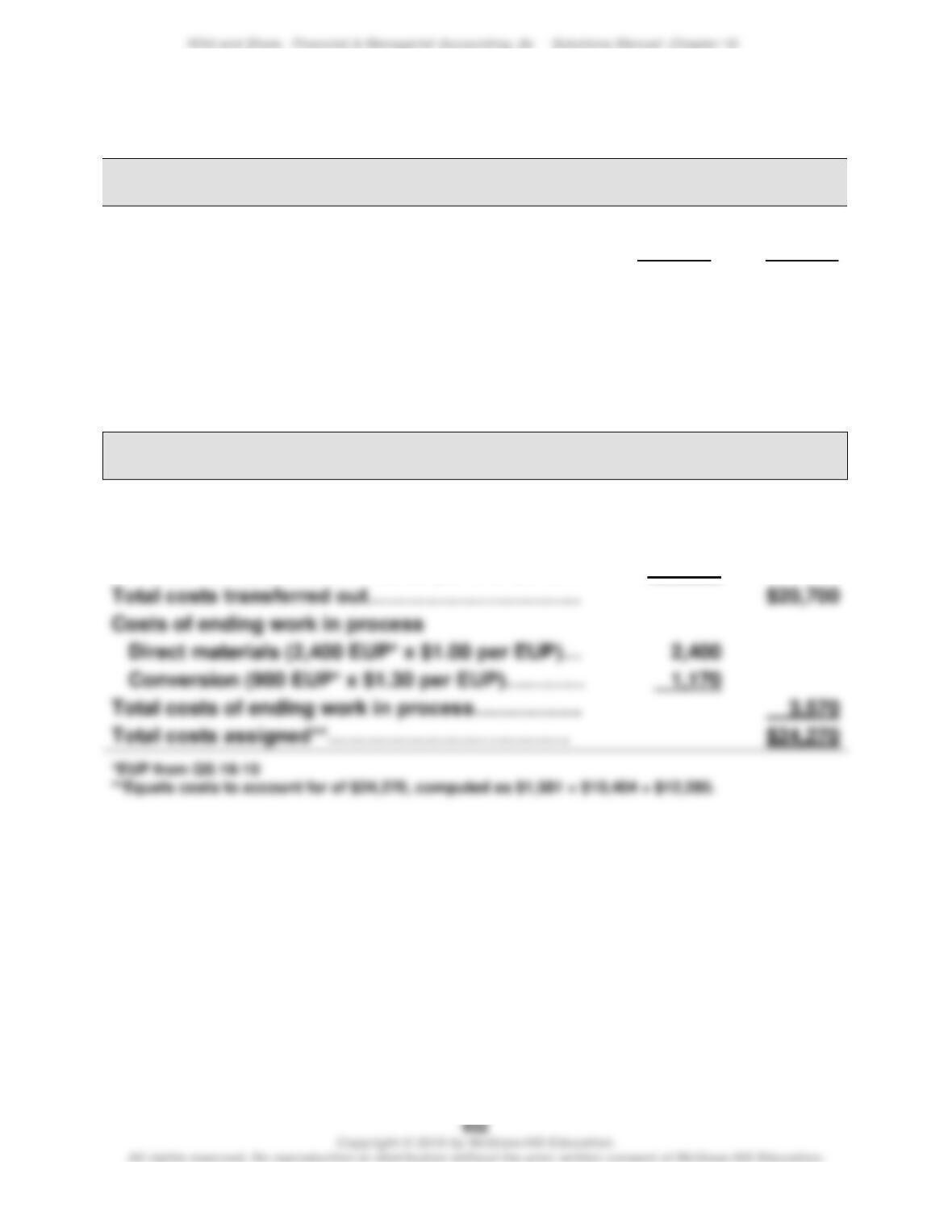
Equivalent units of production—Weighted average
Direct
Materials
Conversion
Units completed & transferred out (9,000 x 100%)
Units of ending work in process
Direct materials, 3,000 x 80%…………………….
Conversion, 3,000 x 30%…………………….……
Quick Study 16–11 (25 minutes)
Cost per equivalent unit—Weighted average
Direct
Materials
Conversion
Costs of beginning work in process………………
$ 996
$ 585
Costs incurred this period…………………………..
10,404
12,285
Total costs……………………………………………..
$11,400
$12,870
÷ Equivalent units of production (from QS 16–10)…
11,400
9,900
Cost per equivalent unit of production……………
$1.00 per
EUP
$1.30 per
EUP
Quick Study 16-12 (10 minutes)
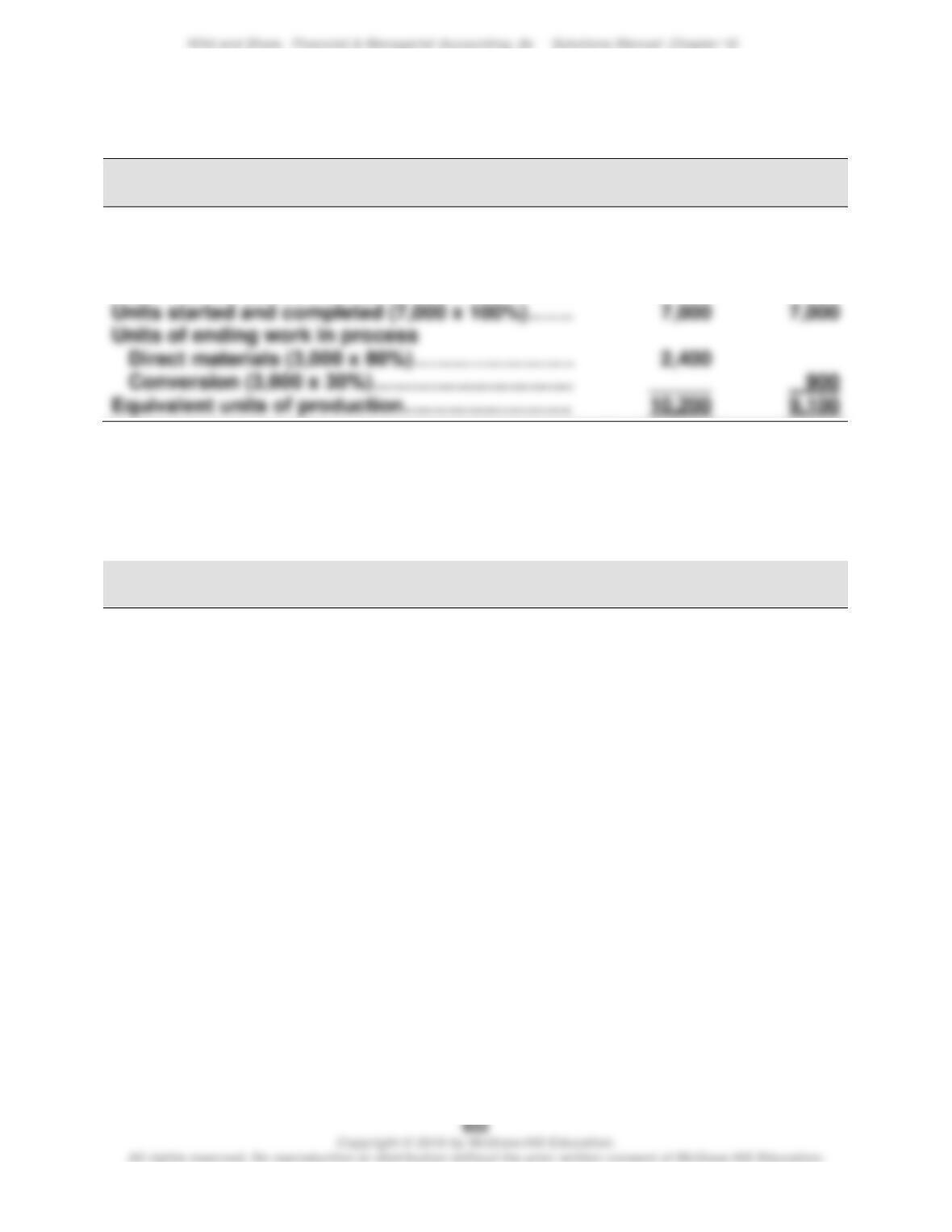
Cost assignment—Weighted average
Direct
Materials
Conversion
Costs of units transferred out
Direct materials (9,000 EUP* x $1.00 per EUP)…
$9,000
Conversion (9,000 EUP* x $1.30 per EUP)………
11,700
Direct materials (2,400 EUP* x $1.00 per EUP)…
Conversion (900 EUP* x $1.30 per EUP)…………
Quick Study 16-13 (5 minutes)
Work in Process Inventory—Painting …………………….
20,700
Work in Process Inventory—Assembly ……………..
20,700
To transfer costs of goods across departments.
Quick Study 16-14 (15 minutes)
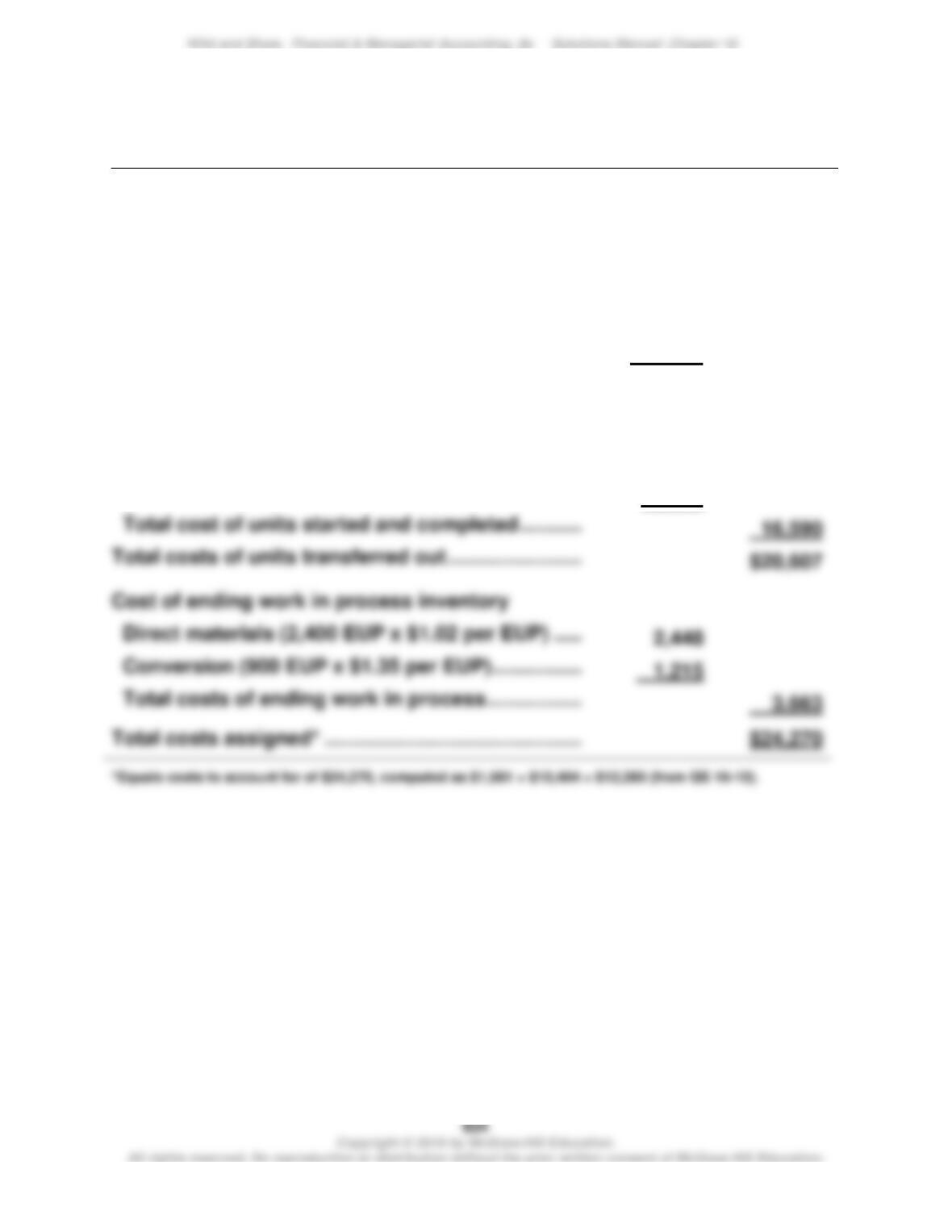
Equivalent units of production—FIFO
Direct
Materials
Conversion
Units to complete beginning work in process
Direct materials (2,000 x 40%)……………………
Conversion (2,000 x 60%)…………………………
Units of ending work in process
800
1,200
Quick Study 16–15 (5 minutes)
Cost per equivalent unit – FIFO
Direct
Materials
Conversion
Costs incurred this period …………………………………
$10,404
$12,285
÷ Equivalent units of production (from QS 16–14)
10,200
9,100
Cost per equivalent unit of production ………………
$1.02 per
EUP
$1.35 per
EUP
Quick Study 16-16 (20 minutes)
Assignment of costs to output of department—FIFO
Costs of units transferred out
Cost of beginning work in process inventory …….
$ 1,581
Costs to complete beginning work in process
Direct materials (800 EUP x $1.02 per EUP) ……..
816
Conversion (1,200 EUP x $1.35 per EUP) ………….
1,620
Total costs to complete …………………………………..
2,436
Cost of units started and completed this period
Direct materials (7,000 EUP x $1.02 per EUP) …..
7,140
Conversion (7,000 EUP x $1.35 per EUP) ………….
9,450
Total cost of units started and completed ………..
Cost of ending work in process inventory
Direct materials (2,400 EUP x $1.02 per EUP) …..
2,448
Conversion (900 EUP x $1.35 per EUP) …………….
Quick Study 16-17 (5 minutes)
Work in Process Inventory—Painting …………………….
20,607
Work in Process Inventory—Assembly ……………..
20,607
Transfer costs of goods across departments.
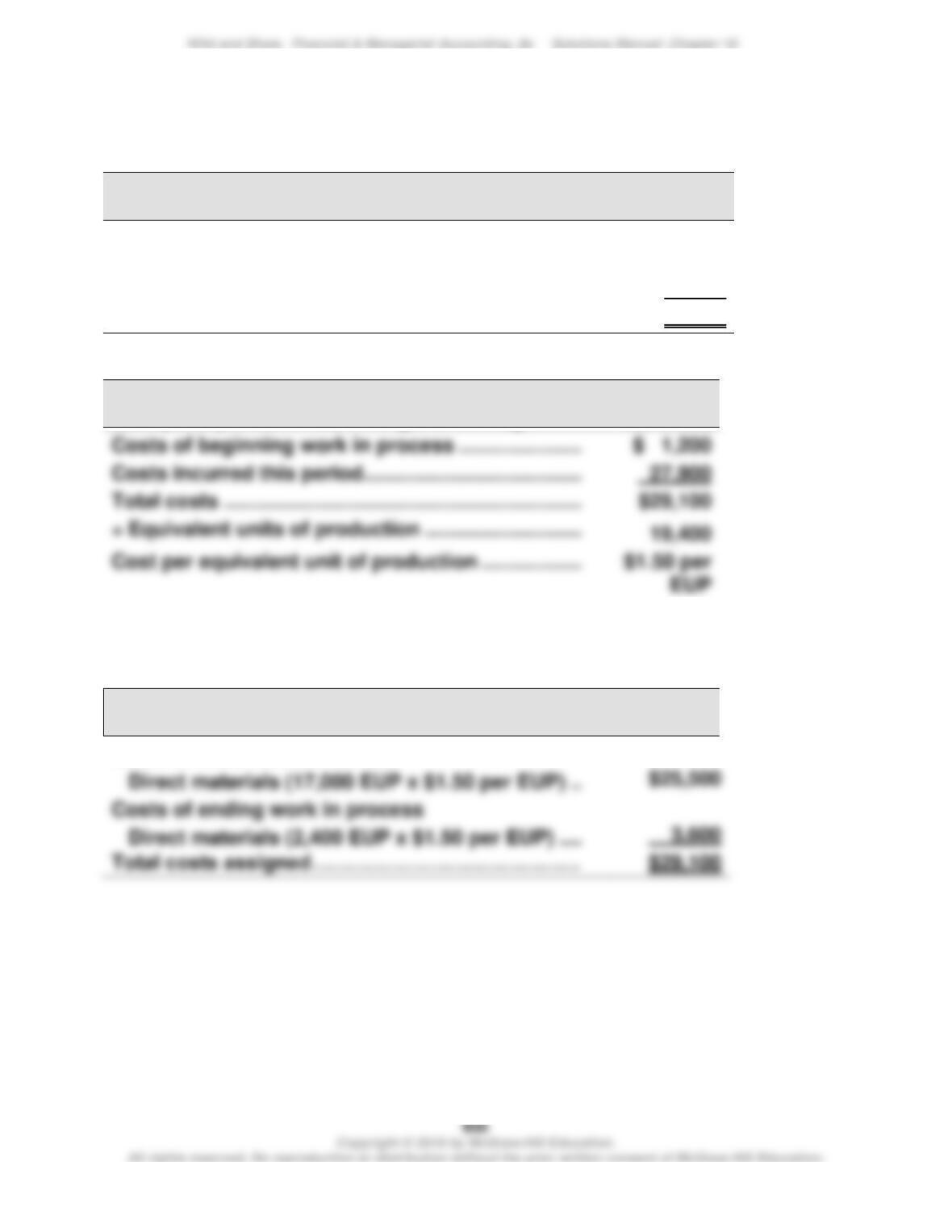
Quick Study 16-18 (10 minutes)
a.
Equivalent units of production—Weighted average
Direct
Materials
Units completed & transferred out (17,000 x 100%)
17,000
Units of ending work in process
Direct materials, (3,000 x 80%) ………………………..
2,400
Equivalent units of production ………………………….
19,400
b.
Cost per equivalent unit—Weighted average
Direct
Materials
Costs of beginning work in process ………………….
Costs incurred this period …………………………………
Total costs ……………………………………………………….
÷ Equivalent units of production ……………………….
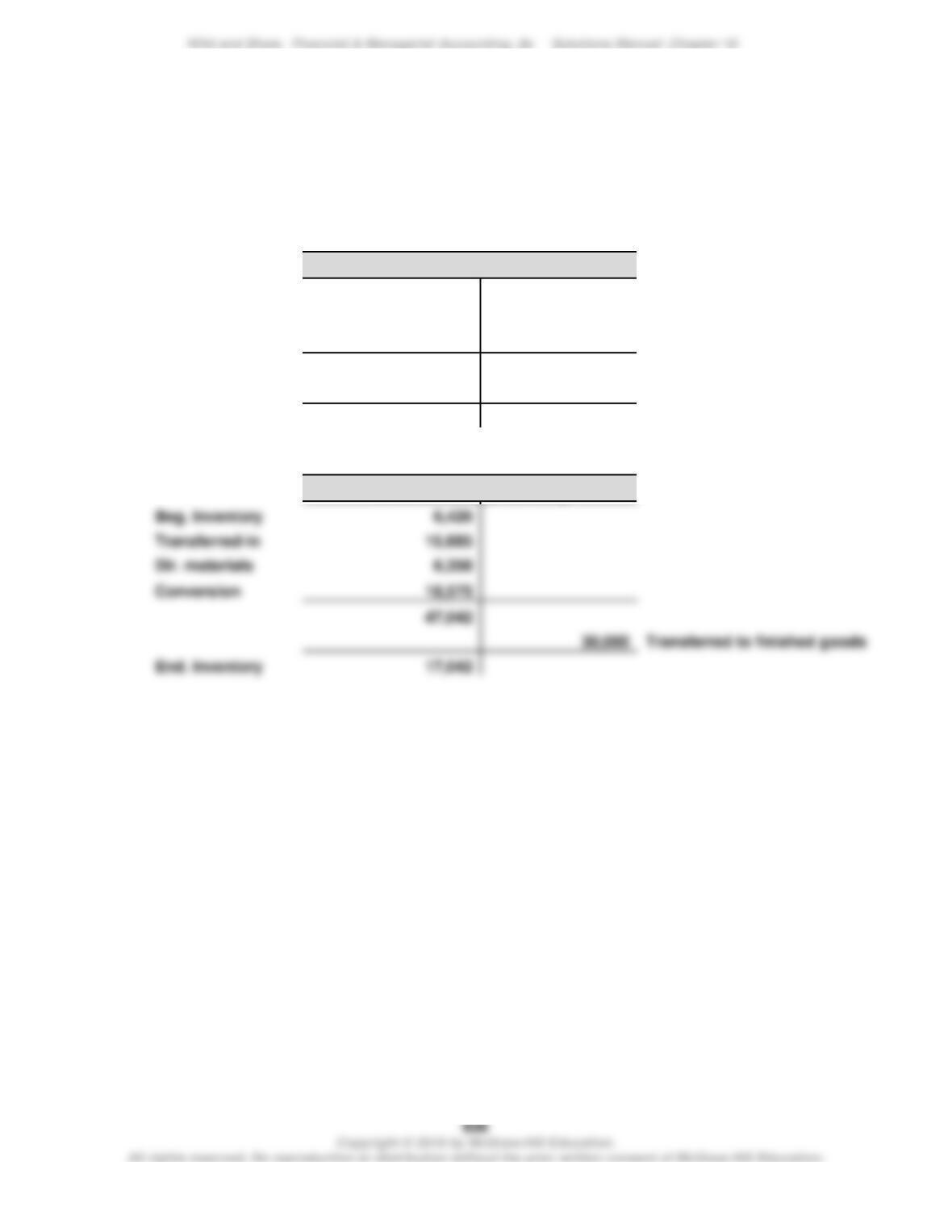
Quick Study 16-19 (10 minutes)
Cost assignment—Weighted average
Direct
Materials
Costs of units transferred out
Direct materials (17,000 EUP x $1.50 per EUP) ..
Costs of ending work in process
Direct materials (2,400 EUP x $1.50 per EUP) ….
Quick Study 16-20 (10 minutes)
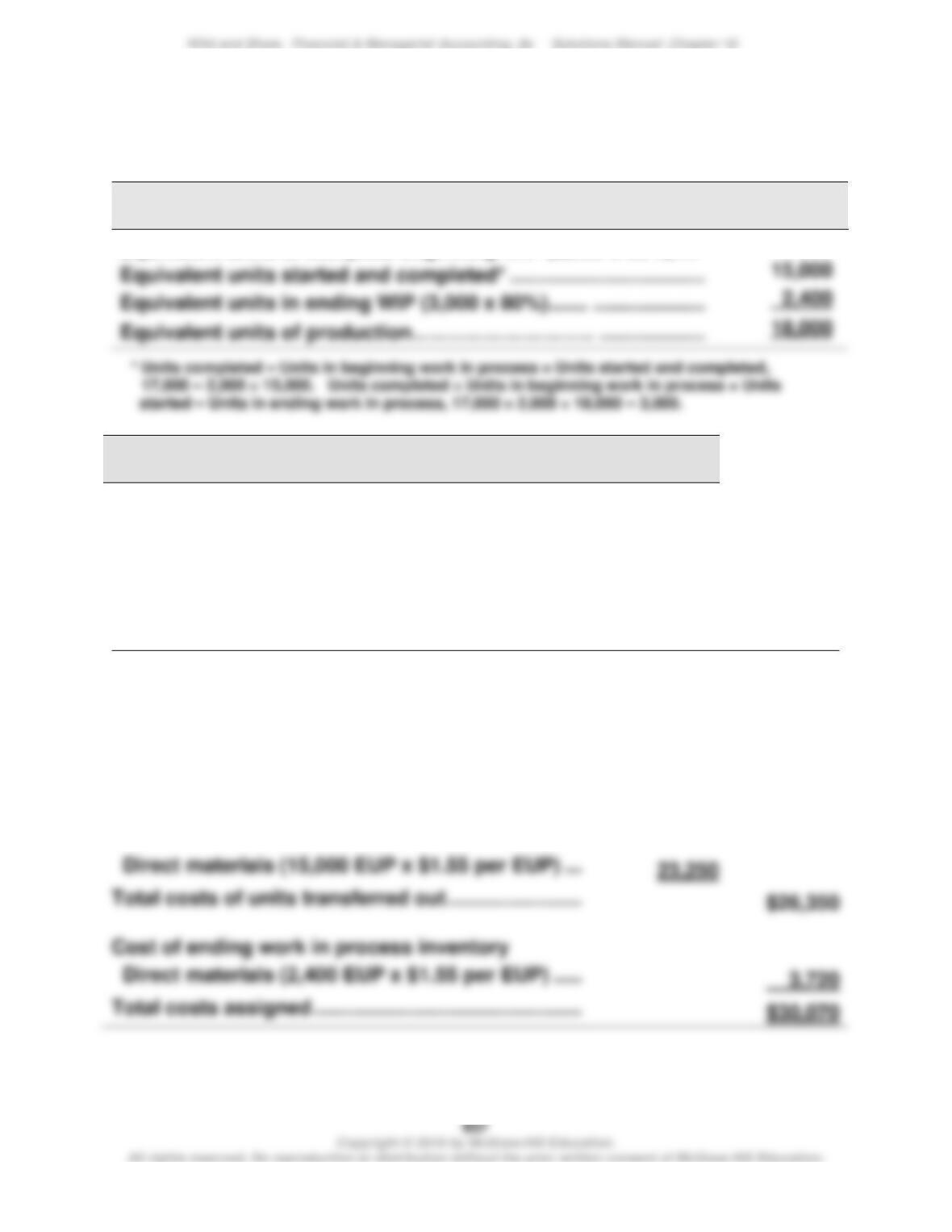
The ending balance in Work in Process Inventory—Cutting is $7,100 and
the ending balance in Work in Process Inventory—Binding is $17,042, as
computed below.
Work in Process—Cutting
Beg. Inventory
3,445
Dir. materials
8,240
Conversion
11,100
22,785
15,685
Transferred to Binding
End. Inventory
7,100
Beg. Inventory
15,685
Dir. materials
6,356
Conversion
18,575
47,042
30,000
End. Inventory
Work in Process—Binding
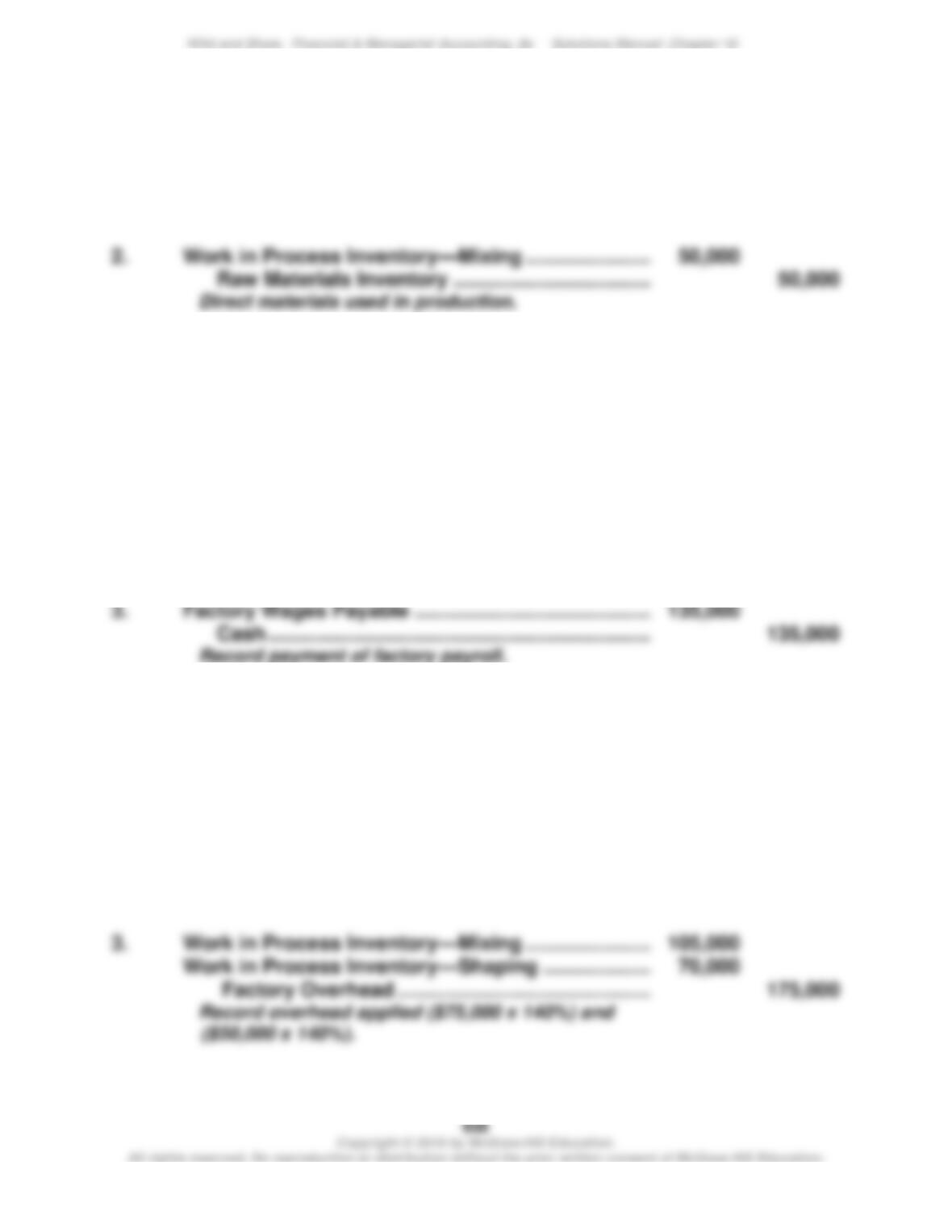
Quick Study 16-21 (15 minutes)
Equivalent units under the FIFO method
Equivalent
EUP for materials—FIFO
Units
Equivalent units to complete beginning WIP (2,000 x 30%)….
600
Equivalent units started and completed* ……………………………..
Equivalent units of production……………………… ……………….
Cost per equivalent unit—FIFO
Direct
Materials
Costs incurred this period …………………………………
$27,900
÷ Equivalent units of production ……………………….
18,000
Cost per equivalent unit of production ………………
$1.55 per
EUP
Quick Study 16–22 (15 minutes)
Assignment of direct materials costs to output of department—FIFO
Costs transferred out
Cost of direct materials in beginning WIP ………….
$2,170
Costs to complete beginning WIP ……………………..
Direct materials (600 EUP x $1.55 per EUP) ……..
930
Cost of units started and completed this period
Direct materials (15,000 EUP x $1.55 per EUP) …
23,250
Cost of ending work in process inventory
Direct materials (2,400 EUP x $1.55 per EUP) …..
Quick Study 16-23 (10 minutes)
1.
Raw Materials Inventory ………………………………………..
62,000
Accounts Payable …………………………………………….
62,000
Purchase raw materials inventory.
2.
Work in Process Inventory—Mixing ……………………….
50,000
Raw Materials Inventory …………………………………..
50,000
Direct materials used in production.
Quick Study 16-24 (10 minutes)
1.
Work in Process Inventory—Mixing ……………………….
75,000
Work in Process Inventory—Shaping …………………….
Factory Wages Payable ……………………………………
50,000
125,000
Record direct labor used in production.
2.
Factory Overhead ………………………………………………….
10,000
Factory Wages Payable ……………………………………
10,000
Record indirect labor used in production.
3.
Factory Wages Payable …………………………………………
Cash …………………………..……………………………………
Record payment of factory payroll.
Quick Study 16-25 (15 minutes)
1.
Factory Overhead ………………………………………………….
9,000
Raw Materials Inventory …………………………………..
9,000
Record indirect materials used in production.
2.
Factory Overhead ………………………………………………….
156,000
Other Accounts ……………………………………………….
156,000
Record other overhead costs.
3.
Work in Process Inventory—Mixing ……………………….
105,000
Factory Overhead ……………………………………………
175,000
Quick Study 16-26 (10 minutes)
Finished Goods Inventory ……………………………………..
275,000
Work in Process Inventory—Shaping ……………….
275,000
Transfer of finished goods from production.
EXERCISES
Exercise 16-1 (10 minutes)
1. Process operation 6. Process operation
2. Process operation 7. Job order operation
Note: Reasonable arguments can be made to classify #7 as being made in a process
operation, and #8 in a job order operation, in some cases.
Exercise 16-2 (10 minutes)
1. Process operation 4. Both
Exercise 16-3 (10 minutes)
1. F 5. G
2. A 6. B
Exercise 16-4 (30 minutes)
1. Beginning inventory is 100% complete with respect to materials.
Ending inventory is 100% complete with respect to materials.
EUP for Materials
Units of
Product
Goods completed (80,000 EUP x 100%) ………………………………
80,000
Ending work in process (16,000 EUP x 100%) ……………………..
16,000
Total EUP …………………………………………………………………………..
96,000
2. Beginning inventory is 40% complete with respect to materials.
Ending inventory is 75% complete with respect to materials.
Units of
EUP for Materials
Product
Goods completed (80,000 EUP x 100%) ………………………………
80,000
Ending work in process (16,000 EUP x 75%) ……………………….
12,000
3. Beginning inventory is 60% complete with respect to materials.
Ending inventory is 30% complete with respect to materials.
Units of
EUP for Materials
Product
Goods completed (80,000 EUP x 100%) ………………………………
Total EUP …………………………………………………………………………..
84,800
Exercise 16-5 (30 minutes)
1. Beginning inventory is 100% complete with respect to materials.
Ending inventory is 100% complete with respect to materials.
EUP for Materials
Units of
Product
To complete beginning work in process (24,000 EUP x 0%) ………
Units started and completed (56,000 EUP x 100%) ……………………
56,000
Ending work in process (16,000 EUP x 100%) …………………………..
2. Beginning inventory is 40% complete with respect to materials.
Ending inventory is 75% complete with respect to materials.
Units of
EUP for Materials
Product
To complete beginning work in process (24,000 EUP x 60%) …….
14,400
Units started and completed (56,000 EUP x 100%) ……………………
56,000
Ending work in process (16,000 EUP x 75%) …………………………..
12,000
Total EUP ………………………………………………………………………………..
82,400
3. Beginning inventory is 60% complete with respect to materials.
Ending inventory is 30% complete with respect to materials.
Units of
EUP for Materials
Product
To complete beginning work in process (24,000 EUP x 40%) …….
Units started and completed (56,000 EUP x 100%) ……………………
56,000
Ending work in process (16,000 EUP x 30%) …………………………..
Exercise 16-6 (30 minutes)
1.
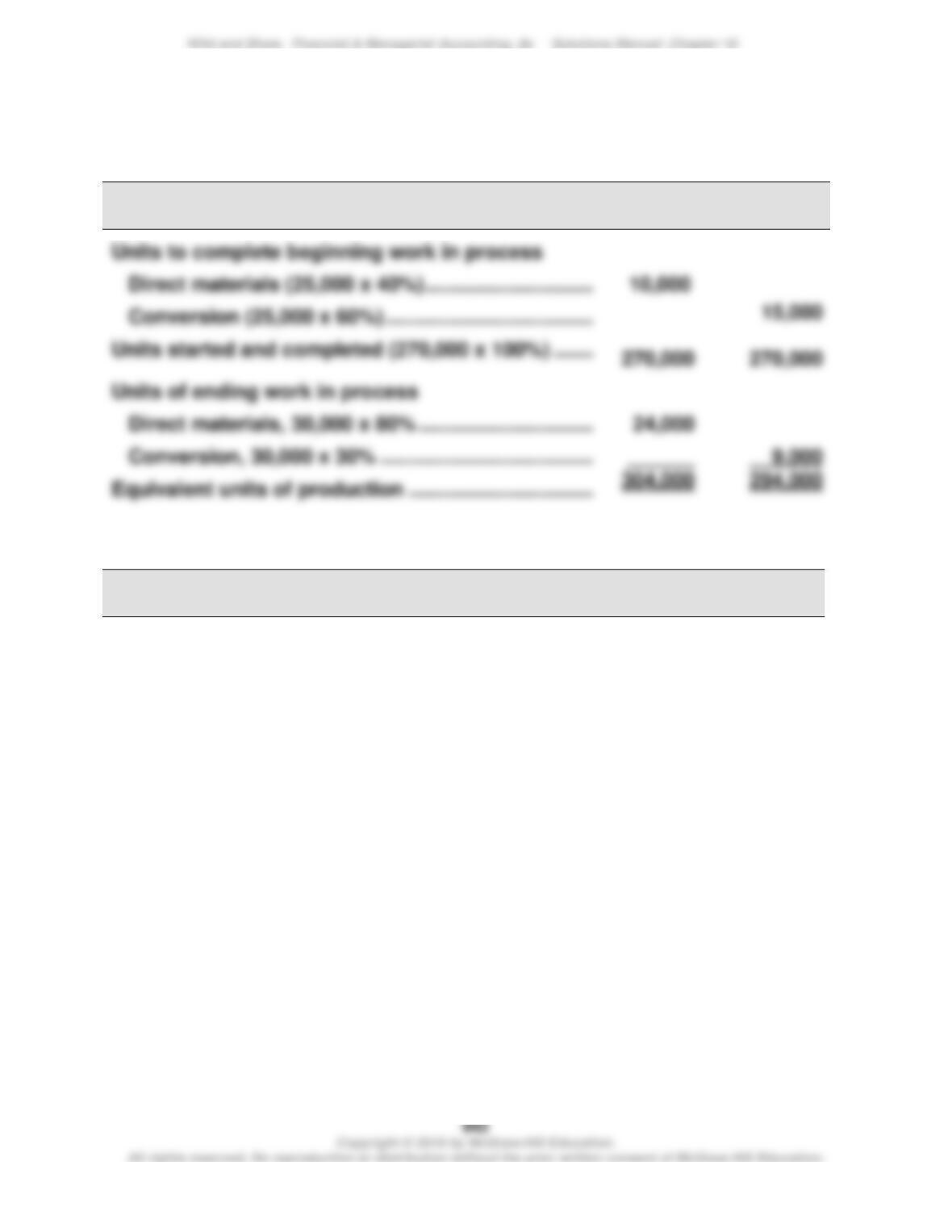
Equivalent units of production—Weighted average
Direct
Materials
Conversion
Units completed & transferred out (295,000 x 100%) ………………..
295,000
295,000
Units of ending work in process
Direct materials, 30,000 x 80% ………………………………………………
24,000
Conversion, 30,000 x 30% …………………………………………………….
_______
9,000
Equivalent units of production ………………………………………………..
319,000
304,000
2.
Cost per equivalent unit—Weighted average
Direct
Materials
Conversion
Costs of beginning work in process …………………………..
$ 44,800
$ 15,300
Costs incurred this period ……………………………………………………….
1,231,200
896,700
Total costs ……………………………………………………………………………..
$1,276,000
$912,000
÷ Equivalent units of production (from part 1) ………………………….
319,000
304,000
Cost per equivalent unit of production …………………………..
$4.00 per
EUP
$3.00 per
EUP
3.
Cost assignment—Weighted average
Costs of units transferred out
Direct materials (295,000 EUP x $4.00 per EUP) …………………….
$1,180,000
Conversion (295,000 EUP x $3.00 per EUP) …………………………..
885,000
Total costs transferred out ………………………………………………………
Costs of ending work in process
Conversion (9,000 EUP x $3.00 per EUP) …………………………..
27,000
Total costs of ending work in process …………………………..
Total costs assigned* ……………………………………………………….
Exercise 16-7 (30 minutes)
1.
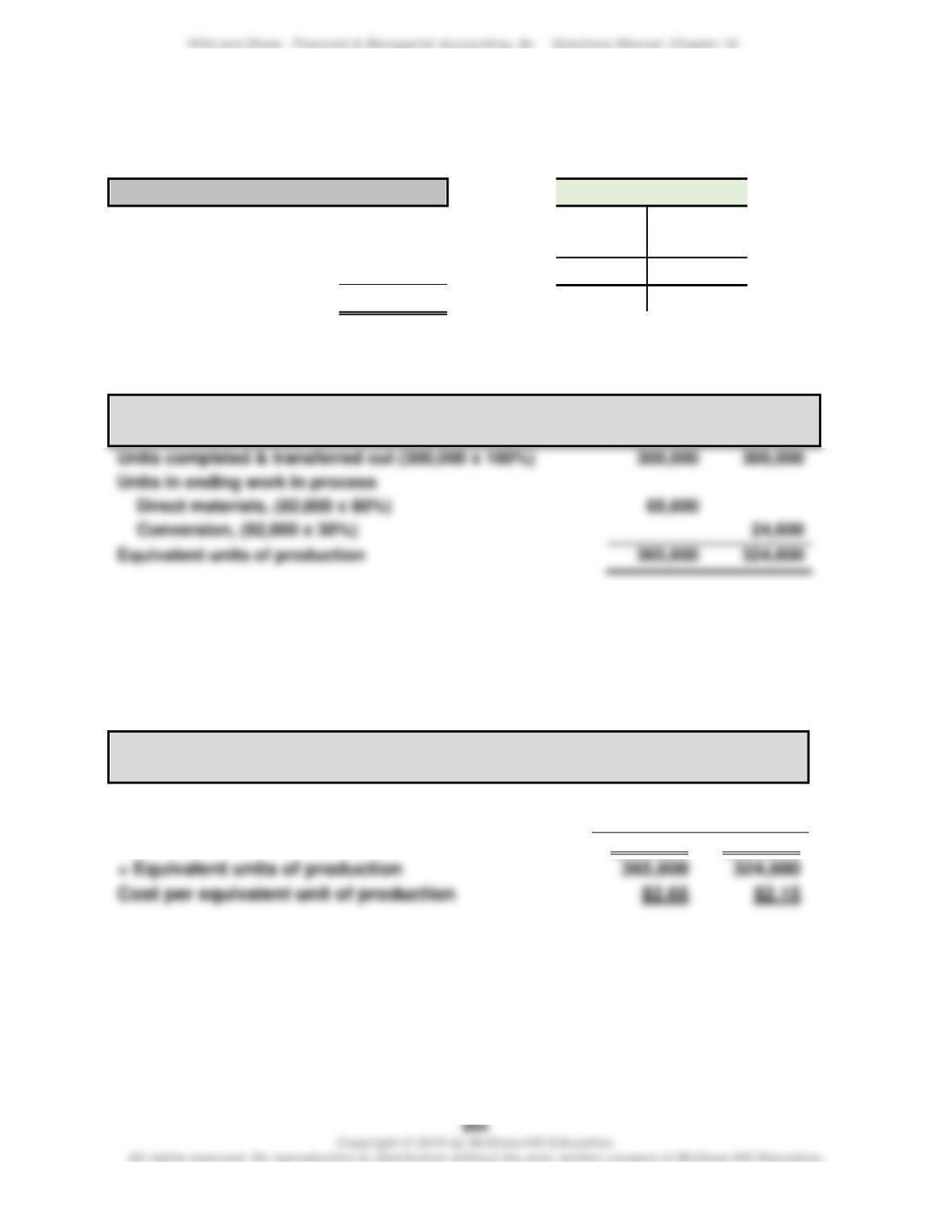
Equivalent units of production—FIFO
Direct
Materials
Conversion
Units of ending work in process
Equivalent units of production ………………………………………………..
2.
Cost per equivalent unit—FIFO
Direct
Materials
Conversion
Costs incurred this period ……………………………….
$1,231,200
$896,700
÷ Equivalent units of production (from part 1) ….
304,000
294,000
Cost per equivalent unit of production …………….
$4.05 per
EUP
$3.05 per
EUP
Exercise 16-8 (20 minutes)
Units transferred out
Units
Dept. 1 – units
Units in beg. inventory
60,000
Beg. Inv
60,000
Units started
322,000
Started
322,000
Units in ending inventory
(82,000)
382,000
300,000
Trfr-out
Units transferred out
300,000
End. Inv
82,000
EUP
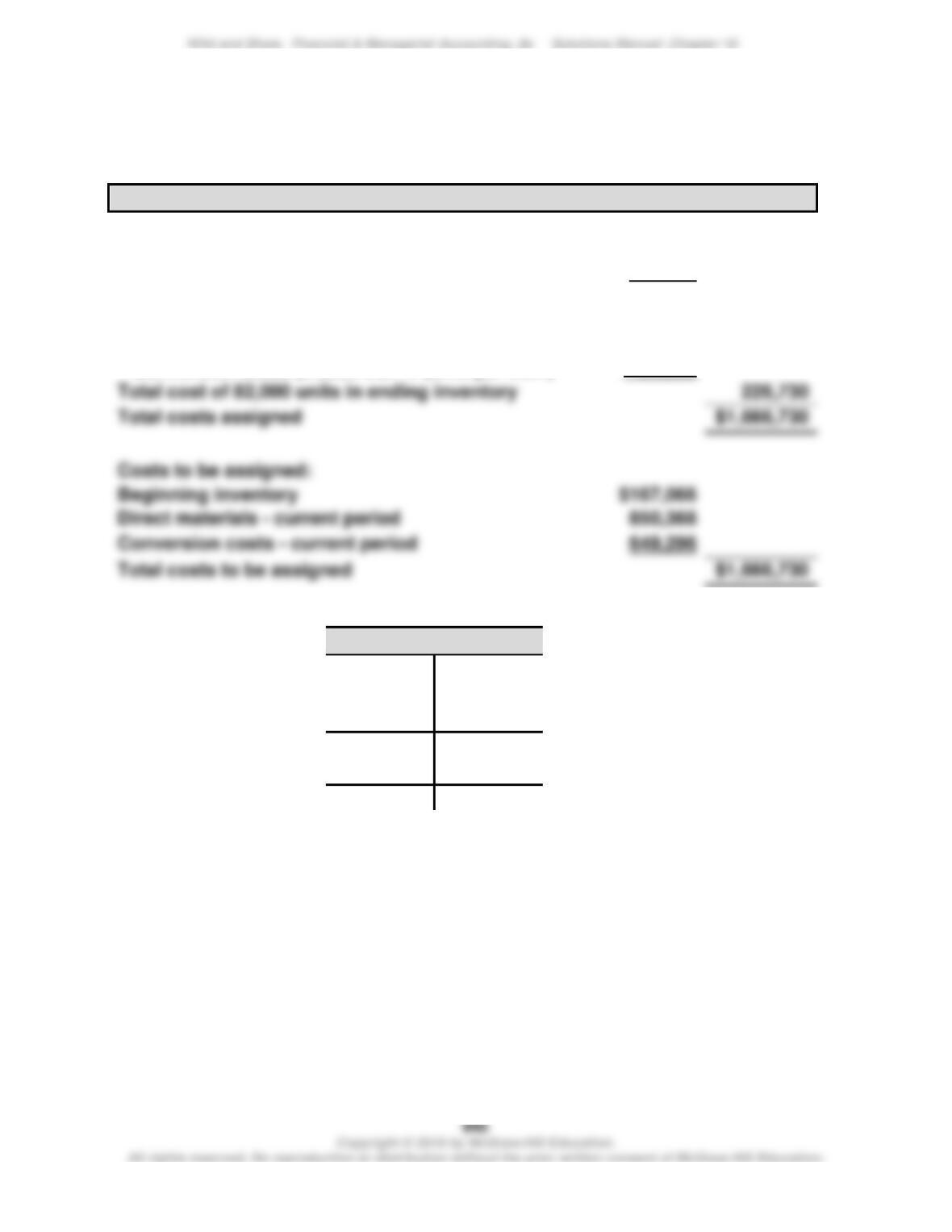
Equivalent units of production – weighted-average
Direct
Materials
Conversion
Units completed & transferred out (300,000 x 100%)
300,000
Units in ending work in process
Direct materials, (82,000 x 80%)
Conversion, (82,000 x 30%)
Equivalent units of production
365,600
Exercise 16-9 (20 minutes)
1. and 2. Cost per EUP
Cost per equivalent unit – weighted-average
Direct
Materials
Conversion
Costs of beginning inventory
$118,472
$48,594
Costs incurred this period
850,368
649,296
Total costs
$968,840
$697,890
Exercise 16-9 (continued)
3.
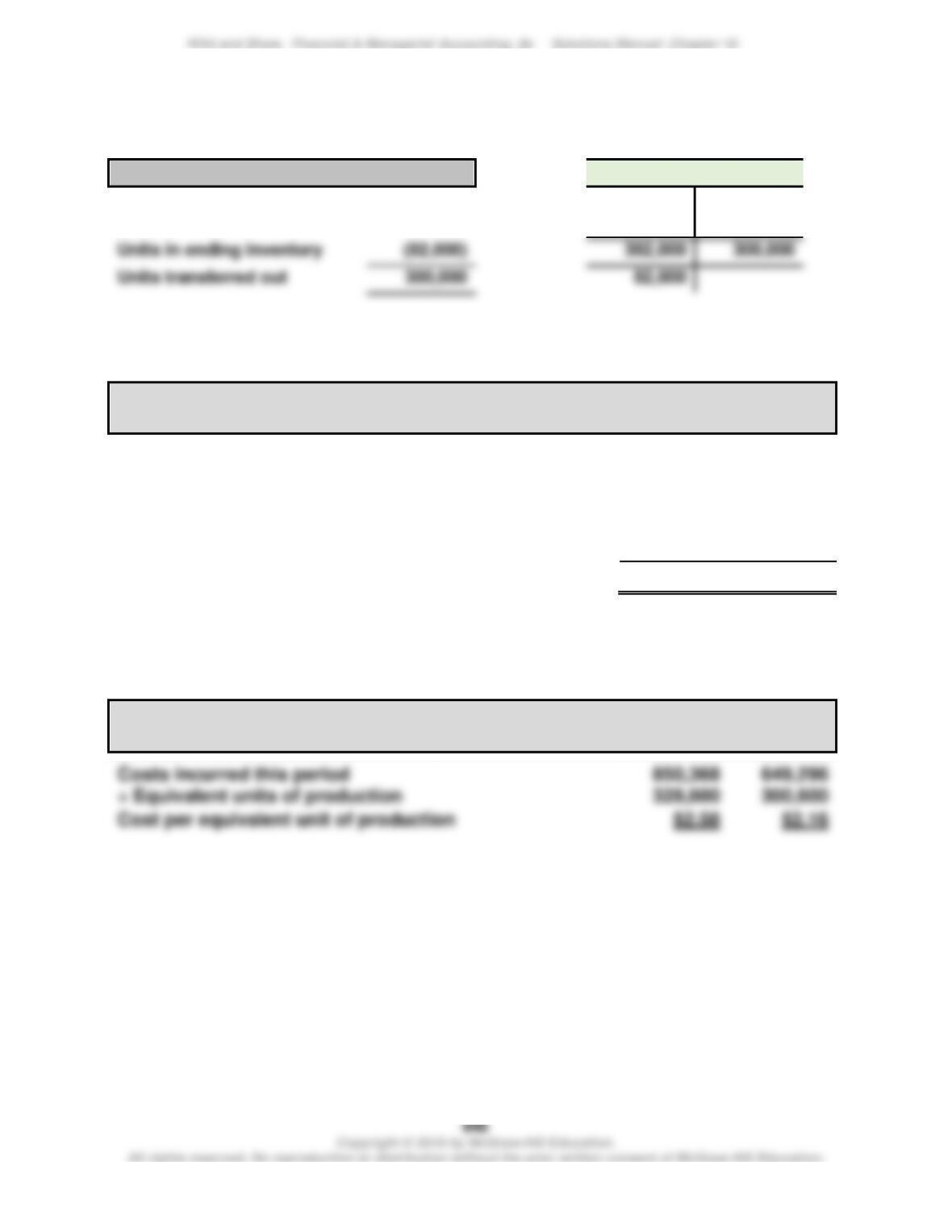
Cost assignment and reconciliation – weighted-average
Costs of units transferred out
Direct materials (300,000 EUP x $2.65 per EUP)
$795,000
Conversion costs (300,000 EUP x $2.15 per EUP)
645,000
Total cost of 300,000 units transferred out
$1,440,000
Costs of units in ending inventory
Direct materials (65,600 EUP x $2.65 per EUP)
$173,840
Conversion costs (24,600 EUP x $2.15 per EUP)
52,890
Total cost of 82,000 units in ending inventory
Costs to be assigned:
Dept. 1 – WIP
Beg. Inv
167,066
DM
850,368
Conv
649,296
1,666,730
1,440,000
Transferred out
End. Inv.
226,730
Exercise 16-10 (20 minutes)
Units
Units
Units in beginning inventory
60,000
60,000
60,000
Units started
322,000
322,000
240,000
Units in ending inventory
382,000
300,000
Units transferred out
300,000
82,000
Equivalent units of production – FIFO
Direct
Materials
Conversion
Complete beginning inventory (60,000 x 40% Mtl, 60% Conv.)
24,000
36,000
Units started and completed (240,000 x 100%)
240,000
240,000
Units of ending work in process
Direct materials, 82,000 x 80%
65,600
Conversion, 82,000 x 30%
24,600
Equivalent units of production
329,600
300,600
Exercise 16–11 (20 minutes)
1. and 2.
Cost per equivalent unit – FIFO
Direct
Materials
Conversion