
Chapter 16
Fundamentals of Variance Analysis
Learning Objectives
1. Use budgets for performance evaluation.
2. Develop and use flexible budgets.
3. Compute and interpret the sales activity variance.
4. Prepare and use a profit variance analysis.
5. Compute and use variable cost variances.
6. Compute and use fixed cost variances.
7. (Appendix) Understand how to record costs in a standard costing system.
Chapter Overview
I. USING BUDGETS FOR PERFORMANCE EVALUATION
II. PROFIT VARIANCE
• Why are Actual and Budgeted Results Different?
III. FLEXIBLE BUDGETING
IV. COMPARING BUDGETS AND RESULTS
• Sales Activity Variance
o Interpreting Variances
V. PROFIT VARIANCE ANALYSIS AS A KEY TOOL FOR MANAGERS
VI. PERFORMANCE MEASUREMENT AND CONTROL IN A COST CENTER
• Variable Production Costs
o Direct Materials
o Direct Labor
o Variable Production Overhead
VII. VARIABLE COST VARIANCE ANALYSIS
VIII. FIXED COST VARIANCES
• Fixed Cost Variances with Variable Costing
• Absorption Costing: The Production Volume Variance
o Developing the Standard Unit Cost for Fixed Production Costs
o Compare with the Fixed Production Cost Price Variance
IX. SUMMARY OF OVERHEAD VARIANCES
• Key Points
Chapter Overview, continued
X. APPENDIX: RECORDING COSTS IN A STANDARD COST SYSTEM
• Direct Materials
• Direct Labor
Chapter Outline
LO 16-1 Use budgets for performance evaluation.
USING BUDGETS FOR PERFORMANCE EVALUATION
• The development of the master budget is the first step in the budgetary planning and control
cycle.
o The budgeting process provides a means to coordinate activities among units of the
organization, to communicate the organization’s goals to individual units, and to ensure
that adequate resources are available to carry out the planned activities.
• The master budget includes:
o Operating budgets (such as the budgeted income statement, production budget,
budgeted cost of goods sold, and supporting budgets)
o Financial budgets (budgets of financial resources—for example, the cash budget and the
budgeted balance sheet)
• Variance is the difference between planned result and actual outcome. That is:
Variance = Actual result − Budgeted performance.
o Variance analysis is used to:
PROFIT VARIANCE
• The simplest measure of performance is the variance between actual income and budgeted
income.
o A favorable variance is the variance that, taken alone, results in an addition to operating
profit.
o An unfavorable variance is the variance that, taken alone, reduces operating profit.
o The labels “favorable” and “unfavorable” should not be considered as evaluations of
performance without additional investigation. (See Business Application box “When a
Favorable Variance Might Not Mean ‘Good’ News.”)
▪ Although a simple comparison of planned and actual profit suggests that performance
was better (or worse) than planned, the additional data (such as those in Exhibit 16.2)
provide information on the impact on profit performance from each of the revenue
and cost line items.
▪ The additional information is useful for two reasons:
• Why are Actual and Budgeted Results Different?
o An important part of variance analysis is to understand:
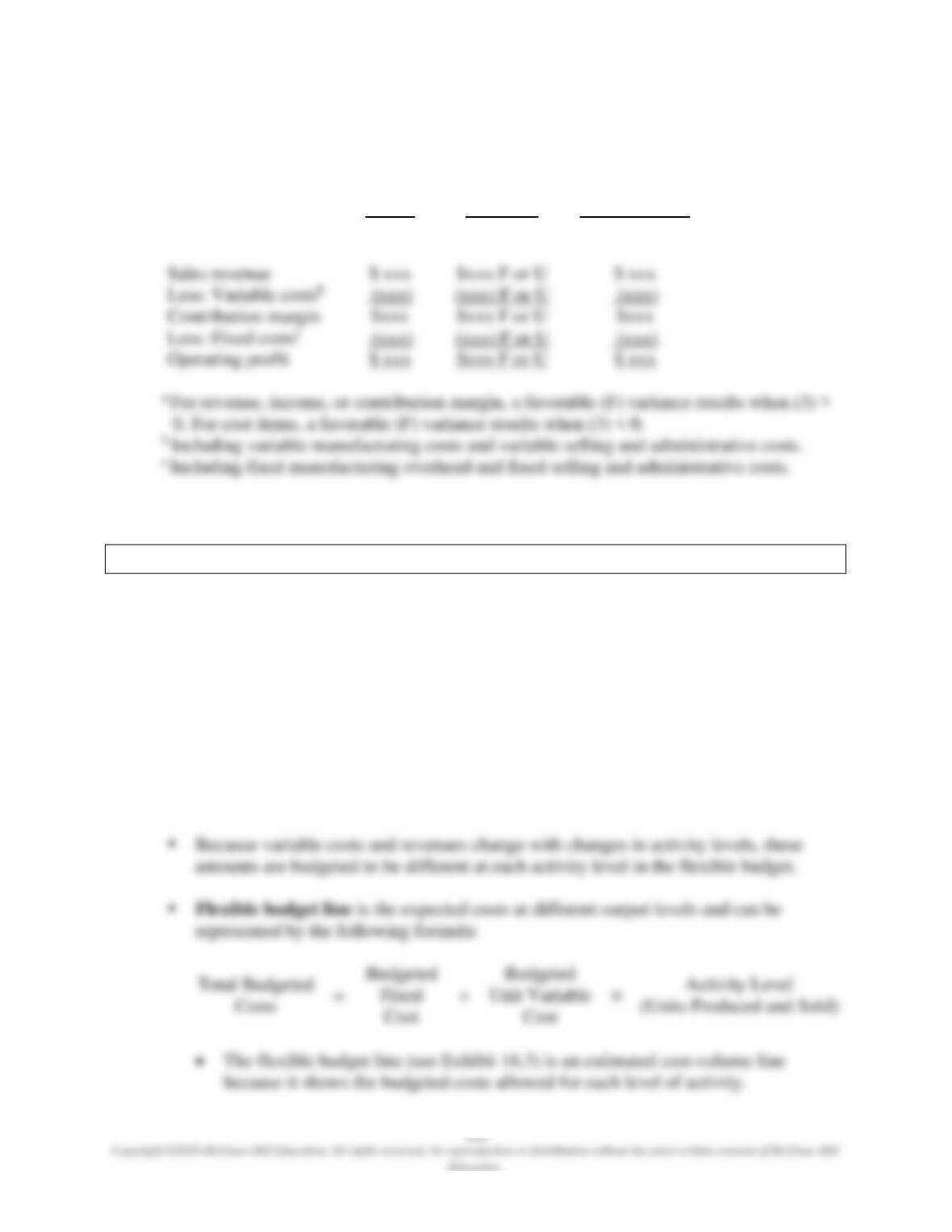
o The following table summarizes the variance analysis between actual results and the
master budget for line items comprising the operating profit:
(1)
Actual
(3) = (1) − (2)
Variancea
(2)
Master Budget
Units
xxx
xxx F or U
xxx
Sales revenue
Contribution margin
$xxx
Operating profit
See Demonstration Problem 1
LO 16-2 Develop and use flexible budgets.
FLEXIBLE BUDGETING
• One obvious reason that actual results might differ from budgeted results is that the actual
activity itself differed from the budgeted or expected activity.
o A static budget is developed in detail for one level of anticipated activity, such as a
master budget.
o A flexible budget indicates budgeted revenues, costs, and profits for virtually all feasible
levels of activities.
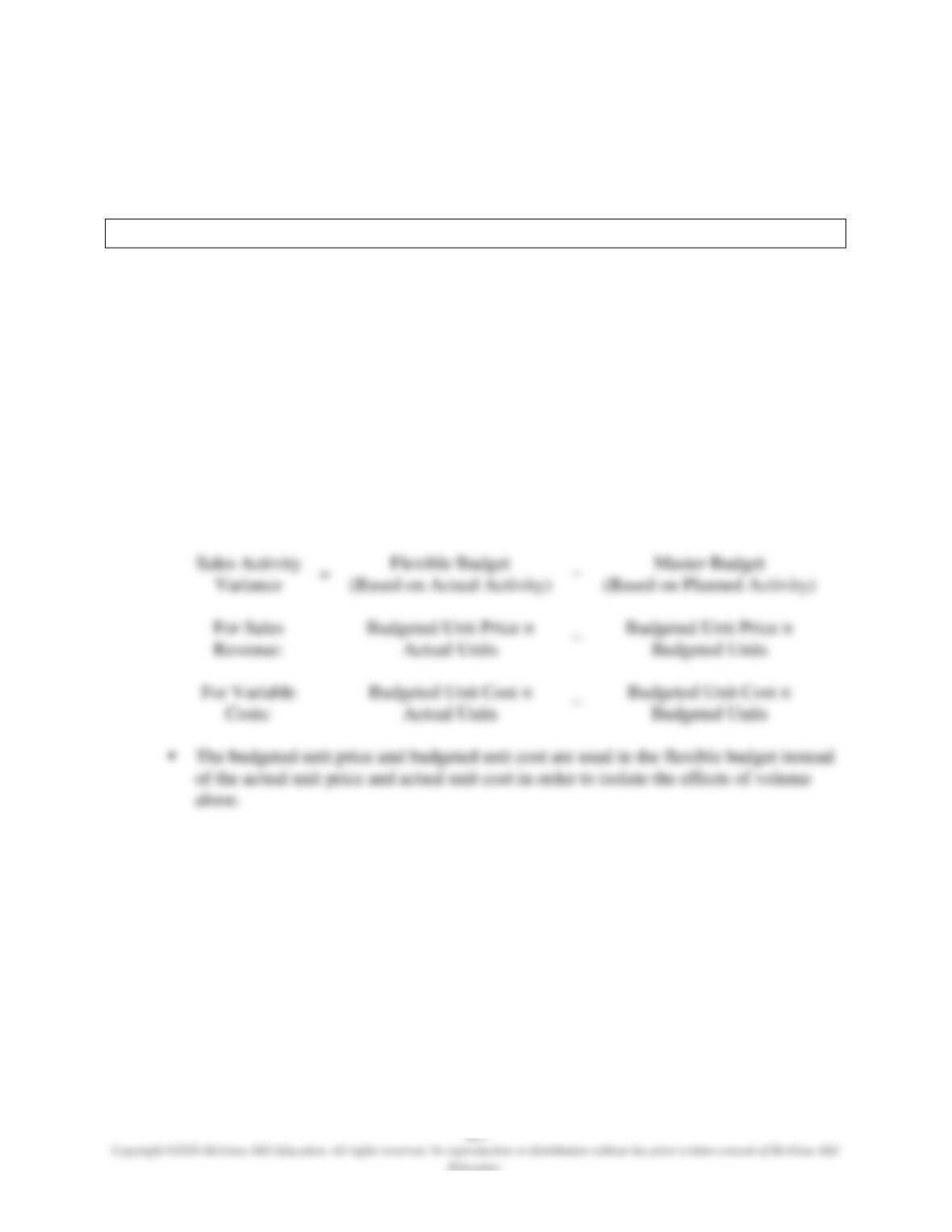
=
+
Unit Variable
×
o The master budget is based on an ex ante (before-the-fact) prediction of the activity level.
o The flexible budget is based on ex post (after-the-fact) knowledge of the actual activity
level.
LO 16-3 Compute and interpret the sales activity variance.
COMPARING BUDGETS AND RESULTS
• A comparison of the master budget with the flexible budget and with actual results is the
basis for analyzing differences between plans and actual performance.
• Sales Activity Variance
o Sales activity variance (also known as sales volume variance) is the difference between
operating profit in the master budget and operating profit in flexible budget that arises
because the actual number of units sold is different from the budgeted number.
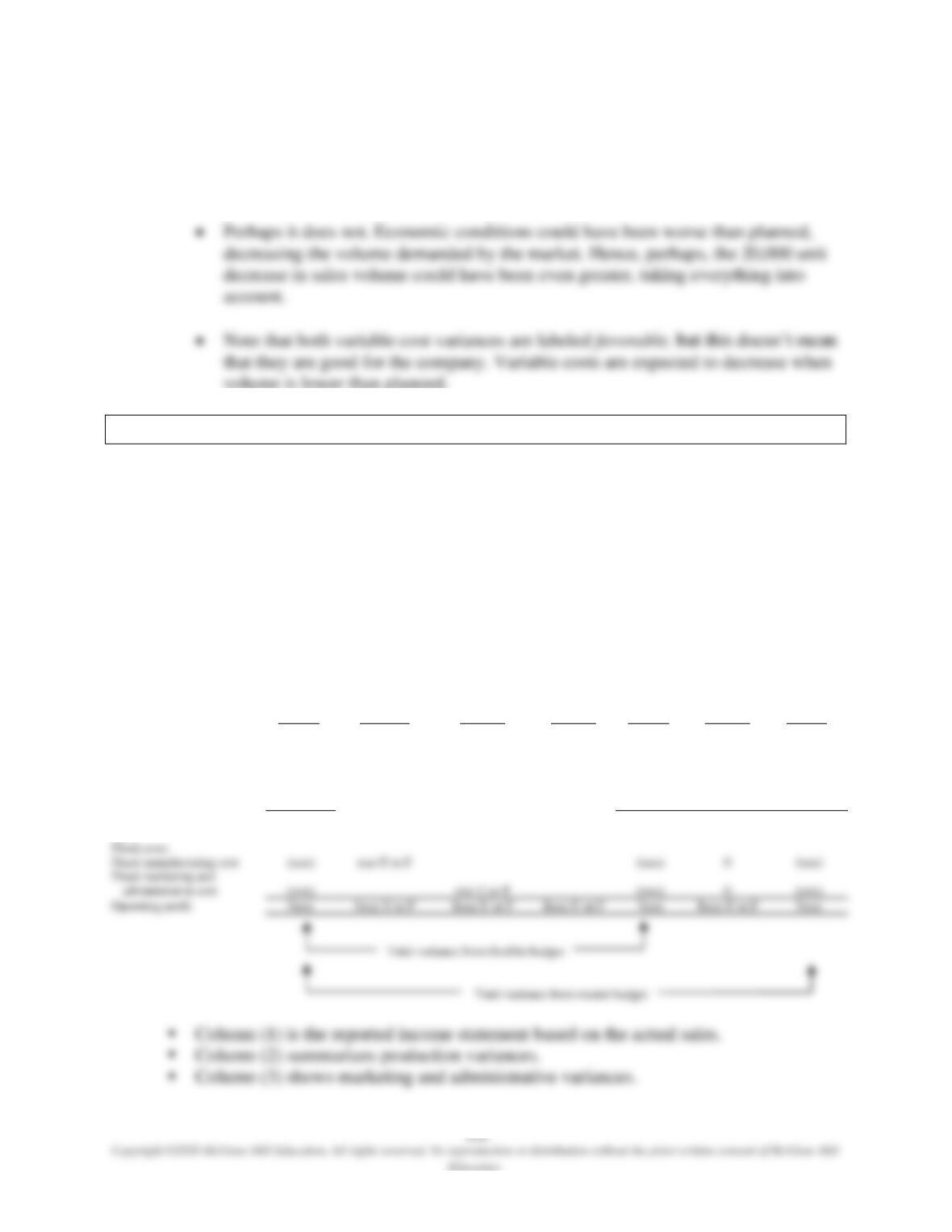
▪ That is:
o The sales activity variance, as shown in Exhibit 16.4, is useful for management because:
▪ It isolates the change in operating profits caused by the actual activity being different
from the master budget level.
▪ The resulting flexible budget shows budgeted sales, costs, and operating profits after
considering the activity change but before considering differences in unit selling
prices, variable costs, and fixed costs from the master budget.
o Interpreting Variances
▪ Holding everything else constant, a decrease in sales creates an unfavorable sales
activity variance as shown in Exhibit 16.4. Does this indicate poor performance?
LO 16-4 Prepare and use a profit variance analysis.
PROFIT VARIANCE ANALYSIS AS A KEY TOOL FOR MANAGERS
• Profit variance analysis shows the causes of differences between budgeted profits and the
actual profits earned.
o The actual results can be compared with both the flexible budget and the master budget in
a profit variance analysis, as shown in Exhibit 16.5.
(1)
(2)
(3)
(4)
(5)
(6)
(7)
Actual
(Based on
Actual
Activity)
Manufacturing
Variances
Marketing And
Administrative
Variance
Sales Price
Variance
Flexible
Budget
(Based on
Actual
Activity)
Sales
Activity
Variance
Master
Budget
(Based on
Planned
Activity)
Sales revenue
$xxx
$xx U or F
$xxx
$xxx U or F
$xxx
Less:
Variable costs
Variable manufacturing cost
(xxx)
$xxx U or F
(xxx)
(xxx) U or F
(xxx)
Variable marketing and
administrative cost
(xxx)
$xxx U or F
(xxx)
(xxx) U or F
(xxx)
Contribution margin
$xxx
$xxx
$xxx U or F
$xxx
Less:
Fixed costs
Fixed manufacturing cost
(xxx)
(xxx)
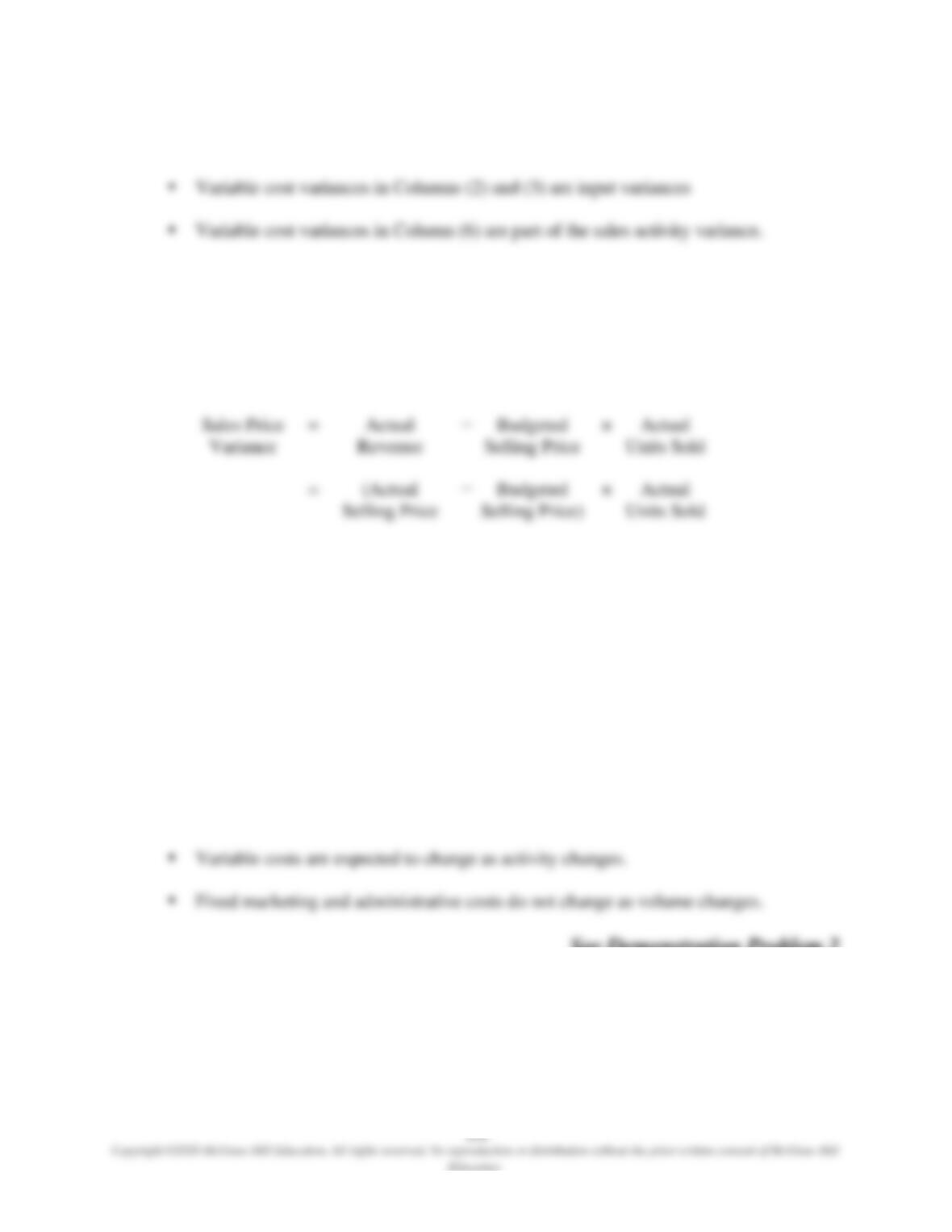
o Cost variances result from deviations in costs and efficiencies in operating the company.
They are important for measuring productivity and for helping to control costs.
• Sales Price Variance
o Column (4) shows the sales price variance as derived from the difference between the
actual revenue and budgeted selling price multiplied by the actual number of units sold.
▪ That is:
• Variable Production Cost Variances
o Variable costs in Column (5) represent what should have been spent given the actual
sales volume.
• Fixed Production Cost Variance
o The fixed production cost variance is the difference between actual and budgeted costs
because the flexible budget’s fixed costs equal the master budget’s fixed costs.
• Marketing and Administrative Variances
o Marketing and administrative costs are treated like production costs.
See Demonstration Problem 2
PERFORMANCE MEASUREMENT AND CONTROL IN A COST CENTER
• For cost centers whose production managers typically do not control what they are asked to
produce, the actual unit production (not sales) should be used as a baseline.
• Variable Production Costs
o For any unit variable cost (such as direct materials), the variable cost in the budget is
determined by multiplying the budgeted amount of the direct material in each unit of
output by the expected price of each unit of direct material.
o Direct Materials
▪ The purchasing manager estimates the cost of direct materials with the correct
specification and quality.
o Direct Labor
▪ The standard labor rate includes wages earned as well as fringe benefits. Most
companies develop one standard for each labor category.
o Variable Production Overhead
LO 16-5 Compute and use variable cost variances.
VARIABLE COST VARIANCE ANALYSIS
• General Model
o Comparing the budget (based on standard costing) to actual results identifies production
cost variances.
▪ Cost variance analysis uses a conceptual model that compares actual input amounts
and prices with standard input amounts and prices.
o Both the actual and standard input quantities are for the actual output attained.
▪ An efficiency variance is the difference between budgeted and actual results arising
from differences between the inputs that were budgeted per unit of output and the
inputs actually used.
• Efficiency variance = (SP × AQ) − (SP × SQ) = SP × (AQ − SQ).
o Managers who are responsible for price variances would not be held responsible for
efficiency variances and vice versa.
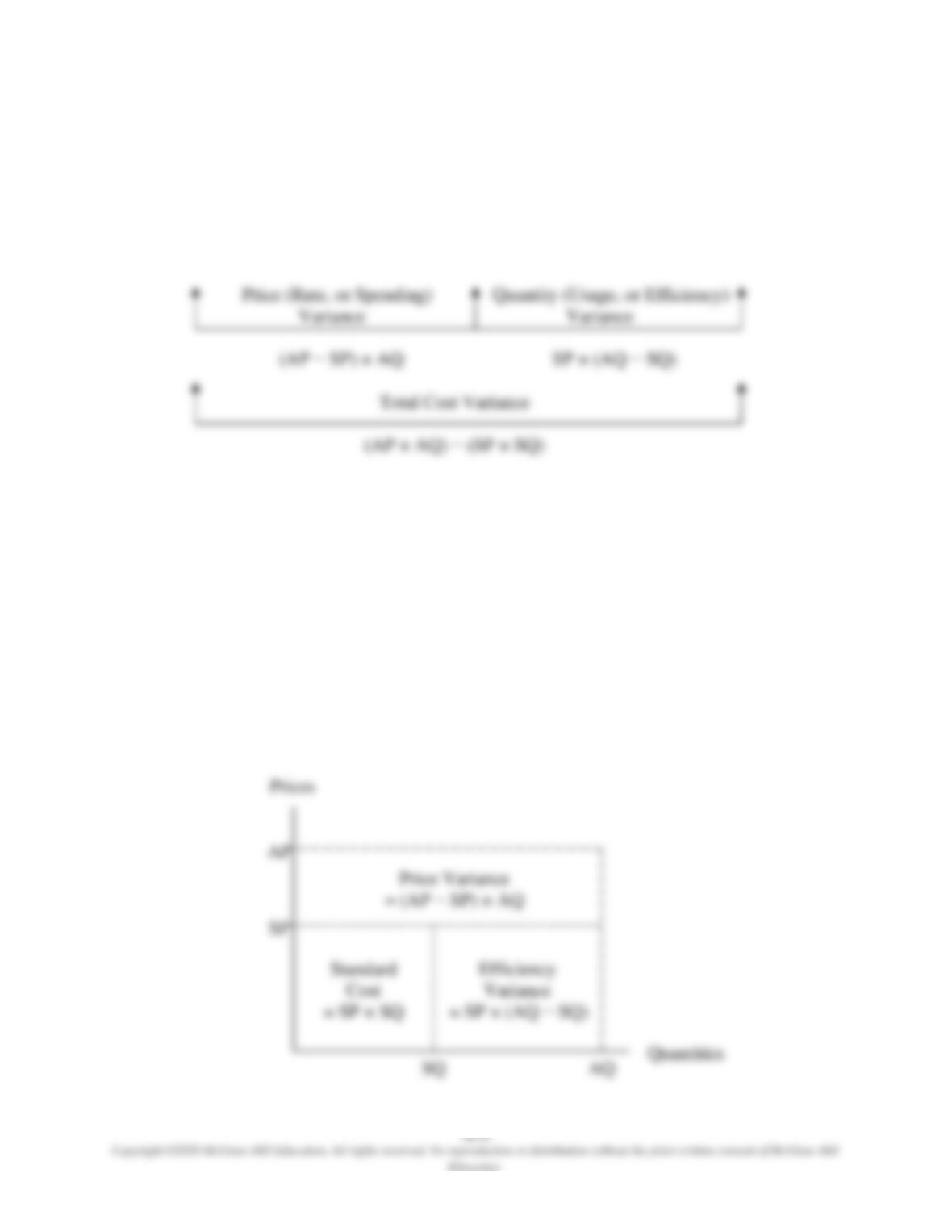
▪ That is,
Actual Costs =
Actual Input Quantity
at Actual Input Price
(AP × AQ)
Actual Input
Quantity at Standard
Input Price
(SP × AQ)
Flexible Production Budget =
Standard Input Quantity Allowed
For Actual Output at Standard
Input Price
(SP × SQ)
Variance Variance
▪ The comprehensive cost variance analysis will ultimately explain, in detail, the
variable manufacturing cost variance calculated earlier.
• Direct Materials
o A flexible production budget is calculated as standard input price times standard
quantity of input allowed for actual good output. It is based on actual production volume.
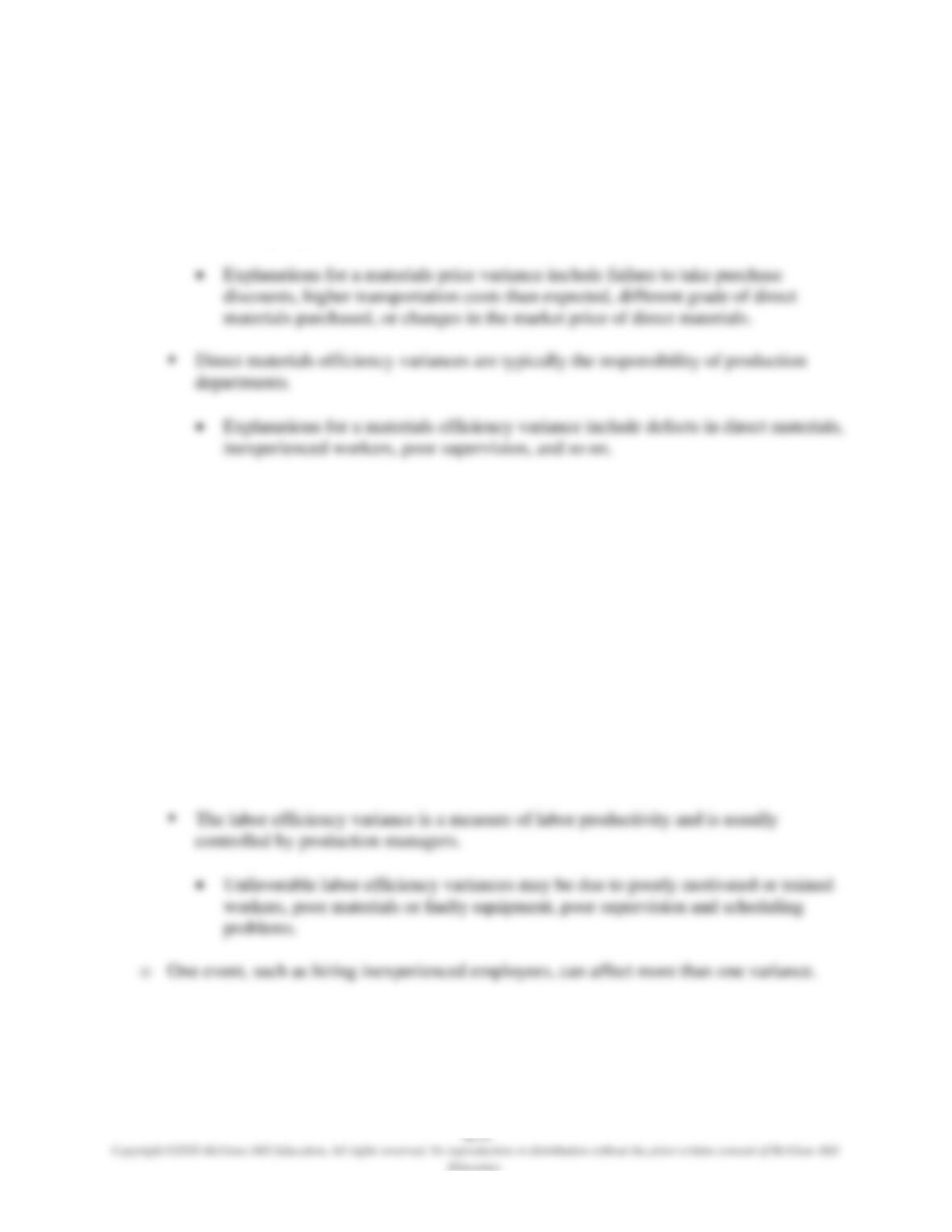
▪ An alternative way to view these variances graphically is shown below. Quantities are
presented on the horizontal axis and prices on the vertical axis. The three areas are
standard cost (SP × SQ), price variance ((AP − SP) × AQ), and efficiency variance
(SP × (AQ − SQ)), respectively.
▪ Exhibit 16.8 applies the general model to direct materials variances.
o Responsibility for Direct Materials Variances
▪ Responsibility for the direct materials price variance is usually assigned to the
purchasing department.
See Demonstration Problem 3
• Direct Labor
o Exhibit 16.9 applies the general model to direct labor variances.
o Direct Labor Price Variance
▪ The direct labor price variance may be caused by hiring less experienced employees.
• If the wage rates used in setting standards are the same as those in the union
contract, labor price variances will not occur.
o Labor Efficiency Variance
See Demonstration Problem 4
• Variable Production Overhead
o Exhibit 16.10 applies the general model to variable overhead variances. The variable
overhead standard rate is derived from a two-stage estimation of:
▪ Costs at various levels of activity, and
▪ The relationship between those estimated costs and the basis.
o Variable Production Overhead Price Variance
▪ The variable overhead price variance could have occurred because
o Variable Overhead Efficiency Variance
▪ The variable overhead price variance actually contains some efficiency items as well
as price items. Some companies separate those components.
See Demonstration Problem 5
• Variable Cost Variances Summarized in Graphic Form
o Exhibit 16.11 summarizes the variable production cost variances.
▪ A summary of this nature is useful for reporting variances to high-level managers. It
provides both an overview of variances and their sources.
LO 16-6 Compute and use fixed cost variances.
FIXED COST VARIANCES
• It is usually assumed that fixed costs are unchanged when volume changes within the
relevant range, so the amount budgeted for fixed overhead is the same in both the master and
flexible budgets.
o Fixed costs are period costs by nature.
• Fixed Cost Variances with Variable Costing
o When the income statement is prepared using variable costing, there is no absorption of
the fixed costs by units of production. All the fixed manufacturing overhead is charged to
income in the period incurred.
o Exhibit 16.12 shows a variance analysis for fixed overhead.
▪ That is:
Actual
Flexible Production
Budget
Price (Spending) Variance
(Efficiency Variance is not Applicable)
• Absorption Costing: The Production Volume Variance
o Developing the Standard Unit Cost for Fixed Production Costs
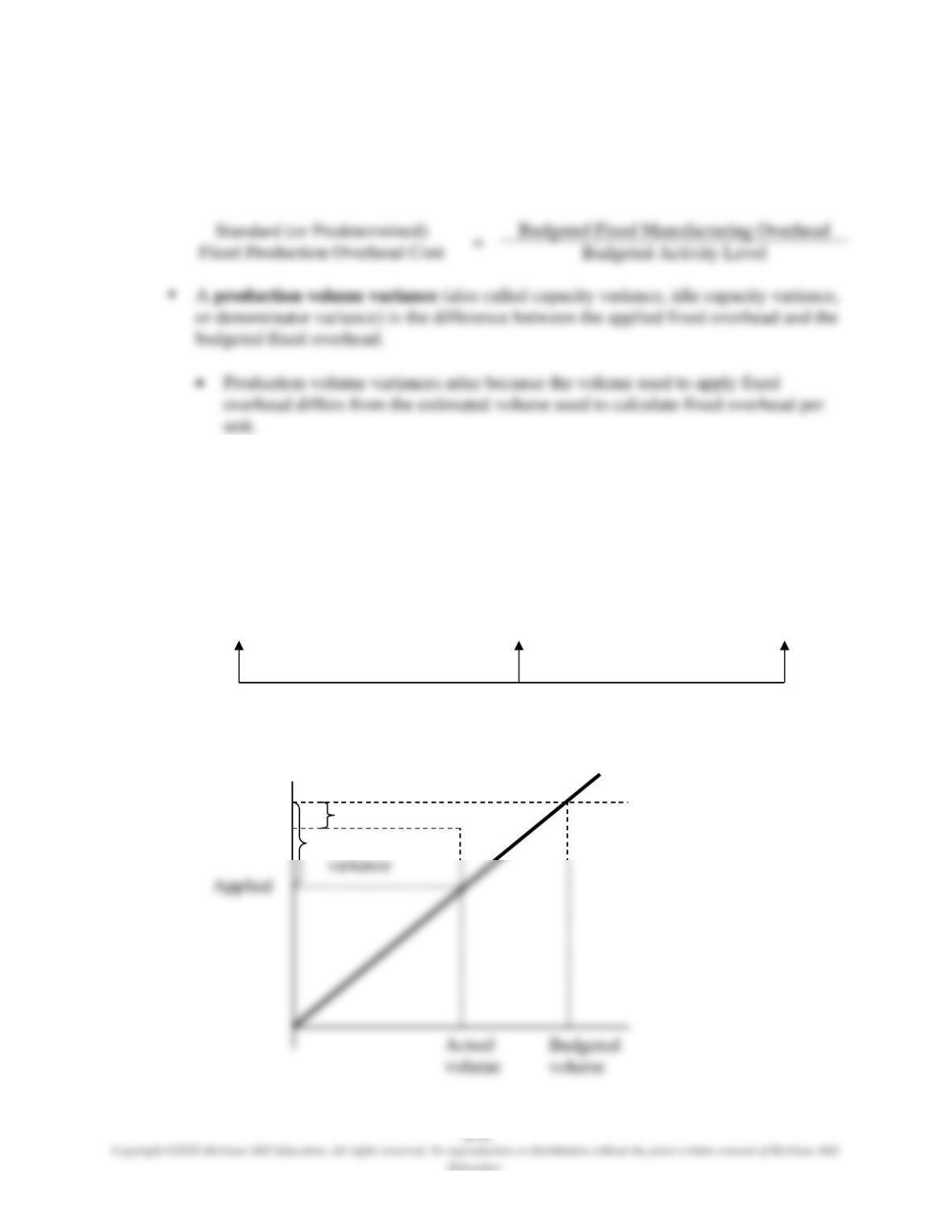
▪ The fixed manufacturing standard cost is determined before the start of the production
period using the following formula from Chapter 7:
o Compare with the Fixed Production Cost Price Variance
▪ Exhibit 16.13 demonstrates the variance analysis for fixed overhead under absorption
costing.
• That is:
Actual
Budgeted
Applied
Price (Spending) Variance Production Volume Variance
▪ An alternative way to present fixed overhead variances graphically is shown below
(see also Exhibit 16-14).
Applied
Application line
Budget line
Budget
Actual
Production volume
Price (spending) variance
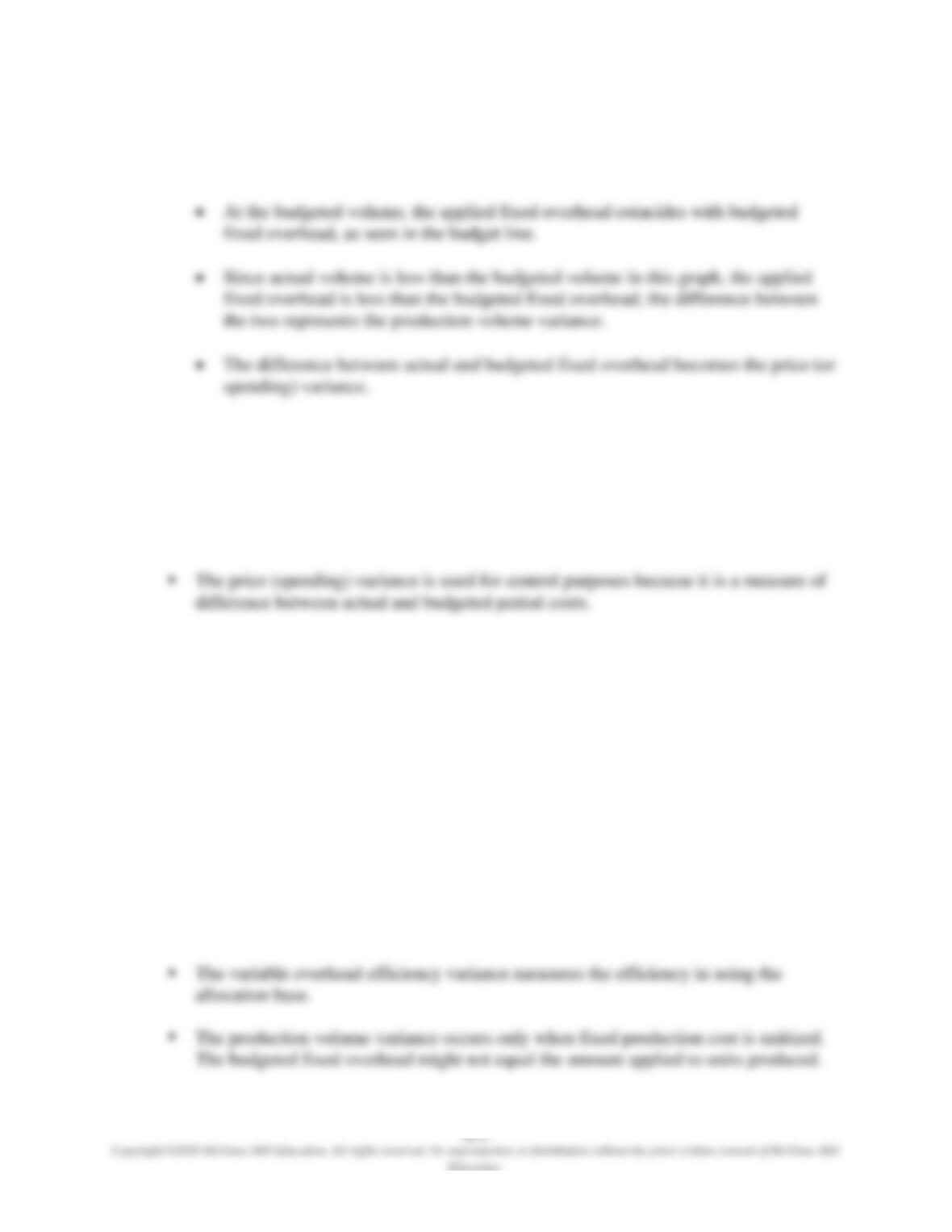
• Since fixed overhead is unitized through the calculation of predetermined fixed
overhead rate, fixed overhead is applied as if it were variable cost, as seen in the
application line.
▪ The production volume variance applies only to fixed costs as a result of allocating a
fixed period cost to units on a predetermined basis. It does not represent resources
spent or saved, and is unique to full-absorption costing.
• The benefits of calculating the production volume variance for control purposes
are questionable.
See Demonstration Problem 6
SUMMARY OF OVERHEAD VARIANCES
• The method of computing overhead variances described is known as the four-way analysis of
overhead variances because it computes the following four variances:
o Price and efficiency for variable overhead
o Price and production volume for fixed overhead.
• Key Points
o Exhibit 16.15 summarizes the four-way analysis of variable and fixed overhead variances.
▪ There is no efficiency variance for fixed production costs.
▪ Managers evaluated by variances that include production volume variance do have an
incentive to overproduce. (See Business Application box “Does Standard Costing
Lead to Waste?”)
LO 16-7 (Appendix) Understand how to record costs in a standard costing
system.
APPENDIX: RECORDING COSTS IN A STANDARD COST SYSTEM
• When using standard costing, costs are transferred through the production process at their
standard costs.
o Standard costing is an accounting method that assigns costs to cost objects at
predetermined amounts.
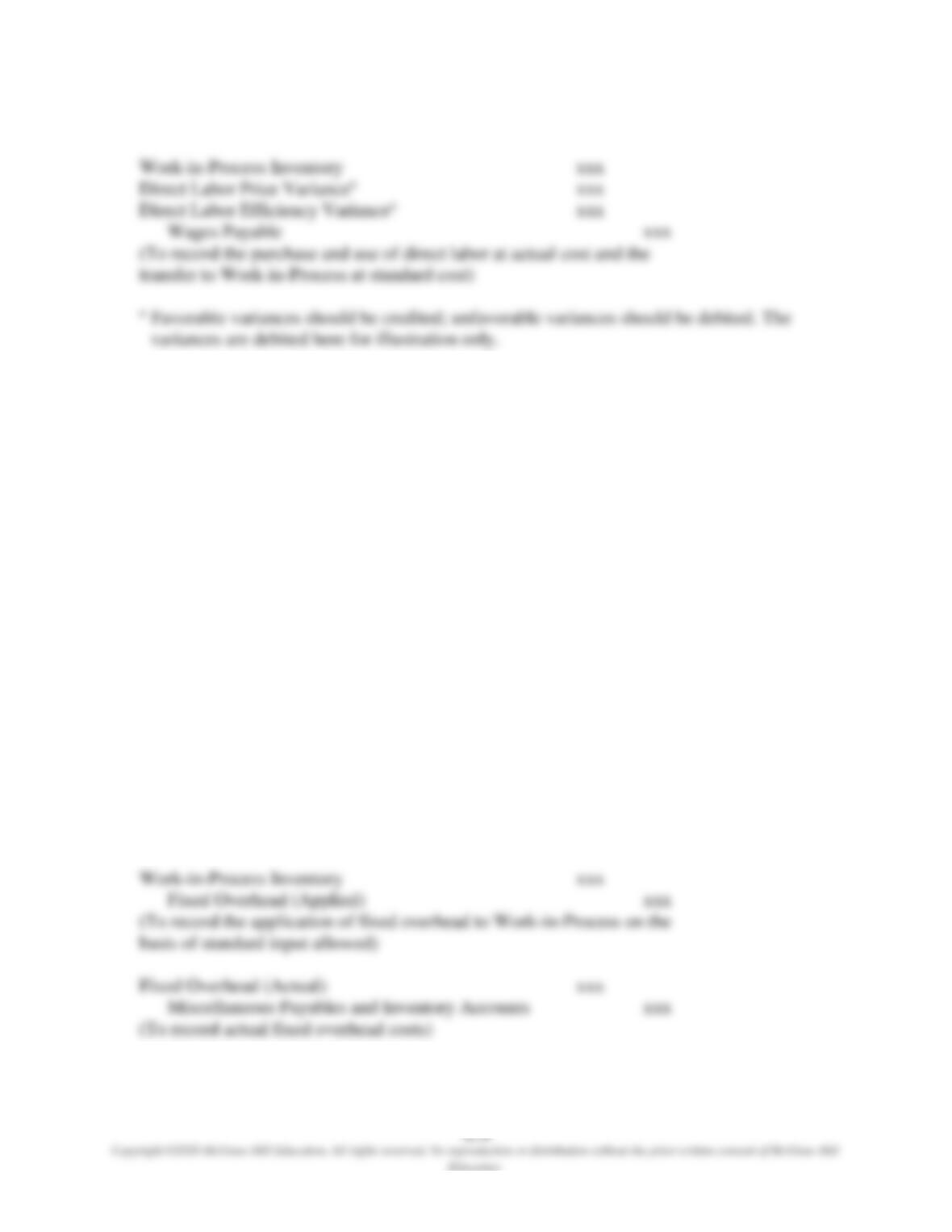
▪ This means that the entry debiting Work-in-Process Inventory at standard cost could
be made before actual costs are known.
o Actual costs are accumulated in accounts such as Accounts Payable and Wages Payable
and are compared with the standard costs allowed for the output produced.
▪ The difference between the actual costs assigned to a department and the standard
cost of the work done is the variance for the department.
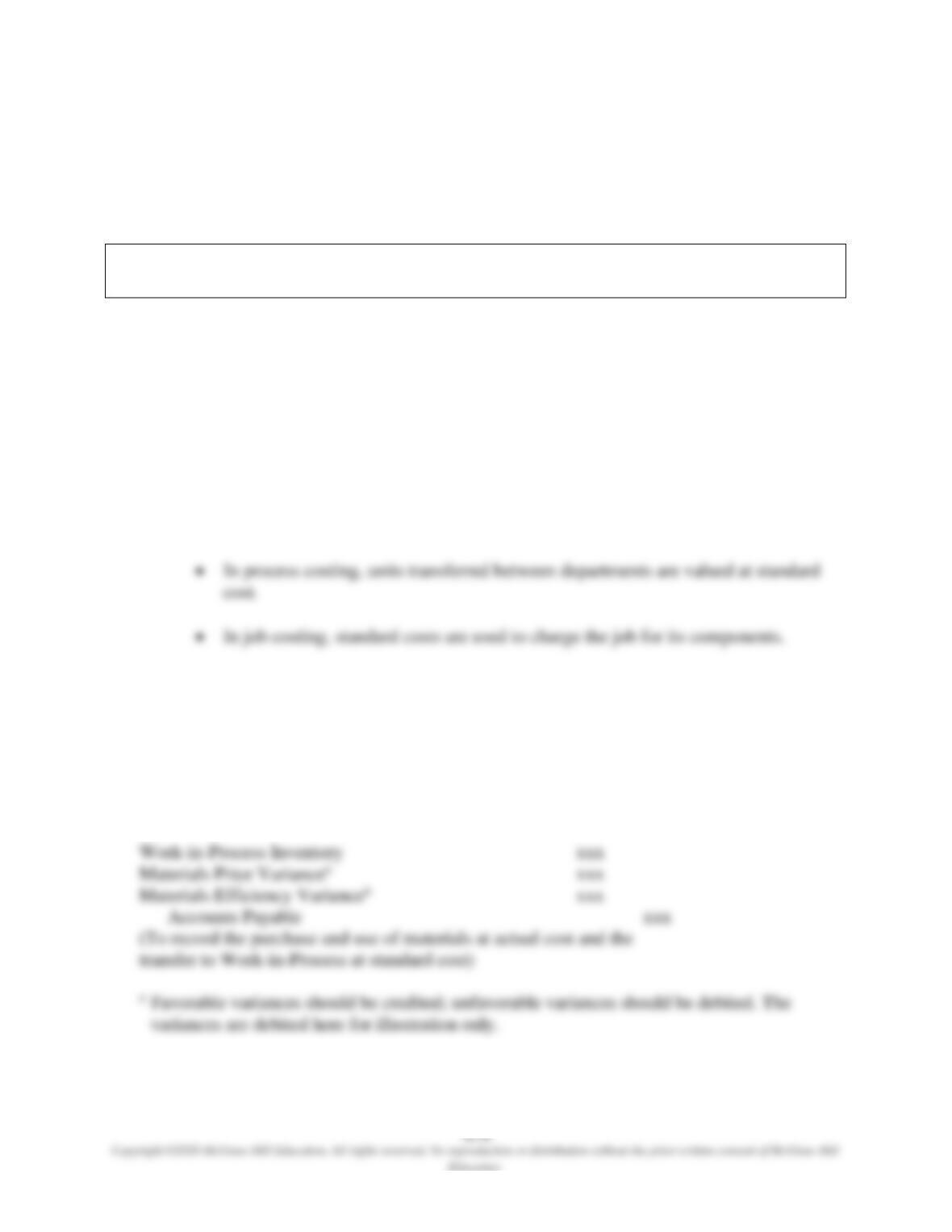
• Direct Materials
• Direct Labor
Work-in-Process Inventory
xxx
Direct Labor Price Variancea
xxx
Direct Labor Efficiency Variancea
xxx
Wages Payable
xxx
(To record the purchase and use of direct labor at actual cost and the
transfer to Work-in-Process at standard cost)
• Variable Manufacturing Overhead
Work-in-Process Inventory
xxx
Variable Overhead (Applied)
xxx
(To record the application of Variable overhead to Work-in–Process on
the basis of standard input allowed)
Variable Overhead (Actual)
xxx
Miscellaneous Payables and Inventory Accounts
xxx
(To record actual variable overhead costs)
Variable Overhead (Applied)
xxx
Variable Overhead Price Variancea
xxx
Variable Overhead Efficiency Variancea
xxx
Variable Overhead (Actual)
xxx
(To record variable overhead variances and close the applied and
actual accounts)
a Favorable variances should be credited; unfavorable variances should be debited. The
variances are debited here for illustration only.
• Fixed Manufacturing Overhead
Work-in-Process Inventory
xxx
Fixed Overhead (Applied)
xxx
(To record the application of fixed overhead to Work-in-Process on the
basis of standard input allowed)
Fixed Overhead (Actual)
xxx
Miscellaneous Payables and Inventory Accounts
xxx
(To record actual fixed overhead costs)
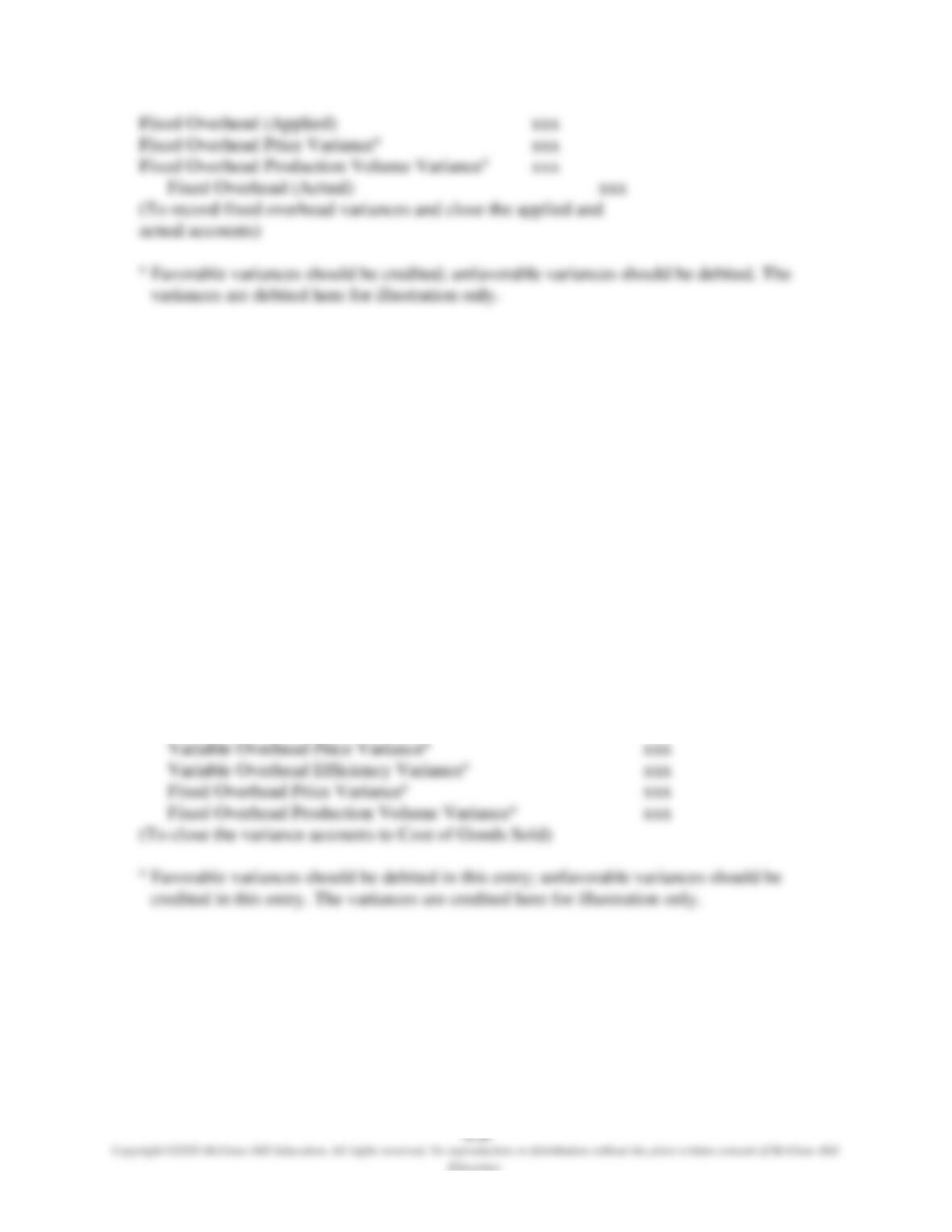
Fixed Overhead (Applied)
xxx
Fixed Overhead Price Variancea
xxx
Fixed Overhead Production Volume Variancea
xxx
Fixed Overhead (Actual)
xxx
actual accounts)
• Transfer to Finished Goods Inventory and to Cost of Goods Sold
Finished Goods Inventory
xxx
Work-in-Process Inventory
xxx
(To record the transfer to Finished Goods Inventory at standard cost)
Accounts Receivable
xxx
Sales Revenue
xxx
Cost of Goods Sold
xxx
Finished Goods Inventory
xxx
(To record the sale and the standard cost per unit sold)
• Close out variance accounts to Cost of Goods Sold
Cost of Goods Sold
xxx
Materials Price Variancea
xxx
Materials Efficiency Variancea
xxx
Direct Labor Price Variancea
xxx
Direct Labor Efficiency Variancea
xxx
Variable Overhead Price Variancea
xxx
Variable Overhead Efficiency Variancea
xxx
Fixed Overhead Price Variancea
xxx
Fixed Overhead Production Volume Variancea
xxx
(To close the variance accounts to Cost of Goods Sold)