16-1
CHAPTER 16
COST ALLOCATION: JOINT PRODUCTS AND BYPRODUCTS
16-1 Exhibit 16-1 presents many examples of joint products from four different general
industries. These include:
Industry Separable Products at the Splitoff Point
Food Processing:
• Lamb • Lamb cuts, tripe, hides, bones, fat
• Turkey • Breasts, wings, thighs, poultry meal
Extractive:
• Petroleum • Crude oil, natural gas
16-3 The distinction between a joint product and a byproduct is based on relative sales value.
A joint product is a product from a joint production process (a process that yields two or more
products) that has a relatively high total sales value. A byproduct is a product that has a relatively
low total sales value compared to the total sales value of the joint (or main) products.
16-5 The chapter lists the following six reasons for allocating joint costs:
1. Computation of inventoriable costs and cost of goods sold for financial accounting
purposes and reports for income tax authorities.
2. Computation of inventoriable costs and cost of goods sold for internal reporting purposes.
3. Cost reimbursement under contracts when only a portion of a business’s products or
services is sold or delivered under cost-plus contracts.
16-6 The joint production process yields individual products that are either sold this period or
held as inventory to be sold in subsequent periods. Hence, the joint costs need to be allocated
between total production rather than just those sold this period.
16-7 This situation can occur when a production process yields separable outputs at the splitoff
point that do not have selling prices available until further processing. The result is that selling
16-2
prices are not available at the splitoff point to use the sales value at splitoff method. Examples
include processing in integrated pulp and paper companies and in petro-chemical operations.
16-8 Both methods use market selling-price data in allocating joint costs, but they differ in
which sales-price data they use. The sales value at splitoff method allocates joint costs to joint
16-9 Limitations of the physical measure method of joint-cost allocation include:
a. The physical weights used for allocating joint costs may have no relationship to the
revenue-producing power of the individual products.
b. The joint products may not have a common physical denominator––for example, one
may be a liquid while another a solid with no readily available conversion factor.
16-10 The NRV method can be simplified by assuming (a) a standard set of post-splitoff point
processing steps and (b) a standard set of selling prices. The use of (a) and (b) achieves the same
benefits that the use of standard costs does in costing systems.
16-11 The constant gross-margin percentage NRV method takes account of the post-splitoff
point “profit” contribution earned on individual products, as well as joint costs, when making
cost assignments to joint products. In contrast, the sales value at splitoff point and the NRV
methods allocate only the joint costs to the individual products.
16-13 No. The only relevant items are incremental revenues and incremental costs when
making decisions about selling products at the splitoff point or processing them further.
Separable costs are not always identical to incremental costs. Separable costs are costs incurred
beyond the splitoff point that are assignable to individual products. Some separable costs may
not be incremental costs in a specific setting (e.g., allocated manufacturing overhead for post-
splitoff processing that includes depreciation).
16-3
16-15 The sales byproduct method enables a manager to time the sale of byproducts to affect
16-16 (20-30 min.) Joint-cost allocation, insurance settlement.
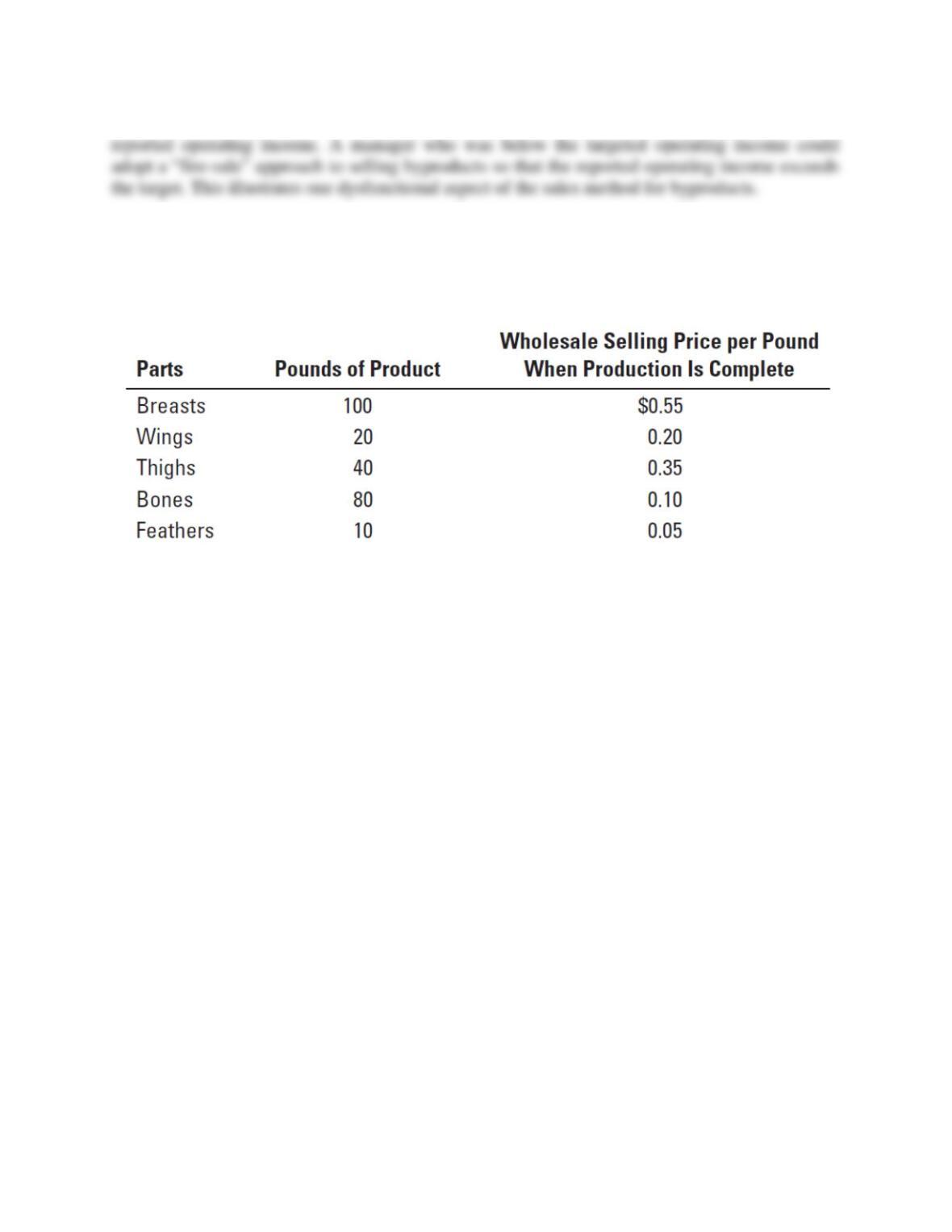
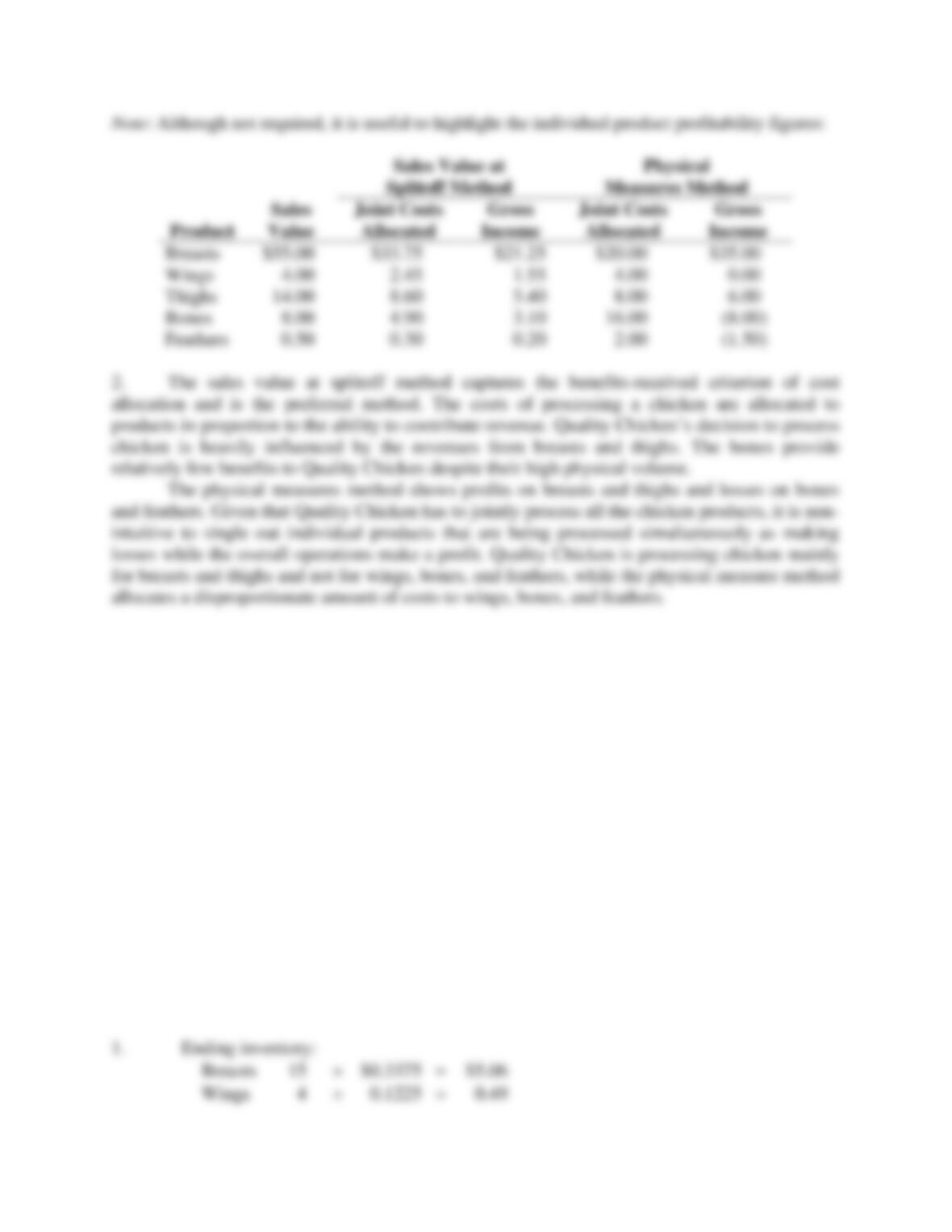
Quality Chicken grows and processes chickens. Each chicken is disassembled into five main
parts. Information pertaining to production in July 2014 is as follows:
Joint cost of production in July 2014 was $50.
A special shipment of 40 pounds of breasts and 15 pounds of wings has been destroyed in a
fire. Quality Chicken’s insurance policy provides reimbursement for the cost of the items
destroyed. The insurance company permits Quality Chicken to use a joint-cost-allocation
method. The splitoff point is assumed to be at the end of the production process.
Required:
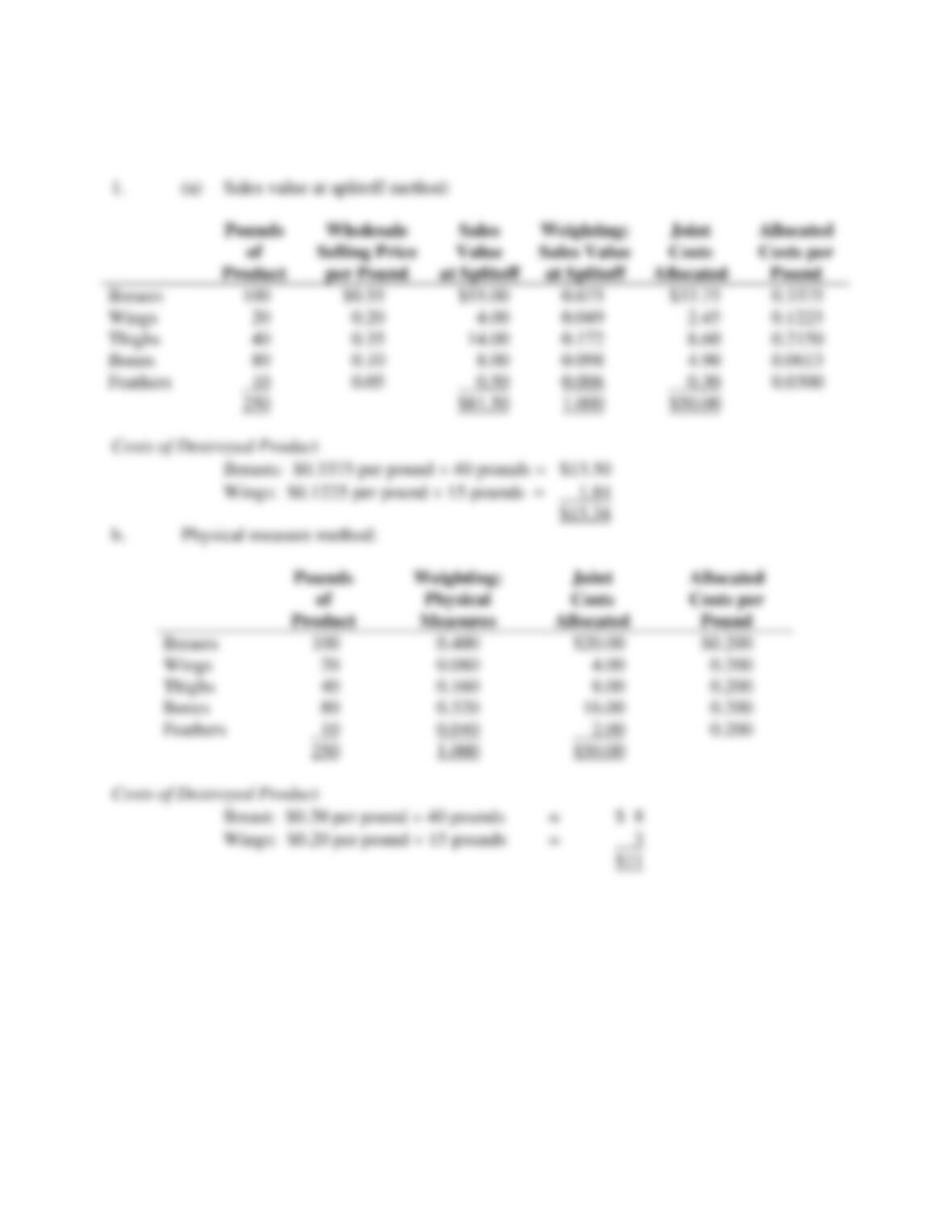
1. Compute the cost of the special shipment destroyed using the following:
a. Sales value at splitoff method
b. Physical-measure method (pounds of finished product)
2. What joint-cost-allocation method would you recommend Quality Chicken use? Explain.
16-4
SOLUTION
16-5
16-17 (10 min.) Joint products and byproducts (continuation of 16-16).
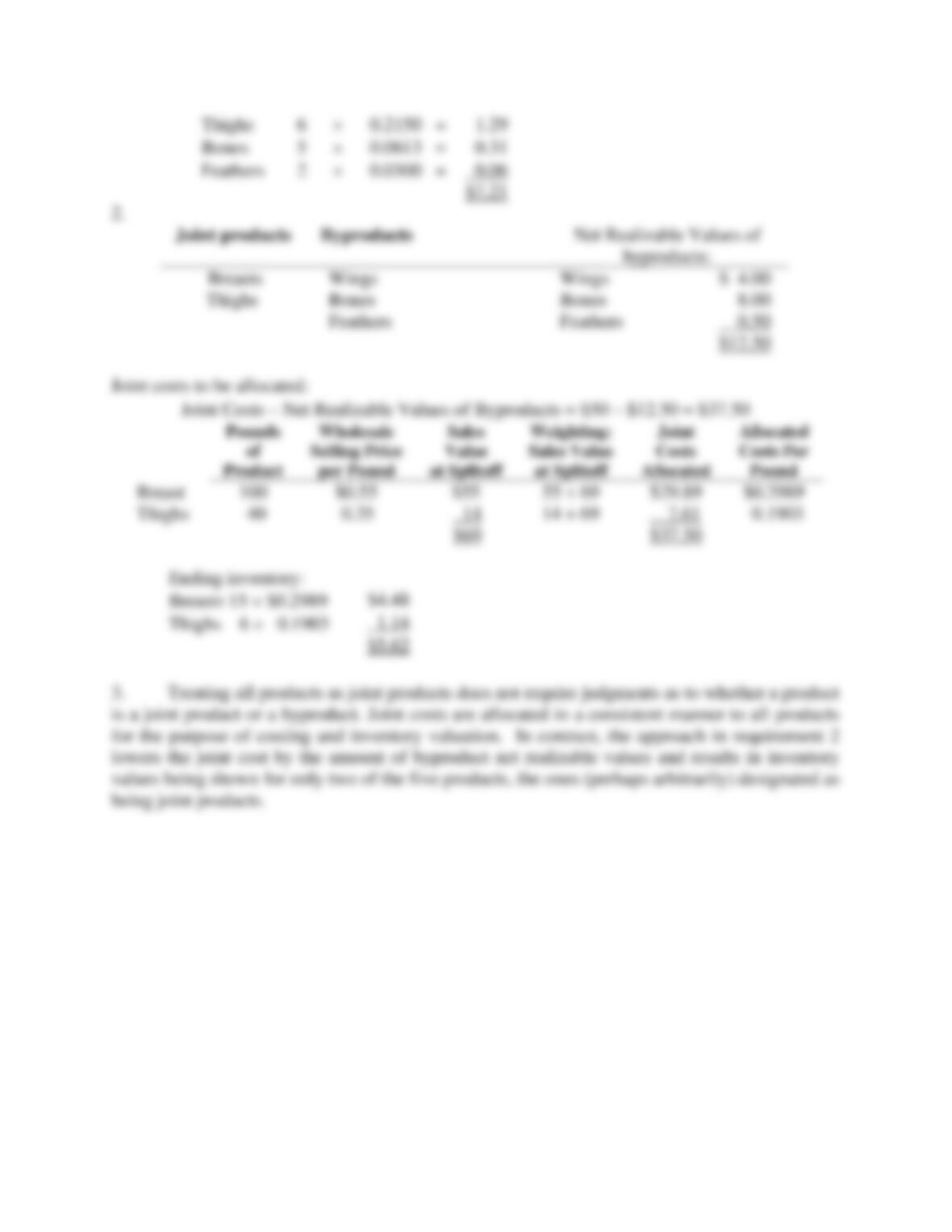
Quality Chicken is computing the ending inventory values for its July 31, 2014, balance sheet.
Ending inventory amounts on July 31 are 15 pounds of breasts, 4 pounds of wings, 6 pounds of
thighs, 5 pounds of bones, and 2 pounds of feathers.
Quality Chicken’s management wants to use the sales value at splitoff method. However,
management wants you to explore the effect on ending inventory values of classifying one or
more products as a byproduct rather than a joint product.
Required:
1. Assume Quality Chicken classifies all five products as joint products. What are the ending
inventory values of each product on July 31, 2014?
2. Assume Quality Chicken uses the production method of accounting for byproducts. What are
the ending inventory values for each joint product on July 31, 2014, assuming breasts and
thighs are the joint products and wings, bones, and feathers are byproducts?
3. Comment on differences in the results in requirements 1 and 2.
SOLUTION
16-6
16-18 (10 min.) Net realizable value method.
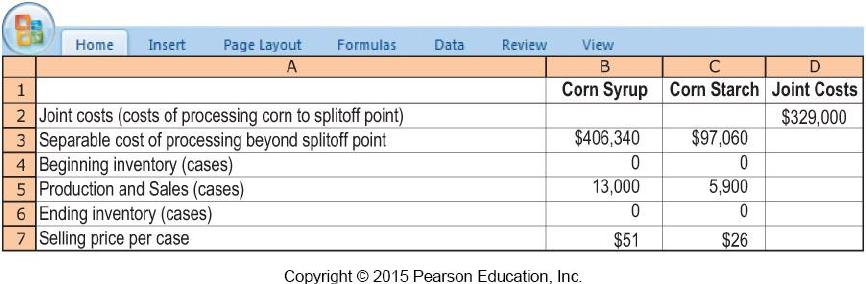
Stenback Company is one of the world’s leading corn refiners. It produces two joint products—
corn syrup and corn starch—using a common production process. In July 2014, Stenback
reported the following production and selling-price information:
16-7
Required:
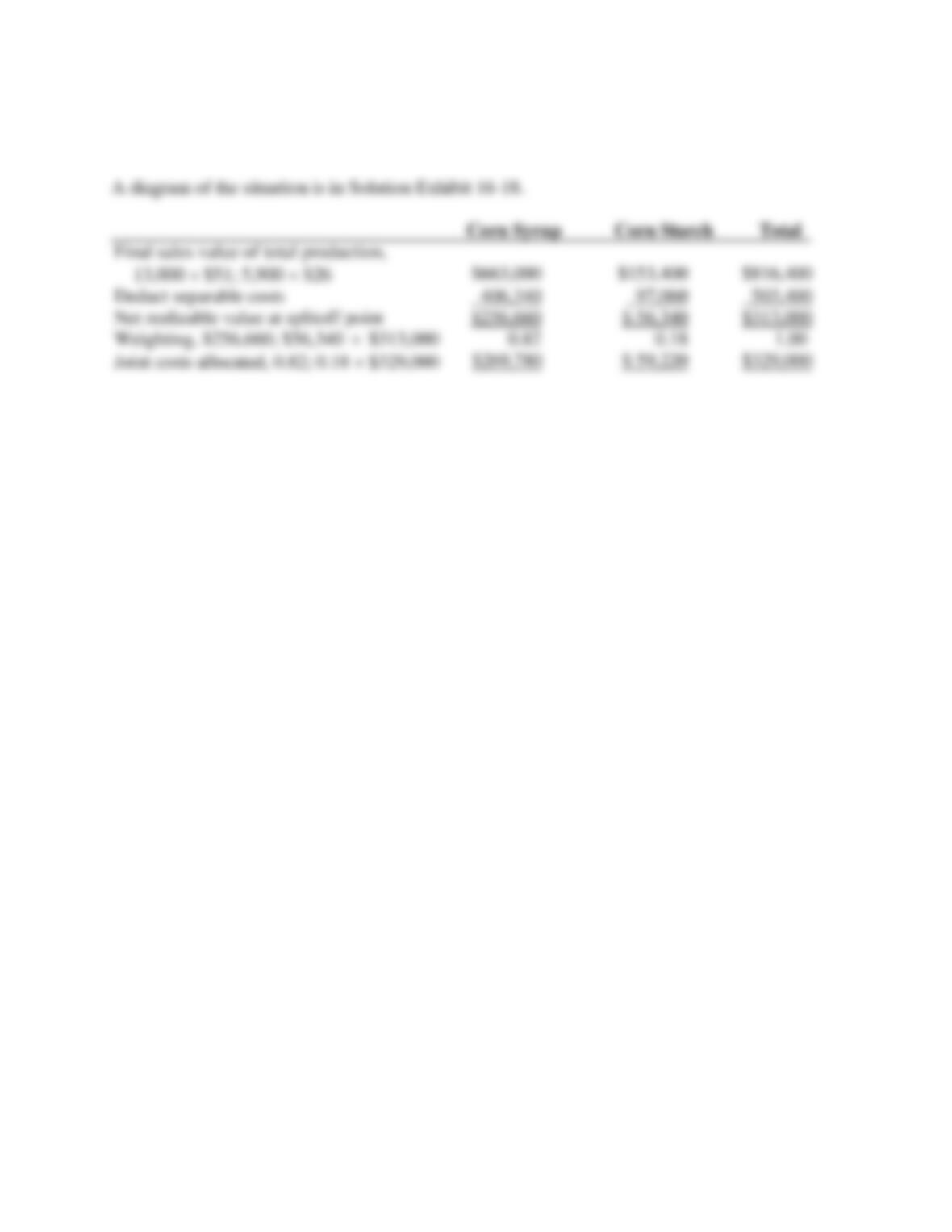
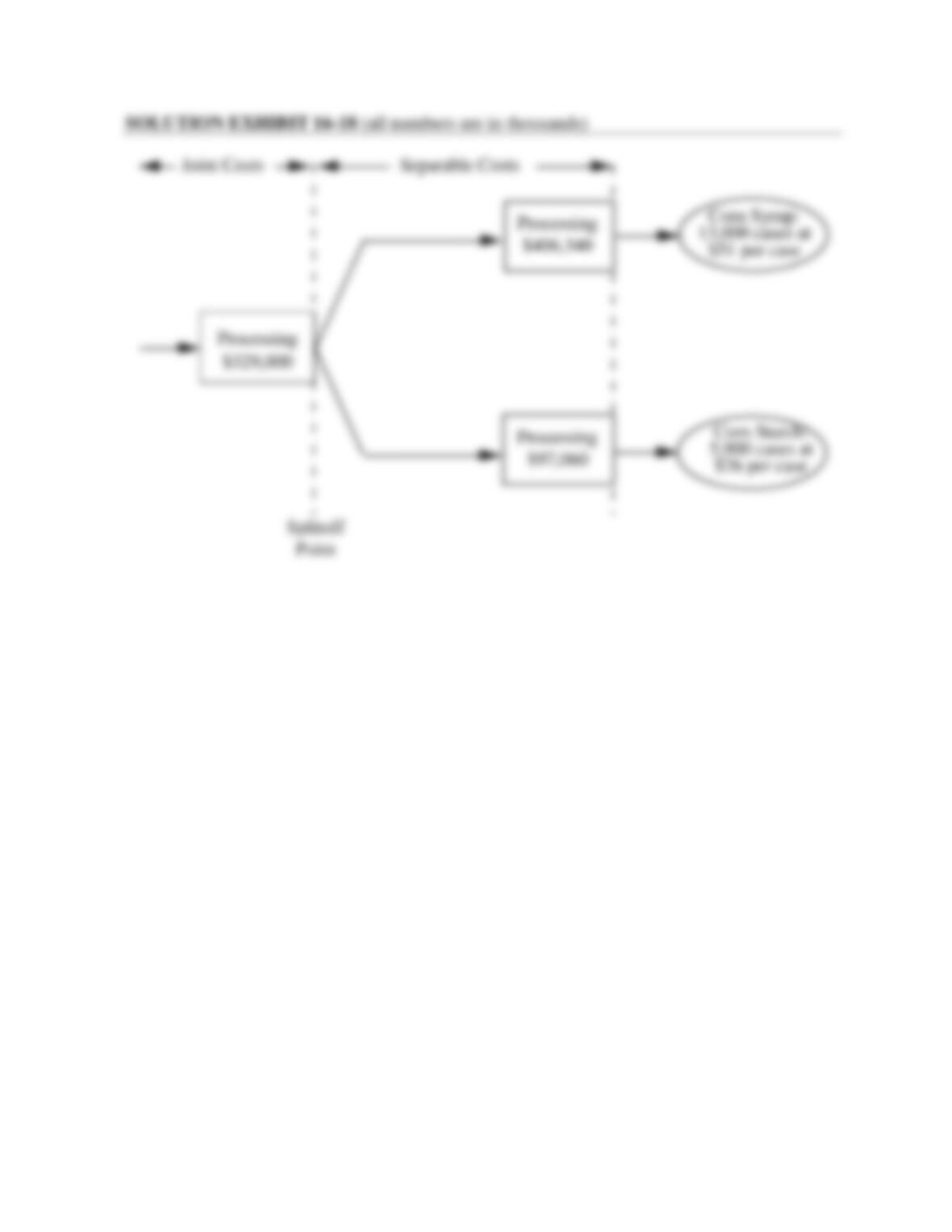
Allocate the $329,000 joint costs using the NRV method.
16-8
SOLUTION
16-9
16-19 (40 min.) Alternative joint-cost-allocation methods, further-process decision.
The Wood Spirits Company produces two products—turpentine and methanol (wood alcohol)—
by a joint process. Joint costs amount to $120,000 per batch of output. Each batch totals 10,000
gallons: 25% methanol and 75% turpentine. Both products are processed further without gain or
loss in volume. Separable processing costs are methanol, $3 per gallon, and turpentine, $2 per
gallon. Methanol sells for $21 per gallon. Turpentine sells for $14 per gallon.
Required:
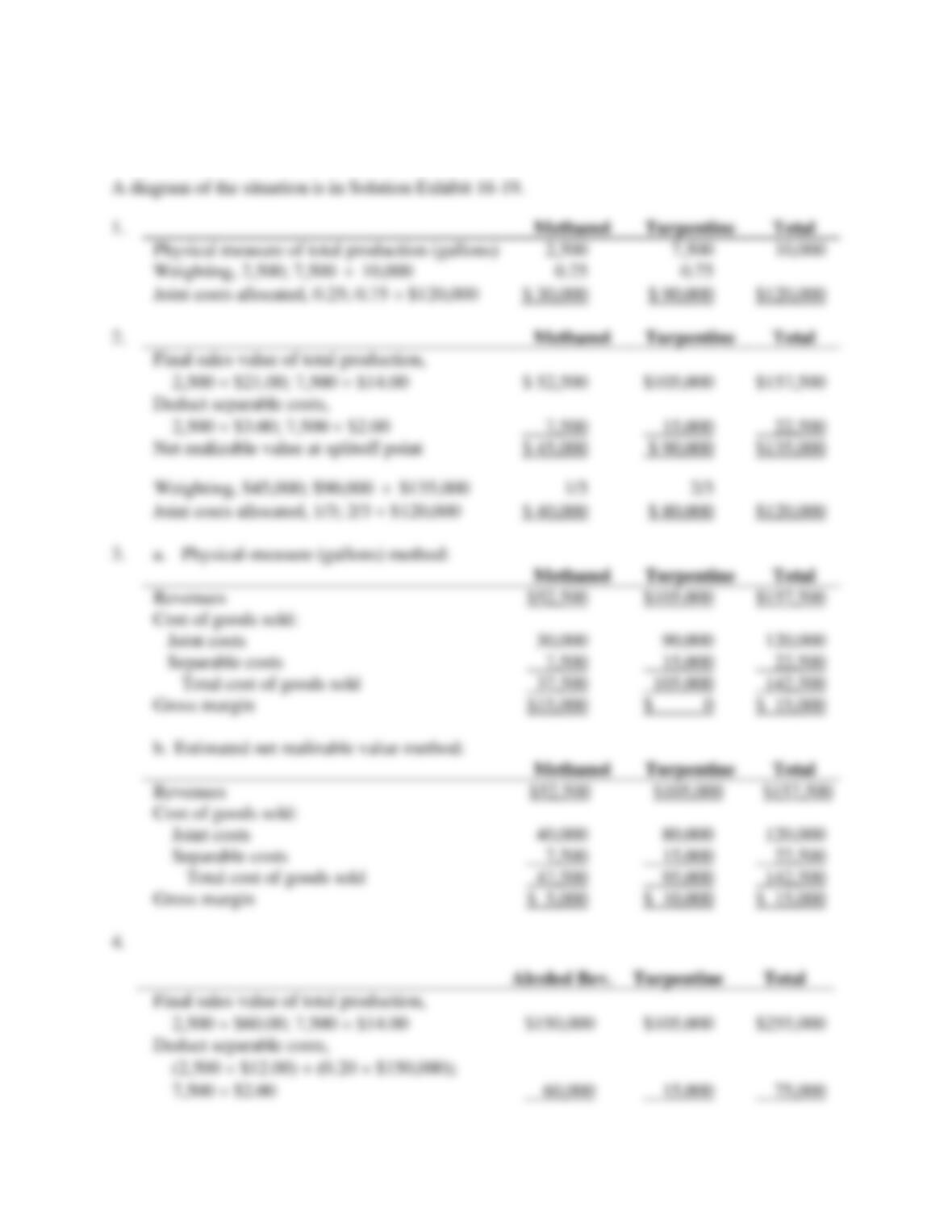
1. How much of the joint costs per batch will be allocated to turpentine and to methanol,
assuming that joint costs are allocated based on the number of gallons at splitoff point?
2. If joint costs are allocated on an NRV basis, how much of the joint costs will be allocated to
turpentine and to methanol?
3. Prepare product-line income statements per batch for requirements 1 and 2. Assume no
beginning or ending inventories.
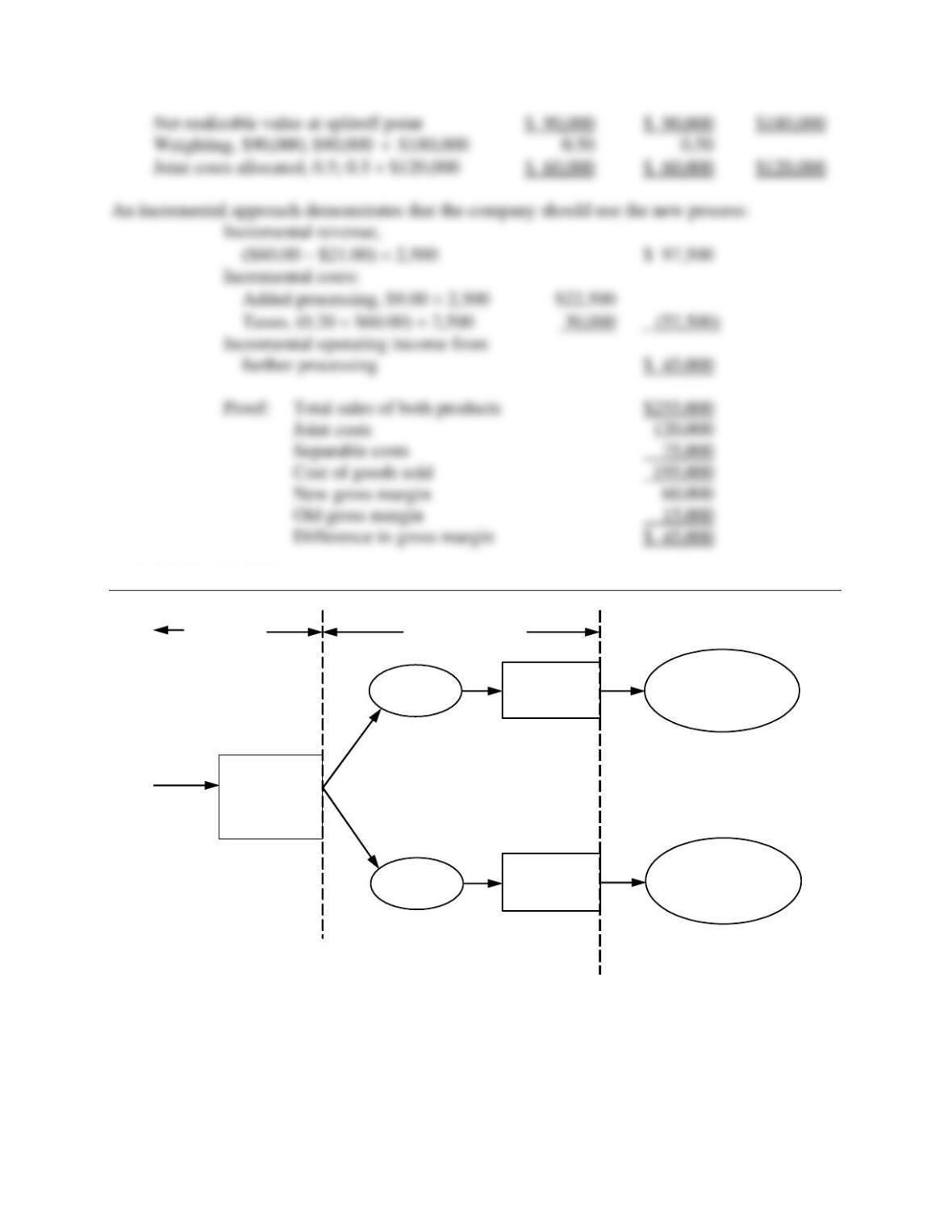
4. The company has discovered an additional process by which the methanol (wood alcohol)
can be made into a pleasant-tasting alcoholic beverage. The selling price of this beverage
would be $60 a gallon. Additional processing would increase separable costs $9 per gallon
(in addition to the $3 per gallon separable cost required to yield methanol). The company
would have to pay excise taxes of 20% on the selling price of the beverage. Assuming no
other changes in cost, what is the joint cost applicable to the wood alcohol (using the NRV
method)? Should the company produce the alcoholic beverage? Show your computations.
16-10
SOLUTION
16-11
SOLUTION EXHIBIT 16-19
Joint Costs
Separable Costs
Processing
$120000
for 10000
gallons
Processing
$2 per gallon
Processing
$3 per gallon
7500
gallons
2500
gallons
Methanol:
2500 gallons
at $21 per gallon
Turpentine:
7500 gallons
at $14 per gallon
Splitoff
Point
16-12
16-20 (40 min.) Alternative methods of joint-cost allocation, ending inventories.
The Cook Company operates a simple chemical process to convert a single material into three
separate items, referred to here as X, Y, and Z. All three end products are separated
simultaneously at a single splitoff point.
Products X and Y are ready for sale immediately upon splitoff without further processing or
any other additional costs. Product Z, however, is processed further before being sold. There is
no available market price for Z at the splitoff point.
The selling prices quoted here are expected to remain the same in the coming year. During
2014, the selling prices of the items and the total amounts sold were as follows:
▪ X—68 tons sold for $1,200 per ton
▪ Y—480 tons sold for $900 per ton
▪ Z—672 tons sold for $600 per ton
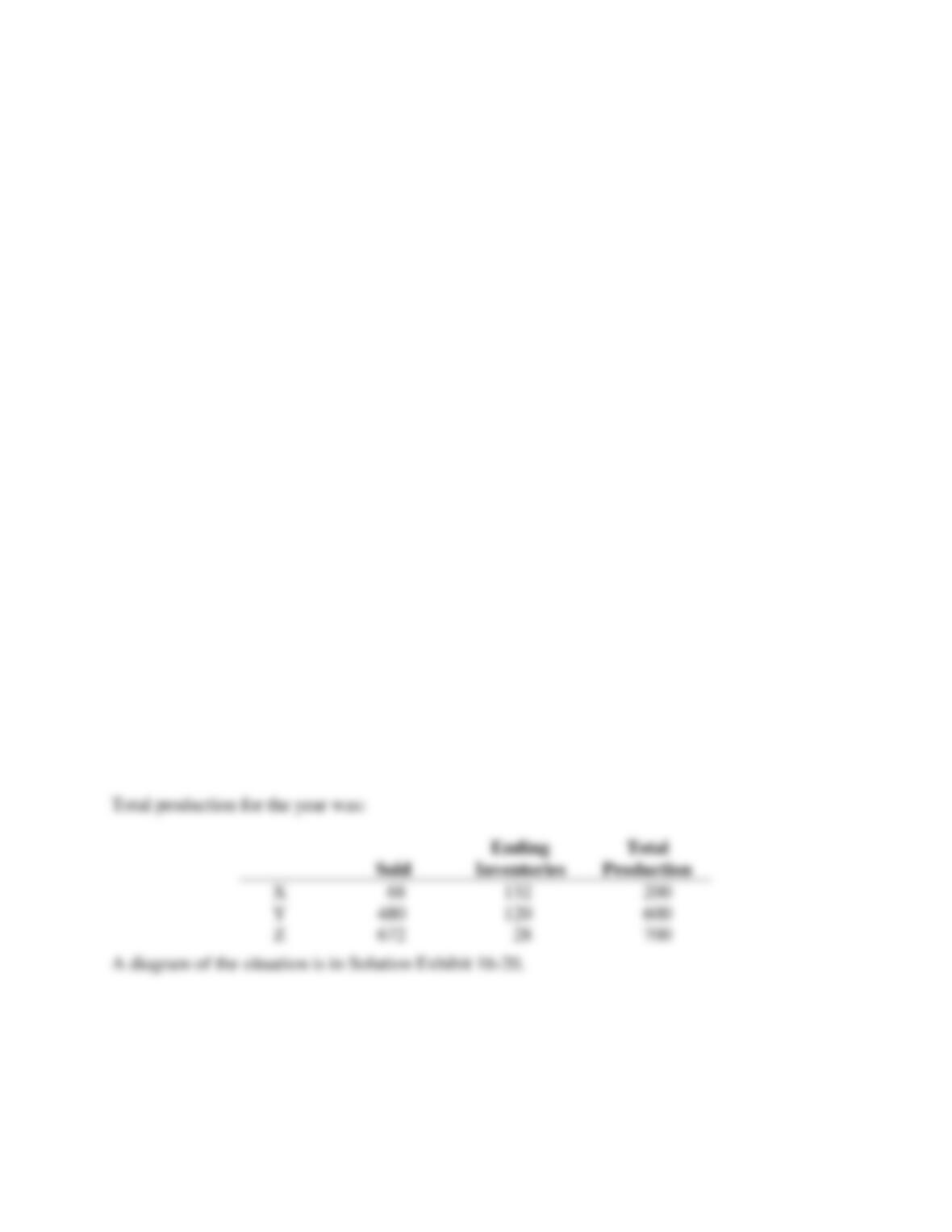
The total joint manufacturing costs for the year were $580,000. Cook spent an additional
$200,000 to finish product Z.
There were no beginning inventories of X, Y, or Z. At the end of the year, the following
inventories of completed units were on hand: X, 132 tons; Y, 120 tons; Z, 28 tons. There was no
beginning or ending work in process.
Required:
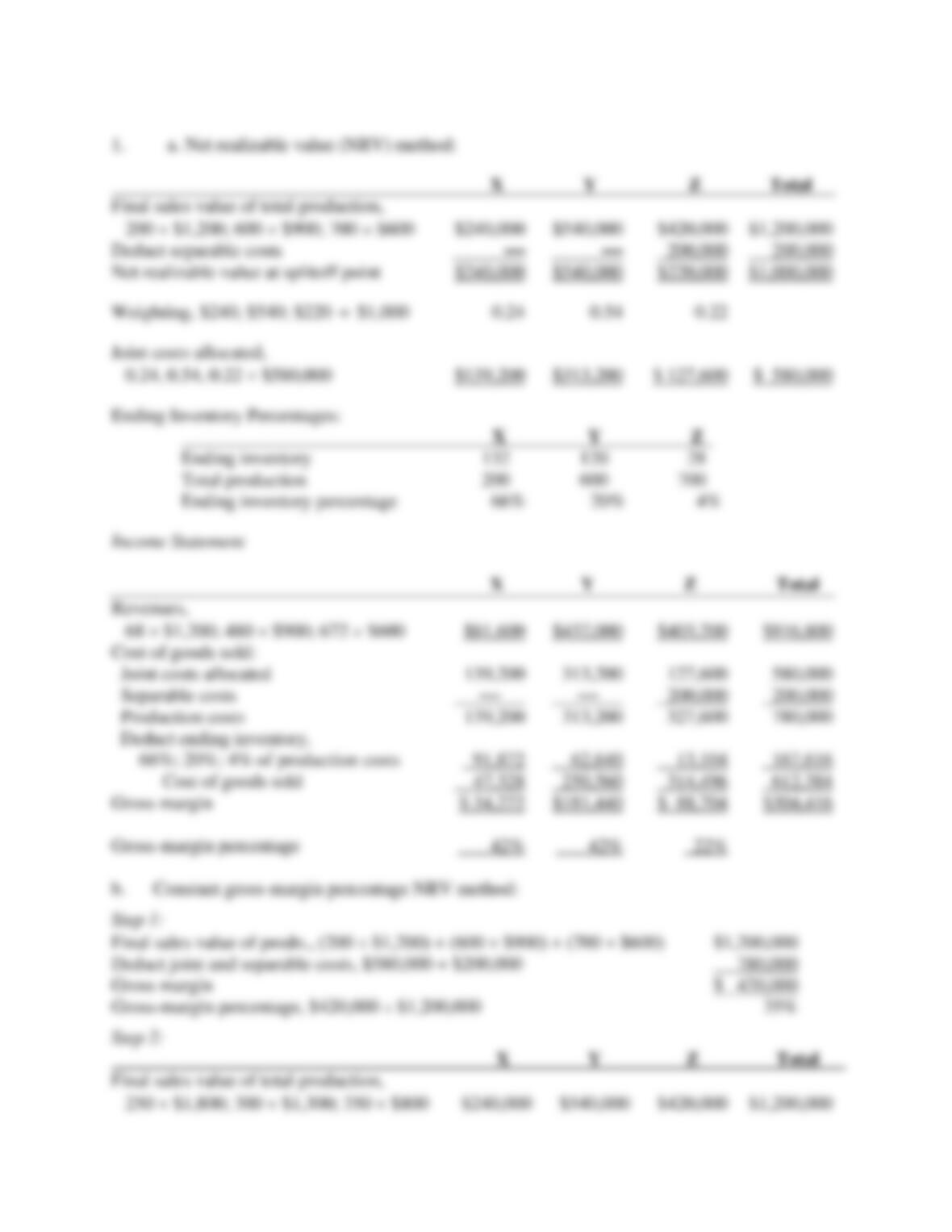
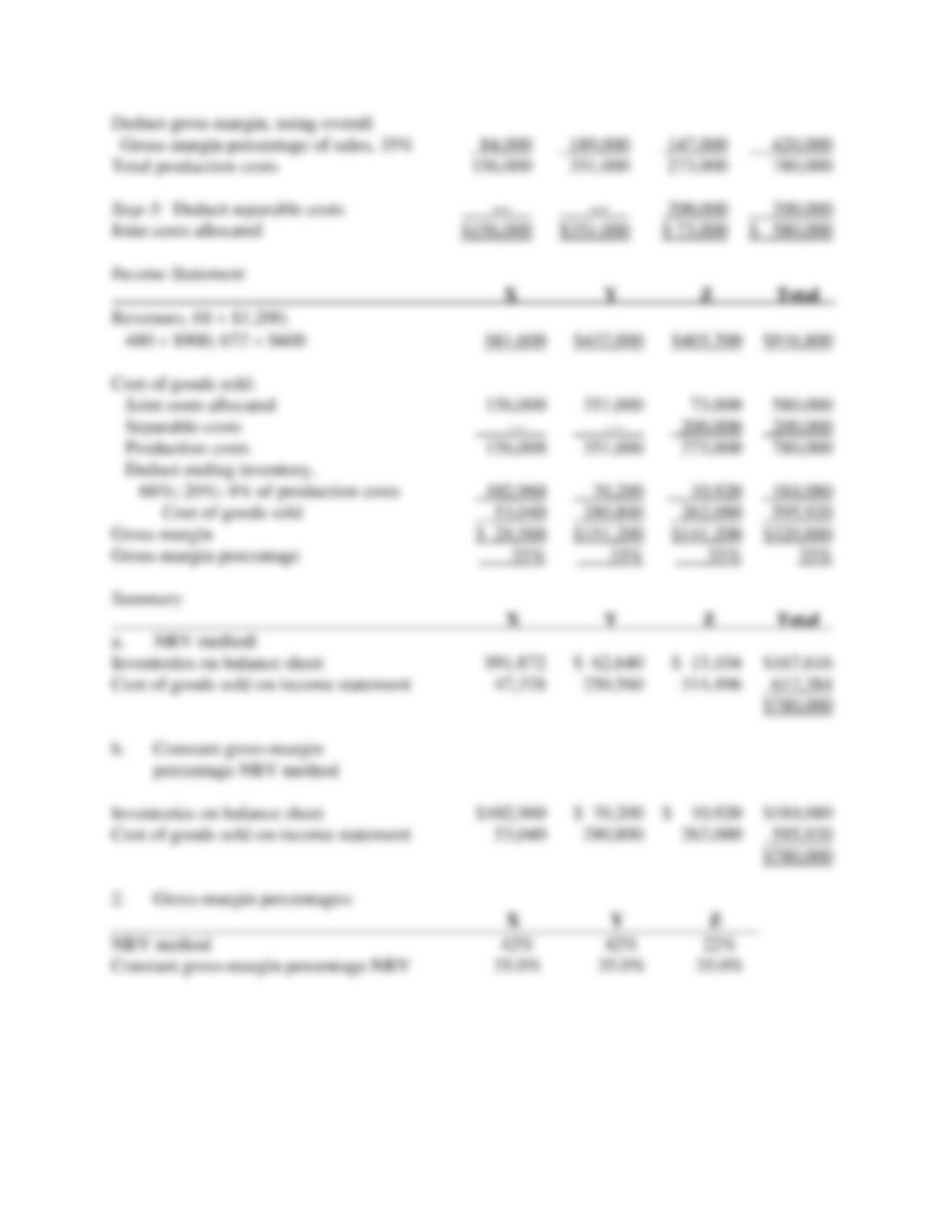
1. Compute the cost of inventories of X, Y, and Z for balance sheet purposes and the cost of
goods sold for income statement purposes as of December 31, 2014, using the following joint
cost allocation methods:
a. NRV method
b. Constant gross-margin percentage NRV method
2. Compare the gross-margin percentages for X, Y, and Z using the two methods given in
requirement 1.
SOLUTION
16-13
16-14
16-15
SOLUTION EXHIBIT 16-20
Splitoff
Point
Processing
$200000
Product Y:
600 tons at
$900 per ton
Product X:
200 tons at
$1,200 per ton
Joint
Processing
Costs
$580,000
Product Z:
700 tons at
$600 per ton
Joint Costs
Separable Costs
16-21 (30 min.) Joint-cost allocation, process further.
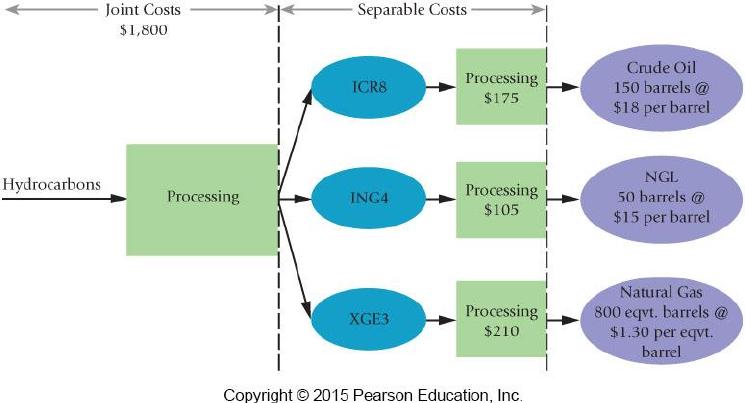
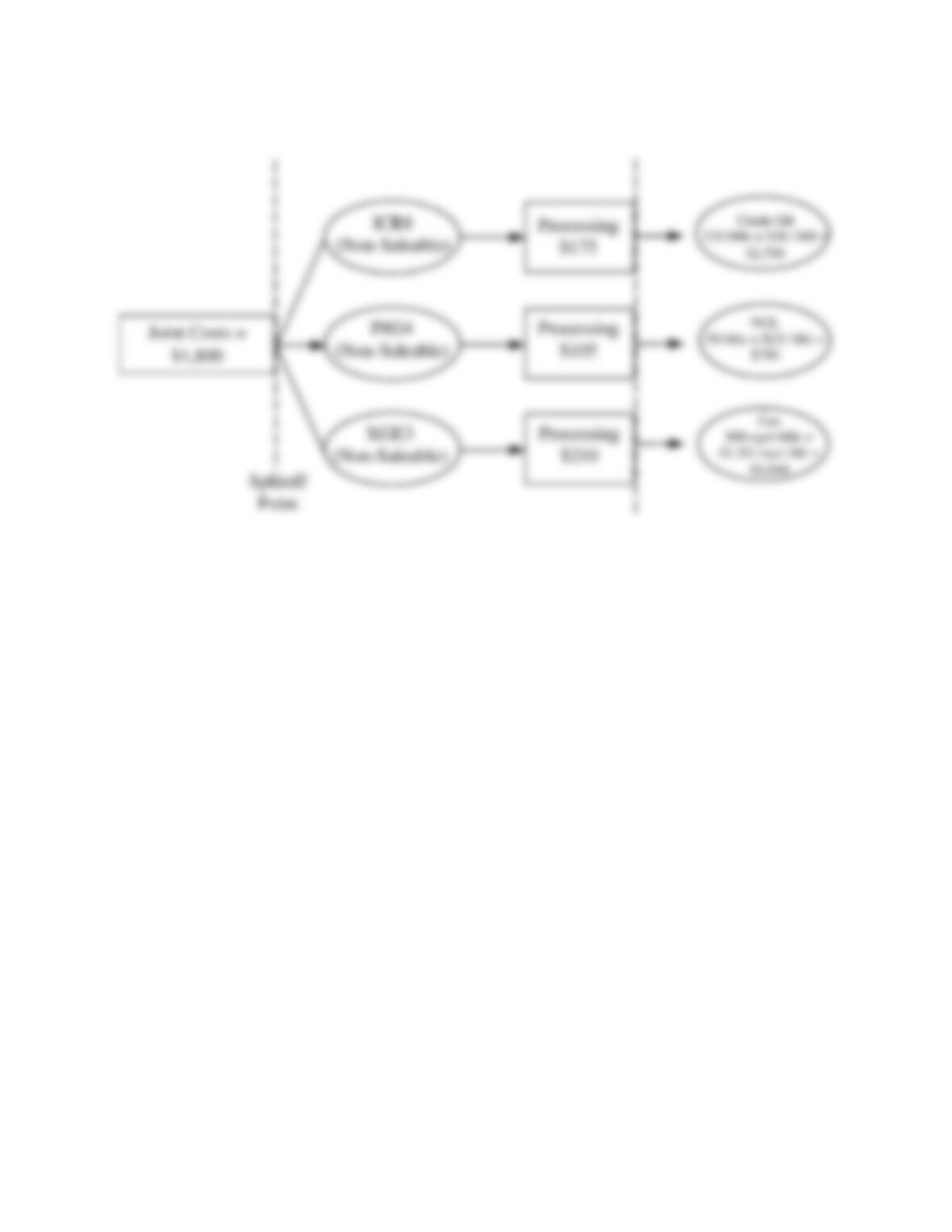
Sinclair Oil & Gas, a large energy conglomerate, jointly processes purchased hydrocarbons to
generate three nonsalable intermediate products: ICR8, ING4, and XGE3. These intermediate
products are further processed separately to produce crude oil, natural gas liquids (NGL), and
natural gas (measured in liquid equivalents). An overview of the process and results for August
2014 are shown here. (Note: The numbers are small to keep the focus on key concepts.)
16-16
A new federal law has recently been passed that taxes crude oil at 30% of operating income. No
new tax is to be paid on natural gas liquid or natural gas. Starting August 2014, Sinclair Oil &
Gas must report a separate product-line income statement for crude oil. One challenge facing
Sinclair Oil & Gas is how to allocate the joint cost of producing the three separate salable
outputs. Assume no beginning or ending inventory.
Required:
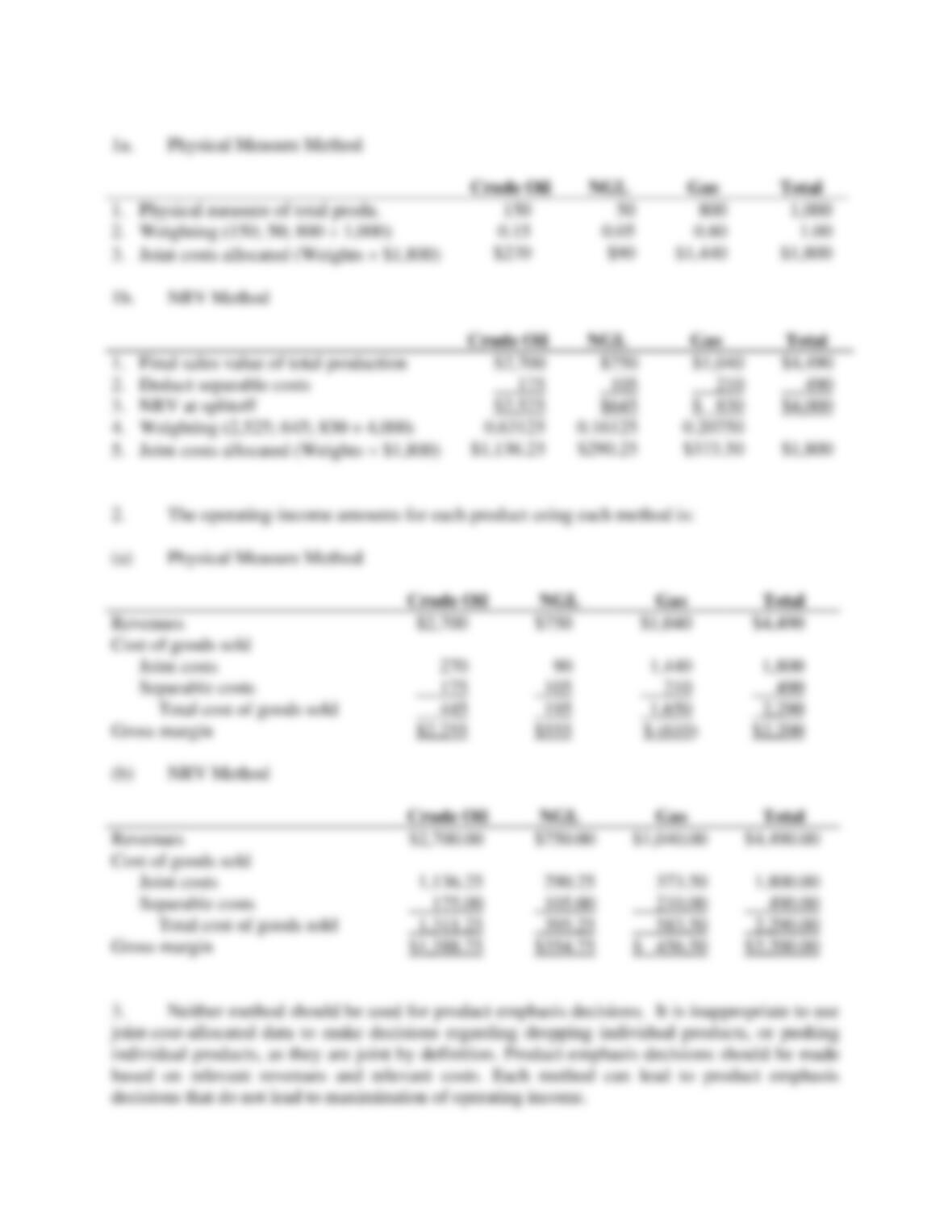
1. Allocate the August 2014 joint cost among the three products using the following:
a. Physical-measure method
b. NRV method
2. Show the operating income for each product using the methods in requirement 1.
3. Discuss the pros and cons of the two methods to Sinclair Oil & Gas for making decisions
about product emphasis (pricing, sell-or-process-further decisions, and so on).
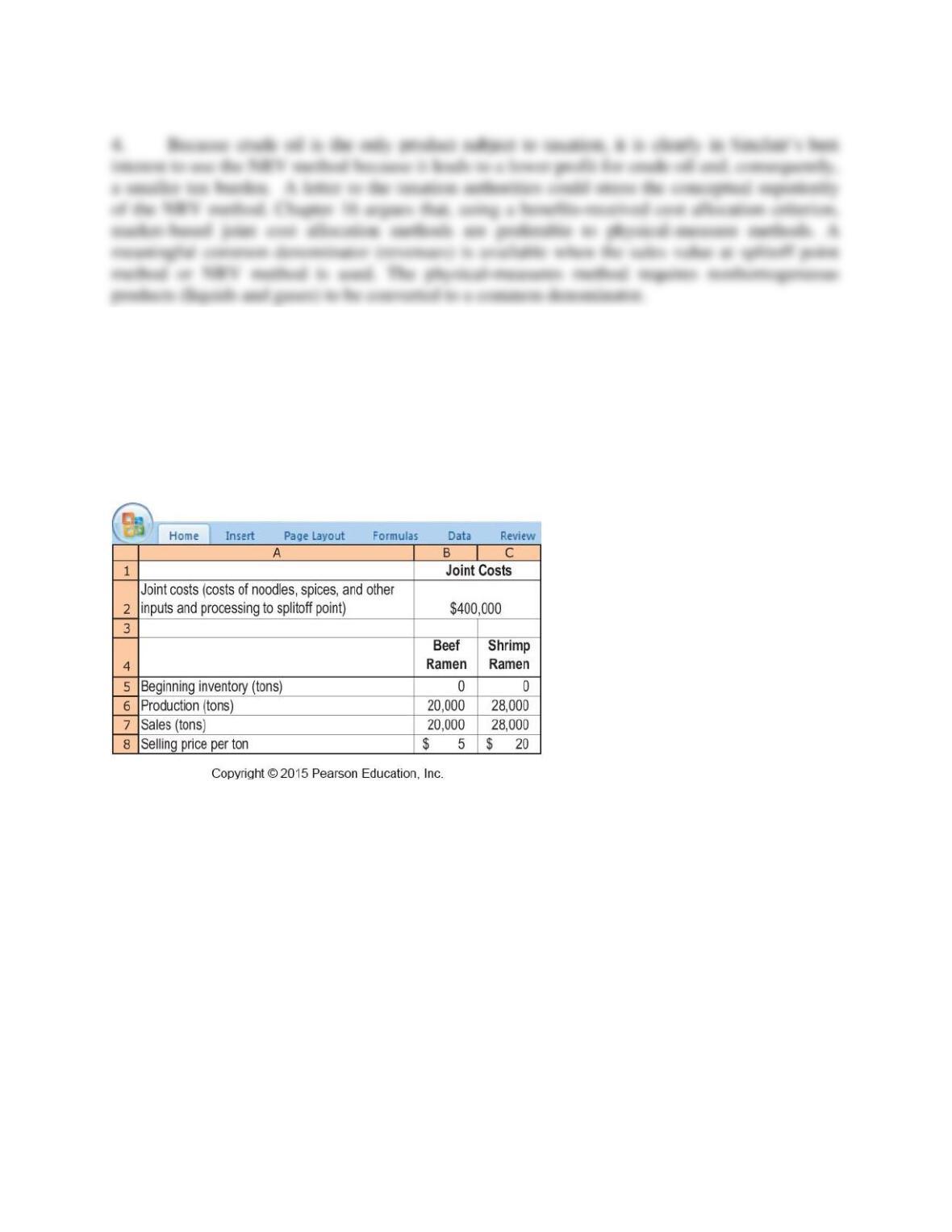
4. Draft a letter to the taxation authorities on behalf of Sinclair Oil & Gas that justifies the joint–
cost-allocation method you recommend Sinclair use.
SOLUTION
16-17
16-18
16-19
16-22 (30 min.) Joint-cost allocation, sales value, physical measure, NRV methods.
Fancy Foods produces two types of microwavable products: beef-flavored ramen and shrimp-
flavored ramen. The two products share common inputs such as noodle and spices. The
production of ramen results in a waste product referred to as stock, which Fancy dumps at
negligible costs in a local drainage area. In June 2014, the following data were reported for the
production and sales of beef-flavored and shrimp-flavored ramen:
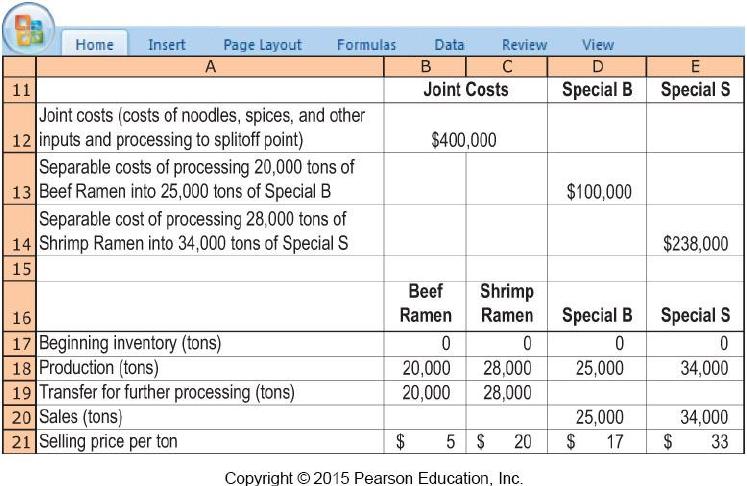
Due to the popularity of its microwavable products, Fancy decides to add a new line of products
that targets dieters. These new products are produced by adding a special ingredient to dilute the
original ramen and are to be sold under the names Special B and Special S, respectively.
Following are the monthly data for all the products:
16-20
Required:
1. Calculate Fancy’s gross-margin percentage for Special B and Special S when joint costs are
allocated using the following:
a. Sales value at splitoff method
b. Physical-measure method
c. Net realizable value method
2. Recently, Fancy discovered that the stock it is dumping can be sold to cattle ranchers at $4
per ton. In a typical month with the production levels shown, 6,000 tons of stock are
produced and can be sold by incurring marketing costs of $12,400. Sandra Dashel, a
management accountant, points out that treating the stock as a joint product and using the
sales value at splitoff method, the stock product would lose about $2,435 each month, so it
should not be sold. How did Dashel arrive at that final number, and what do you think of her
analysis? Should Fancy sell the stock?