Wild and Shaw, Financial & Managerial Accounting, 8e Solutions Manual: Chapter 16
Comprehensive Problem (Continued)
(Using FIFO)
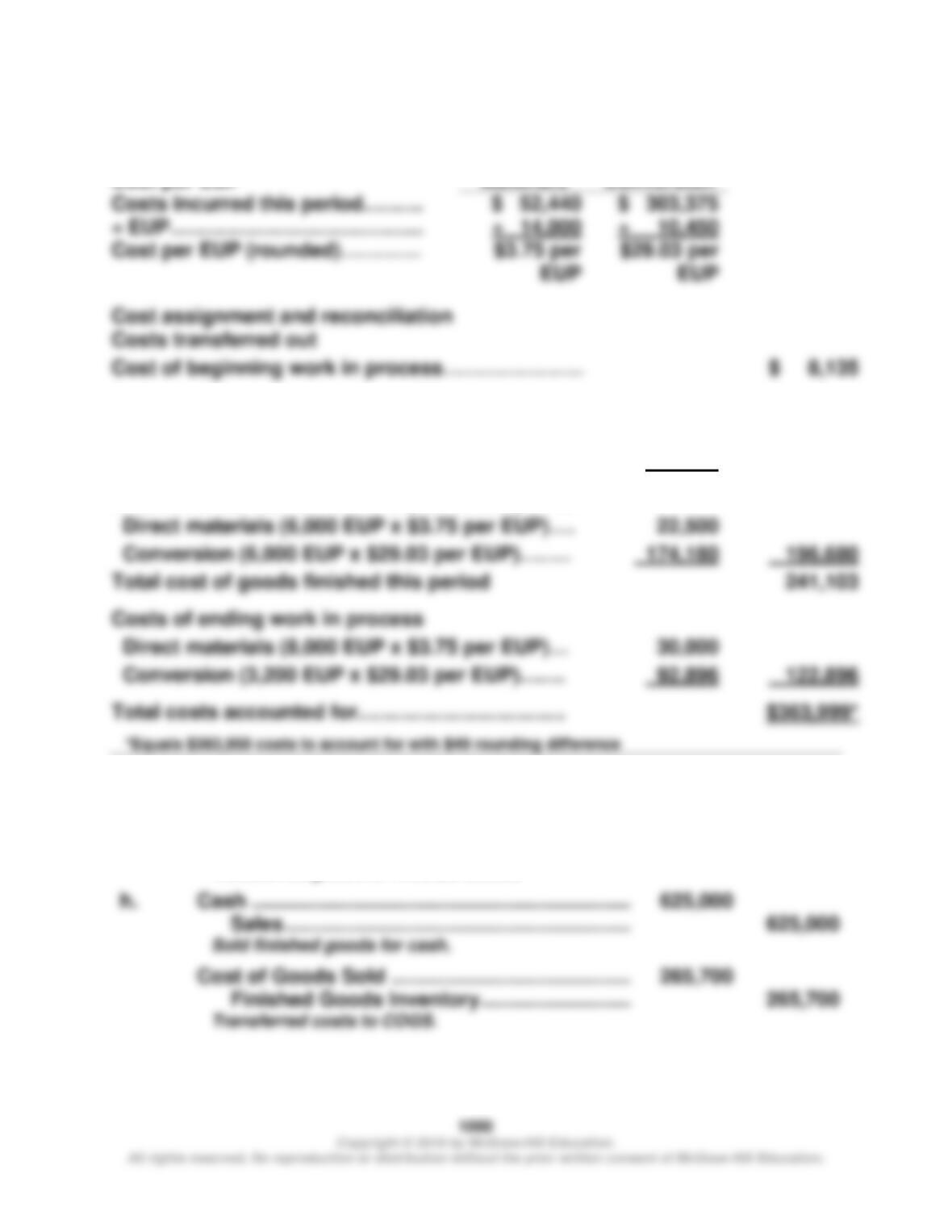
Cost per EUP
Direct
Materials
Conversion
Costs incurred this period………
$ 303,375
÷ EUP………………………………..
Cost assignment and reconciliation
Costs transferred out
Cost to complete beginning work in process
Direct materials (0 EUP x $3.75 per EUP)………..
$ 0
Conversion (1,250 EUP x $29.03 per EUP)………
36,288
36,288
Costs of units started and completed this period
Direct materials (6,000 EUP x $3.75 per EUP)….
Conversion (6,000 EUP x $29.03 per EUP)……..
Costs of ending work in process
Direct materials (8,000 EUP x $3.75 per EUP)…
Conversion (3,200 EUP x $29.03 per EUP)…….
Part 3 — Journal entries (Using FIFO)
g.
Finished Goods Inventory …………………………..
241,103
Work in Process Inventory …………………………..
241,103
Transferred goods to Finished Goods.
h.
625,000
Sales ……………………………………………………….
625,000
Cost of Goods Sold ……………………………………………….
265,700
Finished Goods Inventory …………………………..
265,700
Wild and Shaw, Financial & Managerial Accounting, 8e Solutions Manual: Chapter 16
Comprehensive Problem (Continued)
Part 4 (Using FIFO)
General ledger accounts
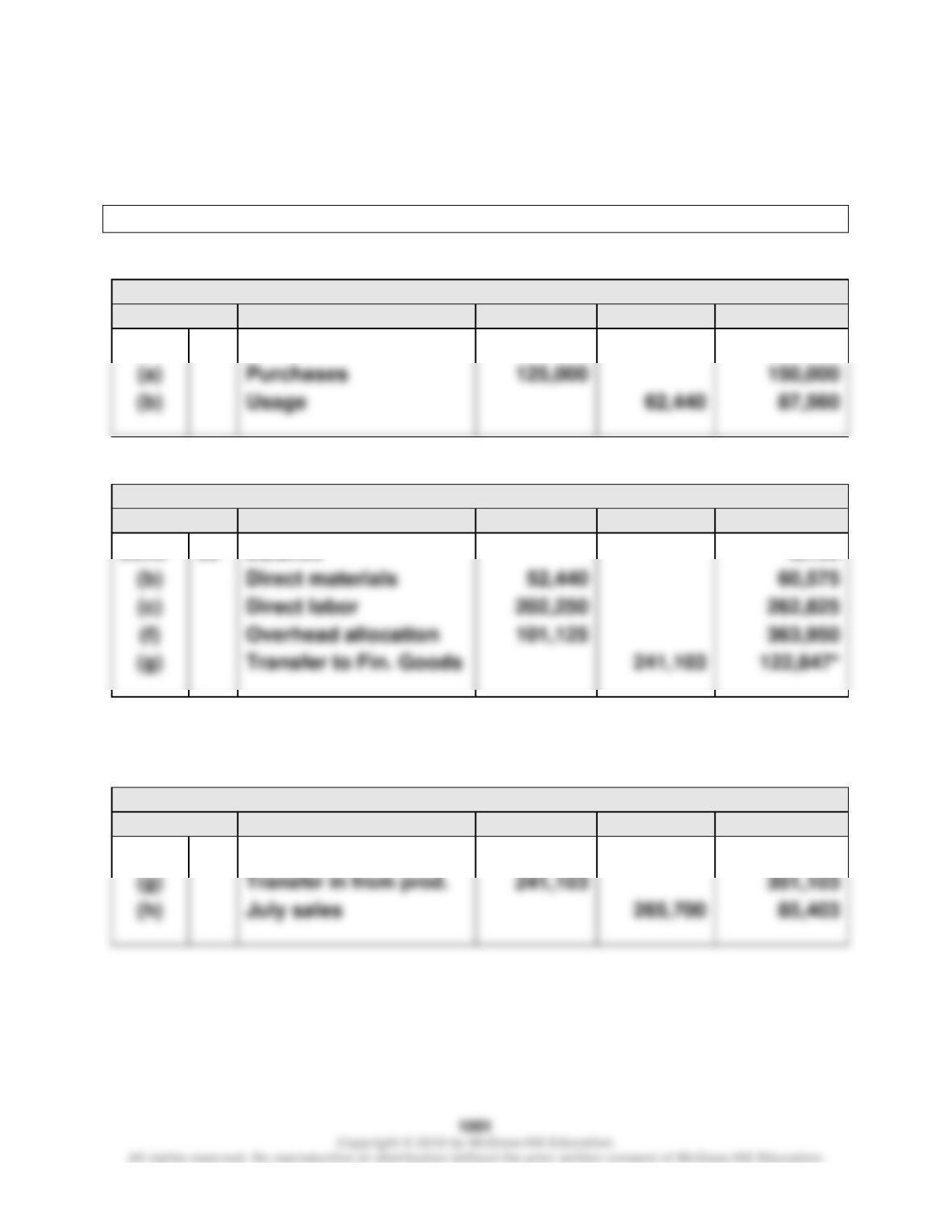
Raw Materials Inventory
Acct. No. 132
Date
Explanation
Debit
Credit
Balance
June
30
Balance
25,000
87,560
Work in Process Inventory
Acct. No. 133
Date
Explanation
Debit
Credit
Balance
June
30
Balance
8,135
Direct materials
60,575
262,825
Transfer to Fin. Goods
*Agrees with $122,896 from process cost summary with $49 rounding difference
Finished Goods Inventory
Acct. No. 135
Date
Explanation
Debit
Credit
Balance
June
30
Balance
110,000
351,103
July sales
85,403
Wild and Shaw, Financial & Managerial Accounting, 8e Solutions Manual: Chapter 16
1002
Comprehensive Problem (Continued)
Part 4—(Using FIFO) concluded
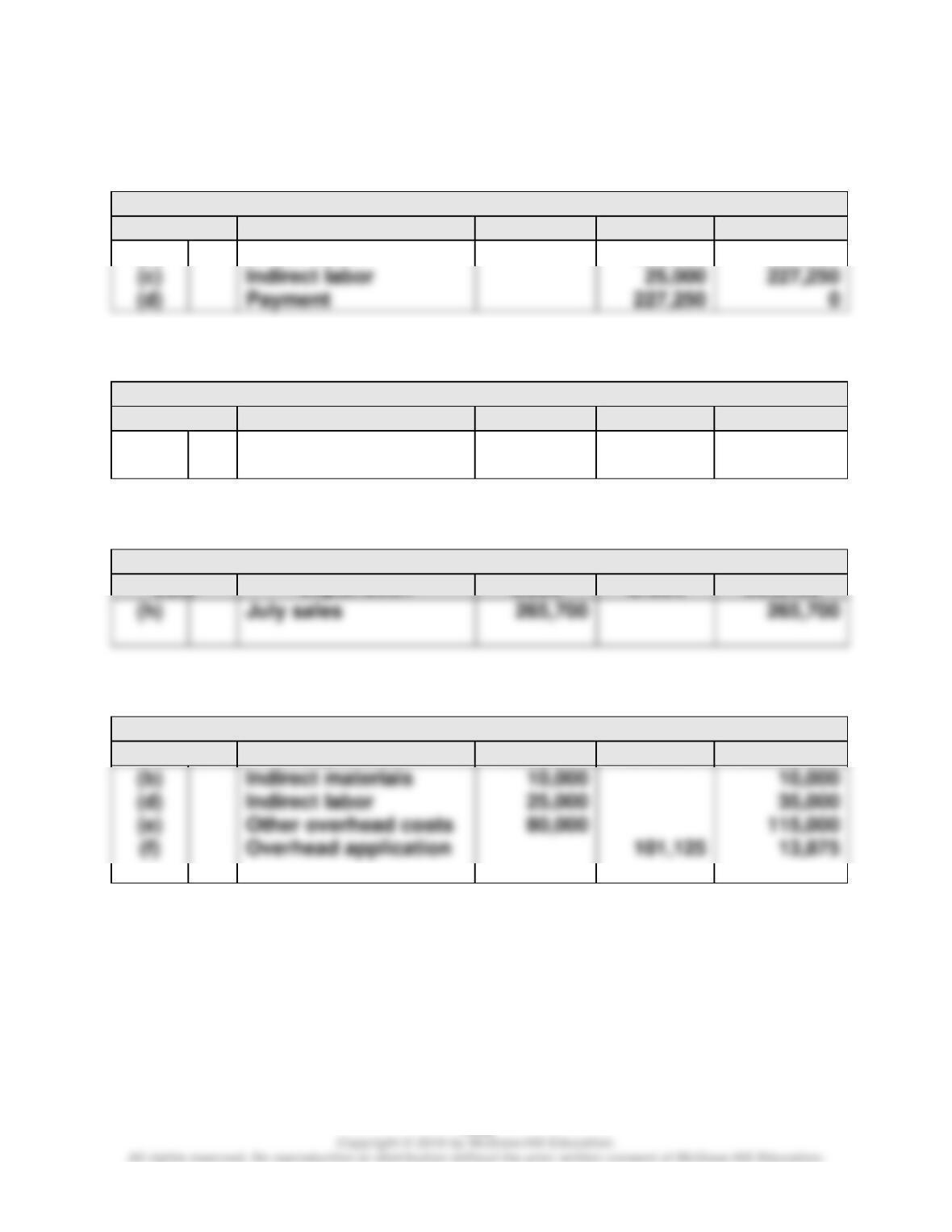
Factory Wages Payable
Acct. No. 212
Date
Explanation
Debit
Credit
Balance
(c)
Direct labor
202,500
202,500
Sales
Acct. No. 413
Date
Explanation
Debit
Credit
Balance
(h)
July sales
625,000
625,000
Cost of Goods Sold
Acct. No. 502
Date
Explanation
Debit
Credit
Balance
(h)
July sales
265,700
Factory Overhead
Acct. No. 540
Date
Explanation
Debit
Credit
Balance
(b)
(d)
(e)
115,000
Overhead application
101,125

Wild and Shaw, Financial & Managerial Accounting, 8e Solutions Manual: Chapter 16
1003
Comprehensive Problem (Concluded)
Part 5 (Using FIFO)
Computation of gross profit for July
Sales ……………………………………………………………………………………….
$ 625,000
$ 345,425
Wild and Shaw, Financial & Managerial Accounting, 8e Solutions Manual: Chapter 16
Company Analysis — AA 16–1
(Dollar amounts in millions)
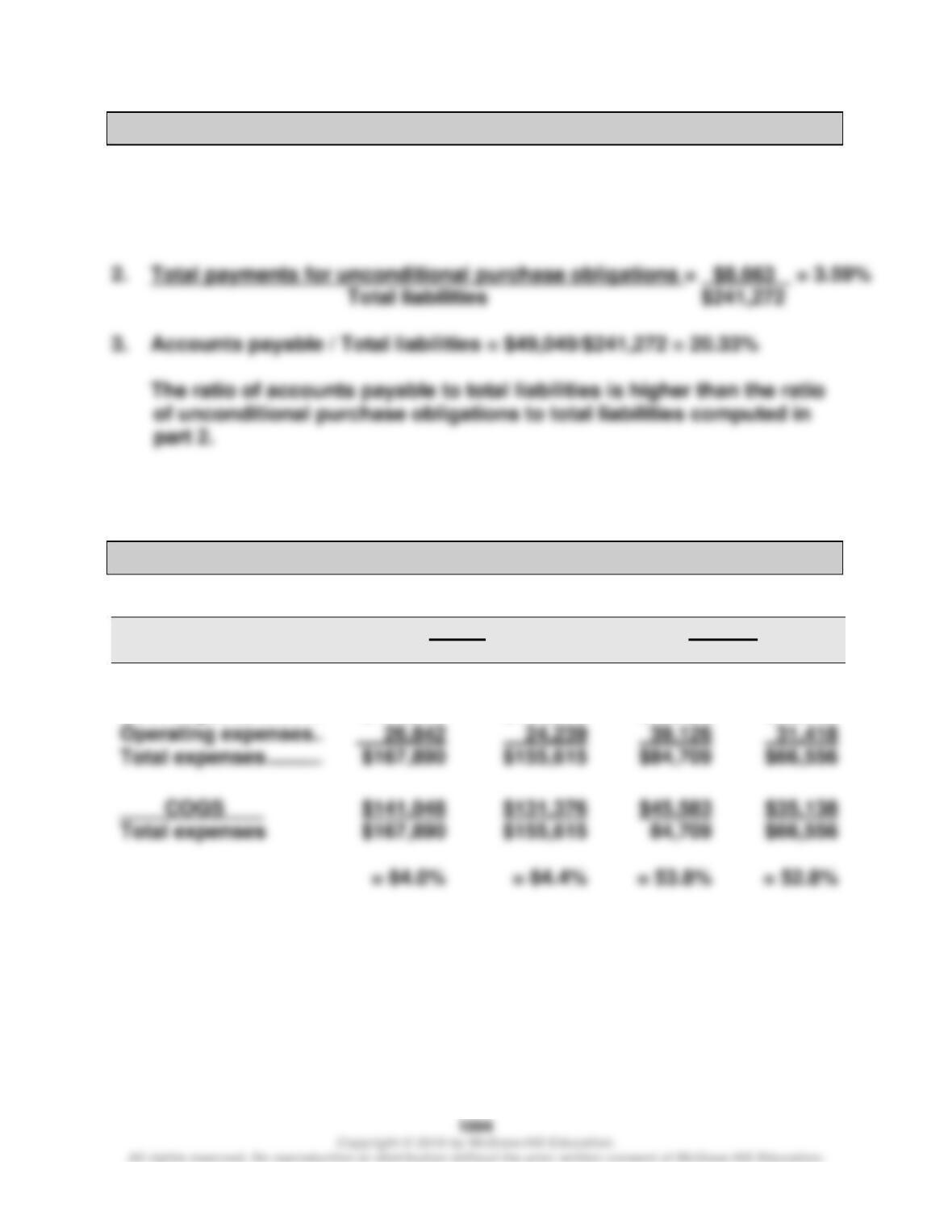
1. Total payments for unconditional purchase obligations = $8,663
Comparative Analysis — AA 16-2
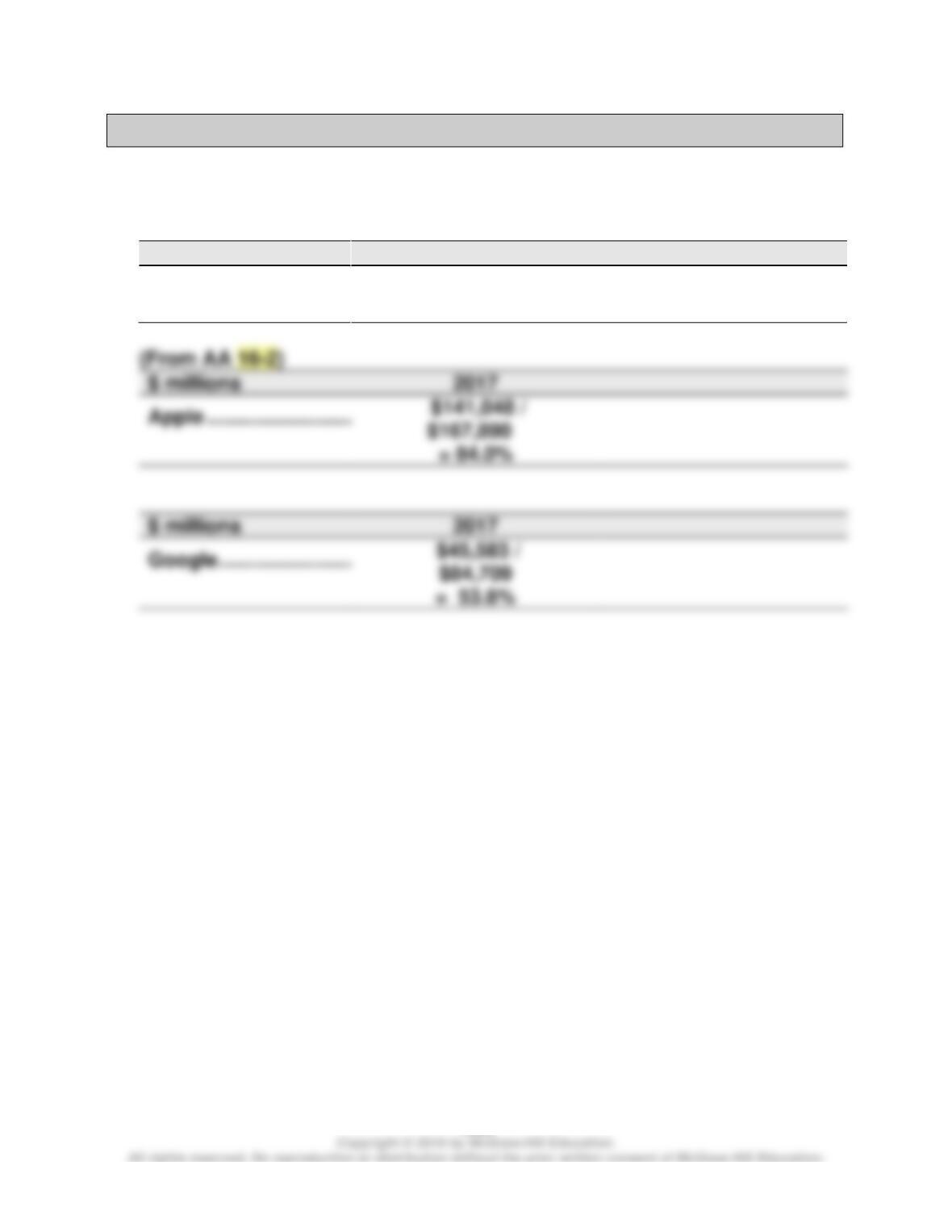
1.
Apple
Google
$ millions
2017
2016
2017
2016
Expenses
Cost of goods sold ……
$141,048
$131,376
$45,583
$35,138
31,418
2. Based on the ratio of COGS to total expenses, Google had a greater
percentage reduction in selling and administrative costs during 2017.
Wild and Shaw, Financial & Managerial Accounting, 8e Solutions Manual: Chapter 16
1005
Global Analysis — AA 16-3
1. Ratio of Cost of Goods Sold to Total Expenses
₩ billions
2017
2016
Samsung …………………..
₩129,291 / ₩185,931
= 69.5%
₩120,278 / ₩172,626
= 69.7%
2017
2017
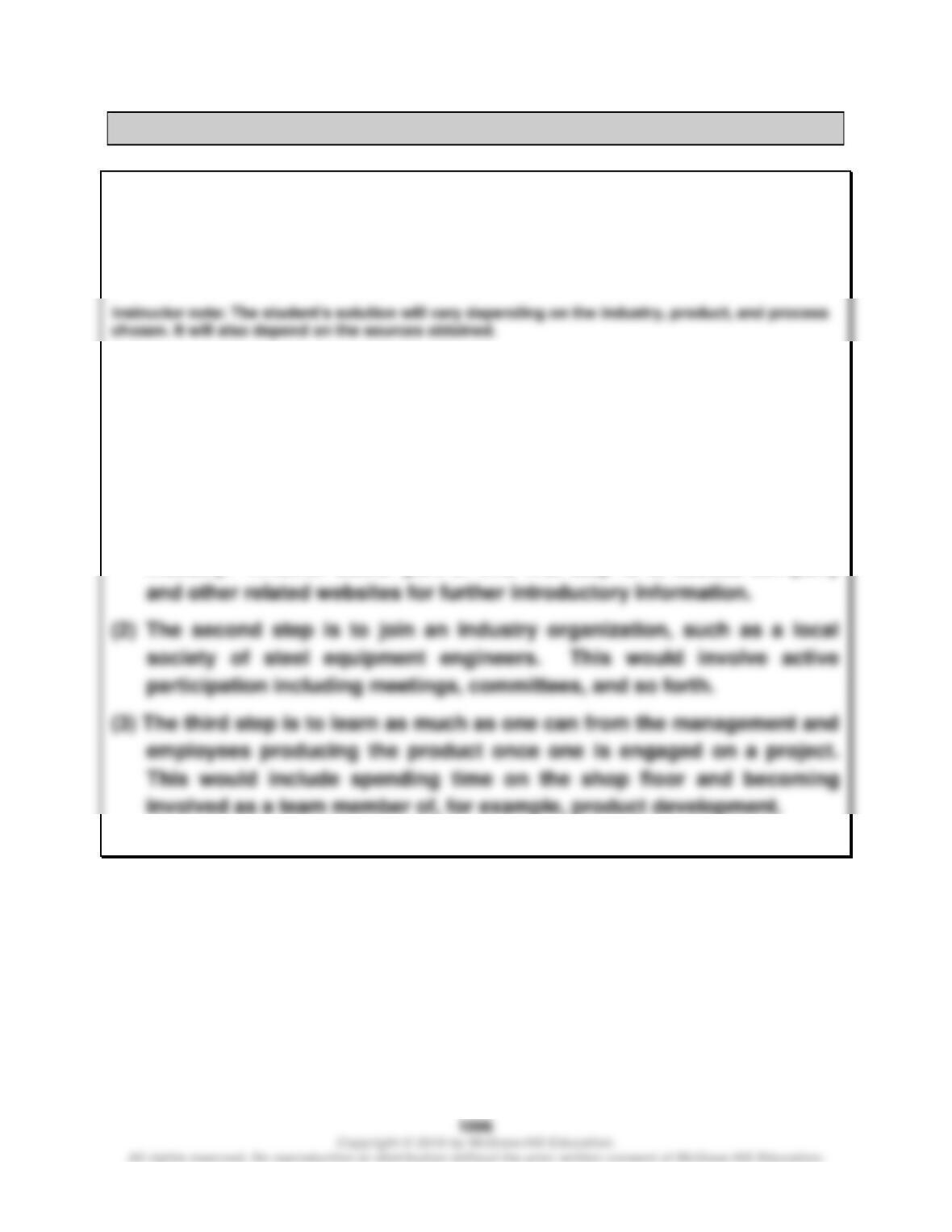
2. Of these three companies, Apple has the highest ratio of cost of goods
sold to total expenses in 2017.
Wild and Shaw, Financial & Managerial Accounting, 8e Solutions Manual: Chapter 16
Ethics Challenge — BTN 16-1
MEMORANDUM
TO:
FROM:
DATE:
SUBJECT:
The memorandum should initially identify an industry (say, steel), a
product (say, cans), and a process (say, forming).
Generally, there are at least three approaches to maintaining and
expanding one’s knowledge about a particular industry, product, and
process—students are likely to have additional insights.
(1) First, the professional should read a quality trade journal in the selected
industry. Another useful part of this first step is to access company
Wild and Shaw, Financial & Managerial Accounting, 8e Solutions Manual: Chapter 16
1007
Communicating in Practice — BTN 16-2
MEMORANDUM
TO:
FROM:
DATE:
SUBJECT:
The main focus of this memorandum should be to explain the difference
between determining direct and indirect costs in a job order versus a
process cost accounting system since this appears to be the primary
source of confusion. In addition to the memorandum’s content, the
instructor should look for a student’s ability to be diplomatic in the
communication.
Points the memorandum should make include:
1. The reason for the assistant’s confusion. Given the assistant’s
experience in a job order system, it is likely s/he views the process
3. It is important to recognize that the cost object is the process, not the
job. If costs are traceable to the cost object, they are direct costs.
4. In job order cost accounting, materials and labor used exclusively on
specific jobs are charged to the jobs as direct costs. Materials and
labor that contribute to manufacturing but are not directly associated
with specific jobs are indirect costs and are allocated to jobs as
manufacturing overhead.
Wild and Shaw, Financial & Managerial Accounting, 8e Solutions Manual: Chapter 16
Taking It to the Net — BTN 16-3
Robotic process automation (RPA) tools are most useful for processes
with repeatable and predictable interactions with information technology
(IT) applications. RPA tools work by mimicking how people interact with IT
applications and they follow simple rules to make decisions. In addition to
cost savings, the proposed benefits of RPA tools include:
• Decreased cycle times and increased throughput
Teamwork in Action — BTN 16-4
Each member of the team should participate in the activity to improve and
reinforce his/her understanding of the entries that correspond to Exhibit
1.
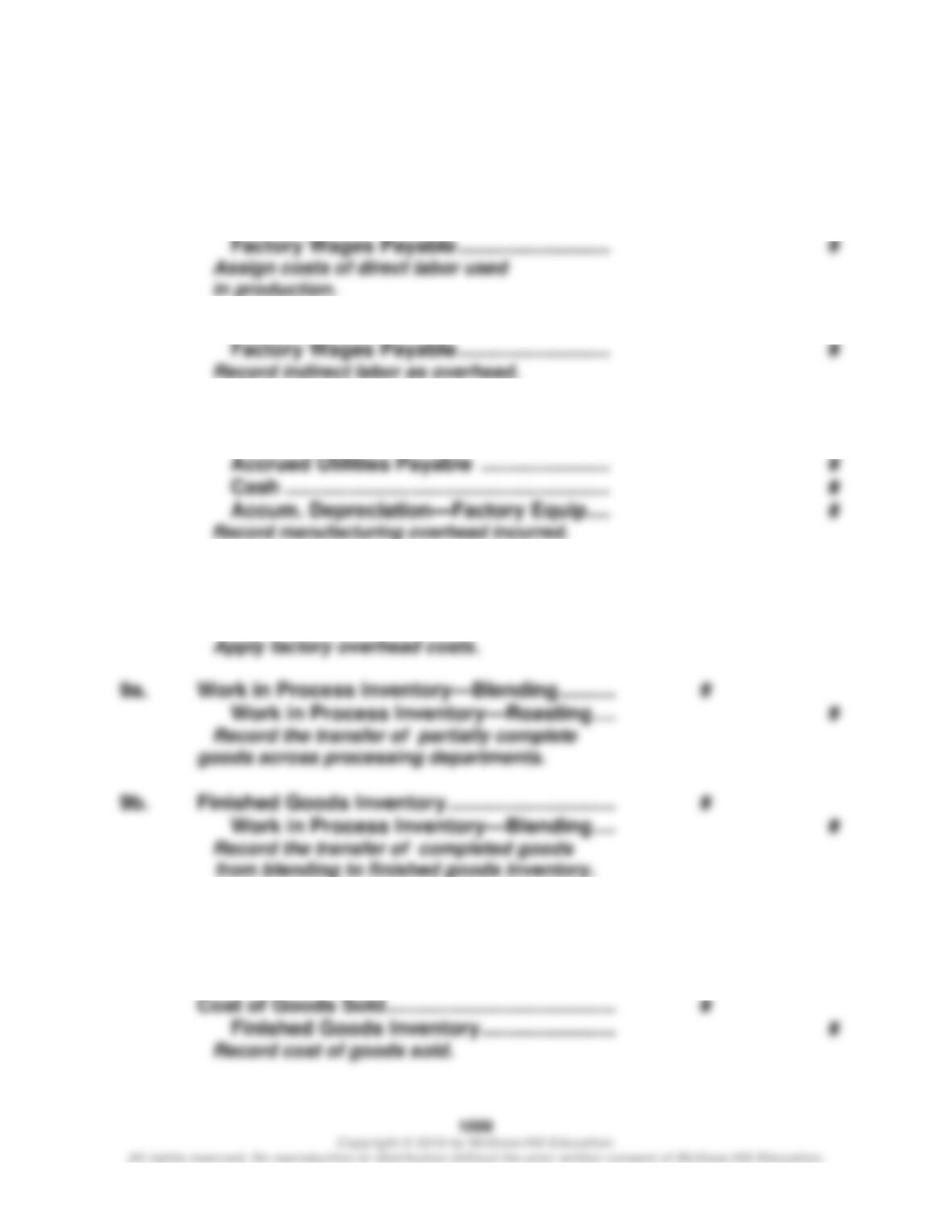
Raw Materials Inventory …………………………..
#
Accounts Payable …………………………………………….
#
2.
Work in Process Inventory—Roasting …………………….
Work in Process Inventory—Blending …………………….
#
#
Raw Materials Inventory …………………………..
#
3.
Factory Overhead …………………………………………………..
#
Raw Materials Inventory …………………………..
#
Wild and Shaw, Financial & Managerial Accounting, 8e Solutions Manual: Chapter 16
Teamwork in Action (concluded)
4.
No journal entry required
5.
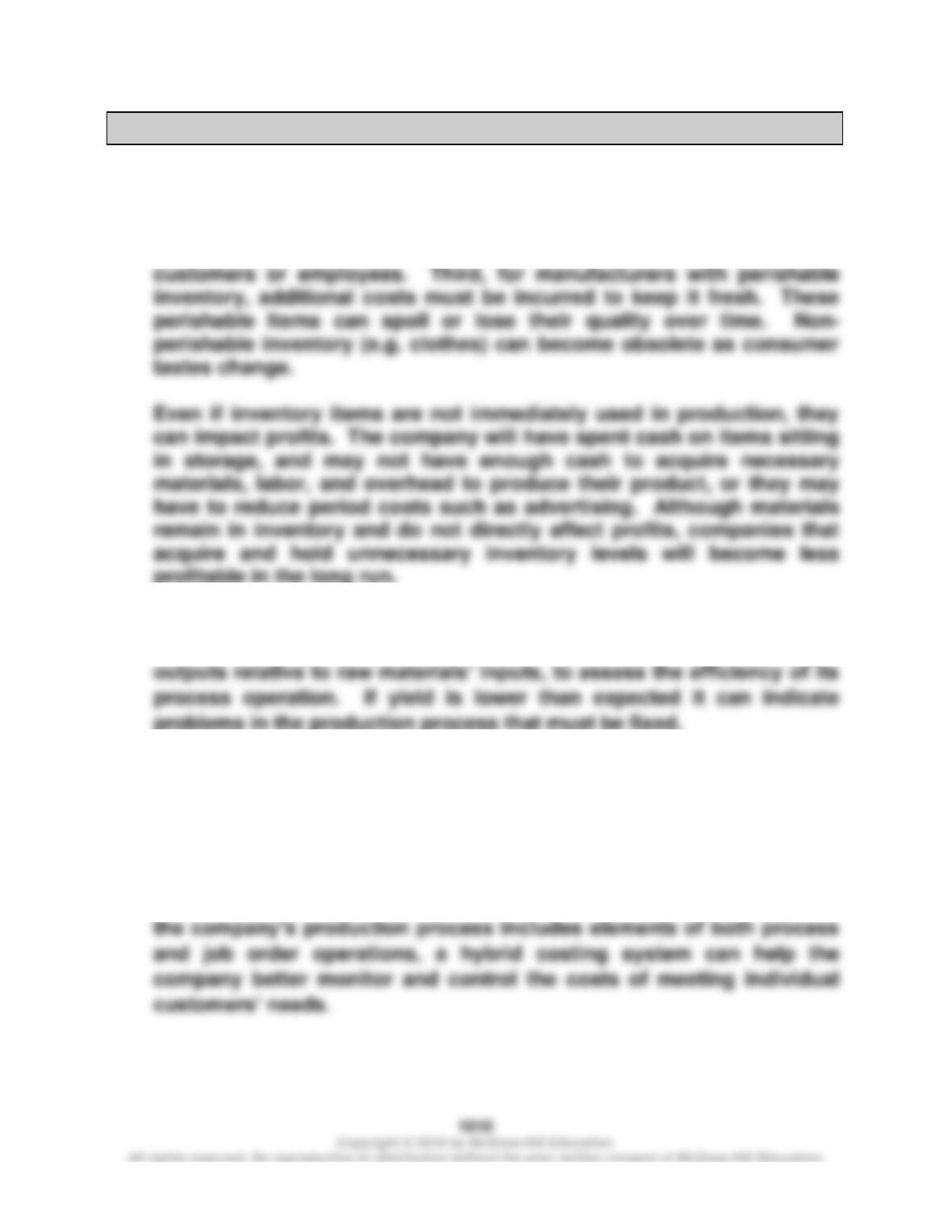
Work in Process Inventory—Roasting …………………….
Work in Process Inventory—Blending …………………….
#
#
Factory Wages Payable …………………………..
#
in production.
6.
Factory Overhead …………………………………………………..
#
Factory Wages Payable …………………………..
#
Record indirect labor as overhead.
7.
Factory Overhead ………………………………………………….
#
Prepaid Insurance ……………………………………………
#
Accrued Utilities Payable …………………………..
#
Cash ……………………………………………………….
#
Accum. Depreciation—Factory Equip ………………..
#
8.
Work in Process Inventory—Roasting …………………….
Work in Process Inventory—Blending …………………….
#
#
Factory Overhead ……………………………………………..
#
9a.
Work in Process Inventory—Blending …………………….
#
Work in Process Inventory—Roasting ……………….
#
9b.
#
Work in Process Inventory—Blending ……………….
#
10.
Accounts Receivable ……………………………………………..
#
Sales ……………………………………………………….
#
Record sale.
Cost of Goods Sold ………………………………………………..
Finished Goods Inventory …………………………..
Wild and Shaw, Financial & Managerial Accounting, 8e Solutions Manual: Chapter 16
Entrepreneurial Decision — BTN 16-5
1. If a business unnecessarily holds raw materials, it will be less
profitable than a company that maintains appropriate raw materials
inventory levels. First, the inventory requires costs for storage space.
Second, higher inventory levels increase the risk of inventory theft by
2. Suzy can use “yield”, which is a measure of the ratio of raw materials’
3. A hybrid system combines features of both process and job order
operations. Azucar Ice Cream Company resembles a process
operation in that each flavor of ice cream goes through the same
processing steps. On the other hand, allowing customers to make
their own unique flavors would be similar to a job order operation. If
Wild and Shaw, Financial & Managerial Accounting, 8e Solutions Manual: Chapter 16
Hitting The Road — BTN 16-6
Instructor note: This assignment is designed to help students identify
Cost
Description
Direct
Material
Direct
Labor
Overhead
Variable
Cost
Fixed
Cost
Manual
sorting
X
X
Heating and
cooling
X
X
equipment
X
X
Manually
X
X
X
Overhead allocation suggestions:
Not all components should be allocated the same. Some examples:

Wild and Shaw, Financial & Managerial Accounting, 8e Solutions Manual: Chapter 16
1012